More on completion percentage…

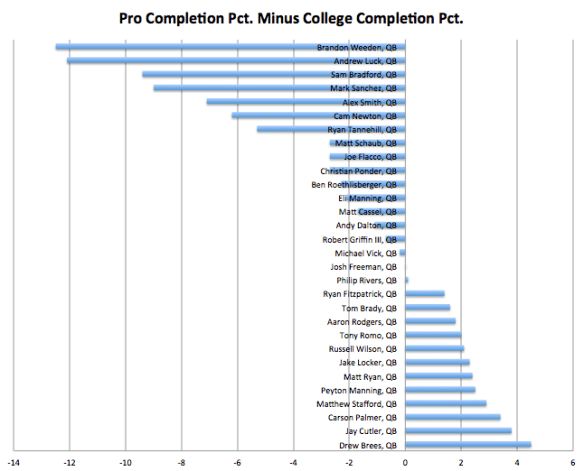
Below is a chart illustrating the change in completion percentage from college to the NFL for current NFL starting QBs (note that I included Alex Smith over Kaepernick because the change was so recent and used Vick over Foles so that Foles didn’t affect the numbers).

Admittedly it’s not the most elegant illustration, but we can quickly infer some useful information.  (The left extreme is a drop from college to pro, while the right extreme is a gain from college to pro)
Screen Shot 2012-12-11 at 4.21.08 PM

Note the x-axis values.  Just one player (Drew Brees) managed to improve upon is college completion rate by more than 4%.   Conversely, 7 current NFL QB’s have a pro completion rate more than 4% below their college marks.

The average change (not weighted for # of attempts) is -1.56%.

This year, the average completion percentage for the QBs included in the chart is 61.63%.

Upshot – With a college completion percentage of 66%, Nick Foles could suffer a decline of 5.28% and still be roughly equal to the average NFL starting measure. (Assumption – the included player sample is accurate for evaluating Nick Foles.)

Coincidentally, Nick Foles is currently completing 61.4% of his passes, or right at league average.

Caveat – The sample above is subject to several unavoidable biases, namely survivorship bias, as any QB whose completion percentage dropped by a very large amount would likely not be starting and therefore would not be included in the sample above (i.e. Jamarcus Russell, whose rate differential was -9.7%).  However, huge declines appear to be relatively rare, and within the sample several of those suffering the largest declines are in no immediate danger of losing their jobs (Andrew Luck, Sam Bradford, even Mark Sanchez is proving incredibly resilient when it comes to keeping his job), suggesting that organizational inertia somewhat counteracts the survivorship issue.

Does Nick Foles = Bobby Hoying 2.0?

(See today’s Philly.com article by Phil Sheridan)

Short Answer:  I don’t think so.

Longer Answer: While there are some eerie similarities, there is a large piece of evidence that points to Nick Foles having a higher probability of long-term success than Bobby Hoying had after his promising start.

Phil Sheridan points to the team adversity as a reason for Hoying’s failure.  Although that didn’t help, perhaps a larger factor was the accuracy of Hoying.  There are a number of attributes necessary for QB success, but accuracy is among the most important (if you don’t believe me please look at the current leaderboard).  While completion percentage is an imperfect measure (not accounting for drops, distance, throwaways, etc…), it still provides a decent indication of how good a QB is at getting the ball to where he wants it to go.  Furthermore, it is a measure that is rarely every significantly improved upon by players making the jump to the pro’s, that is, completion percentage in college is a good indication a player’s potential professional completion percentage.

Bobby Hoying’s college completion percentage was 58%, which is not terrible for college, but a very weak measure for aspiring pro’s (there are currently only two starting NFL QB’s with worse, Jay Cutler and Matt Stafford).

Nick Foles’ college completion percentage was 66.9%. (Of note: Michael Vick’s was 56.5%, which would be by far the worst in the league if he was still starting).

Counterpoint: There is a substantial (and obvious) flaw in the direct comparison of Foles to Hoying: Time.  NFL passing offenses have grown significantly in scale/importance/sophistication since Hoying played, and QB performance has risen substantially.  Hoying’s rookie year, the average NFL completion percentage was just 56%.  The current average for starting QBs is 61.62%.  However, there is a strong case to be made that as teams have emphasized passing, they have changed the methods for scouting QBs, weighing things like completion percentage more heavily than in the past (while lessening the attention paid to “intangibles”).  I believe its fair to say that overall QB play in today’s game is substantially better than in 1997 (Hoying’s rookie year).  In fact, it’s likely that if Hoying’s college career was evaluated for the draft today, he would be a much lower draft choice than #85 (if he was drafted at all).

Regardless, the relative comparison of each player’s college completion percentage to the league at the time of their respective rookie year’s suggests Foles has much more potential for success (relative to league average).