Sorry for the long delay, but as some of you know, the All-22 footage isn’t available until the Wednesday after the game. So at the risk of bringing up the memory of a game most fans would like to forget, here is the All-22 breakdown, featuring notes on key figures and breakdowns of three big plays:
Notes:
Overall – A better game then the score indicates, as I described in the post-game notes. Key figures:
Nick Foles – Played a much better game then most are giving him credit for. The interception was a terrible throw, but other than that he made good decisions. Some will point to a couple throws at the end of the game that clearly weren’t high-percentage passes, and they’re correct, but I would argue that down 24 points with time running out is exactly the time to engage in higher risk plays. Throwing an interception at that point doesn’t really decrease the odds of winning since they are so low to begin with.
He again showed good pocket mobility, though this game he didn’t make his progressions quite as well as he had been doing previously. All-in-all another encouraging game despite what most are saying. (That’s precisely why we just look at the tape rather than going off what we hear.)
Colt Anderson – Colt played a better game than I gave him credit for. In the post-game notes I mentioned the nice pass break-up but nothing else. Colt made some nice plays in the run game (his strength) though he did have trouble bringing down the runner at the point of contact a few times (getting dragged a few yards). A solid game, though, and certainly higher quality than we’ve seen from any of the safeties in a while.
Jamar Chaney – From now on Chaney will be referred to as either “The Invisible Man” or “Human Practice Sled”. It is really amazing how he can play so much and yet have so little impact on the game. The box score will tell you he had 7 total tackles (by far his highest of the year), but most of those came from him chasing down a man he should have stopped earlier. By my count, he made just 1 positive play, bringing the runner down at the line of scrimmage. The best thing you can say about him is that he takes 1 blocker out of the play (which in fact is about the worst thing you can say about a LB).
Fletcher Cox/Brandon Graham – This was easy to see for most watching the game, but both of these players had a huge day. If they can keep up this level of play, the Eagles have the potential for a great d-line. Cox has already shown himself to be among the best pass-rushing DTs in the league, which is what the Eagles hoped for when they picked him. Graham, however, has been a revelation (considering how low his stock was preseason). In addition to the sacks, Graham played with a lot of energy on each play, including coming completely across the field once and bringing down a scrambling Dalton from behind on the opposite sideline. Any fan looking for a reason to get excited has found it.
DRC – DRC reminded everyone why he’s so well-known. He was matched man-to-man against Green nearly the whole game, and held him relatively in check. The TD fade is a tough one, DRC has to know that’s coming and find a way to stop it, but that’s easier said then done for any corner up against a receiver of that caliber.
Kendricks – Another young player to watch. Kendricks had a tough game and was largely missing from the action. He did have one pass defended, but was made to look foolish by Andy Dalton (on Dalton’s TD run). Kendricks’ performance has definitely taken a hit outside of last week’s game. Let’s hope he rebounds, otherwise the LB core is again pretty weak.
Now for some plays:
The Maclin Fake-Screen:
2nd and 3 at the PHI 38 yard line. This is a great play not just because of how well it was drawn up and worked, but because the Eagles started setting this up the week before. Remember all those WR screens they ran against Tampa? Well they came out this game and early-on ran a couple, giving the Bengals plenty to recognize and key off. Laying that groundwork paid off in this play, which ultimately led to a TD.
Here is the pre-snap look: The Eagles come out trips-right with Riley Cooper on the opposite side (total of 4 WRs). On this play, the Bengals are in a nickel defense, which means they only have 3 CBs on the field. To account for the discrepancy, the Bengals’ safety takes responsibility for Maclin.

Just after the snap, seen below, the Eagles are showing the WR screen. Notice the safety covering Maclin has stepped up and crossed the 50. To this point there is no real sign that it’s a fake, as Maclin could just be running to set up blocking position between his man and the receiver.
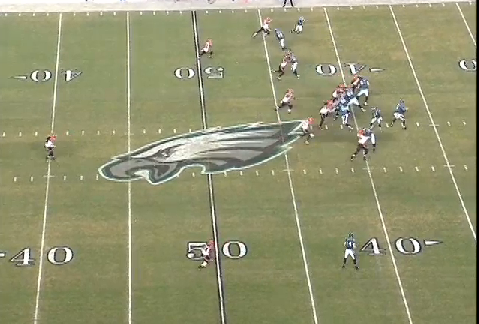
Finally, we get the payoff picture. At first glance it doesn’t look like much, the safety covering Maclin is still farther downfield. What’s key though, as we can see from the above picture, is that at this moment Maclin is at full speed, whereas the safety covering him has just realized it’s a fake and is starting from a dead stop, giving him no chance of matching Maclin’s speed.
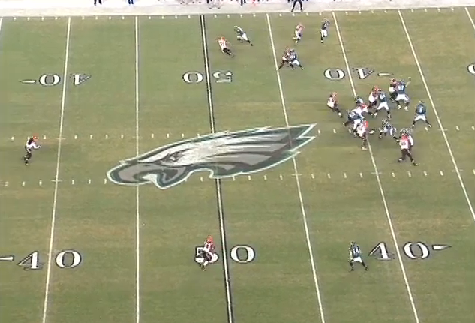
A very well-drawn up play, but fairly simple. The key was setting it up with actual screens both early this game and in the week before. I know some people have mentioned Foles should have hit Maclin in stride (leading to a TD on this play), but I think Foles was really just trying to ensure a catch and got a bit conservative with his throw.
Play 2: The Cooper TD
This play occurs shortly after the previous play. Nick Foles hits Riley Cooper, who is wide-open at the goal line. How did he get so open? Below is the pre-snap. The Eagles come out with 5 WRs and bunch 4 of them just off the line to the right side. As you can see from the diagram, bunching 4 WRs (one is actually RB Lewis) together makes things very difficult for the defense. If they are in man-coverage, the defenders are susceptible to “pick” plays or running into each other as they try to run with their man. Zone coverage alleviates this problem, but means the defenders have to be communicating with each other perfectly, or else they may accidentally double-cover a WR and leave another open. The second option (zone) is what appears to happen here.
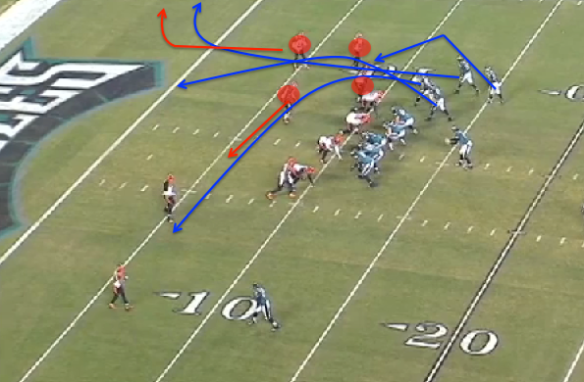
Riley Cooper is the WR lined up closest to the O-Line on the right side. Pay close attention to his route. See how it runs between the two defenders (shown as red circles)? That ends up being the key to the play. Of those two, the outside defender takes Dion Lewis, the Eagles WR furthest right in the above picture. The inside defender actually disrupts Cooper’s route (seen below), forcing him towards the sideline. However, this defender, after running with Cooper, sees Dion Lewis break back inside, therefore entering his zone. He breaks off his coverage of Cooper and picks up Lewis. The outside defender doesn’t get the message and also covers Lewis, leaving Cooper wide open on the goal line.

Above, we can see Cooper being disrupted. Lewis is about to break back towards the inside, which causes Cooper’s defender to leave him, sticking to his zone. Below is the moment this happens.

And here is the moment of the pass. Notice Cooper coming open and the two defenders covering Lewis.

Bunching 4 WRs caused confusion in the defense and led to a very easy throw-and-catch for a TD. It must also be noted that this play only succeeded because the O-Line gave it enough time to develop.
Play 3: One for the defense.
Second Quarter, 1st and 20 at the 2 minute warning. This is the fumble forced by Cullen Jenkins and recovered by Tapp. There are two things that make this play interesting: it comes from the wide-9 alignment, and it involves Jenkins coming over top both the other DT (Cox) and DE (Cole), which means the DBs did a good job in coverage to give him time to do that.

The key to the play, other than the coverage, is Cox and Cole’s ability to attack the center of the offensive line. As I illustrated above and we can see below, the combined power of these players collapses the left side of the Bengal’s o-line, giving Jenkins the space he needs to come around.

Above we can see Jenkins in motion and Cole setting the edge. Below we can see Jenkins as he’s coming around the line. Notice that the stunt action towards the center has drawn the Bengals’ LT to Cole, meaning there is nobody left to block Jenkins, whose original blocker can be seen doing nothing in the picture below.
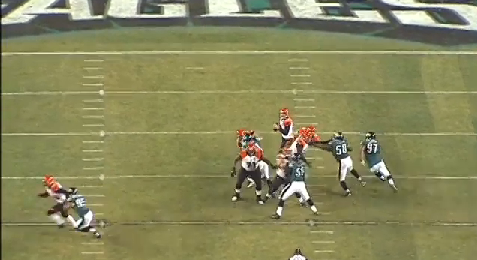
Finally, the moment of the strip Jenkins gets there just in time, as Dalton is about to release the ball (and fortunately just before his arm starts coming forwards.

A big defensive play out of the wide-9, who knew? In any case, this is the type of action the Eagles should be able to generate with Cox/Cole. Both are great pass rushers (Cole not as much this year but he still has to be respected) and are used here to create space for Jenkins, leading to a turnover (something they haven’t created nearly enough this year.) Let’s hope we see more plays like this in the next couple games.
 Eagles Rewind