Eagles Almanac 2013 available for Pre-order

Last year a number of good Eagles writers/bloggers teamed up to create the 2012 Eagles Almanac, a 78 page preview magazine for the Eagles season.  This year I’ve joined the team.  Together, we hope to create the definitive pre-season preview and provide fans with the type of in-depth, Eagles-specific analysis you can’t find anywhere else.

To help the effort, we’ve started a Kickstarter campaign.

Here is the link.

Please click through to see a more detailed description and a list of writers.  $10 gets you a digital copy, $25 gets you a hard copy.  I’ve reviewed last season’s edition and seen this year’s preliminary article list; I promise you won’t regret ordering the 2013 Almanac.

We’ve set a fairly modest fundraising goal and hope to raise enough to allow us to cover the publishing, printing, and shipping costs associated with delivering an actual book.  As of right now, roughly 24 hours since the launch, we are sitting at just under 100 backers and nearly halfway to the primary goal.  You can, of course, wait until its published to decide whether you’re interested or not, but let’s face it; if you read THIS site, you’re going to want it, so you might as well order now and take some credit for helping it get off the ground.

Thanks in advance for your support.

-Brent

Draft Recap Part 2: Examining the QB Class

Yesterday was Eagles focused, but today will be split.  I will start by looking at potential reasons for the way the draft played out for the QB class (focusing mainly on Barkley and Nassib); then I will discuss what the Matt Barkley selection REALLY means for the Eagles and Chip Kelly.

As everyone knows, Matt Barkley and Ryan Nassib were drafted in the 4th round.  The fact that these two players were “widely regarded” as 1st round talents make this an unprecedented occurrence.  Typically, QBs get OVERDRAFTED, in that teams draft them above their presumed ratings.  I’ve addressed this in the TPR system and explained that since QBs offer the largest potential reward, they should be “overdrafted” to a degree. However, we did not see that this year.   In fact, Barkley and Nassib fell much farther than anyone would have sanely predicted prior to the draft.

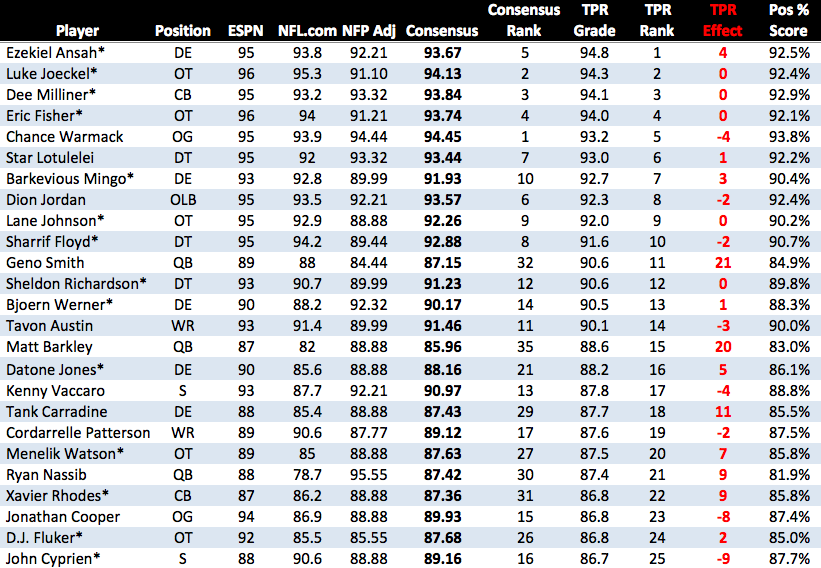
To make things clear before I get to explanations, Barkley’s average rating (from NFP, ESPN, and NFL.com) was 85.96.  That’s not great, but it does usually represent a 1st round grade.  Nassib’s was actually higher at 87.42, due mostly to the fact that NFP had Nassib as its #1 overall player.

Those ratings are why this was an unprecedented event.

So what happened?

I’m going to advance a few theories here.  There is no substantial evidence to work from so I’ll we have is intelligent speculation. I’ll leave it to you to decide which theory(ies) you believe.

1) They’re just not that good.   This is obviously the least exciting and, in my opinion, the most likely scenario.  Knowing what we do about how QBs are usually drafted, the fall of Barkley and Nassib means that, outside of the Bills, NOT A SINGLE TEAM agreed with the media scouts’ draft ratings.  If just one team had graded either QB as highly as the Consensus scores did, that player would have been chosen much earlier.  Teams just don’t let QB’s they like fall down the board like that.

So what we have is a clear disagreement.  The media scouts think Barkley and Nassib will be good QBs, and the ENTIRE NFL (minus the Bills since they drafted a QB in the 1st round) thinks otherwise.  Based on that, I’m going to say the odds are in the NFL’s favor.  That means Barkley and Nassib were simply very overrated by the media.

2) The cynical angle.  This may or may not tie into the 1st reason.  Regardless of how this plays out, it has identified a potential weakness in my TPR rankings.  The ratings I use come from ESPN, NFL.com, and the National Football Post.  Now take a second and think about why that might be trouble.

Got it yet?

Whenever someone or something behaves very differently from how you expect them too, it’s usually best to follow the money.  So here we go:

– The NFL Draft is a huge event that makes a lot of money for all those involved.

– The NFL Draft was broadcast by two networks, ESPN and the NFL Network (familiar?)

– Casual fans gravitate towards the “glamour” positions, especially the QB, since that is the most recognizable player on almost every team.

Is it possible that the NFL network and ESPN overrated the QB class on purpose?  Yes, that’s entirely possible.  If you don’t think the NFL or ESPN would consider something that dishonest, then you haven’t been paying attention.  Now that wouldn’t explain NFP’s grades, but the fact that 3 scouting services all rated these QBs highly is what makes the situation so interesting.  Having one outlier grade would not be unusual.

3) Teams are jealous of the Redskins and Colts.  It’s possible that the pendulum has swung (for this draft at least) to far towards the “get your guy” school of thought when it comes to the QB position.  Every QB-needy team saw what the Colts were able to do with Andrew Luck and had to be a bit jealous.  Perhaps they said to themselves, “rather than take someone in round 2 or 3 just because they’re a decent value, we should build the rest of the team and wait until next year when we may really love a QB prospect”.  I think this is completely possible.

I’ve been arguing against the “get your guy” strategy for a long time.  The issue is that it typically completely ignores the value of each pick and places too much faith in scouting evaluations that are far less precise than team’s want to believe.  A common refrain when it comes to drafting QB’s is that you have to “love this prospect”, or something like that.  But why?

I realize that QB is the most important position in football, but it isn’t so different as to require a completely different analysis and draft strategy.  Perhaps Barkley and Nassib’s flaws made them too risky for 1st or 2nd round selection.  I realize that nobody “loved” either QB. Regardless, by the third round the value proposition has shifted so dramatically that it makes sense for almost any team to take a flyer on one of these players, let alone QB-needy teams.  In fact, I’ll go as far as saying that passing on these players in the third round is PROFESSIONAL NEGLIGENCE if your team does not have a solid QB.

The fact is, scouting evaluations are very uncertain, and they can miss low just as easily as they can miss high.  The opportunity cost of a third round pick (what you give up to take a QB) is very low.  If I was a team that needed a QB, I would have been thrilled to take one of these kids there.

If teams hold out for a “perfect” QB prospect, they’ll might be waiting for a LONG time.  Not everyone can have an Andrew Luck-level draft pick, they’re just not that common.  Meanwhile, you don’t need an “elite” QB to win.  Which means that if either Barkley or Nassib can merely meet the “good enough” threshold, they’re unprecedented value picks.


So how bout them Eagles?

A lot of initial reaction to the Barkley pick was as you’d expect; flawed, stupid, overstated, poorly reasoned, etc…. For the most part, everyone recognized the value.  However, many “analysts” completely bungled the “meaning” of the pick.  Let me start with the value:

At the first pick in the 4th round, Barkley was an incredible VALUE for any team in the league, regardless of QB situation.  The opportunity cost of a 4th round pick is very low.  For example, here are some recent 4th round selections by the Eagles:

Casey Mathews, Mike Kafka, Keenan Clayton, Clay Harbor, Mike McGlynn, Jack Ikegwuono

Was Matt Barkley worth it?  Hell yes, regardless of how his career plays out.  If you’re looking for comparable players for Barkley, you’ve got Drew Brees on the high-side and Colt McCoy on the low side.  Interestingly enough, Colt McCoy was just traded to the 49ers for essentially a 5th round pick (the 6th and 7th that changed hands cancel each other out).  That means, even if Barkley ends up on the low side of his projection, the team will be able to recoup almost the entire value it spent on him.

Ever hear of a free call option?  That’s close to what the Eagles just found.

Now about the meaning:

Count me among those who believes this is GOOD for Nick Foles.  Prior to the pick, the only real “information” we had to go on was the fact that the Eagles brought Dennis DIxon on board.  That would clearly indicate that Kelly was leaning in Vick’s direction, since you typically want backups who have similar skill sets to your starters.

Adding Barkley flips that equation around dramatically.

In general, I think many people have been wrongfully conflating the “read-option” with a “fast-paced” and “no-huddle” attack.  You can run one without the other and I do not believe Kelly will run the read-option with the Eagles.

Tommy Lawlor at Igglesblitz.com made a great point last week (and one I’m embarrassed I didn’t see earlier):

The Penn State offense might be the best example of what Chip Kelly will look to run with the Eagles.

For those of you who don’t know, Bill O’Brien is the coach of Penn State, and was previously the QB coach and Offensive Coordinator of the New England Patriots.  Since moving to Penn State, O’Brien has installed a more balanced version of the Patriot’s offense, relying on multiple RBs and TEs.  Sound familiar?

Note that the quarterbacks for the Patriots (Tom Brady) and PSU (Matt McGloin last year) are as far from “running QB” as you can get.  This is where I believe we can divine the best intelligence on the Eagles QB situation.

Chip Kelly, if he uses a similar system, will require a QB that can stand at the line of scrimmage and quickly identify mismatches.  Then, after the snap, the QB must be able to make several progressions.  If none of those are available, the QB must be smart enough to throw the ball away.

Above all else, this requires poise, intelligence, and short-to-intermediate accuracy.

Note those are all things Nick Foles has (and Matt Barkley has in spades).  Also note that those are all relative weaknesses for Michael Vick.

Therefore, at this stage, I’m inclined to double-down on my prediction for the Eagles QB situation.  I think Nick Foles is the starter day one.  I just think Michael Vick, at this stage of his career, takes more off the table than he puts on it.

At the end of the day, Kelly will look at his QB depth and see Foles/Barkley on one side and Vick/Dixon on the other.  To me, the scales are tipped pretty strongly in the Foles/Barkley direction.

Draft Recap Part 1: Evaluating The Eagles

As you might suspect, I’ve got a lot of thoughts to get through on what was one of the most interesting drafts that I can remember.  Rather than write a 10000 word post that covers everything, I’m going to split my analysis into several parts (probably many) and try to focus on just one aspect of the event each day (today’s post is 1470 words).  While I am very tempted to talk about the QB class today (and the completely unprecedented fall of Barkley/Nassib), I’ve decided it makes more sense to focus on the Eagles’ draft and get that out-of-the-way.

So how did the Eagles do?

In a word: OK, and perhaps as well as they could have under the circumstances.

By now I’m sure most of you have read at least one “grade the draft” article, so I think it’s a good time to tell you that “grading the draft” articles are completely devoid of value and utterly pointless.  The “grades” are determined by each writers’ individual opinion of each prospect, which as we know, is likely worthless.  Needless to say, I will not be grading the Eagles according to which players they selected.  I have no idea if/how each will work out, and neither does anyone else.

I will, however, talk about value, and what information we can infer from each pick.

First, something you should all keep in mind (and something I had to keep repeating to myself during the draft):

This is not a one year process.

For those of you that are disappointed at the lack of attention to Defense, remember that reaching for “need” is what gets you Jaiquan Jarrett and Danny Watkins.

Also:

The draft is about playing the odds the right way.

None of these players are certain to work out, and if a high pick fails, it doesn’t mean it was a mistake to draft him.  As I showed before, since 2005, players carrying a “95+” rating from Scout’s Inc. bust about 20% of the time…

Lane Johnson, OT

I discussed him on Friday, so I won’t go into too much depth now.  He was, by all accounts, a “top tier” player in this draft.  Also, Kelly claims the team did not receive any interest from others trying to trade up.  Those two factors, in combination, suggest the Eagles did as well as they could have.

I’m not entirely sure whether I believe Kelly or not.  I noted that the lack of interest in any free agent OTs was puzzling, but made complete sense if the team was 100% sold on one of the top OT prospects.  It’s possible then, that the Eagles had their sights on Johnson the entire time and had no interest in trading down (which would be a “value” mistake).  Kelly has claimed that he/Roseman had 4 players in their top tier, with Dion Jordan and the other top OTs rounding out the group.  This is pure speculation, but I doubt Jordan was ever actually included.  I think it’s more likely that the Eagles smokescreen worked to perfection, forcing the Dolphins to trade up for Jordan, leaving Johnson to the Eagles.

In any case, Johnson has the potential to provide a big upgrade to the OL.  Also, he’ll eventually replace Jason Peters at LT.  In one pick, the Eagles solidified the RT, RG and future LT positions.  All in all, it was likely a good selection.

Zach Ertz, TE

This one might have caught casual fans by surprise, but everyone who’s been paying attention knows it was always a possibility.  Ertz has the potential to be a real weapon at TE, which Eagles fans haven’t really experienced.  On pure talent and potential, there is nothing to dislike about this pick.  Close readers will note that Ertz was ranked 50th in both the Consensus rankings and the TPR system, making him a slight reach at #35 overall.  However, I’m not too concerned about that, since Chip Kelly will likely use him much more extensively than the model accounts for.  In general, fans should be relatively excited about Ertz.

The most interesting thing about the Ertz pick is what it potential says about the Kelly/Roseman dynamic.  Basically, I think Kelly has a lot more say in personnel matters than we were led to believe.  It is possible, of course, that Ertz was Howie’s BPA at #35 and the Chip had little to do with it.  However, given Chip’s widely known love of TEs I think it’s far too coincidental that the BPA just happened to be a TE.  Objectively speaking, the odds of that seem low.

Also, back when Chip was interviewing, it was widely assumed that he would only go somewhere that granted him a large measure of control.  It came as a surprise that Kelly would choose to go somewhere where he not only didn’t have personnel control, but had to defer to a relatively inexperienced GM like Howie.

I think the Ertz pick make it pretty clear that Howie Chip has a very significant say in roster decisions.  Note that I’m not suggesting that’s a good or bad dynamic, just that it’s different from what we thought.

Bennie Logan, DL

This is the only pick I really had an issue with.  The consensus rankings had him at #92 overall, and my TPR system had him #100.  Neither of those rankings should be taken as definitive (the TPR is essentially still in Beta), but it suggests Logan was probably not a great value at #67 overall.  I won’t get into the scouting report, but it’s safe to say this is the least exciting pick the Eagles made.  He’s not a perfect fit at any position, but will probably play NT for the Eagles (maybe DE depending on the situation) and move inside to DT when the defense is in a 4-3 alignment.

Granted this was a 3rd round pick, so the odds of finding a good player here aren’t great to begin with, but this is the only “mistake” the Eagles made.  The team clearly values Logan more highly than most others.  As readers should know, that usually means the team is wrong.  Hopefully that’s not the case here.

Matt Barkley, QB

I’m going to do a complete post on just the QBs tomorrow, so I will try to hold most of my thoughts until then.  I’ve got several theories for why the draft played out the way it did.  Regardless, I think Barkley was a fantastic pick.  The biggest issue seems to be the amount of press it generated and the potential distraction it creates.  So let me break this into a few smaller pieces.

– Saying Chip got “his guy” is ridiculous and betrays an almost complete ignorance of how the NFL works.  If Barkley was “Chip’s guy”, he would have been selected much earlier.

– This definitely allows us to infer more information on Chip’s system and the QB depth chart, but I’ll explain that tomorrow.  Hint: I think this helps Nick Foles a lot.

– Barkley is a 4th round pick.  Treat him like one.  That means stop hyperventilating and getting excited about potential “Barkley greatness”.  I like him and think he was a tremendous value in the 4th round, but there’s a reason (a few of them) that he fell that far, and it’s probably not because every team ignored how great he is.

– It looks to me like Barkley’s “floor” is probably as a competent back-up.  Note his “ceiling” might not be much higher, but the fact is that a good back-up QB is easily worth a 4th round pick.

– I’m not sure, in the entire history of the draft, that I can find a better example of a low-risk/high-reward draft pick.  The “investment” of a 4th round pick is very small.  You’re odds of finding a “starter” are fairly low, and the odds of finding an “impact” player are almost non-existent.  If Barkley has even a 5% chance of being a “great” QB, then this was an unbelievable pick.

Everyone Else

Lottery tickets…

I could go through and find reasons to get excited about each player drafted in the 5th round or later, but the fact is that most of these players will never make a significant contribution to the Eagles.  If they do, it’ll likely be because the team sucks rather than because the late-rounders are great (see Kurt Coleman, Jamar Chaney, Macho Harris, etc…)

That’s important enough to repeat:

If week one arrives and a player drafted in the 5th round or later is starting, it’s much more likely a GLARING WEAKNESS than it is a draft steal.

There’s a reason these players didn’t get drafted earlier.  Something tells me that the late-round picks in a “weak” draft are probably not worth spending time on.  (If this was a movie it’d now cut to said draft picks waking up for a pre-dawn workout montage…)

I will, however, end today on a high note.  Here is Earl Wolff’s mockdraftable.com chart:

Screen Shot 2013-04-29 at 12.08.10 PM

Ladies and Gentlemen….Jerry Jones!!

Lots to get to today, including a look at the Eagles pick, an unbelieveable example of the Bad GM Theory in practice, and why the second half of the draft could not have gone any better for the Eagles.

First, Lane Johnson.

As you all know, I’m surprised and disappointed that the Eagles could not muster any trade interest for the last “top” OT on the board.  It’s possible that they wanted Johnson regardless and didn’t actually entertain trades, but given the reports I’ve seen, that doesn’t seem to be the case.  However, as I’ll explain later, the team might end up with essentially the same value I was hoping to see with the trade scenarios.

I’m sure you can find full bios and histories of Lane Johnson at a lot of other sites, so I won’t do one here.  I’ll just say that he’s an extremely athletic player with arguably more “upside” than Joeckel/Fisher.  In any case, if we look at our positional value range chart, we can see he is clearly a top tier player:Screen Shot 2013-04-25 at 3.09.19 PM

Also, if you want to get really excited about Lane Johnson, I can show you his workout results.  Below is a chart from MockDraftable, a ridiculously fun site (for draft nerds) that compares every player to their position group via an area chart.  The numbers are the historical %tile rankings within the group.  He’ll have to put on some weight, but you can’t argue with his athleticism.  Enjoy:Screen Shot 2013-04-26 at 10.19.37 AM

Another factor to consider is that, as we discussed, adding a quality OT actually provides the Eagles with upgrades at TWO positions, since it allows Todd Herremans to move back to RG, his best position.

Consequently, it’s hard to be upset with the pick.  Johnson is as good a player as any (that’s what the top tier means) and the trade-down options apparantly weren’t available.

The Bad GM Theory in Effect

I have to shift away from the Eagles for a moment, but I promise the next section will come back to our favorite team.  If you recall the Bad GM Theory, it says to keep an eye out for any trades between two GMs who are clearly not on the same level.  Trent Baalke (49ers) vs. Jerry Jones (Cowboys) certainly fits the bill.

During last night’s first round, the Cowboys traded down from the 18th pick in the draft to the 31st overall.  In return, the team received a 3rd round pick, the 74th overall selection.  Now before we even get to the players, it must be noted that typically, just a 3rd round pick is not enough to move up 13 places in the first round.

If we refer to the draft value chart, the 49ers should have had to throw in a high 4th round pick as well to even out.  Now the Draft Value Chart isn’t perfect, but it’s pretty clear the Cowboys got hosed on the pick compensation.

The 49ers, interestingly enough, used their upgraded 1st round pick on Eric Reid, a FS from LSU.  My consesnsus ranking has Reid at #41 overall, with the TPR system ranking him #47 overall.  It looks like the 49ers reached, meaning they might have difficulty “winning” the trade, which would go against the Bad GM Theory.

In comes Jerry Jones.

Not content with merely getting ripped off in the trade, Jones proceeded to use his new 1st round pick, the 31st overall, on Travis Frederick, a C from Wisconsin.  As you should know by know, Centers in the 1st round are pretty rare.  It’s almost impossible to be an “impact” Center, meaning the opportunity cost of drafting one in the 1st round is VERY high (the 1st round is the only place to consistently get “impact” players).

Not only is Frederick a Center, but he was a relatively low ranked prospect also.  My consensus rankings have him at #63 overall, with the TPR system boosting him all the way to #59.

So to sum up, Jerry Jones got fleeced on the trade down, then wasted his pick. Bad GM indeed.  Frederick will probably turn into a serviceable player (top Centers have very low miss rates), but as Eagles fans, are any of you upset that the Cowboys got him?  Didn’t think so…

BTW, he was not my “reach of the round” (wow, that’s a lot closer to obscene than I intended).  No, that honor goes to the Chicago Bears, who selected Kyle Long, a G from Oregon.  Kyle Long’s consensus ranking is #74! His TPR ranking is #94!  He was selected with the 20th overall pick.  That means when I bring back the reach/value chart next week to see who deviated most from the consensus, he will warrant a mark of -74.  Simply stunning.  I would not have believed that was possible.  For those wondering why his grade is so bad (ESPN rated him an 89); it’s because NFP rated him a 5.4F, which is as bad as it sounds.  NFL.com, meanwhile, was in the middle with a lukewarm 77, still very low for a mid-1st round pick.

Back to the Eagles

As a result of several inexplicable picks (like the Cowboys and Bears selections above), the Eagles are sitting in a great position going into tonight (when they have the 3rd selection).

Originally, part of my desire to trade down from #4 was to accumulate picks that would allow the team to trade back UP from #35.  That would allow them to get both a top tier player in the top 10, and a very good defensive prospect.  Yesterday, I gave you a few names to watch towards the end of round 1, thinking the Eagles might want to come up and get one of them.  To refresh, here’s what I said:

Tank Carradine, DE

Jonathan Cyprien, S

Jamar Taylor, CB

Menelik Watson, OT

Xavier Rhodes, CB

Turns out, the only player in that group not still available is Xavier Rhodes.  We can also eliminate Menelik Watson, since the team will not take another OT with the 2nd round pick.  That still leaves 3 good defensive prospects.  Carradine and Cyprien in particular are exciting, as both have the “talent” to be true impact players and were rated 1st round picks by both the Consensus rankings and the TPR system.

I also have to mention the elephant in the room (what’s the online equivalent of that term?), Geno Smith.  Yes, he’s still there.  Yes, at #35 overall he would represent GREAT value, regardless of what you think of him.  He didn’t make any sense at #4 overall because the risk/opportunity cost was too great.  That equation has shifted, though, since a 2nd round pick isn’t worth anywhere close to a 1st round pick (at least when comparing #4 to #35).

While I would really prefer a defensive player, I have been hammering the Value message home for a while.  If he’s there at #35, Smith would actually be a great pick.

There’s also rumors that the Eagles will select a TE.  This I am less excited about, since by my rankings, it would have to be a “reach”.  However, I will say that I think the perpetuators of those rumors are those focused on Chip Kelly.  If Howie Roseman truly is running the draft, I don’t see any way the Eagles select a TE.  If, however, Kelly has more input than we’ve been led to believe, then TE becomes a definite possibility.  Either way, we’ll learn a fair amount about the management dynamic by the end of tonight.

Note:

I’ll probably hold off until Monday to analyze the rest of the rounds (and the draft as a whole).  It might seem odd for a football blogger to say this, but: You don’t/shouldn’t watch or really care about the 4th-7th rounds.  As I’ve demonstrated extensively, picks thereafter are really just lottery tickets.  The goal should be to accumulate as many as possible and apply them to positions with the lowest margin of evaluative error.  If you are tracking it, the historical success chart I provided a couple of days ago should be your only reference source.  Most of those guys will not play any meaningful role in the NFL, and we have absolutely no way of knowing which ones will “hit”.

Final TPR Rankings

I noticed today that ESPN has recently made MAJOR adjustments to their prospect ratings.  I’ve since updated the TPR rankings to reflect those changes.  Here is the top of the board:Screen Shot 2013-04-25 at 2.40.48 PM

Ziggy Ansah is now the top player on the board.  I’ll put the full board up under the “TPR Rankings Tab”.  I will also update the position graphs and post those under the “Positional Rankings” Tab.

2013 NFL Draft: Notes for the 1st round

Just a few hours until the start of the first round, and I’ve got some last-minute thoughts to disseminate.  Those of you who visit consistently will know I am firmly in the trade-down camp.  However, today I’ll provide some more details and run through a few scenarios.

First, though, I want to make clear that, despite the evidence that the draft is mostly luck, it is DEFINITELY POSSIBLE to “win the draft”.  While individual selections show very little evidence of team skill, maneuvering through the draft to maximize value clearly requires talent.  That’s why you see so much misinformation close to the draft.  You want the rest of the league to believe that you really might take everyone; doing so maximizes your trade leverage.  So for the next three days and especially after the first round, it’s not necessarily about “who” the Eagles select; it’s about “how” and “where”.  I’ll come back to that after the draft and take a run at evaluating the overall “value” the Eagles came out with.

So what will the Eagles do tonight?

First I want to mention that I think the Eagles will choose TWO players tonight, meaning the team will trade up from #35 to get back into the first round.  Between 20-32 there will be some very good Safeties and CB options, and I think Howie makes a play for his favorite somewhere in that area.

As far as the top of the round goes:

The Eagles have been linked by “sources” to close to a dozen players.  This is very much a purposeful misinformation campaign by Howie.  It means he wants to trade down.  I’ve shown pretty clearly the merits of “tiered” drafting, as well as the relative value within the top 15 picks.  Basically the top 15 is its own “round” of the draft, with far and away the heaviest concentration of impact players.  However, within the top 15, there is surprisingly little difference between picks.  The only major note is that QBs and OTs go in the top 5, so you will not find equal value at those positions from 10-15.

In my opinion, the top “tier” this year is around 9 players deep, with Joeckel the only real standout of the group (and even he isn’t a perfect prospect).  Judging by what I’ve seen in the media, I thinks it’s a safe bet that Howie is viewing the first round the same way.  Consequently, the “correct” thing to do would by to trade down but remain in the top 9 picks, picking up extra compensation while guaranteeing you still get a “top tier” player.

The Trade Scenarios:

1) Eric Fisher is available at 4.  This case, while it’ll be tempting for the Eagles to draft Fisher themselves, offers the best potential trade compensation.  Fisher is reportedly rated the best tackle in the draft, and some are speculating he may actually go #1 to Andy and the Chiefs.  If he falls, it should not be difficult for the Eagles to find 2-3 teams willing to bid up the value of the #4 pick.  Potential partners would be Arizona (#7), Miami (#12), San Diego (#11).  Of these teams, only Arizona would allow the Eagles to stay in the top 9.

2) Eric Fisher is gone.  In this case, while the ultimate value of the #4 spot might be lower, the interest will actually be greater (not a direct supply-demand-value result).  With Fisher taken, Lane Johnson remains as the only top OT.  In this situation, I believe the same teams as above will be interested, with the Lions (#5) joining the group as well.  Sliding down one spot would be particularly attractive for the Eagles, as it really would be “free” compensation, assuming the team didn’t rate Johnson well above every other prospect.

3) The Double Trade.  I’m quickly talking  myself into this scenario, though admittedly it’s wishful thinking.  Start with scenario 2, where the Eagles trade down one pick to #5.  The team could then call the Jets, who are in desperate need of an offensive weapon, and ransom Tavon Austin.  In a perfect world, they’d acquire the Jets #9 pick.  This scenario would bring the Eagles at least a few extra picks and allow the team to take whichever “top tier” player is still available.  This is what I’ll be rooting for.

4) The Deep Drop.  I did a post a while ago that discussed why perennial contenders should trade up in the draft more often.  The curse of being a very good team consistently is that you never get to choose in the top 15, limiting your ability to add impact players at cheap prices.  These teams typically resort to free agency, which forces the Winner’s Curse upon them and depletes their cap room.  While it’s risky to trade up that far (you have to give up a lot of pick value), I’d argue that it’s worth it, provided you are selecting a “top tier” guy in return.  There are rumors that both the Ravens and 49ers are interested in moving way up, and to me that makes a lot of sense.  However, I think it’s unlikely they’ll be able to provide enough compensation to come all the way up to the Eagles pick at #4.  Don’t be surprised to see one of them picking between 10-15 though.

So who are the Eagles going to take when they actually do pick?

The short answer is: I have no idea.  I do think there are some guys to keep in mind though.  I’ll run through the potentials with some quick thoughts on each.

Dion Jordan – A very popular “mock pick” for the Eagles.  He’d provide an OLB pass rusher for the new defense and played for Chip at Oregon.  I don’t think he’s as likely to be the pick as many are suggesting.  Despite his athleticism and speed, his production wasn’t great.  Additionally, while I do believe the Eagles are drafting “best available”, Dion doesn’t exactly fill a glaring hole.

Star Lotulelei – I’ve been high on him since November, though his stock has certainly dropped since then.  The key to him is his versatility, as he can play all 3 positions on the D-line in the 3-4.  If the Eagles trade down, I think he’s a likely pick.  He’s a bit old for a prospect (he’ll be 24 before the season), but Chip has a clear preference for versatility, making Star a top target.

Ziggy Ansah – Covered him a bit a couple of weeks ago.  Not getting much Eagles action in the mock drafts, but I can’t ignore him.  Kelly has made it clear he values “athletic freakism” and there is no better example of that in this draft than Ziggy.  Additionally he can likely play both the 5-tech on the d-line and the Rush OLB.  Howie might get sold on his “upside”, which is among the best in the draft if you listen to all the “experts”.  The fact that he HASN’T been strongly linked to the Eagles makes me think they really like him.

Dee Milliner – Health issues may be scaring some teams, but I still see Milliner as one of the better risk/reward prospects available.  I’d be surprised if he was the pick at #4, but he’d be worth it in my estimation (at least as far as any of these guys can be “worth it”).  Another guy that hasn’t been strongly linked to the Eagles, but would go a long way towards shoring up the secondary (the biggest NEED of the team).

Chance Warmack – Don’t sleep on Warmack, though he won’t be the pick at #4.  If the team drops to #9, then Warmack is a clear possibility (if he’s there).  The “best” prospect in the draft by consensus rating, Warmack would make a lot of sense for the Eagles.  By now, I’m guessing Kelly realizes the strength of his offense is it’s RBs.  Adding a potentially dominant run-blocker like Warmack might be more of an offensive weapon then we typically think of when it comes to interior linemen.  The read-option requires being able to sell several looks every play, and being able to run it up the guy behind Chance would be a valuable tool.  Additionally, Bryce Brown’s power behind Chance should make short-yardage gains relatively easy.

Tavon Austin – I don’t think he’ll be the pick, but he has to be mentioned since he’s the top offensive “playmaker” available.  The quick comparison is Percy Harvin, but it should be noted that he’s actually a bit smaller than Harvin.  I’m sure Kelly could dream up some creative ways to use him, but I see Austin’s value to the Eagles as mainly trade bait, rather than a target.

I’ll be surprised if the Eagles don’t come out of the draft with one of the players mentioned above.

Some other names to keep in mind towards the end of the 1st round:

Tank Carradine, DE

Jonathan Cyprien, S

Jamar Taylor, CB

Menelik Watson, OT

Xavier Rhodes, CB

I wouldn’t be surprised if the Eagles came up from #35 to grab any of these guys, though as I said before, the S/CBs make the most sense to me.

Lastly, I do not think the Eagles will come away tonight with a QB.

Historical Success Chart

Just one more day until the draft, and if I’m keeping track correctly, the Eagles are going to: Trade down or take Geno Smith, Dion Jordan, Star Lotulelei, Eric Fisher, Tavon Austin, or Barkevious Mingo….

So basically nobody has any clue what Howie actually wants to do.  Tomorrow I’ll venture a guess as to what the team’s preferred strategy is and what to watch for.

For today, I’ve revised the historical odds by position chart and included it below for reference during the draft:

Screen Shot 2013-04-24 at 11.38.32 AM

Click to enlarge if it’s too difficult to read.  There aren’t many huge changes since the last version, but I did go through and reclassify the positions for a lot of players, so you will notice some differences.

Remember this is for all players drafted from 1999-2011, and to count as a “starter” a player must have either started for 5 seasons in the league (as defined by Pro-football-reference.com) OR, if they have not been in the league for 5 years, must have started for at least half their careers.

Also, I split up CBs and Ss for the first two rounds (in the previous version I only had DBs), though their success rates are so similar it really doesn’t tell us much.

For the first round, I wouldn’t get too hung up on the odds chart, other than to say I would NEVER take a RB in the first round.  The chart becomes more useful as we move later in the draft.

Also, the record for 2nd round QB’s is terrible, and I expect to see at least 2 taken in that round this year.

That’s all for today.  I’ve given you several useful (hopefully) resources for this weekend.  With this chart, the positional rankings illustrations, and the TPR prospect rankings, you should be all set.


Short Post. Odds and Ends

Very short one today, just getting a few things out of the way.

First, here is a very good article from Bill Barnwell on Grantland about the NFL draft.  If you enjoy the work I’ve done here then Barnwell’s piece will make a lot of sense to you.

Second, I added a graph for the TE position:Screen Shot 2013-04-23 at 11.09.31 AM

Few true high-end talents here, and I don’t expect the Eagles to take one with their first two picks.  Travis Kelce has been mentioned a lot as a potential 3rd rounder for the Birds and I think that looks to be about right.  Given Kelly’s purported love of TEs though, this is definitely a potential source for a draft-day(s) surprise (something like Ertz or Escobar in the 2nd).

Lastly, I’ve reordered the top 20 prospect chart I presented on Friday.  Now it matches the format of the positional groups, so that prospect are sorted by “high” value rather than average rating.  Here is the updated chart:Screen Shot 2013-04-23 at 2.06.06 PM

Notice the scale on the left.  All of these prospects are graded very similarly.  Taking “risk” into account, it appears as though the “top tier” is 9 guys deep, ending with Mingo and before Ogletree.  With this in mind, the Cardinals at #7 and the Jets at #9 are the best potential trade down partners for the Eagles.  The team can pick up an extra pick (potentially a high 2nd rounder) and still select a “top tier” prospect, though Mingo is actually the only guy in that group I really DON’T want.

That’s all.  I told you it’d be short (and this time I meant it).

Mega-post: Visual Positional Rankings and Flawed Draft Logic

My goal for today was to apply the same type of analysis I posted on Friday to each major position group, illustrating the prospects tiers in each one.  I have, indeed, done that and will post it below.  However, I also feel compelled to address an article I saw today on Philly.com by Phil Sheridan; so you’re actually getting two posts in one.  If you don’t care about the Sheridan piece, please scroll past it and go right to the positional breakdown, since it’s among the most important draft posts that I’ve done.

The Article

Here it is. In general, I have no problem with Sheridan and don’t mean to pick on someone simply voicing their opinion.  With this article, though, Sheridan PERFECTLY encapsulates the type of conventional “fan-think” and flawed draft strategy that I hate.

The column is titled “Eagles better off keeping the fourth overall pick”.  Now the title itself is not an issue, since there are definitely reasons to keep the pick.  The reasoning, however, is unfortunate.

“With their highest pick since taking Donovan McNabb No. 2 overall in 1999, the Eagles need an impact player. If new head coach Chip Kelly is going to build a championship team, he is going to need some championship players. The fourth pick of this draft is the best place to start.”

The Eagles need an impact player (a few in fact); I couldn’t agree more.  It’s important to note, though, that NEEDING something does not have any effect on it being available.

“If Roseman and his revamped staff can’t identify a Pro Bowl-caliber player from the hundreds available this week, the Eagles have a bigger problem than a single draft bust.”

This is perhaps the worst line of all, and it seems to exemplify what a lot of others are thinking.  The logic goes:

Howie’s job is to evaluate players (with his FO team).  If he can’t accurately identify an “elite” player at #4, he’s not doing his job and therefore doesn’t deserve it.

The flaw in this logic?  What if there aren’t any pro-bowlers in the draft?  It’s unlikely, and I don’t believe that’s the case this year, but it’s possible.  Again, simply wishing for an elite player does not make him appear.  More importantly, what if there are SEVERAL pro-bowl caliber players available at #4?

Here, Sheridan seems to completely ignore the notion of VALUE, which is, of course, the key to the entire draft process.  In essence, you want to get players you LOVE at the LOWEST POSSIBLE PICK.  Focusing on the first part (players you love) and forgetting the second part is a recipe for disaster (I’ll get to that in a second).

“The Eagles haven’t drafted a defensive Pro Bowler since Trent Cole in 2005. Fletcher Cox, Mychal Kendrick, and Brandon Graham may get there, but their chances will be increased exponentially by adding a great player to the mix.” (I added the bold emphasis.)

I’ll just leave that one for you and move on.

“The experts would have torn their meticulously styled hair out if someone had taken Colin Kaepernick or Russell Wilson with the fourth pick of their respective drafts. But those picks would have looked visionary right now.”

WRONG.

First, the fact that each player lasted so long means taking them in the first round, let alone with the #4 overall pick, would have been TERRIBLE VALUE.

Seattle chose Wilson with the 75th overall pick (their 3rd rounder).  In the first round, the team selected Bruce Irvin, and while that was a “reach” at the time, Irvin went on to collect 8 sacks last season.  With their 2nd round pick, the Seahawks selected Bobby Wagner (MLB).  All he did as a rookie was collect 140 tackles, 2 sacks, and 3 interceptions.  ProFootball Focus rated Wagner as the 2nd best inside linebacker in the entire league last year.

So let’s recap:  In hindsight, Seattle could have chosen Russell Wilson with the 15th overall pick and been relatively happy with that selection.  However, they would have given up Bruce Irvin and his 8 sacks as a rookie.  OR, the team could have selected Wilson with the 47th overall pick and been very happy with that selection.  However, they would have given up Bobby Wagner, one of the best young linebackers in the game.

In reality, the Seahawks chose Wilson in the third round, and is ECSTATIC, since the team was able to use its earlier picks on two potential building blocks for the defense.

Safe to say Seattle likes the way that turned out.

There’s a relatively pervasive strand of draft reasoning that says: “be confident in your board and take the guys you love, regardless of where that is.”  Sheridan seems to be advocating that here with his “visionary” comment and when he later says “Target your guy and make a bold move to get him.”  Those types of picks let you pat yourself on the back and feel good about “getting your guy”, but often end in disaster.

This is what happens when you ignore value:

Tyson Alualu, Tim Tebow, Darius Heyward-Bey, Matt Jones, etc…

Yes, there are a few cases that worked out, but they’re heavily outnumbered by the legends you see represented above.

Sorry, Phil, you’re way off.


Positional Breakdown

Now back to the prospects.  If you haven’t yet read Friday’s post, please do so, since it’s the basis for what I’m showing you today.  To recap, I’ve taken the three major scouting ratings (Scouts Inc., NFP, and NFL.com) and averaged them together to get a consensus score for each player.  I then calculated the standard deviation for each player and used that to create a corresponding value range (+- 1 SD).  Overall, I believe this provides a much more informative “draft board” than simply listing prospects sequentially.  While every team assigns each player a specific grade, they must also recognize that certain players have a better chance of reaching those grades than others.  These charts are an attempt to quantify and visualize that logic.

Two notes before I get to the charts: On friday I sorted each graph by average rating. I’ve changed that and am now sorting by the Upside score.  The theory here is that when a player is drafted, it’s likely to be by a team that has a relatively high grade on him.  Therefore, sorting by “high” should provide a better prediction of actual draft order.  Second, ESPN has some conflicting ratings depending on which page you load. I’ve updated a few of the ratings based on noticed differences, so you may see a few small changes in player ratings/ranges from Friday’s post.

Lets start with the CBs:Screen Shot 2013-04-22 at 11.25.08 AM

We can see why Dee Milliner is the consensus #1 CB.  He’s clearly in his own tier, with both a higher expected value than anyone else and a lower range (less uncertainty).  After him, the guy to pay attention to is DJ Hayden, who seems to be rising up draft boards.  Mike Mayock actually has him ranked above Dee Milliner.  This chart shows that Hayden does indeed have the talent to become one of the best CBs in this class.  However, it also shows that he carries a lot of risk as well.  For my money, I’d rather have Jamar Taylor or Xavier Rhodes.  Giving up very little upside for A LOT less downside.

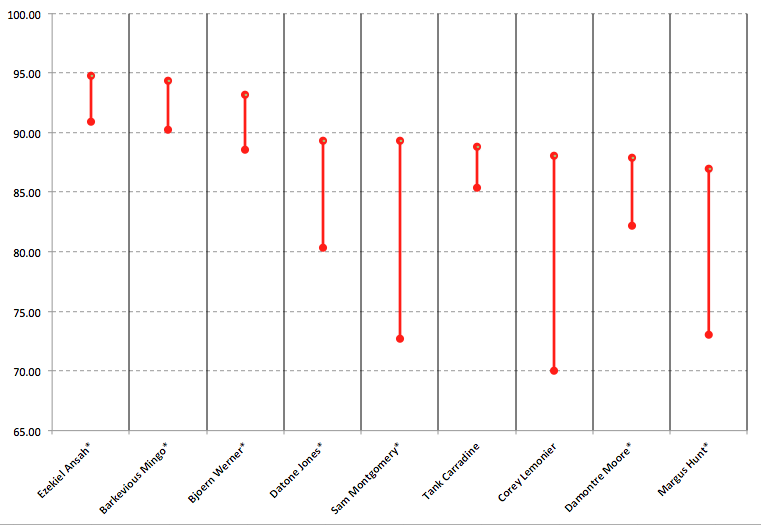
Now DEs:Screen Shot 2013-04-22 at 11.29.13 AM

Note that the DE/OLB breakdown is difficult since there are several players who could go either way (Mingo for example could definitely be an OLB).  I’ve defaulted to whichever position a player is listed as by ESPN.

Here we can see that the top tier of DEs is composed of 3 players, Ansah, Mingo, and Werner, with little difference between them and a big drop-off after them.  Tank Carradine sticks out as the best option after the first tier, but he carries some injury risk that isn’t represented here.

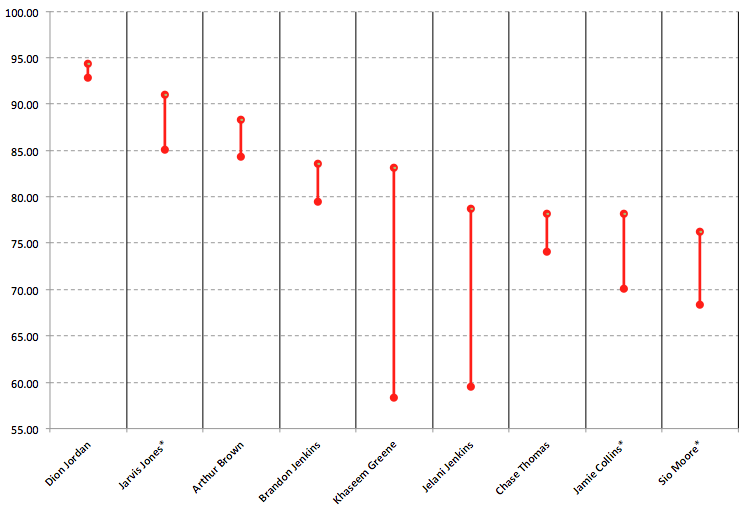
OLBs:

Screen Shot 2013-04-22 at 11.32.51 AM


Similar to the CBs, we see a clear top tier of just one prospect (Dion Jordan).  The talent falls off relatively quickly after Jordan, which is something to keep an eye on in the draft.  If the Eagles really want an OLB, it might be best to take Jordan (if he’s there) at #4, since the options after him are lacking.

DTs:

Screen Shot 2013-04-22 at 11.35.34 AM


I’m a big fan of Star Lotulelei; I think his versatility and skill-set make him a great fit for the Eagles.  However, this chart is a pretty clear case for NOT taking him at #4.  The drop-off in DT talent is not nearly as severe as we saw in the OLBs or CBs, suggesting the team could slide down or wait until round 2 and still grab a DT with a lot of talent.  Five players here have “upsides” that crack 90, illustrating the very strong depth of this DT class.

The OTs:

Screen Shot 2013-04-22 at 11.39.06 AM


The chart confirms Joeckel and Fisher as perhaps the best players in the draft (on an absolute basis).  However, it also shows that there is reasonable depth behind them at the OT position.  I’ve mentioned him a few times, but Menelik Watson looks like he’ll be a great value at the end of the first round or beginning of the second.  He doesn’t crack the 90 point mark, but the scouts are very confident that he’ll be a good (not great) player.

The QBs:

Screen Shot 2013-04-22 at 11.43.18 AM


This is a particularly informative chart, as it clearly shows the risk associated with each QB.  Nassib is clearly the boom/bust player of the class, though EJ Manuel also carries in incredibly large range of potential values.  Tyler WIlson is the “least risky” QB, in that he offers the narrowest range, but he also does not show the potential upside that most teams are looking for in a starting QB.

Some team will take the plunge on Nassib and Manuel, but I wouldn’t touch them in the 1st round with a ten-foot pole.  Even at #35 overall, I’d probably pass.

The Safeties:
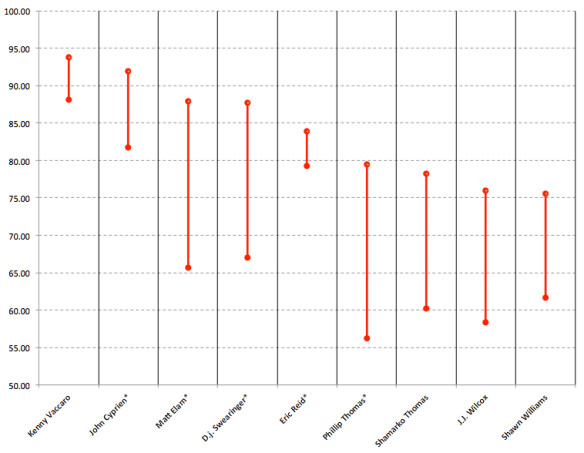
Screen Shot 2013-04-22 at 11.47.25 AM


This is a position of interest for Eagles fans, since the team is in desperate need of some talent at safety.  This is, potentially, a very deep class.  Notice, though, that many of the players carry a LOT of uncertainty.  At this moment, my only concrete “want” for the draft is for the Eagles to come out of it with one of the top guys here.  Cyprien would be my choice, and I think it’s possible the Eagles trade up into the end of the 1st round to get him.  The team could wait on either Elam or Swearinger, but each is a risky play.  Conversely, the team could almost definitely sit at #35 and select Eric Reid, but he doesn’t offer the potential upside I (and most fans) would like to see with that valuable a draft pick.

Lastly, the WRs:

Screen Shot 2013-04-22 at 11.51.57 AM


Not much to say here, other than there aren’t any clear gaps in the group.  That means if you want a receiver, you’ll be able to find one almost anywhere in the first three rounds without “reaching”.  Not a lot of high-level talent (only 3 players break 90, and one just barely), but lots of solid prospects.

That’s all folks. Congratulations and thank you to whomever stuck with this post for all 1800+words.  I’m going to post the positional charts separately under their own page, similar to what I’ve done with the PVM rankings.  That way you can easily refer to them during and after the draft.
The Right Way to Format a Draft Board

Less than a week until the draft begins, and it’s clear that nobody has any clue what’s going to happen at the top of the board (aside from Joeckel, who seems like a decent bet to go #1).  Although it’s fun reading supposed “intelligence”, most of its useless and will bear no resemblance to what the reality will be, so don’t get too worked up over things like “sources say the Eagles really like Geno Smith”.

Also, the full NFL schedule was released yesterday.  Go have a look if you’re interested. Personally, I don’t think it’s worth that much attention at this stage of the off-season, though playing the Redskins week 1 is nice (likely before RG3 is up to speed).

So what to talk about?

Well over the past few weeks I’ve advanced a number of different ways to view/think about the NFL draft.  Today I think I’ve got the clearest illustration yet of what I believe is the “best” way to look at a draft board.

The general idea is that assigning prospects exact values on a 0-100 scale (or any other scale) is ridiculous.  It’s foolish to think that any scout or group of scouts can accurately grade NFL prospects with such precision.  Conversely, the other method of ranking prospects seems to be a non-numerical hierarchy.  That too is useless.  It’s not enough to know that Player A is ranked above Player B.

We need to know how big of a gap there is!  Otherwise, we have no concept of true value as we go through the draft.

So what can we do better?

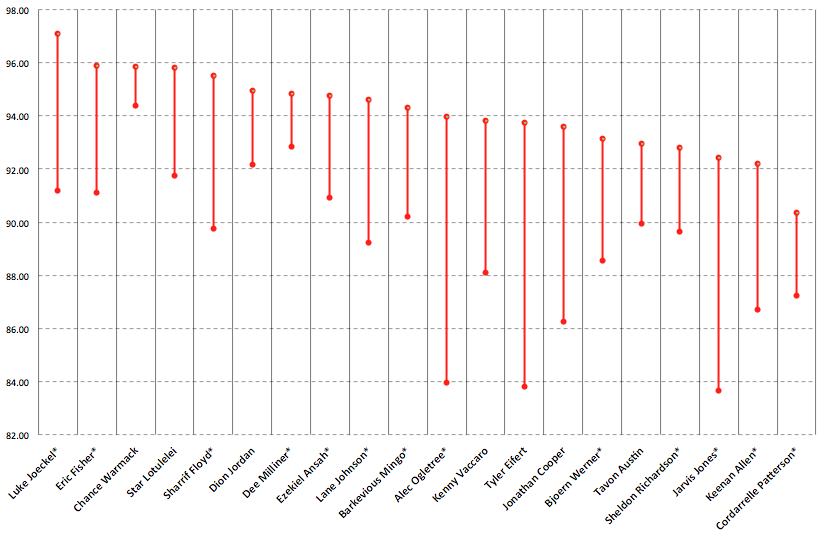
We can, rather than assigning specific values, look at VALUE RANGES.  Below, I’ve included a few charts that depict the top 20 prospects and assigns each a range of expected values.  To come up with the ranges, I simply took the average ratings of NFP, ESPN, and NFL.com (our Consensus Ratings from the TPR system) then used the standard deviation for each prospect to create the range (+- 1 SD).

A few notes:  I wish we had a lot more data (ratings).  This does not make any adjustment for positional value, it is strictly a depiction of each prospects individual ratings.  In practice, each team would incorporate their own rankings and adjust for things like positional value, player personality, fit, etc…

Now let’s look at the charts:

Screen Shot 2013-04-19 at 9.48.20 AMAbove are the top 11 prospects (by average rating).  As we can clearly see, according to our data, some of these players carry much wider potential ranges than others.  There is no “correct” way to read this graph, it all depends on your personal preference.

For example, if we are just looking for “impact” than we would focus on the HIGH end of the ranges.  Doing this, we can see that Sharrif Floyd may turn out to be the best player in the draft outside of Luke Joeckel, despite the fact that he’s ranked just 7th overall.

Or, if we are risk averse, we can see exactly why Chance Warmack is such an interesting prospect.  Despite playing a positional of relatively little importance, he’s clearly the “least risky” prospect, whose “downside” appears to still be extremely good.

Regardless of what your preference or risk tolerance is, it’s should be pretty clear that a discrete ranking or prospects (i.e. a “big board”) is of little practical value.  It’s vital to get a sense of both the potential downside and upside of each prospect, and to EXAMINE THE OVERLAPS.

Dion Jordan and Eric Fisher carry almost identical consensus ratings, but Fisher has a wider range of potential values.  Is Fisher’s downside trade-off worth his upside potential?  Or would you rather take Jordan, who carries a narrower range of values (but necessarily gives up some upside)?

Here are prospects 12-20:
Screen Shot 2013-04-19 at 9.55.36 AM

By average rating, Cordarrelle Patterson is rated higher than Tyler Eifert, but it’s pretty clear you can make the case for Eifert being the better prospect.

Finally, here is a chart of all 20 prospects shown together.  I split them up above to make it easier to see.

Screen Shot 2013-04-19 at 9.52.24 AM

If I can convince you of just one thing going into the draft, it’s this.  False precision is incredibly detrimental to value in the NFL draft.  Let’s say you are agnostic as far as positional need, would you rather take Dion Jordan at #4 or slide down and take Star Lotulelei a bit later (assuming you own board looks like the one above).  The “value” in that situation is pretty clearly on the side of moving down.

Putting a hierarchical ranking together and just selecting the best available is a very poor way to derive value in the draft.