State of the Roster: Building over time

Last year I provided illustrations, by color, of the Eagles offense and defense, using it to identify weaknesses and strengths.  Today I want to take that to the next level, for two main reasons.  First, PFF is now providing the same visuals.  Maybe they did this before and I didn’t know about it, but in any case, there’s no reason for me to duplicate what they’ve already done.  Here is their projected line-up.  Clicking it will take you to the source write-up.

Screen Shot 2014-02-24 at 3.46.18 PM

The second, and more important, reason that I want to do things differently is because the above chart misses out on a vital aspect of team construction.

Time

You can’t sustain success if you’re entire focus is the next season.  The team needs to be built so that it can contend OVER TIME.  Given how much luck there is in the game, it makes more sense to contend over a long period of time rather than “go for it” in any one season.  Andy Reid’s Eagles did this perfectly, they just never had things fall the right way.

This is particularly important for the Eagles because of where the team is currently in its team-building process.  I mentioned in my last post that there are still a lot of holes, and some people pushed back.  While there’s plenty of room to disagree over the projected quality of each player, I realized we first have to agree on just what timeframe we’re looking at.

For example, if we are just considering next season, than Jason Peters is far from a “hole”.  However, if we’re looking at creating a 3-4 year “window” of contention, then things become a bit more difficult.  Peters is 31 years old.  Do you think he’ll still be an above-average OT in his mid 30s?  It’s possible, but the point is that it’s not enough to just look at this coming season.

The question then becomes:  What’s the best way to alter the graphic above to incorporate longer time-projections?

Today I’ll take a stab at that.  First, though, I want to note that the goal is obviously to build a team that contends for a lot longer than 3-4 years.  However, we have to recognize the limitations, or margin of error, in any attempt to project future performance.  The farther out we go, the less accurate or predictions will be.  Therefore, once we go out to 5+ years, there seems to be very little value in attempting to projecting player performance.  That might not be right, but it’s the constraint I’m operating within for right now.

So….the projections:

As you’ll see below, I simply listed every starting player on offense and defense, then assigned them a color based on how I believe they will perform in the relevant year.  For now, we’re going very low-resolution, so I’ve separated players into just 3 groups.  Red is below-average/bad, yellow is average/mediocre, green is above-average/objectively good.  There’s definitely room to refine this (McCoy could be blue, as PFF did above), and I’ll do so after FA and the draft.

The Offense

Screen Shot 2014-02-24 at 4.17.09 PM

As you can see, I also included the salary cap numbers, mainly to show when players’ contracts were up.  Overall, the offense looks pretty good.  There are just 2 areas that could use some immediate improvement, RG and the TE/WR situation behind D-Jax.  Of course, if Maclin resigns and comes back healthy, he could easy go “green” for the foreseeable future.  That would help a lot.  Still, though, the offense looks like it’s in really good shape.

The concern comes in year 3.  As illustrated, Peters, Mathis, and Herremans are all in their 30’s, and while they can certainly perform at a high level into their mid-30’s, we have to ask ourselves:  what are the chances of that happening?  Moreover, what are the chances that all 3 of them do so?  Slim, at least in my opinion.  That’s why I really wouldn’t be upset to see the team add an OL in the draft (beyond the 7th round OL the team should be drafting every year, but that’s a different issue).

I certainly anticipate Zack Ertz moving into the starting TE role, and being a good player for a long time.  Notice, though, that still leaves a whole in the roster.  Anyway you cut it, the offense has space for another receiving weapon.

The Defense

Screen Shot 2014-02-24 at 4.17.18 PM

Now we get to the fun part, the defense.  It won’t shock anyone to learn that the defense has a lot more holes than the offense.  There are some tough calls to make here, as far as projections go.  Can Earl Wolff go “green”?  Yes, but I think the odds still favor him being just OK as a starting safety.  Similarly, some people will probably argue that Bennie Logan deserves a better rating.  Again, its possible, but I’m not convinced.  Additionally, it’s very harmful to the construction process if you assume guys will hit their “ceiling”.  Many don’t, or rather their ceiling gets adjusted downwards as their career progresses.

Most notable here is the lack of good players in the secondary.  Boykin might be able to slide over to the #1 or #2 CB spot, but that still leaves a hole to fill.  Also, remember not to focus on just the first year.  Look at year 3 above.  Naturally, the team has a few offseason to address the issues, so their not urgent, but it has to be accounted for.  Demeco Ryans isn’t getting any better, and how much longer do you think Trent Cole can play effectively for?

You surely noticed the thick black box in both graphics above.  That’s what I’m looking at as the “strike zone” for this team.  If I’m Howie Roseman, I want to turn as many of those boxes green as I can, even if it’s at the expense of next season.  Also, I want to eliminate every red box.  This is what I mean when I mention accounting for time.  You’re not just trying to build the best team you can.  You’re trying to get a lot of different pieces to fit come together at the right time.  It won’t work if your young players improve to “good” just in time for your veterans to decline.

Again, some more work to be done here, and I’m hoping to do a little research into the general career arcs of different positions (so we know things like what age an OT should be expected to decline).  Keep this in mind though when you hear about potential FAs.  How well to they fill those boxes?

Initial Offseason Needs

We’re in the midst of the offseason lull and draft coverage will ramp up soon.  Therefore, it’s a good time to take a high level look at the roster and see what the team’s “needs” are.  Having that framework makes following free agency and the draft much easier (and useful).  One big point before we begin:

This year feels completely different from last year (at this time).  However, that doesn’t mean the goals aren’t very similar.

One year ago, the Eagles looked like a complete mess, and appeared to be at the very beginning of a long rebuilding process.  At least that was the message you got from reading most beat writers.  Readers here obviously knew that things weren’t quite that bleak.  This year, the general Eagles vibe seems to be that it’s a team that has already “rebuilt”, and are now ready to take the next step towards contending (perhaps not competing with Seattle and San Fran next year, but certainly solidifying a place just behind them).  From my point of view, that’s a bit aggressive.

The team took a huge step forward this season (I will probably refer to 2013 as “this season” until FA starts).  Most important was the hiring of Chip Kelly.  However, a number of players emerged as potentially significant contributors to a contending team.  Specifically, Boykin, Lane Johnson, and Zach Ertz all seem to be somewhat reliable pieces that either weren’t with the team last year or still carried a lot of uncertainty (Boykin).  Johnson and Ertz both had issues, but given the totality of their performances, I think the odds are very good that both will become strong starters.

While that certainly helps, we can’t let it blind us to the fact that the team still has a lot of weaknesses.  The defensive roster is still very much in flux or just plain bad.  Most glaring is the lack of talent and depth in the DB corps.  However, the LBs aren’t good either and the DL has some holes as well.  Special teams was atrocious for parts of last year (outside of Donnie Jones), and the kicker probably needs to be upgraded at some point in the near future.  On offense, the scheme obviously works, but Jason Peters and Evan Mathis are getting old, and the WR group is thin and could use some more high-end talent.  LeSean McCoy, the Eagles MVP and the guy the offense is built around, is a unique talent.   If he were to get injured, the consequences for the offense could be catastrophic.

So…in light of all that, what should the Eagles do?

I’ll go through position groups in more detail later, but for now let’s just focus on a few big priorities.

1)  Add talent – This seems so simple, yet it gets glossed over far to quickly by most people.  Did you watch the Seahawks this year? Did you watch the Broncos?  If the answer is yes, then you must have realized that those teams operated on a much higher level than the Eagles did.  Until the Eagles become a “contender”, first priority is to add talent whenever and wherever possible, within the structure of the team of course.  So that doesn’t mean go out and buy every FA available.  It does mean the team should be flexible and agnostic as to what positions it looks to upgrade.

If it were me, I’d go through every FA, under the age of 28, in the league and see where they would slot on the Eagles depth chart.  If they’re an upgrade, I make them an offer.  If that ends up just getting you a handful of 3rd stringers, so be it.  Fans don’t get excited about those type of signings, but they’re really important, especially in the “build” phase.

2) Backup QB – This has to be a high priority.  Michael Vick is gone, he no longer makes sense for the team.  As we saw last season, QB depth is vital to any team looking to make the playoffs.  It’s extremely rare to find someone who can step in and take your team to a title (Brady and Warner were anomalies).  However, you do need someone who can step in and win a few games.  Again, not a sexy position to upgrade, but if Nick Foles goes down for 2-3 games next season, it could cost the team a playoff spot.  When the FA class shakes out a bit, we can look at potential targets here, but it’s HEAVILY dependent on the contract.  As far as traits go, I just want someone who is competent and DURABLE.  I’d gladly sacrifice a bit of talent for durability.  As I said, you’re almost definitely not winning the title with a 2nd string QB anyway, so the extra talent isn’t going to get you much.  Meanwhile, an injury to the 2nd string QB can be a season-killer, as it nearly was for the Eagles this year.

3) DBs….a lot of them – No position group on the team is as weak as the DBs.  The CBs are OK, but each of them seems better suited to a #2 role.  The Safeties are a bigger concern, obviously, and you can’t count on the draft to fix them.  A lot of fans are hoping for a Byrd signing here, but I think it’s too early for a move like that.  Rather, I’d look to sign 2-3 mid-level guys to reasonable deals and see which ones stick.  That’s a similar approach to last season.  Kenny Phillips and Patrick Chung didn’t pan out, but they didn’t cost the team anything either.  Hopefully the BPA when the Eagles pick in the draft is a DB, but you can’t count on that.  In the meantime, keep adding low-risk players and try to make incremental improvements.  That way, when you do find the #1s, the rest of the depth chart is already in place.

4)  LBs – Similar story to the DBs, but for slightly different reasons.  The Eagles LB corps last season was serviceable, and occasionally very good.  Unfortunately, they’re not likely to stay that way.  Demeco Ryans is obviously not a long-term solution, neither is Trent Cole.  I still don’t see Brandon Graham as a viable starter either (in this defense).  That’s a lot of holes to fill, and it’s not going to be done in one offseason.  If the team can plug one of those two spots with a long-term guy, even if he’s just above-average, it will have taken an important step.  The rush LB will draw most of the attention this offseason, but don’t forget about Demeco’s spot.

5)  The Offense – This ties into the first priority, adding talent.  Most of the focus will be on the defensive side of the ball, and for good reason.  However, it’d be a BIG mistake to forget about the offense.  Remember, an above average offense is a NECESSARY condition for winning the SB.  The same cannot be said of the defense.  The Eagles’ offensive position is more precarious than it might seem.  The WR corps is thin, even if Cooper or Maclin return.  One injury to D-Jax and suddenly the group looks like a weakness rather than a strength.  McCoy is also a HUGE risk factor.  The offense is built around him, and the fact that he is so good means there’s just no way to adequately replace him if he goes down.  Another weapon or two would help alleviate that risk.

Lastly, Jason Peters is now 32 years old.  Evan Mathis is 32 years old.  Todd Herremans is 31 years old.

Moral of the story here is that nobody should be surprised if the Eagles take an OT in one of the first two rounds this year.  If that’s the BPA, I have absolutely no problem taking an OT in the first round, even if he sits a year behind Peters (or Johnson before he switches sides).

As I said, I’ll take a much more detailed look at the roster soon, and I think I’ve come up with a good way to visualize things.  In the meantime, be hopeful, but realistic.  There are a LOT of holes in this team, and barring an amazing draft, it’s going to take more than one offseason to fill them.

Break from Football for a Good Cause

You may have noticed that I’ve been posting less often over the past few weeks.  I’ve been swamped with other projects and school.  Fortunately, some of that is clearing, so I’ll have more time to get back to the Eagles.  First, though, I wanted to briefly talk about one of the things I’ve been working on.

As part of the Penn Law curriculum (which is not altered at all for JD/MBAs), every student has to complete 70 hours of pro bono work.  I’ve chosen to fulfill my requirement by volunteering with the Iraqi Refugee Assistance project.  Over the past few months, I’ve been working with a client in Baghdad, helping him and his family apply for resettlement in the U.S.   He and his family have been the victims of severe persecution (attacks, kidnapping, threats, etc…) and have no other choice but to flee the country.  As you can imagine, the red tape involved in U.S. resettlement is immense; that’s where we come in.

This March, six other students and I will be traveling to Kurdistan (Northern Iraq) to conduct in-person interviews with Syrian and Iraqi refugees.  To that end, we’ve started an online fundraising drive to help cover the costs (flights to Erbil ain’t cheap).  If you can help out, please do.  If not, no worries, but at the very least, please watch the video below.  Awareness is a big part of the problem, so just taking 3 minutes to learn more about the situation is helpful as well.  UPDATE:  Video below is not my client, he’s just a good example of the type of people we’re helping.

Help Out

Thanks in advance.  I promise this won’t become a habit (I think this is the first non-sports post I’ve done actually), and I’ll get back to the Eagles soon.

– Brent

Roster Building with Seattle: Skill, luck, or something else….

So Seattle just stomped Denver in the Super Bowl.  Game sucked, commercials sucked, RHCP played air-guitar/bass.  At least Bruno Mars came through.  I didn’t really see anything particularly interesting to discuss from the actual game, other than to note that Pete Carroll made some very poor strategic decisions early on (the 4th down calls).  Of course, if he thought his team was much better than Denver’s (and it appears that was the case), then taking the points may actually have been the right call.  Remember, favorites want low variance.  Refer back to here.

I did, however, see something interesting when looking at Seattle’s roster composition.  Specifically, the great defense the team has put together is composed of players who were drafted with relatively low picks.  Here’s are the starters, plus Cliff Avril:

Screen Shot 2014-02-05 at 9.38.10 AM

Two 1st round picks, neither from the top 10, and one 2nd round pick.  What you’re seeing there is an incredibly efficient use of draft resources.  The vaunted secondary features two 5th round picks, a 6th round pick, and Earl Thomas.

If this isn’t surprising you, remember that elite players come mainly from the 1st round of the draft, and almost entirely from the first two rounds.  See this chart from the archives:

So…it looks like what the Seahawks managed to do (build a historically good defense with low-round picks) should be extremely difficult, if not impossible. Let’s take a look.

First, how good were the Seahawks this year?

I’m going to use a shortcut here, and rely on just points allowed adjusted for league average.  This measure isn’t perfect because it doesn’t account for the contributions from the offense and special teams, but it also relies on readily available data, and more importantly, doesn’t offer a lot of false positives.  Since 2000, here are the best teams by this measure, with Seattle added to the mix:

Screen Shot 2014-02-05 at 9.15.55 AM

The teams highlighted in yellow won the Super Bowl.  I should also note that this year’s Carolina Panthers just missed the list.  They allowed 35.6% fewer points than average.

Anyway, as you can see, Seattle was historically good this year at preventing points.  Now, how does their roster compare?  Well I looked at the starting rosters, according to Pro-Football-Reference.com, of the 5 teams ranked ahead of them (haven’t had time yet to look the rest).  Here’s what I found:

Screen Shot 2014-02-05 at 9.53.22 AM

Screen Shot 2014-02-05 at 9.53.47 AM

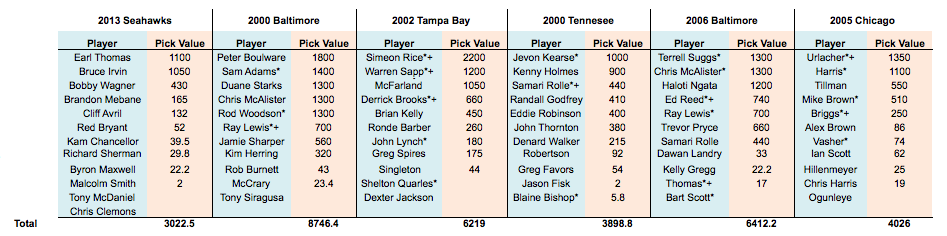
Most of those teams seem to line up with our expectations; the best defenses ever feature a lot of 1st round picks.  I realize that not all of these players were drafted by the teams they ultimately played for above.  That’s a secondary matter, though, and one we can explore separately.  For now, I’m just interested in where the talent originally came from. It’s not enough just to count up 1st rounders.  We want a complete comparison that accounts for the differences in the value of each pick.  To do this, I used the Draft Pick Value Chart.  This is the chart teams either use or used to use as a guideline for weighing trades.  Here are each of the previously mentioned teams, with the starters listed along with their Draft Pick Value.  I’ve summed each at the bottom.  Click to expand.

Screen Shot 2014-02-05 at 10.05.08 AM

Here is the condensed version:

Screen Shot 2014-02-05 at 10.08.44 AM

So yes, the Seahawks appear to have done something remarkable, though perhaps not as remarkable as I expected.  Additionally, nearly all of Seattle’s contributors on defense were, in fact, drafted by the Seahawks, eliminating the possibility that they simply waited for late-round talent to prove itself in the league and then signed it.

The upshot:

There are a few possibilities here:

– The Seahawks are simply better at drafting then everyone else.  If you read the work I did on Skill vs. Luck in the draft, you know that’s almost definitely NOT the case.

– The Seahawks got lucky, and managed to string together several unlikely outcomes (very good players in the late round).  This one’s possible, and perhaps the most likely scenario.

– The Seahawks coaching staff is very good at turning its players into valuable contributors.  Also possible, but the level of results tells me to be skeptical here.

– Something else is going on….

We’ll need to explore these options in more depth to get a good sense of what’s actually happening.  For now, just know that what the Seahawks did, as far as roster-building goes, was EXTREMELY unlikely.  If we can figure out HOW they did it, it will tell us a lot about the kinds of strategies the Eagles should employ (even if it turns out Seattle did just get really lucky).