Self Scouting the Eagles Part 1: On Drops

Patrick Causey, on Twitter @pcausey3

For teams riding a hot streak, a bye week is about as welcomed as a root canal. It threatens to disrupt the positive momentum a team has built by placing 14 long days between their games.

But for a team like the Eagles, who are mirred in the middle of a season that is as disapointing as it is frustrating, the bye week could be the perfect tonic. It provides the opportunity for the team to get away from the facility for a week, clear their heads, and hit the reset button on the season.

While the players are away, Chip Kelly and his coaching staff will be spending the week self-scouting, which simply means they will be evaluating what the hell went wrong with the first seven weeks of the season and coming up with a blueprint for salvaging the rest of it.

The good news for the Eagles is that the NFC East is very much wide open. The Giants are the best team by default, but they have question marks across the board that the Eagles exposed two weeks ago. The Cowboys are an injured, toxic wasteland. And if the injuries to Dez Bryant and Tony Romo don’t derail their season, it could be ended by Greg Hardy and Joseph Randle, two head-cases that seem hellbent on out-crazying one another. And the team from Washington is probably the only team in the NFL that is more inconsistent than the Eagles, as their wild, come from behind victory over the lowly Tampa Bay Buccaneers showed us last week.

So what can the Eagles do to get back into contention? What is holding the team back? Let’s try to replicate what is going on inside the NovaCare Complex this week and do some self-scouting of our own.

I’ve identified five issues with this team, in no particular order, that I want to discuss. But I am sure there are more than this, so feel free to leave your list in the comments:

  1. Drops
  2. Quarterback play
  3. Lack of consistency
  4. Self-inflicted wounds
  5. Mismanaging player acquisition and utilization

I want to address items 1 and 2, as well items 3 and 4, at the same time because I think they go hand in hand. Let’s break down the drops and quarterback play first. Part two and three will come out over the next week.

1. Drops and Quarterback Play

I wrote an in-depth breakdown of the issues facing Sam Bradford last week (which you can read here), so I am not trying to rehash those issues again. Instead, I want to focus on the utility of measuring drops and challenge how we apportion blame for drops between the receiving corp and Sam Bradford.

It is no secret that the Eagles wide receivers have dropped a ton of passes this year. We have seen it discussed ad nauseum for the entire season, but it peaked after last Sunday’s loss to the Carolina Panthers where the team dropped anywhere from seven to 10 passes depending on which website you rely upon.

The common narrative emanating from the game was that the receivers were to blame for the drops, and the optics — at least at first blush — certainly supported that. In a fitting end, Miles Austin dashed any hopes of an Eagles comeback by dropping a Sam Bradford pass on 4th down late in the 4th quarter.

But after going over the game tape, I saw issues that suggested, as always, it was not as clear cut as we thought. While the receivers deserved their fair share of the blame, Bradford’s placement on certain passes, including the Miles Austin drop, had at least some impact on a handful of the drops, and had significant impact on others.

But before I get to that, let’s take a step back and examine how drops are evaluated on a macro-level by the media and advanced metric websites such as ProFootballFocus.com. Gaining a better understanding of the issues inherent with how we measure drops will help us evaluate the Eagles season to date.

Drops at a macro-level

Organizations like Pro Football Focus, as well as other advanced metrics companies that work directly with NFL teams, have placed considerable emphasis on drops when evaluating a quarterbacks play. PFF.com factors drops into two of its key “Signature Stats”: QB Rating and Accuracy Percentage.

From the website, PFF states accuracy percentage “accounts for dropped passes, throw aways, spiked balls, batted passes, and passes where the quarterback was hit while they threw the ball – factors that hurt the quarterback’s completion percentage but don’t help show how accurate they are. The formula: ((Completions + Drops) / (Attempts – Throw Aways – Spikes – Batted Passes – Hit As Thrown)).

PFF does a similar thing with its quarterback rating, again from its website: “Offering an alternative to the out-dated standard, we take into account dropped passes, throw aways, spikes, and yards in the air and further adjust the old formula so it makes more sense and is a more accurate measure.”

In other words, in an effort to determine how accurate a quarterback truly is, and how well that quarterback is performing overall, PFF tries to remove static from the equation — i.e., bad plays which are outside of the quarterback’s control that impact his rating and completion percentage.

Sounds good in theory, right?

But noticeably absent from these equations are plays that the quarterback benefits from undeservingly. For example, PFF does not subtract from the quarterback’s accuracy percentage catches that were off target but caught because a wide receiver made a spectacular grab. And in the quarterback rating, PFF does not factor in easy interceptions which were dropped by a defender.

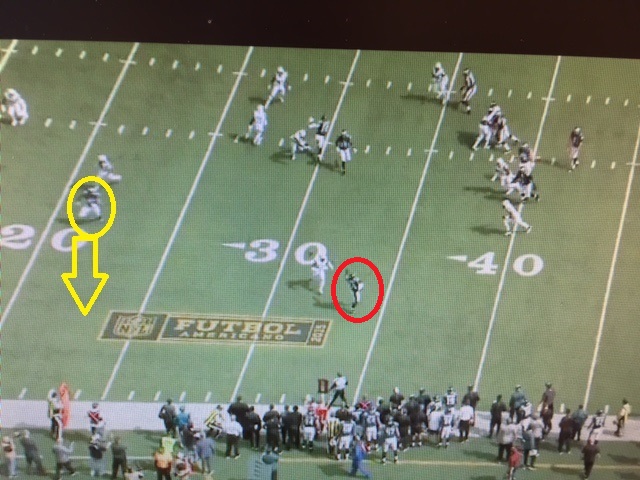
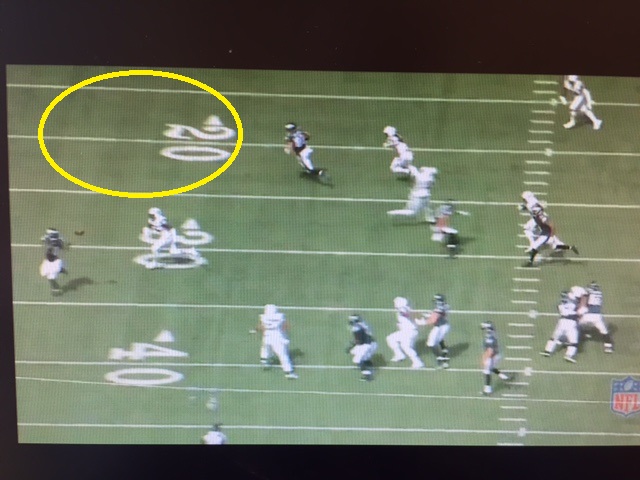
So a quarterback gets credit when a receiver drops a pass like this:

But does not get dinged when a defender drops an easy interception like this:

Or when a receiver bails out the quarterback from an inaccurate throw like this:

By focusing on only half of the equation, the results are improperly skewed to the quarterbacks benefit.

Another different, but related, issue I have with drops is that drops is that not all drops are created equal. But they are largely treated the same.

Drops are inherently subjective; which is why you can look at three different websites and get three different numbers for a total on team drops. Most websites, however, use the basic parameter of ruling something a drop if the ball hits a receiver in the hands.

But this approach places too much emphasis on the wide receiver and ignores the impact that a quarterback’s ball placement has on the receiver’s ability to catch the ball. That simply cannot be ignored if we are to fully and properly evaluate what constitutes a drop pass versus a bad throw.

Let’s take this out of the abstract. I think we all can agree that this is a drop by Riley Cooper. The ball is placed perfectly by Bradford, and Cooper fails to make the catch:

Ditto this play by the otherwise sure handed Darren Sproles:

Bradford has shown an affinity for the wheel route, and you cannot place this ball any better than that.

But what about this throw from Bradford to Jordan Matthews against the Cowboys?

Matthews is running a crossing route and has a step on his defender, so Bradford ideally needs to place the ball in front of Matthews so he can catch the ball without breaking his stride. Instead, Bradford is off with his throw, placing it on his backside shoulder, which forces Matthews to stop on his route and contort back towards his defender to make the catch. Is this really a “drop” or simply a poor throw by Bradford?

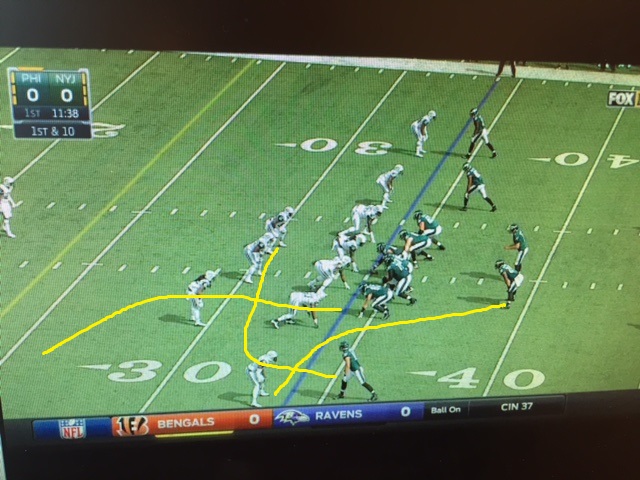
Or what about this throw to Nelson Agholor against the Jets — does this constitute a “drop”? It hit Agholor’s hands, so at least under some standards, it might be labeled a drop even though it was clearly a poor pass by Bradford.

I have not found any website which takes the negative plays — i.e., dropped interceptions, spectacular catches by the receiver —  into account, or which does a fair job differentiating between a drop and an incompletion based on a poor throw by the quarterback.

Until I see a metric that takes both into account, I assume, for better or worse, that these plays even out in the long run. Absent extraordinary circumstances, it is reasonable to expect that a quarterback will be let down by his receivers roughly the same percentage of times that he will be bailed out by his receivers. Ditto with interceptions. It isn’t perfect. But it seems like a more complete way to evaluate a quarterback’s play.

Drops on a micro-level

Which brings me to the Eagles this year. PFF.com has Bradford as the victim of a league leading 25 drops. And against the Carolina Panthers, the Eagles dropped anywhere from seven to 10 passes during the game.

Some of them were flat out drops. Like this pass to Darren Sproles:

Or this pass to Zach Ertz:

Those are inexcusable drops. In Sproles case, it contributed to a stalled drive inside the Panthers 20-yard line. The Eagles ended up settling for three points instead of a touchdown.

But there were other plays — three, to be exact, where Bradford hurt himself with his ball placement.

Let’s start with the interception Bradford threw when he targeted Jordan Matthews early in the game. When I watched this play initially, I thought Matthews was at fault. While ball placement was not ideal — Bradford threw it to Matthews’ outside shoulder when he was running an inside crossing route — I thought the catch should have been made.

But one thing we have to take into consideration is that this is pass is four-five yards past the line of scrimmage, and Bradford delivers the ball on an absolute rope. That increases the degree of difficulty here because Matthews barely has any time to react to the ball.

Here is another view:

Bradford could have made this easier by either taking something off the pass or placing the ball in front of Matthews (or both). While NFL caliber wide receivers likely should have made that catch, NFL caliber quarterbacks –without question — should be able to deliver this easy pass accurately. Bradford did not, which is why I think he deserves a good share of the blame.

In the third quarter, the Eagles were driving deep into the Panthers’ territory, down 21-13. A touchdown could have brought the Eagles within one or tied the game (had they gone for two).

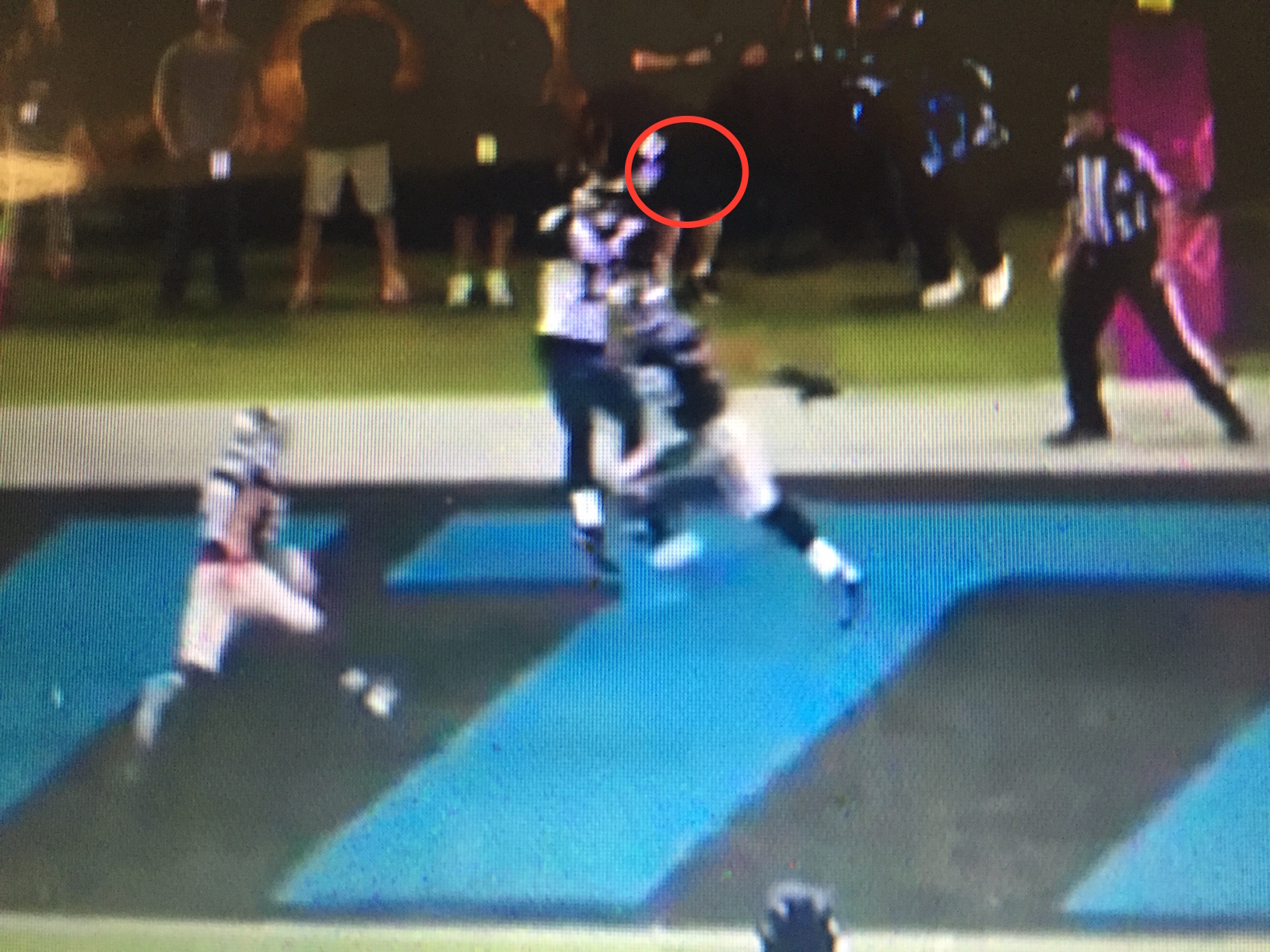
On third and goal, Bradford had Josh Huff running a post route to the middle of the end zone, but Huff dropped the would be touchdown:

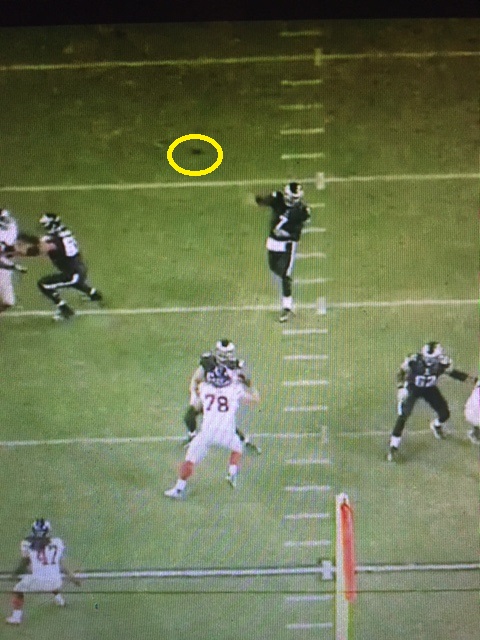
Or did he? Let’s look at this a little further. First, here is the screen shot right before Bradford delivers the throw:

IMG_1825

So far so good. Bradford has Huff one on one with a linebacker (Kuechly) and a clear lane to throw in-between the defenders. The only problem? Bradford doesn’t fully lead Huff; the ball is again thrown to the wrong side of Huff, causing him to have to turn away from where his momentum is carrying him. Here is a close up:
IMG_1828

The ball is hard to see, but what is apparent is that Huff is having to turn 90 degrees in air to try to make the grab. Could he have made the catch? Possibly. But would the catch have been much easier to make if Bradford placed it properly? You bet.

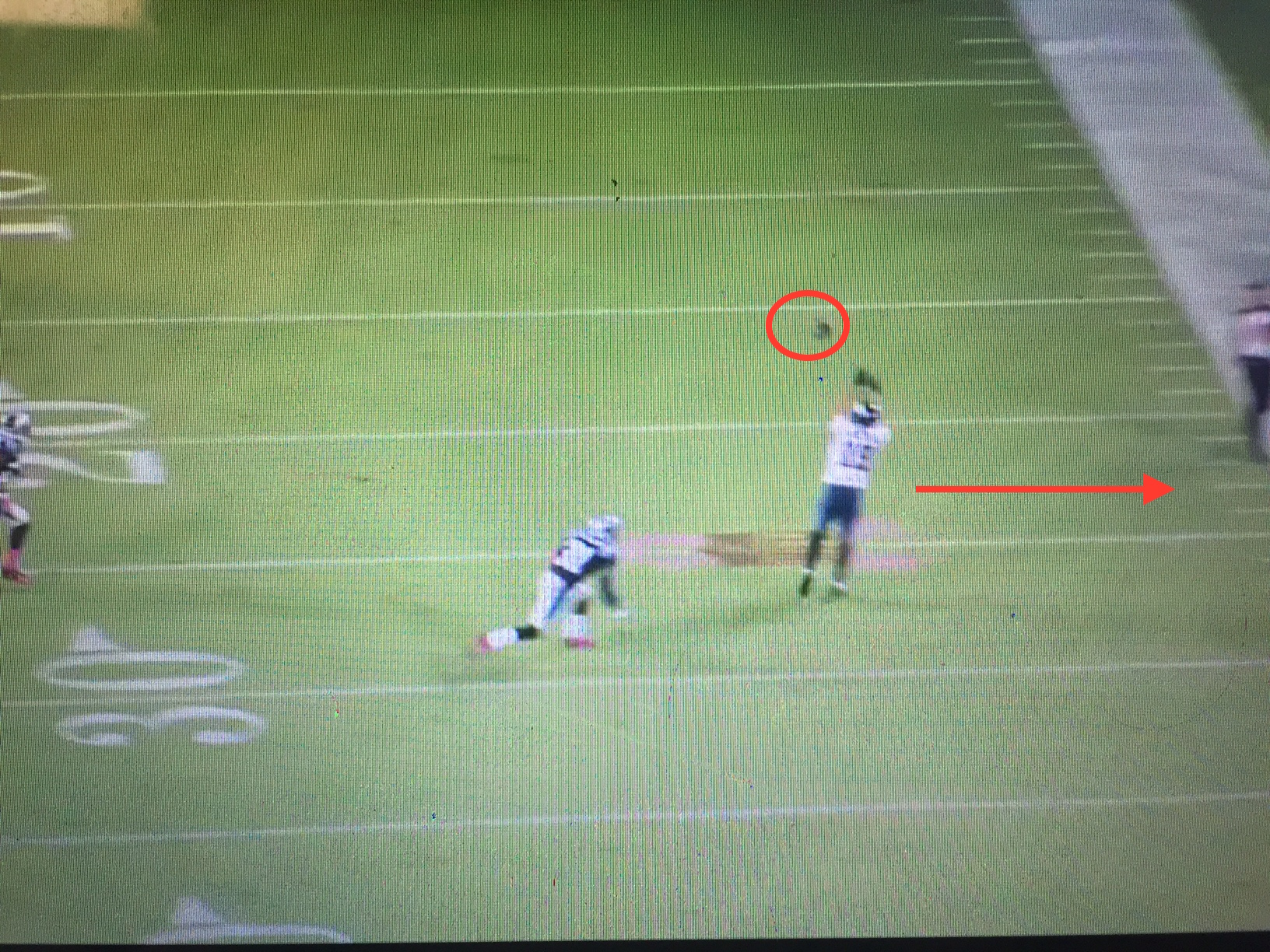
Back to that Miles Austin play I alluded to earlier. It was 4th down on the Eagles last drive of the game, and Austin is running a seven yard out route. He gets open, Bradford gets him the ball, but Austin fails to make the catch.

But again, Bradford’s ball placement here was suspect:
IMG_1831

You can see where the ball is thrown compared to where Austin’s momentum was taking him. It was an easy pitch and catch made more difficult by Bradford’s ball placement. Austin still could have made the catch, but I think Bradford deserves the lion’s share of the blame here.

Without question, the receivers need to improve moving forward. I am not ignoring that nor excusing their poor play. But we should not automatically assume that every (or even most) drops are solely on the wide receiver. The quarterback plays a big part in whether a pass is caught, and up until this point in the season, Bradford has failed to live up to his end of the bargain.

A reason for optimism

Let’s end on a positive note, because I think there is a chance we see the drops improve over the season. For starters, the normal drop rate in the NFL usually is around 7-8%. Currently, the Eagles are at 11.41%. So we should expect at least some regression to the mean over the remainder of the season.

But I also think we should see some improvement from Bradford as he continues to work his way back from his knee injury. Look at this chart of Bradford’s dropped passes throughout his career:

Year

Drops Percentage of Pass Plays Rank
2010 36 6.1% 5th most
2011 31 8.6% 1st*
2012 30 5.4% 18th
2013 12 5.5% 19th
2015 25 11.41% 1st

In Bradford’s first two years in the league, his team struggled with drops, having the fifth most drops in his rookie year, and the most drops in his sophomore campaign. This is understandable: Bradford was new to the league and likely needed time to adjust to the speed of the game, the complexity of the defenses, and the tighter windows through which he had to throw.

But in the following two seasons, Bradford showed marked signs of improvement, ranking slightly better than league average.

The Rams did not bring in any high priced, big name wide receivers over the course of the 2012 and 2013 seasons. And while both seasons were cut short by injury, they were not too short to write off the improvement as too small of a sample size (Bradford played 10 games in 2012, seven games in 2013). So this improvement likely was the result of Bradford becoming more accurate with his passes.

So why the regression this year? Obviously, the wide receivers are not playing well, and that is likely contributing to the high numbers. But I also think Bradford’s knee injury is limiting his play — not only from a confidence and mechanical perspective, but also because it prevented Bradford from getting a full offseason’s work in as he worked through his rehab from March to August.

I am not making excuses for Bradford. He has not played well up to this point in the season and he will need to improve if the Eagles are going to have any chance to competing for the NFC East title. But I would not at all be surprised if we start to see the drops improve over the course of the season, not only because the receivers can’t be this bad (can they?), but also because Bradford’s accuracy should improve as the season progresses.

Diagnosing Sam Bradford’s Struggles

Interceptions are not the issue, but are merely a symptom of the issues hampering Bradford’s game; can they be fixed?

Patrick Causey, on Twitter @pcausey3

The last two weeks of the Eagles season perfectly illustrates the importance of the quarterback position. The Eagles have gone from 1-3 with their season on the brink of collapse, to being in first place in the NFC East. They have been led by a dominating defense and strong play from their offensive line and run game, three things which seemed inconceivable after the loss to the Atlanta Falcons. And they have won their last two games by a combined 44 points while piling up 957 yards of total offense in the process. Heck, even their much maligned kicker, Calib Sturgis, has been perfect on field goal attempts over the last two weeks.

Given what we have seen, it is fair to wonder whether this is the deepest and most balanced team that Chip Kelly has had as head coach of the Eagles. And yet, there is an overwhelming sense of anxiety surrounding this team.

Why? Because of the quarterback.

To put it mildly, Sam Bradford’s play has been inconsistent. Ask anyone the biggest problem with Bradford’s play to date, and they will likely point to the alarming rate at which he is throwing interceptions. And indeed, Bradford’s 3.9% interception rate dwarfs his career rate of 2.2%. His nine interceptions rank second in the NFL, and his four redzone interceptions — three of which that have occurred in the last two weeks — is tops in the league.  Bradford is one of only two quarterbacks to throw two-plus interceptions in four of the six games he’s played (the other being Kirk Cousins).

But the interceptions are not the reason for Bradford’s poor play, they are merely the symptoms of the actual flaws in Bradford’s game that are causing the interceptions.

The tape shows that there are three issues that have haunted Bradford so far this season that are leading to a spike in interceptions:

  • Bradford struggles when he is under pressure or thinks he is under pressure;
  • Bradford is not seeing the field properly which is leading to bad decisions; and
  • Bradford’s ball placement has been inconsistent, which largely results from his failure to transfer his weight during his throws.

Before we dive a little bit deeper, consider this quote about Bradford from NFL.com’s Greg Cosell:

There [a]re two particular areas where significant work was needed [in Bradford’s game]. There were times he was not comfortable in the pocket with bodies around him. That’s a different trait than looking down the gun barrel. When the pocket closes down and functional space is reduced to throw cleanly and comfortably, you must still stay on balance and deliver the ball in the eye of the storm…In addition, there were instances in which Bradford had opportunities to be more aggressive throwing down the field that he didn’t take advantage of…

Bradford [has been] tentative in the pocket, not mentally sharp, and at times he did not let it loose when he had a throw. An inconsistent profile had been established. What really stood out as the year [has progressed is] Bradford’s reaction to pressure — the issue that first surfaced in his rookie season against Kansas City. It is easy to place the blame on the…poor pass protection, but that circumvents the more essential point. You must be able to function effectively in a muddied and noisy pocket to play quarterback well in the NFL, and Bradford began to perceive pressure that was not there. He was anticipating the rush, and you cannot perform that way, no matter what kind of talent you have throwing the football.

[Bradford’s] velocity ha[s] decreased; he [i]s not driving the ball down the field….His precise ball location, a feature of his game as a rookie, had waned. He missed some throws that were there. He had very little sense of timing with his receivers. He threw some balls too early, and some too late; the passing game was clearly out of synch. I strongly believe the injuries, the revolving door and the overall lack of quality at the wide receiver position [i]s a more legitimate reason for Bradford’s struggles than the offensive line. The inability of [Eagles] wideouts to get open on one-on-one isolation routes — a must in the NFL — had an extremely negative impact on Bradford. His game is timing and rhythm, but his uncertainty as to when to deliver the ball is clear on last season’s tape. He was hoping, rather than playing, and that’s a formula for failure.

I think this is a fairly accurate depiction of Bradford’s struggles so far this year, with the exception that Bradford has been willing to take more shots down the field as the season has progressed.

The only problem? Cosell wrote this back in 2012, after Bradford’s second year in the league. I slightly modified the post so that it was in present tense.

Which begs the question: if Bradford is struggling with many of the same issues that limited his game over four years ago, is it reasonable to expect him to improve this year, even if he cuts back on the interceptions? Or, to steal a line from Denny Green, is Sam Bradford what we thought he was? The answer, as usual, is a mixed bag.

When we dig deeper into the numbers and the tape, a picture begins to emerge of an incredibly talented, but flawed quarterback; one that should expect to see areas of improvement as the season progresses, but one who likely won’t live up to the lofty expectations that most fans had during the preseason. Let’s break this down further.

Bradford Throwing Under Pressure

A consistent issue we have heard about Bradford over his career is that he struggles to throw the ball under pressure, real or perceived. As Cosell pointed out in his 2012 article, Bradford “was not comfortable in the pocket with bodies around him” at times, and even “began to perceive pressure that was not there.”

The numbers back this up. Per PFF.com, here is Bradford’s completion percentages, touchdowns and interception totals, plus their ranks (contained in parenthesis), when throwing under pressure:

Year

Cmp%

TD

INT

2010

41.1 (23/29)*

4 (T-18)

7 (T-5)

2011

38.4 (23/24)

6 (21)

2 (22)

2012

41.6 (20/27)

5 (11)

2 (T-23)

2013**

38.8 (26/29)

2 (T-12)

1 (T-21)

2015

44.6 (26/31)

4 (T-2)

4 (T-3)

  • *Note that the number of candidates vary from year to year because a different number of candidates qualified for PFF.com’s statistics.
  • **In 2013, I used only the numbers for the first seven weeks, since that is the time period Bradford played before suffering a torn-acl.

When Bradford was with the Rams, we saw him make costly mistakes like this under pressure:

Bradford has repeated those mistakes this year with the Eagles, as we saw on this interception against the Falcons:

Now, pressure impacts every quarterback. Even Aaron Rodgers and Tom Brady throw bad interceptions under pressure. That is why pass rushers are, on average, the third highest paid position group in the league (behind only quarterbacks and wide receivers). So throwing interceptions under pressure is not unique to Bradford.

While Bradford has thrown the third most interceptions while under pressure this season, there is some evidence to suggest that he will cut back on the interceptions. In Bradford’s rookie year, he threw 7 interceptions, which was tied for fifth most in the league. That’s to be expected for a rookie quarterback. But in each of the following three seasons, Bradford showed marked improvement protecting the football.

Bradford’s struggles this year might be the result of his time away from the game. With time, we should expect to see Bradford improve as he get more comfortable with this offense and more confident in his knee.

But that does not necessarily mean that Bradford’s problems throwing under pressure will be solved once he cuts back on the interceptions. Bradford’s completion percentage under pressure has ranked towards the bottom of the NFL throughout his career, which suggests a deeper issue that cannot be explained away by the rust caused by his time away from the game.

For whatever reason, Bradford struggles when he does not have a clean pocket. This struggle is one of the primary reasons why Bradford is such a frustrating quarterback to watch. In training camp and preseason — when pressure is virtually nonexistent — Bradford’s pinpoint accuracy and quick decision making are on full display. But when the pressure comes, Bradford freezes up. His mechanics become sloppy, he gets rid of the ball too quickly, and he becomes wildly inaccurate.

Five seasons in, it is reasonable to wonder if this is an issue that will persist for Bradford throughout his career.

Bradford’s Faulty Mechanics

The tape also shows that Bradford is struggling with his mechanics. Back in training camp, Louis Riddick, formerly of the Philadelphia Eagles front office and currently of ESPN.com, tweeted the following about Bradford:

Ron Jaworski appeared on 97.5 The Fanatic earlier this season, and saw the same thing:  “He’s favoring the left leg.  I can see it when bodies are around him.  He’s not transferring that weight.  The ball is coming out with a lack of energy.  His footwork is bad. I can’t say any more simply than that.”

To understand the importance of not transferring weight on your throw, we need to understand the technical components of throwing the football. Many exercise scientists and kinesiologists agree that that throwing a football at an elite level is the most complex motor skill in all of sports. It requires flawlessly executing a number of independent, but related moves in one compact throwing motion. Even the slightest breakdown in mechanics can adversely affect a quarterbacks power and accuracy.

Here is the breakdown in simple terms:

  1. A quarterback needs to put approximately 70% of his weight on his back plant leg plant his back leg.
  2. The quarterback then turns his front shoulder inward and away from his target, like loading a spring.
  3. In one fluid motion, the quarterback uncoils the spring, exploding forward with his throwing arm rotating towards the target while transferring his weight from his back leg to the front leg.

Many people mistakenly believe that power is generated from a quarterback’s arm, when in fact, it comes primarily from the quaterback’s core, legs and hips. It is generated in that last motion, with the quarterback rotating his hips and transferring weight from his plant leg to his front leg.

But the key is to allow that weight transfer to occur naturally. If you rush or force the weight transfer to your front plant leg too early, it creates an all arm throw that lacks velocity and consistent accuracy. That’s what happened to Drew Brees last year when he was dealing with an oblique injury, and we are seeing it with Bradford this season as well as he continues to come back from his knee injury.

Perhaps the best example of Bradford not transferring his weight properly came on the second interception he threw to Zach Ertz last week against the New York Giants. If you recall, Ertz was double teamed in the end zone, but Bradford tried for a jump ball hoping Ertz could make it play:

It was a bad decision by Bradford that was compounded by his faulty mechanics. Here is a screen shot just as Bradford released the ball:

Bradford Bad Mechanics

The position of Bradford’s shoulders tells us that he is not transferring his weight properly. With proper mechanics, Bradford should have rotated his throwing shoulder towards his intended target, Ertz (which would be towards the bottom left of this picture). Instead, we see that when Bradford releases the ball, his shoulders are practically parallel to one another; there is virtually no rotation towards his receiver, which explains why the throw came up short.

The question is whether Bradford can fix it. Jaws thinks the issue stems from a lack of confidence in his knee, which wouldn’t be the first time a quarterback has struggled with his mechanics when coming back from a knee injury. Robert Griffing, III had the same issues following his knee injury in 2013.

But as Greg Cosell pointed out, Bradford has struggled with this issue since 2011: “[Bradford’s] velocity ha[s] decreased; he [i]s not driving the ball down the field….His precise ball location, a feature of his game as a rookie, had waned. He missed some throws that were there.”

These are clear signs that Bradford is not transferring his weight properly in his throw.

The encouraging news is that Bradford has recognized the problem. Per Paul Domowitch of the Philadelphia Daily News:

It’s been mechanical. Me and coach Day talked a little bit about it this week. I’m not sure my weight transfer has been where it should be on a couple of throws. I’m not sure I’ve really gotten to my front leg. I think that’s why some of them have been short. So I spent a lot of time this week trying to get back to the fundamentals.”

Now it’s just up to him to fix it.

Bad Decision Making

The final issue I’ve noticed on tape has been Bradford’s poor decision making. While Bradford is known for his high football intelligence, he has curiously struggled to work through his progressions and see open receivers this season. We have seen this issue pop up throughout the season (which I have covered here and here).

Let’s start with his interception to Riley Cooper against the New York Giants.

When I first saw this live, I thought the interception was on Cooper, who stopped short of his route.

But watching the tape again, I saw why Cooper optioned to a deep curl instead of the post: there was safety help over the top. Here is a screen shot right at the moment Bradford was releasing the ball.

Cooper INT

Cooper is highlighted in yellow and is starting to break into the curl route. The safety (highlighted in red at the center of the field), is already breaking on the post route.

Cooper made the right read here. Running a deep post into double coverage, especially with someone as slow as Cooper, is a recipe for disaster. Cooper recognized this, and optioned to a deep curl in single coverage. But Bradford threw to the deep post anyway. He just can’t make this throw.

Brian Dawkins saw the same thing, per Mark Eckel of NJ.com: “On the one interception, I don’t know maybe he expected Riley (Cooper) to do something else, but to throw the ball down the middle of the field like that with a safety there, you can’t do that. You just can’t do that.”

Bradford has struggled making correct reads and getting through his progressions throughout the year. Consider this first and 10 play in the first quarter of the Eagles game against the New York Jets. The Eagles are running a staple of Chip Kelly’s offense, the triangle concept (which I cover in depth here).

Ertz missed

Zach Ertz is running a corner route on this play; Riley Cooper is running a drag route across the middle, and Ryan Mathews is running an out route out of the backfield towards the space vacated by Cooper.

Bradford almost immediately checks the ball down to Mathews (circled in red below) without letting the play develop. The throw is high and to the wrong shoulder, and falls incomplete. But again, Bradford makes a wrong read and misses Ertz (circled in yellow), who was wide open on the corner route:

Ertz 2

Here is a better angle showing the space Ertz had to operate:

Ertz 3

Bradford was not under pressure on this play, he simply rushed the throw to his check down option, missing the opportunity for a big play.

One final example (and apologies for bringing up the bad memories here). In the Dallas game, Bradford threw this costly interception when he targeted Zach Ertz in the end zone.

With the exception of a minor formation change, this is the same play the Eagles successfully ran against the Green Bay Packers in the preseason where Bradford delivered a strike to the underneath crossing route for a touchdown.

But here, Bradford forces the throw to Ertz, and misses Nelson Agholor (circled in yellow), who is open on the underneath crossing route.

Ertz INT Dallas 1

Bradford also had Cooper wide open on the deep in route, as we can see from this screen shot:

Ertz INT Dallas Cooper

Again, there are reasons to believe that Bradford can improve here: he is only six weeks in to learning a new offense, a process which has been hampered by Bradford missing valuable time this offseason recovering from his knee injury.

And Bradford showed progress getting through his progressions against the Redskins and the Saints. That should not be forgotten simply because Bradford had a bad game against the Giants.

Conclusion

So where the hell does that leave us? As I suggested about 2,000 words ago, it leaves us with a muddled picture. That probably isn’t the popular answer in a world that demands hot takes and bold statements, but it is probably the most reasonable conclusion that can be reached.

No one can dispute that Bradford has been inconsistent this year. Part of those inconsistencies can be explained by Bradford struggling to come back from a two-year layoff while simultaneously learning a new offense with new teammates. But part of these issues have persisted throughout Bradford’s career, so they likely are a sign of a fundamental issue with Bradford’s game more than rust.

I still believe that talk of replacing Bradford with Mark Sanchez is wildly premature. Bradford should be given at least until after the bye before we reach any concrete conclusions on the state of our quarterback. And even then, I’m not sure that switching to Sanchez represents any discernible upgrade. Regardless, we should expect some improvement from Bradford this year, but any thoughts of Bradford being a top ten quarterback in this league seems misplaced.