Patrick Causey, on Twitter @pcausey3
I have broken down Sam Bradford’s performance twice this season: once after the Eagles win over the New York Jets, and about a month later after the Eagles beat the New York Giants.
After the Eagles win over the Jets, I concluded that Bradford was playing poorly across the board: making bad reads, not letting plays develop, and delivering the ball inaccurately. After the Giants win, it was clear that Bradford was still struggling in these areas, and also struggled throwing under pressure and maintaining his mechanics. A lot of these issues persisted in St. Louis, which raised doubts about whether it was reasonable to expect Bradford to overcome them. But, with hesitation, I concluded that Bradford deserved more time to develop confidence in his knee and a comfort in the Eagles system.
So now seems like a good time to check back in on Bradford’s development. But before we do, let’s play a guessing game.
Pick which quarterback you want on your team:
https://twitter.com/InsdeTheHuddle/status/679650782413766657
Quarterback B is obviously Sam Bradford’s numbers this year.
Quarterback A? Carson Palmer in 2013, his first season in the Arizona Cardinals’ system.
It is by no means a perfect comparison, as Brian Solomon and Dave Mangels pointed out in our lengthy discussion on Twitter, but it is — to a certain extent — illustrative of the effect learning a new system can have on a quarterback.
Chip Kelly echoed this point a few weeks back, quote courtesy of BleedingGreenNation.com: “I think Sam, as a whole, has progressed as the season has gone along. I know it takes a long while to play quarterback in this league. There’s so many different things you have to get. And when we got Sam, we knew with any quarterback it’s going to take time. Name any quarterback playing at a really high level now and they’ve been playing in the same system for years, not for months. And that’s Sam’s case is. He’s just been playing in our system for months.”
Breaking down the tape over the last three games — with wins over the Patriots and Bills, and a loss to the Cardinals — lends support to Kelly’s point. Without question, last Sunday’s performance against the Arizona Cardinals was his best of the season, which came on the heels of two good — but by no means great — performances against the Bills and Patriots. And while there are still valid questions about why Bradford’s improvement is not translating to more points from the offense (which I plan to address later this week), it is clear that he has improved in the areas I consider most critical for being a successful NFL quarterback: accuracy, throwing under pressure, working through his progressions, manipulating defenses, and operating effectively within the pocket.
Let’s break it down further.
Accuracy
Delivering the football accurately from the pocket is arguably the most important skill a quarterback can posses. When the Eagles acquired Bradford in the offseason, reports emerged that the Eagles coaching staff believed Bradford’s accuracy compared to Peyton Manning and Kurt Warner, while his teammates compared his quick release and accuracy to Aaron Rodgers (chuckle).
But once the games went live, Bradford’s accuracy went out the window. One of the primary issues was Bradford’s faulty mechanics, which led to a lot of passes missing their intended mark:
Of course, Bradford was off by a mile with this throw. The accuracy required to be successful at the NFL level is much more precise than even that.
Consider this throw to Miles Austin (RIP) against the New York Jets:
Bradford needs to lead Austin, but instead throws it a good six inches behind him, which allowed the defender to make the play.
But now, we are starting to see that accuracy in practice and at training camp translate onto the field. Perhaps his best throw of the year came against the Arizona Cardinals, when he delivered the perfect back shoulder throw to Brent Celek:
Here is a better angle:
Against the Buffalo Bills, I thought Bradford’s best pass of the day actually resulted in an interception. No, you read that right, that was not a typo. Bradford’s pass to Brent Celek deep in the red zone was a perfectly thrown pass with enough touch and accuracy to split the linebacker and safety bracketing Celek:
The only problem, of course, is that Celek got outmuscled for the football by a spectacular play from Leodis McKelvin. Of course, we cannot fault Bradford for this — or at least we shouldn’t. It was a great pass and another example of his improved accuracy with the football.
Under pressure
For the majority of Bradford’s career, including the first half of this season, Bradford has struggled to throw under pressure. It was the one achilles heel that I was not sure Bradford could ever get over. Here is a chart showing his numbers throwing under pressure, with the ranks in parentheses:
| Year | Cmp% | TD | INT |
| 2010 | 41.1 (23/29)* | 4 (T-18) | 7 (T-5) |
| 2011 | 38.4 (23/24) | 6 (21) | 2 (22) |
| 2012 | 41.6 (20/27) | 5 (11) | 2 (T-23) |
| 2013** | 38.8 (26/29) | 2 (T-12) | 1 (T-21) |
It’s why we saw bad throws like this against the Atlanta Falcons:
Bradford’s mechanics are all over the place here: his feet are too far apart, and he shorts his release to get rid of the ball before he is hit. The only problem? He didn’t see the underneath defender, who jumps in front of the softball Bradford just lobbed for an easy interception deep in the Eagles territory.
When I originally wrote this article back in October, Bradford’s numbers were staying true to career form: his 44.6 completion percentage ranked 26th of 31 qualifying quarterbacks, and his 4 touchdowns and interceptions ranked 2nd and 3rd worst overall.
But now? Somewhat amazingly, Bradford ranks 1st overall throwing under pressure according to PFF.com. His 73.9 accuracy percentage (completions + drops counted as catches) ranks first in the NFL. His 56.3 completion percentage ranks 6th. That is a drastic improvement in such a short period of time.
One of his best throws under pressure came on 3rd and 11 with 2:49 left in the game against the Patriots. The Eagles were clinging to a touchdown advantage, but momentum had clearly swung in the Patriots favor..
The safe call here is to run the ball. It likely would have given the Patriots the ball around the 2:00 warning deep in their own territory. But Kelly trusted his quarterback (or didn’t trust his defense to stop Brady…. or both), and the move paid off:
Jason Peters deserves credit for the late block which made the play possible. But watch how Bradford navigates the pocket despite the pressure coming from three different spots to deliver a strike to Cooper for the critical first down. We just weren’t seeing that consistently earlier this year or when Bradford was at St. Louis.
Against the Cardinals, Bradford shined throwing under pressure, completing 9/11 passes, 81.8%, for 1 touchdown and 1 interception. He repeatedly connected with his receivers when the defenders were bearing down on him, especially on third down.
Consider this throw to Josh Huff for a first down with Bradford backed up deep into his own end zone
The Cardinals ran a stunt with their defensive line, springing Marcus Golden free. Kelce was too late and Sproles was unable to get a clean block, giving Golden a free shot on Bradford. But Bradford stepped into his delivery and made an impressive throw to Huff for the first down, 25 yards down the field.
On another third and long, the Cardinals again used a stunt up front to bring pressure on Bradford, but he was able to hit Jordan Matthews for the first down:
Bradford’s injury history is an obvious impediment to a long term deal, or at least it should be. But Bradford’s toughness should not be in doubt. Despite taking a beating over the last three weeks, he has stood tall in the pocket and delivered accurate throws to his receivers.
Avoiding Checking Down Too Early
Earlier in the year, we discussed how Bradford was checking down far too often, which left the opportunities for big plays on the field. This was a consistent problem throughout Bradford’s career, as the significant majority of Bradford’s passes were less than 10 yards from the line of scrimmage, as you can see from this chart below:
| Year | Percentage |
| 2015 | 65% |
| 2013 | 74% |
| 2012 | 69.5% |
| 2011 | 65% |
| 2010 | 74% |
Prior to this year, 70.62% of Bradford’s passes traveled 10 yards or less on his career. While 65% this year isn’t a significant drop, it is an encouraging one, especially when coupled with what we are seeing on the tape.
But let’s take a step back for a minute and look at what we saw from Bradford earlier in the year. Take this simple triangle concept that is a staple of Chip Kelly’s offense. Riley Cooper is running an underneath drag route, Ryan Mathews is running an out route out of the backfield, and Brent Celek is running a corner route.
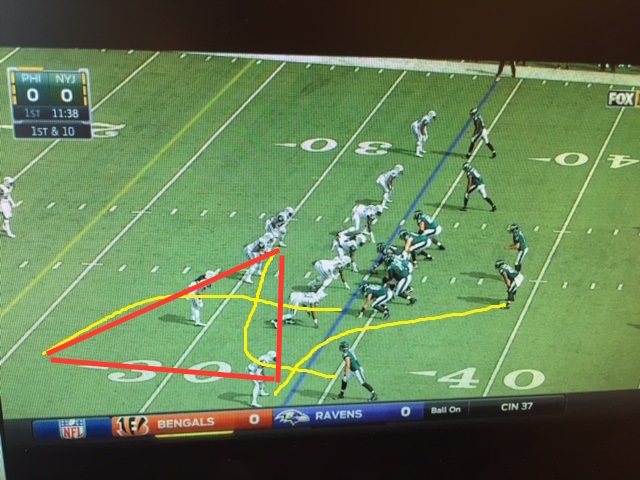
The route concept is called a triangle route because it gives the quarterback three defined reads to make on the play, all of which form the shape of a triangle.
Watch how quickly Bradford — without being under pressure — checks down to Mathews here.
Bradford’s inaccurate throw was made worse by Brent Celek breaking wide open on the corner route. Had he held onto the ball for just a hair second longer, he could have connected with Celek for a huge gain:
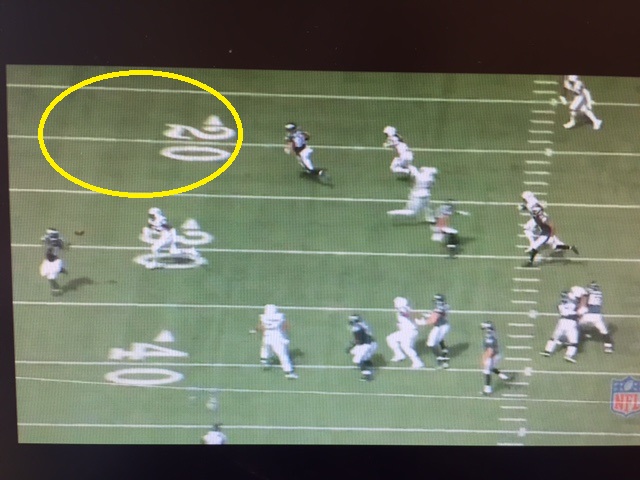
During his time in St. Louis, Bradford averaged a paltry 6.3 ypa. That number has risen this year to 6.91 ypa; an improvement no doubt, but it still ranks 26th of 35 qualifying quarterbacks, according to ESPN.com.
However, over the last three weeks we are seeing Bradford give his receivers more time to get open to make a play downfield. Not all of them have connected, which explains why Bradford’s ypa remains in the pedestrian range of 7.1 over the last three weeks, per PFF.com.
The most obvious example was the deep touchdown pass to Nelson Agholor against the Buffalo Bills:
Watch how Bradford maneuvers in the pocket while keeping his eyes down field. Here is a closer view:
You might have noticed in that clip that most of the underneath routes were open on this play:
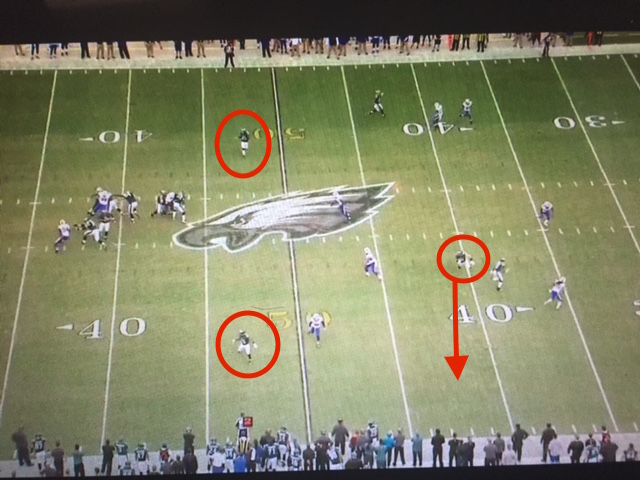
Despite being under pressure and having to navigate the pocket, Bradford did not check down or give up on the play too early, something he likely would have done in the same circumstance earlier this year.
Chip Kelly’s scheme is most effective when he is stretching defenses horizontally and vertically. It prevents defenses from dropping a safety in the box to shutdown the anemic run game and gives the underneath crossing routes more room to breath. Bradford can go a long way towards helping to unclog that congestion by taking even more shots down field.
Manipulating defense
Final good area before touching on a few topics that need to improve. Some of the best quarterbacks in the NFL — Aaron Rodgers, Tom Brady, Drew Brees, to name a few — manipulate defenses with their eyes to create openings in the passing game.
We are starting to see Bradford do the same thing. One of the first times I saw it all year was against the Carolina Panthers, which was around the time that Bradford’s play started to improve overall. Watch as he manipulates All Pro linebacker Luke Kuechly with his eyes to open up the passing lane to Jordan Matthews:
We saw another example with Sam Bradford’s touchdown throw to Zach Ertz against the Cardinals. The Eagles send Cooper, Ertz and Celek on vertical routes, attacking the defenses down the seams. This play puts Cardinals safety Tyrann Mathieu in a bind: he has to choose whether to provide help on Celek or Ertz.
Bradford focuses on Celek which forces Mathieu to provide help over the top, but Bradford quickly pivots and delivers a strike to Ertz for the touchdown
Here is a close up so you can see how Bradford uses his eyes:
These are one of the traits that separate the mediocre quarterbacks from the very good and great ones. While I am obviously not comfortable putting Bradford in the very good category yet, it is an encouraging sign to see him making these types of plays on a more consistent basis.
Chemistry Still a Concern
It’s not all roses and fairy tales, however. While no quarterback is perfect, Bradford is still struggling checking the ball down too frequently, has made some really poor throws, and he still has a penchant for sailing a pass or two:
But the area that I expected to see more improvement from is the chemistry with his receivers. It’s a weekly occurrence for Bradford to throw to one spot while his receiver is running in another direction.
The biggest culprit is with Darren Sproles, as we saw twice during the loss to the Cardinals:
Sproles sat on the route while Bradford thought he was going to continue running across the formation.
Bradford and Sproles again weren’t on the same page when the Eagles were trying to mount a comeback in the 4th quarter. The miscue provided the final nail in the Eagles coffin:
These types of miscues were understandable — and even expected — earlier in the season. But they are becoming much harder to defend 15 weeks in. While Bradford will undoubtedly benefit from a full offseason to learn this offense — especially if it does not involve rehab — you would expect some of these chemistry issues to be ironed out midseason.
Conclusion
In a league starved for quarterbacks, we should be encouraged by Bradford’s improvement over the last half of the season. That is especially true for the last three weeks, where we have seen Bradford make significant strides in areas that he has struggled consistently with his entire career: delivering accurate throws under pressure, and giving his receivers a chance to make a play down the field. And while I am not on board with locking Bradford up long term — not yet, at least — these last two games could go a long way towards answering that question.
 Eagles Rewind