Note: This is a two-part evaluation of Carson Wentz. You can read part one here, which compares Wentz’s production to top rookie quarterbacks drafted since 2009. In part two, I break down the film on areas in which Wentz can improve.
Patrick Causey, Follow him on Twitter @pcausey3
It’s pretty clear that Wentz is playing at a high level for a rookie quarterback. There are only a small handful of rookie quarterbacks in recent history that have matched Carson Wentz’s production. And as I’ve documented before, Wentz’s tape is equally impressive; from his precise ball placement, to his demonstrated ability to perform the advanced aspects of quarterbacking, like adjusting plays at the line, working through his progressions, and manipulating defenders with his eyes. I don’t want to rehash all of that, so for brevity’s sake, you can review my thoughts here:
- A preseason evaluation of Wentz;
- Showing that Wentz can throw deep and work through his progressions;
- Responding to Cian Fahey’s off-based criticisms of Wentz; and
- Advocating for Pederson to take the training wheels off Wentz
I instead want to dig into some areas in which Wentz can improve his game, most notably (1) throwing under pressure, (2) deep passing, and (3) red zone decision making and accuracy. I’m also going to touch on his wide receiver play, because it is clearly impacting his production to date.
Handling Pressure
Because PFF no longer provides the public with access to its advanced statistics (if anyone is aware of another site that tracks pressure, please let me know), I have to get creative in order to evaluate Wentz’s performance under pressure. An imperfect way to evaluate this is to look at the number of times Wentz has been hit or sacked. Of course, pressure can occur without a QB hit or sack, but we will have to make do for now.
| Weeks | QB Hits Per | QB Sacks Per | INTs |
| 1-4 | 4.5 | 1.75 | 1 |
| 5-9 | 6.2 | 2.4 | 4 |
As you probably guessed by now, week 5 was the first game that Lane Johnson missed due to suspension. Big V’s play has undoubtedly improved since his first start, but the offensive line simply is not as good with Johnson on the sideline.
Wentz had issues sailing passes in college, especially when he was under pressure. That issue went largely unnoticed in the first quarter of this season, but has, perhaps not coincidentally, reared its ugly head after Johnson was suspended.
A prime example of this was the first interception Wentz threw against the New York Giants. Kelce tripped over backup guard Stefan Wisneiwski, allowing his man to collapse the pocket on Wentz. Wentz didn’t react well to the pressure; he did a half-ass scramble to the right and threw off his back foot after after Big V lost engagement on his man. Sloppy mechanics led to sloppy accuracy, and the pass sailed on Wentz and was intercepted with ease.

Wentz needs to be smarter here. He could have stood tall in pocket and delivered an accurate pass, as Pederson recognized after the game: “I felt like he didn’t have to move. He could have stayed right there in the pocket and delivered the football.” And while Wentz could not technically throw the ball away since he was inside the pocket and subject to intentional grounding rules, he could have essentially accomplished this by spiking the ball in Agholor’s direction.
On the following drive, Wentz tried to step up in the pocket to avoid pressure. The below clip stops right as Wentz is about to release the ball so you can see how close he is sandwiched between Brooks and Kelce.
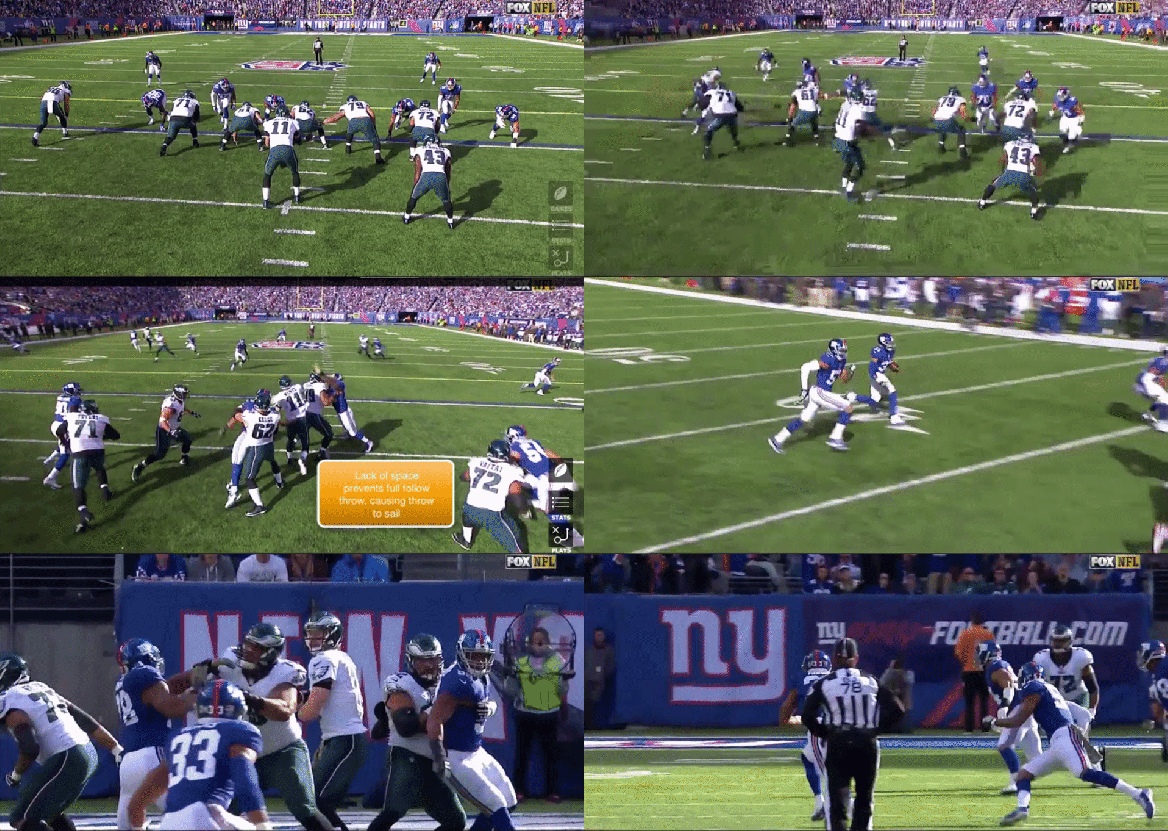
Pederson thought Wentz had enough space to deliver the football: “The pocket was clean enough to deliver the football…but that quick pressure, from a quarterback standpoint, makes you throw a bit high.” It’s hard to tell from this angle just how much space Wentz had to operate. But regardless, you can see that Wentz stops short on his follow through, which caused the pass to sail.
Almost every quarterback struggles throwing under pressure. It’s why you hear defensive coordinators talk about pressure being more important than sacks. So we should not be overly concerned here. But it is an area that Wentz can and should improve moving forward.
Improving Mechanics/Timing on Deep Ball
Wentz has excelled at throwing the deep ball at times, but like most rookie quarterbacks, his deep passing is inconsistent. On the season, Wentz has completed 33.3% of his passes over 21 yards in length, with 2 touchdowns and 2 interceptions, according to ESPN.com.
The issue I’ve noticed comes down to mechanics and timing. When Wentz has a clean pocket, he is usually mechanically sound and delivers a beautiful deep ball. But if Wentz is under pressure or his mechanics are off, his deep passing suffers.
I want to highlight two examples. The first comes against the Chicago Bears on Monday Night Football. The Eagles dial up a play action pass with the hopes of hitting Nelson Agholor on a deep go route. It’s a routine 7 step drop, but as you will see, Wentz takes 10 steps, which throws off the timing of the play:

This might seem like nitpicking, but NFL passing attacks are predicated on timing. As Ron Jaworski once pointed out, each route is synced to a quarterbacks drop down to the millisecond: “You’re throwing a skinny post, and you have 2.1 seconds on a five-step drop, and the weight is on the back foot and, bang, the hips open, and boom, the ball is right there when the receiver makes his break at 19 yards. You drop back 100 times, you have to do that 100 times properly. Not 50 or 75. The mechanics have to be perfect every single time. Weight on back foot, snap the hips open, drive, consistent throwing slot.”
In other words, those three extra steps made the difference between hitting Agholor in stride for a touchdown and Agholor having to stop and come back to fight for the ball.
Against the Browns, the Eagles ran a similar play, but with Jordan Matthews running the go route. Wentz comes out of play action with his back to the defense, which is something quarterbacks are taught not to do because it limits the amount of time that a quarterback has to examine the defense:

You can see the impact it has on the accuracy of the throw, which was about 7 yards too deep and too far towards the sideline. Matthews had no chance on the ball, and this stemmed from Wentz’s sloppy mechanics coming out of the snap.
The good news is that these lapses in mechanics are common for rookie quarterbacks. Wentz has shown the ability to be mechanically sound, so Pederson & Co. do not need to completely revamp his mechanics. Wentz should be able to iron these issues out over the next few seasons.
Improving Redzone Decision Making and Accuracy
First the good news: Wentz has zero turnovers inside the redzone. The absolute worst thing that you can do as a quarterback is take away points from your team. Wentz has avoided that altogether, and for that, he deserves credit.
Now for the bad news: the Eagles rank 25th in red-zone efficiency on the season, scoring touchdowns on only 47.22% of their drives, according to SportingCharts.com. There are a number of reasons behind this. Pederson’s play calling has, at times, been too conservative for my liking. Receivers have dropped easy touchdown catches. And, Wentz has had a couple of plays that he would probably like back.
Jimmy Kempski did a good job breaking down one play I wanted to highlight: Wentz’s misfire to Jordan Matthews on the last play of the Giants game. I won’t rehash Kempski’s analysis. He’s spot on. So go check it out.
Another play happened this past week against the Falcons. The Eagles are are faced with a 3rd and 10 in the 4th quarter. The Falcons are showing press man coverage with a single high safety. The Eagles run man beaters on the bottom of the screen: DGB runs a quick slant while Agholor runs a corner route towards the flag.

The play works as designed. DGB gets inside leverage on his defender and has plenty of green field ahead of him to get the first down (and possibly a touchdown). But Wentz misses him. It looks like Wentz had predetermined that he was targeting Agholor, because he never looks DGB’s way. This isn’t the wrong decision, per se, since Agholor has a half step on his defender. But Wentz sails the throw, putting it high and further up the field, a spot where Agholor doesn’t have a chance to make a play.
By now, you should have noticed a common theme among the issues I’ve covered: they require minor tweaks, not wholesale changes to Wentz’s game. That is a great sign for Wentz’s potential moving forward. Wentz should be able to fix these issues in the coming offseasons, which will only make him a more complete quarterback.
Poor Wide Receiver Play
We cannot fully evaluate Wentz without examining the shortcomings of the players that surround him. That is most notable with his receivers, who are arguably the worst receiving unit in the league. To be more direct, outside of Jordan Matthews, the Eagles wide receivers stink.
I was hopeful that Dorial Green-Beckham might evolve into a functional wide receiver, but he has completely fallen to the wayside over the last two weeks. Meanwhile, Nelson Agholor has never eclipsed 65 yards in a single game in his career. We are probably past the point at which we can reasonable expect Agholor to turn it around.
The Eagles receivers aren’t even making routine catches anymore, and it’s created significant issues for the Eagles offense. Kempski created this video of all of the 24 drops by the Eagles receivers. I’m just going to warn you that this is depressing and infuriating all at once.
Based on Kempski’s calculations, 22% of Wentz’s incomplete passes were the result of dropped passes. If those passes were caught, Wentz’s completion percentage would rise from 65% to 72.6%.
What’s worse, I counted four passes that were dropped in the end zone. Add those four touchdown passes to Wentz’s total, and his TD% rises from 2.9% to 4.18%. Wentz would rank 6th in TD% of the 19 rookie quarterbacks I examined (as opposed to 13th) if those passes were caught.
Of course, every quarterback deals with dropped passes, so it’s unreasonable to give Wentz full credit for those stats. But, Wentz still ranks 5th in the NFL in passes dropped and the 5.14% drop rate is 4th overall. Compare that to Dak Prescott, who has only 4 dropped passes on the entire season, and it’s not hard to see how Wentz is being held back by his teammates poor play.
Bottom line
While Wentz’s play has regressed over the last five weeks, he is still playing at a high level from a historical perspective. The areas in which Wentz can improve his game generally involve minor tweaks, not wholesale changes. And we should expect to see even better production from Wentz once the front office is able to improve the talent at his disposal.
 Eagles Rewind