Fumbles and Luck

There’s a lot of disagreement about how much of a role luck plays in turnovers, and fumbles in particular.  I’ve addressed this in more detail before (search fumbles for the posts), but today I just want to throw out some quick data to give a better illustration of the overall points I’ve been trying to make.

First, we can mostly agree that fumble recovery % is luck-dependent.  Not all fumbles are created equal, and where they happen can effect which team recovers.  However, I think it’s fair to say that, in general, teams should recover around 50%.

Last year the Eagles recovered 35% (according to Teamrankings).  Buffalo was worst in the league at 30.6%.  Washington led the league at 67.39%.

I previously looked at the persistence of fumble recovery rate and, as expected, found no meaningful correlation.  While that’s not enough to prove recovery rates are entirely luck, it is enough to show that the Eagles are very likely to improve on that measure next year.

Fumble Differential

We’ve talked about TO Differential, but now I’ll look at pure fumble differential (gained-lost).

– The 2012 Eagles’ fumble differential was -17, or 2nd worst in the last 10 years.  Obviously, the NFL average is 0.

– There is no evidence of persistence in fumble differential.  That means, despite how bad the Eagles were with fumbles last year (-17), that has no predictive power for what that measure will be next year.

– Something to remember here is that the differential also includes fumbles forced and recovered.  The Eagles gained just 5 last year.  The NFL average is 11 over the past 10 years.  The lowest over that time was 3, not far off from the Eagles’ 5.

So let’s back away from the luck aspect for the moment (that takes a lot longer to address, particularly regarding “fumble-prone” players).  What I’m basically say is this:

– The Eagles are very likely to fumble less next year.

– The Eagles are very likely to force more fumbles next year.

– The Eagles are also likely to recover a greater % of all fumbles next year.

Regardless of where you stand on luck vs. skill, I’d be surprised if many people disagreed with any of those three statements after looking at the data.

Put those together and the Eagles are very likely to have a significantly improved fumble differential, which obviously means the team is likely to have an improved overall TO differential.

Note: Nothing is guaranteed here, we are just talking about probability.  Just because the team was unlucky last year doesn’t mean it can’t ALSO be unlucky next year.  That’s possible.

The key here is that there appears to be extremely LITTLE room for the team to get worse (because of how bad they were), hence they will likely get better.

There’s also the issue of interceptions, which I haven’t really addressed.

I’ll try to tackle interceptions sometime soon, but I wanted to be very clear about the overall ideas here.  Even if you believe fumbles are not inherently luck-dependent, the Eagles are still very likely to improve next year.

I want to make sure we’re not losing the forest for the trees here.  I’ll tackle the luck vs. skill issue in more detail later and provide further evidence for why I believe fumbles are heavily luck-dependant.

BTW, this post is the result of a very thoughtful email from someone who raised a few issues with my previous post.  As I’ve said before, I make no representations for being perfect, so critiques are both welcome and necessary.  Please email me at  eaglesrewind@gmail.com if you have any issues with posts I put up.  I’d rather have the chance to fix mistakes or explain assertions than have individual monuments to my stupidity preserved for posterity.

Leftover thoughts from yesterday

Relatively short post today, but I wanted to get a few things out there:

– I’ve settled on a methodology for incorporating positional evaluative error (in the draft) into the PVM prospect rankings.  However, it’ll require me to reclassify close to 1000 player’s positions by hand (Pro-Football-Reference includes a lot of “DB” labels).  Obviously that’s going to take a little while.  However, I promise I haven’t forgotten about it.

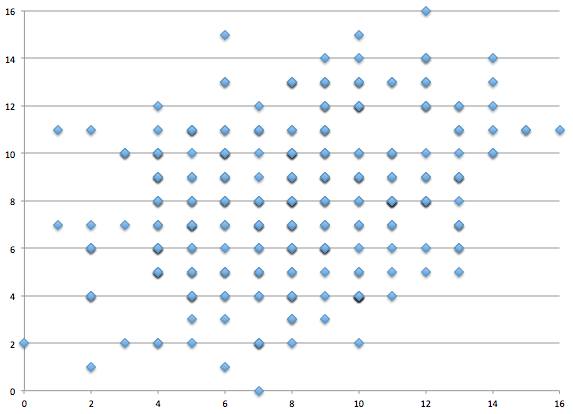
– A valued contributor (see PVM) commented yesterday about the Eagles having a lot of red zone turnovers last year and how that effected the points allowed.  The idea is that a turnover in the red zone, while killing the offense, is essentially a great punt for the defense.  Unfortunately I couldn’t find any source that tells me how many turnovers were committed in the Red Zone last year.  In any case, here’s a chart of TO Margin vs Points Allowed:

Screen Shot 2013-03-28 at 12.02.54 PM


Lot’s of potential external distortions in this comparison, so we can’t draw much from it, but it is interesting nonetheless (and everyone loves charts).  The correlation value is -.50, so pretty significant.

As you can see, the 2012 Eagles are way outside the normal range.  Going back to the original question:  Yes, it appears as though, given the TO differential, the Eagles should have been expected to yield MANY more points.  It’s possible this is the result of where those turnovers happened (i.e. in the red zone).  However, there are a lot of other factors potentially at work here.

It may be that there’s an actual limit to how many points one team can allow (if for no other reason than a finite game time), so that the marginal increase in points allowed per additional turnover decreases to zero.

I realize that’s a bit theoretical for a football blog, so you’re excused if your eyes glazed over reading it.  Overall, my general take is that the location of turnovers is probably a real, but small, factor in the larger points allowed puzzle.

Let’s do some fun stats:

– The 2012 Eagles forced and recovered just 5 fumbles.  That is the eighth WORST in the last ten years (out of 320).

– The NFL average within the sample is 11.

– Fumbles are determined almost entirely by luck.

– The Eagles threw 15 interceptions last year.  The NFL average over the past 10 years? 15.76.

– The 2011 Eagles threw 25 interceptions, so last year was improvement by 10.

– From 1999-2011, the Detroit Lions made 17 1st round picks.  Of those 17 players, just 3 have made a Pro Bowl, one of which was Roy Williams (WR).  That’s 17.6%.

– Of all 1st rounders picked over that timeframe (412 players), 34% made at least 1 Pro Bowl.

– The Lions have been almost impossibly bad at drafting.

– For reference, the Eagles made 11 1st round picks over that timeframe, with 4 making a Pro Bowl, good for 36.4% (better than league average, though that includes the Lions).  However, the most recent one for the Eagles was drafted back in 2004. (sad face)

– Quick trivia: name those 4 Pro Bowlers. Answer below in initials form (hopefully so a glance won’t ruin the question for you.


– Answer: Their initials are LS CS SA DM.

– Eric Winston, to my knowledge, is still a free agent.  Hopefully he and his agent blink soon.


Turnovers and the Eagles potential for 2013 Success

NOTE: After today’s post (and recent analyses), I believe it’s time to change the Blog subtitle.  Hard to believe, but I think I’m now the most positive Eagles blogger I know of. Thank god for data and objectivity.

Today let’s go back to the turnover issue.  As most of you know, the Eagles were terrible last year when it came to “taking care of the ball”.  The team had a turnover differential of -24, which is tied for LAST place over the previous 10 seasons.

I repeat, LAST over the previous 10 seasons. (The Chiefs of last year were equally bad).

With that comes the previous analysis I did showing the correlation between TO Differential and Wins.  The value is a very significant .64.  So turnover differential is really important and the Eagles were historically bad last year by that measure, hence a 4 win season.

Now let’s take it one step further and see if we can learn anything about what might happen THIS year.

I did a similar analysis, but this time focused on the CHANGE in both turnovers and WINS from one year to the next.  Given the .64 value above, teams making improvements to TO differential year-over-year should see a corresponding improvement in Wins (or losses is TO differential gets worse.)

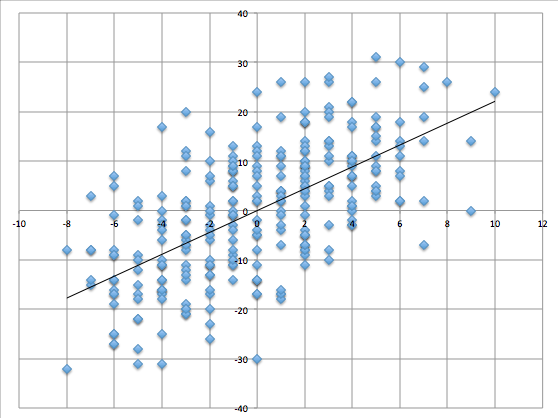
Here’s the chart, with Win Change on the X and TO Differential change on the Y:Screen Shot 2013-03-27 at 12.29.03 PM

The correlation value is .63, about what we would expect given the first order Wins/TO Differential correlation value.

The chart is a little tough to read, so let me make it simple with an example:  Let’s say your team’s TO Differential FELL by 10 this coming season.  To find the corresponding win change, find -10 along the Y axis and then move left or right until you hit the line.  Here, a decline in TO differential of 10 equates to an approximate 4 win decline.  HOWEVER, notice the spread is relatively large; this means we need to recognize that our level of precision (confidence) here isn’t very big.

So what does this mean?

Well let’s go back to the 2012 Eagles.  The team’s TO Differential was -24.  As I’ve discussed before, this was heavily influenced by incredibly bad luck with fumbles (in both their existence and the team’s recovery rate.)  I expect both measures to improve dramatically next season,  purely because last year’s were so unlikely.

Let’s say the Eagles move from the 99% in TO differential (negative perspective) to just the 90% (Using the last 320 team seasons/10 league years as data).  That equates to a TO differential of -13.  That’s still really bad (hence the 90%), so we’re not really doing the Eagles any favors here.

However, because last year’s measure was so bad, moving to -13 is still an IMPROVEMENT of 11 turnovers.

Here’s where it gets fun.  Going back to our chart, an improvement of 11 in TO differential equates to an approximate gain of 5 wins.

Presto chango, 4-12 last year just became 9-7 next year.  

Unfortunately, there’s that pesky little precision problem, which means a 5 win gain is far from certain.  However, the overall point remains: by just being BAD instead of HORRIBLE when it comes to TOs, the Eagles can achieve a much better record.

It must be noted though, that the Eagles achieving 4 wins last year with a -24 TO differential is a minor miracle in itself.  The team’s “overperformance” last year means there’s probably a little less room for adding wins due purely to positive mean regression next year.

Now let’s get really crazy (prepare your happy face):

Over the last 9 seasons (not including this past year since we don’t have subsequent season data), 17 teams registered a TO Differential of -15 or worse.

The average change in TO differential the following season?

+18.4

Conclusion:

a) The Eagles are likely to improve their TO performance substantially next year.

b) Positive improvements in TO differential are STRONGLY correlated with positive Win changes.

A + B = The Eagles have a significant chance (nothing is certain) to be A LOT better than you think next year.

Special Teams Importance and Improvement

Surprise news from the Eagles yesterday: the team signed a punter (Jones) and cut McBriar.  For most casual fans, this move probably doesn’t register as anything other than replacing one guy most people don’t know with another.

However, it has the potential to make a big impact, and put in context with the other moves the team has made, shows a clear recognition of one of the team’s biggest weaknesses last year:  special teams.

Though it flies beneath the radar of most casual fans, special teams is indeed important, and the Eagles were terrible in this area last season.

Let’s look at some stats:

– The Eagles ranked 28th in the league in Net Yards per Successful Punt last year with 37.3.

– The 49ers and Saints were tied for 1st overall with 43.2, meaning these teams, on average, gained SIX more yards per punt than the Eagles did.  While most of the league didn’t perform nearly as well, this is an indication of just how big a role the punting game can play (6 yards per punt difference is HUGE in case anyone didn’t realize that).

– According to Football Outsiders, the Eagles ranked 24th in the league last year in overall special teams.  Only 2 teams ranked in the bottom third of the league made the playoffs (Redskins and Texans).

– According to Football Outsiders, the Eagles ranked LAST in the league in punting last year.

– The Eagles were also UNLUCKY, with the fourth largest special teams disadvantage due to factors outside the team’s control (opposing field goals, kickoff distance, punt distance).

So what?

Looking at the above stats gives us an appreciation for how weak the ST unit was last year.  That last stat is interesting because it fits what I’ve been saying/showing for a long time:

The 2012 Eagles were a mediocre team with VERY bad luck.

While the offense and defense are more important, it’s nice to see Roseman and Kelly taking improvements everywhere they can find them.  There is no guarantee that Donnie Jones will be any better than McBriar was or that the coverage will be any better either.  However, it’s likely that both areas will improve, due to the low bar set by last year’s team.

The upshot is field position.  I’ve covered this before, but the Eagles ranked last, by a long shot, in relative field position last year (-6.67 yards).  Improvements to special teams will help this measure.  Consequently, the offense will have fewer yards to travel to get in scoring range and the defense will have more yards behind them.

Field position is an aspect of the game that is tough to focus on in real-time.  6.67 yards does not sound like much, but remember that is an AVERAGE PER DRIVE.  Last year, every Eagles offensive drive started, on average, almost 7 yards farther from the end zone then the opponent’s corresponding drive.

While everyone is focusing on the defensive scheme and roster changes while getting excited about the offense, arguably the easiest area for improvement is special teams.

The signings of Jones, Benn, Chung, Phillips, etc… will go a long way in that area.  I don’t expect fans to get excited over things like kick coverage and net punting average, but improvements here will show up in the box score by making it easier for the Eagles to score and harder for opponents to do the same.


Parity in the NFL…Why you shouldn’t sleep on the Eagles next year

Let’s step away from the draft and free agency for a moment, since we’ve reached a lull in the action there.  Instead, let’s talk about expectations in general, specifically how team performance this past season should factor into our predictions for next year.

I’ve noticed quite a few people are “down” on the Eagles for this coming season.  Nevermind that the draft has yet to happen and free agency is not yet finalized; generally people do not believe the Eagles can be a playoff team next year.  This shouldn’t come as news to anyone, but the real question is why?

I believe the answer is composed of two related parts: A) anchoring, and B) misunderstanding of the overall NFL competitive landscape.

Anchoring

Anchoring is a fairly common problem than many people don’t fully appreciate.  It’s a specific type of cognitive bias that results in poor evaluations/predictions from almost all of us.  Basically, it’s relying too heavily on the first piece of evidence.  A common example is any game that involves guessing how many pieces of something are in a jar (candy usually).  If the guesses are public, then the overall range of guesses will usually center around the first person’s guess.  Despite the fact that everyone is looking at the same jar (has the same info), the initial guess, by virtue of being first, tends to “anchor” all subsequent guesses, regardless of its accuracy.

While football records are obviously a bit different, I submit that the most recent season’s record fulfills a similar function as the first guess in the example above.  Jumping to the Eagles: last season the team won just 4 games.  Consequently, predictions for next season  are all made in reference to that number (which is why predicting the playoffs for the Eagles next year isn’t common).

Despite the fact that last year’s team roster/scheme/coaching staff/etc… bears little resemblance to the one the Eagles will play next season with, the record remains a major factor.

So the obvious question for us is: how useful is last season’s record in predicting this coming season’s?

Taking the last ten seasons for each team, I plotted season records against the same team’s record from the following year.  Here’s the chart:Screen Shot 2013-03-25 at 12.09.17 PM


There definitely appears to be correlation (as we’d expect), but the value is just .30 (weak/moderate).  Additionally, I’d argue that within this sample are two teams that have an inordinately large impact on the overall correlation values by virtue of their remarkable consistency (the Patriots and Colts obviously).  While I’m usually hesitant to play with the sample, in this case I think it’s worth looking at the results without these teams.  In essence, due mainly to the Brady/Manning effect, I think they are anomalous and a poor representation of the usual state of the league.  More specifically, I think they are useless when it comes to drawing conclusions about the Eagles this year.

When we remove them, the correlation value drops to .22.  Still real but fairly weak.

So far, we’ve got reasonable evidence that the Eagles record this year doesn’t mean much when it comes to next year’s performance.  I’d actually argue that it has almost NO SIGNIFICANCE, due to the overall weak correlation combined with the dramatic makeover the team has undergone.

Average Change

We can also look at the average change in record from year to year.  Using the same sample, I found the absolute value of the difference in wins from one season to the next.

The verdict?  On average, NFL team’s # of wins change by 3.07.  With just 16 games in a season, a 3 win difference in either direction is BIG.  Also, that’s AVERAGE, which means there were a LOT of changes greater than 3.

In fact, the median value was 3, which means half of the season-to-season changes were GREATER than 3 wins/losses.

Upshot

This obviously has large implications for the Eagles, and more specifically Eagles fans.  A change of 4 wins (slightly above average) puts the Eagles in playoff contention (or a winless season).

To be clear: All fans are free to COMPLETELY IGNORE last season’s record, for it is a very weak indicator for how the team will perform this coming year.

At the moment, I’m fairly bullish on the Eagles chances for next year, though there is still a long way to go.  In any case, the fact that the team sucked last year really doesn’t matter, so by all means, forget it ever happened.

P.S. you’re welcome.

1st Round Breakdown

A couple of people asked for a more detailed breakdown of the 1st round, so we’ll do that today.  First, however, I need to apologize for a fairly large mistake.  As I was putting together today’s data, I noticed a mistake in the Strategy Chart I posted yesterday (and have posted before).  The upshot?

– 1st round LBs are much more successful than I had listed them.

Obviously this affects the Dion Jordan comments yesterday and will affect my draft analysis going forwards.  Sorry for the misinformation, just a typo in excel that I missed.  Thankfully I caught it before we start incorporating the data into the PVM rankings.

Now back to the subject:

If you haven’t seen the post showing the top 15 breakdown, please read that here:

Top 15 Breakdown

That post illustrates pretty clearly that there isn’t nearly as big a difference between, say the #5 pick and the #12 pick, as some people believe.  However, there is a big drop-off after #15.  In general, the real “first round” is picks 1-15.  Hence my point about the advantages of trading down from #4 but remaining in the top 15.  There is some positional loss from trading down (no QBs in general), but overall it appears to be a good strategy.

For those wondering, I also did a positional breakdown post for the Top 15 picks here.  That’s also a must-read for anyone interested in the draft, as it gets to the “prospect tiers” aspect of strategy.  Please note that both of those use a slightly different time-frame than we will use today.

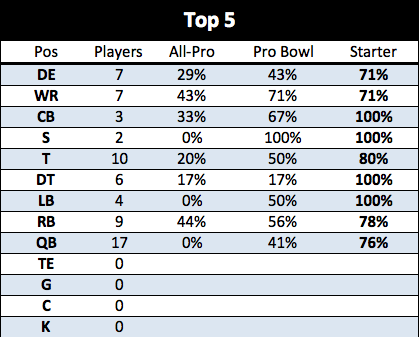
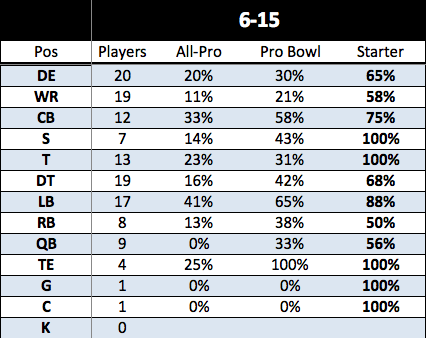
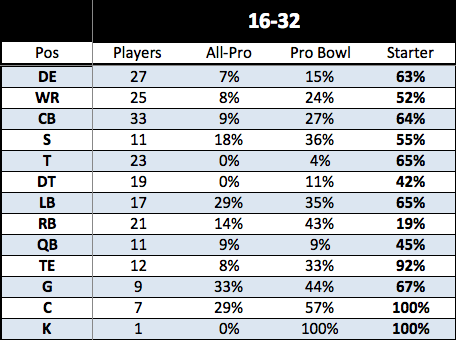
Now let’s look at success rates for the first round.  Here is the complete chart, with the first round broken into three segments.  Following is each segment by itself to make it easier to read.  The data does not include this past season, so pro bowlers/all-pros from this past year are not included.

Screen Shot 2013-03-20 at 11.54.05 AM

Screen Shot 2013-03-20 at 11.55.33 AM

Screen Shot 2013-03-20 at 11.56.58 AM

Screen Shot 2013-03-20 at 11.57.25 AM

Before we start analyzing, I want to warn everyone about the danger of small sample sizes.  The reason I haven’t typically broken the draft into such small sections (1-5) is that when you do that and combine it with a positional breakdown, the samples get way too small to draw any conclusions from.  For example, there have been just 2 safeties drafted in the top 5, Sean Taylor and Eric Berry.  Both were/are very good players and each made the Pro Bowl.  However, it’d be wrong to suggest that the odds of a top 5 safety making the pro bowl are 100%.  In light of that, try view this data in a proper context.

Now the takeaways-

– Notice that the odds of getting an All-Pro caliber player fall significantly after the top 15.

– QBs, as we’ve discussed, are very risky throughout the first round, but especially so in the second half of it.  Just 45% of QBs drafted between 16-32 became “starters”.   Just one of the 11 became a Pro Bowler (Aaron Rodgers).

– The charts certainly support the point I made earlier: The “first round” of the draft should really be viewed as just the top 15 picks.  Odds of success fall dramatically after that, so it’s unreasonable to hold all 1st round selections to the same standard.

– Obviously positional distribution is a major factor here.  Since the best QBs are typically taken high in the first round, we can assume that those selected towards the end of the round are lesser prospects.  Compare that to positions like G or TE, which are not typically taken high.  As a result, it makes sense that those positions would carry greater odds of success towards the end of the first round.

– In all, this highlights the importance of BPA discipline.  Just because you need a QB doesn’t mean you should take the best one available.  As we can see above, taking the best prospect, regardless of position, is a much better strategy.  Note I still believe in adjusting for positional value, but BPA with that adjustment remains, by far, the best draft strategy.

– RBs are really terrible value picks and should be taken in the 1st round much less often.

– Regarding the Eagles, the data shows that, regardless of which position the team selects, it has good odds of getting an elite player.  With several “needs”, the Eagles main focus should be on minimizing risk.  Blowing the #4 pick because you picked “potential” over “performance” or were focused on one position would be a HUGE missed opportunity.  I’m not directing that comment at any prospect in particular, just trying to emphasize how important it is for the Eagles to maintain BPA discipline.

Sorry again for the bad LB data. I’ll be updating the full chart and reposting next week.

I’m on the road the rest of this week, so NO POSTS TILL MONDAY.  I may be able to respond to comments, but full posts will not be possible.

Thanks for reading.  I appreciate all the feedback and hope you continue to find this blog interesting.


Draft Strategy Chart

Today let’s take another look at our draft strategy chart, this time using it to talk about a few prospects.  Some of you have seen this, newer readers have not.  I apologize if its tough to see without zooming in, but I like to get a comprehensive look with this chart.  Note that the 6th and 7th round columns were included in yesterday’s post.  The sample is all players drafted from 1999-2011.Screen Shot 2013-03-19 at 3.12.35 PM

The different color backgrounds reflect my quick attempts to eliminate sub-optimal round/position choices (in black).

Between now and the draft, I am hoping to mine this in a little more detail and ultimately combine it with the PVM system.  However, for today, let’s talk about specific players.

First, a note on value.  Obviously applying this chart to individual players is a misuse of the data.  There is no guarantee that the sample is representative, and there are potentially a lot of other factors at work.  In general, I believe the value of this type of data is to give us a sense of which positions are easier/harder to evaluate.  For example, LBs seem to have a much larger margin of evaluative error than OTs.  Therefore, a LB with similar ratings to an OT will carry more inherent risk by virtue of the fact that, historically, LB projections are less accurate.

Hopefully that made sense.  We’ll be revisiting this a lot in the next few weeks.  Now let’s get to the players.

Dion Jordan – He immediately pops out because A) he’s been frequently “mocked” to the Eagles, and B) plays a position that carries the worst 1st round hit rate.  This doesn’t mean Jordan won’t be a good player, only that LBs are very hard to project coming out of college.  This is a major reason why I do not like him for the #4 pick.  Added risk, no additional reward.  With a lot of similarly rated prospects, no reason to take on any additional risk.  Also, notice that the odds of finding a starting LB in the second round are almost as good as in the first round.

Star Lotulelei – I’ve been a big proponent of Star for as long as this blog has been up (I may have actually been the first one to peg him to the Eagles).  I still believe he is among the best potential picks for the Eagles.  He’s a run stopper and a natural pivot on the d-line, able to hold his ground against a double-team, allowing the LBs  to fly to the ball.  Heart condition notwithstanding, Star would immediately become the Eagles 5-tech and could play NT as well if Spooky doesn’t perform.  However, the chart above is a bit of a red flag.  DTs carry some of the lowest “elite player” odds (all-pro, pro bowl) as well as relatively low starter odds.  Additionally, the odds of finding a starting DT in the second round are good.

Once I figure out how to factor this in to the PVM model, I expect to see Star move down the board a couple of spots.  For now though, he remains a personal favorite.  In a perfect world, the Eagles would trade down to #7 or #8 and pick him up there.

Joeckel/Fisher – The Eric Fisher train has picked up a bit of speed recently, especially with the Eagles sitting out the OT FA market (for the moment).  I’m not a huge Fisher fan, but the odds clearly submit him as a “low-risk” pick.  It is common knowledge at this point that OTs are safer picks in the 1st round than any other position, and the data definitely bears this out (im not counting Cs due to sample size).  HOWEVER, that is an overly simplistic way of looking at it.  You also have to account for the fact that OT is one of the EASIEST positions in which to find contributors later in the draft.  You won’t get an elite OT after the first round, but notice you still have 25% chance to get one as late as the 4th round (and 13% in the 7th).

Let’s play a quick probability game.  Assume that this data was perfectly representative of the upcoming draft.  The Eagles have four 7th round picks.  If the team were to use all 4 of them on OTs, what would the odds of finding a starter be?

Well the chances of missing, according to our table, are 87%.  The chances of missing with all 4 picks are .87^4, or 57%.  Therefore, the odds of NOT MISSING all of them would be 43%.

A 43% chance isn’t great, but it’s pretty significant, and remember this is in the 7th round.

In the second round, 70% of OTs in our sample ended up as “starters”.

This is a long way of saying that the Eagles resources, according to the current prospect rankings and team needs, are probably better spent elsewhere than on an OT in the 1st round.

Dee Milliner – Another guy who has picked up steam (the 40 time helped a lot).  He could go as high as #1, though I think that’s unlikely.  I like him because he is ranked #1 by PVM, though we’ll have to wait and see if he holds onto that position as ratings are updated.  The major pushback on him is that he doesn’t rate as a “shutdown” corner.  Obviously, if you are using the #4 pick on a CB, you want him to be an “island” sort of player.  However, this is a pretty ridiculous read of the situation.  Essentially, draftniks are comparing Milliner to CBs in OTHER drafts.  Obviously there have been better CB prospects.  The fact remains, though, that in THIS draft, Milliner is by far the best CB prospect, and is also one of the best prospects PERIOD.

You can chalk this up to bad timing for the Eagles, in that they got a high pick in a relatively weak draft (projected), but at the end of the day you have to play the cards you’re dealt.  The table above says DBs are pretty safe in the first round.  For those asking, CBs and Ss are not separated because the often switch positions coming out of college or in their first few years (or last).  I’m doing some work to fix this, but keep in mind that this is also a potential advantage.  If a CB fails in the NFL, he may be able to switch to Safety and become a productive player.  If a WR or QB fails (or most other positions), there is no outlet  to salvage that prospect.  Consequently, DBs are lower risk.

In case you didn’t realize it, this is a big thumbs UP for Milliner.

Geno Smith – This chart definitely throws the brakes on the Geno hype.  QBs have a very low success rate, even in the first round (relatively).  That would make me wary of drafting a QB with more than a couple small flaws in his game.  I still think Geno goes high (top 5), but I wouldn’t want to be the team that takes him.

The chart illustrates just how hard it is to draft quarterbacks.  Remember that it isn’t a “reach” just because a QB went higher than his rating suggests.  Hitting on a QB offers a MUCH greater reward than hitting on any other position (hence the PVM adjustment).  HOWEVER, with that reward obviously comes greater risk.  For a team like the Eagles, which has a bunch of holes and some existing talent at QB, a high-risk/high-reward play like Geno Smith doesn’t make much sense.


The Benn trade and late round pick philosophy +other thoughts

Aiming to keep it a little shorter today. I’ll start with the Benn trade and then throw some food for thought out there.

Benn Trade (Steal?)

As everyone now knows, the Eagles acquired Arrelious Benn from Tampa Bay over the weekend.  The Eagles, in exchange for Benn, essentially traded down this year from the 6th to 7th round, and also gave up a conditional pick next year (no word on the conditional, but we can probably assume it’ll be no higher than a 5th, and likely lower than that).

Initial thoughts?  The Eagles stole him.  Benn is 6’2″, 220 lbs. and was a 2nd round draft pick in 2010.  Great size, but he never hit his potential and was injured last year, only playing 8 games.  Still just 24 years old.

That sounds pretty good, but don’t get too excited.  He is not being brought in to be an impact receiver.  This is, as I see it, another low-risk-medium reward play for the Eagles, and on targeted solely at improving special teams.

The Eagles were among the worst Special Teams units in the league last year, and as we saw with the field position numbers (Eagles last by a long shot), that had a LARGE effect on both the offense and defense.  Benn showed a lot of promise on STs last year, and I have no doubt that’s where he’ll be asked to make his mark.  He is a good downfield blocker, which Kelly likes, but I believe that’s more of a bonus and isn’t a major factor in why the trade happened.

So why is it a steal?

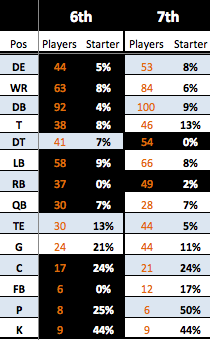
Let’s bring back our draft chart, this time only looking at the 6th and 7th rounds.  To refresh, the chart was put together using every player drafted from 1999-2011.  Players were classified as “starters” if they either started for 5 years or, if they have not been in the league that long, started for at least half the seasons in which they’ve been in the NFL.

Screen Shot 2013-03-18 at 11.27.09 AM

What do we see?  6th round picks, historically, have NOT offered significantly better odds of finding good players than 7th round picks.  Yes, this late in the draft teams are looking for depth, but they are still trying to select the best players possible at the target position.  The numbers above show that, this late in the draft, it’s a complete crapshoot.

In light of this, the Eagles really don’t lose any value by trading from the 6th to the 7th rounds.  Therefore, the Eagles acquired Benn for just a conditional draft pick.  That’s why it’s a steal.  Benn will likely end up being a non-factor, but he’s certainly better than anyone the Eagles would be able to select with whatever conditional pick they end up losing.

Other thoughts:

– I’m very surprised the Eagles haven’t been strongly linked to Sebastian Vollmer, the free agent OT from the Patriots.  I’m assuming the OT market was held up by Jake Long, who signed last night.  If that’s the case we should see the other OTs start to fall into place.  Vollmer would be the best fit.  If the Eagles do not sign a OT, then obviously the odds of drafting an OT go up.  Note this does not mean abandoning the “best available” strategy that Howie is now swearing by.  The team may have looked at Eric Fisher and decided he’s their guy, so no need to sign anyone.

– At this moment, the Eagles’ clear top option for the draft is to trade down with a team trying for Geno Smith.  I discussed this last week.  However, if a trade can’t be made, I think the pick comes down to Fisher (assuming Joeckel is gone), Milliner, or Lotulelei.

Not seeing anyone slotting Lotulelei to the Eagles in mock drafts, but he makes too much sense to me to overlook.  He’s a force in the run-game, which the Eagles need, and will draw consistent doubles, freeing Cox up to wreak havoc.  Also, Lotulelei as a pivot would immediately make Kendricks and Ryans look better, since they wouldn’t have to shed as many blockers to get to the ball.  For reference, Sharrif Floyd seems much more similar to Cox as opposed to complimentary.

Eric Fisher would make sense for the reasons explained above.

Milliner is intriguing because he plays a premier position, is by far the best prospect available at that position, and is the #1 player according to the PVM system.  Note: with the current scouting ratings, his consensus ranking is #3 overall.  The positional value bumps him to #1.

For my money, a defensive backfield with Milliner and Williams does sound a lot better than one featuring Williams and Fletcher and whatever rookie is added in the draft.  I realize there are other CBs on the roster, but they look like slot guys or backups.

I don’t see Dion Jordan being the guy, unless the Oregon ties come into play.  Seems like he’d be a luxury pick that the Eagles can’t afford.  He doesn’t look like the best player on the board and doesn’t fill a pressing need (arguable), therefore he doesn’t seem worth the #4 pick.

Also remember that LBs carry the worst hit-rate of any position in the 1st round.  For whatever reason, there seems to be a much bigger margin of error in scouting/projecting LBs than in most other positions.  Consequently, Jordan would appear to be a higher risk pick as well.

In any case, we should get a better sense of the draft in the next couple weeks, as each team’s needs come into clearer focus.

Time to step back and reflect

After a couple busy days in free agency, it’s time to step back and take stock of where the team is and where it might be going.

First, regardless of where you believe the team’s weaknesses are, the Eagles deserve a very high grade for what they’ve done so far.  As I showed after day one, they’ve hit on most of my “wish list” and there are still plenty of players out there and no reason the team will not sign anyone else.  I do have a few concerns, but I’ll get to those later.

The surface $ numbers surprised me on a couple of the deals (Barwin and Williams), but the reported guaranteed numbers make a lot more sense.  The Eagles haven’t hamstrung themselves with any outrageous deals, which is (or should be) rule #1 for FA.

Now for specifics:

Chip Kelly doesn’t give a fuck about Graham, Cole, Curry, or anyone else on the roster.

After the Barwin signing, a lot of people are worried about how Kelly will fit the DEs into the scheme, which is flawed thinking.  Kelly has no ties to these players.  Right now he is signing any player he believes will be a good fit for his system, as long as they take reasonable contracts.

If at the end of the day that means Cole and Graham are relegated to the bench, so be it. Kelly’s not going to lose sleep over that.

Overall, I think he’ll enter camp with an open competition for just about every position, and go from there.  That was his MO at Oregon, and I see no reason why he’d change his philosophy here.  I’m as excited as anyone about how Graham played last year, but Kelly is not going to alter his plan just to keep a guy like that on the field.

I believe you can summarize the Eagles FA philosophy like this:  Add depth/talent, breed competition, don’t kill your cap, and let the depth chart shake itself out in camp.

Still need another DT: 

The team still needs to add a DT. RJF seemed to be the perfect guy, but the money didn’t make sense.  They could (and likely will) add someone in the draft.  If it were me, even with a rookie addition, I’d want another low-budget veteran that has some experience in a 3-4.

Don’t get too excited about the safeties: 

Patrick Chung and Kenny Phillips, when healthy, would be BIG upgrades over what the Eagles had last year.  Not sure if I have made this point before, but the Eagles Safeties last year were SO bad, that merely getting league average play from them this year would be a huge improvement.

In light of that, the Eagles really didn’t need to do much to start fixing that area of the team. My problem with Chung and Phillips is that they took on risk when they didn’t need to.  I really like the upside of both players, but both are SIGNIFICANT injury risks.  That means there’s a distinct possibility that, at some point in the season, the Eagles will be left with the same starting safeties as last year.

Again, I like both signings; they’re the definition of low-risk/medium-reward as far as the numbers go.  However, I’d have felt better if they had added an average level veteran that they KNEW was going to be available every game, even if he provided just mediocre play.

I’d be shocked if Eagles don’t add a S in the draft (they may do so as high as the 2nd round), so perhaps that’s where the additional player comes in.

In any case, don’t get too excited about the secondary being “fixed”.  Odds are one of the guys they signed (if not more) is going to either get injured or not pan out.  That’s why you have to throw a lot of shit at the wall; not everything’s gonna stick.

For the record, Connor Barwin did have a down year last season.  However, he is just 26 years old, and even off his peak from two years ago is far better than most of the LBs we have.  He also has a LOT of 3-4 experience.  This was a great signing, even if he doesn’t get close to double-digit sacks.

The starting CBs?

This is a similar story.  I like each player the Eagles signed individually, but it’d be silly to pretend there isn’t a lot of risk here.

Cary Williams appears to be the clear leader for #1 CB….I’m not sure he’s that good.  He certainly has the talent, but to date has been inconsistent.  The good news is he plays with a lot of “attitude”, which I sincerely believe was a big factor in the signing.  Kelly/Roseman must have watched tape last year and seen the team roll over.  Williams is not wired that way, he’ll fight (sometimes literally) regardless of the time/score/record.   He’s also very physical and not afraid to tackle, which will be a nice change of pace from what Eagles fans have seen the last few years.

Bradley Fletcher, as I’ve already explained, is a great risk/reward signing.  He’ll compete for the second starting CB job.  If he’s healthy he gets it.

The big thing to remember here is the ceiling we are looking at.  Previously, the Eagles somewhat consistently had, on paper, the best CB pairing in the league (or one of them).  Going back to Vincent/Taylor through Brown/Sheppard (for a time) to Asante/Nnamdi/DRC (remember I said “on paper”).  We are no longer looking for that, so adjust your expectations accordingly.

Even at full health, a Williams/Fletcher combo is not going to be among the best CB tandems in the league (it’s possible but very unlikely).  The Eagles are now looking for reliability, not excellence.  After last year, though, average will look like excellent.

The OL: 

This is the elephant in the Eagles FA room.  Everyone expected the team to address this group, either by adding a starting OT or, at the very least, adding a young player to provide depth.  So far we’ve got….crickets… I’ve got a couple of theories on this.

A) The Eagles have tracked the medical progress of their starters and are convinced all of them will be ready for day 1 of the season.  As a result, no need to pay big money for a starter.  Maybe add a low-priced depth guy after the rest of FA shakes out or draft a couple of players late to compete for back-up spots.

B) The Eagles new regime has watched tape of Danny Watkins and truly believes he can be a viable starter.  This is like adding another starter, so no need to find a big name OT in FA.  Herremans remains on the right side.  Youth and depth will be added in the middle of the draft.

C) The Eagles have already decided that they love Joeckel/Fisher and are set to take him with #4 overall.  Obviously, if they plan on selecting a starting OT in the draft (with the #4 pick), there’s no reason to sign a FA to fill that role.

No idea which theory is accurate (there are certainly others to consider as well).  I hope it’s not C though, and I don’t believe it is.  Which leads me to…

The Draft: 

A lot of people have mentioned that the Eagles moves have “freed” the team to do whatever they want in the draft.  This is a mistake.  The Eagles were free to do what they wanted regardless of who they signed.  Roseman has made it VERY clear that his picks will not be dictated by positional need.  My reading of the situation is that Reid forced the Watkins pick on Howie, and that backfired spectacularly.  Hence, Howie will not choose for need in the first couple rounds.

That is obviously good news for Eagles fans.  Other good news for Eagles fans is the increasing hype for Geno Smith.

Remember folks, I made this point a long time ago.  Smith is very athletic, had a great college career, and completed 70% of his passes last year.  This guy has 1st round written all over him.  Also, PVM has him ranked as the #8 OVERALL prospect.

A while ago I mentioned that the Eagles may be holding the best pick for any team that wants to trade up.  Kansas City isn’t trading its pick.  Oakland and Jax could conceivably each select Geno Smith, but I think the odds of that are low.  Seems too rational for Oakland, and Jacksonville has so many holes that I’m not sure they can afford to give up on Gabbert just yet.  After that, a team like the Cardinals is a prime suspect to get scared and make the jump.

For the record, I do believe there is some legitimate interest in Geno on the Eagles part.  However, I don’t think there’s any way they take him at #4.

I think the most likely scenario is that they make every effort possible to trade down within the top ten, select the BPA (probably an OT or DT) and pick up an extra 2nd round pick.  Then they can use one of those 2nd rounders on defense and the other on whichever QB prospect they secretly like (EJ Manuel?  Nassib if he’s there?).

Regardless, the fact that Geno is now getting serious love increases the value of the Eagles pick.

That’s all for now, I’m at over 1500 words and half the audience (if not more) has probably already left…

Hopefully we’ll have another signing or two to talk about soon.


2013 NFL Draft Prospect Tiers

I’ve talked a lot about the importance of prospect tiers when it comes to the NFL Draft.  However, to my knowledge I have not yet provided any for this year, so I’ll do that today.

The value of this approach is obvious to me and I’ve explained it in detail before.  Quickly: Teams have to recognize that there is a significant margin of error in any individual player evaluation.  Therefore, saying Player A is a 99 and Player B is a 98, so I should take Player A is complete foolishness.  Nobody’s evaluations are accurate enough to allow for that much precision.  Again, refer back to your fantasy draft strategies. I’m confident most of you use some form of a tiered approach.  Each team can (and should) have their own tiers according to their evaluations and positional values, but the overall concept remains.

Now let’s look at the players.

First, glad to see Todd McShay has bought in.  Here are his top tiers, which can be found at ESPN (you might need Insider to see the whole article).  Overall, his take is that if you remove Andrew Luck and RG3, this year’s talent level is no worse than last year, despite what most are saying.

Screen Shot 2013-03-14 at 11.59.41 AM

Screen Shot 2013-03-14 at 11.59.50 AM

Screen Shot 2013-03-14 at 12.00.01 PM

Screen Shot 2013-03-14 at 12.00.11 PM

A big note: McShay’s ratings here do not match up entirely with the Scouts Inc. ratings on ESPN’s main page.  My guess is that the ratings here are updated, but I have no way of knowing that.  As a result, the PVM ranks and the tiers below have not been updated with these numbers.  Once I know which ratings are the right Scouts Inc. numbers, I will update the PVM consensus ratings and repost.  I will update for changes in the other sources as well so that on draft day we will have an accurate measure for consensus ratings.

The good news?  Mcshay’s top tier is 4 players deep, all of whom play a position at which the Eagles need help.  This means the Eagles can stop thinking and just take whatever player is on the board, ensuring themselves of getting one of the draft’s few elite prospects.

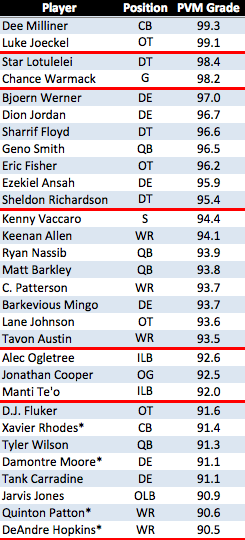
The bad news (well maybe bad news)?  My tiers are a bit different.  Building from the PVM rankings:

Screen Shot 2013-03-14 at 12.36.23 PM

Drawing the lines is admittedly a bit subjective; I’ve included the ratings so you can draw your own if you’d like.  Obviously this set of tiers is slightly worse for the Eagles, since it shows just 2 prospects in the top tier.  Additionally, the 4th ranked player is Chance Warmack, who some of us would be less than thrilled with getting.

However, I’m getting a bit too deep in the weeds there.   The key to this breakdown is the wider view.  The idea is that NOBODY has any real idea of who be be the better player out of, for example, WRs Patterson or Allen.   The best you can do is make sure you get one of those guys (if you need a WR) while spending as little draft resources as possible.

I realize that players at the same position may project differently and therefore be better or worse fits for certain teams.  Teams will incorporate “fit” into their individual draft tiers, so the idea still holds.

It’s all about recognizing and accepting uncertainty.  For example, if there are 3 DEs rated similarly and you can either trade up to #13 to grab the “best” one or stay at #24 and take whoever is left, it’s probably best to sit tight (or to trade up just a couple of draft spots to ensure you get whoever is left).