Eagles Hit Rock Bottom

Patrick Causey, on Twitter @pcausey3

The Eagles hit rock bottom today with one of the worst losses in recent memory. In a critical game that could have put the Eagles in first place of the NFC East, the Eagles didn’t just play poorly, they didn’t even show up.

This game, this performance, this team was an indictment on the Chip Kelly rebuild process that saw him overhaul a roster that went 10-6 in consecutive seasons. Kelly spent the entire offseason getting “his guys” that bought into “his culture,” — and this was the result. 4-6 and unable to take advantage of repeated opportunities to grab the weakened NFC East by the throat.

While I have not bought into the “Fire Chip Kelly” mantra — yet — it is becoming harder to ignore as the bad losses start to pile up. The Eagles loss to the Dolphins seemed like the low point of the Chip Kelly era; up 16-3 on a team that was begging to be put out of their misery, but the Eagles could only muster three points the rest of the way and lost a game they undoubtedly should have won.

But this loss to the Bucs made the Dolphins game look like a walk through the park. Pick any adjective you can think of — pathetic, embarrassing, unprofessional — and it still doesn’t seem strong enough to explain how poorly the Eagles played.

If these losses don’t shaken your resolve in Chip Kelly, then you have the patience of Job.

And while you don’t need me to remind you of how ugly this loss was, here are seven numbers to put this loss in perspective:

72

I understand why Chip Kelly focuses on number of plays run to an extent. But a dogma like adherence to that philosophy can be a fools errand, and today’s game was a prime example of why.

Both the Eagles and Bucs ran 72 plays today. So from that perspective, everything was just peachy. But the Bucs had the ball for almost 36 minutes (35:54) compared to 24:06 for the Eagles. And while the defense played terrible today, the time of possession disparity had to play a factor.

Consider the following drives in order, with time of possession in parenthesis:

  • Eagles: 5 plays, 14 yards, punt (1:53)
  • Bucs: 5 plays, 75 yards, touchdown (2:55): 7-7
  • Eagles: 3 plays, 4 yards, punt (:46)
  • Bucs: 5 plays, 59 yards, touchdown (2:09) 14-7
  • Eagles: 3 plays, 3 yards, punt (1:11)
  • Bucs: 3 plays, 0 yards punt (2:06)
  • Eagles: 3 plays, 6 yards, punt (1:30)
  • Bucs: 4 plays, 85 yards, touchdown (2:03) 21-7

According to Chip, this sequence was okay: the Eagles ran 14 plays to the Bucs 17. But from a time of possession perspective, the Bucs more than doubled the Eagles: 9:13 to 4:20.

The impact on the Eagles defense was as painful as it was obvious. Yet Chip Kelly did nothing. He did not call a timeout to give his defenders a breather. He did not ask his offense to slow it down despite multiple three and outs. He stuck to his guns, insisting his way was the right way, and it provided the Bucs the opportunity to put the game away before it started.

6.25

Mark Sanchez’s interception rate in five and a half quarters of play. He’s thrown four interceptions on just 64 pass attempts. Obviously, that number is not sustainable and some regression to the mean should be expected. But for a quarterback being given every opportunity to win the starting job, Mark Sanchez has really dropped the ball (or given it away, is probably more appropriate).

5

The number of touchdowns the Eagles gave up to rookie quarterback Jameis Winston. That ties the NFL record for most touchdown passes thrown by a rookie, and was equal to half of the touchdowns Winston had thrown all year prior to today.

521

The total yards the Eagles allowed today, the fifth most they’ve ever allowed at home. 283 of those yards were allowed on the ground, where Doug Martin absolutely eviscerated the Eagles once vaunted run defense, running 27 times for 235 yards.

5-9

The Eagles record over the last 14 games, which is why it is wrong to lay all of the blame for this season on Chip Kelly the general manager. These issues started last year — the chemistry problems, the mistakes, the three and outs — but they became an afterthought after this crazy offseason. Despite overhauling the roster, the results are largely still the same, and arguably even worse. Chip Kelly better figure out a way to fix these issues, or his tenure as the head coach and head of player personnel could be over sooner rather than later.

2

The number of times Eagles players (in this instance, Malcolm Jenkins and Connor Barwin) dropped interceptions. On the very next play, the Bucs scored touchdowns. We always hear that football is a game of inches, and these plays certainly lend credence to that theory.

10-16

That was the Bucs third down conversion rate. The Bucs also went 1-1 converting fourth downs. It was comically bad at times, with the Eagles giving up multiple third and longs. I’ll be interested to see Eric Rowe’s snap count for today’s game. We heard a lot about him getting more reps today, but I did not see him much. And that was despite E.J. Biggers getting beaten — repeatedly — on multiple third and longs.

3

Speaking of bad secondary play, Nolan Carroll gave up three touchdown passes today. On two of those passes, Carroll gave large receivers — Mike Evans and Vincent Jackson — free releases at the line of scrimmage. It was a curious decision for a team that likes to play press man coverage. Again, Eric Rowe cannot get in the field for this guy? And to think, the Eagles traded multiple picks to move up and get Rowe.

Final Word

A final word on the state of the quarterback play. It is abundantly clear that the Eagles do not have the long term solution at the quarterback position on their roster. That doesn’t take a rocket scientist to figure out.

And anyone using this game to pound their chest about Sam Bradford would be sadly mistaken. As Brent pointed out during the game:

Add to it Bradford’s significant injury history, and do you honestly feel comfortable committing the $15-18 million per over the next 3-4 years that it would take to sign him? I know I wouldn’t.

(And before you say that is an insane valuation, remember that Jay Cutler signed a seven year $126 million contract ($18 mil/year), and Colin Kaepernick signed a six year $114 million contract ($19 mil/year)).

I don’t want to short shrift this analysis; I plan on getting a post up later this week that puts into proper context what we need to obtain to make the quarterback position work. But the easy conclusion here is the Eagles have a huge hole at the most important position in football, with no easy solutions in sight.

Keys to the Eagles v. Bucs Game

Patrick Causey, on Twitter @pcausey3

The Philadelphia Eagles face off against the Tampa Bay Buccaneers at 1 pm at Lincoln Financial Field. The Eagles are 5.5 to 7 point favorites over the Bucs depending on which site you use, with the line set 44.5 points, which suggests a lower scoring affair.

Full disclosure, I am expecting another frustrating game from the Eagles. This entire season has been predicated on slow first halves followed by the Eagles coming alive in the second. Last Sunday, the Eagles flipped the script, starting strong with a 16-3 lead at the end of the first quarter — sucking us into believing the team had finally turned the corner — only to score three points the rest of the way.

At this point, I think it is time we accept the fact that there won’t be a flipped switch, magical spark, or “aha” moment that turns this season around. 10 weeks into the season, this is who the Eagles are, and they aren’t very good. The only reason they are still relevant is because the rest of the NFC East has been terrible. But that should not change the fact that the Eagles are a bad team. And bad teams don’t tend to turn it around midseason.

But I digress. Let’s breakdown the game and focus on some of the key matchups that will go a long way towards determining its outcome.

Big Picture on the Bucs:

A few weeks ago, this game seemed like a lock on paper. The Eagles had just come off a solid win against their division rival, Dallas Cowboys, and Sam Bradford was starting to look like a competent starting quarterback. But Bradford is now hurt and the Eagles laid an egg against the Dolphins.

To make matters worse, while the Bucs are 4-5, they are playing with newfound confidence on both sides of the ball. Led by rookie quarterback Jameis Winston — who looks every bit the part of a franchise caliber quarterback — the Bucs find themselves winners of three of their last five games.

The Bucs defense was a train wreck during the first six weeks of the year, but has turned things around over the last two weeks. And while they have allowed the sixth most total yards on the year, they are one of the top run defenses in the league, ranking second overall by limiting teams to only 3.4 yards per carry.

The Bucs have lowered their passing yards allowed per game from 243 to 233, thanks to impressive efforts against the Cowboys (186 passing yards) and Giants (243) the last two weeks. During that time, the Bucs have switched cornerbacks to Sterling Moore and undrafted rookie Jude Adjei-Barimah. While neither have been spectacular, they have cut down on the mistakes that were allowing too many big plays earlier in the year.

On offense, the Bucs take a balanced approach (53/47 pass to run ratio), but still rely on the run game to set the tone. Doug Marin is fifth in the league in carries and rushing yards, with 161 carries for 706 yards. Charles Sims has been an effective second option for the Bucs, with 66 carries for 302 yards (4.6 ypc) and 22 catches for 251 yards (11.4 ypc). The offense has been stagnant over the last three games, scoring four touchdowns, three of which came on runs from Jameis Winston. But the offense should get a boost today with Vincent Jackson reportedly playing:

Here are some of the key matchups for today’s game:

Eagles Interior Line Against Gerald McCoy

Gerald McCoy often gets lost in the discussion of best defensive tackles in football because the Bucs have largely been irrelevant over the last three plus season. But make no mistake, McCoy is a dominant force up front that could pose a significant challenge to the Eagles underwhelming offensive line, much like Ndamukong Suh did last week.

While I generally avoid PFF.com’s ranking systems, this is the easiest way to show you what I mean instead of just saying “take my word for it.” Below is a chart showing McCoy’s ranking according to PFF.com for defensive tackles in the league compared to Suh:

Name

2012

2013

2014

2015

G McCoy

2

1

2

25

N Suh

4

2

3

3

Again, take these numbers with a grain of salt. I think Suh has been the better player over the last four seasons, but this should give you an understanding of how good McCoy has been. And while McCoy’s play has regressed somewhat this year, don’t let the number 25 ranking fool you, he’s not playing nearly that bad.

Simply put, McCoy is a menace up front, and should pose a significant issue for the Birds. And their offensive line is going to need to improve significantly from last week in order to accomplish anything on offense.

Eagles Offensive Line Generally and in Blitz Pickup

All week we heard that Jason Peters was going to play. But that is looking less certain now, according to NFL.com’s Ian Rapoport:

Losing Peters would obviously be a huge blow to the Eagles, as it would force Lane Johnson to kick out to left tackle and reserve lineman Dennis Kelly — who was absolutely brutal against the Dolphins — to start at right tackle.

At this point, most Eagles fans should be cursing Kelly’s decision to not address the offensive line in each of the last two offseasons. And while I will concede that it is hard for any team to recover from losing two starters to the offensive line, the Eagles were already starting two backup lineman in Allen Barbre and Andrew Gardner. In essence, the Eagles are on their third and fourth reserve lineman with Matt Tobin and Dennis Kelly, and it is starting to show.

Last week Kelly made the mistake of not giving the offensive line any help despite their struggles. Kelly should not make that mistake this week. The Bucs have a very good front seven that likes to blitz often. The Eagles need to have Celek and Murray/Sproles help provide Sanchez extra time with which to operate. Otherwise, it could be another long, frustrating day for the offense.

Sticking with the Run

Another major issue for the Eagles today will be getting the ground game going. With the Eagles most effective runner — Ryan Mathews — out today, the onus will fall on DeMarco Murray and Darren Sproles to carry the load.

However, the question becomes just how much of an opportunity they will receive. Chip Kelly has shown a tendency to give up on the run game if he sees a decided advantage in the passing attack and/or if the opposing defense is stout against the run. During the first four games of the year, the Eagles averaged only 22.75 carries per game when the offensive line could not run block to save its life.

The Bucs enter this game with the fourth ranked rush defense per FootballOutsiders.com, rank third in allowing only 3.4 yards per carry, and are ranked 10th overall in rushing yards allowed.

The temptation might be there for the Eagles to go for a pass heavy attack. In fact, I largely expect it. But it would be a mistake. As I’ve discussed at length, the Eagles are a much better team when they take a balanced approach. But more importantly, we cannot rely on Mark Sanchez to win this game throwing the football. Asking a quarterback with a 3.8 career interception rate to win the game throwing the football seems like a recipe for disaster. Especially given that his first five drives this year from Sanchez ended with a field goal, an interception, two punts and a turnover on downs.

Stopping the big receivers 

As I mentioned before, Vincent Jackson will be playing today according to ESPN.com’s Adam Schefter. Jackson, at 6’5 230 lbs, will be joined by second year wideout, Mike Evans, who is also 6’5, 231 pounds. On the year, Evans has 40 catches for 662 yards, 16.6 yards per catch, and 1 touchdown. While Evans has been inconsistent this year, leading the NFL in dropped passes with 11, he is still a dynamic receiving threat, especially in the redzone.

This receiving duo will challenge the Eagles secondary. Neither receiver is a burner, but both have good size and are great at high pointing the ball (i.e. catching the ball at its peak). While the Eagles have valued size in their secondary, both Maxwell and Carroll are 6’1, giving the Bucs receivers a four-inch height advantage.

As I mentioned earlier on Twitter, expect to see a lot of jump balls and back shoulder throws today from the Bucs:

https://twitter.com/InsdeTheHuddle/status/668381883483463681

Forcing Turnovers from Winston

Last week’s final drive against the Dallas Cowboys perfectly encapsulates the season Jameis Winston is having. He engineered a 56-yard drive that ended with Winston scoring a 1-yard touchdown run with 54 seconds left in the game. But that touchdown was made possible only after his lost fumble was negated by a Cowboys penalty.

In other words, Winston is playing like a rookie: great plays one minute, head scratching plays the next. His numbers on the year bear that out: Winston has completed 57.% of his passes for 2,159 yards, 10 touchdowns, 9 interceptions and a quarterback rating of 80.1.

Again, nothing to fear, but given that Winson is a rookie, those numbers are actually fairly good.

The Eagles need to disguise their blitzes and coverages to confuse Winston and hopefully force him into turnovers. He had gone four consecutive games without a turnover until last week when he tossed two interceptions. The good news for the Eagles is that forcing turnovers is their specialty: they are tied for second in the NFL with 20 total takeaways.

One final thought on Winston before my ill-advised prediction.

This game has the makings of being a close, and probably ugly contest. If the Eagles have a chance to put the Bucs away early on, they need to seize that opportunity. That means scoring touchdowns instead of field goals (or worse, redzone turnovers, cough, Mark Sanchez).

Because if there is one thing I have learned watching Jameis Winston closely over the last three years, it’s that no game is out of reach when he plays. I know that sounds silly to say about a rookie quarterback, but Winston just has that “it” factor. He led his first career NFL comeback victory last week, which is something he did routinely in college. Don’t give him that chance this week.

Conclusion

As you can probably tell by the tenure of this article, I do not feel good about this game. I would feel better if Peters was playing, but signs are pointing to him missing his third straight game. Given how bad the offensive line played last week, and how good the Bucs front seven is playing, I see Eagles dropping this game 24-17.

The Eagles are Bad and Chip Kelly (the GM and Head Coach) is to Blame

Chip Kelly the general manager deserves all the blame he has received, but Chip Kelly the coach is also part of the problem.

Patrick Causey, on Twitter @pcausey3

In January of this year, I was sharply critical of Jeffrey Lurie’s decision to make Chip Kelly the head of player personnel. I did not like the decision to vest that much power in one person, especially when that person already had to handle being the head coach and play caller.

I was equally concerned with the manner through which Kelly sought to rebuild this Eagles franchise. Kelly seemed to take a page out of the playbook employed by the Daniel Snyder-led Washington Redskins of the early to mid-2000s: high roster turnover, big free agent signings, and even a new wrinkle: relying on oft-injured players.

Many others saw these issue too. Perhaps the most ominous warning came from Bill Barnwell, after the Eagles signed DeMarco Murray and Byron Maxwell to big money free agent contracts:(and Barnwell is looking especially on point, predicting that the Eagles would fail to live up to the preseason hype and finish the season 9-7):

Here’s the simplest way I can put this: Pretend, for a moment, that the Raiders or the Jaguars or the Browns made this exact same pair of moves. They would be the laughingstocks of the league, fools making the same stupid mistakes that bad franchises always make. The Eagles understandably aren’t being painted with that brush because Kelly has earned a certain level of credibility as a forward-thinking coach. With the moves Kelly has made this offseason, that credibility is on the line.

Kelly may very well make these signings work, but the Murray deal is a classic example of what bad teams do in free agency. Two years from now, we may very well look back at the past 72 hours in Eagles history as the moment when Kelly sealed his status as the next Bill Belichick. We also may look back at it as the time when Kelly sealed his fate.

And yet, we largely ignored these problems, giving Chip Kelly the benefit of the doubt because he had won 20 games in his first two seasons. Perhaps part of us ignored the issues because we wanted Kelly to succeed at all costs, warning signs be damned. You can only so through so many years of disappointment before you start grasping on something, anything to believe that this year is finally the year.

But there are certain truisms to building a successful team in the NFL that should not be ignored. You build through the draft, supplement with free agency, and do your best to retain “your guys.” Get lucky along the way with some late round picks, secure a franchise quarterback, and keep the roster intact, and you give yourself a chance.

Those aren’t platitudes. They aren’t catch phrases used to opportunistically criticize a coach because he is having a bad season. They are tried and true methods that we have seen work over the years for teams like the Green Bay Packers, Pittsburgh Steelers, and New England Patriots.

Chip Kelly wholly ignored this blueprint for success: he has 11 new starters on this team — many of whom are in significant positions — and was one of the biggest spenders in free agency.  Couple that with a marginal success rate in the draft, and the team is currently mired in a season that is as disappointing as it is frustrating.

Up until this point, we have largely blamed Chip Kelly the GM for most of the Eagles issues. But watching the Eagles latest loss against the Miami Dolphins reveals that Chip Kelly the head coach might also be part of the problem.

Now, to be clear, this is not a “fire Chip Kelly” #hottake. I still think Kelly is a good football coach. You do not go 20-12 in your first two seasons in the league by accident. And while Kelly never “revolutionized” the game in ways that some may have predicted, his fingerprints are now seen all over the league. Every time you see a team tout their investment in sports science and player monitors, or hear a team using loud music during practice, or watch a team run spread concepts at a fast pace, just know Kelly had a hand in it. And for those facts, Kelly deserves credit.

But we cannot continue to ignore that Chip Kelly not only failed in acquiring talent this offseason, but is also failing in how he manages and utilizes that talent during the season. I covered a few weeks back during our self-scouting series, but it deserves further attention.

Miles Austin is this year’s Bradley Fletcher

Let’s start with the low hanging fruit. We can and should criticize Kelly the GM for signing Austin to a $2.5 million contract, with $1 million guaranteed, when no other team seemed to have any interest in signing him. That is especially true when Kelly could have found much better production elsewhere.

Nate Washington’s stat line of 26 catches, 411 yards, and three touchdowns rivals Austin and Riley Cooper’s combined stat line of 23 catches, 417 yards and three touchdowns. Only the Eagles are paying Cooper and Austin a combined $7.1 million while Nate Washington is making $1 million.

The Eagles could also have signed Michael Crabtree, the 28-year old former first round pick, who signed a $3.2 million contract to play for the Oakland Raiders. Instead, they spent $2.5 on Austin, who is three years older and has a significantly longer injury history. Crabtree’s production: 51 catches, 646 yards, and five touchdowns.

Or if you really want to make your blood boil, consider that the Eagles are currently paying Riley Cooper $4.5 million, while the New England Patriots are paying Julian Edelman $4.25 million this year.  (Yes, the Cooper extension occurred when Howie Roseman was the GM, but Kelly is reported to have pushed for the deal, so he deserves some of the blame).

Even if you dismiss the criticism of the personnel moves as benefiting from hindsight 20/20 — and I think it is a mistake to do that — you should recognize that Kelly is compounding his mistake by playing Austin week in, week out, despite mounting evidence that he is not a competent wide receiver.

If this sounds vaguely familiar to you, it should. Kelly had the same issue last season when he refused to bench Bradley Fletcher, despite Fletcher playing at a comically bad level. It was not until this past offseason that Billy Davis finally admitted that not benching Fletcher was a mistake, which he attempted to write off as a result of having “tunnel vision” during the season.

Regardless, the decision to stick with Austin represents the continuation of a troubling trend for Kelly, who seems either loyal to a fault or unable to correctly determine when a player no longer warrants the playing time he is receiving.

I do not like to call for anyone’s job, but in this instance, I am willing to make an exception. Miles Austin should not be starting for this team, and he arguably should not even be on this roster anymore. This fact has become increasingly obvious as the season has progressed. As we covered before, Austin has an embarrassingly low 50% catch rate on the season, one of the worst marks in the league.

During the Dolphins game, there were at least five plays in which Austin made critical mistakes. Benching Austin after one or even two of those mistakes probably would have been justified. Allowing it to progress to the third, fourth and fifth mistake? Seems like coaching malpractice to me.

Let’s take a look.

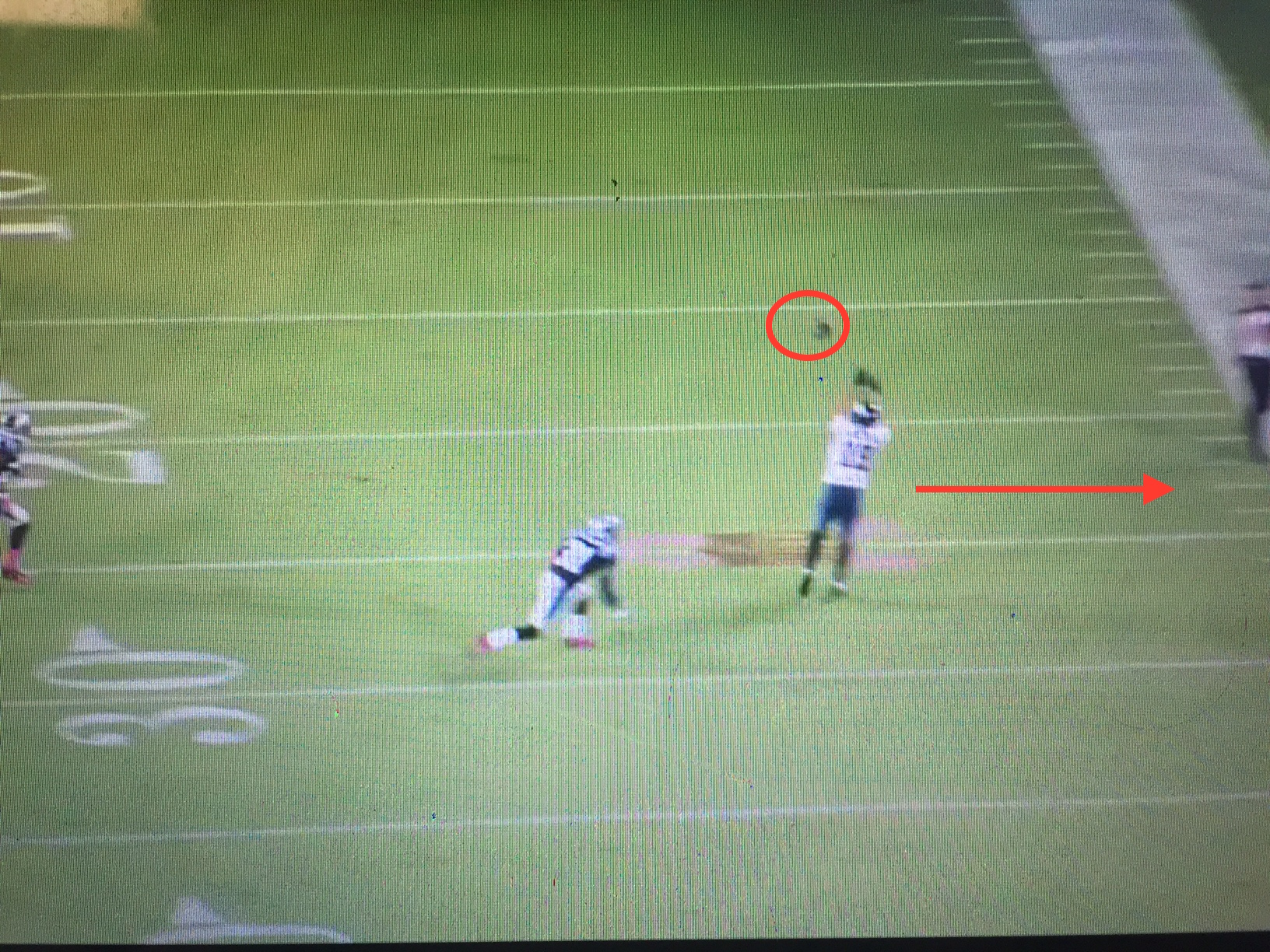
In the third quarter, the Eagles were clinging to a 16-13 lead and in desperate need for some positive momentum. Sam Bradford delivered an absolute perfect strike to Austin streaking down the sideline, but Austin (predictably) dropped the ball.

Here are multiple angles of the drop:

Had Austin made that catch, the Eagles would have been set up nicely inside the Dolphins redzone. Instead, the drive stalled, and the Eagles were forced to punt from the Dolphins 38 yard line.

Later in the third quarter, Sam Bradford notices that Austin is wide open at the line of scrimmage in what looked like to be a designed run play. Bradford attempted to change out of that play and make the quick throw to Austin. The only problem? Austin does not realize he is open, and instead tries to block his defender 10-yards down the field. The result is Bradford having to take a sack for the loss:

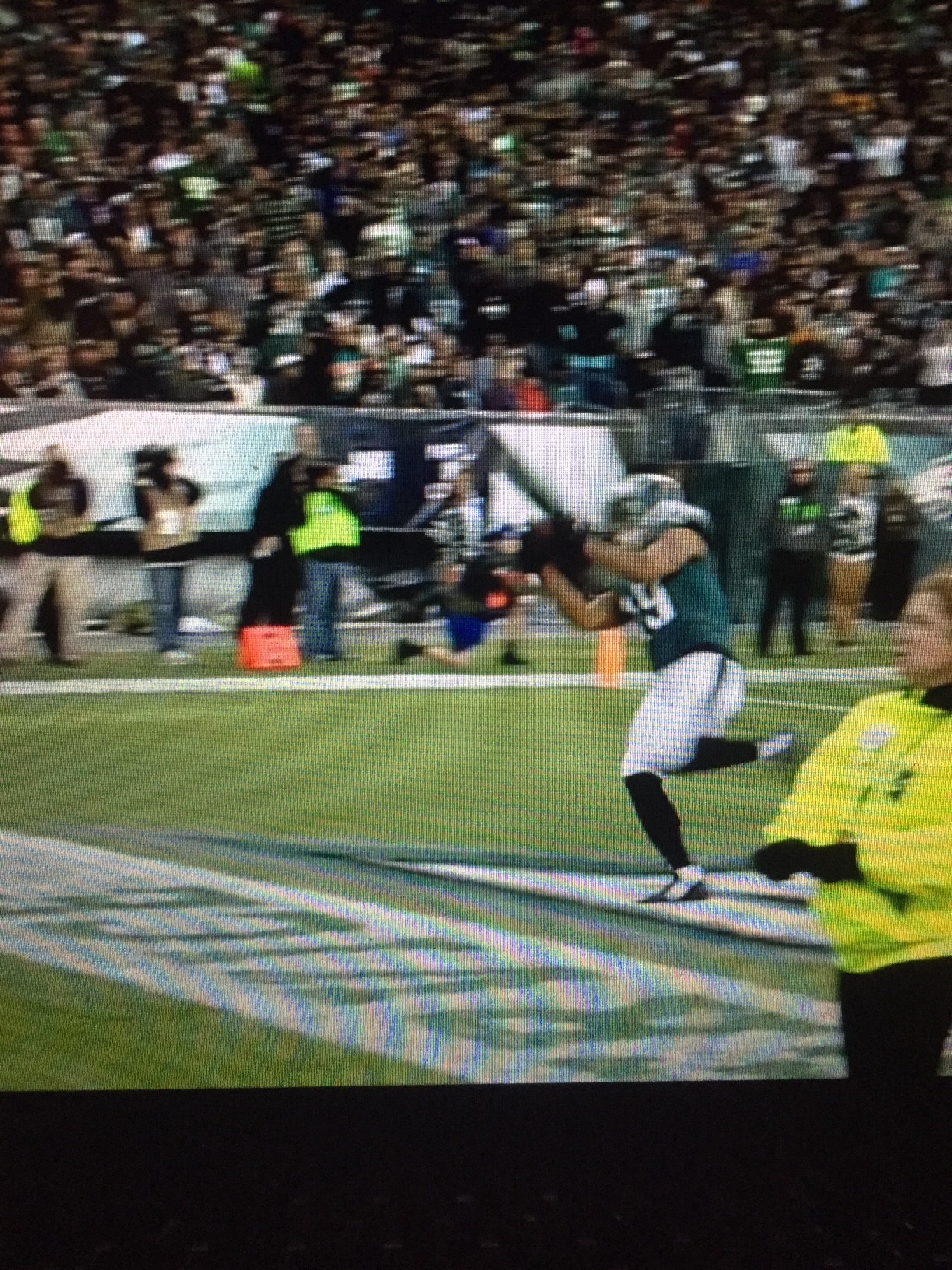
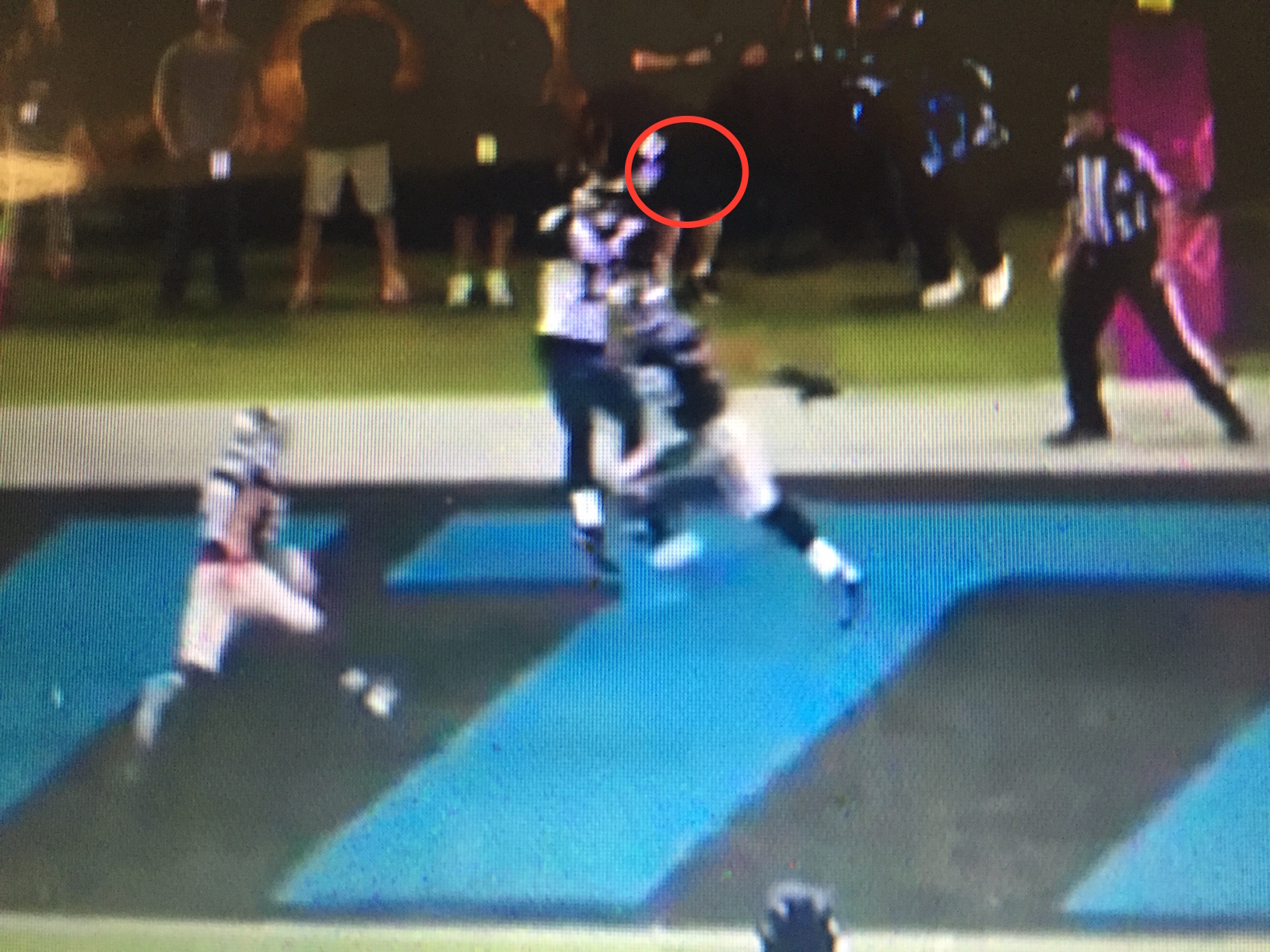
When Sanchez came into the game, the quarterback was different but the result was the same. To start the fourth quarter, Austin broke free on a go route in the end zone. Sanchez found Austin in stride for what should have been the go-ahead touchdown:

But Austin could not drag his foot down, despite having a solid two to three yards with which to operate:

Austin Foot Drag

On a critical second down on the last drive of the game for the Eagles, Miles Austin broke free on a crossing route. Prior to the snap, Sanchez seemed to be directing Austin to run a slant, almost telegraphing that he was coming in Austin’s direction:

Austin was wide open, but did not lift his head up to look for the ball. Here is a better angle:

That’s four bad plays, five if we count the interception Mark Sanchez threw in the endzone when Miles Austin appeared to stop short of his route.

Given Austin’s poor performance to date, Kelly would have been justified benching Austin after the first bad play — the egregious drop in the third quarter. Instead, Kelly stuck with Austin, putting him in a position to fail to make the play over and over again.

Perhaps the most alarming trend was how willing Austin’s teammates were to throw him under the bus. Look at that last vine again and see Sanchez’s reaction.  Now consider Agholor’s reaction after Austin dropped that perfect throw from Bradford:

And finally, watch Bradford’s reaction after Austin failed to realize he was open, leading to the sack:

It’s one thing for the fans or reporters to get on Austin for his poor play. It is an entirely separate matter when his own teammates start to publicly call Austin out through their body language. Simply put, Chip Kelly must bench Austin this week.

Who Can Replace Austin?

A number of you on Twitter have asked who should replace Austin. And given that the Eagles receivers aren’t exactly lighting the world on fire, it is a fair question to ask.

Let’s start with the offensive snap count, courtesy of Zach Berman of the Philadelphia Inquirer:

Miles Austin played 47% of the offensive snaps, which equates to 45 snaps. Splitting up those snaps should not be too difficult of an issue.

The name that immediately jumps to mind is Darren Sproles, who played only 17 offensive snaps Sunday (18%). Why are we paying Sproles $3.5 million this year if we aren’t going to use him? To put his salary in perspective, consider this:

https://twitter.com/InsdeTheHuddle/status/666260652009398272

All this offseason, we heard from the coaching staff that it was going to be a priority to get Sproles more involved in the offense. Yet, it is week 10 and Sproles still is being underused.

It is not unreasonable to give Sproles 15 of those 45 snaps (bringing his total to 32), and splitting the rest between Matthews (who played 59% of offensive snaps), Celek (60%), Agholor (55%), and Huff (44%).

And don’t get fixated on the positions: while Celek and Sproles play different positions than Austin, they are still creative ways to make this offense work without leaving Austin on the field. For starters, the Eagles can run more 12 personnel (two tight ends, two wide receivers, one running back) to have Celek take over some of Austin’s stats. Similarly, they could line up Sproles in the slot, pushing Matthews to the outside, to take Austin off the field. Or, they could even split Ertz out wide (something the Saints and now Seahawks use to great success with another blocking deficient tight end, Jimmy Graham), with a combination of Matthews, Agholor and Huff sharing the outside reps.

(Note: I split this up into two parts; click the number 2 below to get to the second page)

Keys to the Eagles v Dolphins Game

Patrick Causey on Twitter @pcausey3

The Basics

The Philadelphia Eagles come into Sunday’s game 4-4, looking to break the .500 mark for the first time all season. They are one game back of the 5-4 New York Giants, who take on the undefeated New England Patriots this weekend. While nothing is guaranteed in today’s NFL, this certainly seems like a golden opportunity for the Eagles to grab sole possession of first place in the NFC East (the Eagles own the tie breaker over the Giants).

The Eagles are six point favorites against the Dolphins, who have lost two in a row to the New England Patriots and Buffalo Bills by a combined score of 69-24. This came on the heels of the Dolphins winning two straight in dominant fashion against the Tennessee Titans and Houston Texans by a combined score of 82-54. Many thought the Dolphins had turned the corner after firing their head coach Joe Philbin, but the success was short-lived as they came crashing down to earth in consecutive road games against AFC East division rivals.

Despite being 4-4, the Eagles are still respected by the analytics community. Led by a stout defense and strong run game, the Eagles are ranked 10th overall in Team Efficiency Ratings by FootballOutsiders.com. That places them only two spots behind the Denver Broncos and seven spots ahead of the Atlanta Falcons. Their week 10 opponent, the Miami Dolphins, come in ranked 21st overall.

A Familiar Foe

Most of you know that the Dolphins offensive coordinator, Bill Lazor, was the Eagles quarterbacks coach in 2012 when Nick Foles put up the absurd 27/2 stat line. Lazor parlayed that performance into the offensive coordinator gig with the Dolphins, and (somewhat surprisingly) survived the recent firing of Philbin.

Lazor has incorporated some of Kelly’s offensive philosophies in Miami’s offense, running heavily out of shotgun formations, using zone read running concepts, and throwing a lot of wide receiver screens. According to Chip Kelly, about 25 percent of the Dolphins’ offense is based on what Kelly does in Philadelphia.

But Kelly’s influence has lessened since Dan Campbell has been name head coach of the Dolphins. Campbell has committed to playing smash mouth, physical football, running more out of power formations over the last four weeks. Still, in a game that will likely be decided by only a handful of plays, the Eagles familiarity with the Dolphins offensive scheme could prove beneficial this week (and of course, the same could be said in the inverse, with Lazor’s familiarity with Kelly’s offense).

5 Keys to the Game

Here are the keys to the Eagles v Dolphins game which should go a long way towards determining the outcome of this game:

Establishing the Run

As I covered earlier this week, the Philadelphia Eagles have finally found themselves a run game. In the first four games of the year, the Eagles averaged 22.75 carries per game, for 70 yards, on 3.1 yards per carry and .75 touchdowns. They went 1-3 in those contests.

However, over the last four games, the Eagles are averaging 34 carries, 173.25 yards, 5.1 ypc and 1.5 touchdowns. Perhaps not coincidentally, the Eagles are 3-1 in those contests.

Fortunately for the Eagles, the Dolphins are dreadful against the run. They come in ranked 26th in terms of yards allowed per rush (4.5 ypc), and rank second-to-last with 142.1 yards surrendered on the ground. Against LeSean McCoy and the Buffalo Bills last week, the Dolphins gave up an absurd 266 rushing yards.

So it will be important for Chip Kelly to establish the run game early and stick with it. I know I will sound like a broken record here, but the Eagles are 12-2 under Kelly when they run more than pass, and 20-3 when they carry the ball at least 30 times. This is in line with the NFL trends this year, where the team that wins the rushing battle wins a whopping 68% of the time.

However, this might be the game where the Eagles would be better served relying on Ryan Mathews and Darren Sproles this week. The Dolphins are stout up the middle with the likes of Ndamukong Suh and linebacker Koa Misi. They are not nearly as good on the edges, especially after losing defensive end Cameron Wake for the year because of a torn achilles. The Bills had great success last week running McCoy and Karlos Williams to the edge of the Dolphins defense. While the Eagles will likely commit to giving Murray the rock at least 18 times this game, they arguably would be better served relying more on Mathews given his ability to get to the edge.

Taking Advantage of Jason Fox

The Dolphins lost their starting right tackle Ja’Wuan James to a toe injury for the next month. His replacement, journey-man Jason Fox, was abused by Buffalo Bills’ Jerry Hughes last week, who registered 3 tackles, 2 sacks and a forced fumble. According to Orlando Alzugaray of the Big O Show in Miami, Fox has no business starting in the NFL at this point in his career. 

Look for the Eagles to test Fox early and often with a combination of Connor Barwin, Vinny Curry and Cedric Thorton. While Barwin’s sack numbers are down this year, he is still one of the Eagles best pass rushers and could be in line for a big game.

Ryan Tannenhill is the 11th most pressured quarterback in the NFL, per PFF.com. Tannenhill completes 55.6% of his passes, which is good for seventh best in the league. However, Tannenhill has also thrown three interceptions when under pressure, tied for the 11th most. Given that the Eagles lead the league in takeaways with 20, they could be in line for a big game in the turnover department if they are able to take advantage of Fox and force Tannenhill into making some mistakes.

Starting Fast 

Starting fast is important every week, but it could be especially important this week.

The concern is not so much that the Dolphins will run away with the game, but rather the impact getting an early lead has on the Dolphins play calling. The Dolphins have a habit of abandoning the run game when they fall behind early, despite the fact that the Dolphins have a very strong run game: the Dolphins rank second in the league averaging 4.9 yards per carrry, but rank 31st overall with just 21 attempts per game. Similarly, Lamar Miller is averaging an impressive 5.3 yards per carry, but has just 91 carries in 8 games. The Dolphins 34.2 run percentage is the third lowest in the NFL.

The only problem? The Eagles have scored just 10 points in the first quarter all season, and have been equally anemic in the second quarter. It will be critical for the Eagles to get out to a fast start against the Dolphins and turn them into a one dimensional team.

Limiting Jarvis Landry

Jarvis Landry is the Dolphins most explosive weapon on offense. Landry primarily lines up in the slot, which means he will be covered by Malcolm Jenkins on most plays. Up until last week’s game against the Cowboys, Jenkins had been downright sensational this year. But an apparent concussion in the second quarter of the Cowboys game limited his effectiveness, with Cole Beasley feasting on Jenkins to the tune of nine catches, 112 yards and two touchdowns.

This just in: Jarvis Landry is much better than Cole Beasley. Landry has 53 catches, 533 yards and two touchdowns on the year. Jenkins is going to have his hands full with Landry, who is an explosive playmaker with the ball in his hands. Landry can use his precise route running (I thought he was the best route runner in his draft class) to get open deep, and his explosiveness to turn the most innocuous wide receiver screen into a large gain.

But expect to see Landry line up all over the field. Lazor has used Landry as a running back 12 times this year, and will also line up Landry outside. So the Eagles will need to be mindful of Landry at all times on Sunday.

Controlling Ndamukong Suh

This one doesn’t take a lot of analysis. Ndamukong Suh is one of the best defensive players in the NFL. He has the ability to wreak havoc on an offense, collapsing the pocket in ways that few lineman can in the league. And with Cameron Wake lost for the year to a torn achilles, the Eagles will have the ability to put more focus on stopping Suh.

It will be important to keep Suh out of the backfield so the Eagles can establish the run game early and to protect Sam Bradford for a potential cheap shot from Suh — let’s be honest, Suh isn’t exactly a saint. Expect the Eagles to try to double team Suh often with Matt Tobin and Jason Kelce. The last thing the Eagles need is Bradford getting hurt because of a cheap shot from Suh.

Big Picture Take-Away:

The Eagles SHOULD win this game. They have decided advantages on the Dolphins when they are playing on offense, and the Dolphins don’t do anything particularly well on the offensive side of the ball that should threaten the Eagles. But, as we have seen every week, nothing is guaranteed in the NFL. So your guess is as good as mine.

Eagles 31, Dolphins 21

Inside the Huddle Part 3: Predictable Play Calling and Inconsistency on Offense and the Eagles Remaining Schedule

Patrick Causey, on Twitter @pcausey3

This is a three-part series analyzing where the Eagles stand after the game against the Dallas Cowboys. This is part three. You can read all three by clicking the following links below:

Predictability of Play Calling: Murray swing pass, Murray run

Lost in the euphoria of the Eagles win over a hated division rival is how poorly the Eagles played for the first three quarters of the game. As I mentioned about 3,000 words ago, the Eagles offense produced just 91 yards of total offense in the first three quarters, excluding their two touchdown drives.

Many expected the Eagles to come out of their bye week swinging. Instead, the Eagles started off the game with a rare feat, running six plays without getting a single first down. It was an ominous sign of the things to come, and was made worse by the fact that the defense allowed the Matt Cassell-led Cowboys to drive the ball 93 yards down the field for a touchdown.

The Eagles next two drives combined yielded just nine plays for 38 yards.  On three third downs the Eagles faced to start the game, Bradford threw the ball short of the sticks and unsurprisingly, failed to gain a first down. Here are examples of two of those throws:

Eagles fans and media members were understandably frustrated. Throughout the game, Twitter was filled with examples of frustrated fans and media members who had seen enough

https://twitter.com/InsdeTheHuddle/status/663534023017406465

Simply put, it was an incredibly frustrating first 45 minutes of the game.

Many people have asked why the Eagles have consistently struggled in the first halves of games. One explanation is that Chip Kelly has become too predictable of a play caller. Some of this probably unfair, since every team has tendencies in certain downs and game situations. Some level of predictability is to be expected.

But some of it was entirely justified. For example, earlier this year Kelly started running the ball with Bradford under center after it became clear that Murray was struggling running from the shotgun. The Eagles ended up calling 17 plays with Bradford lined up under center against the Saints, which had to be some sort of record for a Kelly-led offense.The only problem? On every single play, the Eagles ran the ball.

Before that, Kelly was telegraphing the direction in which he run plays were designed by the formation of his running back. Specifically, when a running back would line up on one side of the quarterback in the shotgun formation, he would run to the other side of the field 80% of the time.

Each of these examples are far too predictable against NFL defenses and defensive coordinators. It’s why you heard stories about defensive players calling out the Eagles plays before they were snapped.

While Kelly has done a better job switching things up as of late, there is one area that really stands out that needs to be changed. To start the game against the Cowboys, the Eagles called a pass that incorporated a swing pattern for DeMarco Murray out of the backfield:

The next play, Murray did an inside zone run on second down.

The problem with this series of play calling — in addition to gaining only one yard total — is that it has become a staple for the Eagles to start each half.

There have been 16 halves of football played by the Eagles.The first play run in eight of those halves was a designed pass play to Murray out of the backfield. He was targeted on seven of those plays, six of which involved Murray running a swing route.

To make matters worse: on nine of the 16 drives in question, the Eagles ran the ball on the very next play, usually on an inside zone run up the middle.

In other words, there is approximately a 50% chance that the Eagles will start the first and second halves by throwing a swing pass to Murray followed by Murray running the ball up the middle.

If I can figure this out in 30 minutes looking over NFL Films, you can rest assured NFL defensive coordinators have figured this out as well.

And how did the Eagles do on those plays? Not good. On those seven pass plays to Murray on first down, the Eagles have gained an average of 2.14 yards per play. And on those follow up run plays, the Eagles have gained only 3.88 yards per play.

To be fair to Chip Kelly, this is not entirely his fault. Almost every pass play in his offense comes with multiple options. So Bradford can go in another direction if he so chooses, as we saw on the one occasion where Bradford threw the ball to Agholor instead of Murray.

But, if the defense knows what routes are coming — and it says here that they do — then it is much easier for the defense to shut those other routes down and force the Eagles to settle for a dump off to Murray.

The most troubling thing, at least for me, is that the Eagles coaching staff failed to pick up on this during the bye week. The Eagles coaching staff spent the bye week self-scouting themselves, including their play calling.

The fact that the Eagles came out against the Cowboys and ran the exact same two plays to start the game is somewhat shocking. The Eagles need to switch things up on opening drives. One thing we’ve seen is that the offense gets rolling after it is able to convert a first down or two. But that momentum will be much harder to manufacture if the defense knows which plays are coming. Keep an eye against the Dolphins to see if the Eagles run these plays to start each half. If they do, do not be surprised if it leads to another three and out.

The Eagles Remaining Schedule

A short word on the Eagles remaining schedule. The Eagles are in prime position to go on a mini-win streak here, as their next three opponents (Miami, Tampa Bay, and Detroit), are a combined 7-17. If the Eagles handle their business, they will be 7-4 by the time they travel to New England to take on the Patriots.

But it gets better. Looking over the NFC East, the Eagles have a decided advantage over the New York Giants in terms of strength of schedule. Here is a breakdown of the NFC East by records plus the records of their remaining opponents:

  • Giants 5-4 (37-19)
  • Eagles 4-4 (33-32)
  • Redskins 3-5 (31-34)
  • Cowboys 2-6 (35-29)

The Giants have a demonstrably harder schedule than the Eagles. And this is made worse by the fact that five of their remaining eight games are being played on the road. Conversely, the Eagles are playing five home games to just three road games. In what figures to be a close race down the stretch, the Eagles have an advantage over their biggest threat for the NFC East crown.

And while I hate to pick games — usually because I am wrong — it is not hard to get the Eagles to 9-7 or even 10-6:

  • Mia (W)
  • TB (W)
  • Det (W)
  • NE (L)
  • Buf (W)
  • Arz (L)
  • Was (W)
  • NYG (W)

This puts the Eagles at 10-6, a remarkable feat given how inconsistent they were to start the season. But even if we assume the Eagles might lose a game they should win, they could still easily land on 9-7. Given the current state of the rest of the NFC East, that might just be enough to win the division.

Inside the Huddle Part 2: The Passing Game Showing Improvement

Patrick Causey, on Twitter @pcausey3

This is a three-part series analyzing where the Eagles stand after the game against the Dallas Cowboys. This is part two. You can read all three by clicking the following links below:

The Passing Game

My reservations about Sam Bradford are well-documented, but I have also said that he deserves until after the bye-week before we pass judgment on his game. Not to beat a dead horse, but Bradford missed the last two-years recovering from multiple acl tears. He was then forced to learn a new offense and develop chemistry with his new teammates this past offseason. But he was prevented from doing either of those things because he spent most of his time in March through August rehabbing his knee. So the inconsistent play was to be expected.

Chip Kelly was steadfast earlier in the year that chemistry or a lack of understanding of the offense was not hurting Bradford. But this past week, Kelly finally relented some in his press conference. The quote is courtesy of Jimmy Kempski at Phillyvoice.com:

“I think everything in Sam’s game has gotten better,” said Kelly. “As I’ve said before, I’ve seen Sam improve on a weekly basis here. We’re in Game Eight. He’s better in Game Eight than he was in Game One. I think he’s more comfortable in terms of what we’re doing.”

“In terms of where we are as an offense with a lot of these guys, it’s kind of like there was a movie being shown and (Bradford) showed up halfway through it,” said Kelly. “And then he’s supposed to figure out what’s going on and what happened in the first half of the movie because he hasn’t been with us for the amount of time that Celek has been here and some of the other guys, like Kelce, have been here. It’s something you have to get through reps; it’s not something that can be forced.”

And while Bradford got off to a slow start yet again this past Sunday, he played arguably his best half of football in the second half. And this came on the heels of an equally impressive performance turned in against the Carolina Panthers.

Bradford’s numbers over the last two games aren’t anything to write home about: 51/82, 62.2%, 500 yards, 1 td, 1 int, and an 81.05 quarterback rating. But if we go beyond the numbers and look at the tape, some encouraging signs are starting to emerge.

One of the biggest issues Bradford had earlier in the season was not getting through his progressions. Bradford would predetermine where he wanted to go with the ball, which would cause him to often miss open receivers in the process.

Over the last two weeks, however, Bradford has been doing a better job working through his progressions. One such example occurred on this perfectly delivered ball to DeMarco Murray on a swing pass, a route that Bradford has shown an affinity towards throughout the year:

Bradford starts by looking to the far side of the field, where he has three receivers lined up in a trips formation. Watch how quickly he diagnoses that the receivers are covered. By the time he gets to the top of his drop, he is able to pivot and deliver an accurate strike to Murray down the sideline.

Here is a better angle where you can see Bradford work through his progressions and fluidity with which Bradford pivots to Murray:

Another thing we are seeing from Bradford is his ability to manipulate a defense with his eyes. We started to see glimpses of this against the Carolina Panthers, where Bradford was able to manipulate All Pro linebacker Luke Kuechly with his eyes to open up the passing lane for Miles Austin:

That is not something we saw from Bradford through the first six weeks of the year.

It carried over and became even more frequent against the Cowboys.

Early in the game, the Eagles were faced with a third and long deep inside their own territory. Watch Bradford’s head before he throws the ball to Miles Austin for a first down:

Now look at what that action did to the single high safety, who follows Bradford’s eyes to the other side of the field which opens up things for Austin:

When I see things like this happening on a more frequent basis, it tells me that Bradford is starting to get a better understanding of the offense. He is growing more confident in what each play on offense calls for, and is starting to recognize how certain route concepts within this offense work against specific defenses. This is, without question, an encouraging sign.

The last thing I am seeing from Bradford is an increase in the frequency with which he is delivering accurate passes. In the preseason, players and coaches raved about Bradford’s ability to put the ball in the exact location that it needed to be, which gave receivers the opportunity to make plays after the catch. That accuracy was on full display against the Green Bay Packers in a performance that got most Eagles fans dreaming of playing in Phoenix in February.

But as I covered before, Bradford struggled to replicate that accuracy when he was under pressure in real game situations, an issue that has plagued Bradford throughout his career.

Over these last two games, however, Bradford has shown significant strides in his ability to deliver the ball accurately under pressure.

In the fourth quarter, Bradford threw, at least in my opinion, one of his most accurate passes of the year, a 20+ yard strike to Zach Ertz who was streaking along the sideline in single coverage:

If you look at the tail end of that play, you will see that Bradford is not operating with a clean pocket. David Irving (#95) is pushing Matt Tobin back and able to get in Bradford’s face. Yet, Bradford was able to deliver a strike to Ertz, who was blanketed by a defender:

Now, I wouldn’t start planning parades down Broad Street or clamoring for Kelly to resign Bradford to a contract extension just yet. Bradford struggled yet again in the first half, completing only 10 of 18 passes for 74 yards and zero touchdowns, before rebounding in the second half completing 15 of 18 passes for 221 yards and a touchdown.

This continues a troubling trend from the quarterback, who has completed 55.3 percent of his passes for 821 yards, three touchdowns, five interceptions for a 62.9 quarterback rating in the first half, compared to completing 68.7 percent of his passes for 1,240 yards, seven touchdowns, five interceptions and a 95.4 rating in the second half.

If the Eagles are going to have any chance of competing for the NFC East and making a run in the playoffs, Bradford will need to play more consistently. But we are starting to see signs of incremental improvement; which is encouraging to say the least.

We cannot cover the passing game without also spending some time giving love to Jordan Matthews for his performance Sunday. The stat line was sensational: 9 catches, 133 yards, 1 touchdown and ZERO drops.

We read all during the bye week that Matthews was hard at work at his alma matter, Vanderbilt University, trying to correct the issues that plagued him. But my favorite anecdote from this past week came after Matthews dropped a pass during a Thursday practice. Courtesy of Mark Eckel of NJ.com:

“You can’t say enough about the way Jordan worked this week in practice,” quarterback Sam Bradford said. “I don’t know if I’ve ever seen anyone work as hard as he did.

“It was Thursday and he dropped a pass in a red zone drill. He stayed out there and took every snap to make up for it. He never came off the field. When he wasn’t running with the ones; he was on the scout team. I’ve never seen a starting receiver do that before. He just wanted to work at it. He’s relentless.”

It is this type of effort that makes Matthews so easy to root for. He is humble, hard working, and a team first guy. In other words, he embodies exactly the type of player that Chip Kelly wants on this roster. So it was great to see him break out of his slump.

Chip Kelly deserves credit for helping Matthews with some crafty play calling. During the game, the Eagles kept hitting Matthews over the middle with crossing routes. It is a staple of Kelly’s offense and allows Bradford to hit Matthews in stride for easy YAC opportunities.

But Kelly noticed that the Cowboys were jumping the route, so he called the perfectly timed inside-out double move, which played off the Cowboys’ over-aggressiveness:

While the lack of drops and big numbers were impressive, so to was Matthews route running. Here is a better angle, watch how he is able to turn the defender around with ease:

Does this play look familiar? It should, because it was the same play that the Eagles ran in overtime to win the game. Here you can see Matthews running the same route (albeit from very high above):

Here is somewhat of a better angle from the All-22:

The Eagles have to be encouraged by Matthews breakout game, but he cannot do it alone. Zach Ertz has been effective when thrown to, but needs to see more targets (he received only 6 against Dallas).

And Nelson Agholor, who has been hampered by a high ankle sprain, needs to validate his high draft position. The Eagles cannot continue to roll out Miles Austin in the starting lineup. Getting Agholor up to speed will give the Eagles a viable outside threat so the team can spread the field vertically.

And of course, the Eagles need to feed Darren Sproles more. Over the last four games, he has averaged only six (!) touches per game. That is a ridiculous mismanagement of talent by the Eagles coaching staff. There is no reason that Sproles cannot get 10-15 touches a game. He is an obvious mismatch for opposing defenses, and the Eagles are limiting their offense by keeping him on the sidelines.

With all that said, there are signs of improvement. With Bradford gaining confidence, Matthews (hopefully) putting the drop issue behind him, and Agholor finally healthy, perhaps the Eagles can start to get more consistent production from their passing attack.

Note: This is a three-part series analyzing the Eagles. You can continue reading by going to part three here. Or, you can go back to part one, where I analyze the run game, by clicking here.

Inside the Huddle Part 1: Run Baby Run

Patrick Causey, on Twitter @pcausey3

Two camps exist within the Philadelphia Eagles fanbase right now.

The first camp believes that this team is too inconsistent to do anything of worth this year. They will point to the fact that the Eagles gained only 91 yards in the first three quarters of the game outside of their two touchdown drives. They will also point to the inconsistent quarterback, the dearth of talent at wide receiver, and the defense’s frustrating habit of giving up third and long plays.

The other camp looks at the Eagles as a team that has improved incrementally as the year has progressed and has put themselves in position to be the favorites to win the NFC East. They will point to Sam Bradford’s improvement running the offense, a run game which has quietly become dominant over the last four weeks, and the breakout game of Jordan Matthews.

Truth be told, I cannot decide which camp I fall in because I cannot ignore the valid points of both sides. The Eagles offense has been maddeningly inconsistent at times, but looks unstoppable at others. Perhaps that is why this team is 4-4?

So this is my hot take conclusion of where the team currently stands:

ShrugEmoticon-

Now that we’ve gotten that out of the way, let’s try to figure out where this team stands after the win over the Dallas Cowboys.

After I watch a game live I have little idea of what I want to write about. But then I watch the game tape and look at the numbers and I have 18 different topics I want to cover at once. The struggle is real.

But I cannot address all of the issues with this team, there just isn’t enough time. So I have limited my focus on some big ticket items: the emergence of the run game, the improvement of Sam Bradford, and an easy fix that can be made to help alleviate some of the inconsistencies on offense.

But rather than making you read through a 3,500 word short story, I broke this article up into three articles that can still be read in long form if you so choose:

Let’s get right to it.

The Run Game

You may not have noticed, but the Eagles have found themselves a running game over the last four weeks. It has largely gone unnoticed because many — including yours truly — have been fixating on whether Ryan Mathews should start over DeMarco Murray. And while I think that is a valid debate worth having, it should not overshadow how effective the Eagles running game has been over the last four weeks.

Here is a chart showing the difference in the Eagles run game in the first four games of the season compared to the last four:

Team

Attempts

Yards

YPC

TD

Falcons: 16 63 3.9 2
Cowboys 17 7 0.4 0
Jets 38 123 3.2 1
Redskins 18 87 4.8 0
Average: 22.75 70 3.14 .75
Saints 34 186 5.5 2
Giants 37 158 4.3 1
Panthers 30 177 5.9 1
Cowboys 35 172 4.9 2

Average

34 173.25 5.1 1.5

It should come as a surprise to no one that the Eagles were 1-3 in the first four games when they failed to get any semblance of a run game going. (And of course, the one game in which they won during that span — against the Jets —  was in large part thanks to Ryan Mathews kick-starting their run game with an impressive performance.)

It should also not be a surprise that the Eagles have gone 3-1 over the last four games when the Eagles averaged 173.25 yards and 1.5 touchdowns per game on the ground. As Chip Kelly has often said, this is a run first offense. And the numbers support that: whenever the Eagles run the ball more than pass, they are 12-2 under Kelly. But when they pass more than run? The Eagles are 11-15.

Now the Dallas game is a bit of a misnomer in that regard, because the Eagles actually passed more (36) than ran the ball (35). So we shouldn’t get caught up fighting over the margins; the main conclusion that we can reach is that the Eagles are a much better football team when they take a balanced approach.

So why did it take Kelly the first four weeks of the season to start running the ball more? There is a bit of a chicken and egg situation here. Kelly clearly called less run plays to start the season than he has over the course of the last four weeks. And an argument can  — and should  — be made that Kelly was too quick to abandon the run at times.

But in Kelly’s defense, watching the Eagles offense line over the first four weeks was like watching a car accident in slow motion. The Eagles routinely blew assignments leading to running backs getting tackled give yards behind the line of scrimmage. The failure to gain any yards on first or second down put the Eagles in third and long situations, which in turn led to an alarming number of drives that ended with a three and out. It was a self-perpetuating problem that hampered this offense’s effectiveness.

Over the last four weeks, however, we have seen the offensive line improve dramatically. One of the reasons is continuity. To start the season, the Eagles rolled out an offensive line that was, for all intents and purposes, brand new: Jason Peters never played next to Allen Barbre, who never played next to Jason Kelce, who never played next to Andrew Gardner, who never played next to Lane Johnson. For a unit that relies so heavily on communication and knowing what the person next to you is doing, the lack of familiarity proved fatal. But with eight games under their belt, the offensive line is clearly more comfortable playing with each other.

Another reason that has largely gone unnoticed is the emergence of Matt Tobin, the player who many thought would take over for Todd Herremans to start the season. If you recall, Andrew Gardner was lost for the year during the Jets game. Since Tobin has been inserted into the starting lineup, the Eagles have gone from averaging 2.71 yards per carry (against the Falcons, Cowboys and Jets) to 5.06 yards per carry (over the remaining games). This is not entirely entirely the result of inserting Tobin into the starting lineup. But we cannot ignore the impact his presence has had along the offensive line, either.

The continuity on the offensive line, and the increased frequency with which Kelly is relying on the run game, helped the Eagles impose their will on the Cowboys’ defense. Indeed, if you were to give Chip Kelly the ability to construct the “perfect drive”, he would be hard pressed to find one better than the first touchdown drive against the Cowboys. That drive captures everything the Eagles want to do philosophically on offense: run often, run fast, and pound the opposing defense into submission.

The Eagles started the drive off with the following plays:

  • Murray run for 9 yards;
  • Murray run for 3 yards;
  • Bradford pass to Murray for 8 yards;
  • Murray run for 6 yards;
  • Murray run for 3 yards;

Each Murray run was on an inside zone up the middle. With the defense getting gassed and looking to stop the run inside, Kelly unleashed the fresh legs of Ryan Mathews, who beat tired Cowboys’ defenders to the edge for a gain of 21 yards:

The body blows kept coming. Kelly went back to Mathews for a run up the middle and gain of 3 yards, quickly followed by a play-action pass to Jordan Matthews for a gain of 9 yards. This was the Eagles’ fourth first down on the drive, and the Cowboys defenders were spending more time gasping for air than preparing for the next play.

Sensing weakness, Kelly quickly went with a sweep to the outside, letting Mathews use his speed and explosiveness to gash the defense for another 12 yard gain.

To say the Cowboys defense was gassed would be an understatement. The Cowboys were forced to burn a timeout just to get in some fresh legs in the game. But the damage was already done:

Four plays later, the Eagles scored on a DeMarco Murray 1-yard touchdown run. It was an imposing 13 play, 71 yard drive that featured 9 runs to just 4 passes. The drive last four minutes, 12 seconds, which means the Eagles ran a play every 19.38 seconds.

This is the Eagles identity: running roughshod over the defense until it becomes so gassed it either gives up a big play, is forced to burn a timeout, or both. And if they are going to continue their success this year, it will be on the back of DeMarco Murray, Ryan Mathews and Darren Sproles.

You can go to part two, which analyzes the passing game, by clicking here. Or, you can skip ahead to part three, which discusses how play calling predictability is contributing to the inconsistent offense, by clicking here.

Self-Scouting the Eagles: On Playing Time and Play Calling

Patrick Causey, on Twitter @pcausey3

We are in the middle of self-scouting the Eagles, figuring out what has hurt this team during the first seven weeks and what they can do to improve their chances of winning the NFC East moving forward. Two weeks ago, I tried to diagnose the issues holding Sam Bradford back. Last week, I broke down why I think the quarterback has as much to do with drops as the wide receivers.

This week, I want to take a look at how Chip Kelly uses the talent at his disposal. There are two facets to this: playing time and play calling. Let’s look at this further, plus the changes that can be made to improve upon these areas.

But before we get started, a side note: I am cognizant that these have not been the most positive takes on the state of the Eagles. But that’s hard to avoid when your team is 3-4. As they say, you can only put so much lipstick on a pig. But I also want these to be productive articles. It is easy to point out the flaws, but harder to come up with the solutions. I have endeavored to point them out when I can, but always appreciate feedback and thoughts of your own. So don’t be afraid to speak up; leave comments on how you think the Eagles can fix these issues.

Playing time

After acquiring Sam Bradford this offseason, many assumed that Bradford was a shoe-in to be the Eagles starter at quarterback. However, Chip Kelly insisted that Bradford would compete with Mark Sanchez for the starting job, as would every other player on the Eagles roster: “Everybody’s in competition and the best players play,” Kelly said.

A pure meritocracy sounds good in theory: a coach dividing up playing time based on production alone, regardless of a player’s past accomplishments, draft status or contract size.

But it’s not practical, not in an NFL where financial commitments and locker room chemistry must be taken into account. If you are tied financially to a person long term, you might give him a longer leash than a player to whom you have invested very little. And if you are a player that is respected in the locker room, a coach cannot unceremoniously bench you without having to deal with some repercussions.

Which explains why, with the exception of Marcus Smith, whose play has not justified his lofty draft status, Kelly has not stuck to this mantra of “best players play.” On several occasions, Kelly has stuck with a player despite evidence suggesting that an alternative would represent an improvement.

But has he gone too far?

Take last year, for instance. Darren Sproles was one of the Eagles best players, yet he curiously saw his snap count dwindle as the season progressed.

And how about Bradley Fletcher? Fletcher was a human piñata, both on and off the field, and his performance against the Dallas Cowboys late in the season — when he was burned for three touchdowns by Dez Bryant — was arguably the final nail in the proverbial coffin of the Eagles playoff hopes. But for reasons known only to the Eagles coaching staff, they continued to play Fletcher ahead of Nolan Carroll and Brandon Boykin.

Ditto with Trent Cole. I respect Trent Cole immensely; he was a classic lunch pale, blue collar worker that is the perfect embodiment of what this city stands for. But he clearly lost a step last year while Brandon Graham was wreaking havoc in limited playing time. Yet, it was not until Cole broke his hand in December that Kelly finally made the switch, simply because he had no other choice.

And here we are again, seven weeks into the 2015 season wondering why Kelly continues to rely on certain players when the backups are proving to be more effective.

Mathews v. Murray

The most obvious example this season is Kelly’s decision to stick with DeMarco Murray over Ryan Mathews, despite overwhelming evidence that Mathews is the better player at this point in his career and in this offense.

I covered this in-depth earlier this year, so I won’t rehash the same old material. But here are examples of the two biggest issues with Murray so you can see what I mean.

First, Murray has been inconsistent with his reads, leaving too many plays on the field as a result. Against the Saints, Murray failed to see and take advantage of an easy opportunity to gain yards down in the redzone.
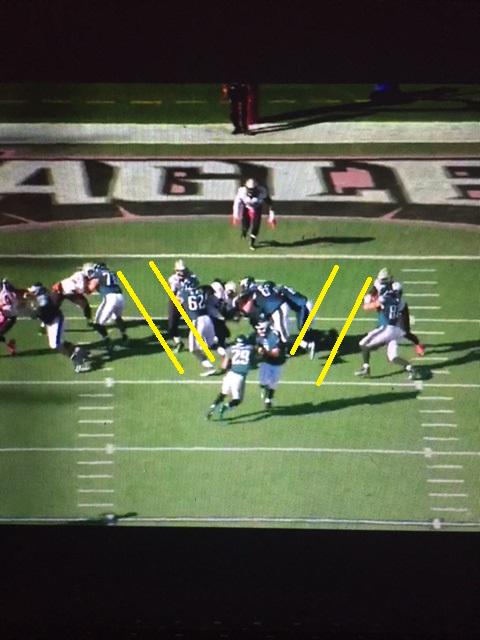
Play 1

As you can see, Murray has two lanes to attack. At a minimum, he should be able to get to the next level before having to beat the single high safety. Instead, Murray tried to bounce the play outside and fell before he was able to gain any yards:

Even when Murray has made the right reads, he has been a step too slow to exploit the hole. This loss of explosiveness and drop in production was to be expected.  Any running back that has touched the ball at least 370 times in a single season had his production fall off a cliff the following year, to the tune of a 39.2% drop in production on average (for some, like Larry Johnson, Terrell Davis and Jamaal Anderson, it was much, much worse).

Murray touched the ball an absurd 497 times last season (392 regular season rushes, 57 catches; 44 carries in the playoffs, four catches). That is 33% more than the 370 bench mark for production decline. It should be a surprise to no one that Murray has lost a step this year.

Meanwhile, Mathews just makes plays whenever he is on the field. He is a decisive, imposing running back that fits the downhill running style that Chip Kelly wants in this offense. He also looks much more explosive in the run game, as evidenced by his 6.1 yards per carry, compared to Murray, who is averaging a paltry 3.5 ypc.

Compare virtually identical plays (save for minor formation changes), and you can see the difference in speed and decisiveness between the backs:

Here is Murray running ta staple of the Eagles offense, the outside zone.

Now watch Mathews, running the same play out of a slightly different formation:

Ignore the result for a moment, and focus on how much faster Mathews makes the right read and explodes through the running lane. To be sure, Mathews had an easier hole to attack, but its not like Murray didn’t have anything to work with. Look at this lane:
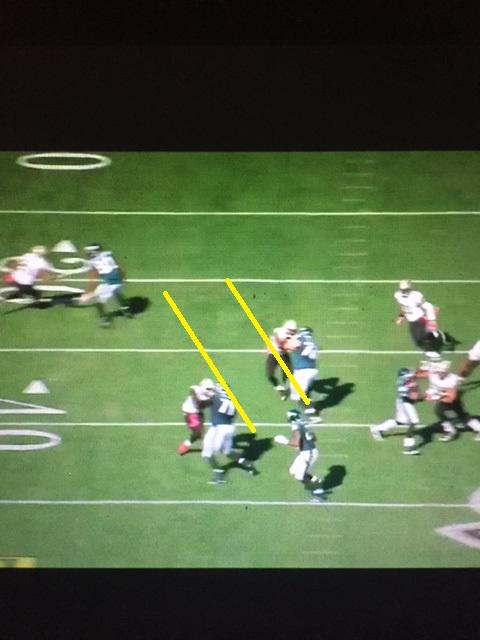
Play 5

It is fair to wonder whether Kelly’s loyalty to Murray has cost the Eagles a loss or two, especially in a winnable game against the Carolina Panthers. After Mathews broke off a 63 yard touchdown in the third quarter, he did not receive a single carry the rest of the game.

His absence was magnified after the Eagles defense picked off Cam Newton following Mathews’ touchdown run, which set the Eagles up at the Panthers 18 yard line. Murray received three carries and gained a grand total of one yard on that drive. Mathews sat on the sideline for the entire series. The drive stalled, and the Eagles settled for a field goal to make the score 21-16, Panthers.

It’s unclear why Kelly has stuck with Murray so far. Perhaps Kelly is trying to prevent Mathews — who has an injury history himself — from breaking down as we get deeper into the season (entirely understandable). Perhaps Kelly sees the $7 million the Eagles owe Murray next year and wants to give Murray every shot to validate the contract (somewhat reasonable, but still not smart). Or perhaps Kelly is just loyal to a fault and/or unable to recognize when a backup deserves more playing time (indefensible).

Regardless of the reason, Kelly needs to make the switch. Mathews should get more carries moving forward, and a case could be made that Sproles needs to get more touches ahead of Murray as well. It might upset Murray, but with the team at 3-4 and in desperate need of a division win this weekend, hurt feelings are the least of the Eagles worries.

Cooper and Austin

A more subtle issue is the frequency at which he is relying on Riley Cooper and Miles Austin to make plays in the passing game. Look, I get it: none of the receivers have been lighting the world on fire. So it’s not like Cooper and Austin are getting playing time over a Julio Jones-esque player.

But Cooper and Austin have been especially poor, and Kelly’s continued reliance on them is questionable, at best.

Kelly had the stated goal of wanting to improve the Eagles depth this offseason, especially on offense. The idea behind this was simple: Kelly runs a lot of plays, fast, and wants to be able to rotate players in without having to adjust his play calling.

The strength by depth approach sounds good in theory, but it hasn’t worked out so far this year. Consider the following break down of the Eagles receivers this season:

Name Targets %  of Targets Catch %
Jordan Matthews 63 22.9% 61.9
Zach Ertz 42 15.3% 57.2
Darren Sproles 37 13.5% 59.5
DeMarco Murray 28 10.2% 82.1
Riley Cooper 22 8% 50
Miles Austin 21 7.6% 52.3
Josh Huff 19 6.9% 68.4
Nelson Agholor 17 6.2% 47.1
Ryan Mathews 15 5.4% 80
Brent Celek 9 3.2% 77.7

A lot has been made about Matthews, Ertz and Sproles dropping the ball — and rightfully so. But if you compare their catch percentage to other receivers around the NFL, they actually are in pretty decent company:

Matthews has a 62% catch percentage, which is comparable to Julio Jones (65%), Odell Beckham (64%), Randall Cobb (64%), Jarvis Landry (64%), Demaryius Thomas (62%) and Calvin Johnson (63%).

Sproles (60%) and Ertz (57%), meanwhile, are among Allen Hurns (61%), Marques Colston (61%), Brandin Cooks (60%), Emanuel Sanders (58%), and DeAndre Hopkins (57%).

If we expect some regression to the mean for the drops on all three (which I think is fair, given that their current drop rate would be historically bad), those catch percentages would improve even more.

But Cooper and Austin? Their 50% and 52% catch rates, respectively, are among some of the worst in the NFL, ranking them along side the likes of Ted Ginn, Jr. (49%), Malcolm Floyd (50%), TY Hilton (50%), and Allen Robinson (49%). Despite their bad production, they still account for 16% of the team’s total targets.

So how can Kelly fix it? I would like to see the Eagles shift some of those targets to Matthews, Ertz and Sproles, and even Huff and Agholor. Yes, the latter two have been underwhelming so far, but it is too early to give up on them given their age and potential. And that is especially true with Agholor, who I suspect will see a resurgence in the second half of the season much like Jordan Matthews did last year.

But I think, no, I am quite certain, that the same improvement cannot be expected from Cooper or Austin.  Cooper is a six year vet, Austin (who used to be very good), is in his ninth season. Expecting a resurgence from either of them at this point in their careers is unreasonable.

Kelly can offset the loss of Cooper’s run blocking skills by relying more heavily on the 12 personnel we have seen emerge in recent weeks (two tight ends, two wideouts, 1 running back).

Celek represents an upgrade over Cooper in the blocking category, so leaving Cooper on the sideline for someone like Huff or Agholor makes sense. And given Ertz’s versatility and strength as a pass catcher, there really isn’t much of a downgrade in the passing game.

I also think the Eagles can look to how the New England Patriots utilize former Eagle Dion Lewis for ways to get Sproles more involved. Lewis is averaging 86 yards per game through the air and on the ground, with the Patriots lining him up all over the field.

In the blowout win against the Miami Dolphins on Thursday night, the Patriots lined up Lewis out wide against a cornerback:

Here is a better look at the route:

The Eagles have split Sproles out wide a handful of times this year. But he is still being underutilized. There is no reason they cannot increase the frequency with which Sproles lines up as a receiver, and continue to look for ways to get Sproles involved in the screen game. He is a dynamic weapon that few defenses have answers for, but right now the best defense for Sproles seems to be Kelly’s unwillingness to use him.

And while having Mathews, Sproles, Ertz and Celek on the field at the same time might not be conventional, they are our best offensive weapons right now, so it makes sense to throw convention out the window in pursuit of more wins.

Play calling

Kelly has invested  $11.61 Million in the running back position, good for third highest in the NFL.  It was a curious decision given how much the NFL has devalued the running back position. The Eagles currently spend more money on running backs than the Denver Broncos, New England Patriots, Atlanta Falcons and Arizona Cardinals combinedwho are a collective 26-4 this year. The teams in the top four of money spent on running backs? The Minnesota Vikings, Chicago Bears, Philadelphia Eagles and Houston Texans, who are a combined 13-16.

While we can debate the merits of Kelly’s investment in the running back position, there really can be no debate that Kelly has under utilized those backs throughout the season. Kelly has actually called the least amount of run plays in his time with the Eagles, as you can see in this chart, which breaks down the run to pass ratio (rankings in parenthesis):

Year Pass% Run%
2013 53 (27) 47 (6)
2014 57.82% (21) 42 (12)
2015 60.17% (15) 39.83% (18)

Earlier in the year, the Eagles’ offensive line could not run block to save their lives, so Kelly had no choice but to abandon the run. But since the Jets game, the run blocking has improved considerably. So it is unclear why Kelly continues to abandon the run game, especially given how poorly both the receivers and quarterback have played.

Take the Carolina game, for instance. With the exception of the tail end of the fourth quarter, the Eagles were not in a position where they needed to abandon the run. Yet, Kelly kept dialing up the pass, calling 51 pass plays (46 passes, 5 sacks) to just 30 runs.

Why is balance so important? Well, for starters, the Eagles have a much better win percentage when they have a more balanced attack. The Eagles are 12-2 when they run more than pass. But when the inverse is true? The Eagles are 10-15.

I understand that correlation does not necessarily equal causation; but it is hard to ignore this sample size. 12-2 and 10-15 are not statistical aberrations. They are large enough sample sizes from which to draw the conclusion that the Eagles are much better when they take a balanced approach.

The other reason is that it will take pressure off of Sam Bradford and the wide receivers, and open things up in the passing game. Look at the difference between the Eagles offensive production in 2013, when they asked Nick Foles to throw the ball on average only 31 times a game, compared to 2014, when Foles was throwing it 39 times a game.

Or look at how Tony Romo enjoyed the best year of his career last season, when the Cowboys ran the ball 49% of the time, good for third most in the NFL. Romo was 12-3, completed 69% of his passes, threw 34 touchdowns, 9 interceptions, and had a 113.2 quarterback rating.  That was career best marks in completion percentage and quarterback rating, and the second best marks in his career for touchdowns and interceptions.

Simply put, the Eagles invested heavily in the running back position. It is time they start using it.

Conclusion

So in short, the Eagles need to consider making the following changes.

  • Give Mathews more carries than Murray.
  • Stop relying on Cooper and Austin so much in the pass game. Divide their targets among Matthews, Ertz, Sproles, and even Huff/Agholor.
  • Run the ball more. The team wins more often and it opens up the passing game.
Self Scouting the Eagles Part 1: On Drops

Patrick Causey, on Twitter @pcausey3

For teams riding a hot streak, a bye week is about as welcomed as a root canal. It threatens to disrupt the positive momentum a team has built by placing 14 long days between their games.

But for a team like the Eagles, who are mirred in the middle of a season that is as disapointing as it is frustrating, the bye week could be the perfect tonic. It provides the opportunity for the team to get away from the facility for a week, clear their heads, and hit the reset button on the season.

While the players are away, Chip Kelly and his coaching staff will be spending the week self-scouting, which simply means they will be evaluating what the hell went wrong with the first seven weeks of the season and coming up with a blueprint for salvaging the rest of it.

The good news for the Eagles is that the NFC East is very much wide open. The Giants are the best team by default, but they have question marks across the board that the Eagles exposed two weeks ago. The Cowboys are an injured, toxic wasteland. And if the injuries to Dez Bryant and Tony Romo don’t derail their season, it could be ended by Greg Hardy and Joseph Randle, two head-cases that seem hellbent on out-crazying one another. And the team from Washington is probably the only team in the NFL that is more inconsistent than the Eagles, as their wild, come from behind victory over the lowly Tampa Bay Buccaneers showed us last week.

So what can the Eagles do to get back into contention? What is holding the team back? Let’s try to replicate what is going on inside the NovaCare Complex this week and do some self-scouting of our own.

I’ve identified five issues with this team, in no particular order, that I want to discuss. But I am sure there are more than this, so feel free to leave your list in the comments:

  1. Drops
  2. Quarterback play
  3. Lack of consistency
  4. Self-inflicted wounds
  5. Mismanaging player acquisition and utilization

I want to address items 1 and 2, as well items 3 and 4, at the same time because I think they go hand in hand. Let’s break down the drops and quarterback play first. Part two and three will come out over the next week.

1. Drops and Quarterback Play

I wrote an in-depth breakdown of the issues facing Sam Bradford last week (which you can read here), so I am not trying to rehash those issues again. Instead, I want to focus on the utility of measuring drops and challenge how we apportion blame for drops between the receiving corp and Sam Bradford.

It is no secret that the Eagles wide receivers have dropped a ton of passes this year. We have seen it discussed ad nauseum for the entire season, but it peaked after last Sunday’s loss to the Carolina Panthers where the team dropped anywhere from seven to 10 passes depending on which website you rely upon.

The common narrative emanating from the game was that the receivers were to blame for the drops, and the optics — at least at first blush — certainly supported that. In a fitting end, Miles Austin dashed any hopes of an Eagles comeback by dropping a Sam Bradford pass on 4th down late in the 4th quarter.

But after going over the game tape, I saw issues that suggested, as always, it was not as clear cut as we thought. While the receivers deserved their fair share of the blame, Bradford’s placement on certain passes, including the Miles Austin drop, had at least some impact on a handful of the drops, and had significant impact on others.

But before I get to that, let’s take a step back and examine how drops are evaluated on a macro-level by the media and advanced metric websites such as ProFootballFocus.com. Gaining a better understanding of the issues inherent with how we measure drops will help us evaluate the Eagles season to date.

Drops at a macro-level

Organizations like Pro Football Focus, as well as other advanced metrics companies that work directly with NFL teams, have placed considerable emphasis on drops when evaluating a quarterbacks play. PFF.com factors drops into two of its key “Signature Stats”: QB Rating and Accuracy Percentage.

From the website, PFF states accuracy percentage “accounts for dropped passes, throw aways, spiked balls, batted passes, and passes where the quarterback was hit while they threw the ball – factors that hurt the quarterback’s completion percentage but don’t help show how accurate they are. The formula: ((Completions + Drops) / (Attempts – Throw Aways – Spikes – Batted Passes – Hit As Thrown)).

PFF does a similar thing with its quarterback rating, again from its website: “Offering an alternative to the out-dated standard, we take into account dropped passes, throw aways, spikes, and yards in the air and further adjust the old formula so it makes more sense and is a more accurate measure.”

In other words, in an effort to determine how accurate a quarterback truly is, and how well that quarterback is performing overall, PFF tries to remove static from the equation — i.e., bad plays which are outside of the quarterback’s control that impact his rating and completion percentage.

Sounds good in theory, right?

But noticeably absent from these equations are plays that the quarterback benefits from undeservingly. For example, PFF does not subtract from the quarterback’s accuracy percentage catches that were off target but caught because a wide receiver made a spectacular grab. And in the quarterback rating, PFF does not factor in easy interceptions which were dropped by a defender.

So a quarterback gets credit when a receiver drops a pass like this:

But does not get dinged when a defender drops an easy interception like this:

Or when a receiver bails out the quarterback from an inaccurate throw like this:

By focusing on only half of the equation, the results are improperly skewed to the quarterbacks benefit.

Another different, but related, issue I have with drops is that drops is that not all drops are created equal. But they are largely treated the same.

Drops are inherently subjective; which is why you can look at three different websites and get three different numbers for a total on team drops. Most websites, however, use the basic parameter of ruling something a drop if the ball hits a receiver in the hands.

But this approach places too much emphasis on the wide receiver and ignores the impact that a quarterback’s ball placement has on the receiver’s ability to catch the ball. That simply cannot be ignored if we are to fully and properly evaluate what constitutes a drop pass versus a bad throw.

Let’s take this out of the abstract. I think we all can agree that this is a drop by Riley Cooper. The ball is placed perfectly by Bradford, and Cooper fails to make the catch:

Ditto this play by the otherwise sure handed Darren Sproles:

Bradford has shown an affinity for the wheel route, and you cannot place this ball any better than that.

But what about this throw from Bradford to Jordan Matthews against the Cowboys?

Matthews is running a crossing route and has a step on his defender, so Bradford ideally needs to place the ball in front of Matthews so he can catch the ball without breaking his stride. Instead, Bradford is off with his throw, placing it on his backside shoulder, which forces Matthews to stop on his route and contort back towards his defender to make the catch. Is this really a “drop” or simply a poor throw by Bradford?

Or what about this throw to Nelson Agholor against the Jets — does this constitute a “drop”? It hit Agholor’s hands, so at least under some standards, it might be labeled a drop even though it was clearly a poor pass by Bradford.

I have not found any website which takes the negative plays — i.e., dropped interceptions, spectacular catches by the receiver —  into account, or which does a fair job differentiating between a drop and an incompletion based on a poor throw by the quarterback.

Until I see a metric that takes both into account, I assume, for better or worse, that these plays even out in the long run. Absent extraordinary circumstances, it is reasonable to expect that a quarterback will be let down by his receivers roughly the same percentage of times that he will be bailed out by his receivers. Ditto with interceptions. It isn’t perfect. But it seems like a more complete way to evaluate a quarterback’s play.

Drops on a micro-level

Which brings me to the Eagles this year. PFF.com has Bradford as the victim of a league leading 25 drops. And against the Carolina Panthers, the Eagles dropped anywhere from seven to 10 passes during the game.

Some of them were flat out drops. Like this pass to Darren Sproles:

Or this pass to Zach Ertz:

Those are inexcusable drops. In Sproles case, it contributed to a stalled drive inside the Panthers 20-yard line. The Eagles ended up settling for three points instead of a touchdown.

But there were other plays — three, to be exact, where Bradford hurt himself with his ball placement.

Let’s start with the interception Bradford threw when he targeted Jordan Matthews early in the game. When I watched this play initially, I thought Matthews was at fault. While ball placement was not ideal — Bradford threw it to Matthews’ outside shoulder when he was running an inside crossing route — I thought the catch should have been made.

But one thing we have to take into consideration is that this is pass is four-five yards past the line of scrimmage, and Bradford delivers the ball on an absolute rope. That increases the degree of difficulty here because Matthews barely has any time to react to the ball.

Here is another view:

Bradford could have made this easier by either taking something off the pass or placing the ball in front of Matthews (or both). While NFL caliber wide receivers likely should have made that catch, NFL caliber quarterbacks –without question — should be able to deliver this easy pass accurately. Bradford did not, which is why I think he deserves a good share of the blame.

In the third quarter, the Eagles were driving deep into the Panthers’ territory, down 21-13. A touchdown could have brought the Eagles within one or tied the game (had they gone for two).

On third and goal, Bradford had Josh Huff running a post route to the middle of the end zone, but Huff dropped the would be touchdown:

Or did he? Let’s look at this a little further. First, here is the screen shot right before Bradford delivers the throw:

IMG_1825

So far so good. Bradford has Huff one on one with a linebacker (Kuechly) and a clear lane to throw in-between the defenders. The only problem? Bradford doesn’t fully lead Huff; the ball is again thrown to the wrong side of Huff, causing him to have to turn away from where his momentum is carrying him. Here is a close up:

IMG_1828

The ball is hard to see, but what is apparent is that Huff is having to turn 90 degrees in air to try to make the grab. Could he have made the catch? Possibly. But would the catch have been much easier to make if Bradford placed it properly? You bet.

Back to that Miles Austin play I alluded to earlier. It was 4th down on the Eagles last drive of the game, and Austin is running a seven yard out route. He gets open, Bradford gets him the ball, but Austin fails to make the catch.

But again, Bradford’s ball placement here was suspect:

IMG_1831

You can see where the ball is thrown compared to where Austin’s momentum was taking him. It was an easy pitch and catch made more difficult by Bradford’s ball placement. Austin still could have made the catch, but I think Bradford deserves the lion’s share of the blame here.

Without question, the receivers need to improve moving forward. I am not ignoring that nor excusing their poor play. But we should not automatically assume that every (or even most) drops are solely on the wide receiver. The quarterback plays a big part in whether a pass is caught, and up until this point in the season, Bradford has failed to live up to his end of the bargain.

A reason for optimism

Let’s end on a positive note, because I think there is a chance we see the drops improve over the season. For starters, the normal drop rate in the NFL usually is around 7-8%. Currently, the Eagles are at 11.41%. So we should expect at least some regression to the mean over the remainder of the season.

But I also think we should see some improvement from Bradford as he continues to work his way back from his knee injury. Look at this chart of Bradford’s dropped passes throughout his career:

Year

Drops Percentage of Pass Plays Rank
2010 36 6.1% 5th most
2011 31 8.6% 1st*
2012 30 5.4% 18th
2013 12 5.5% 19th
2015 25 11.41% 1st

In Bradford’s first two years in the league, his team struggled with drops, having the fifth most drops in his rookie year, and the most drops in his sophomore campaign. This is understandable: Bradford was new to the league and likely needed time to adjust to the speed of the game, the complexity of the defenses, and the tighter windows through which he had to throw.

But in the following two seasons, Bradford showed marked signs of improvement, ranking slightly better than league average.

The Rams did not bring in any high priced, big name wide receivers over the course of the 2012 and 2013 seasons. And while both seasons were cut short by injury, they were not too short to write off the improvement as too small of a sample size (Bradford played 10 games in 2012, seven games in 2013). So this improvement likely was the result of Bradford becoming more accurate with his passes.

So why the regression this year? Obviously, the wide receivers are not playing well, and that is likely contributing to the high numbers. But I also think Bradford’s knee injury is limiting his play — not only from a confidence and mechanical perspective, but also because it prevented Bradford from getting a full offseason’s work in as he worked through his rehab from March to August.

I am not making excuses for Bradford. He has not played well up to this point in the season and he will need to improve if the Eagles are going to have any chance to competing for the NFC East title. But I would not at all be surprised if we start to see the drops improve over the course of the season, not only because the receivers can’t be this bad (can they?), but also because Bradford’s accuracy should improve as the season progresses.

Diagnosing Sam Bradford’s Struggles

Interceptions are not the issue, but are merely a symptom of the issues hampering Bradford’s game; can they be fixed?

Patrick Causey, on Twitter @pcausey3

The last two weeks of the Eagles season perfectly illustrates the importance of the quarterback position. The Eagles have gone from 1-3 with their season on the brink of collapse, to being in first place in the NFC East. They have been led by a dominating defense and strong play from their offensive line and run game, three things which seemed inconceivable after the loss to the Atlanta Falcons. And they have won their last two games by a combined 44 points while piling up 957 yards of total offense in the process. Heck, even their much maligned kicker, Calib Sturgis, has been perfect on field goal attempts over the last two weeks.

Given what we have seen, it is fair to wonder whether this is the deepest and most balanced team that Chip Kelly has had as head coach of the Eagles. And yet, there is an overwhelming sense of anxiety surrounding this team.

Why? Because of the quarterback.

To put it mildly, Sam Bradford’s play has been inconsistent. Ask anyone the biggest problem with Bradford’s play to date, and they will likely point to the alarming rate at which he is throwing interceptions. And indeed, Bradford’s 3.9% interception rate dwarfs his career rate of 2.2%. His nine interceptions rank second in the NFL, and his four redzone interceptions — three of which that have occurred in the last two weeks — is tops in the league.  Bradford is one of only two quarterbacks to throw two-plus interceptions in four of the six games he’s played (the other being Kirk Cousins).

But the interceptions are not the reason for Bradford’s poor play, they are merely the symptoms of the actual flaws in Bradford’s game that are causing the interceptions.

The tape shows that there are three issues that have haunted Bradford so far this season that are leading to a spike in interceptions:

  • Bradford struggles when he is under pressure or thinks he is under pressure;
  • Bradford is not seeing the field properly which is leading to bad decisions; and
  • Bradford’s ball placement has been inconsistent, which largely results from his failure to transfer his weight during his throws.

Before we dive a little bit deeper, consider this quote about Bradford from NFL.com’s Greg Cosell:

There [a]re two particular areas where significant work was needed [in Bradford’s game]. There were times he was not comfortable in the pocket with bodies around him. That’s a different trait than looking down the gun barrel. When the pocket closes down and functional space is reduced to throw cleanly and comfortably, you must still stay on balance and deliver the ball in the eye of the storm…In addition, there were instances in which Bradford had opportunities to be more aggressive throwing down the field that he didn’t take advantage of…

Bradford [has been] tentative in the pocket, not mentally sharp, and at times he did not let it loose when he had a throw. An inconsistent profile had been established. What really stood out as the year [has progressed is] Bradford’s reaction to pressure — the issue that first surfaced in his rookie season against Kansas City. It is easy to place the blame on the…poor pass protection, but that circumvents the more essential point. You must be able to function effectively in a muddied and noisy pocket to play quarterback well in the NFL, and Bradford began to perceive pressure that was not there. He was anticipating the rush, and you cannot perform that way, no matter what kind of talent you have throwing the football.

[Bradford’s] velocity ha[s] decreased; he [i]s not driving the ball down the field….His precise ball location, a feature of his game as a rookie, had waned. He missed some throws that were there. He had very little sense of timing with his receivers. He threw some balls too early, and some too late; the passing game was clearly out of synch. I strongly believe the injuries, the revolving door and the overall lack of quality at the wide receiver position [i]s a more legitimate reason for Bradford’s struggles than the offensive line. The inability of [Eagles] wideouts to get open on one-on-one isolation routes — a must in the NFL — had an extremely negative impact on Bradford. His game is timing and rhythm, but his uncertainty as to when to deliver the ball is clear on last season’s tape. He was hoping, rather than playing, and that’s a formula for failure.

I think this is a fairly accurate depiction of Bradford’s struggles so far this year, with the exception that Bradford has been willing to take more shots down the field as the season has progressed.

The only problem? Cosell wrote this back in 2012, after Bradford’s second year in the league. I slightly modified the post so that it was in present tense.

Which begs the question: if Bradford is struggling with many of the same issues that limited his game over four years ago, is it reasonable to expect him to improve this year, even if he cuts back on the interceptions? Or, to steal a line from Denny Green, is Sam Bradford what we thought he was? The answer, as usual, is a mixed bag.

When we dig deeper into the numbers and the tape, a picture begins to emerge of an incredibly talented, but flawed quarterback; one that should expect to see areas of improvement as the season progresses, but one who likely won’t live up to the lofty expectations that most fans had during the preseason. Let’s break this down further.

Bradford Throwing Under Pressure

A consistent issue we have heard about Bradford over his career is that he struggles to throw the ball under pressure, real or perceived. As Cosell pointed out in his 2012 article, Bradford “was not comfortable in the pocket with bodies around him” at times, and even “began to perceive pressure that was not there.”

The numbers back this up. Per PFF.com, here is Bradford’s completion percentages, touchdowns and interception totals, plus their ranks (contained in parenthesis), when throwing under pressure:

Year

Cmp%

TD

INT

2010

41.1 (23/29)*

4 (T-18)

7 (T-5)

2011

38.4 (23/24)

6 (21)

2 (22)

2012

41.6 (20/27)

5 (11)

2 (T-23)

2013**

38.8 (26/29)

2 (T-12)

1 (T-21)

2015

44.6 (26/31)

4 (T-2)

4 (T-3)

  • *Note that the number of candidates vary from year to year because a different number of candidates qualified for PFF.com’s statistics.
  • **In 2013, I used only the numbers for the first seven weeks, since that is the time period Bradford played before suffering a torn-acl.

When Bradford was with the Rams, we saw him make costly mistakes like this under pressure:

Bradford has repeated those mistakes this year with the Eagles, as we saw on this interception against the Falcons:

Now, pressure impacts every quarterback. Even Aaron Rodgers and Tom Brady throw bad interceptions under pressure. That is why pass rushers are, on average, the third highest paid position group in the league (behind only quarterbacks and wide receivers). So throwing interceptions under pressure is not unique to Bradford.

While Bradford has thrown the third most interceptions while under pressure this season, there is some evidence to suggest that he will cut back on the interceptions. In Bradford’s rookie year, he threw 7 interceptions, which was tied for fifth most in the league. That’s to be expected for a rookie quarterback. But in each of the following three seasons, Bradford showed marked improvement protecting the football.

Bradford’s struggles this year might be the result of his time away from the game. With time, we should expect to see Bradford improve as he get more comfortable with this offense and more confident in his knee.

But that does not necessarily mean that Bradford’s problems throwing under pressure will be solved once he cuts back on the interceptions. Bradford’s completion percentage under pressure has ranked towards the bottom of the NFL throughout his career, which suggests a deeper issue that cannot be explained away by the rust caused by his time away from the game.

For whatever reason, Bradford struggles when he does not have a clean pocket. This struggle is one of the primary reasons why Bradford is such a frustrating quarterback to watch. In training camp and preseason — when pressure is virtually nonexistent — Bradford’s pinpoint accuracy and quick decision making are on full display. But when the pressure comes, Bradford freezes up. His mechanics become sloppy, he gets rid of the ball too quickly, and he becomes wildly inaccurate.

Five seasons in, it is reasonable to wonder if this is an issue that will persist for Bradford throughout his career.

Bradford’s Faulty Mechanics

The tape also shows that Bradford is struggling with his mechanics. Back in training camp, Louis Riddick, formerly of the Philadelphia Eagles front office and currently of ESPN.com, tweeted the following about Bradford:

Ron Jaworski appeared on 97.5 The Fanatic earlier this season, and saw the same thing:  “He’s favoring the left leg.  I can see it when bodies are around him.  He’s not transferring that weight.  The ball is coming out with a lack of energy.  His footwork is bad. I can’t say any more simply than that.”

To understand the importance of not transferring weight on your throw, we need to understand the technical components of throwing the football. Many exercise scientists and kinesiologists agree that that throwing a football at an elite level is the most complex motor skill in all of sports. It requires flawlessly executing a number of independent, but related moves in one compact throwing motion. Even the slightest breakdown in mechanics can adversely affect a quarterbacks power and accuracy.

Here is the breakdown in simple terms:

  1. A quarterback needs to put approximately 70% of his weight on his back plant leg plant his back leg.
  2. The quarterback then turns his front shoulder inward and away from his target, like loading a spring.
  3. In one fluid motion, the quarterback uncoils the spring, exploding forward with his throwing arm rotating towards the target while transferring his weight from his back leg to the front leg.

Many people mistakenly believe that power is generated from a quarterback’s arm, when in fact, it comes primarily from the quaterback’s core, legs and hips. It is generated in that last motion, with the quarterback rotating his hips and transferring weight from his plant leg to his front leg.

But the key is to allow that weight transfer to occur naturally. If you rush or force the weight transfer to your front plant leg too early, it creates an all arm throw that lacks velocity and consistent accuracy. That’s what happened to Drew Brees last year when he was dealing with an oblique injury, and we are seeing it with Bradford this season as well as he continues to come back from his knee injury.

Perhaps the best example of Bradford not transferring his weight properly came on the second interception he threw to Zach Ertz last week against the New York Giants. If you recall, Ertz was double teamed in the end zone, but Bradford tried for a jump ball hoping Ertz could make it play:

It was a bad decision by Bradford that was compounded by his faulty mechanics. Here is a screen shot just as Bradford released the ball:

Bradford Bad Mechanics

The position of Bradford’s shoulders tells us that he is not transferring his weight properly. With proper mechanics, Bradford should have rotated his throwing shoulder towards his intended target, Ertz (which would be towards the bottom left of this picture). Instead, we see that when Bradford releases the ball, his shoulders are practically parallel to one another; there is virtually no rotation towards his receiver, which explains why the throw came up short.

The question is whether Bradford can fix it. Jaws thinks the issue stems from a lack of confidence in his knee, which wouldn’t be the first time a quarterback has struggled with his mechanics when coming back from a knee injury. Robert Griffing, III had the same issues following his knee injury in 2013.

But as Greg Cosell pointed out, Bradford has struggled with this issue since 2011: “[Bradford’s] velocity ha[s] decreased; he [i]s not driving the ball down the field….His precise ball location, a feature of his game as a rookie, had waned. He missed some throws that were there.”

These are clear signs that Bradford is not transferring his weight properly in his throw.

The encouraging news is that Bradford has recognized the problem. Per Paul Domowitch of the Philadelphia Daily News:

It’s been mechanical. Me and coach Day talked a little bit about it this week. I’m not sure my weight transfer has been where it should be on a couple of throws. I’m not sure I’ve really gotten to my front leg. I think that’s why some of them have been short. So I spent a lot of time this week trying to get back to the fundamentals.”

Now it’s just up to him to fix it.

Bad Decision Making

The final issue I’ve noticed on tape has been Bradford’s poor decision making. While Bradford is known for his high football intelligence, he has curiously struggled to work through his progressions and see open receivers this season. We have seen this issue pop up throughout the season (which I have covered here and here).

Let’s start with his interception to Riley Cooper against the New York Giants.

When I first saw this live, I thought the interception was on Cooper, who stopped short of his route.

But watching the tape again, I saw why Cooper optioned to a deep curl instead of the post: there was safety help over the top. Here is a screen shot right at the moment Bradford was releasing the ball.

Cooper INT

Cooper is highlighted in yellow and is starting to break into the curl route. The safety (highlighted in red at the center of the field), is already breaking on the post route.

Cooper made the right read here. Running a deep post into double coverage, especially with someone as slow as Cooper, is a recipe for disaster. Cooper recognized this, and optioned to a deep curl in single coverage. But Bradford threw to the deep post anyway. He just can’t make this throw.

Brian Dawkins saw the same thing, per Mark Eckel of NJ.com: “On the one interception, I don’t know maybe he expected Riley (Cooper) to do something else, but to throw the ball down the middle of the field like that with a safety there, you can’t do that. You just can’t do that.”

Bradford has struggled making correct reads and getting through his progressions throughout the year. Consider this first and 10 play in the first quarter of the Eagles game against the New York Jets. The Eagles are running a staple of Chip Kelly’s offense, the triangle concept (which I cover in depth here).

Ertz missed

Zach Ertz is running a corner route on this play; Riley Cooper is running a drag route across the middle, and Ryan Mathews is running an out route out of the backfield towards the space vacated by Cooper.

Bradford almost immediately checks the ball down to Mathews (circled in red below) without letting the play develop. The throw is high and to the wrong shoulder, and falls incomplete. But again, Bradford makes a wrong read and misses Ertz (circled in yellow), who was wide open on the corner route:

Ertz 2

Here is a better angle showing the space Ertz had to operate:

Ertz 3

Bradford was not under pressure on this play, he simply rushed the throw to his check down option, missing the opportunity for a big play.

One final example (and apologies for bringing up the bad memories here). In the Dallas game, Bradford threw this costly interception when he targeted Zach Ertz in the end zone.

With the exception of a minor formation change, this is the same play the Eagles successfully ran against the Green Bay Packers in the preseason where Bradford delivered a strike to the underneath crossing route for a touchdown.

But here, Bradford forces the throw to Ertz, and misses Nelson Agholor (circled in yellow), who is open on the underneath crossing route.

Ertz INT Dallas 1

Bradford also had Cooper wide open on the deep in route, as we can see from this screen shot:

Ertz INT Dallas Cooper

Again, there are reasons to believe that Bradford can improve here: he is only six weeks in to learning a new offense, a process which has been hampered by Bradford missing valuable time this offseason recovering from his knee injury.

And Bradford showed progress getting through his progressions against the Redskins and the Saints. That should not be forgotten simply because Bradford had a bad game against the Giants.

Conclusion

So where the hell does that leave us? As I suggested about 2,000 words ago, it leaves us with a muddled picture. That probably isn’t the popular answer in a world that demands hot takes and bold statements, but it is probably the most reasonable conclusion that can be reached.

No one can dispute that Bradford has been inconsistent this year. Part of those inconsistencies can be explained by Bradford struggling to come back from a two-year layoff while simultaneously learning a new offense with new teammates. But part of these issues have persisted throughout Bradford’s career, so they likely are a sign of a fundamental issue with Bradford’s game more than rust.

I still believe that talk of replacing Bradford with Mark Sanchez is wildly premature. Bradford should be given at least until after the bye before we reach any concrete conclusions on the state of our quarterback. And even then, I’m not sure that switching to Sanchez represents any discernible upgrade. Regardless, we should expect some improvement from Bradford this year, but any thoughts of Bradford being a top ten quarterback in this league seems misplaced.