Since we’re in the midst of the off-season, between the two major team-construction events, I thought it’d be a good time to explain my personal philosophy on what it takes to win a Super Bowl. The goal is to try to dig down to the most basic attributes a team must have, and in the process examine clichés like “defense wins championships” or “you need an elite QB”.
Here’s where I am currently:
To win the Super Bowl:
– You need a lot of good players.
– You need some of those players to play great (greatly?) in the playoffs.
– You need to get a few lucky bounces along the way.
That’s my current theory at least, I’ll update it as I find new data that conflicts. Today I’ll give my thoughts on the QB position and then examine the whole Offense vs. Defense wins championships thing.
Overall, I’d like to identify a set of necessary conditions for winning the Super Bowl. Today is the first step in that endeavor.
First I’ll attack the QB position:
You do not need an elite QB to win the Super Bowl. It certainly helps, but the fact is you just need a “good enough” QB. The entire “elite” debate is ridiculous, but especially at the QB position. When you use the term “elite”, you’re alluding to a very exclusive group. Is the top 10% fair?
If so, that means the number of “elite” starting QBs in the NFL is between 3 and 4. So congratulations Patriots, Packers, and Broncos; one of you obviously won the Super Bowl last year.
The fact is, the term “elite” is useless since there’s no standard definition, and even if there were it wouldn’t mean anything significant. Teams need a QB that is “good enough”. So what does my list look like?
Good Enough – Brady, Manning (both), Rodgers, Brees, Ryan, Roethlisberger, Flacco, Schaub, Romo (i hate him but yes), Rivers, Kaepernick, Luck
That’s my list, although I’m sure there is some disagreement. Also, this is not to say a QB not on that list CAN’T win the SB, just that, at this moment, I don’t believe they’ve proven themselves good enough.
Joe Flacco is not an “elite” QB, by any realistic definition. However, that doesn’t matter, he still won the Super Bowl. Colin Kaepernick came damn close.
The problem for Eagles fans is that neither Vick nor Foles looks good enough this year. It’s possible Foles could get there, but extremely unlikely this season. I’m pessimistic about Vick’s chances.
Does Defense Win Championships?
Well, what do you think? Now consider:
– Over the last 10 seasons, 5 SB winning teams ranked in the top 7.5% for points allowed per game. Put differently, the top 24 out of the last 320 team seasons contained half of the Super Bowl winning teams.
This is, perhaps, the most surprised I have ever been by a stat I’ve looked up while writing. In any case, it would certainly appear as though having a truly great defense goes a long way.
What about offense?
Based upon the above stat, I would expect to find a similar result (i.e. be great at something, either offense or defense). Looking at the same sample:
– Just 1 SB winning team (New Orleans ’09) in the last ten years placed in the top 7.5% of points scored, or 92.5 percentile.
If we look at the top 10% of offenses over the last 10 years, just one more SB champ makes the cut, the 2004 Patriots.
Put together, it seems like having a “great” defense is preferable to having a “great” offense. That definitely has to change the overall theory a bit.
What about the reverse perspective?
– The lowest ranked offense to win the Super Bowl in the last ten years was the 2008 Steelers, who averaged just 21.7 ppg, good enough for exactly 160 out of 320, or the 50th percentile.
The 2003 Patriots are just above them, having averaged 21.8 ppg. Interesting to note that the Patriots (now offensive juggernauts), won their first title with a fairly weak offense.
As you might have expected, both the ’03 Patriots and the ’08 Steelers had historically great defenses. Both placed in the top 10 of the last 10 years.
– The lowest ranked Defense to win the SB in the last ten years was the ’11 NY Giants, who allowed 25 ppg (while scoring just 24.6, leaving them the only SB winning team with a negative point differential, I really hate the Giants).
That places them 265th out of 320 teams, or 17th percentile.
– Among SB winners of the past 10 years, the 2007 Giants are the lowest ranked offense that did NOT have a corresponding historically great defense. They scored 23.3 ppg, ranking the team 120th out of 320, or the 62.5 percentile.
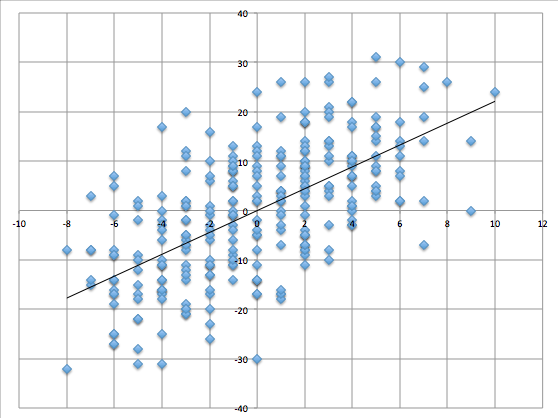
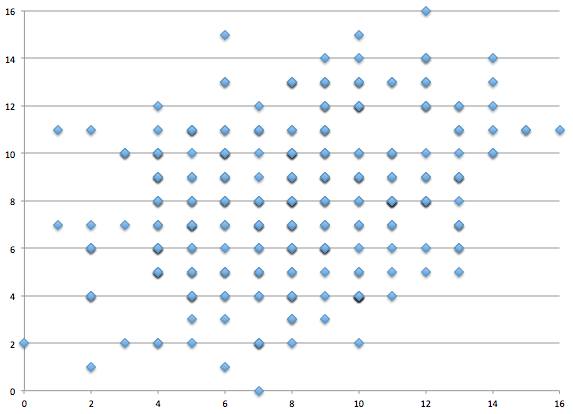
I feel like we need some charts, so here are two, one showing points allowed vs. Wins and the other showing Points Scored vs. Wins. Note this is just regular season data.

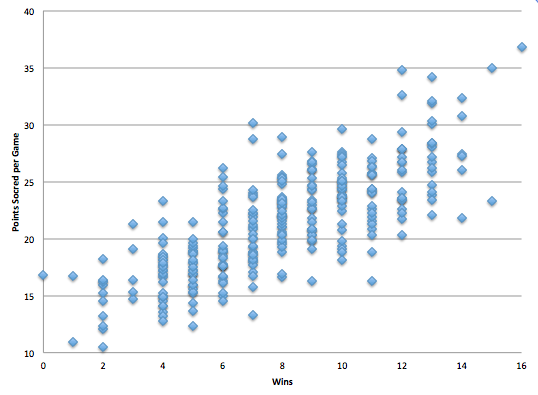
Both illustrate strong correlations. The values:
– Points Scored to Wins: .768
– Points Allowed to Wins: -.669
Have I confused you yet?
If not, good for you, because I’ve certainly confused myself. Let me attempt to summarize what we’ve seen here today:
– A GREAT defense goes a long way, but is NOT a necessary condition to winning a SB. Neither is a GOOD defense, as evidenced by the ’11 Giants, ’06 Colts, and ’07 Giants (all placed in the bottom 50% yet still won the SB).
– A GREAT offense does not go as far, but a GOOD offense does seem to be a necessary condition for winning a SB. No offense ranked in the bottom 62.5% for the last ten years has won the SB.
What does it all mean?
While teams should focus on being good everywhere, it appears as though Offense should take slight preference, as the only way to win without a very good offense is to have a historically GREAT defense, which is obviously harder to put together.
Or you can be like the NY Giants and just ride a wave of lucky bounces…twice.


 Eagles Rewind