Draft Order

Putting the Rewind together, but I wanted to post a note about the draft order.  The Eagles are currently tied with the Raiders and Lions with a record of 4-11.  The draft order is decided by the final standings (with the worst team getting the best pick).  If teams have the same record, my understanding is that strength-of-schedule is the tiebreaker.   Keep in mind that having a tougher schedule ranks you higher in the final standings and therefore give you a worse draft pick.

Currently, the opponents records for the Raiders, Eagles, and Lions are as follows:

Raiders – 112-128

Eagles – 122 – 118

Lions – 136 – 102 – 2

As you can see, the gaps are wide enough that this Sunday’s games are unlikely to change the order.  Therefore, if all three teams lose, the Raiders would secure the #3 pick, the Eagles #4, and the Lions #5.

If the Raiders win (unlikely, but San Diego isn’t exactly invincible), an Eagles loss would give them the #3 pick.

So while I hate to say it, the goal for this Sunday is simple….DO NOT WIN.  The #3-#4 pick pretty much guarantees the Eagles one of the top OTs (there are two, depends on who they like better) or possibly the DT that nobody besides me is talking about (for the Eagles anyway.)

A win, however, makes things more complicated.  I haven’t calculated the SOS for every team, but there are four 5 win teams.  So winning Sunday could potentially move the Eagles draft slot from #4 to anywhere between #4-#9.  I doubt the Eagles would have a stronger SOS than all of those teams, but the overall message is pretty clear:  Losing on Sunday is FAR better for the team’s future than winning is.

As painful as it may be, anyone really hoping for a brighter future for the team should want to lose to the Giants…(on a brighter note, a Giant’s win probably doesn’t get them into the playoffs, so you don’t have to feel too bad about it.)

Fitting End For The Youngsters

First off,  happy holidays to everyone.  Whether you celebrate Christmas or not, I hope everyone was able to enjoy a few days off with friends and family.

Unfortunately, the news for several Eagles rookies over the weekend was not good.  Foles broke his hand and Cox/Kendricks were both concussed against the Redskins.  I don’t expect any of them to play in the final game (Foles is definitely out, still waiting for info on Cox/Kendricks, but why play them?).

Therefore, I thought a quick note reflecting on each of their performances this year was in order:

Nick Foles – Foles is garnering a lot of attention, and for good reason.  Here are Foles’ final numbers for this year:

60.8% Completion percentage

1,699 yards passing, 6 TD/5 INTs

79.1 QB Rating.

Rushed 11 times, picking up 5 first downs.

Overall, I think there is plenty of reason to be excited about Foles and do not understand the detractors.  I believe a large part of the negative analysis is the performances being made by the Luck/Griffin/Wilson combo, to which Foles does not compare.  However, in general, Foles performed very well for a rookie, especially given the circumstances surrounding the team.  (See the post from last week showing the rookie performances of some other current NFL QBs.)

His accuracy, pocket awareness, work ethic (anecdotally), and poise all appear to be strong.  His only big weakness thus far has been the deep ball accuracy and perhaps a reluctance to throw into tight windows (tough to grade him down on that.)

Though there is still one game to review (full Rewind will be posted tomorrow or Friday), I’ve seen more than enough to feel comfortable with Foles heading into next year.  There is no QB in the draft worth the #3-#4 pick, and there is little sense in bringing in a mediocre veteran, so the best use off assets for the Eagles is to commit to Foles for next year, rebuild the rest of the team, and see where that gets them.

Behind a strong OL (a possibility for next year) and with McCoy/Brown (if the team doesn’t ignore him), Foles has a chance to be a very productive QB.

Cox As most readers can probably tell, I am very excited about Cox.  It’s rare to find a DT with the pass-rushing skills this kid has, and he plays with energy every play.  He’s got some work to do against the run, but the talent is there and he has the potential to be a real force for the Eagles for a long time.  A lot will depend on the next coaching regime, but if he’s allowed to attack and put with the right players (perhaps a gap-filling NT….Lotulelei?), he’s gonna wreak havoc on opposing QBs.

Kendricks  Kendricks will probably end up as one of the bigger disappointments of the season.  He started the year with a few strong performances, and it looked like Eagles had found a playmaker at LB. However, his play tailed off as the season progressed.  He did rebound in the past two weeks when he was switched back to the WILL spot, but overall a very inconsistent year.  Still looks like he has the potential to be a good LB, but there are definitely some holes in his game that will need to be addressed (both tackling and reading.)

In total though, this Eagles rookie class looks stronger than any they’ve had in while.  I’ll add some more color once I review the Redskins game, but fans should be encouraged by the overall play of the rookies (we’ll do a full rookie breakdown after the season), especially in comparison to other recent draft classes.


Andy Reid Era

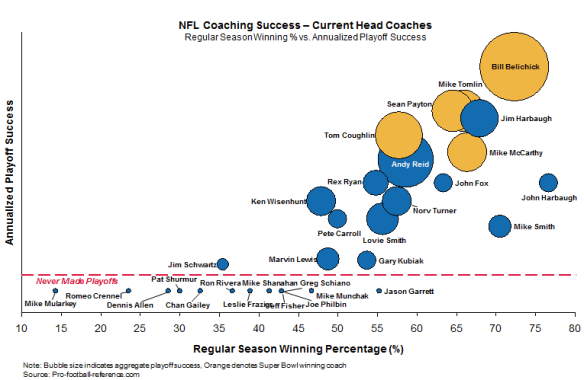
This will probably be just the first in a series of posts we do on Andy Reid over the next couple weeks, but here we have highlighted his success relative to other current NFL coaches.   Before we get to the chart, here are the rules:

The X axis is cumulative regular season winning percentage.  Important to note that this a) only includes current NFL coaches, and b) only includes their track record with their CURRENT team.  So Jeff Fisher and Mike Shanahan don’t get credit.  This is a What Have You Done for Me Lately? world.

The Y axis, I’ve termed Annualized Playoff Success.  I went through each coaches playoff history and gave them credit for their success on a simple point system I created.

Playoff Appearance (No Wins): 1 Point

Playoff Win(s) (but no Conference Championship): 2 Points

Super Bowl Loss: 3 Points

Super Bowl Win: 5 Points

You add up all those points and divide by total coaching tenure with the team (to mitigate the impact of long tenure).

The bubble size represents total Playoff Points under my system (so it’s a bit biased towards long tenure, but instructive nonetheless).  Orange bubbles, in case you couldn’t guess, mean super bowl winners.

Screen Shot 2012-12-24 at 10.43.08 AM


Andy Reid is a little tough to see, but he is the biggest blue bubble, just under Tom Coughlin.

The big takeaway here is: “Be careful what you wish for” regarding a coaching change.  I’ve long been an Andy Reid supporter.  Despite some obvious shortcomings, I believe he is still one of the best coaches in the league.  Most importantly, it is very difficult to find a good NFL coach.  As we can see in the chart above, by our assumed current standards (Andy Reid = just not good enough), there are A LOT of crappy coaches out there.

There’s no guarantee the Eagles make the right choice when it comes to the next coach, and I’d argue that the odds actually suggest it will be tough to find someone as good as Reid has been.

Just to clarify, this is not an endorsement of keeping Reid, just reminding everyone to temper their enthusiasm to get rid of him.


Eagles vs Redskins: Post-game notes

Fun game to watch, though the ending was obviously a bit of a letdown.  However, the #3 pick in the draft is looking pretty good right now.  Here’s a few initial thoughts on the game:

– Foles bounced back as expected.  He made one terrible throw (the missed TD to Maclin) and had an awful fumble, but the rest of the game was strong.  He was accurate and made a few great plays with his feet, buying time and keeping his eyes downfield.  I’m not really bothered by the fumble; he’s been really strong with the ball thus far.  The Maclin miss, however, is problematic.  Watching the replay, the ball just dies as it gets closer to Maclin, with a tight spiral devolving into an ugly mess.  Mechanics issue is the likely culprit, so hopefully it’s something he can address (that may solve some of his deep-throw accuracy issues as well.)

– I was very disappointed by the play-calling and player-usage.  I know Andy Reid really wanted a win in his (likely) final home game, but he put his own success above the team’s long-term best interests today.  Just 18 rushing attempts (non-QB) with Bryce Brown getting just 4 carries.  At this stage in the season, there is no real benefit to playing Shady.  We know how good he is.  Conversely, with Brown’s lack of experience (in the NFL or college), now would seem like a perfect time to feed him the ball.  The O-Line was having trouble, but still need to see Brown touch it more than 4 times on offense.

– Brandon Graham alert.  Though it’s unlikely he will ever make anyone feel good about passing on Earl Thomas (everyone mentions JPP but the consensus pick at the time was Thomas, who is now arguably the best safety in the league), B-Graham is fast becoming one of my favorite players.  Excellent effort on nearly every play.  He led the team in tackles and was very disruptive.  With every additional strong performance, the odds of his improvement being a fluke grow smaller.

– The Invisible Man was indeed invisible again.  Did anyone even notice Jamar Chaney was in the game?  Can’t blame you if you didn’t, he registered just 1 tackle and, on the first view, it seems that was the only time he contacted a ball carrier.  I’m anxious to see how many snaps he got, but in any case 1 tackle from the starting SAM is unacceptable.  The problems at safety have drawn a lot of attention (deserved) and are the biggest hole on the team, but the third LB spot is next on my list and isn’t getting anywhere near the publicity it deserves as a roster weak spot.

Fletcher Cox concussion is a shame.  He was playing a strong game prior to the injury.  Can’t imagine he plays next week, but he and Graham are easily the biggest positives to come out of this year.


Eagles vs. Redskins: Pre-game notes

Looking forward to today’s game; here’s what is important to watch for:

-A cynical note:  It’s close to impossible to actively root against the team during the game, but a win here could prove hugely expensive.  Just remember, a top 3 pick in the draft is a lot more fun than a meaningless win in December.  Also, though I’ll never actively root for a division opponent, I think I’m in the majority when I say I’d much rather see RG3 in the playoffs then Eli Manning or Tony Romo (though watching Romo fail is hugely entertaining if a bit predictable.)

– Nick Foles.  Foles is coming off a relatively weak performance…expect him to bounce back.  The Redskins are among the worst pass-defenses in the league, allowing 285 yards per game through the air.  Their pass-rush has also struggled, notching just 25 sacks, tied for 28th in the league.  All-in-all, Foles should have the time and space to move the offense, so there will probably be a lot of fans trying to jump back on the bandwagon after today.

-Emil Igwenagu.  This is a bit of a wildcard, as there is still no clear indication of how he will be used or how much he will play.  However, Igwenagu has the strength/size/toughness to be a good blocking fullback.  Normally this wouldn’t mean much, but if we take Andy Reid out of the picture for next year, it’s not difficult to see the offense transitioning to more run-emphasis.  Imagine a full-speed McCoy/Brown tandem running behind a rejuvenated O-Line.  Add in a powerful run blocker out of the fullback position and it becomes a very intriguing prospect, especially when you remember DeSean will be there to keep defenses honest.  It probably won’t amount to much, and this could easily be the most we ever talk about Igwenagu, but for today I’m paying close attention and hoping he gets a chance to play.

-Fletcher Cox.  Assuming RG3 starts and plays without any noticeable limitations, this should be a tough assignment for Cox.  To date, he has proven himself as a strong pass rusher, either with the straight bull-rush or by using his hands to get separation at the snap before using his explosiveness to blow by his blocker.  Normally this is great, as collapsing the pocket from the inside disrupts just about every play.  However, against a QB like RG3, this can be an issue as it creates running lanes and makes it harder to contain the QB (assuming he can avoid Cox’s initial pressure).  I’m not sure how they’re going to play RG3, but if it were me, I’d be focused on containment and rely on the DBs to cover (the Washington WRs shouldn’t really scare anyone.)  If that’s the case, then we may see a dip in performance from the rookie DT, as he’s more successful when he can attack rather than react.

-The LB’s. Should be a rough day for Demeco and Co.  The RG3/Alfred Morris combo is a bad matchup, since they put a lot of pressure on the LBs (not exactly the Eagles’ strength.)  Morris is a strong runner both inside and out, and can be tough to bring down.  Hopefully Kendricks can use his speed to make a few plays, but in a one-on-one Morris-Kendricks battle, you’d have to bet on Morris coming out on top.  Also, I think we can safely assume that The Invisible Man (Jamar Chaney for those who forget) will remain invisible.

-Colt Anderson.  This should be a fun game to watch Colt.  He’ll either make a few big plays or look ridiculous.  The running attack of the Redskins plays to Colt’s strength, but he also has a propensity to lose his angle when attacking, making him vulnerable to missed tackles.  He played a solid game last week, but this offense is an entirely different challenge.

-RG3. I typically don’t highlight opposing players because it’s not within the purview of this blog, but RG3 is special.  For any fans who don’t have RedZone or Sunday Ticket, you’ve been missing out.  It’s possible RG3’s career gets derailed by injury or that he adjusts his game to avoid contact, but for now he might be the most entertaining player in the league.  It sucks that he plays for the Redskins, and I’m sure we’ll all grow to hate him if he kills the Eagles over the next 10 years, but for now I encourage everyone to enjoy the show.

Quick link and an administrative note

Mike Clay from Pro Football Focus has a decent article on Nick Foles’ numbers so far, here’s the link.

It’s interesting, but I’d caution anyone against inferring too much from it.  The sample size on Foles is still too small to determine any real tendencies.  Regardless, the breakdown will give readers some additional points to watch for over the last two games.

Administrative note:  For anyone attempting to subscribe to Eagles Rewind by email (link on the right), please know that after submitting your address, you will have to confirm your subscription (in an email you receive after submitting).

Also, I’ve separated the posts into categories, which can be found on the right-side of the site.  This way, anyone interested in the statistical analysis or full game rewinds can go straight to them without having to read every post.

Finally, feedback is always appreciated so give us a shout at eaglesrewind@gmail.com or on twitter (@eaglesrewind) with your thoughts.  If there’s any data you want to see or question you want answered (like are fumble rates largely luck?), please ask.

Andy Reid Drafts:

We’ll be taking a much more detailed look at the Draft after the season ends, but I thought I’d quickly provide a good illustration as to why the team’s performance has tailed off the last few years.  Below are all of the Eagles’ draft picks made under Andy Reid.  I did not include this past year’s since not enough time has passed to really judge any of the picks (though Cox looks like a hit).

I’ve color coded them so we can easily see where and when the good picks were made.

There’s a lot of subjectivity to “grading” players, but the general rule of thumb I used was:

Good starters for the Eagles are highlighted Green.  Complete disasters are Red.  Everyone else is Black (either mediocre or jury is still out).  You’ll notice that nobody after the second round is Red.  Beyond there it becomes very difficult to find quality starters, so the team really isn’t docked much for missing there (though not finding quality backups is another issue altogether).  Also, if a player went on to be successful, but did so for another team, they don’t count as a good pick (think Derrick Burgess or Brandon Gibson).

Screen Shot 2012-12-20 at 2.59.45 PM

Screen Shot 2012-12-20 at 3.00.34 PM

Notice anything?  Now I’m sure some will argue about how I’ve classified a few of the names on the list (Andrews and Bunkley could certainly be Red) but in general I think everyone can see the same overarching trends.   The most shocking realization is the complete lack of strong defensive players picked since 2006.    Maybe Brandon Graham’s emergence is real, in which case he might switch to Green, but there really isn’t anyone else in all that time that I’d happily call a starter.  (And don’t say Stewart Bradley, he started for just 2 seasons, only one of which was a good year)

It’s also easy to see how this happened if we take a glance at who is highlighted in Red (i.e. complete misses).  From 2007-2011, the Eagles used 2nd round picks on the following defensive legends:  Victor Abiamiri, Trevor Laws, Nate Allen, Jaiquawn Jarrett.

That, folks, is a very big reason why this is Andy Reid’s last year as coach.  It looks like he broke the trend with Cox, but too little too late.

Final note:  I do not mean to suggest that Andy Reid is bad at drafting.  My guess is that over his career he has been about average and most people don’t realize just how hard it is to accurately project talent.  The offseason draft analysis will take a look at league-wide success rates and see where Reid actually ranks and if there really are good drafters or if it’s just luck (hint: it’s probably a lot of luck).

Also, I apologize if there are any typos or misspelled names.  Lots of transcription, hopefully its all correct.

Week 14: Eagles vs Bengals Rewind

Sorry for the long delay, but as some of you know, the All-22 footage isn’t available until the Wednesday after the game.  So at the risk of bringing up the memory of a game most fans would like to forget, here is the All-22 breakdown, featuring notes on key figures and breakdowns of three big plays:

Notes:

Overall – A better game then the score indicates, as I described in the post-game notes.  Key figures:

Nick Foles – Played a much better game then most are giving him credit for.  The interception was a terrible throw, but other than that he made good decisions.  Some will point to a couple throws at the end of the game that clearly weren’t high-percentage passes, and they’re correct, but I would argue that down 24 points with time running out is exactly the time to engage in higher risk plays.  Throwing an interception at that point doesn’t really decrease the odds of winning since they are so low to begin with.

He again showed good pocket mobility, though this game he didn’t make his progressions quite as well as he had been doing previously.  All-in-all another encouraging game despite what most are saying.  (That’s precisely why we just look at the tape rather than going off what we hear.)

Colt Anderson Colt played a better game than I gave him credit for.  In the post-game notes I mentioned the nice pass break-up but nothing else.  Colt made some nice plays in the run game (his strength) though he did have trouble bringing down the runner at the point of contact a few times (getting dragged a few yards).  A solid game, though, and certainly higher quality than we’ve seen from any of the safeties in a while.

Jamar Chaney – From now on Chaney will be referred to as either “The Invisible Man” or “Human Practice Sled”.  It is really amazing how he can play so much and yet have so little impact on the game.   The box score will tell you he had 7 total tackles (by far his highest of the year), but most of those came from him chasing down a man he should have stopped earlier.  By my count, he made just 1 positive play, bringing the runner down at the line of scrimmage. The best thing you can say about him is that he takes 1 blocker out of the play (which in fact is about the worst thing you can say about a LB).

Fletcher Cox/Brandon Graham – This was easy to see for most watching the game, but both of these players had a huge day.  If they can keep up this level of play, the Eagles have the potential for a great d-line.  Cox has already shown himself to be among the best pass-rushing DTs in the league, which is what the Eagles hoped for when they picked him.  Graham, however, has been a revelation (considering how low his stock was preseason).  In addition to the sacks, Graham played with a lot of energy on each play, including coming completely across the field once and bringing down a scrambling Dalton from behind on the opposite sideline.  Any fan looking for a reason to get excited has found it.

DRC –  DRC reminded everyone why he’s so well-known.  He was matched man-to-man against Green nearly the whole game, and held him relatively in check.  The TD fade is a tough one, DRC has to know that’s coming and find a way to stop it, but that’s easier said then done for any corner up against a receiver of that caliber.

Kendricks – Another young player to watch.  Kendricks had a tough game and was largely missing from the action.  He did have one pass defended, but was made to look foolish by Andy Dalton (on Dalton’s TD run).  Kendricks’ performance has definitely taken a hit outside of last week’s game.  Let’s hope he rebounds, otherwise the LB core is again pretty weak.

Now for some plays:

The Maclin Fake-Screen:

2nd and 3 at the PHI 38 yard line.  This is a great play not just because of how well it was drawn up and worked, but because the Eagles started setting this up the week before.  Remember all those WR screens they ran against Tampa?  Well they came out this game and early-on ran a couple, giving the Bengals plenty to recognize and key off.  Laying that groundwork paid off in this play, which ultimately led to a TD.

Here is the pre-snap look:  The Eagles come out trips-right with Riley Cooper on the opposite side (total of 4 WRs).  On this play, the Bengals are in a nickel defense, which means they only have 3 CBs on the field.  To account for the discrepancy, the Bengals’ safety takes responsibility for Maclin.

Screen Shot 2012-12-19 at 5.03.52 PM

Just after the snap, seen below, the Eagles are showing the WR screen.  Notice the safety covering Maclin has stepped up and crossed the 50.  To this point there is no real sign that it’s a fake, as Maclin could just be running to set up blocking position between his man and the receiver.
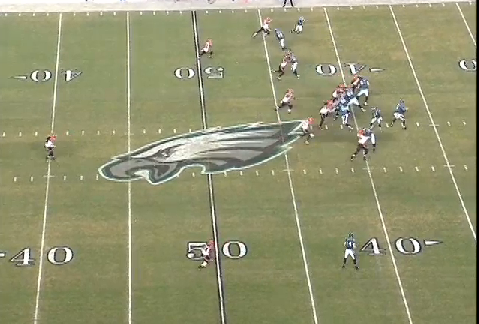
Screen Shot 2012-12-19 at 4.56.05 PM

Finally, we get the payoff picture.  At first glance it doesn’t look like much, the safety covering Maclin is still farther downfield.  What’s key though, as we can see from the above picture, is that at this moment Maclin is at full speed, whereas the safety covering him has just realized it’s a fake and is starting from a dead stop, giving him no chance of matching Maclin’s speed.
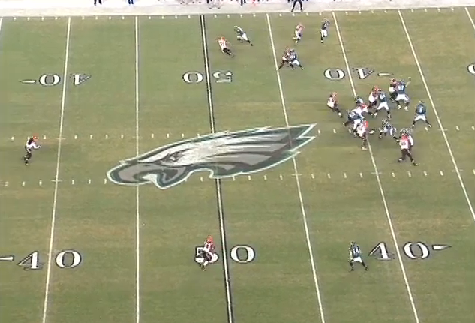
Screen Shot 2012-12-19 at 4.56.19 PM

A very well-drawn up play, but fairly simple.  The key was setting it up with actual screens both early this game and in the week before.  I know some people have mentioned Foles should have hit Maclin in stride (leading to a TD on this play), but I think Foles was really just trying to ensure a catch and got a bit conservative with his throw.

Play 2:  The Cooper TD

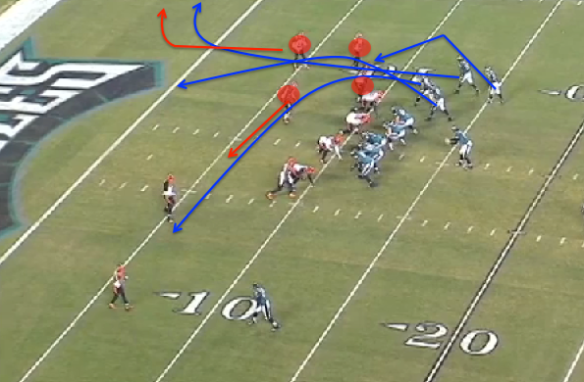
This play occurs shortly after the previous play.  Nick Foles hits Riley Cooper, who is wide-open at the goal line.  How did he get so open?  Below is the pre-snap.  The Eagles come out with 5 WRs and bunch 4 of them just off the line to the right side.  As you can see from the diagram, bunching 4 WRs (one is actually RB Lewis) together makes things very difficult for the defense.  If they are in man-coverage, the defenders are susceptible to “pick” plays or running into each other as they try to run with their man.  Zone coverage alleviates this problem, but means the defenders have to be communicating with each other perfectly, or else they may accidentally double-cover a WR and leave another open.  The second option (zone) is what appears to happen here.
Screen Shot 2012-12-19 at 5.47.07 PM

Riley Cooper is the WR lined up closest to the O-Line on the right side.  Pay close attention to his route.  See how it runs between the two defenders (shown as red circles)?  That ends up being the key to the play.  Of those two, the outside defender takes Dion Lewis, the Eagles WR furthest right in the above picture.  The inside defender actually disrupts Cooper’s route (seen below), forcing him towards the sideline.  However, this defender, after running with Cooper, sees Dion Lewis break back inside, therefore entering his zone.  He breaks off his coverage of Cooper and picks up Lewis.  The outside defender doesn’t get the message and also covers Lewis, leaving Cooper wide open on the goal line.

Screen Shot 2012-12-19 at 5.20.40 PM

Above, we can see Cooper being disrupted.  Lewis is about to break back towards the inside, which causes Cooper’s defender to leave him, sticking to his zone.  Below is the moment this happens.

Screen Shot 2012-12-19 at 5.20.56 PM

And here is the moment of the  pass.  Notice Cooper coming open and the two defenders covering Lewis.

Screen Shot 2012-12-19 at 5.21.06 PM

Bunching 4 WRs caused confusion in the defense and led to a very easy throw-and-catch for a TD.  It must also be noted that this play only succeeded because the O-Line gave it enough time to develop.

Play 3:  One for the defense.

Second Quarter, 1st and 20 at the 2 minute warning.  This is the fumble forced by Cullen Jenkins and recovered by Tapp.  There are two things that make this play interesting: it comes from the wide-9 alignment, and it involves Jenkins coming over top both the other DT (Cox) and DE (Cole), which means the DBs did a good job in coverage to give him time to do that.

Screen Shot 2012-12-19 at 5.54.28 PM


The key to the play, other than the coverage, is Cox and Cole’s ability to attack the center of the offensive line.  As I illustrated above and we can see below, the combined power of these players collapses the left side of the Bengal’s o-line, giving Jenkins the space he needs to come around.


Screen Shot 2012-12-19 at 5.50.18 PM


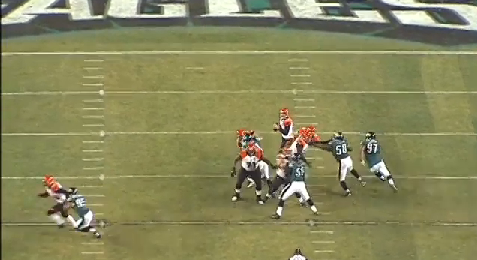
Above we can see Jenkins in motion and Cole setting the edge.  Below we can see Jenkins as he’s coming around the line.  Notice that the stunt action towards the center has drawn the Bengals’ LT to Cole, meaning there is nobody left to block Jenkins, whose original blocker  can be seen doing nothing in the picture below.
Screen Shot 2012-12-19 at 5.50.28 PM


Finally, the moment of the strip  Jenkins gets there just in time, as Dalton is about to release the ball (and fortunately just before his arm starts coming forwards.


Screen Shot 2012-12-19 at 5.50.51 PM


A big defensive play out of the wide-9, who knew?  In any case, this is the type of action the Eagles should be able to generate with Cox/Cole.  Both are great pass rushers (Cole not as much this year but he still has to be respected) and are used here to create space for Jenkins, leading to a turnover (something they haven’t created nearly enough this year.)  Let’s hope we see more plays like this in the next couple games.
What’s the deal with fumbles? (Should we worry about Bryce Brown?)

Given all the hyperventilating going on about Bryce Brown’s supposed fumbling problem, I thought it would be helpful to take a data-driven look into fumbling rates and see if there truly are players with “fumbling problems” or if it’s largely a result of chance.

Verdict?  While there are certainly some players that are better/worse than others at holding onto the football, most of it really is a result of luck (despite all the crap you hear from analysts).

How did I get there?  Stay with me while I explain:

I gathered a sample of relatively prominent running backs over the past ten years.  Admittedly this is non-random, however I wasn’t picking by any specific stat and after reviewing the sample I don’t see any particular reason to suspect that it’s largely skewed (one big caveat that I’ll get to later).

I ended up with 31 running backs of varying career lengths/prominence/etc… I’ve listed the full sample at the end of the post.  In all, this produced 167 seasons of 100 carries or more.  I then looked to see if there was any correlation between a player’s fumbling rate (fumbles/attempts) from one season to the next.

The end result was a correlation coefficient of .17.  For those unaware, correlation coefficients run from -1 to 1, with 1 suggesting perfect positive correlation and 0 suggesting no correlation from one year to the next.  A value of .17 tells us that while a player’s fumbling rate from year-to-year is somewhat correlated, the relationship is weak and largely dictated by chance.

So about Bryce Brown: While his fumbling rate this year is very high (3.9%), it’s way too soon to really worry about this as a long-term problem.  In fact, within the sample there were 7 RBs who carried a fumble rate of greater than 2.5% over the course of a full season (with 100+ carries).  Of those, only one RB recorded that high of a rate a second time in his career (Ricky Williams).

– Hat tip to Matt Swartz from Fangraphs for insight.  Follow him on twitter if you like analytical baseball stuff (@Matt_swa).

More Notes from the data:

– The highest fumble rate within the sample was Reggie Bush’s second year with 100+ carries.  That year he fumbled 4.46% of the time.  However, in every other season of his with 100+ carries (there were 4), his fumbling rate was never higher than 1.89%.

– Just two of the included RBs had career rates greater than 2%, Reggie Bush and Travis Henry.

– The lowest career rate was recorded by none other than Brian Westbrook, who fumbled on just 3 carries out of a total 1385, or just 0.22% of the time.

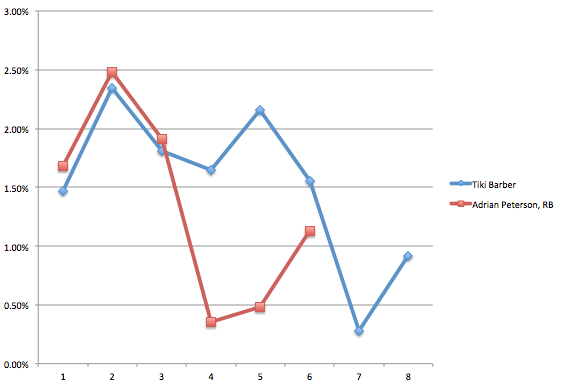
– Below are the charted season rates for Adrian Peterson and Tiki Barber, two players noted for early career “fumbling problems”.  I’ve explained that most of this is likely result of chance, but felt it was interesting to see given the reputation of each player (the chart should probably not have the data points connected given what I’ve talked about, but it makes things easier to see):Screen Shot 2012-12-19 at 11.42.57 AM

-Now for the caveats: As I mentioned above, this was a non-random sample chosen mainly because I was looking for RBs with a large enough number of carries to make for a significant sample.  It’s likely that players who fumble a lot do not get many seasons with 100+ carries, though there were several players included who fumbled a lot in their early career and continued to get carries.  I will take a look at the records to see what the fumbling rates look like for players who did not have long careers (at least 3 seasons with 100+ carries).

-The data I used only includes RUSHING fumbles.  So if an included player caught a pass and then fumbled it is not counted.  I wanted to get a pure representation of rushing.  Westbrook in particular, had several fumbles after receptions.

– The data for current players did not include this past week’s games.

– Here is the sample of players used:

Ladanian Tomlinson
Fred Taylor
Ricky Williams
Eddie George
Jamal Lewis
Willis McGahee
Steven Jackson
Frank Gore
Clinton Portis
Tiki Barber
Shaun Alexander
Chester Taylor
Ahman Green
Adrian Peterson
Maurice Jones-Drew
Travis Henry
Marshawn Lynch
Brian Westbrook
Michael Turner
Chris Johnson
Willie Parker
Ray Rice
Brandon Jacobs
Reggie Bush
Jonathan Stewart
Fred Jackson
Ahmad Bradshaw
LeSean McCoy
Felix Jones
Arian Foster
Jamaal Charles

Nick Foles Perspective

Sensing a few people jumping off the Foles bandwagon.  He had a rough game against a good defense, but let’s not get crazy (i.e. suggesting a trade for Kirk Cousins.)  Figured I’d add a little perspective on what rookie QBs often look like.  Below are the first year QB ratings and TD/INT ratios for each QB (first year = first year with significant playing time).

Alex Smith – 74.8 rating, 16/16

Peyton Manning – 71.2, 26/28

Drew Brees – 76.9, 17/16

Joe Flacco – 80.3, 14/12

Eli Manning – 75.9, 24/17

Obviously there are first year QBs that have done much better, but the point is that it really isn’t rare for QBs to improve dramatically from their early performance.  I’m not suggesting Foles is going to be Manning/Brees, but there is plenty of evidence to suggest that giving Foles the starting gig next year is a smart play (not just because he is the only real option).

At this point, here’s what we know:

Foles has prototypical size for a QB.  He is very accurate on short-medium throws. He has trouble spotting his deep throws.  He’s very slow but moves very well in the pocket.

It’s not much, but it’s enough that I’m intrigued to see what he can do with an upgraded line and starting-caliber weapons.  He’s obviously going to be a focus of the Game Rewind the next two weeks, but for now there’s no reason to be anything but hopeful about his potential.