Let’s talk about Vick

Most of you can probably guess that I was shocked and disappointed at yesterday’s announcement that the Eagles have restructured Vick’s deal for a year.  To be abundantly clear: I think it’s a bad move.  However, there are a lot of different aspects to this decision, which I’ll endeavor to discuss here, some of which may be quite positive/hopeful.

– Chip Kelly clearly isn’t enamored with Foles.  Not a huge surprise, due to Foles’ relative lack of mobility, but I was hoping Chip would value the accuracy and poise more highly than he apparently has.  Also, I’m not buying the whole “open competition” comment.  Foles and Vick could not be more different as quarterbacks.  As a result, whichever “system” Kelly puts into place will tilt heavily towards one of them.  If the offense relies on the read-option, I don’t see any way Foles would win a competition for the starting job, he’s just not a fit for that scheme.

Also, the rumored discussions with Dennis Dixon should be added to the puzzle here.  In total, it’s clear that despite Chip’s professed flexibility, he really does want a truly mobile quarterback that can threaten defenses with his legs.

If I was Andy Reid, I would already be calling the Eagles and making an offer for Foles (or waiting to see if I could sign Alex Smith, then making a play for Foles).

– That doesn’t mean he’s in love with Vick.  My current belief is that Kelly doesn’t like either Vick or Foles as his permanent QB.  However, he has a specific system that he wants to install, and Vick was as close to a “fit” as there was on the market.  The fact that Vick wanted to stay here and was willing to rework his deal made that option very attractive.  Under this scenario, Kelly gets to fully install his system year 1 with Vick as the caretaker, rather than adapting it to suit Foles’ skills and then restarting when he finds “his guy”.  This makes some sense to me, though it suggests Kelly is heavily invested in his scheme, which makes me nervous considering he’s never tried it in the NFL.  In this case, it’s also possible the Eagles have their eye on a couple of QBs in the draft, and if they get one of them, can cut Vick before the season starts.  Vick gives the team insurance and means they don’t have to reach or overpay in the draft for a rookie.

– Maybe Chip is reading this blog.  Over a number of posts, I’ve explained why this past season the Eagles, in all likelihood, underperformed their “true success rate”.  The team was beset by injuries that decimated the OL, arguably the most important position group behind the QB.  Additionally, the Eagles had terrible luck when it came to turnovers (both giving/receiving and recovering).  Add in the near-historic special-teams ineptitude and it’s quite possible Chip reviewed last season and decided the potential is there for a much better football team than we saw this season.  For those of you looking for hope, this is the theory for you.  Predictions, for the most part, are worthless, especially when it comes to sports.  However, I’m going to make a couple here that I am extremely confident in, each of which bodes well for the team (I’ve mentioned them before):

1) The Eagles will not lose 22 fumbles next year or have a TO Differential of -24.  I’ve explained that fumbling the ball is largely random, and this year the Eagles caught the tail of that distribution.  Of the last 320 NFL team seasons, the 2012 Eagles had more lost fumbles than 99.4% of them (only one team had more).  THAT WILL NOT HAPPEN AGAIN NEXT YEAR.

2) In a related note, the Eagles recovered just 35% of all fumbles last season.  This number is almost completely random and over the long-term should be around 50%.  Though it’s certainly possible for the team to be unlucky again next year, I’m going to predict that the Eagles will recover MORE THAN 35% of all fumbles next year.

3) The Eagles this year had the worst relative field position BY FAR at -6.67 yards (a result of turnovers and terrible special teams).  A previous post of mine showed little persistence in this measure from year-to-year, therefore there is no reason to believe the Eagles will be that bad again next year.  So…the Eagles will have SIGNIFICANTLY BETTER average field position next year.

I apologize for repeating these, but they are vital pieces of evidence towards my most hopeful Chip Kelly/Vick/Eagles scenario.  None of these predictions require any great insight, just a cursory exploration of recent historical statistics and basic analysis.  It is quite possible (likely in fact), that Kelly and/or Roseman has reviewed these numbers and arrived at the same conclusions.

If so, it is entirely reasonable for Kelly to believe that combining better luck with a healthier OL, the #4 pick in the draft, and a few positional upgrades to the defense (hard not to find upgrades since they were so bad last year) will result in a significantly better team and one that can compete for both a playoff spot and a division title.

– Grace-period utilization.  Due to the performance of the team this year, it’s clear that Chip Kelly is not expected to perform a miraculous one-year turnaround.  He knows he has, in essence, a free year.  I mentioned early on in the coaching process that regardless of Kelly’s motives, he had to be salivating at the thought of Shady and Bryce Brown together in the back field.  Add in a healthy D-Jax, and you’ve got the type of speed Kelly prized at Oregon (and is VERY difficult to collect in the NFL).  In light of this, Chip might be thinking he has nothing to lose by trying to shoot the moon by adding Vick to this line-up.  I’m seeing a few people talking about Vick losing a step, but I don’t agree with it.  I’ve been pretty clear about Vick’s shortcomings as a QB, but speed is one area I am not concerned about.  Even at 85% of his prime-speed, Vick is fast enough to devastate defenses.

If Kelly has been given explicit guarantees of his job security (i.e. low expectations for this year) from Lurie, and I bet he has, then he really has nothing to lose by trying to go for it with Vick for 1 year.  The only cost here is impeding Foles’ development, but as I mentioned above, I don’t think Kelly cares about that and wouldn’t be surprised if Foles gets traded.

– Run-heavy option offense.  The biggest problem with Vick, outside of his fragility, is his propensity for turnovers.  However, Kelly might believe he can solve that problem fairly easily. How?  Don’t throw the ball.  Shurmur has already alluded to a run-heavy attack, and with Shady and BB, that should be the strategy.  It’s possible, though, that he’s underselling just how run-heavy the offense could be.  Could the Eagles try to run a Georgia Tech-style triple option in the NFL?  Why not?  Kelly has already stated that the only reasoning he won’t accept is “that’s the way it’s always been done”, which BTW is my absolute favorite thing about him.  With the speed in the Eagles backfield, a healthy OL (a healthy Peters especially), and perhaps a stud OT with the #4 pick, Kelly might believe he has the necessary ingredients to make an extremely run-heavy option offense work in the NFL.

If Vick doesn’t throw the ball, he can’t throw interceptions.  Fumbles are another story, but IMO they are much less of an issue than interceptions (both more random and easier to fix).

Concluding – Hopefully the thoughts above have given you a few new things to consider.  In any case, the Eagles will be interesting and entertaining, which at the end of the day is why the team exists.  We can complain all we want about not having a Super Bowl, but at least the team isn’t boring.  Would you rather be a Bucs fan?  If I was in charge, I would have already cut ties with Vick, but in exploring the situation, I can see a few strands of logic in the decision to keep him.  The fact is Kelly is coming into the league with such a good reputation, that anything he does right now deserves the benefit of the doubt.  Don’t worry, there will be plenty of time to tear him up later.


Positional Breakdown of the top 15

After my last post about the historical odds of selecting an All-Pro caliber player in the top 5 versus 11-15, there were several comments about the potential effects of positional skew, so I will address those today.  For example, Quarterbacks are much more likely to be taken in the top 5 than anywhere else in the top 15 picks, so that could affect the overall All-Pro odds.

Before we get to some charts, let me note that one of the reasons I didn’t address this in the last post is that, when broken down by position, the sample sizes get very small.  Hence, we have to be careful not to jump to conclusions.  However, the skew effects by position are real and potentially very large, so it’s worth looking into.

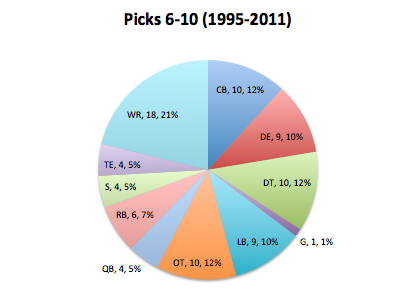
I split the top of the draft into three segments, 1-5, 6-10, and 11-15.  Below are charts illustrating the positional breakdown for each.  We are looking at all drafts from 1995-2011.  The data labels are a bit ugly, but I wanted to show both the values and percentages by position.  Unfortunately, the colors do not match up by chart, so you’ll have to actually compare numbers if you want to dig in.

Screen Shot 2013-02-11 at 1.29.55 PMScreen Shot 2013-02-11 at 1.30.02 PMScreen Shot 2013-02-11 at 1.30.08 PM


We can see pretty clearly that there is a big difference in positional distribution.  Before we re-evaluate the All-Pro odds, its worth noting:

– QBs, not surprisingly, are much more likely to get taken in the top 5.  The premium on the position means teams are much more competitive for them and therefore have to use more draft resources (i.e. higher picks) in order to get them.

– Wide receivers show a very strange pick distribution, with 9 selected in the top five, 18 going between picks 6-10, and just 6 selected from picks 11-15.  Haven’t yet come up with a reasonable hypothesis for this (mainly the drop-off from 18 to 6) but it may just be random.

So how does this effect our “elite” player odds?

Well it depends on the position, obviously.  The overall thesis from the last post was that teams are no more likely to find All-Pro caliber players in the top five than they are to find them with picks 11-15.  Overall, the data bears that out.  However, if you are looking for an All-Pro quarterback, its pretty clear that you need to take them in the top 5, if only because  top graded QBs don’t last very long (so most “1st Round” QBs go in the top 5).

What happens when we look at positions that don’t exhibit great frequency variation by pick?

First, let’s look at Defensive Ends.  In the above charts we can see that from 1995-2011, 11 DEs were taken in the top 5, 9 were selected from 6-10, and 14 went between picks 11 and 15.  Were the top 5 picks any more likely to become elite players?

Screen Shot 2013-02-11 at 1.54.23 PM


Not really according to the data, but since the samples are small, we should probably stick to saying it’s “unclear”.  In any case, this chart certainly supports the notion that it’s probably better to trade down from the top 5 (at least if the team is set on choosing a DE).

Now let’s look at OTs, another position for which there is relative consistency in terms of frequency by draft pick.

Screen Shot 2013-02-11 at 1.59.10 PM


Again it’s unclear.  Here the odds in the top 5 are clearly better than from 11-15, but with just 8 picks in the latter range, we’re really taking a leap to infer anything significant.  Also, the odds here are better between 6-10 than from 1-5.

Outside of QBs, which are so skewed by frequency that we can’t do much with the data, the only position that appears to show a significant decline in odds of success as you move later in the top 15 is Wide Receiver, and the numbers here are shocking.

Screen Shot 2013-02-11 at 2.06.13 PM

To make it a little more interesting, here are the 6 WRs that were selected between 11 and 15:  Yatil Green, Troy Edwards, Rod Gardner, Donte Stallworth, Lee Evans, Michael Clayton.

I’m guessing most people here have only heard of 3-4 of them…

I could go position by position and give you the All-Pro chart for each, but I don’t think it’d be that valuable.  Some positions show slight odds declines, but remember, the question isn’t just “Are the odds better with a top 5 pick?”, it’s “is the difference in odds great enough to outweigh the compensation gained by trading down?”

In general, my previous point stands:  Teams would be better off trading down from the top 5 (while remaining in the top 15).  This doesn’t hold if you are taking a QB, but for everyone else, nothing I’ve seen contradicts this strategy.

But how could this be?  I admit it doesn’t make a lot of intuitive sense.  All of the “elite” players chosen between 11-15 were available with picks 1-5, so shouldn’t the odds have been better there? They should, but they’re not, mainly because NFL scouting isn’t perfect.

Overall, NFL scouts appear to be very good at segmenting players by general ability (tiers if you will).  That’s why elite players are predominantly selected in the first round and almost never slip past the second round.  HOWEVER, scouts do not appear to be good at sub-sorting those tiers.  So they can pick out the handful of DEs (or whatever position you want) that are the best, but ranking the players within that group is extremely difficult.  This is where the problem of false precision comes into play.  If teams would recognize that limitation, they would consistently trade down, selecting the last available player in the best “tier”.  GMs and scouts, though, appear to believe they can reasonably predict which individual player is going to be better,  leading them to use draft resources inefficiently.

If you play fantasy football, you should be familiar with this.  I’m betting at least some of you sort players by tier prior to each season, and draft accordingly.  So you don’t get hung up on which QB is the “best”, you just make sure you get one from the best group, understanding that it’s impossible to predict exactly who among that group will have the most successful season.

I’m going to do a deeper analysis of this concept soon and look at the relative performance of players according to order drafted (for instance, does the 1st player taken at any position outperform the next player taken at the same position), but for now, the Star/Joeckel/trade-down strategy remains (assuming those players are as highly regarded as currently indicated, Joeckel seems to be losing some ground to other OTs).


Big evidence for trading down with a top 5 pick.

Having some trouble with the Game Rewind program, so that’ll have to wait, but what I’ve done instead is far more interesting anyway.

We’ve explained pretty clearly that “elite” players come almost exclusively from the first round. Additionally, it was my expectation that the top 5 picks would see a much higher percentage of All-Pros/Pro Bowlers taken than in the rest of the round.   THIS IS WRONG!

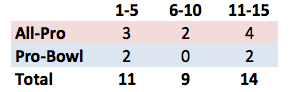
I’ve been operating under the assumption that the Eagles at #4, must get an All-Pro player, because teams rarely get to pick that high in the draft.  However, it turns out the odds of getting an elite player are really no greater in the top-5 than in the top 15.  Here are the numbers:

I looked at every draft from 1995-2011 (slightly different time-frame than I typically use), counting how many All-Pros and Pro Bowlers came from each pick (insert normal caveat about Pro Bowl designation here).  Please note that if a player counts as an All-Pro, he does NOT also count as a Pro Bowler. So…

Screen Shot 2013-02-08 at 12.09.30 PM

Odds of getting an All-Pro player is no different in the top 5 than in picks 11-15.

Here is the same chart, with additional rows showing the comparison of the top 15 picks versus the rest of the 1st round.

Screen Shot 2013-02-08 at 12.13.16 PM

As you can see above, there is little difference within the top 15 picks (the Pro Bowl drop-off is notable, but the All-Pro designation is a lot more valuable IMO).  However, there is a HUGE drop-off after pick 15.   Admittedly pick 15 is an arbitrary place to split the first round, but it does appear to be close to (if not equal to) the actual inflection point when it comes to a dramatic shift in the odds of getting an elite player.

So what does this mean for the Eagles?  Well it depends on your viewpoint, but it certainly supports the notion that the Eagles’ optimal strategy would be to trade down from 4, picking up extra picks while staying in the top 15.  In fact, given how high the pick is, the team could probably trade down twice and still remain in the top 15.

If the team is blown away by either Joeckel or Lotulelei (my two current favorites for the team, with the DT ahead by a nose) and one of them is available, then the Eagles make that pick.  However, if there are ANY reservations about either, or if neither is still on the board, than the right move is to trade down to the bottom of the top 10 and either take the best available, or trade down another couple picks and then take the best available player.

I realize the All-Pro and Pro Bowl designations are a bit subjective, but creating any other criteria in order to identify “elite” or “impact” players would arguably be just as subjective, so this is what we’re going with.

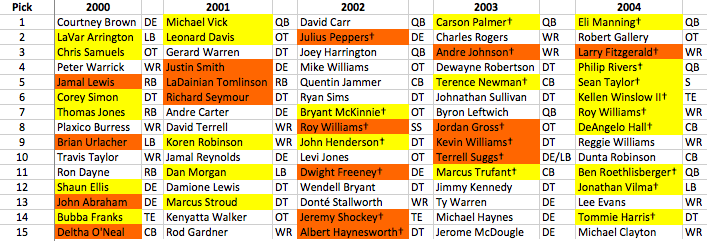
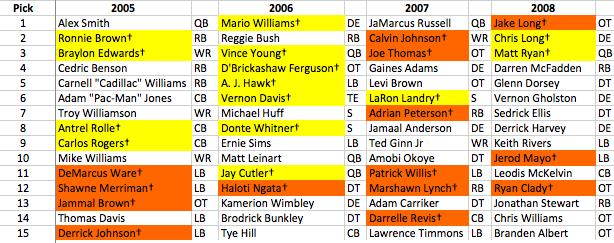
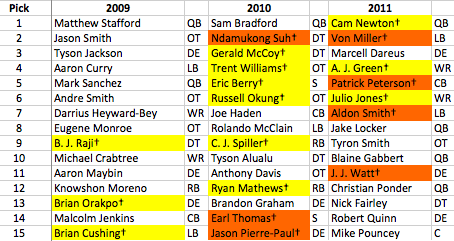
For those who are interested, here are the draft picks I looked at, with All-Pro’s highlighted red and Pro Bowlers highlighted yellow.

Screen Shot 2013-02-08 at 12.25.59 PM

Screen Shot 2013-02-08 at 12.26.50 PM

Screen Shot 2013-02-08 at 12.27.31 PM

Screen Shot 2013-02-08 at 12.28.07 PM

Salary Cap and Roster Cuts

UPDATE:  I mentioned that GCobb had made a ridiculous assertion about Evan Mathis.  Turns out it was actually Denny Basens, who writes at GCobb.com, so adjust my previous point accordingly.

Focus has shifted to the roster and the salary cap, with everyone putting out a stay/go list and predicting who is going to stay.  Here is my take on it.  Sorry in advance for the lack of data.

First, everyone needs to understand that this is NOT a team that is one offseason away from seriously contending for a Super Bowl.  If everything goes right, the Eagles could certainly make the playoffs, but right now that’s the high-end of where the team can expect to be.

Understanding that, the team needs to be very careful with its salary cap space.  Right now, it’s more important to find the right pieces at GOOD VALUES then it is to pay up in free agency looking for impact players to help immediately turn the team around.

Free agency is essentially an auction, with all 32 teams valuing each player (obviously not all teams go after every player).  However, by definition, signing a FA means you are overpaying, in that you are valuing the player more highly than the rest of the market (winner’s curse).  It’s a dangerous game to play, as Eagles fans will know from recent “dream team” experience.  I believe the Eagles’ focus will (should) be on finding depth in free agency, with specific attention paid to “character” guys who will help Chip Kelly install his own atmosphere (Dennis Dixon seems like a prime example if he signs).

So don’t be disappointed if there are no huge player signings.  Conversely, if there is a big signing, remember it doesn’t always work out the way it seems (Nnamdi anyone?).  I’ll be much more excited with 4 or 5 low-profile “solid” signings than with 1 “big-time” addition.

In the meantime, who stays/goes?

I’ve had a lot of fun reading some articles that suggest nearly the entire defense will be released.  While few of them deserve to start, the fact is you still need to field a team, making it very difficult to cut EVERYONE.

Here is GCobb‘s.  Which is notable because he makes a ridiculous claim that Evan Mathis should go.  He believes that any player that doesn’t “dominate” should be replaced.  Ignoring the fact that Mathis was among the best guards in football this year (for those that actually watch the game), it’s outrageous to believe that any team subject to a salary cap could actually “dominate” at every position, especially at a relatively low-impact one like OG.  Needless to say, I won’t be taking anything GCobb Denny Basens at GCobb.com says seriously ever again, and I encourage all readers to do the same.

Before I go player-by-player, let me say something important when it comes to player evaluation.  As I just mentioned, you can’t expect EVERY player to be great.  The fact is, on a lot of good teams there are bad starters.  However, the overall talent allows the coaches to hide the weaknesses of these players.  The Eagles were so bad this season that there was no cover for anybody.  For example, on a good team, you might be able to sneak Akeem Jordan in there as a starter and compensate with a great MLB and strong D-Line.  So some of the players everyone is sick of may in fact be able to make contributions as role players once the rest of the roster gets upgraded.

Finally, here is my opinion on a selection of potential roster changes:

– Bell (already gone, but he was obvious)

– Nnamdi, an easy cut.  Rather than dissect what went wrong, I’d rather all Eagles writers/fans just agree never to speak of this signing again.

– Vick, yet another easy one.  For those still thinking he might be on the team, please remember that HE IS NOT A GOOD QUARTERBACK and now he’s old with an extensive history of injuries.  Not happening.

– Jenkins.  Ideally Jenkins would be plugged in as a 3-4 end in the new system, and I’d be happy if that happened, but all current accounts say he has an attitude problem and will complicate the coaching transition.  Normally I discount such things, but with a new coaching regime, it’s perhaps the only chance to complete a wholesale atmospheric change of the team.  If Jenkins isn’t a good soldier, he’s gone without a second thought.

– Peters stays, provided his rehab is on schedule.  This is becoming a popular suggestion for a potential cut, since his cap hit is around $11 million.  However, with the above cuts, the Eagles will have plenty of cap space.  Also, a healthy Peters (even if he comes back at 80% of what he was) is a BIG help to the offense.  While he clearly isn’t a long-term solution, it gives the Eagles an OT bridge until they can get a younger starter in there.  For example, keeping Peters would allow the team to draft Lotulelei and worry about OT either later in the draft (where I’ve shown they can find a starter) or next year.

– Demeco stays.  He is overpaid ($6.7 mil hit I think), but he is definitely a “character” guy and another veteran the Eagles can count on for one more year while they fill other roster holes.

– Trent Cole.  This is definitely the highest potential for “surprise cut”.  His contract makes that difficult, but judged purely on his play, Cole’s not going to win many fans among the new coaches.  Can he transition to a rush-linebacker?  Maybe, but I think Graham is better suited to that role.  Cole might end up staying, but probably gets shifted to a situational player rather than an every-down lineman (a near-lock if the team goes 100% to the 3-4).

– Invisible Man, Akeem Jordan, Casey Matthews.  Pick two of them to get rid of, doesn’t really matter which ones, though Jordan occasionally contributed on special teams in the past.  Only reason you keep one is so you don’t have so many holes to fill.  Matthews may get the nod because of his Oregon ties.

– DRC.  Anyone suggesting DRC should go is out of their mind.  He is inconsistent and will command a big salary, but the Eagles need to keep him (franchise tag if necessary).  It’s hard enough to replace one starting corner (and both safeties), but replacing the entire defensive backfield is a recipe for disaster.  Also, DRC is one of only a few guys in the league that can actually check some of the big superstar receivers in the league.  If I’m going against a Megatron or Brandon Marshall-type, I want DRC on my team.

– Colt Anderson.  This is a surprisingly tough decision, but I say he stays on one condition: He never steps foot on the field as a defensive player.  As a special-teamer and a locker-room guy, I love Colt.  However, he’s shown he clearly doesn’t have the ability to play on defense.  Some teams keep a roster spot for a “special teams ace”.  If Kelly decides to, then Colt stays.  Otherwise, goodbye Colt.

– Nate Allen, Kurt Coleman.  Love to see both of them go, but this will be a case of what’s available.  Most likely scenario is the Eagles sign a safety and draft one, then let everyone battle it out and pick the least-terrible option.  It’s just not easy to go out and find a starting-quality safety now that the NFL is so pass-happy.  I will say that I’d be OK with Allen as a back-up for a year, while I think Kurt Coleman’s weaknesses have been so clearly exposed that he shouldn’t be on the field.

One final point – I cannot overemphasize how important the #4 pick in the draft is, and not just because it needs to be an All-Pro.  Shifting to the 3-4 seems like a foregone conclusion, but the Eagles do NOT have anyone on the roster that can play NT.  That means if the team does not draft Lotulelei, it needs to either sign a FA (only real fit is Kemoeatu of the Ravens, and he’s 34 years old) or hope one of the other NT prospects falls to the 2nd round, which is unlikely.  If the team cannot find a NT, I have no idea what it will do, but odds are it won’t be pretty.

Ozzie Newsome vs. Andy Reid (Drafting)

Lots of Ozzie Newsome plaudits going around, and justifiably so.  Since he is widely considered the best personnel man in the league, I thought it’d be fun to compare his drafts side-by-side with Andy Reid’s over his tenure with the Eagles.

Here is a breakdown of Ravens and Eagles draft choices since 1999.

Let’s start with the big one, the first round.  AP1 means All-Pro, PB means Pro Bowl, and St means seasons as a starter.  We covered CarAV before (its the pro-football-reference measure of production).  Please note that CarAv is not calculated for K/P, that’s why they each have a zero.

Looking over all of it, the big difference is in this round, which readers of this blog will realize is by far the most important.  Outside of McNabb, Reid just wasn’t able to produce impact players like Ngata, Suggs, Lewis, McAlister.  It isn’t enough to get decent players like Patterson in the 1st round.  Additionally, the aforementioned Ravens overshadow Newsome’s big mistakes with Boller, Clayton, Taylor.

Screen Shot 2013-02-06 at 1.04.17 PM

Contrast that to the 2nd round.  Suddenly Ozzie doesn’t look like a genius.  In fact, it’s a pretty clear advantage to the Eagles (not to say the Eagles haven’t missed a bunch of these picks.)  However, as we’ve seen, the 1st round is significantly more important than the rest of the draft combined.  So mistakes in the 2nd round aren’t nearly as punitive.

Screen Shot 2013-02-06 at 1.16.15 PM

The third round tilts in the Eagles favor, especially since B-West was drafted here.  Meanwhile,the Ravens’ 3rd round history is relatively undistinguished.

Screen Shot 2013-02-06 at 1.16.25 PM

Lots of misses in the 4th round for the Eagles, though they had more draft choices than the Ravens.  Notice this is where the Ravens grabbed players who could contribute significantly at relatively unimportant positions (FB, P, interior OL).  Production-wise it’s fairly close.

Screen Shot 2013-02-06 at 1.55.05 PM

The 5th round has to go to the Eagles since Trent Cole is by far the best selection from either team.

Screen Shot 2013-02-06 at 1.55.13 PM

This 6th round is a relative wasteland for the Eagles, though there’s hope Kelce will change that. Meanwhile the Ravens hit on Thomas and Taylor.  Note: that is not a typo, Derek Anderson really did make a Pro Bowl.

Screen Shot 2013-02-06 at 1.55.21 PM

Script gets flipped for the 7th round, as the Ravens haven’t found anyone useful.  The Eagles have done a pretty good job in the 7th, though that can also be attributed to the weakness of the team allowing players like Chaney and Coleman to become starters.

Screen Shot 2013-02-06 at 1.55.42 PM

As you can see, when it comes to drafting it’s a fine line between genius (Ozzie) and fired (Andy), but it depends largely on success in the 1st round.  The only real standout for Ozzie in the later rounds is Adalius Thomas.

Newsome has had a lot of success with UFAs, but in terms of the actual draft, he’s built his reputation on the performance of his first round picks, not late-round steals.

Field Position Persistence

As I mentioned a few weeks ago, there are several reasons to be hopeful that the Eagles can rebound quickly from this year’s poor performance.  After going through the stats it seems clear to me that this year the Eagles were a mediocre team will really bad luck (and a lot of injuries).

As evidence, I showed how both the offense and defense we actually ranked in the middle of the pack according to yards for/against.  A big difference, however, was the team’s net average starting field position, which was last in the league at -6.67 (So opposing teams, on average, started nearly 7 yards better than the Eagles.)  In fact, that was the fourth worst measure of any team over the past 5 years (’11 Colts/Chiefs and ’09 Lions were worse).

This measure is effected mostly by two aspects of the game, special teams and turnovers. The Eagles were terrible at both this year.  As I illustrated previously, though, turnovers are largely random, showing little persistence from year to year.  Therefore, since turnovers impact field position, we should expect little persistence in the Net Average Starting Field Position measure.

If this too is largely random, then we can expect both the Eagles offense and defense to perform better next year purely as a result of have less yards to go to score (or more yards to go for the opposition.)

Using the past 5 years, I charted each team’s Net Field Position against that team’s same measure the following year.  Here is the chart:

Screen Shot 2013-02-05 at 10.35.19 AM


The correlation value is 0.14.  So some persistence, but fairly small, which is what we thought we’d see.

Over the next few weeks there will be a lot of talk about things like coaching schemes and who stays/goes, but I doubt we’ll hear anyone say the Eagles could keep the same exact team for next year and have a good chance of finishing .500 or better as things like the fumble recovery rate revert to the mean (probably, it’s possible the team will be very unlucky next year but the odds of that are pretty small).

Other notes:

– The 49ers have led the league in net field position in both of the last two seasons.  Last year, the 49ers had the highest mark of the last 5 seasons, with a net value of 9.39, which is a massive advantage.

– Over the past 5 years, the Patriots have the best average (+4.13 yards).  The only other team above +3 is Atlanta (+3.44 yards).

– Detroit has the worst 5-year average, -2.73 yards.  Last year’s Colts had the worst measure for and individual season at -7.26 yards.

– The Eagles 5-year average is -.806 yards.

All data is from Football Outsiders.

Odds and Ends and the Super Bowl

I’m guessing everyone watched last night’s game, which was great.  I’m going to do a full Rewind on it when I get access to the film, so look for that at the end of this week.

Some notes:

– First, a rant:  The officiating at the end of the game was unfortunate (that’s putting it lightly).  Clear interference on the 4th down pass, regardless of what Mike Pereira says.  I’m tired of announcers and commentators giving officials a pass by saying “in real-time it’s a tough call to make”.  I don’t care if it’s a difficult call to get right, it’s their job. Everyone else in the league is expected to make difficult plays, officials shouldn’t be any different.

Also, the idea of giving the players more leeway at the end of games is absurd.  Many people talk about how the players should be the ones deciding games, but an official NOT making a call is just as significant as throwing a flag.

The intentional safety play also featured a number of outrageously obvious holding penalties that weren’t called.  Not that it would have made a difference, but the infractions were so egregious that the only explanation is the refs actually did “put the whistles away”, which is unacceptable.

– Did anyone have a hard time not thinking of Eddie Murphy’s Buckwheat when listening to Jerome Boger last night?  Is that offensive?

– Remember the post about how taking the ball out of the back of the end zone is actually a decent decision most of the time?  So that worked out pretty well, though I obviously would have expected it to come from the 49ers.

– 49ers didn’t run the read-option very much.  Obviously the Raven’s game-plan was to make that difficult, but I’ll be paying close attention to exactly how they managed to shut down a scheme that so many others struggled against.

– Anquan Boldin deserves a lot more credit then he gets.

– As a reminder that nobody needs, the Eagles beat the Ravens this year…

– Nick Foles’ college career and rookie year statistics are now eerily similar to a Super-Bowl winning quarterback.

– Ray Rice does NOT have a fumbling problem. Just terrible luck and bad timing.

– Anyone else really disappointed that Jay-Z didn’t come out for a verse with his wife?  That would have made it easily one of the best halftime shows ever.

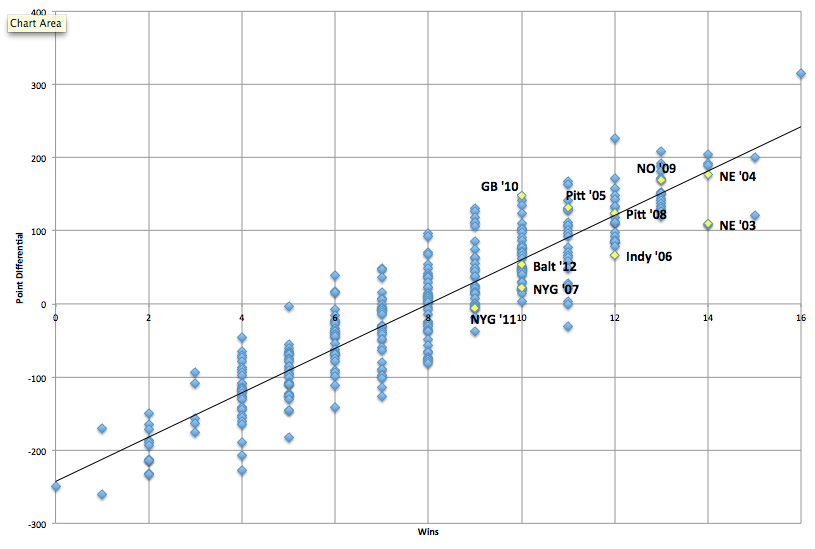
Here is a fun chart.  No great insight, but still interesting to look at.  I graphed every team’s point differential vs. its regular season wins for the last ten seasons and highlighted the Super Bowl winning teams.

Screen Shot 2013-02-04 at 12.10.28 PM


For reference, a data point below the line means the team won MORE games than expected, while a point above the line means the team won FEWER times than expected.

Needless to say…fuck the Giants.