More on DeSean

I told you there was more…today I’ll try to knock a few more things off the list.  For this post, I want to focus entirely on the 2013 season.  While it’s not a large sample, it does represent the “DeSean under Chip” timeframe.  Seeing as how Chip Kelly remains the coach, it seems as though this might be pretty relevant information with which to evaluate DeSean’s importance to the team for next season.

So just how good was DeSean’s 2013 season?

Yesterday I covered Approximate Value and Receiving Yards.  Instead of repeating the analysis, I’ll just say that DeSean had a 2013 AV of 11 and 1332 receiving yards.  That puts him in a tie for 10th in Approximate Value and 9th in yards.

That’s really good, but hardly spectacular.

BUT…(you knew that was coming), there’s more to consider.   Beyond the production, there’s the qualitative (for now) value that DeSean adds to the offense.  His unique talent opens up the offense for the rest of the team, with the benefit redounding to other members of the offense rather than appearing in his stat line.  Let’s go beyond the generic “his speed stretches the defense” and try to illustrate, with stats, what makes him unique.

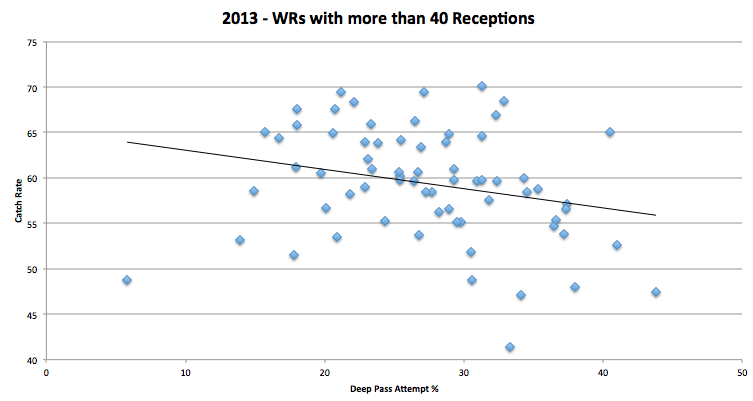
Below is a chart illustrating the Catch Rate for a sample of WRs along with their Deep Pass Attempt %.  These numbers are from AdvancedNFLStats.com.  For the sample, I included every WR who had 40 or more receptions last season.
Screen Shot 2014-03-26 at 6.16.05 PM

I added the trend line to illustrate the correlation (value is -.25).  That’s fairly intuitive.  Longer passes are harder to complete, so the catch rate for “deep threats” should be relatively lower.

Now let’s play a game.  Go to the chart above.  Using just the information displayed, which WR would you want on your team?

I think the answer is pretty obvious, but it might depend on your personal offensive philosophy.  However, regardless of your philosophy, it’s clear there are only a couple of logically defensible choices.  Now let me try to guess which one you chose.

Screen Shot 2014-03-26 at 6.17.43 PM

I thought so.  Now for the fun part.  As you might have guessed, the player I highlighted above is DeSean Jackson.  He’s a fairly significant outlier.  In other words, given the frequency with which his targets were “deep”, we’d expect his catch rate to be much lower.

In fact, just two other qualifying players had Deep Pass Attempt rates above 40%, Torrey Smith and Reuben Randle.  Smith’s catch rate was 47.4%.  Randle’s was 52.6%.  DeSean’s was…65.1%.  Clearly, one of these guys is not like the others.

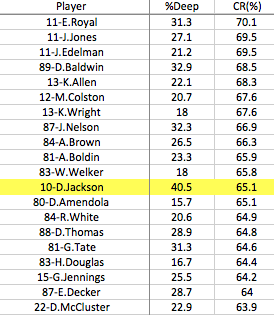
Now let’s sort by Catch Rate.  Here are the top 20 from last season (remember we’re only including WRs with 40+ receptions.)
Screen Shot 2014-03-26 at 6.23.47 PM

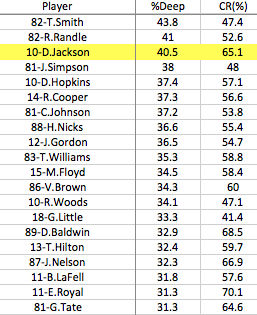
Notice anything interesting?  Look closely at the Deep Pass Attempt rate column.  Among the top 20, DeSean has, BY FAR, the highest percentage of deep pass attempts.  In fact, the next closest player above is Doug Baldwin at 32.9%.  That’s a huge difference.   Now let’s flip it slightly and sort by Deep Pass rate.
Screen Shot 2014-03-26 at 6.33.08 PM

So now we have all of the major “deep threats” represented.  Look at the Catch Rate.  Again, near the top of the list, DeSean blows everyone else away.  Also note that Riley Cooper now makes the list, with the 6th highest Deep Pass rate.  However, his catch rate is “just” 56.6%.  I say put “just” in quotations because that’s still a very good catch rate, as you can see from the chart.   But it’s nowhere near DeSean’s 65.1%.

So, last season DeSean had a Catch Rate similar to the best possession WRs in the game, just behind Wes Welker actually.  Of course, he did so while operating as a true “deep threat”.  That’s a unique, and extremely valuable combination.

You see, last year the Eagles were able to attack downfield with DeSean without taking the normal reduction in Catch Rate.  Obviously, that makes the offense extremely efficient and dangerous.  More to the point, not a single other WR in the game put up numbers anywhere close to DeSean, at least not while catching more than 40 passes.

Now, the caveats.  It was just one season, so it’s certainly possible that DeSean’s Catch Rate and Deep Pass Attempts combination is unsustainable.  We’ll just have to wait and see on this one.  Additionally, you could credit a lot of DeSean’s stats to the genius of Nick Foles.  That too is possible.  Of course, that’s a LOT of credit to give to a 2nd year QB with mediocre arm strength.  As always, the “truth” is probably a combination of several factors.  One of them, though, is DEFINITELY DeSean’s skill.

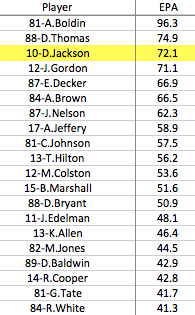
Is there more?  Well yes, lots more, but let’s keep things relatively short.  It turns out AdvancedNFLStats.com also tracks Expected Points Added.  I’ve used the Expected Points concept in great detail before, so I’m not going to do a full explanation here.  Anyway, here are the WRs who registered the highest EPA last season:
Screen Shot 2014-03-26 at 6.54.57 PM

Yep, that’s DeSean, ranked ahead of guys like Josh Gordon, Eric Decker, and Calvin Johnson.  On a per play basis, DeSean also ranked 3rd, behind only Anquan Boldin and Doug Baldwin.

Like I said yesterday, DeSean Jackson is a GREAT player.  We can argue about what he’s “worth” contract-wise.  We can argue about whether he fits the “culture” that the team is trying to develop.  We can argue about how he’ll perform as he gets older.  When it comes to production to date, though, there is no argument.  Since entering the league, Jackson has been among the most productive receivers in the game.  Last season, with Chip Kelly calling the shots and Nick Foles at QB, Jackson became a tremendously unique and valuable weapon.  Don’t lose sight of that.

Scheme Fit

My final comment is a short one.  There was some talk about DeSean not “fitting” the scheme that Chip Kelly is trying to run.  Without engaging completely, because I think that grants too much credit to what is a ridiculous argument, let me just say this:

1) Chip Kelly is a great, creative, perhaps genius-level offensive mind.

2) DeSean Jackson, as shown above, is a unique talent and the premier deep threat in the league.

I’ve pretty much proven the second statement.  If you’re going to make the “scheme” argument, it stands to reason then, that the first statement above cannot be true.  Put simply, if Chip Kelly can’t find a way to use DeSean Jackson in his scheme, then he’s not the offensive mastermind everyone believes he is.  Of course, he did find a way to use Jackson productively last season, so….I told you that argument was ridiculous.

 Update: I forgot to mention that DeSean ranked 11th by Win Probability Added (also from AdvancedNFLStats.com).  That’s good, but given the EPA numbers I expected him to be higher.  I haven’t quite figured out a reason for the discrepancy, hence why I didn’t talk about it.  However, I don’t want it to seem like I’m hiding “unfavorable” stats, so there you go.
Contextualizing Mr. Jackson

Another day, another confusing report about DeSean Jackson.  Until something actually happens (like a trade or release), I’m not going to spend too much time discussing it.  There’s just not much value in speculating when we’re clearly missing a lot of information.  However, I have noticed something worrisome over the past week.  Namely, people seem to be underrating DeSean Jackson.

Make no mistake about it, DeSean Jackson is a great WR and he cannot be easily replaced.  I find it remarkable that I feel compelled to write a whole post about this, but here we are.

D-Jax entered the league in 2008.  He’s played 6 mostly healthy season with the Eagles, with 87 games played.

Take a moment and make a list of the 10 best WRs over the last 6 seasons.  Seriously, jot it down.  Is DeSean Jackson on there?  Probably not, and I’m guessing many of you didn’t seriously consider putting him on there.  Was that a mistake?

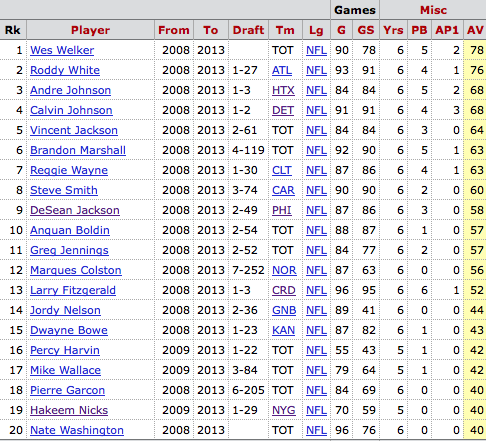
Following is a list of the top WRs over the last 6 seasons, as measured by Approximate Value.  AV is certainly not a perfect measure, and I don’t mean to suggest it is.  However, it’s a very good one, especially for offensive skill players.  Anyway, here’s the list:

Screen Shot 2014-03-25 at 6.11.22 PM

Now go back to your list of the 10 best WRs.  If you actually made it, I’m guessing there’s a LOT of overlap with the top ten WRs by AV.  Of course, the point of this exercise is to highlight where DeSean Jackson is (and is not).  By AV, he ranks 8th (tied), ahead of Larry Fitzgerald, Anquan Boldin, and Greg Jennings.  He ranks just behind Steve Smith.

The point is NOT that Jackson is a better WR than those players, that’s a different discussion.  The point is that he has been among the best WRs in the game since entering the league.  Note that Jackson gains AV points for his Return work as well, inflating his WR ranking.  Of course, it doesn’t make much sense to hold that against him either.

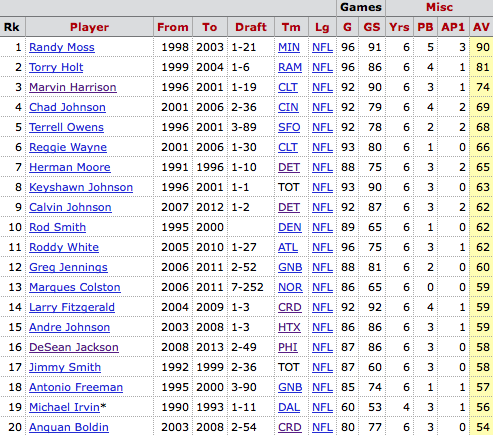
Let’s stick with AV for a moment, but take a slightly different look.  I’m always bothered by the “since he’s been in the league” ranking, because it’s a very arbitrary measure, typically skewed in favor of the subject player.  So, let’s change our filter.  Instead of looking at all WRs from 2008-2013, let’s just look at the first 6 years of each individual player’s career, going back to 1990.  Here’s the top 20:

Screen Shot 2014-03-25 at 6.18.46 PM

Spend a minute examining that list, and note that it underrates Michael Irvin by virtue of the 1990 cutoff date.  Regardless, notice anything?  Nearly half of them are sure-fire Hall of Famers.  Most of the other half at least deserves consideration.  Now you’re starting to see why I think giving Jackson up for little return is insane.  In terms of pure production, DeSean Jackson is a GREAT receiver. Full stop.

BTW, here’s the same filter, but sorting by Receiving Yards instead of AV.  Again, we’re looking at the most Receiving Yards over the first 6 seasons of a player’s career, for all seasons since 1990.

Screen Shot 2014-03-25 at 6.25.38 PM

DeSean has more yards in his first 6 seasons than Roddy White, Isaac Bruce, and Antonio Freeman.  Terrell Owens had just 53 more yards in his first 6 seasons, and actually averaged fewer yards per game.

Like I said…GREAT, and apparently under-appreciated.

Now let me attack the “replaceable” nonsense.  There seems to be an argument out there that basically says: “This is an extremely strong draft for WRs, we can just draft his replacement then.”  This is a fairly ridiculous argument.

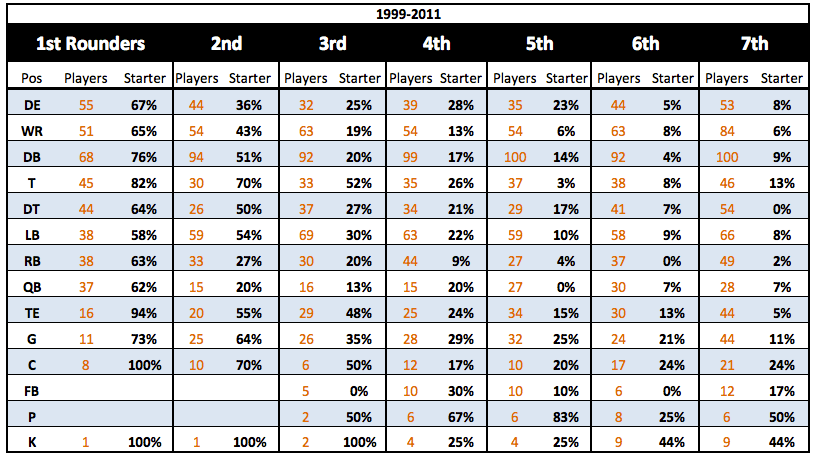
1) Draft prospects are not guarantees!  Remember the post I did on Hacking the Draft?  Let’s take another look at the chart from that study.

See the odds of landing a “starting” WR with a 1st round pick?  Just 65%.  It’s possible that this year’s draft has a higher probability of success.  I’m willing to accept that assertion, but how much higher?  Certainly, given what we KNOW about the draft, not all of the WRs drafted in the 1st round this year will pan out.  Pulling from the studies I did on Skill vs. Luck in the draft, we ALSO know that there’s really no reason to believe the Eagles are more likely than any other team to be able to identify the WRs who WILL pan out.

So if you were planning on replacing D-Jax via the draft, think again.  It’s very possible, but it’s far from guaranteed, and we haven’t even accounted for the opportunity cost of a 1st round draft pick.

Let’s say you DO “hit” on a WR if the first round.  Surely then you’d have adequately replaced D-Jax, right?  Not so fast.

Here is a list of the best rookie WR seasons, by AV, since the 2005 season.  Note that, last season, DeSean registered an AV of 11.

Screen Shot 2014-03-25 at 6.37.11 PM

Since 2005, just ONE rookie WR (Harvin), has registered an AV as high as DeSean did last season.  Moreover, look at the column labeled “Draft”.  12 of the top 20 seasons by rookie WRs were from players NOT drafted in the first round!  Like I said, finding a great WR in the draft is NOT EASY, and certainly not just a matter of taking the best available guy in the first round.

In fact, since 1990, just THREE rookie WRs have registered AV’s above 11.  Randy Moss, Terry Glenn, Joey Galloway.  That’s the list.  23 years, 3 players.  Again, you’re probably not replacing DeSean’s production with a rookie from this year’s draft, at least not next season.

For those of you who don’t trust AV, I’ve also looked at receiving yards.  Here is the list of the best rookie WR seasons, since 1990, sorted by receiving yards.  For reference, DeSean had 1332 receiving yards last year.

Screen Shot 2014-03-25 at 6.43.43 PM

This is going to be tough, but go ahead and count how many rookie WRs had more than 1332 receiving yards….finished yet?  Thought so, counting to ONE doesn’t take that long. Note also that just 8 rookies have exceeded 1000 yards receiving. Remember, we’re looking at every WR in the league since 1990.  That’s a long time.

There’s a lot more to say about DeSean, but I’m going to stop there.  The main takeaways from today’s post are:

1) DeSean Jackson is a GREAT player.

2) The Eagles will NOT be able to replace his production next season, even if they “hit” on a WR in the first round.

Free Agency – Eagles Stick to the Plan

Got back from Iraq last Sunday, but it took me a week to catch up with school, hence the delayed posting. Thanks again to everyone who contributed to the trip.  It was very productive and laid the groundwork for us to do some very impactful work in the future.  Meanwhile, I missed the bulk of free agency, so let’s talk about that today.

First, though, the elephant in the room:

What the hell is going on with DeSean Jackson?

I’ve spent an inordinate amount of time this week trying to game this situation out, searching for some logical thread that will explain it adequately.  I’m sad to say I haven’t come up with anything.  Frankly, I can’t remember a situation as unexpected and bizarre as what’s going on right now.  At first, I thought it was just a leak test.  However, if that was the case the team would have issued a statement by now denying any efforts at trading D-Jax.

Sadly, it sounds like the team really is looking to remove Jackson from the roster.  His contract is onerous, but the team has plenty of cap space.  Cutting/trading him for little value seems like a strange way to deal with that.  The team could, for example, renegotiate Jackson’s contract.  However, it’s possible that Chip is also factoring in Jackson’s attitude.  I have no inside knowledge of DeSean in the locker room, but it certainly doesn’t appear as though he’s that “bad” of a teammate.  Unless there’s some unreported incident or serious cause for concern, this angle seems sketchy as well.

Perhaps we’ll get more information if/when Jackson is moved.  However, if the rumors are true, then it’s pretty clear the team has botched the process to an incredible degree.  That’s strange.  This front office (Howie/Lurie) have made mistakes in the past, sometimes big ones.  However, they’ve never been downright incompetent.  If Jackson gets released and/or traded for a late draft pick, it will be the biggest indictment of the front office yet.

In other, better, news:

The Eagles did exactly what I hoped they’d do in free agency.

If you remember my brief primer, I suggested the team follow a very similar plan as last season.  Namely, pick up a handful of mid-tier players on reasonable contracts, strengthening the middle of the depth chart.  The team is still in “build” mode, and I’d prefer to maintain flexibility for another year before looking to land a premier player via free agency.  The Eagles did just that, and it bodes well for the future.

Malcolm Jenkins is probably the “biggest” signing, and will help improve the team’s biggest weakness from last year, safety play.  Jenkins isn’t a great player.  However, when you’re replacing Nate Allen (hopefully), you don’t have to be great.  If the Eagles, with Wolff and Jenkins (or whomever else), can get anything close to league-average play from the Safeties next year, the team will be in great shape.  Moving from bad to mediocre can make a bigger impact than moving from mediocre to good.

Nolan Carroll is an interesting addition to the secondary also.  Good size/speed, and at 27 years old, he could contribute for a few years.  He’s not a guy you can pencil in as a starter, but the team sorely needed some competition/depth behind Williams and Fletcher.

Braman and Maragos are both bottom-of-the-roster, special teams guys.  Not much to say here other than to note that Special Teams was very weak last year, despite a good year from Donnie Jones.  In general, I’d like to see the team churn the bottom of the roster a bit more than it did during the latter Andy Reid years.

Darren Sproles was not a free agent signing, but he’s obvious a “major” addition, at least in the mind of the pundits.  I put “major” in quotation marks because I’m not sold.  I like Sproles, but he’s 31 and coming off a poor season by his standards.  Basically, if you think he’s going to be the extra “weapon” we were all hoping for, you’re going to be disappointed.  However, I do think he fills an important need.

The Eagles offense is extremely vulnerable by virtue of the fact that it’s built around a single, elite talent (Shady).  Bryce Brown and Chris Polk are decent backups, but they’re completely different players.  In a pinch, they can handle the carries.  Unfortunately, they don’t provide much of a receiving threat.  Sproles fits that need; he had 71 receptions last season.  It means that if Shady gets injured, the offense won’t have to be completely reworked.  None of the plays will be as effective because nobody is as good as McCoy, but the team won’t lose a significant dimension to the offense.

I don’t see Sproles taking the field much WITH Shady.  I think the team will use him to ease McCoy’s workload a bit, hopefully keeping him healthy and perhaps prolonging his career a bit.  If an injury does occur, Sproles will allow the Eagles to keep operating out of the same general philosophy.

It’s a very expensive insurance policy, for sure, but if the Eagles really do believe they can contend next year, it makes sense to sure up the biggest vulnerability on the team.  Of course, that’s hard to reconcile with letting D-Jax go for nothing….

Free Agency Plan

Thanks to everyone who donated to the service trip I’m going on.  We raised over $3400, which is much more than I expected.

Unfortunately, the timing of the trip coincides with the beginning of Free Agency.   While I may be able to comment, I’m not banking on having the time/internet access to do a full discussion while I’m in Iraq.  I’ll certainly address the moves after I return, but before that I figured I’d give you a short-form “wish list.”

Here’s what I’m looking for:

Jairus Byrd –  I am NOT 100% on board with this signing. I think Byrd has become overrated by many fans, and isn’t the guaranteed star he’s being made out to be.  Maybe I’m just gun-shy after the Nnamdi debacle.  I made it fairly clear last week that I’d prefer to  wait another year before taking a big shot or two in free agency.  However, given how big of a whole the Safety position is (and how long it’s been that way), it would be really hard to be upset with signing Byrd.  The Eagles have plenty of cap space, and the cap itself is increasing at a fast pace, so the money isn’t as big an issue as it has been in the past.  Just try to keep expectations reasonable.  Byrd is not going to step into this defense and immediately transform it into a top 10 unit.

The Rest – Outside of potentially signing Jairus Byrd, my plan would look very similar to last year’s.  A handful of moderately priced, mid-tier guys who can add depth and, if the Eagles get lucky, become big contributors.  In particular, NT, CB, S, LB, DE, and WR are all positions that could use some immediate help or at least another body.

A guy like Chris Clemons would seem to fit the bill, but he’s 32.  Short-term stopgaps are ok, but I’d prefer players who can provide depth for 3-4 years.  As the team grows into contention, controlling roster turnover will become a big deal.

The Kicker needs some competition, and that could come via Free Agency.  Todd Herremans needs to be replaced soon, and I suppose that could come through Free Agency too.  Neither of those are “break-the-bank” positions, so it’s unlikely for any signing here to violate the “reasonable, low-priced” requirements.

One thing to keep in mind is that the Eagles appear to believe that players coming back from injury offer good risk/return investments.  Maybe I’m reading too much into last offseason, but Patrick Chung, Bradley Fletcher, and Kenny Phillips were all players with injury concerns.  It wouldn’t surprise me to see the team add a couple of similar profile players this year.  What about Sidney Rice?  Still just 27 years old, but coming off a torn ACL (and a history of injuries).  Is any team still willing to offer him a deal with a lot of guaranteed money?  If not, he’d look good in green.


Hopefully, we’ll see a couple of early signings, but it feels like this could be a fairly quiet FA period for the team.  I think Roseman is very confident in where the roster is and where it’s headed, and I don’t see him getting impatient now.  Next year might be a different story.

That’s all for now. If I can check in from Iraq, I will.  Thanks again to everyone who helped out.  We’ll do our best to earn it while we’re over there.

Resignings: Flexibility in team construction

Peters, Cooper, Kelce, Maclin….ALL good moves, but don’t misread them.  One of the most important aspects of team construction (when you’re essentially starting from scratch), is maintaining flexibility for as long as possible.  That sounds easy, but it requires a lot of discipline.  It means being brutally honest with yourself as to the true quality of the roster and it often means getting ripped by beat writers for a year or two.  As of right now, Howie appears to be doing this perfectly.

Remember last offseason?  The team signed James Casey to play TE (well to play a couple of different roles).  The team signed Isaac Sopoaga to play NT.  The team signed Patrick Chung and Kenny Phillips to play S.

After that haul, what did the Eagles then do in the draft?   They drafted a TE (Ertz), a NT (Logan), and a S (Wolff).  Granted, Wolff wasn’t expected to play much, but the overall point is:  FA and the draft serve two very different purposes.  Free agency is for filling holes in the roster, the draft is for adding talent.  Even though the Eagles re-signings weren’t like the Free Agency deals we typically think of, they still fall into that category.

Heading into free agency, the goal of any team must be to fill any huge gaps in the roster.  If you think back to the color chart I posted last week, this means identifying the “red” areas and trying to upgrade them to “yellow”.  Those types of acquisitions aren’t the headline-generating deals, but they’re extremely important!  If you don’t fill the gaps in FA, you’re left with just two potential outcomes:

1) You have to draft somebody relatively early in the draft at that position, regardless of it he’s the BPA.

2) You go into the season with a huge gap in the roster.

Both of those outcomes are terrible, and the only way out is to get lucky in the draft and have the BPA coincidentally be the position you need.  Of course, it almost never happens that way.  Instead, you end up taking a 26-year-old Guard in the first round….

I want to make this abundantly clear, so let’s conceptualize it a bit:

Imagine you’re a team with identified NEEDS at SS, CB, DE, OT.   What’s your free agency plan?  Many fans would look at that situation and hope for the team to sign a top-end starter at 1-2 of those positions (the unreasonable fans might hope for all 4).  However, there’s a big problem with that strategy.

Namely: You don’t know who is going to be available for you in the draft.

There are two main methods of roster construction, free agency and the draft.  Free agency has no uncertainty.  The draft has a LOT of uncertainty.  The problem with that is free agency occurs BEFORE the draft.  The interplay between these two processes is tricky, and many people don’t properly connect the two when analyzing them.

Going back to our pretend team, let’s say we’ve got the 8th pick in the draft.  What are the odds that the best player available (or a player in the top remaining tier) is a SS, CB, DE, or OT?   Pretty damn good.  Now let’s say you signed a starting CB and DE in the draft. free agency.

Now your “needs” are SS and OT.  What are the odds that the BPA at your pick in the draft will be a player at one of those positions?  Decent, perhaps, but A LOT LESS than they were when you also “needed” a CB and a DE.

By filling the starters roles in free agency, you made it LESS likely that you’ll find a starting quality player at a position of need in the draft.  That’s the important takeaway.  Remember that given the salary cap, the new CBA, and the auction dynamics involved in free agency, finding a quality starter in the draft is MUCH more valuable than finding one in free agency.

The optimal draft strategy is to take the BPA and move up and down in the draft whenever there is a serious dislocation in value.  To do that, though, you need to have all of your gaps filled BEFORE the draft.  Not necessarily with star players, but with guys who can at least pass for mediocre.  Otherwise, you either reach for a non-BPA player, and likely ruin the pick, or you go into the season with a glaring hole.

So, teams that are still in the construction phase, and not yet ready to seriously contend (like the Eagles right now IMO), need to be VERY careful about signing star players in free agency.  Instead, the team should use free agency to fill those holes, and when the roster IS at or very close to contending, THEN you use free agency to put the final 1-2 pieces int place.  At that point, you’ve lost flexibility anyway, and what you NEED is certainty.  Until then, though, it makes no sense to play around in the top-tier free agent market.

With that, let’s talk about a couple of deals:

Jason Peters: Convenient timing for this signing, as I’d just said that the Eagles need to think about replacing Peters soon.  Does the extension mean they disagree?  No, though it suggests they think it might take 1-2 years longer for Peters to decline than I had projected.   Note my projection was admittedly a guess and not backed up by any research into the aging trends of left tackles.  However, I assure you that the Eagles are not banking on Jason Peters being the starting LT in 2018.  He signed for $38.3 million….but only $19.55 million of that is guaranteed.  Also, the guaranteed portion flames out quickly, and after next season the Eagles will be able to cut him with very little $ impact.

Basically, the Eagles bought themselves a call option on the downside of Jason Peters’ career.  If his play declines quickly, they can cut him loose.  If he continues to be an elite LT, they’ve got him locked up at a reasonable level.

Cooper/Maclin: This goes right to the heart of what I was saying above.  If you let BOTH walk, you’ve got a big need at WR.  You either sign someone in free agency or head into the draft knowing you need a WR who can contribute immediately.  Instead, the Eagles signed both of them, to reasonable deals (again, you should only really care about the guaranteed money).  That means the Eagles don’t “need” to draft a WR early.  However, it also doesn’t mean they won’t.  What they’ve done is given themselves the flexibility to take a WR if he’s the BPA, while also allowing them to pass on the WR if he’s not.

Like I said, Roseman is already having a great offseason, but don’t let the beat writers mislead you.  These contracts (Peters and Cooper especially) are nothing more than reasonable call options that give the team flexibility going forwards.  Neither player is guaranteed to be here beyond 1-2 more seasons.  So don’t be shocked if the Eagles take an OT or WR in the first three rounds.