Lowering Expected Variance: Why the Eagles might be “better” but finish the same.

Quick post today.  We’ll start taking a detailed look at the upcoming season soon (hopefully next week), but I wanted to mention a high-level point today.  The over-arching question is: Are the Eagles better this season than they were last season?

I haven’t ventured a complete answer just yet; I still have a lot of stats to go through.  However, I have stated quite explicitly that, from a pure roster perspective, I don’t think the Eagles improved very much (and may actually have gotten worse).  There’s a problem with that statement, though.  It’s incomplete.  Here’s why:

When we talk about a team’s “true” ability level, we’re not really discussing discrete values.  Although many pundits (i.e. anyone/everyone on ESPN) views season projections this way, it’s a very bad method of forecasting.  In reality, ex-ante (before each season), the best we can do is put together an expected performance distribution.  In other words, before the season, we have no idea how many wins each team will produce.  Beyond our inability to fully quantify all the known controllable variables, there’s a HUGE degree of natural uncertainty (luck) in the game.

I touched on this a bit before last season.  In making my projection for the Eagles, I gave a range of outcomes before settling on 9.1 (if I remember correctly) as the average.  I ALSO explained that the Eagles were among the highest VARIANCE teams heading into last season.  Put simply, the team, prior to last season, had perhaps the largest range of expected outcomes.  So while I thought the team “should” win between 9 and 10 games, I also thought it was reasonably possible for them to go 4-12 or 12-4.  Chip Kelly was a big reason for that range; he brought with him a very large degree of uncertainty.  In hindsight, things works out generally as expected (at least on this site) and the Eagles finished with 10 wins.  Note that, given the point differential, the Eagles “true” performance last year was 9.4 wins (via Pythagorean formula).

So why am I telling you this?

Well, if we think about each team’s expected performance as a probabilistic distribution, then there are TWO main ways for the team to actually improve.  Most clearly, a team can increase it’s average win projection.  For instance, it could sign multiple impact starters, or take a great prospect very high in the draft.  Doing so might shift the teams entire distribution to the right, like so:

This is a graphic I used before the playoff game against the Saints.  The X-axis is wins in this example.  The values don’t really matter.  What matters is that the team has moved from left to right.  Clearly, the blue distribution represents a better team.  It’s average performance is much higher.

BUT, there is another way to improve (several actually but we’re focusing on the big ones), at least conceptually.  A team can keep its average win projection the same, but decrease its expected variance.  For example, the Eagles might still be looking at 9.1 wins this year, but the team’s range may have decreased.  That means our certainty increases.

Visually, it might look like this (again borrowing from this post from last season):

Notice the Cardinals; distribution is much narrower than the Eagles’.  Pretend that both have the same average (i.e. move the Eagles to the right so it’s centered on the Cardinals).

That’s better.  To borrow a finance concept, think of the distribution like a stock.  Many analysts/investors use volatility (technically standard deviation, not variance, but for our purposes they’re the same thing) as a proxy for risk.  When looking at an investment, you have to look at both the expected return AND the risk associated with the investment.  Here, you have to look at both the expected average win projection AND the range of potential outcomes.

It’s important to note here that, assuming a symmetrical distribution, narrowing the range ALSO decreases upside while minimizing downside.  Hence, sometimes it is better to have a wide distribution, like when you are a bad team.  However, since there are diminishing returns at the top end of the distribution (a 10 win playoff team isn’t much worse off than an 11 win playoff team), especially where the Eagles look to be headed (good enough to make the playoff but not good enough to challenge for a bye), a smaller range of outcomes is an improvement for the team.

Here’s the important part:

While it’s unclear whether or not the Eagles have shifted their distribution to the right (i.e. expect to win more than 9.4 games this year), it seems very likely that the team has narrowed its range of expected outcomes.

Chip Kelly is no longer huge unknown.  Nick Foles expected performance is undoubtedly higher this year than Michael Vick’s was before last season.  Personnel-wise, the Eagles have made significant improvements below the starters on the depth chart.  Obviously, injuries are a massive source of uncertainty.  Although the Eagles have not added any impact starters (making it tough to increase projected wins), they have made the roster more robust, particularly on the defensive side of the ball.

So yes, the Eagles likely are better this year, if only in terms of uncertainty.  Whether the team’s average win projection has improved is a separate issue that I’ll address over the next couple of weeks.

Nick Foles YPA Projection; An Eagles Almanac Preview

Update: The Almanac is now available for preorder at http://www.eaglesalmanac.com.

Apologies for the lack of posts over the past couple of weeks.  I’ll remain on a very intermittent schedule for the next couple weeks, but after that my schedule clears a bit and I hope to return to a more consistent schedule just in time for training camp to ramp up.

For today, I’m teasing a section of my article for the 2014 Eagles Almanac.  I hope you all purchased it last year and, more importantly, I hope you all enjoyed it.  For those unaware, a group of the best Eagles bloggers puts together an annual season preview magazine.  I contributed last year and will do so again this year.  I promise you there is no better way to get ready and excited for the upcoming season.  Stay tuned for an announcement on its release date and where/how you can get it.

For my piece, I examined Nick Foles performance last year through the lens of his QB Rating.  I pulled it apart and looked at each of his component statistics, then provided context and a projection.  At the end, I put those projections back together to come up with a final QB Rating and stat line that will form my baseline expectation for Nick Foles’ performance next year.  Here is the Yards Per Attempt section.  Note that I have yet to edit it or really re-read it in great detail, as I just finished it; so sorry for any typos/mistakes.

——

Yards per Attempt

Last season, Nick Foles recorded 9.1 Yards per attempt, placing him first in the league.  For his career, Foles’ yards per attempt now stands at 7.9.  Of course, the scheme he is playing in now bears very little resemblance to the one he played in his rookie year, so the quality of that information is suspect.  Of the 37 QBs who qualify under Pro-Football-Reference.com’s leaderboard, the median value was 7.0 yards per attempt.  Clearly, Foles’ performance was a relative outlier.  Aaron Rodgers, second overall, registered a YPA of 8.7 and Peyton Manning, third overall, had just 8.3 YPA.  Historically, Foles 9.1 YPA ranks 19th overall.  However, many of the greatest YPA attempt seasons occurred in a different era (mostly completed by Otto Graham).  Post-merger, Foles’ 2013 season ranks 8th overall.  Is that good?

Well, for a little more context, let’s take a look at the best performances by some other QBs.  The only ones to top Foles are Warner, Chandler, Stabler, Rodgers, Dickey, Esiason, and Manning (the good one).  Notice that no player topped Foles more than once.  Joe Montana’s best YPA season merely tied Foles.  Beyond that, the only players to crack the 9.0 YPA barrier were Bert Jones, Steve Young, and Dan Marino.  Again, nobody in the modern NFL has every cracked 9.0 YPA more than once.  That doesn’t mean it’s impossible to do, but it definitely means that it’s extremely difficult.

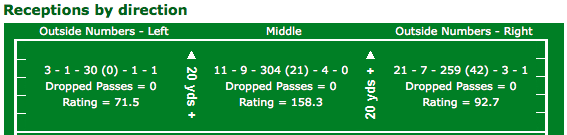
So how did Foles do it?  Beyond the factors mentioned above (good team health and a low drop percentage), I’m sorry to say that there’s one particular factor that looms large when looking at YPA.  Perhaps you’re tired of thinking about him, but there’s really no way around it in this context: DeSean Jackson was a huge boon to Foles’ YPA in 2013.  Part of what made Foles’ YPA so great last year was his remarkable success on deep passes.  According to PFF, 17.4% of Foles’ total attempts went farther than 20 yards.  On those plays, Foles registered 14 TDs against just 1 interception.  More clearly, here is part of a chart from PFF, showing Foles’ rating by area of the field (I’ve only included the 20+ yard section):

Screen Shot 2014-07-14 at 11.29.51 AM

As you can see, Foles performed much better when his deep passes were targeted at the middle or right side of the field.  Now, which WR do you think was in that area most often?  Here’s the corresponding chart for DeSean Jackson:

Screen Shot 2014-07-14 at 11.33.10 AM

The first number is targets, the second is receptions.  Comparing the two, it’s abundantly clear that Foles’ deep passing success, a major factor in his great YPA (and every other statistic) was highly correlated with DeSean Jackson’s.  There’s naturally a problem of causation here, maybe Jackson played so well because Foles was so great at getting him the ball downfield. (Yes, Vick threw some of those passes to Jackson, but most were indeed thrown by Foles. I think somebody, maybe me, tackled the Vick/Foles/Jackson conundrum a few months ago.)   Looking at Riley Cooper’s chart supports that theory a bit:

Screen Shot 2014-07-14 at 11.35.55 AM

However, look closely at the target numbers (the first listed).  Jackson was target far more often than Cooper (as he should have been), meaning the bulk of Foles performance was in combination with Jackson.  Regardless of who you believe was more responsible for the performance, the fact that Foles and Jackson no longer play together is a bright red flag for a potential change in performance.

To reiterate, Foles YPA performance last year was phenomenal, and very unlikely to be reproduced, even if every factor from last year’s team was reproduced.  The loss of his best deep threat, Jackson, provides even more opportunity for variance from his performance.  As I showed above, any change from last year in Foles’ YPA is almost certain to be negative.

Now the important question: What can we expect this year?

Let’s take a look at the other QBs who registered 9.0+ YPA seasons.  What did they do over the course of their career?  Here is the chart:

Screen Shot 2014-07-15 at 9.24.57 AM

Wow…that’s a bit worse than I expected.  Granted, we have to at least mention the fact that NFL offenses have evolved since most of these players played, and it’s now easier to achieve a high YPA.  However, the fact that only two of the players on that list even cracked 8.0 YPA for their career’s speaks volumes to just how unusual Foles’ 2013 campaign was.  Even Aaron Rodgers, on his way to perhaps the greatest QB career of all-time, has a career YPA nearly a full yard worse than Foles’ 2013 measure.  So yes, it’s safe to say Foles will not put up 9.1 YPA again next season.

Remember that the median value for QBs with 50%+ snaps last year was 7.0 YPA.  Just 6 players of those players had greater than 8.0 YPA.  Now, I want to make it clear that I think Foles will still produce a strong YPA this season.  As I showed, while DeSean was a major force, Cooper also put up sterling deep passing (receiving) stats last season.  Jeremy Maclin, in 2012, also had very strong deep-ball numbers.  Thus, I think league average or median is overly pessimistic.  This is still Chip Kelly’s offense and there are still good players here.  However, we also can’t pencil in 9.0 yards per attempt, at least not with a straight face.  Looking at last season’s leaders, the historical comparisons, and the quirks of the Eagles’ offense, I think somewhere between 7.5 and 8.5 is fair, and if I had to narrow that range I’d put it at 7.5 to 8.3.  Taking the midpoint, that gives us a rough projection of 7.9 YPA.  That’s still very good, it would have ranked 7th overall (tied with Drew Brees) last season.  But that’s a BIG decline from 9.1.

——-

In the full article, I also make projections for Completion %, TD Rate, and Interception Rate.  Using those numbers, I also provide projections for QB Rating, Yards, TDs, and INTs.

Lane Johnson’s suspension and the rationality of using PEDs in the NFL

Sorry for the absence, combination of exams/vacation/world cup conspired to occupy all of my time.  Fortunately, not much has happened that needs immediate reaction.  At least until yesterday.

As everyone knows by now, Lane Johnson is looking at a likely 4 game suspension after testing positive for PEDs.  There are a few different angles to view this from, but let’s start with the most obvious, the effect on the Eagles.  Clearly, this is a big loss.  The Eagles offense is dependent on the run game, which in turn relies on the O-Line providing lanes for Shady to work with.  Losing Johnson for four games means the Eagles, regardless of how they fill Johnson’s position, will see a decline in performance at RT.  Moreover, assuming the Eagles fill the need from within (Allen Barbre is the favorite), the team is left VERY shallow at OL for the first four games.  So an injury to another member of the OL would move the unit from a team strength to a glaring weakness.

But you didn’t need me to tell you that.  That’s the easy stuff.

A more interesting angle from which to view this story is the overall use of PEDs in the NFL.  Now I’m going to let you in on a little secret about PEDs….the NFL doesn’t care! Why would they?  They make the players bigger, stronger, and faster; they don’t cost the owners anything; and the fans don’t really care either.  The only real losers in this situation are the players themselves (assuming there are long-term negative health effects from PEDs).  So why do they take them?  It’s essentially a prisoner’s dilemma.  In total, the players are probably better off if nobody uses PEDs.  However, if only a few players take them, they are significantly better off than everyone else.  Given the number of players in the league (hard to trust/coordinate with everyone) and the immense competition for every roster spot, the rational course of action for many players is to take the drugs!  Especially when the first suspension is just 4 games.  They can’t trust the testing policies to catch the cheaters, and they can’t trust the other players not to cheat.  Theoretically, they could actually advocate for very strict testing procedures during CBA negotiations, but that’s a topic for another day.

Ok, so obviously the incentives are pretty badly misaligned and there are structural issues within the league that suggests PED use should be fairly widespread.  That brings me to the next angle to this story, and the only one I think the NFL secretly cares about (if only just a little).  The Seattle Seahawks.

Did you watch them last season?  Bigger…stronger…faster.  The team, top-to-bottom, looked to be in better physical condition than everyone they played against.  Now remember they have a coach, Pete Carroll, who has a history of bending (and outright breaking) the rules.  Most glaringly (perhaps I’m burying the lede here a bit), the Seahawks have led the league in PED suspensions since Carroll took over.

Bruce Irvin…Brandon Browner…Winston Guy…John Moffit…Allen Barbre (oh shit)…Richard Sherman (overturned due to technicality)…

That’s a lot of suspensions.  But that’s not all.  Do you think EVERYONE who uses PEDs gets caught?  I don’t know enough about the testing procedures to suggest a catch rate, but we can use logic to figure this one out.  If 100% of those who used got caught, nobody would use!  Ok, maybe a couple of players who were either really stupid or simply believed their only chance was to use PEDs would still do it, but clearly it would be a very small number.  Moving a bit further, look at the penalty for using.  It’s only 4 games!  Conceptually, think about the expected value of this situation.

Option A: Don’t use PEDs, no chance of getting suspended but you are also at a competitive disadvantage.  What’s the alternative employment for most of these players?  The rookie minimum salary is $375,000.  The veteran minimum is either $450,000 or $525,000 (with 2 years of service).  What would these players earn outside the league?  10% of their NFL salary? 20%?  That makes Option A borderline irrational, at least for players on the fringe.

Option B: Use PEDs, gain competitive advantage (or at least avoid a disadvantage).  We don’t know the odds of getting caught (I personally think they’re VERY low), but let’s be extremely conservative here and say 50%.  So if you take option B, there’s a 50% chance you get away with it (at least for the first year, we can iterate this process to account for testing schedules and PED cycles but the overall point is the same).  Conversely, there’s a 50% chance you get caught.  If you do, you’re suspended for 4 games.  So using PEDs carries an expected value of missing just 2 games?  Against the benefits of using PEDs?

Here’s where I should mention that for true fringe players, the downside of getting caught isn’t limited to just the suspension, it may actually cost them their roster spot and place in the league.  However, we also have to acknowledge the likelihood that some of these players, without PEDs, wouldn’t make the team anyway.  Add in the fact that the PED catch rate is almost certainly far less than 50%, and it’s pretty clear that using PEDs is an extremely attractive risk/reward opportunity.  That ignores potential negative health effects.  That may be important to you and me, but I’d suggest that by playing football (with all of the known concussion risks) is a clear signal that these players are not placing as high a value on long-term health as other’s perhaps would.

The Seahawks appear to have this figured out.  I’m not necessarily suggesting that Seattle has an organized, team-sanctioned PED program.  They almost definitely do not.  However, I am suggesting that there’s probably a don’t-ask/don’t-tell policy, and clearly a relaxed attitude that tacitly condones PED use.  Again, that’s a perfectly rational way for Seattle to run its team.  The team-wide benefits more than outweigh the risks.  The occasional suspension is simply a cost of doing business.  Fans can complain about it and other team’s can claim the moral high ground…but the Seahawks are the Super Bowl Champions.

Enter Chip Kelly.  Unconventional coach with a college background and a history of flouting the rules and pushing the envelope?  Sound familiar? #SportsScience anyone?

Needless to say, Lane Johnson’s suspension does not surprise me.  Not even a little.  Now let’s get controversial….I expect more suspensions under Chip Kelly.  Not necessarily soon, but over the next couple of seasons.

I’m not trying to pass moral judgment here, nor am I taking a side on whether I’d support PED use or not.  Just reading the signs and coming to what I think is the most logical conclusion.  The current league incentives encourage PED use (at least until a player gets their first suspension) and I think Chip Kelly realizes it.

Lastly, this is from a 2013 ESPN article that looked at PED suspensions by team from 2010-2013.  Here are the top 5:

Screen Shot 2014-07-01 at 10.33.31 AM

Note the Bengals, Texans, and Rams also had 3 suspensions each.

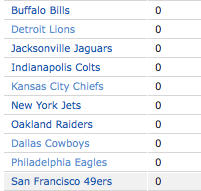
Here are the teams that did NOT have a PED suspension:

Screen Shot 2014-07-01 at 10.35.15 AM

The NFL…if you ain’t cheating, you ain’t trying.