In Support of Carson Wentz

Patrick Causey, Follow him on Twitter @pcausey3

Through the first three games of his career, Carson Wentz has been nothing short of sensational. He has completed 64.7% of his passes for 769 yards, 5 touchdowns, 0 interceptions, on 7.5 ypa and with a 103.8 quarterback rating. Wentz holds the record for most pass attempts to start a career without an interception (102 attempts), received the highest grade ever awarded by Pro Football Focus to a rookie quarterback through three games, and led the Eagles to a 3-0 mark and the second most points scored in the NFL.

Not bad for a rookie.

Despite the impressive performances, some pundits are telling everyone to tap the brakes on the Wentz-hype. They rely on three principle arguments: (1) Wentz has only played three games; (2) Wentz cannot throw deep, but has instead padded his stats by checking down to open receivers; and (3) Wentz cannot work through his progressions, but instead locks onto his primary target. Cian Fahey even went so far as to compare Wentz’s rookie season to RGIII’s, suggesting it is the byproduct of a system and not quarterback skill.

The first point is completely legitimate. While three games is a good enough sample size to evaluate a draft prospect, you need considerably more evidence to judge a player’s long term potential. So we should hold off on booking tickets to Wentz’s Hall of Fame induction speech, at least for a few more years.

But the last two points are not supported by the tape or the numbers.

Working Through Progressions

Let’s start with the claim that Wentz cannot work through his progressions, but instead locks onto his primary target.

While I concede that Wentz often throws to his first read, I disagree that this is actually an issue. That’s because this criticism ignores why Wentz is throwing to his first read so often: because the receiver is open. If Wentz was constantly throwing to his first read and that receiver was covered? Then we’d have a problem. But he isn’t. Wentz is simply making the right decision within the confines of the play he was running and the defense he was facing. He shouldn’t be penalized for that.

Here’s an example. There’s 12:10 left in the 3rd quarter against the Browns. The Browns are showing press man coverage with a single high safety, a coverage they had been playing all game. Wentz brings Jordan Matthews in motion; this forces Matthews’ defender to follow and confirms what Wentz already suspected: the Browns are man coverage. The Eagles are running crossing routes over the middle, which are designed to beat man coverage. So Wentz locks onto Zach Ertz from the moment he snaps the ball because he knows that Ertz should be open. He doesn’t have to look anywhere else.

Watch this play without understanding why Wentz locked onto Ertz, and you will likely (wrongfully) assume that Wentz cannot work through his progressions.

But there are enough examples of Wentz working through his progressions in the tape to prove that theory wrong. Against the Browns, the Eagles were running a slightly modified version of the “sail concept” with Jordan Matthews running a go route, Zach Ertz starting inside but then breaking outside with a corner route, and Darren Sproles running a flat route off the play action pass.

Wentz was required to perform a deep-to-short read, starting with Matthews’s deep vertical route and working back towards the line of scrimmage. As you can see from the clip below, Wentz recognizes that Matthews doesn’t have a step on his man to the outside, so he goes to his next read — Zach Ertz on the corner route — and connects for a 15 yard gain:

Look closely enough in the second highlight contained within that clip, and you will see Wentz’s head, shoulders and body pivot away from the deep route to Ertz on the corner route. It’s all done in one, smooth transition, a sign that Wentz is comfortable moving off his first read and onto his second and third.

This is atypical for rookie quarterbacks, who usually struggle to work through their progressions with fluidity and confidence: “The ability to read defenses is not something that players have learned to a high degree coming out of college,” Hall of Fame coach Bill Walsh once said. “You can see if he locates that secondary receiver — or maybe even an emergency outlet receiver — with ease or with a sense of urgency. This should work like a natural progression, not a situation where it’s — “Oh, my gosh, now I must look over here … no, over there.” You can see which quarterbacks handle these situations with grace. These are the types who have a chance to perform with consistency in the NFL.” 

It’s why we saw quarterbacks like Cam Newton, Big Ben and Sam Bradford take years of seasoning in the NFL before they were able to consistently work through their progressions. While Wentz isn’t on the level of Aaron Rodgers or Tom Brady, he is well ahead of the curve set by most rookie quarterbacks.

All of this ties into one of Wentz’s greatest strengths: the ability to make good decisions on a consistent basis. As the venerable Chris Brown once said,  good decision making requires a quarterback to know “where to go with the ball,” how to “avoid the killer mistake” and to have the “knowledge and the ability to quickly process information while under fire.” It’s “not enough to make the right decision some of the time: If the passer does the right thing four out of five times but throws a brutal pick-six on the fifth attempt, the mistake will mask the successes.”

So far, Wentz has made great decisions way more often than not. Out of the 102 passes he’s thrown, I counted one pass that was interceptable: this pass to Dorial Green-Beckham against the Pittsburg Steelers, where Wentz threw to DGB’s inside shoulder when he had outside leverage.

But, that is one interceptable pass out of 102 total, an absurd (and likely unsustainable) rate of good decision making that aligns with research from Jeff Dooley of PFF.com, who stated that Wentz “has the lowest percentage of negative-graded plays among quarterbacks this year, hardly ever putting the ball in harm’s way.”

Simply put, the tape doesn’t support claims that Wentz is a one-read quarterback that cannot work through his progressions. I’ll leave you to guess why these so-called draft “experts” are suggesting otherwise.

Throwing Deep

So what about the claim that Wentz is a check-down artist that never throws deep? For starters, the numbers don’t back this up. Wentz’s 7.54 yards per attempt ranks 14th in the NFL, ahead of Cam Newton, Russell Wilson, Carson Palmer, Andrew Luck and Big Ben, to name a few.

But even if Wentz’s ypa are somewhat skewed by his receivers gaining significant yards after the catch (especially on screens), we’ve seen enough evidence in the tape to know that Wentz is not only capable of throwing the ball deep, he excels at it. Wentz’s first touchdown pass of his career was a perfectly placed 20-yard pass to Jordan Matthews in the corner of the end zone:

Here is a closeup of where the ball is placed relative to Matthews’ defender. By putting the ball on Matthews’ outside shoulder, the Browns cornerback has no chance to make the play. The only way this doesn’t go for a touchdown is if Matthews drops it (fair possibility all things considered).
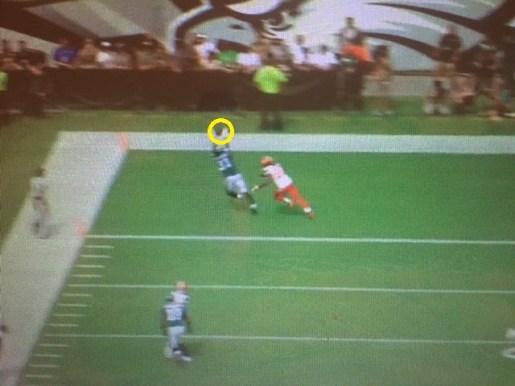
Matthews TD.jpg

Later in the game, Wentz delivered another perfect strike, this time on a 40 yard bomb to Nelson Agholor, who was in single coverage against All Pro cornerback Joe Haden:

Again, look at the ball placement relative to where Agholor’s defender is. The ball is placed on Agholor’s outside shoulder, leading Agholor to the pylon, but away from Joe Haden. You could not ask for a better ball placement on this throw.

One of Wentz’s most impressive throws came against the Chicago Bears on Monday Night Football. The Bears got pressure up the middle and from the right side of the line, forcing Wentz to flush out of the pocket to his left. Wentz had a running lane, but stopped just short of taking off to hit Nelson Agholor between three defenders.

This would have been an impressive throw if Wentz was standing tall in the pocket with his feet set. Wentz instead made it while moving to his left and throwing across his body, which magnifies the degree of difficulty by a considerable margin. Look again at where that ball is placed; the only player able to make a play on the ball is Agholor. That’s simply an incredible throw for any quarterback to make, let alone a rookie quarterback making his second start.

One last example. Watch this pass to Jordan Matthews against the Cleveland Browns. Wentz delivers this 20 yard pass on a rope and in a spot where only Matthews can catch it:

Bill Walsh once stated that “Some players can throw 80 yards, but they aren’t good passers. Good passing has to do with accuracy, timing, and throwing a ball with touch so it is catchable. It is a plus to be able to throw a ball on a line for 35 yards, but not if it is off target or arrives in such a way that it is difficult to catch.”

Indeed, if you cannot deliver a catchable pass on a consistent basis, it doesn’t matter how hard you throw or how fast you run. Just ask Michael Vick.

Wentz no doubt has impressive arm strength, but his precise ball placement is even more encouraging. Here is a screen shot of the moment right before Matthews caught the pass. If Wentz throws this 6 inches in the other direction, the defender likely knocks this pass incomplete:

Matthews low and away.jpg

Those are just four examples of Wentz attacking the defense with deep and intermediate throws with good arm strength and precise accuracy. There are many others, so you cannot say that Wentz only attacks defenses with short passes.

Throwing Under Pressure

Since I have your attention, I wanted to touch on two other areas that make Wentz such a tantalizing prospect moving forward: his ability to throw accurately under pressure and how Wentz uses his legs to extend plays instead of shorten them.

Ron Jaworski once told a great story about the difference between a quarterback that understands passing concepts versus a quarterback that can apply that understanding in live game situations: “I’m doing a “Monday Night Football” broadcast years ago, and during the production meeting…Joey Harrington was talking about the system, and says “I love this system, I have total control at the line of scrimmage, if I see something I can audible to it. ‘Two strong,’ I audible to this route adjustment. ‘Two weak’ I can adjust to this.” He’s standing up in front of us and showing us. It was beautiful. Joey knew the offense in and out….Then first play of the game, there’s two defenders to his right, they came with a blitz, he dropped back, held the ball and got smashed. You sit in a film room and put your feet up and say “When this guy comes here, I’ll hit that guy there.” But Harrington couldn’t apply it. There are a lot of guys who are great at the chalkboard, can tell you where to go, but they need to execute it.

Wentz has played only three games in his career but has already shown that he can retain his accuracy, arm strength, and mechanics when under pressure. Consider this throw against the Bears with 4:24 left in the second quarter. Wentz hits Trey Burton in stride despite having pressure bearing down on him almost immediately:

Or consider this throw against the Bears. Wentz was hit as he released the ball, but had the wherewithal to throw Celek open and hit him in stride:

As you can see, Wentz is halfway through his release before Celek has yet to break into the post route. Wentz knows he’s about to get crushed, yet he stands tall in the pocket and delivers the ball into an open space, throwing Celek open and away from the two Bears defenders guarding him:

Throwing Open.jpg

Those are advanced level throws that we have not seen in Philadelphia in a long, long time. So while I agree we shouldn’t get too carried away with the Wentz hype, we also cannot ignore that this kid has been playing at an extremely high level.

The final thing I wanted to touch on was Wentz’s functional athleticism. One of the biggest reasons the comparison to RGIII is so off-base is because Wentz uses his legs to extend plays, while RGIII consistently used his legs to run after the first sign of trouble.

The perfect illustration of this was Wentz’s touchdown pass to Darren Sproles. Wentz used his athleticism to avoid the pressure from Steelers defensive lineman Cameron Heyward, kept his eyes downfield, and stopped short of the line of scrimmage so that he could deliver a perfectly placed touch pass to Darren Sproles:

Compare that to this article from the Washington Post, where Chris Cooley explains in painstaking detail how Robert Griffin, III was unable to process information quickly and make the right reads. You simply cannot compare Wentz’s play with RGIII’s with a straight face.

Conclusion

I agree that we need to see more from Carson Wentz before we crown him the next great young quarterback in the league. But that doesn’t mean we should ignore how impressive he has played. Wentz has been fantastic, and the main criticisms aimed at him are wholly off-base. So the next time someone tells you Wentz can’t throw deep or work through his progressions, show them this article. Because those claims are not supported by the numbers or the tape.
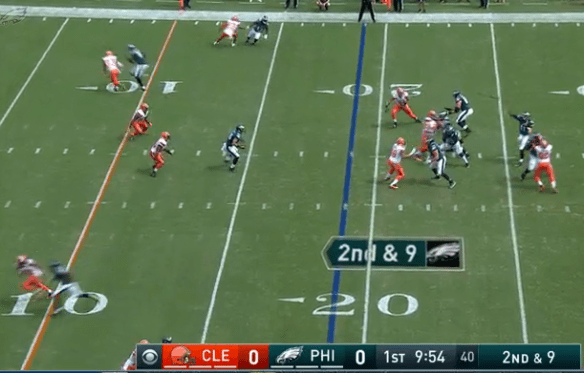
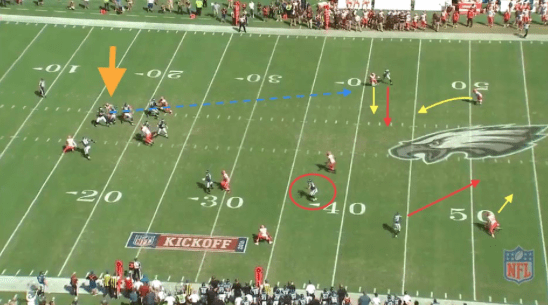
It’s the Little Things

Life is good in Eagles Nation.

Carson Wentz is the greatest QB to ever play. The offense is scoring points. Jim Schwartz and the defense are on a warpath. No QB who has faced the Eagles wants any business with doing it again. Sam Bradford netted a first round pick. The run game suddenly exist again. Now if the WR’s (and secondary) can just hold on to the damn football, watch out.

Now unfortunately the realities of being a comically underemployed recent college graduate mean I have not had time to dig into the All-22 footage and really get a good feel for the offensive line play. However, this one play did stand out and I thought I would share my thoughts on how it is so much more than meets the eye, and really impressive. As the title of this post suggest, it’s the little things that make all the difference.

The Play

https://twitter.com/JoshPaunil/status/780214085900181505

At first glance this is just a simple “Power” play. Wendell Smallwood shows good burst and acceleration. The line creates a nice hole. Solid 13 yard run. Nothing to write home about, let alone a meandering post.

BUT… The play shouldn’t have worked.

The way it was executed, is not the way it was drawn up.

Allen Barbre is supposed to pull and kick out DE Arthur Moats. TE Trey Burton is supposed to follow up on the inside of Barbre and ISO block the LB (preferably inside out as well).

None of this happens though, because Arthur Moats makes his reads, and diagnoses the play, compresses the hole, and “wrongarms” Barbre. This is perfect technique. Up to this point in the play the Steelers coaches will be happy and the Eagles coaches will be annoyed that it didn’t work, but it would be more in the “the other guys get paid to play football too” category. Nobody is getting cusses out for this play on film, if it just ends here.

But it doesn’t.

Barbre has the wherewithal to pivot his hips around Moats, and then use the defenders momentum against him to wash him out of the play. Burton also adjusts on the fly and instead of going inside Barbre, or just running into him, goes around Barbre to the outside, and still gets a block on the linebacker.

The final piece of the puzzle is rookie running back Wendell Smallwood. He shows good patience. When he first gets the ball, the hole that should be there isn’t. It would be easy for a young runner to panic and bounce the run to the outside or simply try to bury a shoulder into the mass of bodies. Instead he isn’t in a rush, a gap emerges, and Smallwood accelerates through it for a nice gain.

This play doesn’t happen last year. Last year Allen Barbre couldn’t figure out who to block on inside zone (and given that inside zone was 40% of the offense that’s a big deal). This Eagles team is getting better each week. And with better play design and coaching that is alot more effective, it leads to plays like this.


Tyler Aston is a contributor at Eagles Rewind. You can yell at him on twitter @Astonia67.

Scouting The Steelers Defense

Patrick Causey, Follow him on Twitter @pcausey3

Carson Wentz has exceeded all reasonable expectations with his play to date. He is the first rookie quarterback since the merger to go 2-0 without any turnovers. He is PFF’s top rated quarterback. And his 94.1 quarterback rating is better than Cam Newton (92.7), Joe Flacco (84.3), Aaron Rodgers (82.6), and Russell Wilson (80.7). Given the drops and clock killing for an entire quarter against the Bears, it’s reasonable to assume his numbers could be even better.

Of course, it’s only been two games — against the Browns and Bears, no less — so it would be ridiculous to suggest he is as good as those quarterbacks. The Steelers represent his first real challenge of the season; they will provide the Eagles organization and its fans a good barometer for judging just how talented the rookie signal caller is.

So how will Wentz (and the Birds) fair against the Steelers? Let’s dive deep into the tape and numbers to get a better understanding. If you missed my scouting report on the Steelers offense, you can check it out here.

By The Numbers 

The Steelers rank a pedestrian 21st in total yards allowed, primarily because they have given up the second most passing yards in the league (695), behind only the Oakland Raiders. But their rush defense ranks second in the league, allowing only 101 yards over two games. A term you will hear a lot with the Steelers D is “bend, but not break,” and the numbers bear this out. Even though they give up a ton of yards, the Steelers are tied 8th with the New York Giants in points allowed, giving up on average 16 points per game.

From an efficiency standpoint, the Steelers defense ranks 14th according to FootballOutsiders’ DVOA rankings, 6th against the run and 14th against the pass.

Football Outsiders has a great metric that lets you measure how a defense has done in pass defense compared to the league average. Here is how the Steelers stack up:

Pos

Yards Allowed

League Avg YA

WR1

103.0

83.2

WR2

49.5

50.5

Other WR

87.5

51.9

TE

64

54

RB

81.5

43.0

Not surprisingly, the Steelers are worse than league average against receivers almost across the board. Matthews, Burton and Sproles seem to have the most favorable matchups given the Steelers tendencies to give up the underneath passes. Get them in your lineups, fantasy owners.

The Base

For what seems like an eternity, the Steelers have run a two gap, 3-4 defense that relied heavily on zone blitzes. Things have changed under second year defensive coordinator Keith Butler, who — at least this season — has been employing more of a 2-4-5 front, eschewing the Blitzburgh defensive philosophy in favor of dropping more players in coverage.

Carson Wentz has been phenomenal diagnosing defenses at the line and throwing under pressure. The Steelers present a different type of challenge, as they are known for their complex zone coverages. And while they don’t blitz as often as they used to, they still do a good job switching up which players they send on the rush. Wentz is going to be tested in this game.

Stout Against Run

One thing that hasn’t changed for the Steelers is the emphasis to shut down the run and make opposing teams one dimensional. The Steelers are relentless in pursuit, closing running lanes before a play has a chance to get started.

Cameron Heyward is a big reason for their run success. While the box score won’t reflect it, he was virtually unstoppable against the Redskins, routinely getting into the backfield to disrupt the run. On this play, Heyward doesn’t get a tackle, but watch how quickly he explodes through the line, forcing a holding penalty that negated a nice gain.

Jason Kelce’s struggles are well documented. He’s been dreadful through two weeks, and this comes on the heels of a disappointing 2015 campaign. Heyward will likely give Kelce problems this week, as he often lines up between the guard and center. Kelce must improve, or the Eagles are going to have a hard time getting the run game going.

Giving Up The Underneath Passes

Against both the Bengals and Redskins, the Steelers routinely dropped 7-8 men into coverage, selling out to shut down the big play. With that, the underneath routes were open all damn game.

Cousins obliged, drinking and dunking his way down the field while completing 69% of his passes for 329 yards. But Cousins’ production failed to translate to touchdowns, as their first three possessions inside the red zone yielded only 9 points.

The Steelers deserve some credit for this, as their defense has been very good inside their own 20. But Cousins left some plays on the field as well:

While I won’t quibble with Cousins decision to go with Reed — he had a clear step on his man — Cousins threw behind him, leading to the incompletion. But Cousins had two better options on this play, a wide open receiver on the underneath crossing route and DeSean Jackson with a clear step on his man on a fade route into the end zone. This was one of several plays that Cousins missed in the redzone, and before they knew it the Redskins were down 24-9.

Andy Dalton was more aggressive, attacking the Steelers up the seams with vertical passing concepts. It didn’t work; the Steelers defense suffocated any chance of the deep pass by creating impossibly tight windows to attack. The Bengals offense didn’t get any semblance of consistency until Dalton started to take the underneath routes, but by then it was too late.

Like the Redskins, the Bengals also struggled in the red zone, getting field goals on their first three possessions inside the 20. Like Cousins, Dalton left some plays on the field, missing at least two opportunities to score touchdowns. On one, Dalton had tight end Tyler Kroft breaking wide open across the back of the end zone. But Dalton’s throw led Kroft too far out of bounds, and the Bengals settled for three.

Earlier in the game, the Bengals were set up inside the Steelers 10 yard line. Dalton had a receiver wide open on an out route out of the slot, but he skipped the ball into the ground. The Bengals settled for another field goal.

That’s one of the most encouraging things I picked up from the tape. While the Steelers have been good at preventing touchdowns, some of that was based on their opponents own errors. In other words, the opportunities are there for Wentz and company to make plays.

The Eagles have their own problems scoring touchdowns, with bad drops from Jordan Matthews and Nelson Agholor costing the Eagles at least 14 points against the Bears last week. The game was never close enough for it to matter, but the margin for error will be significantly smaller against the Steelers. If the Eagles are trading field goals for touchdowns, they won’t have a chance. So Wentz and his receivers must capitalize when the opportunities present themselves.

Ryan Shazier

We can’t do a report on the Steelers D without talking about Ryan Shazier, who is playing like an All Pro linebacker through two games. He was making plays at every level and every facet of the game. Shazier has always been talented, he just couldn’t stay healthy. But so far, he looks like a complete linebacker, possessing a rare combination of size, speed and intelligence. Watch how much ground Shazier covers on this play before forcing the fumble:

Shazier is the quarterback of the Steelers defense, setting the plays and making any necessary adjustments. The chess match between Shazier and Wentz is going to be fun to watch. Wentz needs to know where he is at all times because Shazier has shown that he can make plays in the passing game as well:

The Keys To The Game & Prediction

I see three keys to this game: first, Wentz must be patient and take what the defense gives him. He’s not shy about attacking defenses deep, but those opportunities are going to be harder to come by against the Steelers. Wentz must avoid trying to force things and attack the Steelers through the short passing game.

Second, the Eagles must capitalize inside the red zone. The Steelers offense is likely going to score in bunches, so the Eagles cannot afford to trade field goals for touchdowns. Matthews, Agholor, et al., are going to need to hang onto the ball. They cannot afford costly drops.

Finally, how is Wentz going to handle the Steelers exotic zone defenses? They are notoriously complex, confusing even the most seasoned veteran quarterbacks. Wentz has impressed with his command and confidence, but this defense presents a different challenge. If Wentz rises to the challenge, the hype surrounding Wentz is only going to get louder.

Before breaking down the tape, I intuitively assumed that the Eagles were going to lose this game. Now I’m not so sure. While the odds still favor the Steelers, the Eagles have a chance to surprise some people.

Vegas seems to agree. The line started at Pittsburgh -5.5, but has dropped to -3 in the last 48 hours despite over 70% of the public taking the Steelers. That tells us big money is going on the Eagles late, an encouraging sign that they might have a better chance then many believe.

I really want to pick the Birds. But I have a hard time choosing them over Big Ben and Antonio Brown right now. I think the Eagles cover, but the Steelers win 23-21.

Season Record: 2-0


Know Your Opponent: Scouting Report on the Steelers Offense

Patrick Causey, on Twitter @pcausey3

The Pittsburgh Steelers will provide a litmus test for the Philadelphia Eagles.

They will test rookie quarterback Carson Wentz, whose terrific start has been marred (for some at least) only by the quality of the opponents that he has faced.  They will test the Eagles defense, which hasn’t allowed more than 14 points in two games, something it took them 16 games to accomplish last year. And they will provide a litmus test for first year head coach Doug Pederson, who out-coached John Fox and Hue Jackson in consecutive weeks, but now has to go toe-to-toe with Super Bowl winning head coach, Mike Tomlin.

Here is a scouting report on the Steelers offense based on the numbers and tape. Check back on Saturday for a similar breakdown for the defense.

By The Numbers

Pittsburgh ranks 8th in total yards with 811 (or 405.5 per), according to ESPN.com. They are 12th in passing yards (540), 6th in rushing (271), and have scored the 4th most points in the league, behind only Carolina, San Diego and Oakland.

The Steelers offense is also very efficient, ranking 7th overall according to FootballOutsiders.com’s DVOA efficiency metric. They are 6th in points per drive and 10th in Drive Success Rate (“DSR”), which, according to Football Outsiders, “measures the percentage of down series that result in a first down or touchdown.” What’s more, Football Outsider’s DAVE ranking, which combines preseason predictions with a team’s performance to date, projects the Steelers to have the top rated offense in football for the entire season.

In other words, Todd Haley, Big Ben & Co. are picking up right where they left off last season, when they finished on a 6-2 run and were one of the hottest teams in football.

The Counter

While the offense revolves around the passing attack, the Steelers are a highly productive run team, ranking 6th in the NFL in total rushing yards. Their primary run play is the famed Counter Trey, which was created by Tom Osborne during his heyday in Nebraska. Joe Gibbs is credited for bringing the Counter Trey (or Georgia Counter) to the NFL during his first stint in Washington, and Steelers offensive coordinator Tom Haley has been using it throughout his coaching career.

At its core, the Counter Trey involves a tight end and guard pulling from the backside to lead the way while the frontside lineman downblock to create an open lane.

The Steelers use subtle variations of this play to keep defenses honest. You’ll mainly see it run when they are in 12 personnel (two tight ends) and Big Ben under center; but they also run it out of the shotgun formation and will attack the backside of the line when the defense starts attacks the frontside of the line. Against the Redskins, I counted at least 6 variations of the Counter Trey, 2 of which went for touchdowns. In other words, the Redskins knew it was coming, but they just couldn’t stop it.

33-year old running back DeAngelo Williams has found the fountain of youth in Pittsburgh. While he’s not as talented as Le’Veon Bell — then again, who is? — Williams still leads the league in rushing through two games with 237 yards. Not bad for a backup.

Williams has carried a heavy work load through two weeks, toting the rock more than any other running back in the league. Williams is a capable pass catcher out of the backfield and still has enough juke left in the tank in both run and pass situations to make defenders miss. Watch Williams hit R1 on these defenders for a touchdown:

Big Ben to Antonio Brown 

But make no mistake, the Steelers offense revolves around Big Ben and Antonio Brown, which for my money is the best QB/WR combo in the entire league.

Big Ben isn’t quite as elusive as he used to be, but he still has moments where he makes plays that only he can make. Against the Bengals, Big Ben turned in a vintage play, spinning and bobbing long enough to let Sammy Coates break free for a big gain down field.

But even though these plays are becoming less frequent with age, Big Ben has more than compensated for this by mastering the cerebral part of the game. He is a complete quarterback in the prime of his career. He is ball placement is precise, his understanding of the game advanced, and he has freedom within Todd Haley’s offense to attack the defense as he sees fit. He is light years ahead of Jay Cutler or RGIII as quarterbacks and is going to present the first true challenge for the Birds defense.

Brown needs no introduction. He is the best wide receiver in the NFL, and it’s not subject to debate. Over the last three seasons, Brown has caught an absurd 375 passes for 5,031 yards and 31 touchdowns.

In an age where wide receivers are bigger and faster than ever before, Brown is ordinary. He’s 5’10 and 181 lbs and ran a 4.47 40 time coming out during the draft. Despite these otherwise meh physical metrics, Brown is still practically unguardable. He is one of the best route runners in the league. His body control — especially mid-air — is matched only by Odell Beckham, Jr. And he catches everything thrown his way. He is particularly adept at getting open when Big Ben starts dancing in the backfield; the two have an intuitive, unspoken understanding of where the other is going before anyone else figures it out.

Big Ben fully trusts Brown and will throw to him even when he’s double covered. Against the Redskins, the Steelers were on 4th and 1 from the Redskins 30 yard line. The safe call is to kick a field goal. A conventional gamble on 4th and 1 would involve a run up the middle or a quick hitch/slant/curl route just pass the markers. Big Ben wasn’t having that:

Look at how open the underneath routes were — that’s as close to a guaranteed first down as you can get. Now look at how covered Brown was. At the moment the ball is released, Brown is a step behind his man and has a safety tracking him for the double team. Yet, Big Ben let’s it fly, and Brown’s impressive closing speed and freakish body control allows him to come down with a pass that 90% of receivers in this league would not have caught.

Brown ran a similar fade/go route at the 26 yard line for a touchdown later in this game. It seems to be a preferred route for Brown and Big Ben. So if you see the Steelers inside the 30 and Brown is single covered on the outside, don’t be surprised if they take this shot against the Eagles.

The only problem? Brown can just as easily cut the route short and catch a back shoulder fade for a big gain. That’s precisely what we did after his second touchdown catch, and gained about 25 yards.

Quick Passes Will Negate The Pass Rush

Watching the tape, Todd Haley has a good mix of vertical passing with 1-3 step drops designed to get the ball out of Big Ben’s hands quickly. You’ll see no huddle, package plays (with read and pass options), sail concepts (a three receiver combo route that typically includes a flat, corner, and go route), the triangle read (or snag), and the Hank Route (hitch routes across the board).

I am most concerned about the Steelers quick passing attack. Against the Redskins, Big Ben was routinely getting rid of the ball before the defense had any chance of getting pressure.

All game long, the Steelers were running quick slants, digs, and WR screens. And on the year, 64% of Big Ben’s passes have travelled less than 10 yards.

It’s no secret that the Eagles defense is predicated on pressuring the quarterback without having to blitz. Jim Schwartz has built his entire defensive philosophy off this simple idea. And through two games, their defense has been nothing short of sensational, ranking 2nd overall in FootballOutsiders’ DVOA efficiency ratings, behind only Seattle. They have allowed the 4th fewest yards in the league (572) and the second fewest points allowed (24).

But if Big Ben is getting rid of the ball after a one-step drop, the Eagles defensive line will be neutralized. That will take away the strength of the Eagles defense and put tremendous pressure on the Eagles already suspect secondary.

One way the Eagles can combat this quick passing game is to jam receivers at the line of scrimmage, preventing them from getting a free release. Schwartz likes to mix in press man with zone coverage. So don’t be surprised to see the Eagles defenders getting close to the secondary to take away the quick passing routes.

How The Eagles Can Game Plan To Stop The Steelers

As I am writing this report, I am watching the New England Patriots systematically beat the Houston Texans despite starting their third string quarterback. Most people will focus on that (and rightfully so), but I am more impressed by Bill Belichick’s ability to consistently take away the one thing that his opponent does best on offense. For the Texans, that meant shutting down the deep passes to Will Fuller and DeAndre Hopkins. The Patriots gave help over the top and forced Brock Osweiller to check down and attack the middle of the field, and the offense never got any sort of rhythm.

If I am Jim Schwartz, I am taking a page out of Belichick’s playbook and double teamming Brown all damn game. Now, as we just saw, even a double team won’t completely shut Brown down. But I would force the Steelers beat us with Sammy Coates, Eli Rogers and Jesse James in the passing attack. I can live with that. If we leave our corners in single coverage against Brown all game, we are going to be toast.

The other thing the Eagles will need to do is force turnovers. Big Ben has a habit of doing two things that make him prone to turning the ball over: dancing around in the backfield trying to find time for his receivers to get open; and forcing the ball to Antonio Brown.

The Redskins missed out on multiple opportunities to create turnovers and turn the tide of the game against the Steelers. Big Ben lost, and then recovered, two fumbles. And the Redskins dropped two sure fire interceptions, one of which occurred when Big Ben tried to force the ball to Brown. The Eagles defense has been opportunistic so far this year, and they will need to capitalize on the opportunities this week if they are presented.

If they can contain Brown and cause a few turnovers, the Eagles will have a chance for the upset. But if they don’t, this could be one of those reality check games that we were all expecting to get eventually.


Week 2 Notes (Pre-Game)

A few thoughts/notes to add before tomorrow’s game:

  • Obviously, the focus is on Wentz.  The Bears present a tougher challenge defensively than Cleveland (we think), especially on the road in primetime.  Wentz has looked very poised thus far, so I doubt the MNF aspect will matter much.  The real question for me is: Will Wentz continue to throw into tight coverage windows?  The most impressive part of Went’s debut was his willingness and ability to make throws to receivers that were less than wide open.

Not the best angle, but here is the first Wentz TD throw, at the moment of release.    Matthews is the blurry WR in the lower left corner.  That’s relatively good coverage, and Wentz still saw the opportunity, took it, and made a perfect throw.

screen-shot-2016-09-18-at-6-17-41-pm

Here is a shot put together by @NFLosophy showing the coverage on Went’s 3rd down conversion to Matthews:

screen-shot-2016-09-18-at-6-24-27-pm

Again, the coverage is good, and many QBs (ahem..Bradford), wouldn’t have made the throw.  Perhaps Wentz made the wrong read here.  However, the fact that the scenario shown above was a conversion opportunity for Wentz suggests there is huge upside for him as a player.  If that’s all the window he needs, he’s going to be extremely difficult to defend, regardless of who his recievers are.

Keep any eye one whether he attempts/completes passes into similarly tight coverage tomorrow night.

  • One of the main reasons I was not too confident in the team this year (I predicted 6-10), is that the OL seemed to be a big weakness. In particular, I was worried about the continued decline of Jason Peters.  However, in week 1, Peters looked close to his old self.  If Peters can indeed bounce back from last year, despite his age, the outlook improves considerably.  On the negative side, Jason Kelce looked awful.  Pay close attention to each of them tomorrow night
  • Is the Eagles WR corps better than I thought?  In other words, was Sam Bradford making them look bad?  As shown above, Wentz was able to create opportunities for the WRs even in tight coverage.  Nelson Agholor looked like a legitimate receiver, if only on go routes, and Matthews looked like a good #1.  I’m still skeptical, but am anxious to see more evidence in favor of this.  Attributing results properly between QBs and WRs is really difficult if you don’t have the time to go through every throw multiple times on replay.  Moreover, even that won’t show you all the counterfactuals; all of the opportunities that existed but weren’t taken. For example, in the above screenshot: if Wentz doesn’t make that throw, nobody reviewing the tape would have called that a missed opportunity.  And yet, it turned into a long completion and a big third down conversion.
  • Can the Eagles cover Alshon Jeffery?  Although Cleveland looked somewhat respectable on offense today versus the Ravens, it seems clear that the Browns are fielding one of the worst offenses in the league.  In particular, they don’t have any players that pose significant individual match-up problems.  Certainly nobody like Jeffery. 6’3″, 218 lbs.  And he runs a 4.48 40 yd dash.  He averages 8.5 targets per game, with a 57.9% catch rate and 15 yards per reception.  We’re all hopeful that the Eagles defense will be a strength of the team both this season and in the near future. The Bears and Jeffery will provide a better measuring stick than the Browns did.
  • Will Doug Pederson stay aggressive on 4th down?  Last week, the Eagles were up 15-10 in the 3rd quarter when they faced a 4th down with 4 yards to go for a first down at the Cleveland 40 yard line.  Pederson went for it and the team converted.  But it wasn’t a hard decision.  Actually, it was a fairly easy one as far as those decisions go. Still, it’s encouraging to see Pederson get the easy ones right, especially in his first game.  But will he make the right decision when it’s not so clear?  With all of the focus on Wentz, Pederson isn’t getting enough attention.  Tomorrow night should be a closer game.  If that’s the case, we should be able to learn a lot more about what kind of coach Pederson really is.


Key matchups and numbers for Eagles v. Bears

Patrick Causey, on Twitter @pcausey3

I have been slammed at work this week, so I didn’t get to provide an in-depth scouting report on the Bears like I had hoped. But, here are 10 thoughts on the Eagles/Bears:

Key matchup: Fletcher Cox & Bennie Logan versus rookie center Cody Whitehair and newly signed guard Josh Sitton

This will likely be a recurring theme for the Eagles since they are built around their defensive line. But how Cox and Logan play against the Bears’ interior line, specifically Whitehair and Sitton, could go a long way towards determining the outcome of this game.

Sitton signed with the Bears 2 weeks ago, Whitehair is a rookie that made his first career start last week; the inexperience and lack of cohesion between the interior of the Bears offensive line was apparent. The Bears struggled mightily handling stunts from the Texans, which requires offensive lineman to either communicate the switches or understand who is responsible for which player intuitively. Given that they were on the road in a hostile environment, it makes sense that they struggled with the latter. Cutler was sacked 5 times and hit 12.

Schwartz likes to use stunts to supplement his pass rush since he tries to avoid blitzing if he can. Expect to see stunts used regularly this week to test whether the Bears were successful in their stated goal of improving against stunts. Don’t be surprised if Schwartz tries to stay a step ahead and throw other wrinkles designed to generate pressure by maximizing confusion. He’s shown an affinity for double A gap and corner blitzes, so he might go that route while the Bears are expecting (and prepared for) stunts.

The Bears offensive line problems led to inefficiency issues for their offense.

Langford averaged 3.4 yards per carry, Cutler averaged 7.4 yards per attempt, and the Bears were only 4 of 13 on third down conversions.

This inefficiency kept the Bears offense off the field for prolonged periods of time. Their 54 total plays was tied for 2nd fewest in league (by comparison, the Eagles ran 73 plays last week). The Bears also turned in a Chip Kelly-esque time of possession with 23:41 (compared to 36:19 for the Texans).

That inefficiency was largely due to the struggles of the interior line, which had a trickle down effect on the entire offense. So getting pressure up front and stopping the run will go along way towards making life easier for the Eagles offense.

Alsho Jeffery looks like his old self.

2015 was supposed to be Alshon Jeffery’s breakout season, solidifying himself as a bona-fide #1 wide receiver. Instead, it was an ineffective campaign marred by nagging injuries.

Those problems looked like a thing of the past last week, with Jeffery turning in an impressive 4 catch, 105 yard performance, including a nice 54 yard grab.

The Eagles secondary struggled defending the deep pass last week, getting beat twice by Terrell Pryor. Pryor made a great catch on one deep pass — nothing you can do but tip your hat and say good play. But on another, he was able to beat three Eagles defenders for a big gain. It conjured up nightmares of watching Nate Allen, Nnamdi Asomugha and Jaiquawn Jarrett be absolute sieves against the long ball. Jeffery is obviously a better receiver that Pryor. If the Eagles secondary  doesn’t improve, they could be in for a long night.

Matchup problem for the Eagles: Jason Kelce v. NT Eddie Goldman.

Keep an eye on Jason Kelce tonight, who will be matched up against another very large human being. Last week, Kelce was dominated at the point of attack by Danny Shelton, who is 6’2, 335 lbs. This week, Kelce gets 6-4, 336 lb nose tackle Eddie Goldman. Kelce’s struggles against large interior lineman are well-documented. And I would expect that to continue this week, leading to the talk of Kelce’s decline becoming a focal point of discussion leading up to next week’s game.

Bears defense is solid up the middle.

This offseason, the Bears made strengthening the interior of their defense a priority. To that end, they signed inside linebackers Danny Trevathan, who played for John Fox in Denver, and Jerrell Freeman from Indianapolis. That investment paid off, with the linebackers combining for 28 tackles against Houston.

While Lamar Miller gained 108 yards on the ground, he only averaged 3.8 ypc. The Eagles will continue to run the offense through Ryan Mathews to make life easier on their rookie quarterback. Mathews had a workman like 22 carries for 77 yards, for 3.5 ypc and 1 touchdown last week against the Browns.  I would expect a similar stat line this week; it won’t be an efficient run game, but it should be effective enough to keep the Bears defense honest.

Other pass catchers need to step up:

With Zach Ertz out with a displaced rib, expect the Bears defense to key on stopping Jordan Matthews. I wouldn’t be surprised to see Matthews double teamed with bracketed coverage over the top, forcing Wentz to rely on his other receiving options.

Nelson Agholor has all the physical talent in the world, but he’s struggled with his consistency and route running. Last week, he turned in arguably the best game of his young career, catching 4 passes for 57 yards and a touchdown. That included a nice 35 yard touchdown catch against Pro Bowl cornerback, Joe Haden. Agholor will be a key cog in the offense tonight, and must continue to play well.

That goes for Darren Sproles as well, who has struggled with dropped passes since arriving in Philadelphia. In New Orleans, Sproles routinely caught around 78% of his passes. In Philadelphia, his catch rate dropped to 64.5% and 66.3% respectively over the last two seasons. It looked like more of the same last week, with Sproles catching only 2 of 5 targets, with (by my count) 2 drops. Sproles is 33 years old. So it’s not a surprise to see his production slipping. But the Eagles have big plans for Sproles this year in this offense, and if they are going to pan out, Sproles needs to step his game up asap.

A final thought: expect to see more of Dorial Green-Beckham with Ertz out. He could become the Eagles preferred red zone target given his size and ability to catch the fade route, which is one of Wentz’s favorite passes. The Eagles have been bringing DGB along slowly, but Ertz’s absence might accelerate their plan.

Protecting Wentz.

The Bears sacked Brock Osweiler twice and got 8 hits. Those aren’t impressive numbers, which bodes well for the Eagles rookie signal caller. Even if the Bears get pressure this week, it is unclear how effective it will be at accomplishing its intended goal. Wentz was phenomenal against the blitz last week, getting sacked once, but otherwise completing 11/11 passes for 123 yards, including a key 4th down completion to Zach Ertz with a free blitzer bearing down on him. That stat line is obviously not sustainable, but Wentz showed grace under fire in his pro debut, which is atypical for rookie quarterbacks.

With that said, Wentz has to get better at getting rid of the ball quickly. He held onto the ball too long last week, getting hit 9 times. We don’t want to see Chase Daniel taking snaps this season. So it is imperative for Wentz to get the ball out quick and learn to navigate the pocket better.

Expect to see designed boot legs this week to take advantage of Wentz’s athleticism. Despite his mechanical flaws, Wentz is an unusually strong thrower on the run. The Eagles will look to take advantage of that this week to minimize his exposure to harm.

Bears struggle at home.

The Bears have lost an incredible 13 of their last 16 games at home. I don’t know if any team has a worse run of futility at home, but this has to be near the top of the list. This is welcomed news for the Eagles, who will be on the road in prime time with a rookie quarterback and head coach.

Don’t expect a shootout:

Vegas has set the over/under for the Eagles at around 42.5 (depending on what website you look at). That is tied for the third lowest in the league, higher than only the Rams/Seahawks and Jets/Bills (whoops). Simply put, I wouldn’t expect a high scoring affair. Neither offense is loaded with playmakers and the defenses seem to be playing at an above average rate.

Given this, the game will likely come down to who wins the turnover battle. Cutler had another interception last week, while the Eagles opportunistic defense came up with a key interception that helped blunt the Browns momentum. Getting pressure on Cutler will be key, even though he has done surprisingly well throwing under pressure as of late.

The Prediction:

Vegas has had the Eagles as 3 point underdogs all week. That actually seems low given that the Eagles are on the road with a rookie quarterback and rookie head coach. Given those circumstances, a good team would be at least 4.5 point favorites.  That the Bears are only getting the traditional home field advantage bump of 3 points tells you how much confidence Vegas has in them.

I have gone back and forth on this one. Jeffery gives me the biggest pause for concern; I think he is going to give the Eagles secondary fits. But games are won and lost in the trenches, and right now I think the Eagles are superior along the lines on both sides of the football.

Give me the Eagles 23-20, with the Eagles forcing a key Jay Cutler interception late to seal the game. Wentz will have a solid, but not spectacular, game, going 20/32 for 250 yards, 1 touchdown, 1 interception, and 1 rushing td.

Season record: 1-0.


Carson Rewind

 We all know Carson Wentz had an impressive debut. But breaking down the film was even more impressive, revealing Wentz’s precise ball placement and veteran like understanding of how to beat a defense with his mind.

Patrick Causey, on Twitter @pcausey3

There will be plenty of time to dissect the rest of the Eagles performance in their 29-10 win over the Cleveland Browns. But this was Carson Wentz’s debut game for the Eagles, so I am going to focus exclusively on his play.

Simply put, Wentz was sensational. There really is no other way to describe his first start in the NFL.

Could he have played better? Sure. Were there some throws that he missed? You bet. Can he continue to take as many hits as he did on Sunday? Absolutely not. But for a rookie making his debut — after sitting out most of preseason with an injury — Wentz passed this test with flying colors.

Here is how Wentz’s first start stacks up with other notable rookie quarterbacks (note, I did not include players like Aaron Rodgers or Tom Brady, who did not start their first game until after their rookie season):

QB Att/Cmp Cmp% Yards TD INT Rating
Wentz 22/37 59.4% 278 2 0 101
Luck 23/45 51.11% 309 1 3 52.9
P. Manning 21/37 56.76 302 1 3 58.6
Newton 24/37 64.86 422 2 1 110.4
Bradford 32/55 58.18 253 1 3 53.1
Wilson 18/34 52.94 153 1 1 62.5
Stafford 16/37 43.24 205 0 3 27.4
Winston 16/33 48.48 210 2 2 64.0
Mariota 13/15 86.87 209 4 0 158.3

By at least this measure, Wentz compares favorably to every quarterback on this list save for Newton and Mariota. That of course doesn’t guarantee anything — it’s only one start against potentially the worst team in the NFL — but it was encouraging, nonetheless.

It goes without say that we should expect regression at some point this year. Mariota had a historic first start by almost any measure, completing an absurd 86.87% of his passes for 4 touchdowns (on only 15 attempts!) and a college-like quarterback rating of 158.3. He followed that up by going 21/37 for 257, 2 TDs, 0 INTs, and a QB Rating of 96.3 in his second start. But eventually, he came back to earth with a handful of bad games – throwing more interceptions than touchdowns against Buffalo and Miami in weeks 4 and 5, respectively.

I wouldn’t at all be surprised if we see a similar pattern from Wentz. In fact, I would be more surprised if he didn’t regress at some point. That’s how this works with rookie QBs, even those destined for greatness.

One final stat before getting to the tape: Wentz threw for over 250 yards, 2 touchdowns and 0 interceptions in his first start of his career. Bradford had only one game last year out of 14 (Week 4 against the Redskins) where he accomplished that feat, and he was in his fifth season.

Now to the tape.

Football Intelligence

All offseason, we heard the Eagles organization rave about Carson Wentz’s intelligence. The 4.0 GPA; the impressive wunderlic score; a quick study in the film room. It’s hard to separate facts from a team that is trying to hype up a player they just traded a boat load of picks to acquire.

But almost immediately, Wentz validated that praise by showing an advanced understanding of the game. On his first drive of the game, Wentz was faced with a 2nd & 4 at the Browns 30 yard line. He had trip wide receivers split out to the top of the screen in a designed bubble screen to Darren Sproles. But Wentz recognized that he did not have the numbers in his favor, as the Browns had three defenders in man defense on that side of the field to cover the Eagles three receivers.

So Wentz audibled out of the play, switching instead to a hand-off to Kenjon Barner. The play wasn’t a huge success, but it was better than what would have happened had he stayed with the screen.

Just look at Sproles’ man keying on the WR screen. Had Wentz not called the audible, that 2 yard gain would have been a 2+ yard loss. But that was avoided because Wentz recognized the defense and got out of a bad play.

On the very next play, the Eagles were faced with a 3rd & 2. Wentz pulled off his best Aaron Rodgers impersonation, using a hard count to draw a defender offsides and get the first down.

This type of play is impressive for a 4 or 5 year veteran. But from a rookie on the first drive in his first career start? You just don’t see that very often.

In the second quarter, the Eagles were faced with a 1st & 10 inside the Browns 35 yard line. Wentz was under center with Ryan Mathews in the backfield in what looked like a designed run play.

But Wentz noticed that the Browns were in man coverage given the single high safety playing center field. So Wentz dropped back into the shotgun and audibled to a play that got Matthews in a one-v-one matchup on the outside. Notice how Agholor’s route clears out Matthews corner route and freezes the safety long enough to spring Matthews free.

In other words, a rookie quarterback making his first NFL start not only recognized what the defense was playing, but also had the wherewithal to audible to a play designed to take advantage of that scheme, and had the talent to execute it to perfection.

Yup, that’s pretty good.

Accurate Ball Placement

Wentz flashed pinpoint accuracy and the ability to fit passes through impossibly tight windows on Sunday. The best example came in the third quarter, with Wentz delivering a strike to Matthews between two defenders as he was getting hit. This is one of the best passes I saw in any game yesterday. You simply cannot throw it any better than this:

Wentz arguably should have sensed the pressure and stepped up into the pocket to avoid the hit: the space was there and Wentz stood stationary for what seemed like an eternity. But this is his first start. He will have time to improve on his pocket presence. So I am not going to crush the guy for taking the hit.

Wentz was especially accurate on passes of 10+ yards, completing 9/11 passes for 161 yards and 2 touchdowns, according to Pro Football Focus. On both touchdown passes, Wentz showed great touch and ball placement; lofting the pass over the defender and putting it on the outside shoulder of his receiver, where only he could catch it.

The other thing you will notice from both of these plays? Wentz uses his eyes to manipulate the safety and spring open his intended target. Watch that first clip again. Notice how Wentz stares to the top side of the right, and how the safety playing center field reacts accordingly. Then, in a moment, Wentz pivots and throws to Matthews when the safety is too far out of position to make a play.

I’ll need to watch the All-22 to confirm this, but it looked like Wentz did the same thing on the touchdown pass to Agholor. It’s hard to see Wentz’s head move from this angle, but it looks like he stares down Jordan Matthews (breaking over the middle of the field) just long enough to get the single high safety to bite. The key for me is watching Wentz’s shoulders: his shoulders open up just as he’s about to throw to Agholor, suggesting this was by design. That makes the touchdown throw all the more impressive.

Mental toughness

Arguably the most heated discussion last year centered on how to evaluate Sam Bradford’s performance in light of the drops from his receivers. And to be fair, the Eagles did drop a lot of passes. But every quarterback deals with drops; not all of them handle the dropped passes well.

When I rewatched the tape, I conservatively counted 4 drops (2 a piece from Matthews and Sproles) against the Browns. While the drops were bad, Wentz’s reaction to them was anything but. Wentz followed two of those drops up with completions.

The first happened during the first drive of the game when the Eagles were at their own 37 yard line. On first down, Wentz hit a wide open Darren Sproles in the hands, but he dropped the football. Instead of panicking or letting the play affect him, Wentz brushed it off and threw a back shoulder fade to Zach Ertz, on his outside shoulder and away from his defender:

Ertz obviously made an impressive catch, but credit is due to Wentz for the ball placement and letting Ertz go up and make a play on the ball. That isn’t something we saw often enough from Sam Bradford last season, who seemed more concerned with avoiding mistakes than making plays.

At a critical stage in the third quarter, Jordan Matthews dropped an easy catch on third down that likely would have been enough to move the chains. Pederson went for it on 4th down, putting his rookie QB in empty set (which tells us how much confidence Pederson has in Wentz).

Again, the drop didn’t phase Wentz. He delivered a perfect strike to Ertz despite having a blitzer bearing down on him through the A gap:

Quick side note: Wentz showed in his lone preseason game that he can recognize pressure presnap and get the ball out quick. He erased any doubt about that ability during this game. By my count, the Browns blitzed Wentz 12 times. He was sacked once, but completed 11/11 passes for 123 yards, including this strike to Ertz on 4th down.

Bottom line, Wentz showed the mental toughness to not let his teammates mistakes affect his play. Put another way, Wentz still found a way to get it done despite the drops, which is a nice change from what we saw last year:

https://twitter.com/pcausey3/status/775138684064690176

The Take-Away

Wentz was by no means perfect. He took too many hits and had periods in the game where the offense was largely ineffective. Wentz will also face tougher tests as we get deeper into the season (hello, Seattle), so we should expect some regression.

But pointing that out feels like nitpicking what was otherwise a very impressive debut. Wentz flashed his strong arm and athleticism. But I was more impressed with his accuracy, blitz recognition and understanding of how to attack the defensive schemes that he faced. Some quarterbacks take years to figure that out. Some, like Wentz’s week 1 opponent, RGIII, never do. So to see that from Wentz during his first start? We can’t ask for more than that.

Scouting Report on the Cleveland Browns

Patrick Causey, on Twitter @pcausey3

The Philadelphia Eagles fast tracked their rebuilding process by trading away Sam Bradford and ushering in the Carson Wentz era. First up, the Cleveland Browns, who might be perfect fodder for the Eagles as they transition to a new coach, new scheme and new quarterback. Here is a scouting report on what to expect from the Browns and weaknesses that the Eagles can exploit.

Big Picture: The Browns are a team in the midst of a youth movement

A lot is being made about whether Carson Wentz is going to be a liability in this game. But less attention is being paid to the Browns again being the youngest team in the NFL. This offseason, the Browns let go veterans Josh McCown, Andrew Hawkins, Travis Benjamin, Alex Mack, Mitchell Schwartz, Randy Starks, Karlos Dansby, Paul Kruger, Donte Whitner and Tashaun Gipson. In their place are 17 rookies and 32 players with three years or less experience in the league.

So don’t let flashy names like RGIII, Josh Gordon and (I guess?) Terrelle Pryor fool you. This is a young team in the midst of a total rebuild. Add in a new coaching staff and system, and I expect to see a lot of self-inflicted wounds from the Browns on Sunday.

Hue Jackson’s Offense: power run mixed with deep passing

Hue Jackson is a brilliant offensive mind. Steelers coach Mike Tomlin once said his offense in Cincinnati was the hardest to game plan against in the entire league.

Jackson’s offense is predicated on the run game, which he uses it to set the tone and open things up for his deep passing attack. While it’s often called a power rushing scheme, Jackson mixes things up with man and zone blocking concepts as well. In Cincinatti, he’d dial up power runs with Jeremy Hill, but relied on more zone blocking schemes with the shiftier Gio Bernard.

I would expect to see a similar approach with Isaiah Crowell and Duke Johnson this year in Cleveland, with Crowell serving as the battering ram for Jackson’s power run game, and Johnson being brought in to attack the Eagles on the perimeter.

Jackson likes to use multiple formations and creative play designs to keep defenses on their heels. In that way, he is the anti-Chip Kelly. Don’t be surprised if the Browns offensive lineman split out wide as receivers or Jackson overloads one side of the line with an extra lineman.

We all know that Jim Schwartz’s scheme is built on his defensive line getting upfield and after the quarterback. One of the achilles heels of the wide nine is that it leaves the heart of the Eagles defense vulnerable to the run. Jackson’s offense presents the early perfect season test for whether the Birds are equipped to stop the run game. Expect Jackson to use the Eagles aggression against it with a heavy dose of misdirections, screens, draws, and some read options for RGIII. Another play that can pose problems to the Birds is the power sweep, which involves multiple lineman pulling to get the running back to the edge.


In the passing attack, we will see shades of Chip Kelly with plays that have read and pass options built in to counteract how the defense is defending the play (hence why it’s called the read-pass option). If the defense stacks the box to stop the run, the quarterback will likely have a WR bubble screen on one side of the field, and a go or dig route on the other. If the defense defends the pass, the quarterback has the option to hand it off or, in RGIII’s case, keep it.

Another staple of Jackson’s areal attack is the four verticals. With weapons like AJ Green, Tyler Eifert and Marvin Jones, the Bengals put enormous pressure on defenses by attacking the seams with tall and athletic receivers.

While the Browns don’t have the same talent at receiver — Pryor and Coleman have a long way to go before they are considered in the same breath as AJ Green —  tight end Gary Barnridge has emerged as a legitimate threat in the passing game.  Expect to see him used early and often in the 4 vertical route concept. It will be up to Mychal Kendricks, Malcolm Jenkins, and even Jordan Hicks to limit the damage that Barnridge causes up the seam:

This vertical passing attack is likely one of the reasons why Jackson targeted RGIII this offseason. While RGIII’s game has plenty of holes — more on this in a moment — he continues to excel throwing deep.

Terrelle Pryor has emerged as Griffin’s favorite deep target this offseason. At 6’4, 230 lbs and with a 4.38 40, Pryor poses a significant challenge for the Birds secondary. They don’t have any player that can match Pryor’s size (or, quite frankly, speed). RGIII routinely looked to Pryor for the long ball during the preseason, so I would expect to see Pryor targeted at least 2-3 times deep in this game.


The Weaknesses: Offensive Line and Quarterback

Now that you understand the basics, let’s look at some ways the Eagles defense can throw a wrench in Jackson’s offensive gameplan.

The most obvious mismatch is in the trenches. The Eagles boast one of the deepest and most talented defensive lines in the league, and they will finally be let loose under Jim Schwartz’s attack scheme. Meanwhile, outside of future Hall of Famer Joe Thomas, the Browns offensive line is a mess. Gone are Pro Bowl center Alex Mack (signed by the Falcons), and right tackle Mitchell Schwartz (who signed with the Chiefs), and the remaining pieces make up potentially one of the worst offensive lines in football.

The Browns are attempting to replace Mack with last year’s first round pick, Cameron Erving. Erving struggled mightily at guard last year, routinely getting overpowered at the point of attack. Part of that was expected, since Erving had played offensive lineman for only two years and was being asked to switch from center to guard. Erving has switched back to center this year, but if his preseason play is any indication, it hasn’t helped. Don’t even watch the run on this play; focus on Erving’s attempt to get to the second level and block the linebacker:

Erving has been equally suspect in pass protection. He seems overwhelmed by the position at times, which carries with it added responsibilities like protection calls, blitz recognition, and staying on point with the snap count. Here, the Bucs dialed up a stunt, and Erving looks like he is trying to block his man while wearing ice skates.

Schwartz is a smart man. He’s seen this tape and is likely salivating about the ways that he can force Erving to match up one-on-one with Cox and Logan. Expect stunts, double A gap blitzes, and other creative scheme calls designed to take advantage of Erving tomorrow.

But the offensive line problems extend beyond Erving. Joel Bitonio was great at left guard during his rookie season in 2015, but injuries and poor play derailed his sophomore campaign. Meanwhile, 31-year old John Greco was a shell of his former self last year, producing his worst rated campaign of his career according to ProFootballFocus.com. These problems reared their ugly head during the third preseason game against the Bucs, where RGIII was sacked five times.

Speaking of RGIII, I still haven’t seen anything that suggests he’s improved at the most important aspects of being a quarterback. While RGIII has immense physical talent, he hasn’t figured out the cerebral part of the game. His pocket presence is nonexistent and he routinely lowers his eye level when he’s under pressure. RGIII has a tendency to lock onto his primary target and struggles to understand how offensive plays interact with the defensive schemes he is reading.

Jackson will likely look to keep things simple for RGIII early on, with defined reads and simplified play calling in the pass game. But if RGIII’s primary option was taken away, he often held onto the ball too often, leading to unnecessary sacks. At least three of the five sacks during that Bucs game were avoidable, but RGIII’s lack of pocket presence led to the sack.

Now, Hue Jackson is one of the best in the game at working with quarterbacks. Joe Flacco once said he was the best quarterback coach he has ever worked with. So maybe Jackson  was able to help RGIII overcome the holes in his game. The reports out of Cleveland have been positive, with RGIII being named as a team captain by his teammates. If so, RGIII will pose a significant test for the Eagles tomorrow. But RGIII has already had a number of high level offensive coaches during his career, and none of them were able to unlock his full potential.  I don’t see how this ends any differently in Cleveland, and I expect him to struggle tomorrow behind that suspect offensive line.

Ray Horton’s Aggressive 3-4 Defensive Front

Ray Horton spent the early part of his coaching career cutting his teeth as the Steelers’ secondary coach. While he still runs that aggressive 3-4 defense, he will switch up his fronts to create confusion along the offensive line and pressure on the quarterback.

Horton discussed this progression with ClevelandBrowns.com after he was hired this offseason: “The genesis probably comes from the 3-4 of Pittsburgh because everybody is familiar with that, but since I left, I’ve changed quite a bit and we do some things they do not that are unique to us,” Horton said. “The personnel here will allow me to do even more creative things. I’ve talked about a multiple defensive front. It could be a 3-4, it could be a 4-3, it could be a 5-2, sometimes it will be a 4-4 depending on what we do. I guarantee we’ll have 11 on the field but the arrangement and configuration will be limitless.”

In fact, when you turn on the film you are much more likely to see Horton’s defense line up in a 4-3 under front than the 3-4.

Overall, Horton is widely respected in NFL circles as a defensive coordinator. After his time in Arizona, there was thought he would be next in line for a head coaching gig. But that opportunity hasn’t happened yet. And lately, his defenses haven’t been very good. Here are the FootballOutsiders.com rankings of Horton’s defenses:

Ways the Eagles can Attack Horton’s Scheme

Of course, a defensive coordinator is only as effective as the talent at his disposal. And while I have tremendous respect for Horton as a coach, this Browns defense figures to be a work in progress, especially early on.

Like Schwartz, Horton wants his defense to attack. But this is a young defense across the board, so that aggressiveness can be used against them with misdirections and play actions:

While the defense lacks talent, two players especially stood out in the tape: safety Jordan Poyer and cornerback Jamar Taylor.

Poyer might sound familiar to some of you, and that’s because he was a former seventh round draft pick of the Eagles. But he never stuck in Philly, and has become the de facto starter at safety after the Browns lost both starting safeties to free agency.

I counted at least four plays this offseason where Poyer took bad angles in run defense. In that respect, he reminds me of another former-Eagle: Nate Allen, who was notorious for taking poor angles in both run and pass defense:

Person can look to take advantage of Poyer in both the run and passing attack. Ryan Mathews flashed some big play ability for the Eagles last season, with a 63 yard touchdown against the Panthers and 5 20+ yard runs in limited action. If he is able to get to the second level, he should be able to feast on Poyer. The Eagles can also look to attack Poyer with DGB and Zach Ertz running go/seam routes up the middle.

Meanwhile, Jamar Taylor is a former second round pick of the Miami Dolphins that the Browns acquired on draft night in exchange for swapping seventh-round picks. Taylor’s time in Miami was marred by injuries and poor play. He started in only nine games in three seasons, and never recorded an interception or forced fumble, according to Pro-Football-Reference.com.

The Browns just traded 2014 first round pick, Justin Gilbert, to the Pittsburgh Steelers for a sixth round pick in 2018. (Makes the return on Eric Rowe seem a little better now, eh?). So the coaching staff might see something in Taylor that made them comfortable giving up on Gilbert so soon. But whatever they have seen, it must have been in practice, because he has been a liability during the preseason.

Here, Taylor gets beat by Mike Evans initially on the go route, and then barely makes any effort to tackle Evans before he waltzes into the end zone.

I don’t know how much the Eagles will be attacking the Browns vertically with Carson Wentz under center. But if I am Pederson, I am testing Taylor early and often, especially with Pro Bowl cornerback Joe Haden on the other side of the field.

The Prediction

The Eagles aren’t world beaters by any stretch. But they still have some talent on their roster, which is more than can be said for the Browns, who will likely challenge for the worst record in the league. If the Eagles can’t win this game? We are in for a long season.

I am trying to temper my expectations, here. Part of me thinks this is going to be a sloppy, ugly game with the Eagles coming out on top but not giving the fan base any reason to feel excited about the rest of the season.

But I just don’t see how the Browns keep this close, even with the Eagles starting Carson Wentz at quarterback. That Browns offensive line is a train wreck, and the Eagles defensive line will likely treat RGIII as a human pinata. I think the Eagles win 27-17, causing drastic overreaction from fans and media members about the Eagles potential for this year.

How Good Are The Eagles In The Draft Under Howie Roseman?

Patrick Causey, on Twitter @pcausey3

Many of you are probably wondering why the hell I am writing about the draft on the week leading up to the start of the regular season. Fair point. But in my last post, I said Howie Roseman had a mixed track record in the draft. But I largely assumed that was the case based on my understanding of the Eagles draft history.

I started to fixate on whether I had any concrete data to back it up. My fixation led to research, which led to a 2,000 word article on the draft. So here we are.

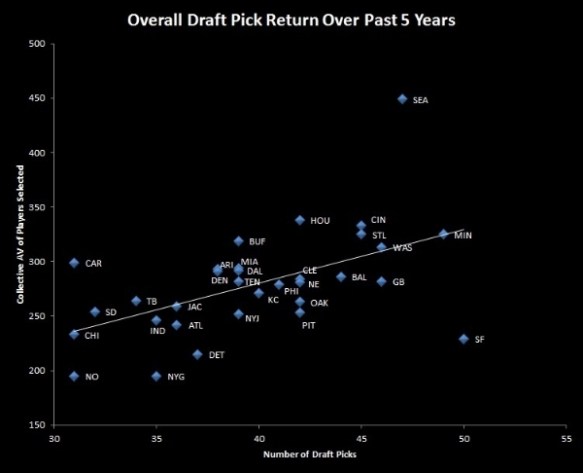
I’m going to update this post during draft season, but my goal is to quantify how successful Roseman has been in the draft compared to his peers. The first thing I learned? Evaluating the evaluators is as much of a crapshoot as the NFL draft process itself, a sentiment echoed by FiveThirtyEight.com this past April.

But there is enough evidence out there to evaluate Roseman’s track record to some extent. Here, I relied on three sets of data during the time period in which Roseman was the general manager (2010 through 2014):

  • (1) comparing the percentage of games that Roseman’s picks started with the historical expected start rate for a player drafted in the same round;
  • (2) comparing Roseman’s rate at drafting Pro Bowl and All Pro players to the league wide average and compared to some of the best in the game; and
  • (3) comparing the approximate value of the players that Roseman selected with other players from the same draft class.

So what did I find? The overall picture is a bit murky. Some metrics suggest Roseman is a below average talent evaluator compared to his peers, while others suggest he is above average. Where there is no disagreement, however, is Roseman’s rate at identifying top tier talent  — it’s not good, and explains why the Eagles haven’t seriously competed for a Super Bowl in the last six season.

Before getting to the data, a quick note.  Lurie’s “shared responsibility” front office structure makes it impossible to identify who had final say over draft picks. Was it Reid? Roseman? Kelly? I realize that everyone has their own opinion on this. But I am not concerned with parsing that out here. I am only concerned with how the Eagles have drafted under Roseman (hence the title); I’ll defer to others to assign credit or blame for a particular pick.

Judging by “Start Rate” 

There are a number of ways by which you can measure the success rate of general managers, each of which carry their own inherent flaws. Caveats aside, I am evaluating the relative success of our draft picks by comparing the percentage of games each Eagles draftee has started to the expected start percentage based on data I compiled from Pro-Football-Reference.com.

To determine the expected start rate, I examined every draft pick taken from 2010-2014 and calculated the average start rate for each round of the draft during that time period. So, for example, I found that first round draft picks from 2010-2014 have started, on average, 63.62% of their possible games. As you will see in a minute, Marcus Smith (started 0% of his possible games) would be considered a failed pick, while Fletcher Cox (89%), would be considered a success.

You can access the entire data set I compiled here, which provides some useful information regarding not only the overall strength of a draft class, but also the strength of a particular round within each draft. But this chart summarizes my overall findings:

Round Start % Range
1 63.6% 58.4% – 65.6%
2 42.5% 39.5% – 45.8%
3 34.8% 29.4% – 40.4%
4 23.4% 18.7% – 29.7%
5 17.5% 15.6% – 20.7%
6 12.3% 10.7% – 13.8%
7 10.6% 7.8% – 14.8%

Not surprisingly, the percentages track what we would have expected: higher round draft picks start more frequently than the lower round picks. I did not see any trends in the data that required me to adjust the raw numbers. For example, with the league average career at 3.3 years, one might expect higher start percentages for more recent drafts. That was not the case. So I am sticking with these overall numbers.

Start Rates of Roseman’s Picks

Here is each draft pick made by the Eagles under Roseman from 2010 until 2014. I am excluding this past year for obvious reasons and 2015 since Roseman was not involved in personnel decisions. Numbers highlighted in red indicate a player falling short of his expected start rate, while numbers in green show a player that exceeded it.

2014

Round Player Position Start % Expected Start %
1 Marcus Smith LB 0% 63.6%
2 Jordan Matthews WR 71.8% 42.5%
3 Josh Huff WR 12% 34.8%
4 Jaylen Watkins CB 0% 23.4%
5 Taylor Hart DE 3% 17.5%
6 Ed Reynolds DB 9% 12.3%
7 Beau Allen DT 6.25% 10.6%

2013

Round Player Position Start % Expected Start %
1 Lane Johnson T 91.6% 63.6%
2 Zach Ertz TE 29.7% 42.5%
3 Bennie Logan DT 79.1% 34.8%
4 Matt Barkley QB 0% 23.4%
5 Earl Wolff DB 14% 17.5%
7 Joe Kruger DE 0% 10.6%
7 Jordan Poyer DB 5% 10.6%
7 David King DE 0% 10.6%

2012

Round Player Position Start % Expected Start %
1 Fletcher Cox DT 89% 63.6%
2 Mychal Kendricks LB 82.8% 42.5%
2 Vinny Curry DE 0% 42.5%
3 Nick Foles QB 60.9% 34.8%
4 Brandon Boykin DB 10.9% 23.4%
5 Dennis Kelly T 23.4% 17.5%
6 Marvin McNutt WR 7.8% 12.3%
6 Brandon Washington G 0% 12.3%
7 Bryce Brown RB 10.9% 10.6%

2011

Round Player Position Start % Expected Start %
1 Danny Watkins G 22.5% 63.6%
2 Jaiquawn Jarrett S 11.2% 42.5%
3 Curtis Marsh CB 0% 34.8%
4 Casey Matthews LB 20% 23.4%
4 Alex Henery K 62.5% 23.4%
5 Dion Lewis RB 7.5% 17.5%
5 Julian Vandervelde G 0% 17.5%
6 Jason Kelce C 77.5% 12.3%
6 Brian Rolle LB 16.25% 12.3%
7 Greg Lloyd LB 0% 10.6%
7 Stanley Havili RB 12.5% 10.6%

2010

Round Player Position Start % Expected Start %
1 Brandon Graham DE 23.9% 63.6%
2 Nate Allen S 75% 42.5%
3 Daniel Te’o-Nesheim DE 28.1% 34.8%
4 Trevard Lindley DB 1% 23.4%
4 Keenan Clayton LB 1% 23.4%
4 Mike Kafka QB 0% 23.4%
4 Clay Harbor TE 36.4% 23.4%
5 Ricky Sapp DE 0% 17.5%
5 Riley Cooper WR 56.25% 17.5%
6 Charles Scott RB 0% 12.3%
7 Jamar Chaney LB 23.9% 10.6%
7 Jeff Owens DT 0% 10.6%
7 Kurt Coleman DB 48.9% 10.6%

So what do these numbers tell us?

  • The Eagles had 48 total picks from 2010-2014.
  • Under Roseman, the Eagles met or exceeded the expected start rate for 17 of the 47 picks.
  • So the Eagles “success rate” in the draft under Roseman is 36.17%. 
  • Put another way, 30/47 draft picks failed to meet their expected average start rate.

We can probably take issue with how certain players are characterized. For example, this approach considers Brandon Graham, Zach Ertz and Vinny Curry as misses because they didn’t start the requisite number of games. That’s clearly not right. But it also marks Alex Henery, Nate Allen and Brian Rolle as hits, and those characterizations seem equally suspect. In other words, I think it’s reasonable to assume that this evens out in the end, but I won’t argue if you make some changes to the classifications.

At first blush, these numbers suggest that Roseman/the Eagles are falling short of what we would expect. When you are meeting “average” production only 36% of the time, that seems like a problem. But I would feel more confident in that conclusion if I ran this calculation for all 32 general managers during that five year window. That would give me a much more accurate benchmark by which to evaluate how Roseman has done. I am going to leave that for leading up to the draft, since it is going to take a herculean effort to run those calculations. It will be much easier for me to spread out running the numbers over the course of the season given my other time commitments.

I filled in the gaps by looking at other research done on success rates of draft picks. The best data set I could find came straight from the horses mouth: ESPN.com’s Paul Kuharsky interviewed several general managers that provided their teams’ internal statistics regarding draft success rates. Teams have access to much more comprehensive data sets than I do, so I feel confident relying on this.

Here is one general manager’s bench mark for success: 1st and 2nd round picks: 56%, third round picks 35%. Those numbers are almost identical to the numbers I have compiled (combined 53.05% for 1st and 2nd rounders, 35% for third). So I feel comfortable using this as a baseline for evaluating Roseman’s picks, even if the relative definition of “success” might be different.

The Eagles had 11 first and second round picks from 2010-2014. Based on the data above, five of 11 were hits, or 45%. An argument can be made to count Graham, Curry, and Ertz as hits, but Allen as a miss. Under that assumption, Roseman’s hit rate is a much more impressive 63%.

The Eagles also had 5 third round picks during this time period, and hit on 2 of them, or 40%. I wouldn’t change any of the hits or misses as they are defined above, so Roseman beats that rate.

Finally, one general manager suggested that teams aim to gain 2.3 starters out of every 7 picks (Bill Polian was much more aggressive, saying good teams hit on 4.5 out of 7 picks, but he included undrafted free agents in that calculation, something I have not accounted for in this study). Using that 2.3 mark, we should expect 15.36 starters out of the 48 picks the Eagles had. Based on my evaluation, the Eagles drafted 10 such players: Cox, Kendricks, Johnson, Ertz, Logan, Matthews, Coleman, Graham, Curry and Kelce. Maybe we could include Allen and Henery in the mix. But getting to 15 would require us to consider players like Lewis, Foles and Boykin as starters. And I don’t think the evidence we have to date supports that conclusion. So Roseman falls short of this mark.

Bottom line: Roseman graded out positively under some metrics, but came up short on others. I think we will get more clarification once I run the numbers for other GMs, so for now let’s split the baby and call his rate middle of the pack.

All Pro and Pro Bowl Players

Another way to measure Roseman’s draft acumen is to compare the rate at which he has drafted Pro Bowlers and All Pros with the rest of the league.

According to Pro-Football-Reference.com, there have been 1,272 players drafted from 2010-2014. Out of those draft picks, 116 have been named All Pros, which is 9% of the players drafted. That means we should expect each team to draft, on average, 3.625 All Pros during that time period.

The Eagles have zero. (Although I firmly believe that Fletcher Cox should have received an All Pro award, but I digress).

What about Pro Bowls? Again courtesy of Pro-Football-Reference.com, there were 207 Pro Bowl selections for players drafted from 2010 to 2014. That is an average of 6.46 Pro Bowlers per team.

The Eagles have three: Kelce (2014), Cox (2015), Nick Foles (2013). Even if we count Kurt Coleman’s Pro Bowl with the Panthers last year (and I don’t think we should), Roseman still falls short of the league wide average.

A recent study on NFL.com confirms Roseman’s place below the elite general managers when it comes to identifying and drafting elite talent. Mike Huguenin found the top 10 general managers had the following success rate at drafting Pro Bowl players:

  • Ryan Grigson, Colts: 9.09%
  • Ozzie Newsome, Ravens: 9.09%
  • Mike Brown, Bengals: 9.52%
  • Rick Spielman, Vikings:  10.34%
  • Ted Thompson, Packers: 10.42%
  • Bill Belichick, Patriots: 10.53%
  • Kevin Colbert, Steelers: 12.3%
  • Rick Smith, Texans: 12.33%
  • John Schneider, Seahawks: 14.58%
  • Mickey Loomis, Saints: 14.6%
  • Jerry Jones, Cowboys: 14.72% (What the hell?!)

Under Roseman, the Eagles success rate is 6.25%.

Some might question how fair this study is given that the Eagles have drafted towards the tail end of the first round more often than not. It’s a reasonable question, but one that doesn’t hold up under closer scrutiny. Look at that list again: it includes the Patriots, Packers, Steelers, Vikings, Seahawks, Saints, and Ravens, to name a few, teams that are routinely drafting at the end of the first round.

That Roseman struggles at drafting elite players is not controversial. If you were asked to identify the biggest weakness of the Eagles, outside of lacking a franchise quarterback, you would likely say that they lack elite playmakers. This lends credence to that idea.

Evaluating by Approximate Value

The final way I judged Roseman’s drafting ability is by using Pro-Football-Reference.com’s approximate value metric. Specifically, I examined where the Eagles draft picks ranked in terms of approximate value compared to their peers. This approach confirmed the results above: the Eagles do a decent job at accumulating league average players, but fall short when it comes to getting elite ones.

Consider this, of the 48 players the Eagles drafted, only one — Fletcher Cox — ranks in the top 10 in approximate value for his respective draft class. That’s a poor rate compared to the top franchises in the league.

Or consider this: in two consecutive drafts, 2010 and 2011, the Eagles did not get a single player that currently ranks in the top 32 of approximate value (i.e., a first round talent).

And finally, the Eagles drafted five players that rank in their respective top 32 (Cox, Johnson, Logan, Kendricks and J Matt). But that pales in comparison to the Seahawks (11), Bengals (9), and Steelers (8).

Here is a breakdown of the analysis:

2010:

2011:

  • 254 players drafted.
  • The Eagles again do not have any players rated in the top 32 of approximate value.
  • The highest rated player, Jason Kelce, just missed out, ranking 33rd overall.
  • The Seahawks and Bengals have 3, while the Cowboys and Broncos have 2.
  • Confirming our belief that the 2011 draft was historically bad, the Eagles have only one other player in the top 100, Casey Matthews, who ranked 99th in career approximate value.

2012:

2013:

2014:

The biggest concern is that the Eagles have only one player in the top 10 of their respective draft classes. This falls short of some of the best franchises in the league. Perhaps Logan, Ertz and/or Johnson make the jump over the next year or two. Or maybe Wentz becomes that guy. Either way, the Eagles are going to need to get more elite talent if they are going to realistically compete for a Super Bowl.

Final study: Rotoworld evaluated the 2011-2015 drafts based on approximate value. It doesn’t perfectly track our timeline, but it’s pretty damn close. As you can seee in the graph below, they track the combined approximate value of each franchise’s draft picks compared to the number of draft picks used.

As you could have guessed, Seattle blows everyone out of the water given their late round hits with Russell Wilson, Richard Sherman, Kam Chancellor, etc. Houston, Cincinnati and Carolina are also very efficient in terms of maximizing value for the number of picks they used. While the Giants, Saints, Lions and 49ers have come up short on approximate value.

Philadelphia is averaging about dead center in the NFL in terms of number of picks and approximate value.

RotoWorld

The Take-Away

We can confidently say that under Roseman, the Eagles have come up short identifying and drafting elite talent in the draft. There is less certainty regarding how they have done overall. The evidence suggests that they are right around league average, but I’ll feel more confident once I can dig into the success rates of every general manager in the league.

What do you think? Leave a comment below. I am interested to hear your thoughts and see if you have any ideas on additional ways to examine this.

Projecting the Eagles 2016 Record

It’s that time of year again. Fortunately, I waited until just about the last possible moment to post this, so now I can account for Carson Wentz.

First, thoughts on the trade:  Obviously a fantastic deal.  Bradford is a marginal QB, and clearly didn’t have a long-term future with the team.  Getting a 1st round pick back for him goes a long way towards digging the team out of the draft resources deficit they’re in.  It’s not as if the team was a SB contender with Bradford, so the opportunity cost isn’t large either.  Yes, the team might have been better with Bradford (though more on that in a second), but a slightly higher chance of eeking out a 9 win division title and losing in the first playoff game isn’t worth forgoing a 1st and 4th.

Additionally, the Vikings have serious collapse potential this year, so the 1st round pick could be more valuable than the conventional wisdom suggests.

1) They weren’t actually that good last year.  Minnesota ranked 11th by Overall DVOA.  16th on offense, 14th on Defense, 4th on STs.

2) Teddy Bridgewater played better last year than Bradford is likely to play this year.  Forget the fact that Bradford has just 1 week to get up to speed.

Here is Bridgewater from last year: 88.7 Rating, 62.71 QBR, 7.2 Y/A, 3.1% TD, 2.0% INT

Here are Bradford’s from last year: 86.4 Rating, 41.83 QBR, 7.0 Y/A, 3.6% TD, 2.6% INT

That was the best “full” season Bradford has ever had.  Even in his best year, the 7 games Bradford played with the Rams in 2013, he registered a QBR of just 52.33 and a Rating of 90.9.

That’s a long way to go to show that Minnesota’s QB play will likely be worse this year than it was last year.  It’s hard to improve on offense if that’s the case.

3) Adrian Peterson is 31 years old.  Terrence Newman is 38.  Can’t assume either of those guys will decline, but it’s certainly reasonable to suggest they might.

So while we’re having fun watching the start of the Wentz era, we’ll also be able to enjoy rooting against Bradford and the Vikings.  If the wheels fall off, the Eagles could actually have a chance to add another key piece in the first round next year (as well they should since we’re hosting).


Enough about Minnesota, what’s going to happen with the Eagles this year?

Welp, that’s a tough one.  New Coach, new system, rookie QB, multiple new starters on offense and defense.  The basis of accurate predictions is taking what we know (i.e. performance last year and recently) and adjusting that performance given what has changed.  Every bit of change means more uncertainty, making it harder and harder to gauge what will happen.  But that doesn’t mean we can’t try.

Let’s start with the QB.  What does starting Wentz mean for the offense?

To begin answering that, I pulled all of the high-drafted (top 5 and all 1st-2nd rounders) QBs from the past 10 years that started 10+ games during their rookie year.  Here is the list:

Screen Shot 2016-09-05 at 1.33.59 PM

Then I took their rookie stats and compared them to what Bradford posted last year.  Here is the comparison:

Screen Shot 2016-09-05 at 1.38.34 PM.png

So…that’s pretty encouraging.  Bradford was certainly more efficient than the rookies, but the differences aren’t as big as you might assume.  Overall, rookie QBs starting immediately have performed better than I would have guessed prior to looking up the data.

A note on the sample: I think the Top 5 picks is the correct comparison for Wentz.  I’ve seen some concern about the fact that he played at North Dakota and that his learning curve will be steeper.  I don’t agree.  My current way of think is that the background of each player is unique and extremely difficult to parse with any accuracy.  Moreover, that is all factored into draft position anyway.  The entire league evaluates all of these quarterbacks, and each one of them has a different set of experiences and abilities upon entering the league.  If the league says Wentz is worth a top 5 pick, then it means either (1) the strength of competition doesn’t actually matter or (2) he has other traits that make up for that weakness.  Regardless, both explanations lead to the same place: Wentz was drafted in the top 5, and he should be judged based on how similarly judged prospects have played.

The only adjustment I considered making to the sample was dropping Weeden (age), but avoided it for fear of starting to bias the sample unnecessarily.

Now, it’s not enough to just look at Wentz and what the average rookie QBs have done recently.  What happens when we take a look at team offensive performance?  Below is a chart showing each of the teams from the sample above (Top 5 picks).  It shows Points Scored in the year before drafting the QB, and Points Scored during the QB’s rookie year.

Screen Shot 2016-09-05 at 1.54.23 PM

Every team, save one, either performed in line with the previous season or improved dramatically.  Ironically enough, the only significant decline was Mark Sanchez, and that team went to the AFC title game that year.

So starting a rookie QB isn’t a death knell for team offense.  Of course, the reason those teams drafted these QBs was because they were terrible enough to get such a high pick.  If you look at the base level scoring (Year -1 column), you can see that it’d be pretty hard to get worse for some of these teams.

By comparison, the Eagles scored 377 points last year.  Some of that was due to the pace of the offense (more plays = more pts).  But by DVOA the team ranked 26th and was 22nd in points per drive.  Not good, but not dreadful either.   In other words, the team is in a relatively unique situation.  We just haven’t seen teams as good as the Eagles were last year draft top 5 QBs.

The closest analogue is Mark Sanchez and the Jets.  The Jets were a 9 win team with Brett Favre the year before drafting the Sanchize. The team traded up from #17 to #5 to take him.  The offense declined significantly by points scored and marginally be DVOA (18th to 22nd).

The bad news is that I don’t think the Eagles are making the conference title game this year.  The good news is that Wentz has a chance to be a much better player than Sanchez.  That’s a trade I’ll gladly take.

Still, the 2009 Jets seem to be our best (only reasonable) comparison.  Combined the rookie expectations and the Jets experience, and we’re looking at a small step back for the offense based on the QB position.

The OL

The OL was a major problem last year.  Jason Peters declined significantly. The unit overall ranked 30th by DVOA.  This year, Brandon Brooks replaces Matt Tobin at RG.  But Peters is another year older, and Lane Johnson might miss time to a suspension.

Given that, I just don’t see a good rationale for expecting significant improvement.  The good news (I guess), is that they were so bad last year that the bar is set really low.  I haven’t done a study on OL performance persistence (that I remember anyway), but my guess is there is enough year-to-year variability to allow for improvement this year absent any other factors.  That’s a really weak basis for prediction, but it’s possible.

Overall, I expect worse OL play this year.  Hoping for better, obviously, but betting on a resurgent season from Peters at nearly 35 years old seems overly optimistic.  The long-term neglect of the unit will really show itself this year.

The WR

Could they get any worse? Yes, but that’s unlikely.  Jorden Matthews returns and is should be right in the middle of the steepest incline of his performance curve.  Ertz is there as well.  Nobody else gained more than 400 receiving yards last year.  Celek was closest at 398.  After that?  Nothing encouraging, but at least there’s no Riley Cooper or Miles Austin.  That alone should be worth a few karma points (half-joking).

Overall, I see a small improvement from last year’s very low base.  Agholor really couldn’t be any worse.  Huff as well.

The RBs

Well they’ve basically swapped out Demarco Murray for Wendell Smallwood on the depth chart.  Taking carries from Murray and giving them to Mathews should be a net improvement, but we can’t assume Mathews will actually play enough to capitalize.  Meanwhile, Sproles is another year older (33 years old now) and his game is based on quickness.  RB is a position with a LOT of variability, so it really wouldn’t surprise me of Barner or Smallwood stepped up and surprised people this year.  But with the OL as it is, it’s tough to see any high-end upside here.

Overall, treading water seems to be an appropriate expectation from this group.

The Whole Offense

I think the offense will be worse this year than it was last year.  Weaker OL, weaker QB play, and nobody on the WR/RB side that can pick up the slack or help hide the holes.  That’s an ugly combination.

The Eagles scored 377 last year.  The league averaged 365.  So the team was 3.2%+.

Pace helped a lot though, as the team was just 23rd by yards per drive and 22nd by points per drive.  Turnovers hurt last year’s team, with 1.1 interceptions thrown per game (27th) and 0.8 fumbles lost per game (30th), but don’t forget that a high pace increases those rates as well.  With a rookie QB and a higher-than expected INT rate, I don’t foresee a big benefit from turnover regression.

Overall, I think a base-case projection of -10% to -15% for this year is reasonable.  Let’s call it -12.5%.  

Without any scoring inflation, that would put them at approximately 320 points scored.

The Defense

The Eagles ranked 17th by DVOA on defense last year.  The pass defense was 14th by DVOA, the rush defense was 28th.  They allowed 430 points, 28th in the league.

I think the defense will be much better this year.  I think the scheme fits the personnel much better than it did last year.  The DL, especially, is worth getting excited about.

The DL

Fletcher Cox and Bennie Logan in the middle could be among the league’s best interior combos.  Brandon Graham and Vinny Curry get to rush the QB from the edge, with Cox likely to give them plenty of 1-0n-1 chances by drawing double-teams.  Barwin’s coverage abilities could allow Schwartz to do some creative things, but at the very least, it’s hard to see Barwin not finding a way to contribute consistently one way or another.

That should be a tougher front to rush against than last year, which was a huge weakness for the team.  The Cox/Logan combo, in particular, provides an anchor that will make everyone else’s job a lot easier.

The LBs

Thin, but intriguing.  Jordan Hicks could be great…or he could miss most of the season with injuries.  That’s worrisome because there really isn’t any depth.  As of this moment, there are just 4 LBs on the roster.  Honestly, I have no idea how to project this group.  Kendricks has shown flashes of brilliance in the past, but his inconsistency is frustrating and the coaching staff appears to be losing patience with him.  This will be his 5th year, so he’s basically out of excuses.

Stephen Tulloch is a nice piece to have on the roster, especially given the injury concerns of Hicks/Kendricks.  Nigel Bradham should be a solid SAM.  If any of those guys goes down, though, it’s unclear what happens.  My guess is the team is working on adding another LB, but obviously can’t account for that now.

Overall, the corps of Hicks/Kendricks/Bradham/Tulloch could form a strong unit, but it is VERY dependent on Hicks staying healthy.  That’s a tough bet.  Still, the LBs struggled last year (especially Demeco), so from a benchmarking standpoint, improvement is definitely possible.  If Hicks stays healthy, the LBs could prove to be MUCH better than last year.

The DBs

McKelvin and McLeod are significant additions, but I’m not sure a wholesale improvement is in order here.

Maxwell was maddening last year, but a lot of that was failing to live up to his contract.  Had he been paid less, I’m not sure everyone would be as down on him as they were.  Meanwhile, Walter Thurmond turned in a very serviceable season at S.  While McLeod will hopefully be an improvement (especially in run support), a significant increase seems unlikely.

In fact, the corps might benefit most from increased DL pressure, rather than from personnel changes.  In general, though, a slight improvement can be expected, though depth is an issue.

Total Defense

The scheme change is as big a factor as any of the personnel changes.  The 4-3 alignment fits the DL extremely well, and if Hicks can put together a healthy season, the Cox/Logan/Hicks pyramid can anchor the defense and let everyone else play downhill.  Better pressure from the DEs (I expect Graham to have a big season) will make the DBs jobs a lot easier.

However, given the lack of depth and the injury concerns, there is a LOT of uncertainty here.  The unit could be among the best in the league.  Or it could suffer 1-2 key injuries and the entire house of cards could collapse.  Imagine if Cox and Hicks missed significant time.  In other words, there is an extremely wide range of potential performances for the defense this year.

Last season, the team was -18% by points allowed.  On a per drive basis, the team was a bit worse than average (22nd and 23rd by yards and points per drive).  A big improvement has them close to league average.  Given the depth problems, though, that seems a bit aggressive.  -5% is where I’m at on a base case.  That amounts to 383 points allowed.

Special Teams

Unlikely to have a significant impact this year.  The unit was 10th in the league by DVOA last year, but was dead last in “Hidden Points”.  That means they were fairly unlucky.  The main contributors are all back (Jones, Sturgis, Sproles), though the coverage team’s ability remains to be seen.  However, even a good season from STs won’t have a huge effect on overall performance.  Without significant reason to believe STs will be either great or terrible, there isn’t much reason to adjust the overall projection.

The Prediction

That puts us at 320 points scored, 383 points allowed.  With a 2.67 exponent, that’s a 38% win percentage.  In practical terms, that’s a 6-10 season.

Below are my previous predictions. As you can see, last year really hurt the track record I was building.  Ex-ante, I would assign a LOT more uncertainty to this year than I would have for last year.  So at the very least, it’s a good reminder of just how much variability there is in exercises like this.

Screen Shot 2016-09-05 at 3.28.51 PM