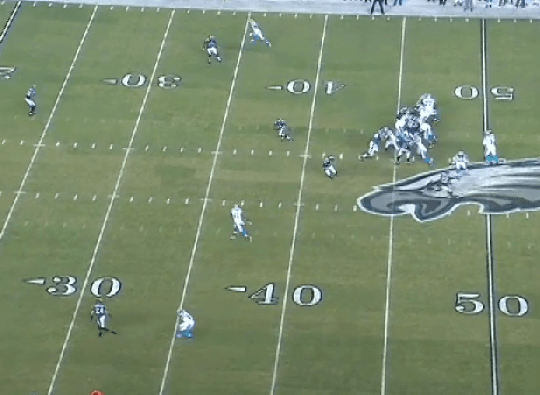
A look at the standings:

As the season winds down, I thought it’d be a good time to take a look at the standings, particularly the bottom as teams jostle for better draft position. While it’s very difficult to root for the Eagles to lose, make no mistake, losses are much more valuable than wins right now (repeating the note from last week’s post-game, the drop from the #3-#4 draft pick is worth a second round pick according to the standard value chart).

There are currently 8 teams at 4-9 (including the Eagles).  Below is the current order of teams (according to ESPN) as well as the combined records of the teams each has left to play.  There are 5 teams at 5-8, but for the sake of clarity, I chose to omit them.

Team                             Remaining Schedule (Combined Record)

Carolina (4-9) –                        SD, OAK, NO (13-26)

Tennessee (4-9) –                   NYJ, GB, JAC (17-22)

Detroit (4-9) –                         ARZ, ATL, CHI (23-16)

Arizona (4-9) –                       DET, CHI, SF (21-17-1)

Philadelphia (4-9) –               CIN, WAS, NYG  (22-17)

Oakland (3-10) –                   KC, CAR, SD (11-28)

Jacksonville (2-11) –             MIA, NE, TEN  (19-20)

Kansas City (2-11) –            OAK, IND, DEN (22-17)

Note:  The first tiebreaker is strength of schedule (teams with a lower SOS get a higher pick).

– It’s very unlikely that either KC or JAC will win 2 of their remaining 3 games, meaning we can cross the Eagles off for the #1-#2 draft pick.

– Oakland actually has a very easy schedule and could win any of their three remaining games, though it’s likely that if they finish with the same record as the Eagles they will win the tiebreaker (a function of the relative division strength).  Therefore, the #3 pick is unlikely as well).

– After that, the Eagles have the inside track on the #4 pick, and will likely take it if they lose out.  Conversely, one win by the Eagles puts all of the 5-8 teams in play (remember there are 5 of them now).

– Key game to watch this week (other than the Eagles of course) is Oak-KC.  If Oakland wins, the Eagles could find themselves tied for the #3 pick.  Though I noted above that SOS would likely still favor Oakland, the Raiders have two games (CAR, SD) that are relatively winnable.

Due to the Thursday night game this week, there will be a long layoff before the All-22 comes out and I can review it.  Therefore, the beginning of next week will have look at the draft board and what’s available for the Eagles versus what the projected needs are going into next year.

Week 14: Eagles vs. Bucs

This week:

Notes from the game, with a focus on Nick Foles and the defense.

The Catch (and throw)

Foles to Avant Part 2 (Illustration of pocket awareness).

First, Nick Foles:

– Hello West-Coast Offense!  It seems like the Eagles have finally found a QB that is a perfect fit for the west-coast offense.  What you saw on Sunday was precisely how it is supposed to work, with many short (5 yd) routes and pinpoint throws substituting for a running game.  One of the strangest aspects of the Andy Reid era has been his insistence on running a west-coast scheme without finding the right QB for it.  Neither McNabb nor Vick were accurate enough.  In fact, the offense McNabb ran really wasn’t a true West-Coast scheme (Andy Reid just used that as cover for why he threw the ball so much), as it relied on deep throws and big plays.

-The Tampa Bay pass defense is the worst in the league.  However, Foles did exactly what a good QB should do against a terrible pass defense, and after reviewing the tape, this clearly was not a case of a terrible defense making a QB look good.

– Particularly encouraging: Foles finally showed he has the ability to make more than 1.5 progressions before hitting a check-down.  In fact, he often used his legs to buy time while keeping his eyes downfield and making all of his reads.  Perhaps more importantly, he was remarkably accurate when throwing on the run, which in any case is a good sign, but especially since the Eagles O-line didn’t do him any favors.

-For the most part, his decision making was strong, though he had a few ill-advised passes.

-Considering how bad the running game was (more on that in a moment), fans should be very encouraged that Foles was able to handle carrying the whole offense.

-One note of caution: we still did not see evidence of an ability to hit a deep ball.  He had several opportunities, but was not accurate in any of them (one could argue the left-sideline bomb to Riley Cooper was accurate since it he got his fingertips on it, but he would have had to lay out for it while keeping himself in bounds in very limited space).

Overall, though, I think this game definitely improved Foles’ value, regardless of the last second heroics (which have been a little overblown in my opinion).  He clearly knows how to use the pocket and seems extremely comfortable now that he has a few games under his belt.

The O-Line:

– The O-line was completely overpowered, especially when run-blocking.  Not a huge surprise, given the Bucs lead the league in rush defense, but this was definitely a step back for a unit that had improved modestly over the last couple games.

– While the Bucs did register 6 sacks, several were coverage sacks, and late in the game the O-Line did a good job of giving Foles both the time and space to make some plays (and he helped them by scrambling intelligently, stepping upfield rather than pulling a Vick special and rolling sideways into a DE).

The Defense:

– In the first game of the post-wide-9 era, the defense certainly appeared to improve greatly.  Don’t get too excited though, Josh Freeman played a terrible game and missed badly on some throws he should have completed.

– Though I think things like “effort” and “attitude” are usually over-valued by most commentators, the defense really did seem to be playing harder.  Whether that’s a direct result of Washburn being gone is unknown, but it was nice to see nevertheless.

– Among the most encouraging signs was the team’s tackling, as they did a very good job of bringing down receivers at first contact.  Doug Martin caused some problems, but nothing unexpected (he’s a very strong runner) and when he did break a tackle, the rest of the defense was there to prevent a breakaway.

– Though they only managed 2 sacks, the D-line was active all game and did a good job of disrupting the pocket for Freeman.  Would have liked to see some more direct pressure, but it was better than the stat line would suggest.

– The defense deflected 9 passes, suggesting strong coverage throughout (an in fact it was mostly strong).  Kendricks played a particularly active game, deflecting 3 balls and making a bigger impact than we have seen from him recently (he was shifted to WLB and seemed much more comfortable in that role).

– Nnamdi will likely not be on the team next year.  He struggled all game, and although it’d be nice to blame it on his injury and praise his toughness in coming back, this isn’t an isolated instance.  He hasn’t performed anywhere close to his paycheck all year, and I can’t see the Eagles holding on to what’s clearly a poor value proposition (if he’s willing to take a pay cut then perhaps there’s a deal to be made).

-I’m very puzzled by the game-plan for the Bucs.  The Eagles have been susceptible all year to PA and the Bucs didn’t run much of it, despite getting a lot of traction on the ground with Martin.  Also, Colt Anderson was not tested much in coverage, which as far as I’m concerned is a massive error by the Bucs coaches.

Now for some key plays:

Play 1 Avant’s Catch (really could be called Foles’ Throw):

– By now we’ve all seen the replay of Avant’s amazing one-handed grab, however, Foles’ throw on the play has been repeatedly overlooked.

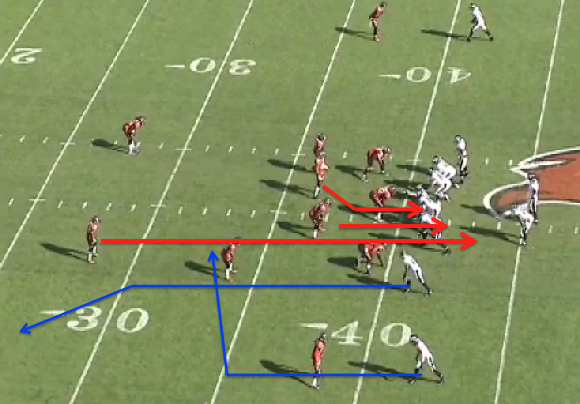
3rd and 16 in the second quarter, this play led to a Henery field goal.  Below is the set-up. Although the Bucs line up with 3 down lineman and 3 LBs, this is essentially a Nickel D (with one rusher standing in an attempt to disguise the rush).  From this, the Bucs send a big blitz, overloaded the left side of the Eagles line.  Notice the MLB’s route, as he comes across the center to ensure the left side of the Eagles line is outmanned.  Also, the safety begins his rush presnap so his distance to the QB is not as great at he start of the play.  While this helps the Bucs get pressure, it also ensures that Avant has single coverage.

Screen Shot 2012-12-12 at 4.53.03 PM

Just after the snap, we can see the blitz in progress.  Notice the safety-blitz has created a lot of space on the left side of the field.  Avant’s corner takes inside position, knowing his team is blitzing from that side and ensuring that Avant can’t break to the middle (which would be vital if Foles rolls out away from the blitz).

Eagles Vs Bucs 2

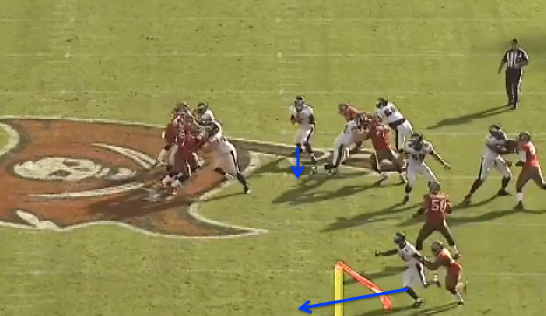
At the moment before the throw, Avant is just getting out of his break.   Harder to see is what Foles is dealing with.  The rush is successful, and Foles not only can’t step into the throw, but actually has a defender grabbing him when he releases the ball.  Also, note how deep the remaining safety is.  With 6 rushers (and one delayed when the LB realizes he has nobody to cover), the Bucs are forced to keep a defender very deep in an effort to prevent a touchdown if the rush doesn’t get home.

Eagles Bucs 3

Here is a good look at Foles the moment he throws the ball.  We’ve all seen the resulting catch, but take note of how impressive the throw is.  With a man on him and no space to step up, Foles throws a perfect ball 40 yards to Avant, putting it high enough to get over the CB (who remember is playing inside so is between Avant and Foles) while still giving Avant a chance to make the catch.

Eagles Bucs 4

In all, a great play by both Avant and Foles.

Foles to Avant Part 2:

1st and 10 in the 3rd quarter.  This led to Henery’s missed 31 yard field goal.

This play is a great example of Foles using the pocket to beat a blitz and complete a big play to Avant.  The Bucs line up with 5 men on the line (4 in 3 point stances, 1 standing up top).  Again, they bring a safety blitz around the end while rushing the MLB at the center.  In all, 6 men end up as pass rushers, with the end on the bottom of the screen falling back into coverage (though he ends up doing nothing).  Meanwhile, Avant is lined up in the slot, and despite getting tripped by the lineman who drops into coverage, he manages to get himself open across the middle, giving Foles the outlet he needs.

Screen Shot 2012-12-12 at 5.31.37 PM

Here is Foles at the depth of his drop.  Avant is just breaking and will gain separation in another moment.  However, the rush is closing in on Foles, particularly from the ends.  Notice the open space ahead of Foles, he is about to put it to good use.

Screen Shot 2012-12-12 at 5.24.40 PM

Below we can see Foles as he is about to step up in the pocket.  We can see the end closing in on him from the right, meaning if he doesn’t step up at this moment he’s taking a blind side sack.

Screen Shot 2012-12-12 at 5.43.58 PM

Here is the moment of the throw.  Foles has stepped up, giving himself just enough time to get the ball to Avant, who is now streaking across the middle of the field (though hard to see below, Foles is just ahead of the 50 yard line).

Screen Shot 2012-12-12 at 5.24.54 PM

In summary, a good example of Foles’ pocket awareness, which was strong the entire game.  Despite his lack of speed (see the amazingly slow TD run), Foles seems to understand how to use the mobility he has.  It’s nice to see a rookie with such awareness.

Additionally, the ball is delivered accurately, which allowed Avant to break the initial tackle and gain an additional 14 yards after the catch.

More on completion percentage…

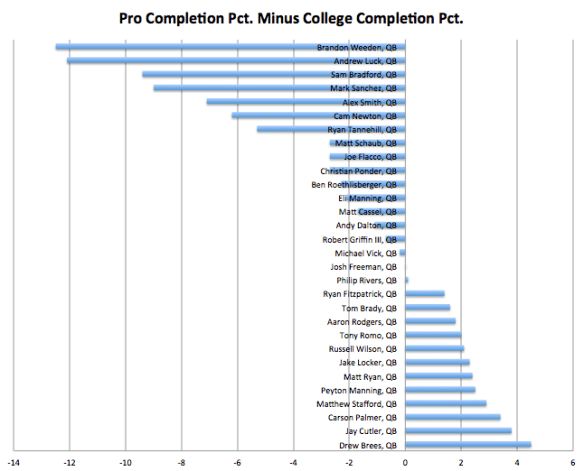
Below is a chart illustrating the change in completion percentage from college to the NFL for current NFL starting QBs (note that I included Alex Smith over Kaepernick because the change was so recent and used Vick over Foles so that Foles didn’t affect the numbers).

Admittedly it’s not the most elegant illustration, but we can quickly infer some useful information.  (The left extreme is a drop from college to pro, while the right extreme is a gain from college to pro)

Screen Shot 2012-12-11 at 4.21.08 PM

Note the x-axis values.  Just one player (Drew Brees) managed to improve upon is college completion rate by more than 4%.   Conversely, 7 current NFL QB’s have a pro completion rate more than 4% below their college marks.

The average change (not weighted for # of attempts) is -1.56%.

This year, the average completion percentage for the QBs included in the chart is 61.63%.

Upshot – With a college completion percentage of 66%, Nick Foles could suffer a decline of 5.28% and still be roughly equal to the average NFL starting measure. (Assumption – the included player sample is accurate for evaluating Nick Foles.)

Coincidentally, Nick Foles is currently completing 61.4% of his passes, or right at league average.

Caveat – The sample above is subject to several unavoidable biases, namely survivorship bias, as any QB whose completion percentage dropped by a very large amount would likely not be starting and therefore would not be included in the sample above (i.e. Jamarcus Russell, whose rate differential was -9.7%).  However, huge declines appear to be relatively rare, and within the sample several of those suffering the largest declines are in no immediate danger of losing their jobs (Andrew Luck, Sam Bradford, even Mark Sanchez is proving incredibly resilient when it comes to keeping his job), suggesting that organizational inertia somewhat counteracts the survivorship issue.

Does Nick Foles = Bobby Hoying 2.0?

(See today’s Philly.com article by Phil Sheridan)

Short Answer:  I don’t think so.

Longer Answer: While there are some eerie similarities, there is a large piece of evidence that points to Nick Foles having a higher probability of long-term success than Bobby Hoying had after his promising start.

Phil Sheridan points to the team adversity as a reason for Hoying’s failure.  Although that didn’t help, perhaps a larger factor was the accuracy of Hoying.  There are a number of attributes necessary for QB success, but accuracy is among the most important (if you don’t believe me please look at the current leaderboard).  While completion percentage is an imperfect measure (not accounting for drops, distance, throwaways, etc…), it still provides a decent indication of how good a QB is at getting the ball to where he wants it to go.  Furthermore, it is a measure that is rarely every significantly improved upon by players making the jump to the pro’s, that is, completion percentage in college is a good indication a player’s potential professional completion percentage.

Bobby Hoying’s college completion percentage was 58%, which is not terrible for college, but a very weak measure for aspiring pro’s (there are currently only two starting NFL QB’s with worse, Jay Cutler and Matt Stafford).

Nick Foles’ college completion percentage was 66.9%. (Of note: Michael Vick’s was 56.5%, which would be by far the worst in the league if he was still starting).

Counterpoint: There is a substantial (and obvious) flaw in the direct comparison of Foles to Hoying: Time.  NFL passing offenses have grown significantly in scale/importance/sophistication since Hoying played, and QB performance has risen substantially.  Hoying’s rookie year, the average NFL completion percentage was just 56%.  The current average for starting QBs is 61.62%.  However, there is a strong case to be made that as teams have emphasized passing, they have changed the methods for scouting QBs, weighing things like completion percentage more heavily than in the past (while lessening the attention paid to “intangibles”).  I believe its fair to say that overall QB play in today’s game is substantially better than in 1997 (Hoying’s rookie year).  In fact, it’s likely that if Hoying’s college career was evaluated for the draft today, he would be a much lower draft choice than #85 (if he was drafted at all).

Regardless, the relative comparison of each player’s college completion percentage to the league at the time of their respective rookie year’s suggests Foles has much more potential for success (relative to league average).

Post-Game Thoughts: Eagles vs. Bucs

Stoppable force beats movable object – Entering the game, the Bucs’ defense had 18 sacks in 12 games, or 1.5 per game.  Today they sacked Foles 6 times and hit him 13 times.  We’ll have to wait for the All-22 to see exactly what happened, but there were several egregious 1-on-1 losses by Eagles O-lineman.

Foles seizes opportunity – In what I predicted would be a showcase game for the rookie QB (see pre-game thoughts), he did not disappoint.  He made several very impressive throws while running, and more importantly, did not throw an interception against a defense that had a lot of them coming into the game.  However, in the next few days, I expect most commentators to gloss over the horrendous decision/throw he made on the final drive that should have been an easy interception and ended the game.  He was bailed out by the dropped ball, but that was a catastrophic mistake that he’ll need to avoid in the future.

Win the battle but lose the war? – While it’s certainly more fun to watch the Eagles win (especially in exciting last-play fashion), it is somewhat likely that the team will regret this win upon entering the offseason.  The win dropped (or raised) the Eagles from the #3 draft pick to #4.  According to the standard NFL Draft Pick Value Chart, that’s equivalent to a 2nd round pick.  It should be noted that the drop-off is less severe once outside the top 3 picks, but if the standings hold then that last second victory will cost the Eagles big.  (Would you trade a 2nd round pick for a meaningless win?)

Daniel Te’o Nesheim is still alive? – Apparently, and he had a sack and 2 QB hits.

Pre-Game Notes: Eagles vs. Bucs

A few pre-game thoughts/notes:

– Kurt Coleman is out with a chest injury, meaning Colt Anderson will likely get major PT (Andy Reid has shown no inclination towards Sims).  While I’d normally be excited by anything involving the words “Kurt Coleman” and “not playing”, Colt Anderson has looked lost in limited playing time (against the Lions he was solely responsible for 2 TDs if I remember correctly).

– The Bucs’ pass defense is terrible, giving up an average of 309 ypg.  Their run defense, however, is ranked #1 in the league.

THINGS TO  WATCH FOR:

– Given the Bucs’ defensive strengths/weaknesses, this should be a showcase game for Nick Foles.  Tampa Bay actually has less sacks this year than the Eagles do (Bucs – 18, Eagles – 20), meaning Foles should have plenty of time.  Pay particular attention to his downfield attempts, as thats an area of his game we haven’t seen much of.

– While the Bucs are 30th in sacks, they are 4th in interceptions, meaning Foles’ decision making has to be good if he’s going to avoid turning it over.

– Brandon Graham is coming off arguably the best game of his career.  With increased playing time (with Babin gone), the next few games will go a long way towards determining whether he is a complete bust or can be a contributor.

– Under Todd Bowles, opposing QB’s have a 142.4 passer rating, with 16 TDs and 0 interceptions.  This is a historically bad stretch of defense.  Watch the DE alignment to see if they’ve truly abandoned the wide-9.  If so, we should see them less susceptible to the PA seam routes that have torched them all year.

– Tampa Bay is favored by 7.5.  The fact that the Eagles are 7.5 point underdogs to a 6-6 team is both remarkable and sad.  Against the spread this year, the Eagles are 2-9-1, the worst record in the league.  Meaning they have been the most consistently overrated team in the league (by the betting market).

Week 13: Eagles vs. Cowboys

This week on Eagles Rewind:

-Initial Thoughts From Eagles/Cowboys

-Why Wide-9 Sucks (In Pictures)

-Let’s Talk About Nick Foles Part 1 (In Pictures)

-Let’s Talk About Nick Foles Part 2 (In Pictures)

-You Mean We Should Cover Jason Witten? (In Pictures)

Initial thoughts:

Nick Foles had his best performance, by far.  For the first time this season, Foles managed to consistently make more than one read and was finally given an opportunity to throw some deep balls, which he did with some success.

He reaffirmed my view that he is much more mobile than he was given credit for coming out of Arizona, and he was able to repeatedly use his legs to buy himself time (and delivered accurate throws when he moved out of the pocket)

However, Dallas’ defense is mediocre, so let’s not get too excited just yet.  A lot of the passes Foles completed were to open receivers and though he delivered the ball in stride to most, he didn’t have to (or didn’t try to) fit the ball into tight windows.

In any case, he certainly showed a lot more promise then he has over the past few weeks. But remember that Andy Reid made AJ Feeley look like a starting QB or a little while.  It’s best to focus on his progressions, accuracy, and decision making over the rest of the season rather than look at his stat line.

Bryce Brown really is that good.  Granted the fumbles are a problem, but a McCoy/Brown tandem definitely has the talent to be among the best running attacks in the league (and it’s a near certainty that the next coach will run the ball more than Reid has).

The safeties really are that bad.  With every game, my opinion of Kurt Coleman and Nate Allen gets worse (which is really remarkable considering how low it was to start the season).  I really don’t see any way for either of these two players to become dependable starters.  Both are weak in coverage and take terrible angle’s when stepping up to make a tackle.  Neither shows any evidence of a reasonable football IQ.  Though I realize it sounds like hyperbole, after watching lots of tape, I really do believe the Allen/Coleman duo is among the worst in recent history.  Just really dreadful play all season, and frankly, most of the time I feel embarrassed for them when watching the replays.  There’s still a slight chance its scheme-related, but I think the odds of that are now very low.

Play 1:  Why the Wide-9 Sucks

At this point, most people realize the huge weaknesses of the Wide-9 , and thankfully the Eagles have moved on from it.  However, I felt it would be helpful to show a quick example that illustrates why it’s so easy to beat.  Here is Dallas’ first play from scrimmage:

Eagles Cowboys 1

The result of this play is a 14 yard run.  Notice the Wide-9 alignment of the Eagles d-line.  At the snap (below), both ends rush straight upfield, leaving a large hole on either side of the line (Demarco Murray will rush left).  At this point, as we can see from the picture, either the corner needs to shed his block and make a tackle or the safety needs to step up.  Here, Coleman makes the play (barely, he takes a bad angle) and pushes Murray OB, but not before Murray has a large gain.

Eagles Cowboys 2

Obviously this is a very exploitable weakness, because the Cowboys take advantage of it again on the very next play:
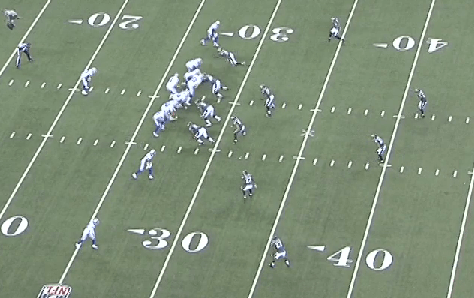
Eagles Cowboys 4

Eagles Cowboys 5

Look familiar?  Again, both ends rush straight upfield, leaving gaping holes on either side of the line.  Here, Asomugha makes a good play, getting off his block and limiting it to an 8 yard gain.

Sadly, the plays above have been run repeatedly against the Eagles the entire season, and it took until this week for Reid to finally admit that the Wide-9 as a base alignment is a terrible strategy.

Play 2:  Let’s Talk About Nick Foles (Part 1)

This play is one that a lot of people have highlighted, and rightfully so.  It’s 1st down, with the Eagles up 7-3 and the ball on their own 19 yard line.  Dallas shows a big blitz, though ends up rushing just one extra, with 5 defenders going after Foles.  Here is the pre-snap alignment:

Eagles Cowboys 6

At the snap, Dallas’ slot corner (top of the screen) blitzes , with the safety picking up coverage.  The left DE (seen standing above) will actually drop into coverage, while the strongside LB blitzes.  This is a very well designed blitz.  The DT on the strong-side (top of the screen) stunts towards the middle, bringing the guard with him.  Meanwhile, the corner blitz forces the LT to pick him up wide, leaving an open lane for the LB to come through.  Seen below:
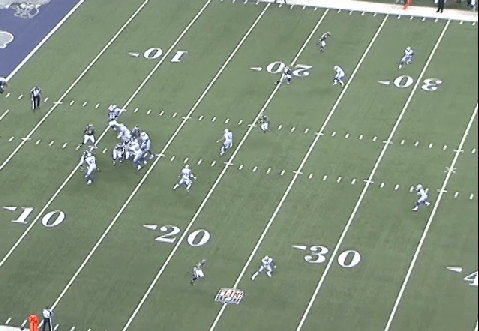
Eagles Cowboys 7

Above and below are both shots of what Foles is looking at just before he gets hit (with the picture below taken as he releases the ball.  Notice (particularly in the shot below) the big lane on the left side of the line.  This is why the LB got pressure so quickly.  However, Foles beats this blitz for a big gain, as the Dallas LB does not get enough depth on his coverage drop, leaving a hole for Celek in the middle of the field.

Eagles Cowboys 8

Seen above, Foles delivers the ball between the LBs and hits Celek at the hash-mark for a gain of 19 yards.  This particular play is one with which Vick struggled mightily (both leading his receiver and throwing into the face of a blitz).

Also note, Foles’ size gives him a big advantage when facing this type of pressure, as he can both see over the rusher and is tall enough to deliver the ball over him without getting it tipped.

Play 3: Let’s Talk About Foles Part 2

Here is a play that did not grab as much attention as the previous one, though I think it’s a great example of one of Foles’ strengths as well as a clear illustration of how much yardage Vick left on the field as a result of his poor accuracy (inability to hit receivers in stride).

The Eagles have 3rd and 6 on the Dallas 33.  After the first down the Eagles will proceed to score a TD, with this play the most important of the drive (aside from the scoring play of course).  Pre-snap, the Eagles have a single back set, with 2 WRs split to either side.  Jeremy Maclin is lined up in the left slot and will motion across the formation from left to right.
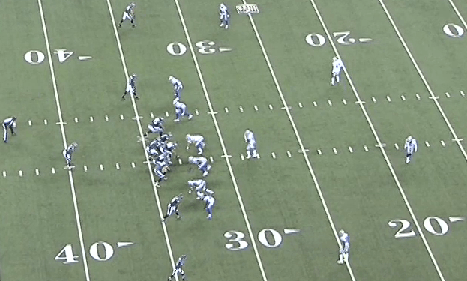
Eagles Cowboys 9

The ball is snapped just as Maclin clears the line:

Eagles Cowboys 10

Maclin runs a slant while the other two receivers run deep outs (10yd and 15 yd), clearing their defenders from the middle of the field.  As a bonus, the DB covering Maclin gets caught in the traffic, giving him the space to make an easy catch. Below is at the moment of release, we can see Maclin breaking towards the middle of the field, which as a result of strong play design, has no defenders in it.

Eagles Cowboys 11

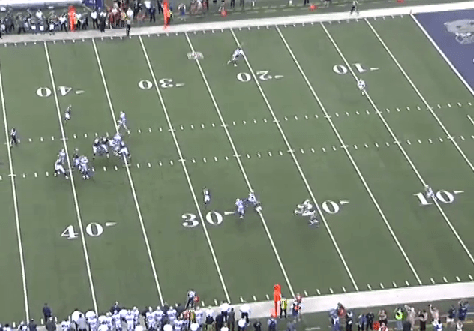
What ultimately makes this play successful though, is that Nick Foles delivers the ball to Maclin in stride, meaning Maclin isn’t forced to sacrifice his separation by waiting for the ball.  So even though Maclin catches the ball at the 30 yard line, he is able to maintain his speed and isn’t tackled until he reaches the Dallas 12.  Below is Maclin catching the ball.  Notice the progression from the picture above, he is still moving forwards at the time of the catch, and look at the ridiculous amount of open field ahead of him.
Eagles Cowboys 12

Play 4:  You Mean We Should Cover Jason Witten?

Our final play rewind is one I’m sure everyone who watched the game remembers.  Keeping the spirit of the season alive, the defense decides to let Jason Witten run clear down the middle of the field for a TD (he’s tackled at the 1 yard line and Murray runs it in from there, but this is essentially the scoring play).  At this point the Eagles are up 14-3 with about 1 minute remaining in the 2nd quarter, so to say this is a pivotal moment of the game is an understatement.

So how did it happen?

The Cowboys have 1st and 10 on the Eagles 29 yard line.  Here is the pre-snap look:

Eagles Cowboys 13

The Eagles are in a Nickel defense, with the Cowboys lining up with 3 WRs and a single back to Romo’s left.  Witten is on the right side of the line and will cut underneath the LB before running a seem-route (straight up the middle of the field).

Below is after the snap as Romo reaches the depth of his drop. The Eagles have only rushed 4, meaning there should be plenty of defensive help in the d-backfield (The Eagles have 7 defenders back versus the Cowboys’ 4 receivers).  However, in the shot below we can see the start of what goes wrong.  Kurt Coleman (eager to keep his crown as Worst Eagles Starter) can be seen running to double-cover Dez Bryant (on the bottom of the picture).  Let’s forget for a moment that the corner here is Nnamdi, who was really never suppose to need help in the form of a standard double-cover (as opposed to over-the-top deep help every once in a while).  Meanwhile, Nate Allen, the other safety, is rolling towards the top of the screen.  This appears to be the designed coverage, as the defense shouldn’t allow one half of the field to be played 2 v. 2 when there are extra defenders, though the final look makes me think Allen may have messed up.

Eagles Cowboys 14

Though it’s impossible to know exactly who’s mistake it was (without someone admitting it), it’s very clearly either Coleman (the obvious choice) or Nate Allen (which I’ll explain in a moment).  regardless, in the picture above we can see Witten coming upfield between the LBs, who let him go and maintain their zone.

Below is just after the pass has been thrown, and we can see a wide open Witten in the middle of the field, with no defender within 7 yards (or even looking at him for that matter).  Outrageous breakdown in defense, especially when you consider two things: ITS JASON WITTEN, one of the greatest receiving TE’s in the history of the league and Romo’s favorite target, and HE ALREADY HAS 4 CATCHES and has been thrown to 6 times, easily leading the Cowboys for both receptions and targets.  In light of both, he should probably have been a focus of the defense.

Eagles Cowboys 15

Final note on this play from the picture above.  Notice Nnamdi’s coverage on the bottom left of the picture.  It certainly looks like he is playing over top, while Coleman appears to be in a decent underneath position.  This may be a coincidence, but if the Eagles were bracketing Dez Bryant, this is what it should look like.  Conversely, the coverage to the top of the screen is pretty clearly single man-to-man.  If this is the case, then it’s probably Nate Allen who screwed up (perhaps he was confused by Witten’s route, which cut from one hash mark (on Allen’s side) to the other before becoming a seam route.

Final Notes:

– Brandon Graham had 1.5 sacks and 4 QB hits.  He is quietly starting to show at least some of the skill that made the Eagles draft him so high.

– The Eagles were 3-3 in the Red Zone.

– Tony Romo’s QB Rating was 150.5, continuing the historically bad stretch for the Eagles Pass Defense.

– Nick Foles was sacked just once and hit only 3 times.  In general, the O-Line played much better then it has all year, but making the jump from terrible to mediocre isn’t overly encouraging.

– Oh yeah, the Eagles had a return TD.  Remember when everyone was excited that we hired Bobby April?
R.I.P Wide-Nine

With the departure of Jim Washburn, it appears the era of the Wide-9 as a base alignment is over. (Brandon Graham said on Monday that the Eagles won’t use it for the rest of the year). While it was exciting at first, this year the alignment clearly contributed (heavily in my opinion) to the historically bad defensive performance.

As a result, everyone should play close attention to the performance of the DBs for the rest of the season. The Wide-9 forced the Safeties to take on greater than typical run responsibilities, which may be why there has been such an issue defending PA.

Or Kurt Coleman and Nate Allen are just that bad…

Regardless, the coaching change will hopefully provide some clarity heading into the offseason, as a return to a base 4-3 alignment will make it easier to judge each defensive player (because their responsibilities will be easier to infer).

Week 12: Eagles vs. Panthers

So…a once promising season has devolved into a series of embarrassing performances, which have significantly altered the path of the entire franchise.  My thoughts from the last couple weeks:

– Nick Foles has not shown anything that makes me believe he can be a franchise quarterback.  It’s fair to suggest a full judgment wait until he has some semblance of an NFL-caliber offensive line, but right now i think the odds are much greater for him being a mediocre player rather than a good one.

– Following is a breakdown of the Panthers’ second touchdown.  What went wrong?….the same thing that almost always goes wrong, the defense falls hard for PA.  This has gotten to be so bad that I’m almost convinced they’re doing it on purpose.  Maybe Lurie, realizing that this season is blown, made a deal with NFL films to provide some great teaching film.  Or perhaps there is some sort of bizzaro bounty system in place, with the winner decided by who can take themselves farthest from their correct position.

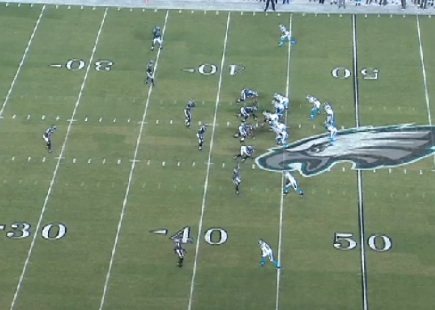
The Panthers have lined up with 3 WRs and two in the backfield (one of these is a TE that was motioned pre-snap from the left into position to Cam Newton’s right).  In the left slot for the Panthers is Brandon LaFell.

NOTE: Judging from the pre-snap look (the Eagles are in a nickel D, with 5 DBs for 3 WRs), a 43-yard TD pass would be among the least likely plays to happen.

Eagles Panthers 1

So how did they fuck it up?

Step one:  BLITZ!  The slot corner (Boykins I believe) will blitz, as will the weakside safety (Coleman i think).  Something to keep in mind here is that at the snap, Coleman is a full 16-18 yards from Cam Newton.  Forget for a moment that Newton is hard to bring down for anyone, let alone as bad a player as Coleman, but the odds of Coleman even getting to the QB are low given the huge distance he has to cover.  Meanwhile, Boykin blitzing from the slot leaves LaFell without a defender, meaning either on of the LBs or the deep safety has to pick him up.  As you probably guessed, this doesn’t happen.

Step Two: LBs bite hard on PA.  Perhaps feeling left out, the LBs (both of them) decide that they will show everyone that can bite just as hard on PA as the safeties can.  This takes both of them (Ryans and Kendricks) out of the play.  Below, you can see the moment Cam fakes the handoff.   The LBs have barely moved from the pre-snap position, though a moment later they will both take a step forward.  You can also see the safety blitz in progress just above the LBs (and the corner coming from the slot).  At the time of the handoff, Coleman is still roughly 10 yards away (ignoring the fact that there are several 300 lb men in the way).

Eagles Panthers 2

Step 3:  If you look at the above image, you can see the final piece of the puzzle fall into place.  With the corner blitzing, and the LBs eager to show how quickly they can commit to all fakes, the last remaining hope is for Nate Allen, the deep safety, to see the gap in coverage and save the day.  However, he is already rolling over to the weak side WR, ensuring that he too, even after the throw is made, will be out of position to stop a TD let alone break up the pass.

Finally, we can see the “Oh SHIT!” moment below, as LaFell is open to streak down the middle of the field.  The LBs at this point have realized their mistake, but arent close to fast enough to make up the gap.  Nate Allen either hasnt noticed or doesn’t care.  Nnamdi is left as the only DB on the left side of the field, but he has to stick with his man.  Also, anyone see Kurt Coleman?  No?  He’s predictably caught up in the O-Line, still 5 yards from the QB just before the pass is thrown…

Eagles Panthers 3

That gentlemen, is how you throw a football game.  Not a single defensive player made a positive move.  Nobody on the line got any pressure (you can see from the three pictures that there was absolutely no penetration.  Neither blitzer came close to getting home, and Colemans presnap position essentially made this a 11 v. 10 play.   The LBs bit on PA, taking them out of position, and the deep safety didn’t adjust and was too slow to get over and stop a TD even after the throw was made.

Further thoughts:

-The Eagles suddenly look like they can very realistically finish the season at 3-13.  Remaining games are against Dallas, Washington, Cincinnati, Tampa Bay (not in that order).

-Vinny Curry made a few nice plays.

-If you watch the remaining games, the guys to pay attention to are Curry, Graham, Bryce Brown, DeMaris Johnson (I think he’ll start getting some real playing time), Kendricks….thats about it.

– This years draft doesn’t have a can’t-miss QB in it (naturally), so expect the Eagles to be bad (bad = non-contenders) for a couple of years as the new coach essentially starts from scratch.