Maximizing the Kick Return Game

Time for another guest post from Jared.  For those of you who don’t know, Jared is my brother.  He’s also a U of Chicago MBA and a two-time Jeopardy! champion.   You can follow him @jaredscohen or see the original of this post at his site, linked here.  Now, his words:

Last year I put together some analysis of NFL kick returns. I was really motivated by one big question – Why do teams return kicks?

Initially, I wondered if returning kicks was even the optimal decision for teams trying to win football games. I wondered if the risks of turnovers and poor field position meant teams really should prefer a touchback to bringing the ball out of the end zone.

As a brief review, that’s not the case. Returning kicks is, on average, better for scoring points than taking a knee in the end zone as the returns leave your team with better field position. If you look at it in terms of expected points generated on kick returns vs. generated on touchbacks – the distinction is clear: (Note: this analysis relies on the concept of expected points based on field position – which I’ll assume readers have already seen and grasped)

This data comes from the first 16 weeks of this NFL season, over 2400 kicks. It’s also consistent with last year’s data.

So returning kicks is good, but think about why it’s a good idea. Although it presents better average field position, the average return nets only about four yards of position (and only two yards if the ball is brought out of the end zone relative to a risk-free touchback).

Linking back to material my brother has posted – the upside is directly tied to variance. Returning kicks is much more of a high-variance strategy.

Below – is an illustration of all returned kicks through Week 16 this year. The histogram shows the distribution of expected points.
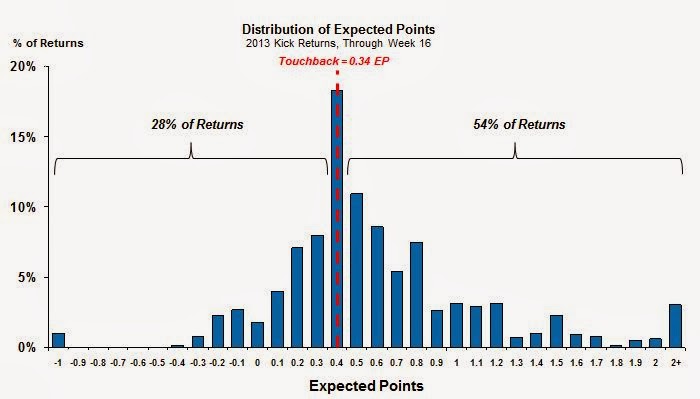
You see the giant spike between 0.3-.04 which equates to a return between the 18 and 22 yard lines, that’s the most typical result (remember a touchback is worth 0.34 expected points). But there’s also an extremely long tail of positive performance, and these outliers can be worth a lot more (even a touchdown). Those outliers are what make kick returns worth the risks (injury, turnover), which is exactly what we mean when we talk about high-variance strategies.

A touchback has zero variance. That result is predictable and constant. But a return, that could be a whole bunch of possibilities.

OK – so let’s take the idea that returning kicks instead of taking touchbacks is a high-variance strategy as a hypothesis. Now, if that’s true, we would expect to see a couple different trends in the data. Generally, we would expect less talented teams to return kicks MORE often than their better opponents. Weaker teams should be pursuing higher variance plays in an attempt to pick up ground on those other (stronger) squads. In an example – you’d expect the Jaguars to try everything to beat the Broncos because Denver is extremely talented and playing a conventional game will leave the Jaguars at a big disadvantage. That could mean any number of things, more shots downfield, 4th down conversion attempts, surprise onside kicks, and we could expect – more kick returns.

So…is that something we actually observe in the data? Are weaker teams pursuing higher variance strategies in the form of more frequent kicks?

To test this, I went back and looked at my favorite kickoff metric – percentage of touchback eligible kicks returned. This counts the number of kicks that were returned out of the end zone as a proportion of the total number of kicks fielded in the end zone. Obviously – teams will return all kicks fielded short of the end zone, so we need to exclude these. The real decision point is whether or not teams bring balls out of the end zone – this is our true high variance strategic choice.

The data set it built off of play-by-play information, which is the best I can get. Unfortunately, there are a large number of touchback kicks where distance is not recorded and it isn’t specified whether the kick was fielded or kicked out of the end zone. After some initial eyeballing I’m confident these are kicks out the back of the end zone (Matt Prater of the Broncos had a lot of them as an example). So our set of kicks is a little smaller than you might expect. But there are still 950 kicks in our sample.

Then, I took all the NFL teams and split them into three performance tiers based on point differential. Teams with the highest point differential are members of the first tier, teams with the worst scoring differential are in the third tier. Below are the teams and their tier positions.
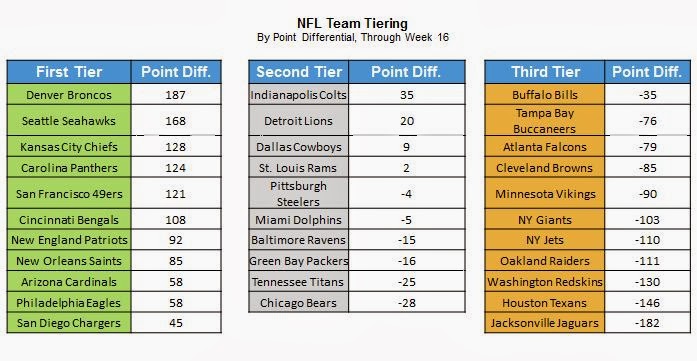
You can see the usual suspects in both the first and third tiers. And to me, this is where we’d expect to see the biggest change. These third tier teams – they have to do MORE to compete against first tier teams. Alternatively, first tier teams, one might argue, don’t need to take additional risk by sending their return man out of the end zone. If we look at touchback eligible kickoff return percentage across the different matchups – we can see if there’s any difference in the way teams behave. Do third tier teams return more kicks when they face off against first tier teams? Do first tier teams (who don’t need to pursue high-variance strategies) return fewer kicks?
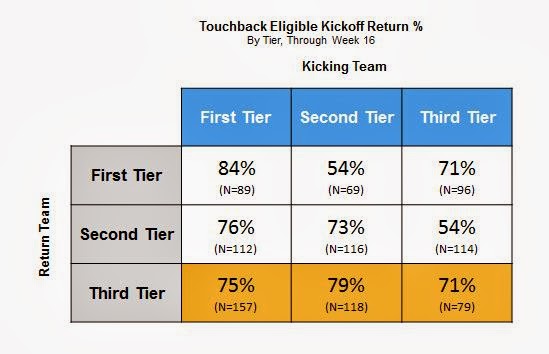
Hmm…there’s almost no difference in return % whether the worst teams are facing other crappy teams or the best teams. That seems a little odd…as we had guessed the worse teams SHOULD be returning more kicks when they face better teams. This indicates that this doesn’t happen.

It’s also not a result of sample size, as most of these cells are large enough (80-120 observations).

As another check, I looked at touchback eligible return percentage relative to specific team talent (via point differential) on a team-by-team basis. I did this to see if there were any teams that really seemed to be demonstrating aggressive tactics at the individual level.
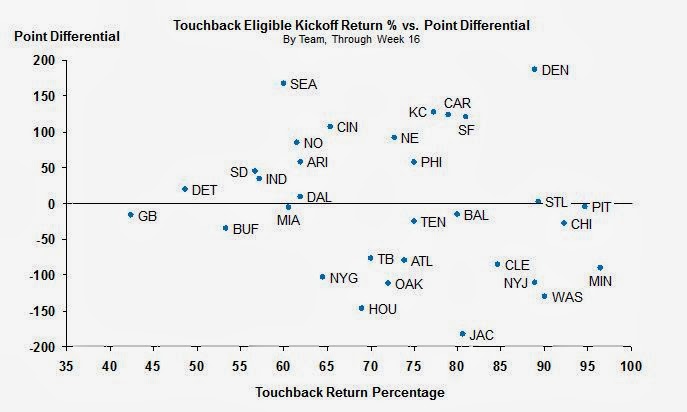
Again, this doesn’t appear to support our thinking that poor teams are pursuing higher variance strategies by returning more kicks. At best, it’s inconclusive. There are a couple of teams, like the Vikings, who really push the envelope – but there’s not a major correlation between team talent and return percentage (correlation is roughly -0.15)

Strange, but maybe identifying high-variance strategies before the game starts and following them blindly isn’t really what coaches of less-talented teams spend time on. Is there another way we can test our hypothesis?

Another theory is that if teams aren’t determining to return more kicks as part of pre-game strategy, maybe it’s something they pursue once they fall behind on the scoreboard. This wouldn’t even have to be exclusive to poor performing teams – any team that’s fallen behind might be more likely to run back kicks to try to break a big play to help catch up. What if we examine touchback eligible return percentage by in-game score differential?

The chart below illustrates the return percentage across a set of different score bands, ranging from down by more than 14 points to ahead by more than 14 points.

Again – there doesn’t seem to be any real connection between the scoreboard and aggressive kick return tactics. A team down by more than two touchdowns is just as likely to return a kick out of the end zone as one who is tied. If a kick return out of the end zone is indeed an aggressive play with a higher reward – teams don’t appear to be pursuing it MORE when they need to make up ground or LESS when they have a large lead. (As an aside, I absolutely cannot explain why having a small lead seems connected to a dramatic drop off in returns. I’ll chalk that up to some data wonkiness unless someone has a great insight there.)

But the broader concern remains. Shouldn’t teams which are behind or less talented need to take more chances to win? Why aren’t they doing that and bringing kicks out of the end zone?

My initial guess, though I’d welcome other speculation, is that teams the organizational structure of coaching almost inhibits something like that from happening. This comes with the obvious caveat that I’ve never coached in the NFL (so sure, Bill Belichick or someone else can dismiss all this out of hand as mom’s basement musings – but screw them). But if you’re the special teams coach of an NFL team – your work includes a thorough evaluation of your special teams and your upcoming opponent. All that work and planning becomes a little less valuable if a head coach just says – ‘Hey, I think we should return any kick we get in the end zone’

If the special teams coach is to maintain any kind of control over what his squad does – a simplistic rule like ‘run them out when we’re behind’ may not be sophisticated enough to justify all that pre-work and planning.

But that’s just a thought, based on the idea that coaches know their teams and customize approaches based on their own teams’ skills and the matchup with the opponent. Of course, when you actually look at the data, teams don’t really appear to be all that successful in managing their return game. Below is an illustration of touchback eligible return percentage, but this time charted against the average return position (i.e., return ability).
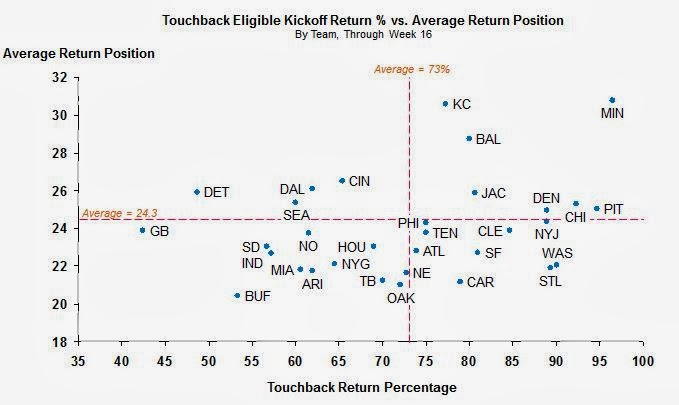
While we’d expect to see some correlation here – to show that teams with good return games return more kicks and teams with poor return teams take more touchbacks – that’s only true to the degree of a 0.2 correlation.

Some teams seem to get it – the Bills are really bad in the return game, but they rarely return kicks out of the end zone (on a relative basis – still over 50%). At the other extreme are the Vikings. The have Cordarrelle Patterson and, as such, they return kicks out of the end zone over 95% of the time!!!

On the flip side, look at Washington and St. Louis, teams with mediocre return units that run kicks out of the end zone 90% of the time. The Chiefs and Ravens seem odd as well – teams with great performance who could stand to run some more back. Now, maybe the Redskins are pursuing a high variance strategy, and maybe the Chiefs a more conservative one, but the overall results remain inconclusive.

At the end of the day, I come back to the idea of coaches and control over their special teams. For any team to read any of this and think about employing a ‘high-variance’ strategy – it really requires an admission of the role of chance in the outcome of a football game. Running every kick out of the end zone is a strategy based on the concept of inherent variability in outcome. Some returns may get stuffed, and others may go for big returns, but you can’t be sure when one or the other will happen. That view, to me, is fundamentally opposite the idea that with the right scheme and flawless execution – you can create the optimal outcome.

One of those ways of thinking supports the coach as the ultimate authority, while the other incorporates more probabilistic thinking. That gap is why I think we haven’t seen any patterns to support our hypothesis, and no clear evidence of high-variance kick return strategy consistently employed in today’s game.
Two-Factor Blitz Theory

I received some pushback from yesterday’s Billy Davis rant, so today I’m going to try to add some nuance to my explanation.  First, I want to note that while Davis bears the brunt of my criticism, he’s certainly not the only DC I disagree with on a fairly consistent basis.  Graded against everyone else, Davis is OK (for now).  However, as is usually the case, just because everyone else does something doesn’t mean we need to do the same thing.  Conventional wisdom, especially in sports, frequently lags the “optimal” strategy.

So….Defensive Strategy, and more specifically, the Blitz.

My general take on this is that the Blitz (sending more than 4 pass rushers) should be viewed as a TOOL, not a general philosophy.  I realize that in Philadelphia, that’s borderline heresy (lot of Jim Johnson fans out there).  But let me explain.

Two Factors

To complete a pass, two things must happen (generally speaking): an “open” receiver must exist, and the QB has to identify that opening (after which he presumably throws the ball there).  It’s tough to determine what constitutes an “open receiver”, so I’m going to discuss this side of things in terms of Windows.  So a passing window refers to an opportunity to place the ball where the receiver can catch, and one must exist and be identified in order to complete a pass.  Simple enough?

Also, for a QB to identify the available passing window, he must have TIME to do so.  The more time he has, the higher the odds of him seeing an existing window or of one developing.

By breaking the process down into these factors, we can see the basic trade-off in defensive strategies (against the pass).  The best of both worlds, of course, is to minimize the passing windows AND minimize the time the QB has to identify them.  That’s why DEs are so coveted.  If you can generate a strong rush (i.e. lower QB time) with just 4 d-linemen, you can use everyone else to close passing windows.  However, very few teams area able to do that on a regular basis.

More often, you have to make a choice.  You can rush an extra man (blitz), which should decrease the amount of time the QB has to see a window.  Conversely, you can rush fewer men, and use more of them to minimize the windows.

With me so far?  Good, now let’s talk a little bit about passing windows.

Passing Windows

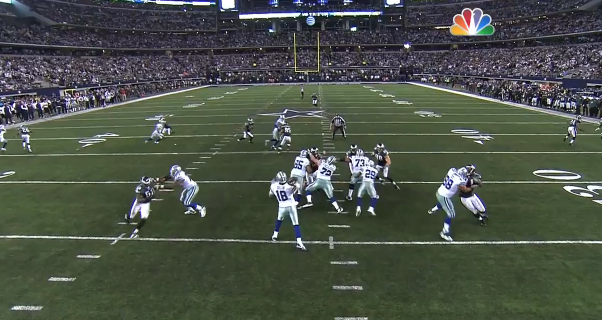
Passing windows open and close throughout each play.  A complete pass occurs when one of them opens and the QB hits it.  To help illustrate, I’ll pick a random frame from Sunday’s game:

Screen Shot 2013-12-31 at 9.57.59 AM

Nice….Now let’s superimpose the passing window on it.  Despite the outcome of the play (Boykin game-saving interception), there was, in fact, a window to hit here for Orton.

Screen Shot 2013-12-31 at 10.02.04 AM

That’s a rough approximation, obviously, but you can see the idea.  Given such a big opening, how the hell did Orton miss?  Any guesses?

How about:  He’s not a good QB!?

That’s a little unfair (just a little), because every QB misses opportunities sometimes.  However, let’s dig a little deeper into this.

When deciding what pass-rush strategy to use, there’s perhaps no greater factor for consideration than the skill of the opposing QB.   We now have to combine the QB skill with our Window illustration from above.  Let’s visualize it like this:

Screen Shot 2013-12-31 at 10.11.23 AM

Don’t get too caught up in the relative sizes, this is far from a “to-scale” illustration.  In the middle we have the passing window.  On either side I’ve provided a visual representation of each QB’s (Peyton and Orton) accuracy.  Think of the two layers as confidence intervals; something like 70% certainty the ball will end up within the smaller red circle and 90% certainty it will end up within the outer circle’s boundaries.

Hopefully this is rather intuitive.  Now play a mental game using those images.  The green square will move across the screen from left to right.  You control the red circle, and your job is to align it with the passing window and and press go.  Think of it like aiming a rifle.

Now…which player’s range (red circles) would you rather play with?

Easy, Peyton Manning’s, because his confidence ranges are smaller, meaning there’s a smaller margin of error.  For example, let’s say you align each perfectly with the passing window:

Screen Shot 2013-12-31 at 10.19.15 AM

See the problem?  The window is smaller than Kyle Orton’s accuracy range.  Meanwhile, it the window is significantly larger than Manning’s 70% accuracy range.  The upshot, naturally, is that Manning is a lot more likely to complete this pass.  Going back to our game image above, we can visualize the pass like this, with the yellow X denoting the final placement of the ball, which was intercepted.

Screen Shot 2013-12-31 at 10.23.35 AMMoreover, we can extrapolate the idea.  In general, Peyton Manning will be able to hit smaller windows than Kyle Orton will.  Obviously, smaller windows occur more frequently than larger windows, hence Peyton Manning, by virtue of his accuracy, will have many more opportunities to complete passes than Kyle Orton.

Now pretend you’re a defensive coordinator.  Remember you have a choice to make between eliminating passing windows and minimizing time.  In this exercise, you cannot do both.  Against which player is the “window elimination” strategy more likely to work?

Easy (again), Kyle Orton.

Since Peyton Manning’s required window size is so small, eliminating them will require extremely good coverage.  More likely, you can play excellent coverage on the receivers and STILL not prevent several of these small windows from opening up.

Conversely, against Kyle Orton, things aren’t so difficult.  He needs a relatively large window.  Large windows are easier to eliminate.  You don’t have to play perfect coverage. Notice in the Boykin play, there was a relatively large are in which Orton could have complete a pass for a big gain.  Fortunately for the Eagles, Orton didn’t hit his spot.  Boykin’s coverage was far from perfect, but it didn’t need to be!

In light of that, go back you your strategy decision.  Which do you think is easier to do:

– Eliminate windows

– Minimize time

Now consider that Orton was operating out of 3-step drops for much of the night.  Then, the answer is easy.  Eliminating his passing windows is the much higher-probability play.  Note that’s the BASE strategy.  Obviously, you need to blitz every once in a while, if for no other reason than to add some unpredictability.

That’s the crux of my argument against Billy Davis’ blitzes.  He doesn’t seem to vary his usage as much as I believe he should, and he doesn’t save his blitzes for high-leverage situations.  Instead, he uses them in LOW-leverage situations, where the reward of a sack is comparatively low, especially when weighed against the odds of a big play.

Against a great QB (like Drew Brees this week), you have to be much more aggressive because it’s much more difficult to eliminate those passing windows.  Moreover, there’s another factor to discuss:

The Blitz Bonus

A very successful blitz will result in a sack.  A sack dramatically swings the odds of a turnover (punts included) in the defense’s favor.  Now, comparing opposing QBs, against which ones do you think that’s most important to do?  I’ll give you a hint, it’s not Kyle Orton.

Against a great offense or great QB (frequently one and the same), the odds of allowing a 1st down are comparatively high.  For example, according to Pro-football-reference.com, the Denver Broncos faced 93 third downs needing 5 or fewer yards for a first down.  They converted 62.4% of those.

Now compare that to a bad offense, like Baltimore (ranked 30th by Football Outsiders).  The Ravens faced 96 third downs with 5 or fewer yards to gain.  They converted just 49% of those.

As you can see, getting to 3rd and less than 5, normally not considered much of a “win” for the defense, is still good enough to get you to 50/50 against a bad offense.  Assuming each opportunity is an independent event, the odds of the Ravens converting two consecutive such third downs is just 25%.

Hopefully your mental light-bulb just turned on.  Facing a Kyle Orton-driven offense, the Eagles were looking at a team much closer to the Ravens than the Broncos.  In that situation, just preventing a big play and forcing the Cowboys to convert a string of third downs was VERY LIKELY to produce a punt.

In other words, we didn’t NEED a sack!  The odds were already in our favor.  Conversely, if we had been facing the Broncos, the risk/reward equation flips.  That team is much more likely to convert a string of third downs, meaning the defense needs to do something to increase its odds.  Getting a sack is one of the only affirmative ways to do this.  In that case, the reward of getting a sack outweighs the risk of giving up a big play.  Without the sack, you’re likely to give up a long drive anyway!

Against a bad offense, though, that’s not the case.  It’s better to sit back, eliminate passing windows, and wait for the odds to shake themselves out.  By blitzing bad QBs, you’re making a foolish grab for upside that you don’t need.  Bad QBs will struggle to hit receivers that are even marginally covered, so why make it easy for them by making those passing windows larger?

Wrapping Up

Hopefully that illuminated things a bit more clearly.   Basically, against bad QB’s, the odds are already in your favor.  The reward of a sack (or forced incompletion), and the increased odds of a punt that come with it, are NOT worth the risk of the big play. In all likelihood, a bad offense will NEED a big play in order to score.  They simply won’t be able to string together a 12 play drive with a lot of 3rd down conversions.  Hence, the goal should be to get to third down as often as possible, and let the odds take effect.

Against a great QB, though, that’s not enough.  They ARE somewhat likely to string together 3rd down conversions, especially if their short yardage situations.  Similarly, they DO NOT need a big play to sustain a drive.  In that case, the risk of giving up the big play (which is worth relatively less to a great offense than to a bad one) is worth the associated reward of a longer yardage situation (which the defense needs to push the odds in its favor).

That doesn’t mean you never blitz a bad QB or always blitz a great one.  It does mean that you’re general pass rush strategy, particularly when it comes to sending extra pass rushers, should vary greatly depending on which QB you’re playing against.  Just saying “we’re a blitzing defense”, so we’ll blitz, is a very low-level strategy.  It’s far too simplistic, and sounds a lot more like a crutch than a well-thought out, adaptable and deployable strategy.

Week 17: Eagles v. Cowboys Post-Game Notes

Well that was….agonizing.  The offense simply didn’t do its job, if it had, the game would have been a blowout.  Not going to dwell too much on it, though.  Only thing really worth investigation is whether Foles had places to throw the ball instead of taking the sacks.

For now, some quick notes:

– One of the biggest issues the past few years has been the lack of impact players on defense.  My perspective is that, in general, you can scheme to score points, but need talent to prevent them.  The Eagles haven’t had that….until now (maybe).  Mychal Kendricks played a great game, and looks to have found some measure of consistency (his biggest issue last year).  Boykin, outside of the really stupid PR penalty, also played a very good game.  The development of those two players is HUGELY important for the future of the team, especially when you consider the very real possibility (hopefully) that the team won’t be picking in the first half of the draft for a while.  Fletcher Cox didn’t make many players, but it looked like he was seeing consistent double-teams.  If that’s true, then he’s doing his job as well.

– Jason Garrett made some very poor strategic decisions, to the Eagles advantage of course.  Punting on 4th and 2 in Eagles territory is just completely indefensible, especially when you consider how good the Eagles’ offense is (despite its performance yesterday).  It’s shocking to me that coaches still do things like that, when so much work has been done to show it’s clearly the wrong move.  According to Expected Points, from AdvancedNFLStats.com, Garret gave away MORE THAN A FULL POINT with that decision.  He also struggled with more than just 4th down calls…

– The Cowboys’ biggest advantage coming into the game was on Special Teams.  Moreover, their return man, Dwayne Harris, was healthy again and among the more dangerous return men in the league.  Yet….he brought just 2 kicks out of the end zone (averaging 32.5 yards on those returns).  Another huge strategic blunder.  It doesn’t matter that the kicks were in the back of the end zone.  As an underdog, you need to (a) up the variance, and (b) leverage your strengths.  They did the complete opposite by not returning every kick.  This isn’t an isolated occurrence either.  Look at this, from Jared Cohen,

Screen Shot 2013-12-30 at 11.17.26 AM


You can see Dallas in the upper-left quadrant.  They’re above average in returns, yet attempt them far less than average.  Yes, there is some cross-causation here (it’s possible they’re above average because the only return kicks that don’t go deep into the end zone).  However, remember they were big underdogs here, with a QB that couldn’t push the ball downfield.  Maybe they should have taken a shot at giving Dwayne Harris a few shots against a poor Eagles STs unit?  Yeah…but I’m sure happy they didn’t.

Let’s just hope Jerry Jones isn’t lying when he says he’s keeping Garrett….

– Billy Davis….I’m done.  He’s at the top of the list as far as changes I’d like to see the team make.  The personnel still needs improvement, and blown coverages can’t get blamed on him, but he just doesn’t seem to have any feel for the strategic ebb and flow of the game.  He also seems to be completely ignorant of the risk/reward equation of blitzing in various situations.

The toughest part about judging coaches is that you never know if the players are actually executing what they’re told.  However, allowing the Cowboys, in a vitally important situation, to get Dez Bryant matched up one-on-one with Patrick Chung as a result of a simple, single-man pre-snap motion is absolutely ridiculous.  It shouldn’t happen. It CAN’T happen.

Also, when blitzes aren’t working, the answer is NOT to blitz more!  Here, Davis seemed to have no idea who he was playing against.  Kyle Orton, at this stage of his career especially, is a check-down, quick-read QB.  He’s not great, but if there’s a wide-open receiver, he’s going to complete the pass.  He also can’t push the ball downfield.  So why blitz?  If the QB is routinely taking 3-step drops, it doesn’t matter what blitz you call, there isn’t enough time to for it to get home.  Instead, Davis should have been happy to rush just 4 linemen and drop everyone else into coverage.  Orton’s not mobile, so the LBs are all free to man-up or drop into an underneath zone.

Against a QB with great accuracy (like Drew Brees for example), you can’t do this, because coverage is much more difficult.  Against Kyle Orton, though, the coverage doesn’t have to be perfect, he’s not that good!  He made one legitimately great throw all game (to Terrance Williams).  Other than that, his ball-placement was off, sometimes by a lot.  If that’s the case, the last thing you want to do is make things easy for him by leaving receivers uncovered (a side-effect of blitzing).

Most unfortunately, this isn’t a one-time occurrence; Davis has struggled with this all year.

– One last blitz point….it’s a high-variance strategy!  In other words, it’s something you should generally avoid if you are the favorite.  If you’re the better team, you don’t need the high-reward!  As a result, the payoff isn’t worth the associated risk.  As a significant favorite, it’s the OTHER team that should be forced to make riskier plays.

To be fair, though, I don’t think many DCs (if any) really conceptualize blitzing or general defensive strategy like this.  That’s not a good excuse for Davis though, it just means the whole profession needs some instruction.

Now some happy thoughts:

– 10 wins, a division title, a home playoff game, the league’s top rated passer, the league’s leading rusher, the most 20+ yard plays in NFL history.  As I said in the pre-game notes, this season has been a resounding success.  We’re playing with house money now.

– The Eagles went 7-1 over the second half of the season.

– Drew Brees is legitimately great, and scares me regardless of where the game is, but getting him out of the dome really is a big deal.

– The Saints are 2-3 in their last 5 games.  It’s been a very difficult stretch (losses have come against Seattle, Carolina, and St. Louis), but still.  This team isn’t quite as good as the Saints you’re used to hearing.  That said, they have a point differential of +110, nearly twice the Eagles’ mark of +60.  (My first reaction to the -2.5 line is that it’s off by a couple of points).

– Despite that, if I told you pre-season that the Eagles were a 50/50 proposition to make it to the divisional round of the playoffs, my guess is you’d have been thrilled and/or called my insane.

– Playoffs!

Week 17: Eagles vs. Cowboys Pre-Game Notes

Win or go home; the playoffs start today for the Eagles.  As I wrote in my breakdown, the Eagles are, deservedly, significant favorites and are likely to win.  However, that doesn’t mean they will. Here’s where thinking probabilistically becomes difficult for many fans and commentators.

According to Vegas, if this game was played a very large number of times, we would expect the Eagles to win about 70% of the time.  That’s a LOT.  Moreover, I think the line is too low.  At my line, I’ve got the Eagles between 75-83%.  Very encouraging, but it raises an interesting question:

If the Eagles lose, did they “choke”?

Let’s assume for a moment that the Eagles do lose tonight.  The low-level analysis will involve “choking” and talk about things like cracking under the pressure or Chip Kelly not being ready for such a big game.  Mostly, it will revolve around one supposed fact, that the Eagles SHOULD win this game.   Read that again:

The Eagles SHOULD win this game.

It sounds right, but it’s complete bullshit.  That’s not how the sport (or the probabilities the sport is based on) works.  The correct way to say it is that, ex-ante, we know that the Eagles are LIKELY to win.  The problem with “should” is that it implies a level of control that the team simply doesn’t have, regardless of what generic sportswriters would have you believe.

Let’s use an analogy.  Imagine you’re playing poker (Texas Hold ‘Em).  You’re heads up, looking at the river.  There are no more strategic moves to be made, the outcome of the hand depends entirely on which card comes out.  Of all the cards remaining in the deck, 75% of them will result in a Win, 25% a loss.

If a Loss card comes out, did you “choke”?  Similarly, before the card is drawn, “should” you win?

Of course not, that’s ridiculous.  The fact is, the entire strategy of Poker (and many games/sports in general) is to shift the odds in your favor as much as possible (and maximize the expected payout when you do).  Unfortunately, that’s all you’re doing, shifting the odds.  As anyone who truly understands what that means knows, even after you’ve shifted the odds, there is still a chance for a loss.  In Poker, it’s sometimes called a Bad Beat.

Circling back to the game tonight, if the Eagles lose, it may just be a Bad Beat.  The Eagles are the better team, but if they played tonight’s game a large number of times, they’d STILL LOSE a decent percentage of the time (30% according to the spread).  Just as the Eagles MUST win a large majority of the games if it played a large series, they also MUST lose as well.  Unfortunately (when you’re a favorite), you don’t get a series, you get one game.

The ball takes lucky/unlucky bounces.  The refs don’t see everything correctly.  Players will have bad games, coaches will have bad games.  They are not robots, their performance varies.  If those bad games coincidentally happen to occur when the stakes are high, the knee-jerk reaction is to say the player/coach “choked”.  Or to somehow imply that the stakes themselves forced them into a sub-optimal performance.  I’m not ruling this out.  It’s possible, and it may even be probable (at the extreme margins).  However, it’s much more likely that they simply caught a Bad Beat.

As anyone who plays poker knows, when that happens, the “right” thing to do is to shake your head and check your calculations.  If they were correct, you don’t do anything different the next time (unless you really did screw up), even though the results this time were bad.  Process, not outcome.

Now, a few actual notes:

– The Eagles are 7 point favorites. E = R ((60 – T) / 60) + C.  That means, at least to start, they should be playing a relatively low-variance game.  Over any stretch of time, we expect the Eagles to outplay the Cowboys.  That puts the onus on Dallas to change the conditions.  Note though, that at 7 points, all that would take is an early TD from Dallas.

– Don’t let Dez Bryant beat you.  He’s the only elite weapon the Cowboys have.  Demarco Murray is having a good year, but if the Eagles offense performs anywhere close to expectations, Murray isn’t going to be able to keep the Cowboys in the game.

– Don’t get blitz-happy.  A frequent reaction to a back-up QB is to blitz him.  Yes, getting pressure on Orton is important, but when you blitz, you actually make it EASIER for receivers to get open, you just (hopefully) diminish the time the QB has to make that decision.  If I were calling the game, I’d want to see if Orton can move the ball against the base defense before dialing up an blitzes.  Remember, blitzing is a high-variance move.  If you’re a big favorite, you should blitz sparingly.

– Don’t get sloppy.  Penalties and turnovers can equalize a skill-advantage pretty quickly.  There’s no reason to believe either will be a problem, but that doesn’t mean the players shouldn’t be reminded to play under control (Cary Williams especially).  The Eagles have averaged 53.4 penalty yards per game this season, Dallas averages 57.5.    Similarly, both teams have averaged +0.7 turnovers per game, which is 4th best in the league (7-way tie).

– Watch out for “David” strategies.  We’ve looked at these from the underdog’s perspective, but since Dallas is in that position tonight, it’s a good chance to view things from the other perspective.  So, watch out for surprise-onside kicks or fake punts.  Expect a few 4th down plays.  Prepare to be blitzed.  I don’t think Garrett has the balls (or brains) to fully deploy these strategies, but that doesn’t mean we won’t see one or two instances. They’re high-risk/high-reward; the Eagles really want to focus on that high-risk part.

– Enjoy.  This has been a lot of fun, and regardless of what happens, Eagles fans should be pretty excited about the Chip Kelly era.  The team has already met my expectations (surpassed them in some respects), so it’d be silly to consider the season anything less than a great success, no matter what the outcome of tonight’s game is.

That said, it’s Dallas, the Eagles are the better team, and it’s for a playoff spot.  I think the Eagles roll.

Eagles vs. Cowboys: Breaking down this week’s betting lines.

Split the action again last week, so let’s try to finish strong.  I will do a breakdown for any playoff games, but of course, that’s not guaranteed.

I get the sense that a lot of fans are nervous about Sunday night’s game.  Things are going a bit TOO well and everyone’s scared of getting the rug pulled out from under them.  That’s fair, but really, Eagles fans should be nothing but ecstatic and excited heading into this week.

Before I start breaking things down, I want everyone to ask themselves one question:

What were your preseason hopes and expectations for this team?

My guess is, if you’ve answered honestly, then the team has already surpassed them.  My personal projection was for a 9-7 record, with a playoff spot depending on whether one of those nine wins came from the last game of the season.  That was spot on, but I’ve still been surprised by the level of play.  The fact is that we’re now playing with house money. A loss on Sunday sucks, but it doesn’t change the fact that the season has been successful in every sense.

The goals for this season were:

– Prove Chip Kelly can be successful.

– Make the transition to the 3-4 and find a couple of young players who fit the scheme.

– Identify one or two “cornerstones”.

– Give Nick Foles a chance and see what he can do (not a popular one, but a big one for me).

In every aspect, the team has met those goals.  Chip Kelly’s “college” offense is tearing up the league, even after teams have seen it once and supposedly had the chance to make adjustments.  So far, the only thing that has really defeated it is having a 3rd string rookie QB at the helm or a Nick Foles body-snatcher.  The 3-4 is installed and functioning much better than I expected.  To be fair, I wasn’t a fan of the switch.  However, it’s been decent and, more importantly, Mychal Kendricks and Fletcher Cox have made successful transitions.  In that vein, while it’s too early to call Kendricks a “cornerstone”, the team clearly has a few guys with the potential to be impact players (Cox, Kendricks, Boykin).  Moreover, there have been several big surprises that bode extremely well for the future (Logan, Thornton, Wolff in particular).

Lastly, Nick Foles is having one of the greatest seasons ever for a QB. Read that sentence again, this time emphasizing NICK FOLES.  He leads Peyton Manning, having perhaps HIS greatest year ever, by 5.7 points in the Passer Rating title race.  Safe to say Nick Foles has done better than anyone thought possible.  Ok, one more thing:

Nick Foles’ current Rating is 118.7.  Only TWO QBs in history have had higher single-season Ratings (Aaron Rodgersand Peyton Manning).  Remember Tom Brady’s 2007 season?  The only with Randy Moss and the undefeated record?  Well Foles’ rating is currently 1.5 points higher than Brady’s was that year.

So, relax.  Win or lose, this season has been an unqualified success, and the Eagles look like they’ll be the class of the NFC East (again) for the foreseeable future.

Now, this week’s game:

The Breakdown

The Eagles are 7 point favorites.  The Over/Under is 52.5.

The comparison:

– The Eagles are ranked 8th overall by DVOA.  The Cowboys are ranked 18th.

– The Eagles are ranked 3rd overall by Weighted DVOA, which is just regular DVOA weighted more heavily to recent games.  The Cowboys rank 22nd.

– The Eagles offense ranks 2nd overall by DVOA.  The Cowboys defense ranks 30th.

(If you didn’t just tee-pee your hands and say “Excellent….”, go relive the 90s)

– The Eagles defense ranks 23rd by DVOA.  The Cowboys offense ranks 11th.  Note that’s with Tony Romo at QB.  We can safely assume that its AVERAGE performance level would be lower with Kyle Orton at QB.

– The Eagles STs rank 26th overall, Dallas’ rank 6th.  This is the only matchup where Dallas has a significant advantage.

– The Eagles have a point differential of +58.  The Cowboys’ is +9.

– The Cowboys last five games:

Beat the Giants (27th DVOA) by 3 points.

Beat Oakland (31st)  by 7 points.

Lost to Chicago (12th) by 17 points.

Lost to GB (21st) by 1 point.

Beat Washington (29th) by 1 point.

Notice anything?  Dallas’s resume isn’t exactly great.  In fact, it’s not even good.  Looking at the whole season, the Cowboys’ only win over a top 10 team by DVOA (currently) is when they beat the Eagles.  Outside of that game, here are the DVOA ranks of the teams the Cowboys beat:

14th, 26th, 27th (twice), 29th (twice), 31st.    The Eagles, of course, rank 8th.

Meanwhile, the Eagles’ wins have come over teams ranked:

10th, 12th, 16th, 17th, 27th, 29th (twice), and 31st.

It’s also worth noting that Dallas’ only “good” wins came in weeks 3 and 7.  More recently, the Cowboys have lost to both Chicago and Green Bay.  Conversely, the Eagles’ “good” wins have come in the past few weeks, against Chicago, Arizona, and Detroit.

So…taking the above as a whole, the Eagles are the MUCH better team.  The ONLY significant factor weighing in Dallas’ favor is the fact that it beat the Eagles head-to-head.  However, that was in week 7, so that win’s informational value has seriously depreciated since then.  Also, Kyle Orton.

That’s why the Eagles are a 7 point road-favorite in a winner-takes-all division title game.  (That and the Romo injury).

The Projection

Since the bye week (4 games ago), the Eagles have averaged 35.5 points per game.  The Cowboys defense, as I showed above, is bad.  It ranks 3 spots below Minnesota’s, and the Eagles put up 30 points against them.  There are no significant injuries and weather will not be a factor unless something completely unexpected happens.  As a result, I’ve got the Eagles base-case projection at 31-35 points.  To make things easier, we’ll take the mid point and say 33.

Meanwhile, the Cowboys have averaged 28.6 points per game since their bye week (5 games ago).  The Eagles defense is also not very good, and ranks just 1 spot above Oakland, against which the Cowboys scored 31 points (4 weeks ago).  Additionally, the Eagles defense ranks just one spot BEHIND Washington, against which the Cowboys scored 24 points just last week.  So there’s our range, 24-31 points.  Taking the midpoints, we’ll say 27.5.

HOWEVER, we have yet to account for the Tony Romo injury.

I know a lot of people rip Romo, but the fact is he’s one of the best QBs in the game.  In my opinion, not nearly enough blame gets put on everyone else in that organization.  Stepping down from Romo, who has a career rating of 95.8, to Kyle Orton, who has a career rating of 79.7 (and just 15 pass attempts over the past two seasons), is a MASSIVE hit.

Also, this “game-manager” stuff is bullshit.  Kyle Orton’s career Interception rate is 2.6%, just a tick below Tony Romo’srate of 2.7%.  Romo has 55 fumbles in 108 career starts, or .51 per game (that’s total fumbles, including from games not started, if there are any like that).  Orton has 32 fumbles in 69 career starts, or .46 per game.  So there’s a difference there, but it’s very small (.05 per game).  Overall, Orton is really no less likely to turn the ball over, and in fact may be MORE likely, by virtue of the fact that he’s barely played in 2 years.

To account for Orton, I’m taking EIGHT points off the Cowboys’ projection.  That sounds like a lot, right?  Especially since the line moved just 5 points after the injury was announced.  Looking at it practically, though, you’ll see it’s not that drastic.  Basically what I’m saying is that, as a result of having Kyle Orton instead of Tony Romo, the Cowboys will have 2 drives that end up in field goals instead of TDs.  Of course, that’s just one way the difference could manifest itself, but it’s instructive because of how reasonable it is.  Kicking 2 field goals instead of scoring 2 TDs gets you the 8 point difference.

Taking that from the 27.5 points projections, we’re left with 19.5 points.  However, there’s a big special teams discrepancy, so I’m going to add another 1-2 points back in, giving us 20.5-21.5.  That’s a very convenient number (I swear I didn’t work backwards) because it’s midpoint is 21, or three TDs.

Pulling it all together, I’ve got the base-case projection at Eagles 33, Cowboys 21.

That’s a difference of 12 points.  The Spread is 7, meaning our margin of error is 5 (very large).  That’s the second biggest margin I’ve seen this year.  Take the Eagles -7, and take them confidently.

The Over/Under

This bit is easy, since we’ve already got our scoring projection.

Eagles 33, Cowboys 21 adds up to 54 points overall.  The O/U is 52.5.  Also, the teams are a combined 18-12 against the O/U this year, and the line hasn’t shifted at all since opening, so we’re not joining a sucker’s move by taking the over.

54 is 1.5 points higher than 52.5, so take the over.  Note, however, that it’s a relatively small margin, so adjust the stakes accordingly.

Summing Up

I like the Eagles -7, and I like it A LOT.

I’ve got the Over 52.5 as the better side there, though it’s not as attractive as the spread.

Finally, for fans here, a win is much more important than whether the Eagles cover or not.  So, I looked up win rates for 6-8 points road favorites since the year 2000.  In those games (245 of them), the favorite has won the game almost exactly 70% of the time.

Using my projection, 12 points, I looked at the recored of teams since 2000 that were 11-13 point favorites.  Road favorites won the game 75% of the time, but the sample was just 20 games.  Looking at ALL games, home and away, the favorite won roughly 83% of the time.

So yeah, the odds are HEAVILY in the Eagles favor. (But that still leaves close to a 1 in 5 chance of a Dallas victory).

The Benefits of Being a High-Variance Team

Great game yesterday.  It was a nice preview of what this team COULD be if both the offense and defense play well at the same time.  Can’t ask for a much better set-up for the Eagles than a win-or-go-home game next week in Dallas.  The Eagles are, objectively, a much better team.  The stakes should take care of the motivation aspect.  Also, with Romo being out (assuming the news is accurate), if Foles shows up looking anything like “GoodFoles”, there’s very little chance of Kyle Orton keeping pace.

Now, to today’s topic.

According to Football Outsiders, the Eagles are ranked 31st in the league by DVOA Variance, at 25.4% (BEFORE the Chicago game).

Only St. Louis has been more uneven.  Normally, you’d prefer your team to be both very good, and very consistent (low-variance).  That’s the goal.  However, there’s more to the story, and it ties in to our general underdog strategy discussion.

The Eagles are not the best team in the NFC.  They might not even be in the top 5 (before yesterday, DVOA had them 7th in the NFC).  That means that winning the Super Bowl will require winning multiple times against inarguably “better” teams.  When I say better, I mean the expected performance of the other team is clearly higher than the expected performance for the Eagles.  Of course, that’s only one part of the equation.  The other, obviously, is variance.

The fact that teams don’t always perform to expectations is exactly what makes the game fun.  Otherwise, there’d never be any upsets.  So…taking the next step, that means if you’re a large underdog, you really want at least one of the teams involved (you or the opposition) to be a high-variance team.  Remember, underdogs (both ex-ante and as a result of current conditions) want to MAXIMIZE variance.

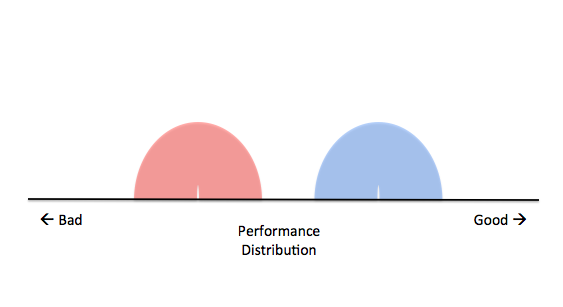
Let’s illustrate.  Below is a graphic showing the expected performance distributions for two teams.  Unfortunately, the shape-options in Powerpoint are fairly limited, so the shapes are a bit crude.

Screen Shot 2013-12-23 at 7.23.36 PM

Above, the width of each distribution and it’s height at each point tells you both how good the team is and how consistent it is.  If this were a “to-scale” drawing, the area under the curve would add up to 1.  Notice that in the above chart, there is a gap between the two teams.  That means, in this case, the Red team would NEVER beat the blue team.

Let’s pretend you’re the Red team.  What can you do?  Obviously, you can’t do anything to Blue’s distribution.  In general, the whole point of team-construction is to move the distribution to the right, so that’s option A.  If you shift Red far enough to the right, you’ll catch up to Blue.

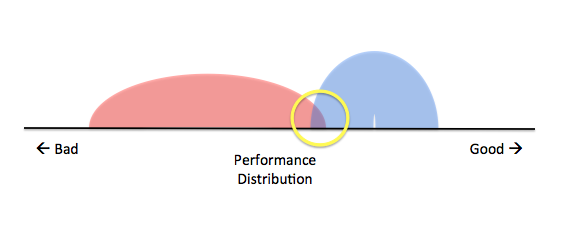
But what if it’s in-season?  What if you only have one week before the game?  You can’t do much to change the make-up of your team, so Option A is out.  There’s still hope, though.  You can WIDEN the performance distribution.  This is what it means when we say  teams in desperate situation must make High-Variance moves.  Let’s say Red team had the same average performance expectation, but is now a High-Variance team.  Then the chart might look something like this:

Screen Shot 2013-12-23 at 7.31.55 PM

See the overlap?  That’s the key.  Although it’s still unlikely, there is now an actual possibility of Red beating Blue.  Notice that there’s also a possibility of Red losing by a lot more than it would have before.  However a loss counts the same whether it’s by 1 point or 40 points. (Ask any real racer….)

Back to real life: the Eagles have a very WIDE expected performance distribution; it’s reflected in their high-variance.  That means that even if they’re undeniably worse, on average, than a team like Seattle, they’ve still got a decent shot at winning (compared to if they were a low-variance team.)

For example,

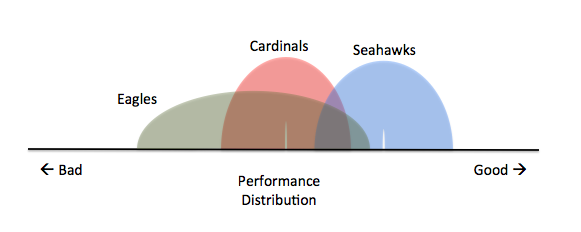
Prior to yesterday, the Arizona Cardinals ranked one spot ahead of the Eagles by DVOA (10.9% to 7.7%).    However, the Cardinals are among the most consistent teams in the league, and rank 4th overall by Variance, ahead of the Eagles by 27 spots, and a variance margin of 18.9%.

Charting each team against Seattle (very rough approximations here), we’d get something that looks like the following:

Screen Shot 2013-12-23 at 7.55.05 PM

Notice that while the Eagles’ average is worse than the Cardinals, their overlap with Seattle is actually greater than the Cardinals.  We’d have to do some calculus (and put a lot more effort into an accurate chart) in order to calculate the difference, but the overall idea is sound.

While it’s incredibly unlikely, the Eagles do stand a greater chance than similarly skilled teams to actually win the Super Bowl if they get to the playoffs by virtue of their high-variance nature.

Lastly, let’s look at the regular season variance of recent Super Bowl winners (this is going to warrant a dedicated post, but let’s just take a peak for now):

Baltimore Ravens – 15.6%, 24th in the league

New York Giants – 15%, 20th in the league

Green Bay Packers – 14.8%, 15th in the league

New Orleans Saints – 15.8%, 17th in the league

Pittsburgh Steelers – 10.8%, 8th in the league

SI Curse: Contrary Indicators 101

My last final of the semester was yesterday, so I should be able to post much more frequently over the next few weeks, just in time for the Eagles stretch run.  There’s a lot to be said there, and a few things I started and have to finish, but today I want to illustrate the “SI Cover Curse”.

Screen Shot 2013-12-20 at 9.36.04 AM

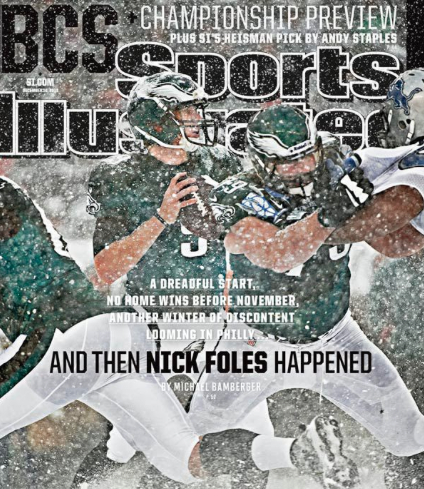
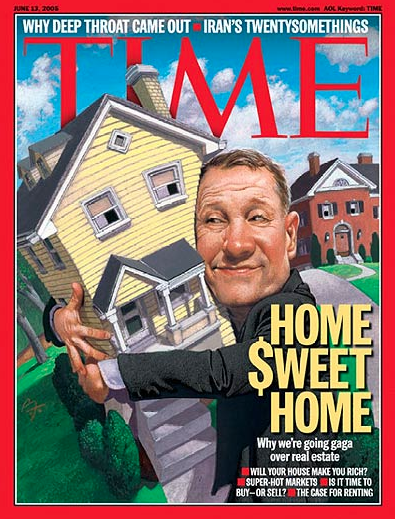
Obviously, being on the cover of Sports Illustrated, as Nick Foles was last week, does not actually “curse” its subject.  So why does it seem to work so often?  Basically, it’s because it HAS to work; that’s how the system is designed.

Items with covers that change by installment use those covers to drive sales.  Think of the gossip magazines paying millions of dollars to celebrities for exclusive pictures.  They do that because people decide which ones to buy based on what the see on the cover.  Beyond the brand, it’s the only real advertising available.  As a result, you only get “attention-grabbing” cover subjects.

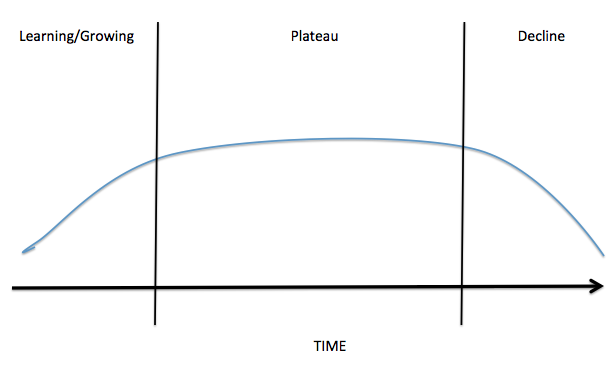
Now let’s look at a normal career arc for an NFL player (or any athlete).  I apologize for the crudeness of the drawing.

Screen Shot 2013-12-20 at 9.45.04 AM

Generally, players start slowly as they adjust to the NFL game (and get bigger/stronger).  After an initial period of development, they plateau, and remain there until they get old and decline.  Pretty simple.  Let’s take that graphic and break it into those sections.

Screen Shot 2013-12-20 at 9.48.58 AM

Note that this tracks closely with relative fame.  Very few players are really famous upon entering the league.  Similarly, very few players maintain their level of fame after they decline and retire.  That has obvious implications for magazine covers.  They don’t put nobody’s on the cover of Sports Illustrated (well, rarely).

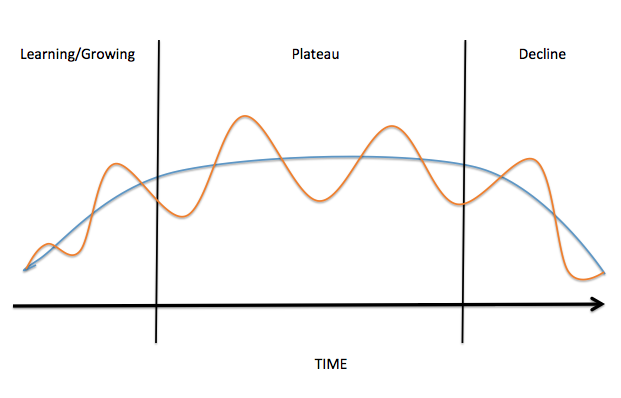
Of course, that curve is far too smooth.  So let’s add a layer to show the general oscillation of a player’s career skill/fame.  Every player has peaks and valleys, which oscillate around the longer term average.

Screen Shot 2013-12-20 at 9.56.12 AM

These are rough approximations, obviously some players have drastically different career arcs (injuries, in particular, can throw things off).  However, looking at the larger point: when, in the graph above, do you think a player is most likely to be on the cover of Sports Illustrated, or any magazine for that matter?

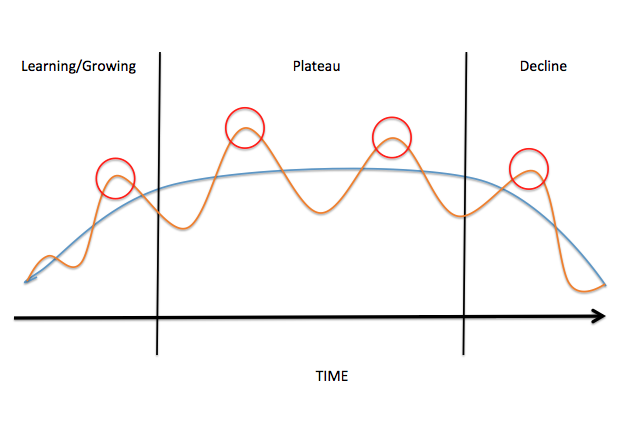
How about at these points:

Screen Shot 2013-12-20 at 10.01.26 AM

At the highlighted points above, players are at their short-term peak in fame/significance.  That’s when they’re most likely to be put on the cover of Sports Illustrated.  And in order for it to be a “peak”, it MUST be followed by at least a short-term decline thereafter (otherwise it wouldn’t be a peak).  That’s the essence of the “Sports Illustrated Curse”.  Generally, players only get on there if they’ve been playing extremely well.  For example, looks at these headlines and decide which ones are actually interesting:

– No-name player plays badly!

– Famous player plays well!

– No-name player plays well!

– Famous player sucks!

You don’t have to be a marketing major to realize that the bottom two are the better “stories”.  Moreover, for a “no-name” player to actually get on the cover, he has to more than just “play well”, he has to be lights out, or be involved in a singular moment of some large significance.  This is why Nick Foles was featured.  Outside of Philadelphia, nobody knew who he was, yet he’s putting up a historically good streak of play.  That’s a story.

However, it’s only a story because he was playing SO well.  If he had been merely “good”, he wouldn’t have made it.  That leaves us with just two possible consequences of the following statement:

Nick Foles, relative unknown, played historically well for a short period of time.  Then…

– Nick Foles was just that good, and continued to play at that level until he had broken nearly every NFL passing record.

– Nick Foles was not actually the greatest QB ever, and his subsequent performance declined soon after.

Now, if the second option happens (as the odds suggest is an almost certainty), it won’t be because he was “cursed” by Sports Illustrated.  Encouragingly, Foles has been playing SO well that a somewhat significant decline in performance will still leave him as a very good quarterback.

The system within which the magazine business operates is built upon capitalizing on short-term over-performance.  It’s no surprise that cover subjects experience a decline in performance/fame soon after.  The level of play required to get Nick Foles on the cover of SI is almost certainly unsustainable; consequently, it won’t be sustained!

So the “Sports Illustrated Cover Curse”, while not an actual “curse”, is not complete bullshit.  It’s a valuable contrary indicator for those who know how to properly evaluate it within the larger context of the player/team/league/etc…

Lastly, this isn’t just a sports-related phenomenon.  It’s relatively well-known in the investment industry, though it’s tough to follow due to the long-term nature of the trends (2 year lag for an inflection point after a 30 year trend is on point, but tough to make money from).  For example…

From 2005 (the market peaked in 2007):

Screen Shot 2013-12-20 at 10.20.34 AM

From 2008 (the market bottomed in 2009):

Screen Shot 2013-12-20 at 10.22.58 AM

And the classic (some say original), from 1979:

Screen Shot 2013-12-20 at 10.19.37 AM

Mean Reversion and the 2012-2013 Eagles Improvement

Preseason, I did a number of posts that focused on the reasons why the Eagles finished with such a poor record last year.  The general thesis was that the team was bad, but it was also very unlucky.  Therefore, we could expect a better record this year purely as a result of reverting to the mean in several meaningful statistics.  Today, let’s take a look at a couple of them and see how they look.

First, here’s the 2012 performance dashboard I put together.

Remember that I scaled everything by historical standard deviation (last 10 years of data) so that it could all be viewed in one chart.  For our purposes today, the most important terms above are Fumble Recovery %, Fumbles Lost, and Net Field Position.

Note that, for now at least, I’m going to avoid the whole luck-vs.-skill angle.  I’ve explored that before and I’m sure I’ll revisit it again.  Regardless of which side you believe in, the fact is that regardless of the role of luck, those statistics show NO PERSISTENCE from year to year.  Note also that the three stats I’m highlighting are obviously interrelated, so it’s no surprise that terrible performance in one is correlated with terrible performance in the others.

Fumble Recovery %

In general, teams should expect to recover around 50% of all fumbles.  There’s been some additional research done about varying rates for different TYPES of fumbles (Downfield WR vs QB for example), but after including all types, the overall rates converge to 50%.

Last year, the Eagles recovered just 35.09% (Teamrankings.com), which is 1.99 standard deviations below the mean.  That’s really bad, and extremely unlikely to happen again.  So how is the team doing this year?

46.34%

Not great, but a much more reasonable rate of recovery.

Fumbles Lost

Relatedly, the Eagles problem last year wasn’t just the rate of recovery, it was an overwhelming number of fumbles.  Combined, that meant the 2012 Eagles lost a historically large number of fumbles to the other team.  Looking at the chart above, we see that the team lost 22 fumbles last year, which is nearly 3 standard deviations from the mean.  Like I said, historic, and a big reason why last year’s team struggled so much.

So how do things look now?

Well so far, the team has lost just 8 fumbles, or .615 per game, meaning it’s on pace for just under 10 fumbles lost, less than half of last year’s measure.

Net Field Position

Finally, for today at least, there’s Net Field Position.  As a result of both special teams and the historic turnover rates, the 2012 Eagles had TERRIBLE net starting field position.  Looking at the chart above, we see the team’s average drive started 6.67 yards behind the other team’s average starting position.  That’s a very big difference, and it’s more than 2 standard deviations from the mean.  The offense last year was actually middle-of-the-pack by yards-per-drive.  The problem was that they had farther to go than everyone else.

This year?  +1.4 yards, good enough for 11th overall (Football Outsiders).

Having trouble conceptualizing the significance of the shift?  Well consider this:

This year, the team is averaging 33.06 yards per drive.  It’s scoring 25.7 points per game.

Last year, the team averaged 31.51 yards per drive.  It scored just 17.5 points per game.

Put differently, this year’s team is gaining an average of just 1.5 yards per drive more than last year’s team did.  

The real difference?  Mostly turnovers and field position, both of which we’re primed for mean reversion.

Lastly, the really good news

Did you notice anything else about the stats I just discussed?  Let’s look at them again:

Fumble Recovery %: 46.34%

Fumbles Lost:  On pace for 10

Net Field Position:  +1.4 yards (11th overall)

Now?  While last year’s numbers were EXTREMELY bad, and thus carried a very high probability for improvement, this year’s numbers are squarely in the middle of the expected range.  That means, while last year’s team was both bad AND unlucky, this year’s team is just good, no luck caveat needed, at least as it pertains to these stats.

That means what we’re seeing isn’t likely to be a fluke.  Once the season is finished I’ll look at a larger number of statistics and see where we can expect improvement or decline, but for now, it looks like the team is just good.

P.S. I’m in the middle of the law school exam period, hence the low volume of posts.  Good news is I’m finished next week, meaning my break coincides with the home stretch of the season, and I’ll be able to post a lot more frequently, at least until late January.

Eagles v. Lions: Pre-Game Notes

A few thoughts on today’s game, after which the Eagles could be in sole position of 1st place (I think Chicago’s got a good shot to knock of Dallas).

– Depending on the weather, this is a game where the general strategy should be more “aggressive” than usual.  We’ve got a great offense against a mediocre defense (Eagles v. Detroit) and a mediocre offense against a bad defense.  In both cases, we expect the offense to have a significant advantage, that’s why most people are projecting a shootout. That means field position has less relative value than normal.  For example, giving Detroit the ball at the 20 yard line isn’t worth that much more than giving them the ball at the 40 yard line (their’s).

In other words, the bar for going for it on 4th down should be lower, and TDs should be prized more heavily than usual over field goals.  Also, it’s a great game for a surprise onside kick.

If the weather is awful, it changes things a bit, but that depends on what type of bad weather there is.  If the offenses are unimpaired, then the “right” play is to be aggressive, because you have to assume Detroit is going to move the ball well against the defense.

– Tough test for the O-Line.  Nothing groundbreaking here, but the Lions have perhaps the best DT combo in the league (Suh and Fairley), with rookie Ziggy Ansah at DE (remember him? he was the #1 prospect on my TPR rankings).   Together, those three have 16 sacks, with 9 coming from the DTs.  They’re going to get pressure today, the key is how difficult it is for them.  If they can consistently give Foles problems with just 4 d-linemen, the Eagles are in trouble.

The plus side is that the Lions d-line is very aggressive (wide-9 anyone?), meaning it can be pulled out of position with misdirection, which just happens to be the Eagles’ specialty. I’m expecting a lot of PA, back-side screens, and maybe an end-around.  Ansah and Suh are going to get upfield regardless, might as well take advantage of it.

– Can the Eagles get pressure?  Perhaps the most surprising Lions stat of all is Matt Stafford’s sack percentage this year.  He leads the league at just 2.9%.  Foles, by comparison, is at 8%.  He also throws the ball more than anyone else in the league.  Today is the toughest test for the Eagles defense since it played Denver..and we all know how that turned out.  By DVOA, Dallas ranks higher than Detroit, but based on the match ups, I think Detroit poses more problems for the Eagles.  Patrick Chung needs to have a much better game than last week, and the LBs have to be very alert for Reggie Bush and Joique Bell as receivers out of the backfield (they have a combined 79 receptions).

I expect the Lions to score a lot.  The key for the Eagles is to create a turnover or two so the offense has extra possessions to keep up/go ahead.  Any drive that ends in a Lions field goal is a success.

– The Eagles play the Vikings next week….That means a win today likely gets them to 9-5 going into that last two games of the year (Chicago and Dallas).  Basically, a win today up the expected win total to 10 wins, and 10 wins probably gets you the division title.  See what I’m saying?  If Aaron Rodgers come back next week to play the Cowboys, a win today might make the final game of the year a moot point.  So yeah, it’s pretty important.

I’ll leave it there for now.  I think the Eagles are SLIGHTLY more likely to win (if you saw my odds column on BGN, I had the Eagles -2 in my projection), but it’s close enough that a single turnover or STs return could make the difference (or onside kick!).  Good luck to anyone at the game…it’s days like this I’m happy I don’t have tickets.

Notes from Yesterday

Yesterday’s game went down just about exactly as expected.  I’ve got a few notes, and I’m going to try to steer clear of the obvious ones.

The Eagles average starting field position was the 36 yard line.  Arizona’s was the 19 yard line.   In a game between two evenly matched teams, that’s a HUGE difference.  Some of that was the turnovers, some of that was Donnie Jones.  I get the sense that he’s flown under most fans’ radars, but Jones has been a very important piece this year (relatively speaking).  Yesterday, he had 7 punts inside the Arizona 20 yard line.   Against a poor offense (which the Cardinals are), that’s a very big deal.  Remember pre-season, one of the things I highlighted was how bad the Eagles average field position differential was last year (nearly -7 yards) and that it was very unlikely to be that bad again, or even close to that bad.  I haven’t seen the season numbers for this year, but its safe to say there’s been some mean reversion there, regardless of why it’s occurring (Jones? TOs? Luck?  Likely all 3).

– The Eagles passing game was incredibly balanced yesterday, and illustrates a big point in Nick Foles’ favor.  He really doesn’t seem to have “favorite” receivers.  Yesterday, Jackson, Cooper, Ertz, Celek, and McCoy all had 6 targets.  Avant had 4.  That’s the definition of balance, and it shows Foles was “taking what was there”.

– Foles did NOT play that well.   This definitely qualifies as a “lucky” game.  He had the INT called back, but more worrisome were the handful of open passes that he missed badly on.  That’s what we saw in the Dallas debacle, and it’s still without explanation.  Fortunately, it was less pronounced yesterday.  Perhaps I’m digging too deep for criticism, but I don’t think it’s nit-picking to say QBs should hit almost every pass when he has time to deliver and sees a wide-open receiver well within his range.  Can’t expect him to be perfect, but missing more than 1-2 of those per game is too many.

– Billy Davis hurts my brain.  Some questionable scheming by Davis yesterday.  Most notably, and I’ve made this point before, he continues to send CB or S blitzes and “disguising” them at the snap by having the players stay in base position.  Note that this means the CB is often around 20 yards from the QB at the snap.  See the problem?

The fastest players in the league run 4.3 40 yard dashes (roughly).  That’s with perfect conditions and no pads.  So even in that situation the player will take at least 2.15 seconds to get to the QB.  Moreover, when you account for the pads, sub-optimal alignment (not in a sprinter’s start), and the obvious potential for blockers to be in the way, you have to figure it’s going to take more than 3 seconds for the CB to get there.  Meanwhile, while he’s en route, you’ve essentially taken a defender off the field.  He’s in no man’s land.  It’s quickly becoming one of my least favorite plays in football, but Davis continues to call it.

– Eagles were just 5 of 16 on 3rd down.  Nothing to add here.  It was a good defense, but you’d still like to see that conversion rate much higher.  It’s a big reason the game was close.

– Brandon Graham had 2 sacks.  That’s not really news.  However, he did it with just 13 snaps.  That’s a pretty good impact rate.

– The Eagles are lucky they played the Cardinals, the defensive backfield looked very vulnerable for much of the game.   Have to wait for All-22 to confirm, but it looked like the Safeties especially had a tough game.  Didn’t matter because Carson Palmer is not a good QB anymore (at least he wasn’t yesterday), but that will hurt a lot against a good passing offense (say Detroit?).  Can’t believe I’m saying this, but they really need Earl Wolff to come back…

Big win regardless of caveats. .500 record from here on (with one game against Minnesota) gets them to the 9 wins we thought they’d get to.  Whether that equals a playoff game depends almost entirely on the last game of the season.