I was out for a few days (apparently law school involves going to classes and reading a lot of stuff). The only thing I really haven’t addressed is the “controversial” decision to cut Acho (presumably instead of Matthews). So here it is, in a larger context.
There are a lot of ways to think about the move, but the simplest is:
– It’s a minor change at the bottom of the roster; it’s unlikely to affect the team in any significant way.
That’s probably true. The specific move to cut Acho, who looked good in the preseason games, while keeping Matthews (who looked terrible in his REGULAR season games) will NOT have any large effect on the overall team performance this year.
So why am I talking about it?
It may give us insight into Chip Kelly’s thinking. Namely, Chip appears to be placing MUCH more importance on the Special Teams unit than Andy Reid did.
From igglesblitz.com:
“It’s about special teams,” Kelly said. “There’s three ways to make this football team: special teams, special teams, special teams. …If you’re going to be the fourth or fifth receiver, it’s the value to Coach Fipp and our special teams.” Kelly said that’s the reason the Eagles acquired Najee Goode, because special teams outweighs a player’s production on offense or defense because that’s how they’ll contribute in games.
With Andy Reid, STs frequently felt like an afterthought. Part of that was because the Eagles were blessed with David Akers, who held the kicking job (special teams’ most visible role) down for 10 years. Coverage units and the return game were rarely a problem and sometimes a weapon (Brian Westbrook as PR for example). As a result, little attention was paid (in the media at least) to the overall STs unit. Andy rarely made any substantive changes and the biggest decision in recent years was simply whether or not D-Jax would return punts.
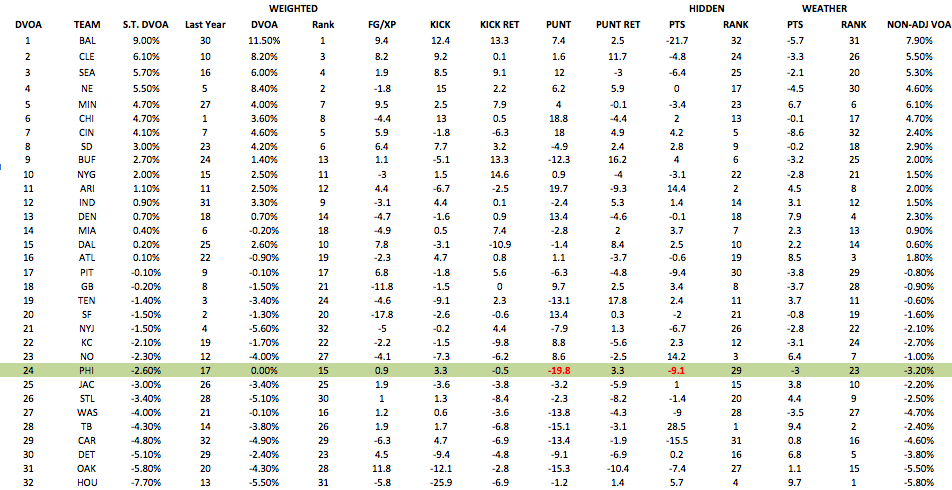
Last year shocked many of us out of our STs complacency. The team’s STs unit was AWFUL, particularly in the punt coverage and return game. I’ve quoted the statistic several times before, but the Eagles Net Field Position was -6.67 yards last year, which was nearly a full yard worse than the 31st ranked team last year (STL) and the third worst measure of any team over the last 5 seasons. TOs also factor into that measure, but the overall message remains:
– Last year, the Eagles’ Offense and Defense were basically playing the game on a higher difficulty level than the other team (as a result of STs and TOs).
In steps Chip Kelly
Chip Kelly cited STs play as the deciding factor in the roster decisions. If there was a “battle”, the player who was better on special teams won. In the context of last year’s performance, this makes a lot of sense. Chip obviously must have known how bad the STs unit was last season. He perhaps also knew that it was never a “priority” for Andy Reid. Therefore, it is entirely possible that Chip Kelly is trying, in his first year, to quickly address the overall team attitude towards special teams. Emphasize it now, make roster decision based on STs play, and players will subsequently know to both value and focus on their STs contributions.
That’s the positive way to put it. There is also another side.
Special Teams plays a much larger role in the College game than it does in the NFL. Essentially, the marginal difference between the best STs players at the NFL level is much smaller compared to the corresponding difference in college. Therefore, there is less advantage to be gained at the NFL level. Kickers make a higher percentage of their field goals, returns aren’t nearly as easy to “break”, etc…
As a result, Chip Kelly might have an inflated view of the relative importance of STs at the NFL level. That’s probably surprising to hear, given the 2012 Eagles experience. However, we have to note that last year was an anomaly. STs units, across the league, are rarely as bad as the Eagles were last year. Additionally, there is definitely an aspect of diminishing marginal returns to overall STs play; going from terrible to average is likely to be “worth” a lot more than going from average to good, and even the best STs units don’t effect the game nearly as much as the Offense and Defense.
In clearer terms, what I’m saying is that STs should NOT be used as the tiebreaker for deciding bottom of the roster personnel. It absolutely must be a factor, but should not be the definitive issue.
Here is where Chip Kelly is running a reasonably significant risk. In an effort to improve and emphasize special teams, he has hurt the depth on offense and defense (mostly defense). For example, if a MLB gets hurt, we now have Casey Matthews stepping in instead of Acho. It’s possible the coaching staff doesn’t see that as a downgrade, but for the purposes of this discussion we will.
If that injury happens, and Matthews is worse on defense than Acho would have been, then the tradeoff is obviously not worth it. I’ll take a marginal improvement on defense over a slightly larger improvement on STs any time. The tricky part, of course, is that the defensive side of the equation is POTENTIAL while the STs side is CERTAIN.
We KNOW that Casey Matthews will play on STs and contribute to the overall team’s performance.
We DO NOT KNOW that a MLB will be injured and require a backup to play for an extended period of time.
Therein lies the risk. If it was just one position, it wouldn’t be an issue. However, it looks like STs play may have been the deciding factor in keeping guys like Maehl, Knott, Matthews, Anderson, Goode. That’s a lot of roster spots. (BTW, Chip obviously knows how many roster spots he has now, especially compared to how many he had in college, so I don’t think it’s a case of not appreciating the smaller roster, but that’s a possibility.)
With that many, it’s extremely likely that one of them will need to step into a major role on Offense or Defense at some point during the year. Contrary to Kelly’s quote above, their “contribution” would then not be coming from STs. At that point, the trade-off (sacrificing depth for STs) becomes negative.
Naturally, it’s possible that the marginal difference in offense/defensive skill for each of these roster “battles” was negligible, in which case deferring to the better STs play makes sense. If that’s not the case though, Chip’s decisions are likely to hurt the team more than it helps.
There absolutely needs to be 1 or two STs “aces”, guys who are kept specifically for their STs prowess. However, the rest of the roster needs to be constructed under the assumption that EVERYONE will have to start at one point or another. Injuries are a CERTAINTY. The second one of the “STs” needs to contribute on offense/defense (think Colt Anderson last year), the advantage gained by their STs skill is immediately outweighed by corresponding drop in production on offense/defense.
Overall, the point I’m trying to make is that there is a natural trade-off between Offense/Defensive depth and Special Teams. Chip appears to be tilting more heavily towards the STs side of the equation than most coaches do (certainly a lot more than Reid did). While I typically am in favor of his decisions to defy convention, this time I’m inclined to agree with the rest of the league (or at least with Andy).
One things’ for sure, though, the Eagles Special Teams better be damn good this year (they’ll likely have to for the team to be good).



 Eagles Rewind