Leftover thoughts from yesterday

Relatively short post today, but I wanted to get a few things out there:

– I’ve settled on a methodology for incorporating positional evaluative error (in the draft) into the PVM prospect rankings.  However, it’ll require me to reclassify close to 1000 player’s positions by hand (Pro-Football-Reference includes a lot of “DB” labels).  Obviously that’s going to take a little while.  However, I promise I haven’t forgotten about it.

– A valued contributor (see PVM) commented yesterday about the Eagles having a lot of red zone turnovers last year and how that effected the points allowed.  The idea is that a turnover in the red zone, while killing the offense, is essentially a great punt for the defense.  Unfortunately I couldn’t find any source that tells me how many turnovers were committed in the Red Zone last year.  In any case, here’s a chart of TO Margin vs Points Allowed:

Screen Shot 2013-03-28 at 12.02.54 PM


Lot’s of potential external distortions in this comparison, so we can’t draw much from it, but it is interesting nonetheless (and everyone loves charts).  The correlation value is -.50, so pretty significant.

As you can see, the 2012 Eagles are way outside the normal range.  Going back to the original question:  Yes, it appears as though, given the TO differential, the Eagles should have been expected to yield MANY more points.  It’s possible this is the result of where those turnovers happened (i.e. in the red zone).  However, there are a lot of other factors potentially at work here.

It may be that there’s an actual limit to how many points one team can allow (if for no other reason than a finite game time), so that the marginal increase in points allowed per additional turnover decreases to zero.

I realize that’s a bit theoretical for a football blog, so you’re excused if your eyes glazed over reading it.  Overall, my general take is that the location of turnovers is probably a real, but small, factor in the larger points allowed puzzle.

Let’s do some fun stats:

– The 2012 Eagles forced and recovered just 5 fumbles.  That is the eighth WORST in the last ten years (out of 320).

– The NFL average within the sample is 11.

– Fumbles are determined almost entirely by luck.

– The Eagles threw 15 interceptions last year.  The NFL average over the past 10 years? 15.76.

– The 2011 Eagles threw 25 interceptions, so last year was improvement by 10.

– From 1999-2011, the Detroit Lions made 17 1st round picks.  Of those 17 players, just 3 have made a Pro Bowl, one of which was Roy Williams (WR).  That’s 17.6%.

– Of all 1st rounders picked over that timeframe (412 players), 34% made at least 1 Pro Bowl.

– The Lions have been almost impossibly bad at drafting.

– For reference, the Eagles made 11 1st round picks over that timeframe, with 4 making a Pro Bowl, good for 36.4% (better than league average, though that includes the Lions).  However, the most recent one for the Eagles was drafted back in 2004. (sad face)

– Quick trivia: name those 4 Pro Bowlers. Answer below in initials form (hopefully so a glance won’t ruin the question for you.


– Answer: Their initials are LS CS SA DM.

– Eric Winston, to my knowledge, is still a free agent.  Hopefully he and his agent blink soon.


The Benn trade and late round pick philosophy +other thoughts

Aiming to keep it a little shorter today. I’ll start with the Benn trade and then throw some food for thought out there.

Benn Trade (Steal?)

As everyone now knows, the Eagles acquired Arrelious Benn from Tampa Bay over the weekend.  The Eagles, in exchange for Benn, essentially traded down this year from the 6th to 7th round, and also gave up a conditional pick next year (no word on the conditional, but we can probably assume it’ll be no higher than a 5th, and likely lower than that).

Initial thoughts?  The Eagles stole him.  Benn is 6’2″, 220 lbs. and was a 2nd round draft pick in 2010.  Great size, but he never hit his potential and was injured last year, only playing 8 games.  Still just 24 years old.

That sounds pretty good, but don’t get too excited.  He is not being brought in to be an impact receiver.  This is, as I see it, another low-risk-medium reward play for the Eagles, and on targeted solely at improving special teams.

The Eagles were among the worst Special Teams units in the league last year, and as we saw with the field position numbers (Eagles last by a long shot), that had a LARGE effect on both the offense and defense.  Benn showed a lot of promise on STs last year, and I have no doubt that’s where he’ll be asked to make his mark.  He is a good downfield blocker, which Kelly likes, but I believe that’s more of a bonus and isn’t a major factor in why the trade happened.

So why is it a steal?

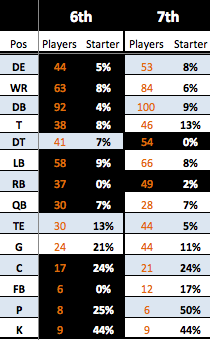
Let’s bring back our draft chart, this time only looking at the 6th and 7th rounds.  To refresh, the chart was put together using every player drafted from 1999-2011.  Players were classified as “starters” if they either started for 5 years or, if they have not been in the league that long, started for at least half the seasons in which they’ve been in the NFL.

Screen Shot 2013-03-18 at 11.27.09 AM

What do we see?  6th round picks, historically, have NOT offered significantly better odds of finding good players than 7th round picks.  Yes, this late in the draft teams are looking for depth, but they are still trying to select the best players possible at the target position.  The numbers above show that, this late in the draft, it’s a complete crapshoot.

In light of this, the Eagles really don’t lose any value by trading from the 6th to the 7th rounds.  Therefore, the Eagles acquired Benn for just a conditional draft pick.  That’s why it’s a steal.  Benn will likely end up being a non-factor, but he’s certainly better than anyone the Eagles would be able to select with whatever conditional pick they end up losing.

Other thoughts:

– I’m very surprised the Eagles haven’t been strongly linked to Sebastian Vollmer, the free agent OT from the Patriots.  I’m assuming the OT market was held up by Jake Long, who signed last night.  If that’s the case we should see the other OTs start to fall into place.  Vollmer would be the best fit.  If the Eagles do not sign a OT, then obviously the odds of drafting an OT go up.  Note this does not mean abandoning the “best available” strategy that Howie is now swearing by.  The team may have looked at Eric Fisher and decided he’s their guy, so no need to sign anyone.

– At this moment, the Eagles’ clear top option for the draft is to trade down with a team trying for Geno Smith.  I discussed this last week.  However, if a trade can’t be made, I think the pick comes down to Fisher (assuming Joeckel is gone), Milliner, or Lotulelei.

Not seeing anyone slotting Lotulelei to the Eagles in mock drafts, but he makes too much sense to me to overlook.  He’s a force in the run-game, which the Eagles need, and will draw consistent doubles, freeing Cox up to wreak havoc.  Also, Lotulelei as a pivot would immediately make Kendricks and Ryans look better, since they wouldn’t have to shed as many blockers to get to the ball.  For reference, Sharrif Floyd seems much more similar to Cox as opposed to complimentary.

Eric Fisher would make sense for the reasons explained above.

Milliner is intriguing because he plays a premier position, is by far the best prospect available at that position, and is the #1 player according to the PVM system.  Note: with the current scouting ratings, his consensus ranking is #3 overall.  The positional value bumps him to #1.

For my money, a defensive backfield with Milliner and Williams does sound a lot better than one featuring Williams and Fletcher and whatever rookie is added in the draft.  I realize there are other CBs on the roster, but they look like slot guys or backups.

I don’t see Dion Jordan being the guy, unless the Oregon ties come into play.  Seems like he’d be a luxury pick that the Eagles can’t afford.  He doesn’t look like the best player on the board and doesn’t fill a pressing need (arguable), therefore he doesn’t seem worth the #4 pick.

Also remember that LBs carry the worst hit-rate of any position in the 1st round.  For whatever reason, there seems to be a much bigger margin of error in scouting/projecting LBs than in most other positions.  Consequently, Jordan would appear to be a higher risk pick as well.

In any case, we should get a better sense of the draft in the next couple weeks, as each team’s needs come into clearer focus.

Ignore the Dolphins, Eagles won day 1 of FA

Now that’s more like it…as I suspected, none of the pre-free agency rumor bullshit had anything to do with what actually happened (at least as far as the Eagles are concerned).

For those living under a rock, the Eagles signed 5 players:

James Casey (TE, FB, WR, HB, etc…)

Patrick Chung (S)

Bradley Fletcher (CB)

Isaac Sopoaga (NT)

Jason Phillips (LB)

If you read my post yesterday, you can probably guess that I absolutely love what the team did on day one.  Let me bring back what I said yesterday (in italics) and use it to frame today’s post:

In general though, my FA plan would be:

– Add depth (everywhere) with low-priced veterans on 1-2 year deals.  

Not sure the team could have done better on this goal in one day.  The Eagles need new blood, and given the defensive holes and ST weaknesses, they need a lot of bodies to compete for those spots.

Patrick Chung is a promising player who has struggled with injury.  If healthy, he’s likely a starting safety for us.  Not sure if it’s at FS or SS yet, but the fact that he can play a little of both helps.  He’s also just 26 years old.  Not much guaranteed money in his deal, so it’s very much a low-risk-moderate reward opportunity.  If he can stay healthy, we may have just found a starter, if not, he’s gone after this year and we move on.  BTW, he played at Oregon with Kelly.

Bradley Fletcher is, in my opinion, the best signing any team made yesterday.  He’s young, has a lot of potential, plays a premium position, and didn’t take a ton of money.  At 6’0″ 200 lbs, he also has rare size for a corner.  He fell out of favor in St. Louis and has a history of injury (2 ACL tears).  However, he has the ability to be a good starting CB, and the Eagles got him with very little risk.  Also, according to Tommy Lawlor, he has the best cover skills of any CB in free agency.

James Casey is getting a lot of love in the press, but I’m not sure what to make of him.  Versatile player who apparently is highly regarded by Chip, but until we know the type of offense Kelly will run it’s really impossible to get a good read on how much Casey will contribute.  In any case, the Eagles gave him 3 yrs $14.5 million, so you’d think they plan to use him a fair amount (though I have no idea how that money is structured).

– Add a NT. Doesn’t have to be a great one (not many of those in the NFL), but a huge need if the team is moving to a 3-4.  This wouldn’t preclude taking one in the draft, but even then you need a back-up and it would be nice to not be overly reliant on Dixon.

Ask and ye shall receive….Sopoaga.  Not a guy to get excited about, but the fact is the Eagles needed a body at NT; they literally did not have a single one on the roster, which is problematic for a team thinking 3-4 (or some variation of it).  Sopoaga did not play well last year, so fans shouldn’t expect much from him.  At the very least, though, he’ll compete with Antonio Dixon for the starting job or be a quality backup to a NT not currently on the roster.

– MAYBE add one marquee guy, as long as he is relatively young (<26-27).  Plenty of cap space, so if the team loves a guy like Smith or Long then take a shot.  Key is to pick the one they really like and let the others go.

No marquee guy yesterday, but that’s fine.  Marquee guys are where teams screw up.  Still rumors out there that the Eagles like Jake Long, but no way to tell if they’re true (I’m skeptical).  I think the team will kick the tires on a few OTs, but only bring one in if the money is reasonable (i.e. not paying starting LT money).

– Don’t tie up cap space beyond this year.  This is a massive transition for the Eagles, and the fact is that Howie/Chip themselves don’t know how it’s going to shake out.  They key is to bolster the roster while maintaining cap flexibility for the next couple years.  With so many moving parts, it’s impossible to say who fits and who doesn’t, so throwing big money around is very risky.

Team gets an A+ on this aspect.  None of the deals are big-money or will have any significant effect on the cap situation after this year.  Signing a guy like Goldson would make news, but I don’t think it’s the right strategy for the team right now.

I expect a few more signings, hopefully get Ricky Jean-Francois wrapped up this morning (he’s visiting) to provide more DL depth/versatility.  If the team comes away with a big name OT, great.  If not, I’ll be quite happy with another handful of guys like the ones they signed yesterday.

The key to FA is to find low-risk/moderate-reward players.  The draft is where you find your stars.  Once the rest of the team is built out and the roster is strong, then overpaying for an impact FA makes sense.  For now, though, be patient.

P.S. I didn’t talk about Jason Phillips because he’s likely just a depth LB and special-teamer, but if the guy let’s us plant Jamar “The Invisible Man” Chaney on the bench (or on the street), he becomes a personal favorite.


Alex Smith Thoughts and ramifications for the Eagles

I already liked the Chiefs to be a drastically better team next year, and now I like them even more.  The reported trade has KC giving up this years 2nd round pick and a conditional 2014 pick.  No word on the conditions, but it’s likely going to be as high as another 2nd round pick.

Why I like the trade:

– Andy Reid is very good at identifying QBs he can win with.  That’s not the same as identifying good QBs, but from Reid’s perspective, that really doesn’t matter.  Smith is a perfect fit for the offense Reid claims to run (west-coast).  I say “claims” because there were times with the Eagles when he clearly strayed from the short-passes concept, relying on deep throws and quick strikes.

– Kansas City already had a top 5 rushing offense.  Now they add an accurate, low-risk QB, and the #1 overall pick (Joeckel has to be odds on favorite now).

– Alex Smith went 19-5-1 as a starter over the last two seasons, and this past year completed 70% of his passes.

I could go on for a thousand words, but I’ll just go on record now as having the Chiefs as my pick for a surprise team next year.  With that roster (better than record suggests) and Reid/Smith, no reason the team can’t contend for the playoffs just one year after a 2-win season.

How does it effect the Eagles?  

– Nick Foles’ value obviously drops.  KC was, by far, the most likely destination for Foles.  That is the clear negative for the Eagles.  Additionally, KC will almost certainly take Joeckel (or whoever the top OT is at draft-time), meaning the Eagles will miss out.  However, it’s doubtful the top OT in the draft was going to fall to #4 regardless, so I don’t feel so bad about that.

Also, I’ve been pretty clear that I think Foles has a legitimate chance to be a good starting QB, so keeping him isn’t exactly the worst thing IMO.

– One less team looking for a QB in the draft.  As I explained in the Vick-Insurance post, it would make a lot of sense if the Eagles had their eye on a particular QB in this year’s class.  Nassib would seem to be a good bet, but at this point we have no idea who the team really likes.  The Smith trade makes it more likely that the subject QB will be available at the Eagles pick in round 2.

– Several outlets are now reporting that San Fran is an obvious candidate to move up in the draft.  As I’ve demonstrated before, elite players come almost entirely from the 1st round of the draft, and within the first round, they are predominantly found in the top 15.  The toughest aspect of being perennial contender (like San Fran hopes to be) is the inability to continue adding elite players in the draft (because to don’t get top 15 picks).  With San Fran’s ammo, they can rectify that this year.

I mention that because the Eagles, at #4, would seem to be an obvious trade partner.  At #4, the 49ers could get a top DT (Floyd or Star, depending on the heart condition).  If the Eagles don’t see any prospects that absolutely love at #4, the team should absolutely trade down, and the top pick in the 2nd round would be a pretty attractive trade chip.  In fact, this would allow them to take a QB prospect at the right spot in the draft (value-wise), while allowing them to use the other 2nd round pick on the best available defensive player.

Pure speculation at this point, but the Chiefs, Jaguars, and Raiders all seem unlikely to trade down, given their respective needs.  That would leave the Eagles with the top “gettable” pick for any team looking to move up for a top prospect.

Judging by the current prospect evaluations (and what we learned from our previous draft analyses), that trade outlook might be the best possible scenario for the Eagles.

Turns out Andy Reid may not be quite finished helping the Eagles out…

Scattered thoughts

– Historical Draft Performance

The last post was a pretty broad look at draft performance.  I’m currently making a few adjustments to the analysis that will hopefully provide a more accurate ranking system (though the existing version passes the eye test).  If we get an accurate system, it’s a small step to mine it for performance persistence (skill).  Adjusting for draft position is the big addition, but I’m also looking at relative magnitude (team share of all production available in draft).  If you have any other ideas for making a more accurate ranking system let me know in the comments and I’ll see if I can work it in.

– Sean Smith Interest

This is exactly the type of fake news you should avoid.  The Eagles are interested in the top CB available at the right price?  Shocking.  Saying you’re interested in a top FA but don’t want to get in a bidding war is ridiculous.  That’s how free agency works (for the top players).  However, the Eagles do need to add a CB, preferably one that can start, and adding a mid-level guy in FA would make me feel a lot better about the roster for next year.  If they really do like Smith, they’ve got the cap space to make the move and win a bidding war.

– Nnamdi

Anyone who was against tagging DRC should be completely aghast at the potential for bringing Nnamdi back with a restructured deal.  From what I saw, most people don’t like DRC because of his inconsistent effort.  I challenge you to watch Nnamdi’s tape from this year and tell me you think he was playing hard.  All that talk about players giving up was heavily pointed at Nnamdi, so bringing him back is certainly a knock against the “change the culture” plan.  Almost every player is attractive at the right price, including Nnamdi, but I’d rather tag DRC and pay him $10 mil for one year than bring back Nnamdi at half the price (he’s guaranteed $4 mil, so any renegotiation has to be higher or he wouldn’t accept).  If they do bring him back, he’s going to need safety help, since it was abundantly clear last year that he doesn’t have the speed to stay with fast WRs.

– Nightmares of the 2009 draft

The general draft discussion seems to have settled on the “deep class but no elites” theme.  Allow me to translate: “there are elite players in this class, but we (scouts) have no idea who they are”.  This is definitely bad news for the Eagles, as it diminishes the value of their pick, but don’t believe any story that says there aren’t elite players in this year’s draft. The nightmare scenario for teams at the top is a repeat of 2009.  Here is the top 15 from that year, with pro bowlers highlighted yellow:

Screen Shot 2013-02-25 at 2.17.42 PM

There are a few nice players in there, but the top 5 is a relative wasteland.  However, taken later in the first round were Clay Matthews and Percy Harvin.  And Shady was available in the second round.  While I doubt this year will be as weak as 2009, it is definitely a cautionary comparison as we get closer to the draft.

Rest assured, there will be elite players available at #4.  Whether or not the Eagles (or any other team) can identify them is another story.

 – Geno Smith

Not a fit for the Eagles, and I’m definitely not a scout, but this guy ran a 4.59 and, more importantly, completed 67% of his college passes.  The last time a QB was not selected in the top 5 was 2000, and that may have been because one year earlier 5 QBs were taken in the top 15.  If you’re looking for a guy that might sneak into the top of the board (and all Eagles fans should be), this is your best bet.


Let’s talk about Vick

Most of you can probably guess that I was shocked and disappointed at yesterday’s announcement that the Eagles have restructured Vick’s deal for a year.  To be abundantly clear: I think it’s a bad move.  However, there are a lot of different aspects to this decision, which I’ll endeavor to discuss here, some of which may be quite positive/hopeful.

– Chip Kelly clearly isn’t enamored with Foles.  Not a huge surprise, due to Foles’ relative lack of mobility, but I was hoping Chip would value the accuracy and poise more highly than he apparently has.  Also, I’m not buying the whole “open competition” comment.  Foles and Vick could not be more different as quarterbacks.  As a result, whichever “system” Kelly puts into place will tilt heavily towards one of them.  If the offense relies on the read-option, I don’t see any way Foles would win a competition for the starting job, he’s just not a fit for that scheme.

Also, the rumored discussions with Dennis Dixon should be added to the puzzle here.  In total, it’s clear that despite Chip’s professed flexibility, he really does want a truly mobile quarterback that can threaten defenses with his legs.

If I was Andy Reid, I would already be calling the Eagles and making an offer for Foles (or waiting to see if I could sign Alex Smith, then making a play for Foles).

– That doesn’t mean he’s in love with Vick.  My current belief is that Kelly doesn’t like either Vick or Foles as his permanent QB.  However, he has a specific system that he wants to install, and Vick was as close to a “fit” as there was on the market.  The fact that Vick wanted to stay here and was willing to rework his deal made that option very attractive.  Under this scenario, Kelly gets to fully install his system year 1 with Vick as the caretaker, rather than adapting it to suit Foles’ skills and then restarting when he finds “his guy”.  This makes some sense to me, though it suggests Kelly is heavily invested in his scheme, which makes me nervous considering he’s never tried it in the NFL.  In this case, it’s also possible the Eagles have their eye on a couple of QBs in the draft, and if they get one of them, can cut Vick before the season starts.  Vick gives the team insurance and means they don’t have to reach or overpay in the draft for a rookie.

– Maybe Chip is reading this blog.  Over a number of posts, I’ve explained why this past season the Eagles, in all likelihood, underperformed their “true success rate”.  The team was beset by injuries that decimated the OL, arguably the most important position group behind the QB.  Additionally, the Eagles had terrible luck when it came to turnovers (both giving/receiving and recovering).  Add in the near-historic special-teams ineptitude and it’s quite possible Chip reviewed last season and decided the potential is there for a much better football team than we saw this season.  For those of you looking for hope, this is the theory for you.  Predictions, for the most part, are worthless, especially when it comes to sports.  However, I’m going to make a couple here that I am extremely confident in, each of which bodes well for the team (I’ve mentioned them before):

1) The Eagles will not lose 22 fumbles next year or have a TO Differential of -24.  I’ve explained that fumbling the ball is largely random, and this year the Eagles caught the tail of that distribution.  Of the last 320 NFL team seasons, the 2012 Eagles had more lost fumbles than 99.4% of them (only one team had more).  THAT WILL NOT HAPPEN AGAIN NEXT YEAR.

2) In a related note, the Eagles recovered just 35% of all fumbles last season.  This number is almost completely random and over the long-term should be around 50%.  Though it’s certainly possible for the team to be unlucky again next year, I’m going to predict that the Eagles will recover MORE THAN 35% of all fumbles next year.

3) The Eagles this year had the worst relative field position BY FAR at -6.67 yards (a result of turnovers and terrible special teams).  A previous post of mine showed little persistence in this measure from year-to-year, therefore there is no reason to believe the Eagles will be that bad again next year.  So…the Eagles will have SIGNIFICANTLY BETTER average field position next year.

I apologize for repeating these, but they are vital pieces of evidence towards my most hopeful Chip Kelly/Vick/Eagles scenario.  None of these predictions require any great insight, just a cursory exploration of recent historical statistics and basic analysis.  It is quite possible (likely in fact), that Kelly and/or Roseman has reviewed these numbers and arrived at the same conclusions.

If so, it is entirely reasonable for Kelly to believe that combining better luck with a healthier OL, the #4 pick in the draft, and a few positional upgrades to the defense (hard not to find upgrades since they were so bad last year) will result in a significantly better team and one that can compete for both a playoff spot and a division title.

– Grace-period utilization.  Due to the performance of the team this year, it’s clear that Chip Kelly is not expected to perform a miraculous one-year turnaround.  He knows he has, in essence, a free year.  I mentioned early on in the coaching process that regardless of Kelly’s motives, he had to be salivating at the thought of Shady and Bryce Brown together in the back field.  Add in a healthy D-Jax, and you’ve got the type of speed Kelly prized at Oregon (and is VERY difficult to collect in the NFL).  In light of this, Chip might be thinking he has nothing to lose by trying to shoot the moon by adding Vick to this line-up.  I’m seeing a few people talking about Vick losing a step, but I don’t agree with it.  I’ve been pretty clear about Vick’s shortcomings as a QB, but speed is one area I am not concerned about.  Even at 85% of his prime-speed, Vick is fast enough to devastate defenses.

If Kelly has been given explicit guarantees of his job security (i.e. low expectations for this year) from Lurie, and I bet he has, then he really has nothing to lose by trying to go for it with Vick for 1 year.  The only cost here is impeding Foles’ development, but as I mentioned above, I don’t think Kelly cares about that and wouldn’t be surprised if Foles gets traded.

– Run-heavy option offense.  The biggest problem with Vick, outside of his fragility, is his propensity for turnovers.  However, Kelly might believe he can solve that problem fairly easily. How?  Don’t throw the ball.  Shurmur has already alluded to a run-heavy attack, and with Shady and BB, that should be the strategy.  It’s possible, though, that he’s underselling just how run-heavy the offense could be.  Could the Eagles try to run a Georgia Tech-style triple option in the NFL?  Why not?  Kelly has already stated that the only reasoning he won’t accept is “that’s the way it’s always been done”, which BTW is my absolute favorite thing about him.  With the speed in the Eagles backfield, a healthy OL (a healthy Peters especially), and perhaps a stud OT with the #4 pick, Kelly might believe he has the necessary ingredients to make an extremely run-heavy option offense work in the NFL.

If Vick doesn’t throw the ball, he can’t throw interceptions.  Fumbles are another story, but IMO they are much less of an issue than interceptions (both more random and easier to fix).

Concluding – Hopefully the thoughts above have given you a few new things to consider.  In any case, the Eagles will be interesting and entertaining, which at the end of the day is why the team exists.  We can complain all we want about not having a Super Bowl, but at least the team isn’t boring.  Would you rather be a Bucs fan?  If I was in charge, I would have already cut ties with Vick, but in exploring the situation, I can see a few strands of logic in the decision to keep him.  The fact is Kelly is coming into the league with such a good reputation, that anything he does right now deserves the benefit of the doubt.  Don’t worry, there will be plenty of time to tear him up later.
 

Odds and Ends and the Super Bowl

I’m guessing everyone watched last night’s game, which was great.  I’m going to do a full Rewind on it when I get access to the film, so look for that at the end of this week.

Some notes:

– First, a rant:  The officiating at the end of the game was unfortunate (that’s putting it lightly).  Clear interference on the 4th down pass, regardless of what Mike Pereira says.  I’m tired of announcers and commentators giving officials a pass by saying “in real-time it’s a tough call to make”.  I don’t care if it’s a difficult call to get right, it’s their job. Everyone else in the league is expected to make difficult plays, officials shouldn’t be any different.

Also, the idea of giving the players more leeway at the end of games is absurd.  Many people talk about how the players should be the ones deciding games, but an official NOT making a call is just as significant as throwing a flag.

The intentional safety play also featured a number of outrageously obvious holding penalties that weren’t called.  Not that it would have made a difference, but the infractions were so egregious that the only explanation is the refs actually did “put the whistles away”, which is unacceptable.

– Did anyone have a hard time not thinking of Eddie Murphy’s Buckwheat when listening to Jerome Boger last night?  Is that offensive?

– Remember the post about how taking the ball out of the back of the end zone is actually a decent decision most of the time?  So that worked out pretty well, though I obviously would have expected it to come from the 49ers.

– 49ers didn’t run the read-option very much.  Obviously the Raven’s game-plan was to make that difficult, but I’ll be paying close attention to exactly how they managed to shut down a scheme that so many others struggled against.

– Anquan Boldin deserves a lot more credit then he gets.

– As a reminder that nobody needs, the Eagles beat the Ravens this year…

– Nick Foles’ college career and rookie year statistics are now eerily similar to a Super-Bowl winning quarterback.

– Ray Rice does NOT have a fumbling problem. Just terrible luck and bad timing.

– Anyone else really disappointed that Jay-Z didn’t come out for a verse with his wife?  That would have made it easily one of the best halftime shows ever.

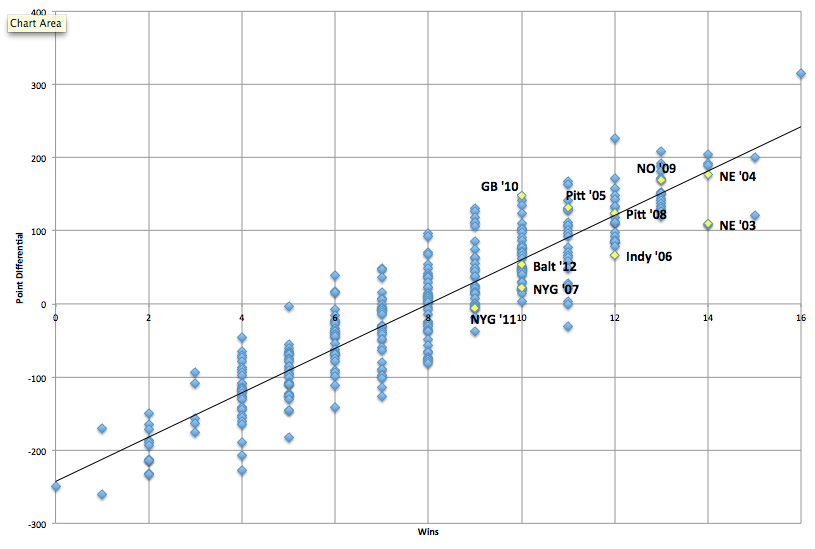
Here is a fun chart.  No great insight, but still interesting to look at.  I graphed every team’s point differential vs. its regular season wins for the last ten seasons and highlighted the Super Bowl winning teams.

Screen Shot 2013-02-04 at 12.10.28 PM


For reference, a data point below the line means the team won MORE games than expected, while a point above the line means the team won FEWER times than expected.

Needless to say…fuck the Giants.

Roster Breakdown update (Wait…the Falcons lost?)

So obviously I was a little distracted this morning (largely by CNN, though I’ll refrain from political discussion here.)  The Falcons, it turns out, really did lose that game (I wasn’t just hallucinating).  Sorry for the mix-up.  Here is the 49ers breakdown.  Note: doesn’t change the idea of the post at all, in fact reinforces it.  The 49ers have 7 players starting that they acquired with 1st round picks and only 4 that they drafted with 4th round picks or lower.

Screen Shot 2013-01-22 at 4.46.36 PM

Chip Kelly and Two Point Conversions (hypothesis formulation)

UPDATE: The following is a case for occasionally attempting 2 pt conversions earlier in the game (when current coaches don’t typically try them), NOT going for two every time.  Should have made that clearer.

There’s an article up on Bleacher Report that talks about the possibility of Chip Kelly attempting 2-point conversions more often:

http://bleacherreport.com/articles/1489471-philadelphia-eagles-on-chip-kelly-and-two-point-conversions.

It’s interesting because it indirectly highlights how one of the biggest weaknesses (assumed) to Chip Kelly’s candidacy might also be one of the biggest strengths.  Kelly’s lack of NFL experience is presumed to increase the risk that he won’t be successful as a coach, however, all Eagles fans should hope that this also has the side effect of freeing Kelly from some prevailing NFL wisdom.  Specifically, I’m hoping Kelly takes a much more aggressive approach to both 2-point conversions.

As most fans know, the 2-point conversion gives the offense the ball at the 2-yard line, with one play to get in the end zone.  Much has been written about the optimal strategy regarding 2-point tries, with mixed opinions.

However, among NFL coaches, there seems to be a general consensus that you should NOT go for two unless it is absolutely necessary.  Assuming NFL coaches have actually looked at the statistics, we are led to believe that they are deferring to the historical success rate, which is in the 47%-48% range depending on which plays the data compilers include (botched kicks for instance).  A 48% success rate means the expected value of an extra point is higher, and therefore the correct play.

So why do I want Kelly to go for it more often?  I believe that the following three aspects, when aggregated, will lead to a higher than 50% success rate, meaning the expected value for the 2-point conversion will be higher than an extra point.

– If we assume that the league-wide success rate is 47-48%, then obviously some teams have better conversion rates.  I have not pulled the statistics (unfortunately they are not as readily available as most other measures), but I think it’s reasonable to suggest that a team with an above-average offense can expect to have an above-average conversion rate as well.  (If Chip Kelly does not put together a better-than-average offense, he will be a huge disappointment.)

– I’m also hypothesizing that the element of surprise via the no-huddle offense will itself add to the conversion success rate.  NFL defenses have been conditioned to leave the field after allowing a TD.  It’s a fairly small jump to assume that an NFL team using a hurry-up offense to attempt 2-point conversion, especially in the first half, will catch the defense off-guard.  The associated confusion/lack of defensive focus will presumably add to the likelihood of offensive success.  (Yes, if the Eagles always went for two, they would lose this element of the strategy.  That’s why its best implemented only occasionally.)

– Lastly, currently teams do not devote a significant amount of practice time towards the 2-point conversion.  Obviously, considering the rarity with which most teams attempt the play, devoting practice time to it likely isn’t worth the time spent.  However, if a team decided to implement the 2-point play more often, then it would therefore make sense to practice the 2-pt playbook more often.  Does anyone disagree that practicing the plays more often would make them more effective?

So…

I apologize for the lack of data here, but we’re dealing largely with a theory that hasn’t been tested in the NFL.  While the above analysis may seem a bit disjointed, the overall question is as follows:

Would the 3 factors mentioned above (strong offense, surprised defense, more practice) add more than 2%-3% to the overall 2 pt. conversion success rate?

If you believe the answer is yes, then hope that Chip Kelly’s ego is (as I suspect) big enough to give him the confidence to move strongly against prevailing NFL wisdom.

P.S. Unfortunately, the most easily predicted aspect of this plan is commentator reaction.  Even if it is statistically the right play, you can bet every announcer will talk about how “bold” and “risky” the decision is, as well as how stupid it is every time it doesn’t work.