Inside the Huddle Part 1: Run Baby Run

Patrick Causey, on Twitter @pcausey3

Two camps exist within the Philadelphia Eagles fanbase right now.

The first camp believes that this team is too inconsistent to do anything of worth this year. They will point to the fact that the Eagles gained only 91 yards in the first three quarters of the game outside of their two touchdown drives. They will also point to the inconsistent quarterback, the dearth of talent at wide receiver, and the defense’s frustrating habit of giving up third and long plays.

The other camp looks at the Eagles as a team that has improved incrementally as the year has progressed and has put themselves in position to be the favorites to win the NFC East. They will point to Sam Bradford’s improvement running the offense, a run game which has quietly become dominant over the last four weeks, and the breakout game of Jordan Matthews.

Truth be told, I cannot decide which camp I fall in because I cannot ignore the valid points of both sides. The Eagles offense has been maddeningly inconsistent at times, but looks unstoppable at others. Perhaps that is why this team is 4-4?

So this is my hot take conclusion of where the team currently stands:

ShrugEmoticon-

Now that we’ve gotten that out of the way, let’s try to figure out where this team stands after the win over the Dallas Cowboys.

After I watch a game live I have little idea of what I want to write about. But then I watch the game tape and look at the numbers and I have 18 different topics I want to cover at once. The struggle is real.

But I cannot address all of the issues with this team, there just isn’t enough time. So I have limited my focus on some big ticket items: the emergence of the run game, the improvement of Sam Bradford, and an easy fix that can be made to help alleviate some of the inconsistencies on offense.

But rather than making you read through a 3,500 word short story, I broke this article up into three articles that can still be read in long form if you so choose:

Let’s get right to it.

The Run Game

You may not have noticed, but the Eagles have found themselves a running game over the last four weeks. It has largely gone unnoticed because many — including yours truly — have been fixating on whether Ryan Mathews should start over DeMarco Murray. And while I think that is a valid debate worth having, it should not overshadow how effective the Eagles running game has been over the last four weeks.

Here is a chart showing the difference in the Eagles run game in the first four games of the season compared to the last four:

Team

Attempts

Yards

YPC

TD

Falcons: 16 63 3.9 2
Cowboys 17 7 0.4 0
Jets 38 123 3.2 1
Redskins 18 87 4.8 0
Average: 22.75 70 3.14 .75
Saints 34 186 5.5 2
Giants 37 158 4.3 1
Panthers 30 177 5.9 1
Cowboys 35 172 4.9 2

Average

34 173.25 5.1 1.5

It should come as a surprise to no one that the Eagles were 1-3 in the first four games when they failed to get any semblance of a run game going. (And of course, the one game in which they won during that span — against the Jets —  was in large part thanks to Ryan Mathews kick-starting their run game with an impressive performance.)

It should also not be a surprise that the Eagles have gone 3-1 over the last four games when the Eagles averaged 173.25 yards and 1.5 touchdowns per game on the ground. As Chip Kelly has often said, this is a run first offense. And the numbers support that: whenever the Eagles run the ball more than pass, they are 12-2 under Kelly. But when they pass more than run? The Eagles are 11-15.

Now the Dallas game is a bit of a misnomer in that regard, because the Eagles actually passed more (36) than ran the ball (35). So we shouldn’t get caught up fighting over the margins; the main conclusion that we can reach is that the Eagles are a much better football team when they take a balanced approach.

So why did it take Kelly the first four weeks of the season to start running the ball more? There is a bit of a chicken and egg situation here. Kelly clearly called less run plays to start the season than he has over the course of the last four weeks. And an argument can  — and should  — be made that Kelly was too quick to abandon the run at times.

But in Kelly’s defense, watching the Eagles offense line over the first four weeks was like watching a car accident in slow motion. The Eagles routinely blew assignments leading to running backs getting tackled give yards behind the line of scrimmage. The failure to gain any yards on first or second down put the Eagles in third and long situations, which in turn led to an alarming number of drives that ended with a three and out. It was a self-perpetuating problem that hampered this offense’s effectiveness.

Over the last four weeks, however, we have seen the offensive line improve dramatically. One of the reasons is continuity. To start the season, the Eagles rolled out an offensive line that was, for all intents and purposes, brand new: Jason Peters never played next to Allen Barbre, who never played next to Jason Kelce, who never played next to Andrew Gardner, who never played next to Lane Johnson. For a unit that relies so heavily on communication and knowing what the person next to you is doing, the lack of familiarity proved fatal. But with eight games under their belt, the offensive line is clearly more comfortable playing with each other.

Another reason that has largely gone unnoticed is the emergence of Matt Tobin, the player who many thought would take over for Todd Herremans to start the season. If you recall, Andrew Gardner was lost for the year during the Jets game. Since Tobin has been inserted into the starting lineup, the Eagles have gone from averaging 2.71 yards per carry (against the Falcons, Cowboys and Jets) to 5.06 yards per carry (over the remaining games). This is not entirely entirely the result of inserting Tobin into the starting lineup. But we cannot ignore the impact his presence has had along the offensive line, either.

The continuity on the offensive line, and the increased frequency with which Kelly is relying on the run game, helped the Eagles impose their will on the Cowboys’ defense. Indeed, if you were to give Chip Kelly the ability to construct the “perfect drive”, he would be hard pressed to find one better than the first touchdown drive against the Cowboys. That drive captures everything the Eagles want to do philosophically on offense: run often, run fast, and pound the opposing defense into submission.

The Eagles started the drive off with the following plays:

  • Murray run for 9 yards;
  • Murray run for 3 yards;
  • Bradford pass to Murray for 8 yards;
  • Murray run for 6 yards;
  • Murray run for 3 yards;

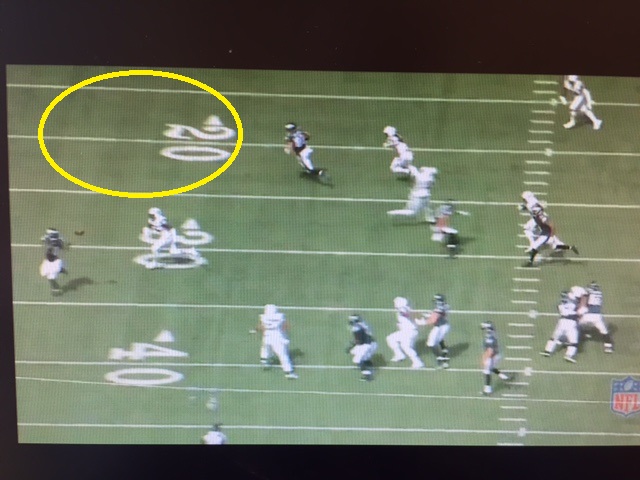
Each Murray run was on an inside zone up the middle. With the defense getting gassed and looking to stop the run inside, Kelly unleashed the fresh legs of Ryan Mathews, who beat tired Cowboys’ defenders to the edge for a gain of 21 yards:

The body blows kept coming. Kelly went back to Mathews for a run up the middle and gain of 3 yards, quickly followed by a play-action pass to Jordan Matthews for a gain of 9 yards. This was the Eagles’ fourth first down on the drive, and the Cowboys defenders were spending more time gasping for air than preparing for the next play.

Sensing weakness, Kelly quickly went with a sweep to the outside, letting Mathews use his speed and explosiveness to gash the defense for another 12 yard gain.

To say the Cowboys defense was gassed would be an understatement. The Cowboys were forced to burn a timeout just to get in some fresh legs in the game. But the damage was already done:

Four plays later, the Eagles scored on a DeMarco Murray 1-yard touchdown run. It was an imposing 13 play, 71 yard drive that featured 9 runs to just 4 passes. The drive last four minutes, 12 seconds, which means the Eagles ran a play every 19.38 seconds.

This is the Eagles identity: running roughshod over the defense until it becomes so gassed it either gives up a big play, is forced to burn a timeout, or both. And if they are going to continue their success this year, it will be on the back of DeMarco Murray, Ryan Mathews and Darren Sproles.

You can go to part two, which analyzes the passing game, by clicking here. Or, you can skip ahead to part three, which discusses how play calling predictability is contributing to the inconsistent offense, by clicking here.

Self Scouting the Eagles Part 1: On Drops

Patrick Causey, on Twitter @pcausey3

For teams riding a hot streak, a bye week is about as welcomed as a root canal. It threatens to disrupt the positive momentum a team has built by placing 14 long days between their games.

But for a team like the Eagles, who are mirred in the middle of a season that is as disapointing as it is frustrating, the bye week could be the perfect tonic. It provides the opportunity for the team to get away from the facility for a week, clear their heads, and hit the reset button on the season.

While the players are away, Chip Kelly and his coaching staff will be spending the week self-scouting, which simply means they will be evaluating what the hell went wrong with the first seven weeks of the season and coming up with a blueprint for salvaging the rest of it.

The good news for the Eagles is that the NFC East is very much wide open. The Giants are the best team by default, but they have question marks across the board that the Eagles exposed two weeks ago. The Cowboys are an injured, toxic wasteland. And if the injuries to Dez Bryant and Tony Romo don’t derail their season, it could be ended by Greg Hardy and Joseph Randle, two head-cases that seem hellbent on out-crazying one another. And the team from Washington is probably the only team in the NFL that is more inconsistent than the Eagles, as their wild, come from behind victory over the lowly Tampa Bay Buccaneers showed us last week.

So what can the Eagles do to get back into contention? What is holding the team back? Let’s try to replicate what is going on inside the NovaCare Complex this week and do some self-scouting of our own.

I’ve identified five issues with this team, in no particular order, that I want to discuss. But I am sure there are more than this, so feel free to leave your list in the comments:

  1. Drops
  2. Quarterback play
  3. Lack of consistency
  4. Self-inflicted wounds
  5. Mismanaging player acquisition and utilization

I want to address items 1 and 2, as well items 3 and 4, at the same time because I think they go hand in hand. Let’s break down the drops and quarterback play first. Part two and three will come out over the next week.

1. Drops and Quarterback Play

I wrote an in-depth breakdown of the issues facing Sam Bradford last week (which you can read here), so I am not trying to rehash those issues again. Instead, I want to focus on the utility of measuring drops and challenge how we apportion blame for drops between the receiving corp and Sam Bradford.

It is no secret that the Eagles wide receivers have dropped a ton of passes this year. We have seen it discussed ad nauseum for the entire season, but it peaked after last Sunday’s loss to the Carolina Panthers where the team dropped anywhere from seven to 10 passes depending on which website you rely upon.

The common narrative emanating from the game was that the receivers were to blame for the drops, and the optics — at least at first blush — certainly supported that. In a fitting end, Miles Austin dashed any hopes of an Eagles comeback by dropping a Sam Bradford pass on 4th down late in the 4th quarter.

But after going over the game tape, I saw issues that suggested, as always, it was not as clear cut as we thought. While the receivers deserved their fair share of the blame, Bradford’s placement on certain passes, including the Miles Austin drop, had at least some impact on a handful of the drops, and had significant impact on others.

But before I get to that, let’s take a step back and examine how drops are evaluated on a macro-level by the media and advanced metric websites such as ProFootballFocus.com. Gaining a better understanding of the issues inherent with how we measure drops will help us evaluate the Eagles season to date.

Drops at a macro-level

Organizations like Pro Football Focus, as well as other advanced metrics companies that work directly with NFL teams, have placed considerable emphasis on drops when evaluating a quarterbacks play. PFF.com factors drops into two of its key “Signature Stats”: QB Rating and Accuracy Percentage.

From the website, PFF states accuracy percentage “accounts for dropped passes, throw aways, spiked balls, batted passes, and passes where the quarterback was hit while they threw the ball – factors that hurt the quarterback’s completion percentage but don’t help show how accurate they are. The formula: ((Completions + Drops) / (Attempts – Throw Aways – Spikes – Batted Passes – Hit As Thrown)).

PFF does a similar thing with its quarterback rating, again from its website: “Offering an alternative to the out-dated standard, we take into account dropped passes, throw aways, spikes, and yards in the air and further adjust the old formula so it makes more sense and is a more accurate measure.”

In other words, in an effort to determine how accurate a quarterback truly is, and how well that quarterback is performing overall, PFF tries to remove static from the equation — i.e., bad plays which are outside of the quarterback’s control that impact his rating and completion percentage.

Sounds good in theory, right?

But noticeably absent from these equations are plays that the quarterback benefits from undeservingly. For example, PFF does not subtract from the quarterback’s accuracy percentage catches that were off target but caught because a wide receiver made a spectacular grab. And in the quarterback rating, PFF does not factor in easy interceptions which were dropped by a defender.

So a quarterback gets credit when a receiver drops a pass like this:

But does not get dinged when a defender drops an easy interception like this:

Or when a receiver bails out the quarterback from an inaccurate throw like this:

By focusing on only half of the equation, the results are improperly skewed to the quarterbacks benefit.

Another different, but related, issue I have with drops is that drops is that not all drops are created equal. But they are largely treated the same.

Drops are inherently subjective; which is why you can look at three different websites and get three different numbers for a total on team drops. Most websites, however, use the basic parameter of ruling something a drop if the ball hits a receiver in the hands.

But this approach places too much emphasis on the wide receiver and ignores the impact that a quarterback’s ball placement has on the receiver’s ability to catch the ball. That simply cannot be ignored if we are to fully and properly evaluate what constitutes a drop pass versus a bad throw.

Let’s take this out of the abstract. I think we all can agree that this is a drop by Riley Cooper. The ball is placed perfectly by Bradford, and Cooper fails to make the catch:

Ditto this play by the otherwise sure handed Darren Sproles:

Bradford has shown an affinity for the wheel route, and you cannot place this ball any better than that.

But what about this throw from Bradford to Jordan Matthews against the Cowboys?

Matthews is running a crossing route and has a step on his defender, so Bradford ideally needs to place the ball in front of Matthews so he can catch the ball without breaking his stride. Instead, Bradford is off with his throw, placing it on his backside shoulder, which forces Matthews to stop on his route and contort back towards his defender to make the catch. Is this really a “drop” or simply a poor throw by Bradford?

Or what about this throw to Nelson Agholor against the Jets — does this constitute a “drop”? It hit Agholor’s hands, so at least under some standards, it might be labeled a drop even though it was clearly a poor pass by Bradford.

I have not found any website which takes the negative plays — i.e., dropped interceptions, spectacular catches by the receiver —  into account, or which does a fair job differentiating between a drop and an incompletion based on a poor throw by the quarterback.

Until I see a metric that takes both into account, I assume, for better or worse, that these plays even out in the long run. Absent extraordinary circumstances, it is reasonable to expect that a quarterback will be let down by his receivers roughly the same percentage of times that he will be bailed out by his receivers. Ditto with interceptions. It isn’t perfect. But it seems like a more complete way to evaluate a quarterback’s play.

Drops on a micro-level

Which brings me to the Eagles this year. PFF.com has Bradford as the victim of a league leading 25 drops. And against the Carolina Panthers, the Eagles dropped anywhere from seven to 10 passes during the game.

Some of them were flat out drops. Like this pass to Darren Sproles:

Or this pass to Zach Ertz:

Those are inexcusable drops. In Sproles case, it contributed to a stalled drive inside the Panthers 20-yard line. The Eagles ended up settling for three points instead of a touchdown.

But there were other plays — three, to be exact, where Bradford hurt himself with his ball placement.

Let’s start with the interception Bradford threw when he targeted Jordan Matthews early in the game. When I watched this play initially, I thought Matthews was at fault. While ball placement was not ideal — Bradford threw it to Matthews’ outside shoulder when he was running an inside crossing route — I thought the catch should have been made.

But one thing we have to take into consideration is that this is pass is four-five yards past the line of scrimmage, and Bradford delivers the ball on an absolute rope. That increases the degree of difficulty here because Matthews barely has any time to react to the ball.

Here is another view:

Bradford could have made this easier by either taking something off the pass or placing the ball in front of Matthews (or both). While NFL caliber wide receivers likely should have made that catch, NFL caliber quarterbacks –without question — should be able to deliver this easy pass accurately. Bradford did not, which is why I think he deserves a good share of the blame.

In the third quarter, the Eagles were driving deep into the Panthers’ territory, down 21-13. A touchdown could have brought the Eagles within one or tied the game (had they gone for two).

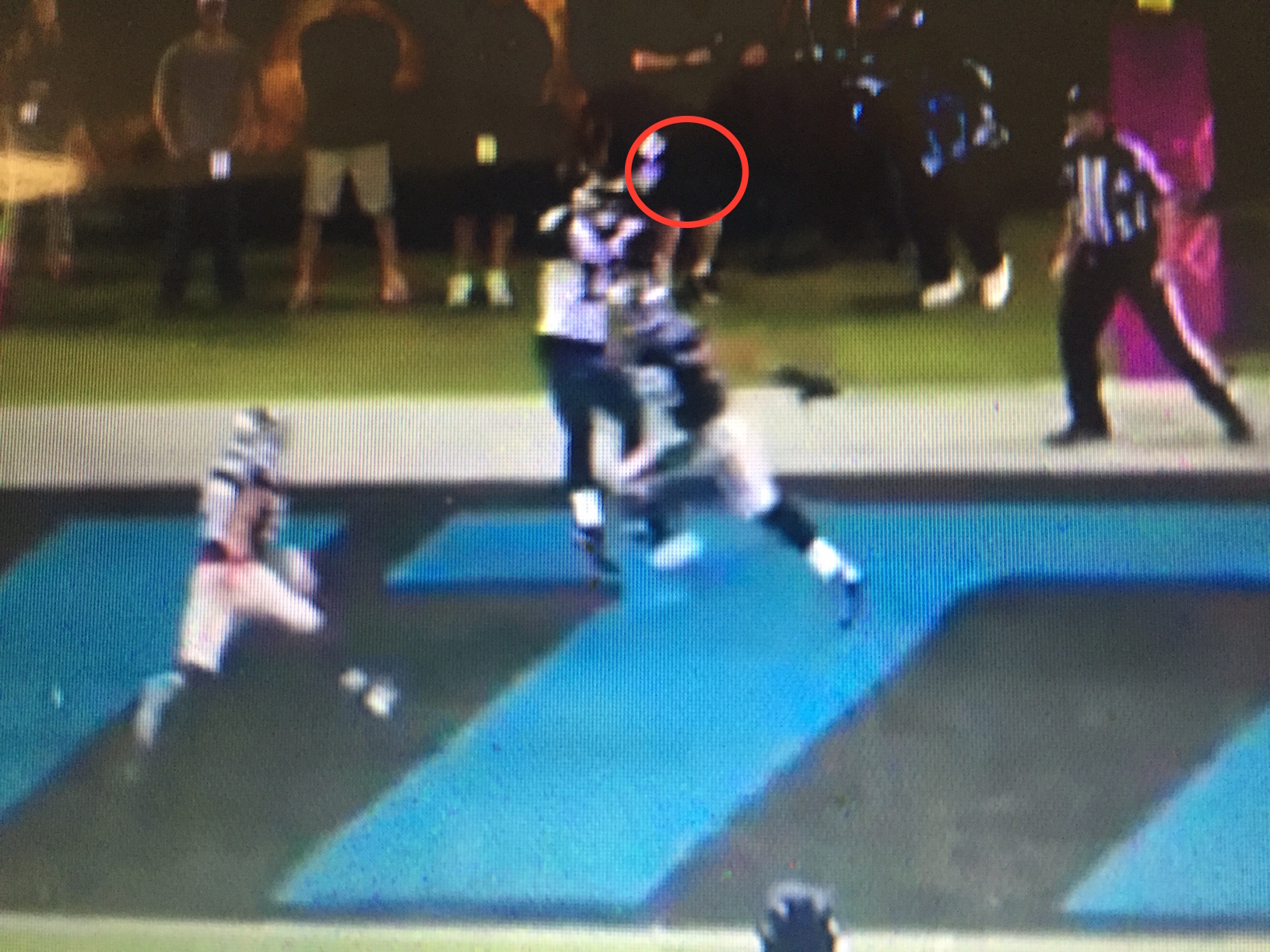
On third and goal, Bradford had Josh Huff running a post route to the middle of the end zone, but Huff dropped the would be touchdown:

Or did he? Let’s look at this a little further. First, here is the screen shot right before Bradford delivers the throw:

IMG_1825

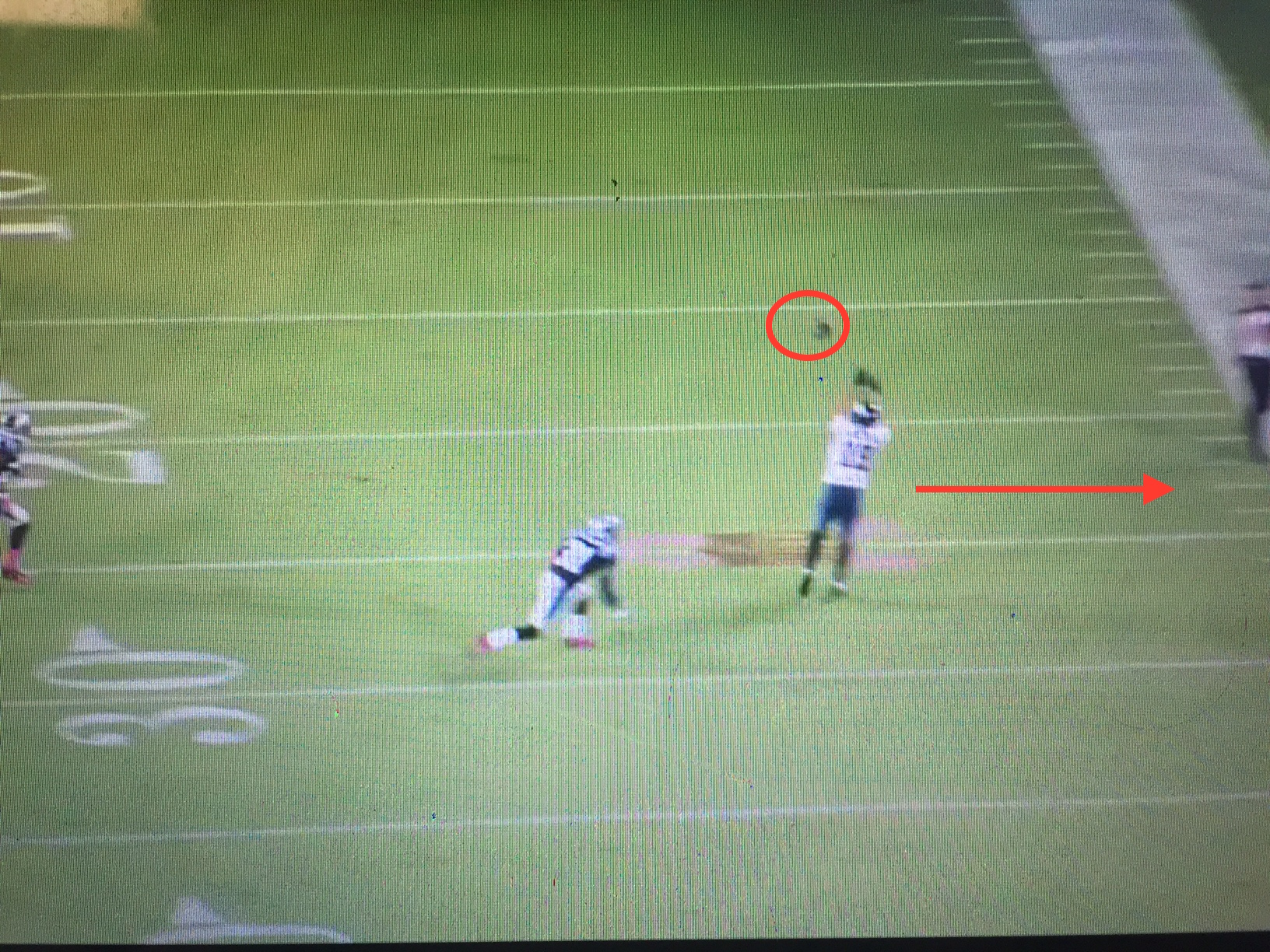
So far so good. Bradford has Huff one on one with a linebacker (Kuechly) and a clear lane to throw in-between the defenders. The only problem? Bradford doesn’t fully lead Huff; the ball is again thrown to the wrong side of Huff, causing him to have to turn away from where his momentum is carrying him. Here is a close up:

IMG_1828

The ball is hard to see, but what is apparent is that Huff is having to turn 90 degrees in air to try to make the grab. Could he have made the catch? Possibly. But would the catch have been much easier to make if Bradford placed it properly? You bet.

Back to that Miles Austin play I alluded to earlier. It was 4th down on the Eagles last drive of the game, and Austin is running a seven yard out route. He gets open, Bradford gets him the ball, but Austin fails to make the catch.

But again, Bradford’s ball placement here was suspect:

IMG_1831

You can see where the ball is thrown compared to where Austin’s momentum was taking him. It was an easy pitch and catch made more difficult by Bradford’s ball placement. Austin still could have made the catch, but I think Bradford deserves the lion’s share of the blame here.

Without question, the receivers need to improve moving forward. I am not ignoring that nor excusing their poor play. But we should not automatically assume that every (or even most) drops are solely on the wide receiver. The quarterback plays a big part in whether a pass is caught, and up until this point in the season, Bradford has failed to live up to his end of the bargain.

A reason for optimism

Let’s end on a positive note, because I think there is a chance we see the drops improve over the season. For starters, the normal drop rate in the NFL usually is around 7-8%. Currently, the Eagles are at 11.41%. So we should expect at least some regression to the mean over the remainder of the season.

But I also think we should see some improvement from Bradford as he continues to work his way back from his knee injury. Look at this chart of Bradford’s dropped passes throughout his career:

Year

Drops Percentage of Pass Plays Rank
2010 36 6.1% 5th most
2011 31 8.6% 1st*
2012 30 5.4% 18th
2013 12 5.5% 19th
2015 25 11.41% 1st

In Bradford’s first two years in the league, his team struggled with drops, having the fifth most drops in his rookie year, and the most drops in his sophomore campaign. This is understandable: Bradford was new to the league and likely needed time to adjust to the speed of the game, the complexity of the defenses, and the tighter windows through which he had to throw.

But in the following two seasons, Bradford showed marked signs of improvement, ranking slightly better than league average.

The Rams did not bring in any high priced, big name wide receivers over the course of the 2012 and 2013 seasons. And while both seasons were cut short by injury, they were not too short to write off the improvement as too small of a sample size (Bradford played 10 games in 2012, seven games in 2013). So this improvement likely was the result of Bradford becoming more accurate with his passes.

So why the regression this year? Obviously, the wide receivers are not playing well, and that is likely contributing to the high numbers. But I also think Bradford’s knee injury is limiting his play — not only from a confidence and mechanical perspective, but also because it prevented Bradford from getting a full offseason’s work in as he worked through his rehab from March to August.

I am not making excuses for Bradford. He has not played well up to this point in the season and he will need to improve if the Eagles are going to have any chance to competing for the NFC East title. But I would not at all be surprised if we start to see the drops improve over the course of the season, not only because the receivers can’t be this bad (can they?), but also because Bradford’s accuracy should improve as the season progresses.

Diagnosing Sam Bradford’s Struggles

Interceptions are not the issue, but are merely a symptom of the issues hampering Bradford’s game; can they be fixed?

Patrick Causey, on Twitter @pcausey3

The last two weeks of the Eagles season perfectly illustrates the importance of the quarterback position. The Eagles have gone from 1-3 with their season on the brink of collapse, to being in first place in the NFC East. They have been led by a dominating defense and strong play from their offensive line and run game, three things which seemed inconceivable after the loss to the Atlanta Falcons. And they have won their last two games by a combined 44 points while piling up 957 yards of total offense in the process. Heck, even their much maligned kicker, Calib Sturgis, has been perfect on field goal attempts over the last two weeks.

Given what we have seen, it is fair to wonder whether this is the deepest and most balanced team that Chip Kelly has had as head coach of the Eagles. And yet, there is an overwhelming sense of anxiety surrounding this team.

Why? Because of the quarterback.

To put it mildly, Sam Bradford’s play has been inconsistent. Ask anyone the biggest problem with Bradford’s play to date, and they will likely point to the alarming rate at which he is throwing interceptions. And indeed, Bradford’s 3.9% interception rate dwarfs his career rate of 2.2%. His nine interceptions rank second in the NFL, and his four redzone interceptions — three of which that have occurred in the last two weeks — is tops in the league.  Bradford is one of only two quarterbacks to throw two-plus interceptions in four of the six games he’s played (the other being Kirk Cousins).

But the interceptions are not the reason for Bradford’s poor play, they are merely the symptoms of the actual flaws in Bradford’s game that are causing the interceptions.

The tape shows that there are three issues that have haunted Bradford so far this season that are leading to a spike in interceptions:

  • Bradford struggles when he is under pressure or thinks he is under pressure;
  • Bradford is not seeing the field properly which is leading to bad decisions; and
  • Bradford’s ball placement has been inconsistent, which largely results from his failure to transfer his weight during his throws.

Before we dive a little bit deeper, consider this quote about Bradford from NFL.com’s Greg Cosell:

There [a]re two particular areas where significant work was needed [in Bradford’s game]. There were times he was not comfortable in the pocket with bodies around him. That’s a different trait than looking down the gun barrel. When the pocket closes down and functional space is reduced to throw cleanly and comfortably, you must still stay on balance and deliver the ball in the eye of the storm…In addition, there were instances in which Bradford had opportunities to be more aggressive throwing down the field that he didn’t take advantage of…

Bradford [has been] tentative in the pocket, not mentally sharp, and at times he did not let it loose when he had a throw. An inconsistent profile had been established. What really stood out as the year [has progressed is] Bradford’s reaction to pressure — the issue that first surfaced in his rookie season against Kansas City. It is easy to place the blame on the…poor pass protection, but that circumvents the more essential point. You must be able to function effectively in a muddied and noisy pocket to play quarterback well in the NFL, and Bradford began to perceive pressure that was not there. He was anticipating the rush, and you cannot perform that way, no matter what kind of talent you have throwing the football.

[Bradford’s] velocity ha[s] decreased; he [i]s not driving the ball down the field….His precise ball location, a feature of his game as a rookie, had waned. He missed some throws that were there. He had very little sense of timing with his receivers. He threw some balls too early, and some too late; the passing game was clearly out of synch. I strongly believe the injuries, the revolving door and the overall lack of quality at the wide receiver position [i]s a more legitimate reason for Bradford’s struggles than the offensive line. The inability of [Eagles] wideouts to get open on one-on-one isolation routes — a must in the NFL — had an extremely negative impact on Bradford. His game is timing and rhythm, but his uncertainty as to when to deliver the ball is clear on last season’s tape. He was hoping, rather than playing, and that’s a formula for failure.

I think this is a fairly accurate depiction of Bradford’s struggles so far this year, with the exception that Bradford has been willing to take more shots down the field as the season has progressed.

The only problem? Cosell wrote this back in 2012, after Bradford’s second year in the league. I slightly modified the post so that it was in present tense.

Which begs the question: if Bradford is struggling with many of the same issues that limited his game over four years ago, is it reasonable to expect him to improve this year, even if he cuts back on the interceptions? Or, to steal a line from Denny Green, is Sam Bradford what we thought he was? The answer, as usual, is a mixed bag.

When we dig deeper into the numbers and the tape, a picture begins to emerge of an incredibly talented, but flawed quarterback; one that should expect to see areas of improvement as the season progresses, but one who likely won’t live up to the lofty expectations that most fans had during the preseason. Let’s break this down further.

Bradford Throwing Under Pressure

A consistent issue we have heard about Bradford over his career is that he struggles to throw the ball under pressure, real or perceived. As Cosell pointed out in his 2012 article, Bradford “was not comfortable in the pocket with bodies around him” at times, and even “began to perceive pressure that was not there.”

The numbers back this up. Per PFF.com, here is Bradford’s completion percentages, touchdowns and interception totals, plus their ranks (contained in parenthesis), when throwing under pressure:

Year

Cmp%

TD

INT

2010

41.1 (23/29)*

4 (T-18)

7 (T-5)

2011

38.4 (23/24)

6 (21)

2 (22)

2012

41.6 (20/27)

5 (11)

2 (T-23)

2013**

38.8 (26/29)

2 (T-12)

1 (T-21)

2015

44.6 (26/31)

4 (T-2)

4 (T-3)

  • *Note that the number of candidates vary from year to year because a different number of candidates qualified for PFF.com’s statistics.
  • **In 2013, I used only the numbers for the first seven weeks, since that is the time period Bradford played before suffering a torn-acl.

When Bradford was with the Rams, we saw him make costly mistakes like this under pressure:

Bradford has repeated those mistakes this year with the Eagles, as we saw on this interception against the Falcons:

Now, pressure impacts every quarterback. Even Aaron Rodgers and Tom Brady throw bad interceptions under pressure. That is why pass rushers are, on average, the third highest paid position group in the league (behind only quarterbacks and wide receivers). So throwing interceptions under pressure is not unique to Bradford.

While Bradford has thrown the third most interceptions while under pressure this season, there is some evidence to suggest that he will cut back on the interceptions. In Bradford’s rookie year, he threw 7 interceptions, which was tied for fifth most in the league. That’s to be expected for a rookie quarterback. But in each of the following three seasons, Bradford showed marked improvement protecting the football.

Bradford’s struggles this year might be the result of his time away from the game. With time, we should expect to see Bradford improve as he get more comfortable with this offense and more confident in his knee.

But that does not necessarily mean that Bradford’s problems throwing under pressure will be solved once he cuts back on the interceptions. Bradford’s completion percentage under pressure has ranked towards the bottom of the NFL throughout his career, which suggests a deeper issue that cannot be explained away by the rust caused by his time away from the game.

For whatever reason, Bradford struggles when he does not have a clean pocket. This struggle is one of the primary reasons why Bradford is such a frustrating quarterback to watch. In training camp and preseason — when pressure is virtually nonexistent — Bradford’s pinpoint accuracy and quick decision making are on full display. But when the pressure comes, Bradford freezes up. His mechanics become sloppy, he gets rid of the ball too quickly, and he becomes wildly inaccurate.

Five seasons in, it is reasonable to wonder if this is an issue that will persist for Bradford throughout his career.

Bradford’s Faulty Mechanics

The tape also shows that Bradford is struggling with his mechanics. Back in training camp, Louis Riddick, formerly of the Philadelphia Eagles front office and currently of ESPN.com, tweeted the following about Bradford:

Ron Jaworski appeared on 97.5 The Fanatic earlier this season, and saw the same thing:  “He’s favoring the left leg.  I can see it when bodies are around him.  He’s not transferring that weight.  The ball is coming out with a lack of energy.  His footwork is bad. I can’t say any more simply than that.”

To understand the importance of not transferring weight on your throw, we need to understand the technical components of throwing the football. Many exercise scientists and kinesiologists agree that that throwing a football at an elite level is the most complex motor skill in all of sports. It requires flawlessly executing a number of independent, but related moves in one compact throwing motion. Even the slightest breakdown in mechanics can adversely affect a quarterbacks power and accuracy.

Here is the breakdown in simple terms:

  1. A quarterback needs to put approximately 70% of his weight on his back plant leg plant his back leg.
  2. The quarterback then turns his front shoulder inward and away from his target, like loading a spring.
  3. In one fluid motion, the quarterback uncoils the spring, exploding forward with his throwing arm rotating towards the target while transferring his weight from his back leg to the front leg.

Many people mistakenly believe that power is generated from a quarterback’s arm, when in fact, it comes primarily from the quaterback’s core, legs and hips. It is generated in that last motion, with the quarterback rotating his hips and transferring weight from his plant leg to his front leg.

But the key is to allow that weight transfer to occur naturally. If you rush or force the weight transfer to your front plant leg too early, it creates an all arm throw that lacks velocity and consistent accuracy. That’s what happened to Drew Brees last year when he was dealing with an oblique injury, and we are seeing it with Bradford this season as well as he continues to come back from his knee injury.

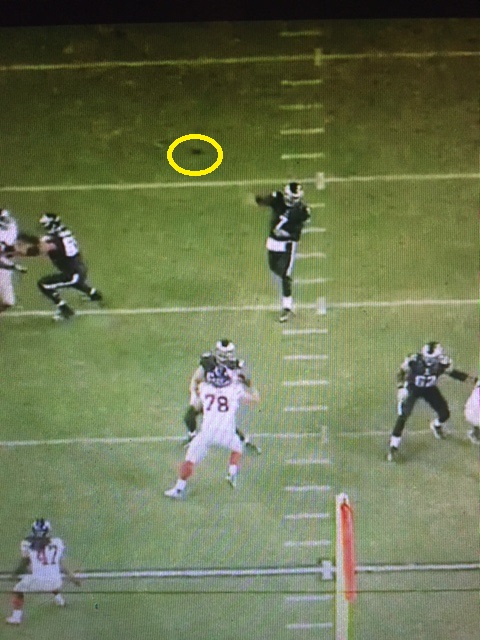
Perhaps the best example of Bradford not transferring his weight properly came on the second interception he threw to Zach Ertz last week against the New York Giants. If you recall, Ertz was double teamed in the end zone, but Bradford tried for a jump ball hoping Ertz could make it play:

It was a bad decision by Bradford that was compounded by his faulty mechanics. Here is a screen shot just as Bradford released the ball:
Bradford Bad Mechanics

The position of Bradford’s shoulders tells us that he is not transferring his weight properly. With proper mechanics, Bradford should have rotated his throwing shoulder towards his intended target, Ertz (which would be towards the bottom left of this picture). Instead, we see that when Bradford releases the ball, his shoulders are practically parallel to one another; there is virtually no rotation towards his receiver, which explains why the throw came up short.

The question is whether Bradford can fix it. Jaws thinks the issue stems from a lack of confidence in his knee, which wouldn’t be the first time a quarterback has struggled with his mechanics when coming back from a knee injury. Robert Griffing, III had the same issues following his knee injury in 2013.

But as Greg Cosell pointed out, Bradford has struggled with this issue since 2011: “[Bradford’s] velocity ha[s] decreased; he [i]s not driving the ball down the field….His precise ball location, a feature of his game as a rookie, had waned. He missed some throws that were there.”

These are clear signs that Bradford is not transferring his weight properly in his throw.

The encouraging news is that Bradford has recognized the problem. Per Paul Domowitch of the Philadelphia Daily News:

It’s been mechanical. Me and coach Day talked a little bit about it this week. I’m not sure my weight transfer has been where it should be on a couple of throws. I’m not sure I’ve really gotten to my front leg. I think that’s why some of them have been short. So I spent a lot of time this week trying to get back to the fundamentals.”

Now it’s just up to him to fix it.

Bad Decision Making

The final issue I’ve noticed on tape has been Bradford’s poor decision making. While Bradford is known for his high football intelligence, he has curiously struggled to work through his progressions and see open receivers this season. We have seen this issue pop up throughout the season (which I have covered here and here).

Let’s start with his interception to Riley Cooper against the New York Giants.

When I first saw this live, I thought the interception was on Cooper, who stopped short of his route.

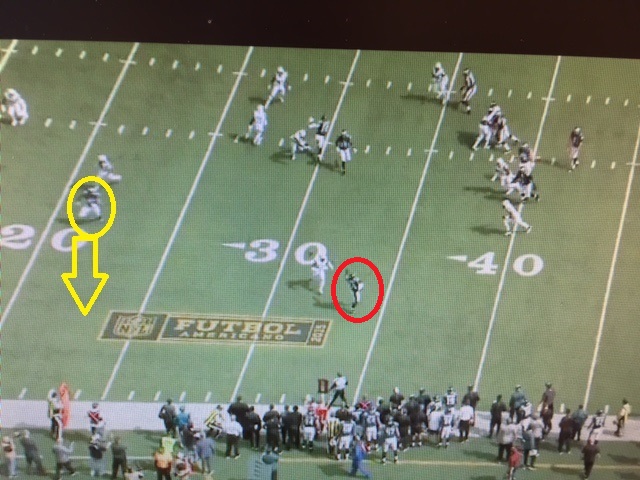
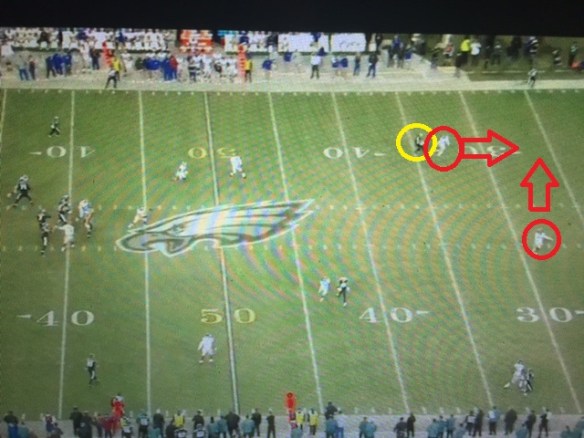
But watching the tape again, I saw why Cooper optioned to a deep curl instead of the post: there was safety help over the top. Here is a screen shot right at the moment Bradford was releasing the ball.
Cooper INT

Cooper is highlighted in yellow and is starting to break into the curl route. The safety (highlighted in red at the center of the field), is already breaking on the post route.

Cooper made the right read here. Running a deep post into double coverage, especially with someone as slow as Cooper, is a recipe for disaster. Cooper recognized this, and optioned to a deep curl in single coverage. But Bradford threw to the deep post anyway. He just can’t make this throw.

Brian Dawkins saw the same thing, per Mark Eckel of NJ.com: “On the one interception, I don’t know maybe he expected Riley (Cooper) to do something else, but to throw the ball down the middle of the field like that with a safety there, you can’t do that. You just can’t do that.”

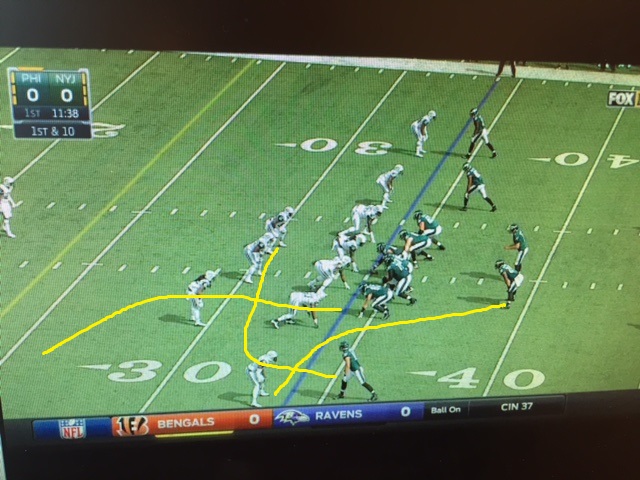
Bradford has struggled making correct reads and getting through his progressions throughout the year. Consider this first and 10 play in the first quarter of the Eagles game against the New York Jets. The Eagles are running a staple of Chip Kelly’s offense, the triangle concept (which I cover in depth here).

Ertz missed

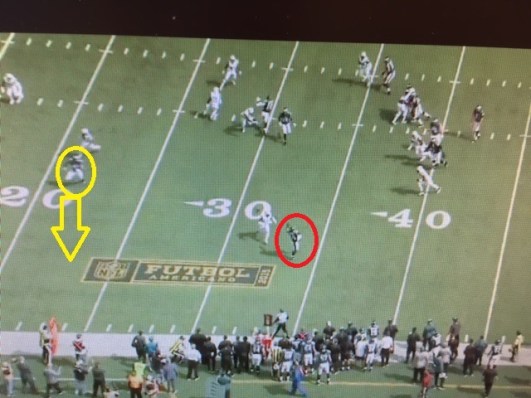
Zach Ertz is running a corner route on this play; Riley Cooper is running a drag route across the middle, and Ryan Mathews is running an out route out of the backfield towards the space vacated by Cooper.

Bradford almost immediately checks the ball down to Mathews (circled in red below) without letting the play develop. The throw is high and to the wrong shoulder, and falls incomplete. But again, Bradford makes a wrong read and misses Ertz (circled in yellow), who was wide open on the corner route:
Ertz 2

Here is a better angle showing the space Ertz had to operate:

Ertz 3

Bradford was not under pressure on this play, he simply rushed the throw to his check down option, missing the opportunity for a big play.

One final example (and apologies for bringing up the bad memories here). In the Dallas game, Bradford threw this costly interception when he targeted Zach Ertz in the end zone.

With the exception of a minor formation change, this is the same play the Eagles successfully ran against the Green Bay Packers in the preseason where Bradford delivered a strike to the underneath crossing route for a touchdown.

But here, Bradford forces the throw to Ertz, and misses Nelson Agholor (circled in yellow), who is open on the underneath crossing route.

Ertz INT Dallas 1

Bradford also had Cooper wide open on the deep in route, as we can see from this screen shot:

Ertz INT Dallas Cooper

Again, there are reasons to believe that Bradford can improve here: he is only six weeks in to learning a new offense, a process which has been hampered by Bradford missing valuable time this offseason recovering from his knee injury.

And Bradford showed progress getting through his progressions against the Redskins and the Saints. That should not be forgotten simply because Bradford had a bad game against the Giants.

Conclusion

So where the hell does that leave us? As I suggested about 2,000 words ago, it leaves us with a muddled picture. That probably isn’t the popular answer in a world that demands hot takes and bold statements, but it is probably the most reasonable conclusion that can be reached.

No one can dispute that Bradford has been inconsistent this year. Part of those inconsistencies can be explained by Bradford struggling to come back from a two-year layoff while simultaneously learning a new offense with new teammates. But part of these issues have persisted throughout Bradford’s career, so they likely are a sign of a fundamental issue with Bradford’s game more than rust.

I still believe that talk of replacing Bradford with Mark Sanchez is wildly premature. Bradford should be given at least until after the bye before we reach any concrete conclusions on the state of our quarterback. And even then, I’m not sure that switching to Sanchez represents any discernible upgrade. Regardless, we should expect some improvement from Bradford this year, but any thoughts of Bradford being a top ten quarterback in this league seems misplaced.
How long can we expect Jason Peters to play?

In my previous post, I mentioned that one of my biggest concerns about the roster is that staging of the “rebuild” might be disjointed.  In other words, the Eagles have a lot of good players, but I’m worried there aren’t enough of them that will be in peak form (or close to it) at the same time, lowering the potential ceiling of the group.

While I still have a lot of work to do to explore this issue, it seemed natural to begin with a look at Jason Peters.  He is one of the best players on the team (arguably THE best), a potential future HOFer, and a keystone of Chip’s dominant running attack.  He’s also going to be 33 years old this year.  How much longer can he be expected to play at a high level?

There are a few ways to dig into this, but I began with the simplest.  I used Pro-Football-Reference.com’s Approximate Value measure as a proxy for impact/skill.  I searched for all OTs, post-merger, who registered a combined Approximate Value of at least 20 in their age 31-32 seasons.  Basically, I was looking to get a sample of Tackles who played as well as Peters has this late in his career.  There were 15 such players.  I then looked at how those players progressed.  The results, unfortunately, were not encouraging.  I rebased the annual AV of each player to their age 32 season value.  I then took an average of those to get an aggregate aging curve.

Below is a chart illustrating the analysis.  The blue line illustrates the performance progression.  The red bars show how many players remained in the analysis each year.  Studies like this are highly sensitive to survivorship bias, so I wanted to make it very clear how few of these players remained in the league as they got older.  In general, this effect serves to OVER-estimate the contributions of players as they age (unless you make adjustments for it, which I have not done here).

Screen Shot 2015-05-28 at 11.01.09 AM


Jason Peters is entering his Age 33 season.  The 15 tackles I looked at, on average, recorded an Approximate Value in that season of just 73% of their age 32 season.  Also note that by age 36, just 4 of the 15 players were still playing, and beyond that, only Lomas Brown continued.

This is obviously a very rough analysis.  OL contributions are very difficult to quantify and Approximate Value isn’t a perfect statistic.  Also note that Jason Peters’ AV last season was 12.  Just 60% of that would still result in an AV of 7.2.  By comparison, Lane Johnson’s average AV over the past two years is 7.  The takeaway is that even if Jason Peters follows the above progression exactly, he can still be a decent contributor for another year or two.  Expecting much beyond that, however, seems irrational.

Now let’s take a less systematic look at things.  I also searched the PFR database for all post-merger OTs that recorded an AV of at least 7 in the seasons corresponding to the following ages, which are shown with the number of players meeting that threshold:

34 yrs – 36 players

35 yrs – 23 players

36 yrs – 6 players

37 yrs – 4 players

38 yrs – 3 players

As you can see, it’s extremely rare for OTs to have a great season beyond the age of 33, and it almost never occurs after age 35.  The conclusion is that we shouldn’t expect Peters to play at a high level for more than another 1-2 yrs, and if he plays longer than that, it might be due as much to a failure of finding a decent replacement as to his ability.

A few other notes (all post-1970):

– Willie Roaf recorded an Av of 17 when he was 34 yrs old.

– Just 4 tackles made the All-Pro 1st team after age 33: Walter Jones (33), Mike Kenn (35), Willie Roaf (34), and Gary Zimmerman (35).  Each of them was also drafted in the 1st round (not saying that means anything, just thought it was interesting).

– 25 OTs made the pro bowl after turning 33 (includes multiple appearances by the same player).

– OTs older than 35 have started at least 12 games 49 times (36 different players).


The State of the Eagles

Been a long time since I posted, and a lot has happened in the interim.  Instead of parceling out my thoughts over several days, I decided to just throw them into a single long post.  Apologies for some rambling, I hope to return soon with more detail on the more important issues highlighted below.

Chip Kelly the Coach vs. Chip Kelly the GM

Chip has taken over as GM of the Eagles (functionally).  Thus, in order to adequately evaluate the team’s decisions, we need to get one thing very clear:  It is entirely possible that Chip is a great coach but a terrible GM.  I’m not saying that’s the case; we don’t have nearly enough data to make that judgment.  However, everyone needs to understand that those are two separate positions, requiring completely different skill-sets.  Additionally, you can absolutely be a huge fan of Chip Kelly the coach, but hate Chip Kelly the GM.  That might be too much nuance for some fans, but it’s the way it is.

I happen to think Chip Kelly is a great coach.  Time will tell whether he can also be a good GM…but we do have a few decisions to start looking at.

The QB Situation

I’m intrigued by Sam Bradford, but there’s no question the Eagles paid too much.  I was always among the bigger Nick Foles fans, but recognize that he was never going to be one of the best QBs in the game.  There’s really no argument regarding Foles’ performance last season: it was bad.  Not Blake Bortles bad, but certainly appreciably worse than what you’d like from your QB, and a far cry from his 2013 season.

Foles ranked 20th in Adjusted Net Yards/Attempt (5.93).  He ranked 14th in QBR (62.21).  27th in Rating (81.4).

Of course, he did that behind a really bad offensive line and against a erasable difficult schedule.  But qualification aside, he was comfortably in the bottom third of the league in terms of performance.

So why do I think the Eagles paid too much for Bradford?

Well….

Bradford’s career Adjusted Net Yards/Attempt is 5.17.  His career Rating is 79.3.  I haven’t calculated his weighted-average career QBR (and can’t calculate it because nobody knows the formula), but his BEST single season QBR was 50.28 in 2012.

See what I’m getting at?

Bradford, by nearly any measure, has been a bad QB in the NFL.  He gets a bit of a pass because he plays in a small market, was a former #1 pick (retains the pedigree associated with that), and has had a dreadful supporting cast for his entire career.  Objectively speaking, however, he’s never proven himself to be even a league-average QB.

Basically, there’s a very good chance Bradford doesn’t provide even marginally better expected performance than Foles.  If you want to make the argument that Bradford has been held back by his cast, and that Foles, conversely, was inflated by his, then you might convince yourself that Bradford can, at best, be expected to be slightly better than Foles.  Of course, slightly better is not enough for a 2nd round pick.

I am confident that Bradford, if healthy, will outperform his career averages to date.  Kelly’s offense has proven its ability to juice the QB’s stats.  Still, if you think you’re going to be much more confident in Bradford than you were in Foles, I think you’re going to be disappointed.

To summarize: I think Bradford can absolutely be a “good-enough” QB in Kelly’s system.  However, I also think Foles and a 2nd round pick was far too much to pay.  For those keeping track, that would seem to amount to support for Kelly the coach, but skepticism of Kelly the GM.

The RBs

I liked the McCoy trade.  Culture issues aside, McCoy just wasn’t going to be worth what he was getting paid, and Alonso, if healthy, is a very good player at a position of greater need.

Of course, we also have to deal with the signings of Murray and Matthews.  These signings bothered the “analytics” crowd because it’s become widely accepted that you shouldn’t pay a lot for RBs.  Giving big deals to both players clearly goes against this notion, and the signings undercut one of the main benefits of trading McCoy (better cap allocation).  However, when you look at the figures, the Eagles actually have made progress:

In 2014, the Eagles allocated 8.22% of the salary cap to RBs, more than any other team. In 2015, the Eagles are allocating 6.94% of the cap to RBs, 5th in the league.

(Update: The above allocation doesn’t include McCoy’s dead cap money for 2015, which is significant at $3.4 mil.  That obviously should be accounted for and pushes the cap allocation for 2015 above 9%.  I’ll have more to say on cap allocation later, so for now the take-away is: Eagles haven’t made “progress” like I initially thought, but it’s also not that big of a deal for reasons explained below.)

That’s not a complete picture, because the Eagles could have achieved the same result by just getting a new deal done with McCoy (as the Bills have).  The overall point, though, is that the Eagles’ cap allocation to RB isn’t really that concerning.  In a vacuum, it’s not ideal. However, Chip’s offense is the most run-dominant in the league and he’s proven his ability as an offensive coach.  Of all the areas in which Chip has control, the run game deserves our highest level of deference to his decisions.  However, there are reasons to be concerned about Murray/Matthews:

Murray will be 27 next season.  Matthews will be 28.

For reference, here’s an illustration of the RB aging curve (usage via attempts) pulled from something else I’m working on:

Screen Shot 2015-05-26 at 1.19.19 PM

As you can see, on average, RBs peak (in terms of usage) at age 26.  This is far from a hard-and-fast rule, but it highlights the fact that we shouldn’t expect “peak” performance from either player.  The bigger concern is that we’re looking at a 1-2 year window where we can reasonably expect decent productivity from both players.

Unfortunately, the Eagles signed Murray for 5 years and Matthews for 3.  That means we’re likely looking at some dead money towards the end of those deals.  That’s not a huge problem if Murray produces for 2-3 years.  If he only has 1 good year, though, the Eagles are in a very tough spot.  Matthews isn’t as significant, as I don’t expect him to get to the third year of his contract (when he’ll have a $5 mil cap hit).

The Draft

I liked the draft. Given where the Eagles chose and the price to trade up, I think the team did quite well.  I certainly would have liked to grab several OL late, and would have tried to move down more in the later rounds, but those are very minor aspects.  Whether a draft is “good” or not is almost entirely determined by the first two rounds.  If Agholor and Rowe turn into impact starters, it doesn’t matter what the rest of the players do.  If they don’t, the rest of the picks similarly won’t do enough to make up for those busts.  Remember, it’s extremely rare for a late-round pick to turn into an impact player.  So we can quibble over the later round selections, but they just aren’t that meaningful in the grand scheme.

In other words, if you like both Agholor and Rowe, you should like the draft.  If you don’t like them, you don’t like the draft.

Also note that the draft has to be evaluated on its own basis.  For example, one might say that the Agholor pick was a bad one, because the Eagles shouldn’t have needed a WR (they could’ve resigned Maclin or not cut DeSean).  If that’s your critique, you’re still arguing past moves rather than this one.  On the day of the draft, the Eagles could have used a top WR prospect, and it looks like they got one.

The O-Line

I’m not satisfied with the offensive line, and can’t believe the Eagles didn’t make any other moves to address the positions.  Allen Barbre is starting at RG.  It’s possible he’s terrible.  Over the course of a 7 year career, he has an Approximate Value of 7.  Over his past 4 seasons, he’s appeared in just 23 games with an AV of 0.  This isn’t some young player who is getting his first chance.  Barbre has played for 3 different teams and will be 31 this season.  He might be fine; Guard is a low-impact position.  He might also be a big problem.

Behind the starters are Gardner, Tobin, Kelly, and Molk.  Not a confidence-inspiring group.

This wouldn’t be quite as bad if the Eagles weren’t so heavily dependent on the OL.  The offense is run-dominant, and the QBs aren’t good.  Any weaknesses on the OL will be magnified.

My concerns about the age of Peters and Mathis have more to do with finding their eventual replacements than they do with their expected performance this year.  If healthy, I expect both to be good (Peters can be great again).  But at some point, the Eagles will need to replace them, and as I’ve said before, having to replace 2+ starters on the OL in one offseason is not a good position to be in.

As I mentioned in the RB section, Peters/Mathis look like they’re able to provide another 2-3 years of high-quality play (though I expect less from Mathis).

When you take a step back and look at the roster, it really looks like the Eagles are a team whose “window” to contend is actually now.  The problem?  Sam Bradford is the QB and there’s still a gaping hole at Safety.

I need to dig much deeper into this problem, but I think it’s perhaps the biggest question facing the team:  Did the Eagles screw up the staging of their rebuild?  I’ve discussed this before, but depth chart breakdowns are woefully incomplete if they don’t project over 3-5 years.  You need to plan ahead, and have each unit of the team in close-to-peak form at the same time.  Otherwise, you’re just a mediocre team perennially treading water and patching holes.  I worry that’s where the Eagles are headed, but will come back with more detailed thoughts on the matter once I’ve had more time to think about it.

Byron Maxwell

Byron Maxwell is the most important acquisition the Eagles made this offseason.  It was overshadowed by the moves on offense, but make no mistake: this is THE big one.  Maxwell is 27 years old, and if he is truly a #1 CB, could have a huge impact on the defense for 5-7 years.  They certainly paid Maxwell like a #1, which is why it’s so important  he play up to that standard.  Note that his contract is front-loaded, so the dead money isn’t too bad after the first 2 years of the deal.

Maxwell has started just 17 games, with 6 interceptions and 27 passes defensed during that time.  From PFF, QBs had a rating of 81.1 when throwing against Maxwell last season, WRs had a catch rate of 63.4%.   (Note there are some minor discrepancies in the PFF data. I pulled from the leaderboard pages, not the individual player pages).

Those are good numbers, but not great ones.  Boykin, for example, allowed a rating of 77.2, on just 5 fewer targets.  They were playing different coverage positions, of course, but it gives you some context to work with.  Bradley Fletcher allowed a Rating of 107.6.

Maxwell also played alongside Richard Sherman, the best CB in the game, and in front of Earl Thomas, the best S in the game.  I don’t know what effect that had on Maxwell’s performance, but it’s worth noting.  In theory, he should have been OVER-targeted last year, by virtue of being the “easier” CB to throw against, but he was targeted just 6 more times than Sherman.

Regardless, Maxwell MUST be REALLY GOOD if the Eagles are to truly contend.  He’s far from a sure thing.  That’s what makes him the most important player for the Eagles this season.

Back to Chip

The above issues all point to one unavoidable conclusion: Chip has a LONG way to go to prove he can be a good GM, and if he can’t, it won’t matter how great a coach he is.  To date, none of the moves he’s made are definitively “wrong”, but they’re not “right” either, and several of them seem more likely than not to prove unwise.

That’s enough for now.  I really just wanted to throw a lot out there, and drill down in more detail later.

My odds breakdown is below, but it’s relatively inconsequential if you’re not betting the game.  Washington is TERRIBLE.  According to Weighted DVOA, they’ve been the wort team in the league over the past few games.  In other words, this game shouldn’t be close.

I know a lot of people are down on the team after the previous two weeks, but the pessimism is a bit overdone.  We knew coming into the season that the Eagles were a good, but flawed, team.  Nothing that has happened since then changes that assessment.

That said, the Eagles still have a good chance at the playoffs.  I’m guessing everyone is familiar with the pathways, and clearly the most realistic one involves Dallas losing tomorrow.  Given the spread, Dallas has about a 55% chance of winning the game.  Not too different from a coin-flip, so no reason to be hopeless just yet.

Also, using 538’s ELO ratings, I’ve calculated that there is just a 29% chance of Dallas, GB, and Detroit all winning this weekend.  Conversely, that means the Eagles have a 71%+ chance of staying alive (not including the odds of Dallas winning this weekend but losing next).

Now, a few points about today’s game:

– Mark Sanchez is not a good QB.  We knew that.  However, by DVOA, Washington has the worst pass defense in the league.  If Sanchez just plays a mediocre game, he should still end up with a very nice stat-line.

Washington has the worst Special Teams unit in the league.  The Eagles have the best.  That means field position should benefit the Eagles greatly today, giving the offense a head start.  In particular, Washington’s kickoff and punt coverage teams are awful.  They kick touchbacks just 37.1% of the time.  So they’re bad at covering returns and allow a lot of them.  Eagles returners might have a very big day.

– RG3 is playing for Washington, and his headline stats have been OK.  He’s completing nearly 70% of his passes, and has a rating of 89.8.  If we dig a little deeper, though, we see some serious weaknesses.  He’s taking sacks at a rate of 15.7%.  The Eagles are sacking opponents at a rate of 8.4%, second best in the league.  Put those together and we get a recipe for a dominant day by the defense.  RG3 has also thrown just 3 TDs in 150 pass attempts (2.0%).  That’s VERY low impact.

– Let’s not belabor this game too much.  The Eagles will almost certainly win. They have a close to 80% chance according to the spread, which I think understates thing a bit.  Washington is a train-wreck and the Eagles are still a good team, despite consecutive losses.  Moreover, the Eagles should be pissed about their recent performance and anxious to prove they can still beat up bad teams.  Remember, outside of the first Washington game, the Eagles have performed very well against bad teams.  Here are the win margins against teams at the bottom of the league:

Jacksonville (17), Giants (27), Tennessee (21), Carolina (24).  We can also throw St. Louis in there, which was a 6 point win due to a couple of prevent-aided TDs.

Basically, don’t let the Eagles middling performance against good teams obscure their relatively consistent strong performance against bad teams.  Win big today, put the pressure on Dallas, and hopefully watch them crumble tomorrow.

———-

My picks record to date:

Line: 6 – 8

O/U: 8 – 6

Reader record:

Line: 7 – 7

O/U: 11 – 3

This week’s lines:

Eagles -8 (-110)

Washington +8 (-110)

Over 50.5 (-110)

Under 50.5 (-110)

Reviewing last week:

Uggh.  If we go back to the first matchup, the only worry was Dez Bryant.  He’s an elite receiver, and clearly a terrible matchup for any of the CBs.  However, in that matchup Bryant was well-contained.  This past week…not so much.  That, combined with one of the flukiest plays I’ve ever seen (the opening kickoff debacle), was too much for the team to overcome.  Fortunately, we hit the Over, splitting the action yet again.

This week’s game:

Strictly a “take care of business” type of game.  Washington is an absolute train-wreck, and the Eagles need a win to hold onto playoff hope.  Washington has 11 losses this year, and 8 of them have come by 10+ points.  The Eagles should be quite motivated after a tough 2 week stretch, and there’s a lot of potential for recency bias here (against the Eagles).

DVOA Breakdown:

Eagles Overall DVOA: 12.3% (7th)

Washington Overall: -27.5% (29th)

Eagles Offense: -2.2% (16th)

Washington Defense: 9.3% (27th)

Eagles Defense: -5.4% (8th)

Washington Offense: -12.2% (27th)

The Eagles are #1 in STs, Washington is last.

Not much to parse here.  The Eagles are still a good team, they’re just clearly a step below true “contender” status.  Washington, meanwhile, is absolute garbage.  By Weighted DVOA, they’re the worst team in the league.

Opponents in Common

Turns out ESPN has this section in its Insider PickCenter.  So let’s use their chart:

One Dallas result, Jacksonville, and SF favor Washington slightly.  The rest favor the Eagles, most by a significant margin.  The Eagles obviously have a head-to-head win as well.  However, that was all the way back in week 3, and with how much each team has changed that result doesn’t offer much value to us.

Score Projection

Washington’s defense ranks just worse than Dallas and just better than Tennessee.  The Eagles scored 33 on the road against Dallas, 27 at home, and 43 against Tennessee at home.  Even with Sanchez’s struggles, the Eagles should have no trouble topping 30 points tomorrow.  For what it’s worth, in the first meeting this year, the Eagles scored 37 points.

The Eagles offense ranks 16th, which puts it slightly ahead of San Francisco and Houston, as well as the Giants (by a little bit larger margin).  Against those teams, Washington allowed 17 (road), 17 (road), 45 (home), and 24 (road) points.  Note that 3 of those games took place in the first 4 weeks of the season (Phi, NYG 45, and Houston).  The San Francisco game (17 points) is by far the most recent.

The Eagles are averaging 29.7 ppg, Washington is allowing an average of 26.4 ppg.  The Eagles have topped 30 points in 8 of 14 games this season, and I see little reason to believe they won’t hit that mark again.  Remember the big edge in Special Teams.  I expect the Eagles to have several short-field opportunities tomorrow, leading to a lot of red zone chances.  Even if Sanchez struggles, I see the Eagles getting 28-32 points.  If he’s on his game, this could easily go to 40.  For a projection, I’ll stay on the low side and call it 32 points, just above the Eagles average.

Washington’s offense is also bad.  The closest comps on the Eagles schedule are Arizona and St. Louis, both of which are slightly better than Washington.  Against those teams, the Eagles allowed 24 (road) and 28 (home) points.

The Eagles defense ranks 8th, just below St. Louis.  Against them, Washington scored 0 points.  That game took place just 2 weeks ago.  In fact, over the past 5 games (since the bye week), Washington is averaging just 12 points per game.

On the season, the Eagles are allowing 24.8 ppg, and Washington is scoring 18.4.  However, as I mentioned above, Washington’s recent performance has been dreadful.  Robert Griffin is back and playing OK, but he’s also taking sacks at a rate of 15.7%.  That makes it really hard to sustain drives.  Given the Eagles’ pass rush, I don’t see many long Washington drives.  DeSean might get free for a big play or two, but outside of that I can’t see where the offense will come from.  2 DeSean bombs and a TO-aided TD still gets you to just 21 points.

I think Washington scores less, but for the sake of the spread, I’ll stick with 21 for Washington. The spread is 8, and I’m looking at a projection of Eagles 31, Washington 21.  As bad as everyone feels after last week, I’d take the Eagles. I have stayed away from teaser recs this year, but this looks like a great option for that type of play.  The 8 point line is big for a road team, especially one starting Mark Sanchez, but Washington really is terrible.  Tease the line down to a TD or better and throw them in a teaser.

On the Over/Under, we’ve got a little difficulty.  The line is 50.5, and I think the Eagles might get close to that on their own.  However, we might see a replay of the Giants game.   No matter how good the offense is, if the other team doesn’t score it’s really hard to hit the over.  My projection says 52 points, so that points to the Over.  However, I think there’s some serious downside risk in the Washington score projection, so wager accordingly.

Eagles v. Dallas II: Pre-game notes

We’re all familiar with the Cowboys, so I’m not really doing notes for today.  The Cowboys offense is good, but its defense is bad.  The Eagles can absolutely win a shootout, provided Sanchez doesn’t give the game away.  Special teams is again a big advantage, especially in the return game.  I see a lot of points coming, so field position isn’t as important, but I also see a much closer game than last time.   You can see the odds breakdown below, but I’ve got the Eagles (-3.5) and the over.

Something to remember: this game is important, but a loss doesn’t kill the Eagles’ playoff hopes.  The wild card would be a possibility, but the division would still be in reach as well.  Dallas plays the Colts next week.  The Colts have just 4 losses this year, to the Eagles, Broncos, Patriots, and Steelers.  If Dallas beat the Eagles today but lost to the Colts, the Eagles would retake the division with wins over Washington and the Giants.  Not the best scenario, but very possible.

———

My picks record to date:

Line: 6 – 7

O/U: 7 – 6

Reader record:

Line: 7 – 6

O/U: 10 – 3

This week’s lines:

Eagles -3.5 (-105)

Cowboys +3.5 (-115)

Over 55 (-110)

Under 55 (-110)

Reviewing last week:

That didn’t go quite as planned.  The Seahawks offense/Eagles Defense matchup went as projected, but the reverse did not.   The Eagles struggled to produce points and obviously dropped the game.  That gives us a loss on the line, but a win on the O/U.  Mistake was likely due to underrating the Seahawks’ defense rather than overrating the Eagles’ offense.  Fortunately, now we’re back into divisional games, which means we should have a LOT of information to work with.

This week’s game:

Huge for the Eagles.  A win essentially clinched the division title and keeps the team in the race for a playoff bye.  A loss isn’t catastrophic, but the Eagles would then need the Cowboys to lose to the Colts next week to be able to reclaim the top spot in the division.  Of course, the most interesting aspect to this game is that these teams played just two weeks ago. As everyone here knows, the Eagles won the game cleanly, by 23 points on the road.

This week, the line favors the Eagles by just 3.5 points.  Thus, we’re left with an interesting exercise in new information integration.  First, let’s review the Thanksgiving game breakdown:

The Cowboys were favored by 3.

However, our breakdown suggested a final score of 29-31 points for each team, so I had it as a toss-up.  The Eagles scored 31, hitting the range nicely.  The Cowboys, though, scored just 10 points.  Tony Romo struggled mightily, and the big question for this week is whether that performance was due to his back and whether it will reappear this Sunday.

In any case, though, we’re left with the following building blocks:

– We thought the Eagles-Cowboys in Dallas should be a toss-up.

– The Eagles then beat the Cowboys by 23.

– Since then, the Eagles lost to the Seahawks at home by 10.  The Cowboys won in Chicago by 13.

Before I get to the breakdown, I’m going to say that with these pieces alone, we’re looking at Eagles -6 or so.  We’ll check that against the breakdown, but the fact is two weeks ago we though these teams were close to even (Eagles slightly better).  Since then, we’ve moved even farther towards the Eagles.  Note that the Cowboys actually beat the Seahawks in Seattle, so that result favors them by a fair amount.  However, it’s outweighed by the head-to-head result.  Lastly, a win against Chicago doesn’t mean very much at this point, no matter where it takes place.  Chicago ranks 25th by DVOA, and at this point in the season we pretty much know both Dallas and Philly are better than Chicago, so the informational value of a win is quite low.

DVOA: 

Eagles Overall DVOA: 13.7% (7th)

Cowboys Overall: 3.6% (13th)

Eagles Offense: -2.6% (16th)

Cowboys Defense: 10.2% (28th)

Eagles Defense: -7.2% (7th)

Cowboys Offense: 13.3% (6th)

The Eagles are #1 in STs, the Cowboys are 13th, with a DVOA just above zero (0.6%).

The DVOA breakdown has moved in the Eagles favor since Thanksgiving, and it now suggests a fairly significant gap in team strength.  The biggest highlight above is the Dallas defense:  They’re not good…at all.   The Eagles looked terrible against Seattle, but the Seahawks rank 4th by DVOA (and improving fast).  The Cowboys are on the other end of the spectrum, and the defense is the only unit from either team that’s actually BAD.

Opponents in Common

This is very similar to the section from two weeks ago.  We just have to add the head-to-head and the Seahawks.

Jacksonville – Eagles won at home by 17.  Cowboys won on the road by 14. (Tie)

Washington – Eagles won at home by 3.  Cowboys lost at home by 3. (Advantage Eagles)

49ers – Eagles lost on the road by 5.  Cowboys lost at home by 11. (Eagles)

Rams – Eagles won at home by 6.  Cowboys won on the road by 3. (Tie)

Giants – Eagles won at home by 27.  Cowboys won at home by 10.  (Eagles).  The Cowboys also beat the Giants on the road by 3.

Arizona – Eagles lost on the road by 4.  Cowboys lost at home by 11. (Eagles).

Houston – Eagles won on the road by 10.  Cowboys won at home by 3 in OT.  (Eagles).

Titans – Eagles won at home by 19.  Cowboys won on the road by 16. (Tie).

Seahawks – Eagles lost by 10 at home.  Cowboys won on the road by 7.  (Cowboys).

Head-to-Head – Eagles won by 23 on the road.  (Eagles).

As you can see, the opponents in common points strongly towards the Eagles.  The Cowboys have just one advantageous result, the Seahawks game.  While that’s the most recent result for the Eagles, the Cowboys comp took place back in October (Week 6).

Score Projection

The Cowboys rank 28th by DVOA on defense.  The Eagles, of course, played them and scored 33 points on the road.  The Eagles also played the Titans, who rank just below the Cowboys on defense.  Against Tennessee, the Eagles scored 43 points (at home).

The Eagles offense now ranks 16th by DVOA, just ahead of Houston and a few spots beneath Chicago.  Against those teams, the Cowboys allowed 20 (Houston at home) and 28 (Chicago on the road).

For the season, the Eagles are averaging 29.9 ppg.  The Cowboys are allowing 23.2 ppg, a rate that doesn’t look terrible but is skewed by the easy schedule Dallas has played (though you can say the same about the Eagles).  I’m going to try not to overthink this one too much.  The Cowboys defense is bad, the Eagles are at home, and we have a very recent direct comp.  All together, I’m setting the Eagles projection at 33-35 points. 

On the other side, the Cowboys’ offense ranks 6th by DVOA.  That’s just one spot behind Seattle.  Against these teams, the Eagles allowed 10 points (Dallas on the road), and 24 (Seattle at home).

The Eagles rank 7th by DVOA, behind Arizona, SF, and Seattle but a little ahead of St. Louis.  Against those teams, the Cowboys scored 17 (ARI home), 17 (SEA home), and 30 (SEA road).  Against St. Louis, the Cowboys scored 34 on the road.

We see a pretty big home/road split for the Cowboys, so we’ll need to adjust our expectations upwards a bit.  All told, those games point to a scoring range in the mid-high 20s.  For the season, Dallas is averaging 26.4 ppg.  The Eagles are allowing 23.8 ppg.  Given the matchup, we should expect both teams to perform worse than average (Eagles have a good defense, Cowboys a good offense).  That gives us a projection of 24-26 for the Cowboys.  With the big home/road split, I’m inclined to raise the Cowboys high end a couple of points.  It’s tough to quantify this tip of thing accurately (is it real or coincidence?), but we should at least add a buffer just in case.  That gives us a Cowboys range of 24-28 points.

Together, we get a projection of Eagles 33-35, Cowboys 24-28.  Using the midpoints, we’ve got a spread of Eagles -8.  That seems aggressive.  Note, though, that the spread is just 3.5, so we have a fairly large buffer.  Moreover, I didn’t shift the projection at all to account for the Eagles big advantage on Special Teams.  Checking that against our back-of-the-envelope spread up top, we’ve actually come out more bullish on the Eagles (thought Eagles -6 initially).  That’s a potential flag for confirmation bias, but that’s why I use things like DVOA and comps.  On the flip side, it’s a good sign that the numbers back up what we thought initially.

In total, take the Eagles -3.5. We haven’t seen a difference this big in a while, but I think there is a lot of opportunity here.  The real question is:  Why is our spread so much different?  First, recency bias.  The Eagles are coming off a loss, the Cowboys a win, so there might be some recency at work here.  Two, narrative.  This is a big one.  The Eagles JUST BEAT THE COWBOYS cleanly, in Dallas.  However, the reaction to that has been to point to the home/road splits for the Cowboys, talk about the short week hurting Dallas’ prep (nevermind that the Eagles had the same short week), and to talk about Romo not taking a shot before the game.  Those are all possible explanations for why we shouldn’t put too much stock into the head-to-head result.

We need to think probabilistically, though, and in my opinion, odds are those explanations are bullshit.  Maybe I’m wrong (always a significant chance of that), but it looks like the narrative is obscuring a pretty clear Eagles advantage here.

For the O/U, the line is 55.  Or projection midpoints get us to an O/U of 60, so take the over again. However, keep an eye on the conditions.  It’s a night game, so the temperature will likely be close to freezing at game time.  Right now there’s a 10% chance of precipitation.  Wait to play here until we’re closer.  If there’s rain, stay off.  If it’s snow, go for it.

Lastly, for what it’s worth, some other sources:

FiveThirtyEight’s Elo system has the Eagles -4 (64% chance to win).

ESPN’s PickCenter says take Dallas.  (Eagles by 1-3 points).

Time Out for a Good Cause

It’s that time of year again.  For those of you who’ve been here long enough, you’ll remember that last year I went on a service trip to Iraq.  While there I, along with several other IRAP volunteers, conducted interviews with refugees, made connections with NGOs, and helped people whose lives are in imminent danger apply for asylum in the U.S.

For obvious reasons, I will not be returning to Iraq this year.  I will, however, be going to Lebanon.  The country has seen an incredible influx of Syrian refugees, who are caught in the fight between an oppressive ruling regime on one side and radical islamic fundamentalists on the other.  The organization I volunteer for, the Iraqi Refugee Assistance Project, helps these people navigate the bureaucratic nightmare that is the U.S. asylum and immigration procedure.  I want to emphasize that we target out limited resources towards the clients judged to be in immediate, life-threatening danger.  We help them apply for asylum in the U.S., prepare them for their interviews, push the immigration services for case resolutions, and file appeals on client’s behalf when they have been wrongly rejected.

For those of you who donated last year, I’m pleased to tell you that one of the clients a met with, a young LGBT Iraqi man, has already been resettled safely in the U.S.  So don’t worry about results, because we get them!

Unfortunately, the trip is expensive.  To help defray the costs, we’ve set up a fundraising page here.  Any help is greatly appreciated (and tax deductible).

Even if you can’t donate, you can watch the video below.  It’s just a few minutes long, and it will give you a feel for the type of clients we deal with and the issues they face.

For those of you with some additional time (17 mins), here’s a clip from Last Week Tonight with John Oliver that gives a really good overview of the issue.

Thanks again.  If you’re reading this blog, you probably have a relatively stable life.  Not everyone is as lucky, so if you can afford it, please do help us.


Eagles – Titans Pregame Notes

Last week sucked, but the Eagles couldn’t have asked for a better game with which to get back on track.  The Titans are 2-8, and have lost 8 of their last 9 games.  Their only win came by two points, at home, against Jacksonville.  As you’ll see below, the spread reflects this as the Eagles are 11 point favorites.  Here are a few notes:

– The defense was embarrassed last week, but now they play an offense averaging just 16.8 points per game.  In fact, the Titans have scored 17 or fewer points in 7 of their 10 games this season.  Basically, the defense has absolutely no excuse for not shutting this team down.  Bishop Sankey isn’t exactly a world-beater at RB, and the Titans don’t have anything close to the deep passing game of the Packers.  Nate Washington could certainly beat Bradley Fletcher in a footrace, but he still needs Zach Mettenberger to get him the ball.

In all, if the defense plays well, we should see a huge blowout.

– The Titans defense isn’t quite as bad as their offense, but it’s still not a unit the Eagles should struggle too much with.  I’m not a big Mark Sanchez fan, but he’s certainly capable of putting scoring drives together with regularity against a mediocre defense.

– Tennessee ranks first in the league with a Fumble Recovery % of 66.67%.  That’s pretty high.  The team overall has recovered 11 fumbles while losing just 4.  That doesn’t really effect today’s game, but it suggests the Titans’ “true” level as a team might be even worse then their record.

– The Titans are allowing 4.4 yards per carry to opposing teams and are 2nd to last in the league in rush yards allowed per game (143.5).  Shady hasn’t looked 100% this year, but today is a chance for him to have a strong performance.  Leveon Bell ran for 204 yards and a TD last week against TEN, and Justin Forsett rushed for 112 and 2 TDs the week before.

That’s all for now.  I could keep throwing out stats, but the message isn’t changing.  There are no excuses for not coming away from today’s game with a comfortable win.  The Eagles are playing at home, against a 2-8 team coming off a short week (they played Monday night).  With the Eagles playing on Thanksgiving, it’s even more important for the team to take care of business early.  Although Chip Kelly has shown a puzzling tendency to leave starters in the game too long, pulling Shady/Maclin/Sproles/Cox/etc… early might go a long way to keeping them in good condition for Thursday.

Full odds breakdown from BGN is below, but the summary is I see some recency bias in the line here and think the Eagles win by close to 2 TDs.  I’m taking the over because its the Eagles (they’ve hit the over 7 out of 10 this season, despite very high lines).

My picks record to date:

Line: 4 – 6

O/U: 5 – 5

Reader record:

Line: 5 – 5

O/U: 8 – 2

This week’s lines:

Eagles -11 (-110)

Packers +11 (-110)

Over 49 (-105)

Under 49 (-115)

Reviewing last week:

Well that sucked.  I didn’t think the Eagles would win, but certainly expected it to be a close game.  That’s what happens when you get outplayed AND have nearly every bounce go against you.  Took an 0-2 here, and the 55 point O/U that seemed really high ahead of time was nearly covered by just GB.

This week’s game:

This is a really interesting line.  11 points is big, especially when it favors a team that just lost by 33 points.  Meanwhile, the Titans are just 2-8.  After an opening week win against Kansas City, Tennessee has lost 8 of its last 9 games.  It’s only win was at home against Jacksonville, by just 2 points.   Last week, the Titans nearly beat the Steelers (lost by 3), but that’s about it for positives.

Needless to say, the Eagles will almost certainly win this game.  The question, of course, is by how much.

DVOA Breakdown:

Eagles Overall DVOA: 9.6% (8th)

Titans Overall: -16% (27th)

Eagles Offense: -3.4% (18th)

Titans Defense: 9% (29th)

Eagles Defense: -5.6% (8th)

Titans Offense: -6.0% (20th)

On Special Teams, the big news is that the Eagles have fallen out of the top ranking for the first time since week 2.  They now trail Baltimore, but Tennessee ranks just 19th.

Opponents in Common:

Washington – Eagles won by 3 points at home.  Titans lost by 2 points on the road.

Jacksonville – Eagles won by 17 at home.  Titans won by 2 at home.

Houston – Eagles won by 10 on the road.  Titans lost by 14 at home.

Indianapolis – Eagles won by 3 on the road.  Titans lost by 24 on the road.

Every result is in the Eagles’ favor, and to a significant degree.  Now, we already knew the Eagles would be the the pick to win, but these results point to a lot of potential for a blowout.

Score Projection:

The Titans are bad on defense.  The team is allowing an average of 25 points per game and ranks 29th by DVOA.  The Eagles haven’t played anyone quite as bad on defense, with the Colts coming closest (26th).  Against them, on the road, the Eagles scored 27.

The Eagles offense ranks 18th by DVOA, just better than Houston.  Against the Texans, at home, the Titans allowed 30.

Those results point towards a 30-33 point game for the Eagles.  Given that the team is averaging 29.9 on the season, that seems reasonable. For a projection, I’m setting the Eagles line at 31.5 points.

The Titans, on the other hand, are averaging just 16.8 ppg.  By DVOA, they rank 20th, right above Washington, and just below Houston.  Agains those teams, the Eagles allowed 34 and 21 points.

Among Titans’ opponents, the Eagles rank most similarly to Baltimore, coming in just be behind them.  Against them (on the road) the Titans scored just 7 points.

Now we see the tricky part.  Pegging the Eagles defense is tough, especially after the team gave up 55 (Yes, I know that wasn’t all the defense).  If we think the Eagles will score 31-32 points, that means we need to project the Titans to score 20 or less, so let’s see how likely that is.

The team is allowing an average of 25.1 ppg this season.  They’ve allowed 20 or less just twice, against Jacksonville and New York.    They’ve also allowed 21 points twice, to Houston and Carolina.  So expecting them to hold the Titans below to 20 or less doesn’t seem like a high probability bet, BUT, we have to look at the other side of the equation.

The Titans have scored 20 or less SEVEN TIMES.  In 10 games.  Overall, the team averages just 16.8 points per game.   If we just peg the Titans at their average, we get a spread of 13-14 points.

So why is the spread just 11?  Everything above points to a 2 TD game.

My answer:  I think there’s a strong recency bias here.

The Eagles are coming off of a terrible game, and the Titans have just played their most impressive game since week one.  Add in the fact that Tennessee is coming off a short week (played Monday Night) and playing on the road, and it looks like we might be seeing a dislocation here.

I’m taking the Eagles, and I think the Titans score just 15-17 points. 

Adding my projections together, I get 46-48.5 points.  The over/under is set at 49, so that says take the Under.  However, that goes against my general rule for this year (bet the over unless there’s a VERY strong signal.)  The Eagles have hit the over in 7 of 10 games this year, and I’m confident in Billy Davis and the defense allowing 1-2 late garbage TDs.

So Over is the pick.

Eagles – Cardinals Odds Breakdown

As promised, my column from BGN is below. Short version: I’ve got the Eagles +3 and Under 48.  If Sproles plays I like the Eagles a bit more, if he doesn’t I like the under a bit more.  This looks like a close matchup, but I’m still skeptical that the Cardinals are a very good team.  If the Eagles defense plays like it has over the past few games, it will be very tough for Arizona to put up any points (their offense is bad).  Most importantly, of course, is the play of Nick Foles.  In a tight game, TOs are often determinative.  Against a bad offense on the road, I’d be quite happy to see a lot of sacks if it means avoiding an INT (and hopefully a fumble).  Note, though, that Arizona has a sack rate of just 3.0% (low), but an opposing INT rate of 3.6% (high).  That just reinforces the notion that Foles should be extra conservative with his throws today.

Sproles’ potential absence looks like a big factor today.  The Cardinals punt team is close to the bottom of the league according to DVOA.  If he plays, that could easily swing the game in the Eagles favor.

Rumor has it Mychal Kendricks might play.  If so, watch him closely.  If he’s developed like we all hoped he would (he looked good to start the season), it could have a big impact on the Eagles defense, particularly against a player like Andre Ellington who is dangerous catching passes out of the backfield.

See the rest below, but I’m cautiously optimistic that Chip Kelly used his bye week effectively.  Just 1-2 big plays on offense should be enough to win this game.

My picks record to date:

Line: 2 – 4

O/U: 2 – 4

Reader record:

Line: 3 – 3

O/U: 4 – 2

This week’s lines:

Eagles +3 (+125)

Cardinals -3 (-145)

Over 48 (-115)

Under 48 (-105)

Reviewing last week:

The Giants are who we thought they were! I had a strong suspicion that the Giants hype was built largely upon a really easy schedule, and it looks like that was correct.  Unfortunately, I really heavily on the numbers, so I ended up taking a loss on both sides. The Eagles covered against the Giants (by 24 points) but failed to clear the over.  That gives me a loss on both sides.  To be fair, though, I did say I would actually touch the line.  But this column isn’t much fun if I don’t take a side each week, so losses it is.  Readers split the action, winning with the Eagles but losing on the over.

This week’s game:

Another “big” game for the Eagles, because the Cardinals are currently 5-1 and appear as though they could be competition for a top playoff seed.  Similar to last week, I’m skeptical. The Cardinals point differential is just 21 points, which ranks 10th in the league.  That means the teams “expected” record is just 3.6 wins.  Now, we can’t be too dismissive here, because the team took a -20 hit in its game against Denver (in Denver).  By comparison, the Eagles PD is 51, for an “expected” record of 4.1 wins.

Beyond that, the Cardinals are a very tough team to peg on paper.  The team has wins against the Giants, Washington, and the Raiders.  As we know, that doesn’t tell us anything about the Cardinals beyond “they’re not terrible”.  It is interesting to note that they’ve won those games by 11, 10, and 11 points.  Those are strong margins, but if the Cardinals were really a great team, we’d expect to see them blow a few bad teams away.

Of more concern, if you’re an Eagles fan, are the Cardinals’ wins against San Diego and San Francisco.  Both of those came within the first 3 weeks of the season, so they’re informational value is declining, but they still stand as high quality wins, albeit home wins.

The numbers:

Eagles Overall DVOA: 14.5% (6th)

Cardinals Overall DVOA: 0.6% (15th)

Eagles Offense: -2.9% (18th)

Cardinals Defense: -10% (5th)

Eagles Defense: -6.3% (8th)

Cardinals Offense: -11.2% (25th)

The Eagles have a big advantage on STs (as they have against everyone) and rank 1st in the league in STs DVOA.  The Cardinals rank 15th.

The DVOA breakdown is quite positive for the Eagles.  They rank as the better team by a significant margin.  Additionally, the Cardinals offense is the weakest unit of the group.  Given that the Eagles are underdogs, DVOA would lead us to take the points and side with the good guys.

Let’s look at a few comparative match-ups:

The Cardinals and Eagles, despite only having played 6 games each, actually share 3 common previous opponents.  Each team has played the Giants, Washington, and San Francisco.  The results:

Against the Giants:

Arizona won in New York by 11 points.

The Eagles won at home by 27.

Against Washington:

Arizona won at home by 10.

The Eagles won at home by 3.

Against the 49ers:

Arizona won at home by 9.

The Eagles lost on the road by 5.

That’s an advantage for the Cardinals.  Against the same competition, the Cardinals have performed a bit better on balance.  However, the difference isn’t stark enough to provide a really strong signal towards the Cardinals.

The projection:

Using our DVOA comps:

The Cardinals offense does not rank similarly to any other Eagles opponent thus far.  Arizona is much worse than both Washington and New York, but is a lot better than Jacksonville.  Of course, against those teams the Eagles allowed 34, 0, and 17 points.  That’s very low value information given the dispersion.

From the flip side, the Eagles defense is a bit better than San Francisco, against which the Cardinals scored 23 points.  If we write off the Giants game as an anomaly, that result fits well with the results from the previous paragraph.  Overall, it gives us an expected point range for the Cardinals of 20-24 points. For the season, Arizona is averaging 23.3 points per game, so our range looks very reasonable.

The Cardinals defense is very good.  It’s better by DVOA than any team the Eagles have faced this year.  The closest comparison is with Indianapolis and, to a lesser extent, San Francisco.  Against Indy (in Indy), the Eagles scored 30 points.  Against San Francisco, the Eagles scored 21 points, with ZERO coming from the offense.  As I explained two weeks ago, it is NOT correct to just write that off.  However, it is a warning sign we need to account for.

On the other side, the Cardinals have allowed 14, 14, and 20 points against the Giants, 49ers, and Washington.  Each of those teams ranks almost identically with the Eagles by offensive DVOA.  If we use all of those results, we come to an average of about 20 points and a range of 14 – 24 points (skewed to the low end because of the 49ers game).  Let’s take the midpoint of 18 rather than 20.

BUT, we still haven’t accounted (at least fully) for the fact that A) the Eagles are coming off a bye week and B) the Eagles have a very significant STs advantage.  Qualitatively, people tend to place a lot more weight on the bye week advantage than is probably warranted, but it can’t be ignored.  Last season, the Eagles also played the Cardinals just after the bye week, beating them 24-21.  But the spread was 3.5…  As I said, the bye week is an advantage, but not a huge one.  I’ll give it 1 point, moving the Eagles to 19.

Now, STs must be accounted for, but as everyone knows, Darren Sproles probably deserves a lot of credit for the Eagles great return game.  He’s currently listed as questionable, but I’m operating under the assumption that he won’t play.  That’s a shame, because the Cardinals’ punt team is particularly weak, at least according to Football Outsiders.  There are just 5 teams that have worse punting units, whereas the Eagles have the second best return unit.  Even without Sproles, that’s a potential source of variance in the Eagles favor.  However, as good as Cody Parkey has been, Arizona has a sizeable advantage on the Kick/FG side. That seems really strange, and I’m still figuring out how that’s possible, but I can’t ignore the numbers.  That’s a long way of saying STs is largely a wash.  If Darren Sproles were definitely playing, I’d be inclined to add 2-3 points for the Eagles.  With him potentially missing the game, I’ll dial it back to 1.

That moves us to an expected point output of 20 for the Eagles. That’s REALLY low, especially considering the team is averaging 30.5 points per game.  Fortunately, the spread is 3, which means the Eagles at 20 and the Cardinals at 20-24 points largely points towards taking the points.  The big margin of safety from the Eagles difference from average just increases the confidence a bit more.  Take the Eagles +3.

Lastly, with two good defenses and no Darren Sproles, it looks like under 48 is the play. That goes against our general rule (always take the Eagles over), but the breakdown points strongly in that direction.  Nick Foles, as he’s playing now, and Carson Palmer do not seem likely to combine for a shootout.  If Sproles really is out, I think the under is actually a really attractive play.