Didn’t really mean for this to become a multi-day subject (naive), but given what I’ve seen in the comments and on Twitter, it’s clear my job isn’t finished yet. To refresh, I posted yesterday about McNabb’s career and why he deserves a lot more credit than he gets. I made a few player comparisons with other great QBs to show McNabb is not out-of-place in that company.
In response to this, several people mentioned that the players I cited (Jim Kelly for example) played in a different era, and therefore it is not fair to compare things like QB Rating. McNabb’s habit of throwing the ball into the ground was also mentioned. I’ll address both of those “weaknesses” now.
QB Rating and other stats across Eras
Before I even try to account for this, let me say I remain unconvinced by this argument. The formula for QB Rating has not changed. It’s an apples-to-apples comparison. This argument is most compelling when we talk about advanced statistics. In baseball, for example, you could argue that previous eras should not be judged with stats like on-base percentage or WAR, because the players in those days did not know what those stats were. If they did, it’s logical to believe they would have adjusted their individual games to improve.
However, this argument doesn’t hold for many NFL stats. The importance of throwing many more TDs than INTs is not a new concept. Similarly, I wasn’t there but I’m pretty sure everyone knew that completing a high percentage of your passes was a good thing.
Regardless, that’s the argument I’m facing (QB Rating inflation, offensive inflation, etc…), so let’s take a shot at it.
First, let’s adjust for league-average play. I’m going to lean heavily on Pro-Football-Reference.com today. If you don’t visit that site, you’re missing out. In fact, if I had just one website to choose for NFL access, it’d be that one. Anyway, among the valuable stats on there is Rate+. Basically, this compares each QB’s rating each year to league average. 100 is average, with higher numbers equalling better performance. So this accounts for changes in the league. Here are the season breakdowns for 3 different players. See if you can guess who they are.



Any ideas? Obviously one of them is McNabb, but which one?
The point isn’t that any one of these careers is better than the others; the point is that it’s very difficult to discern which is best. What do you value? Is it the # of above average seasons? Is it the highest “peak”?
The three players, in order from left to right, are Jim Kelly, Donovan McNabb, and Troy Aikman.
Notes:
– Kelly had 10 seasons of 100 or better (average or better). Aikman had 9. McNabb had 9 (and a 99 and 98). Keep in mind that the key here is longevity. Obviously, HOF QBs need to be well above average. However, being above average for a decade is very difficult to do.
– How about “good” seasons? Let’s look at seasons in which each player recorded a Rate+ measure of 110 or greater. Kelly has 5, McNabb has 5, Aikman has 5.
Again, the point is not that McNabb is BETTER than either of these players (though he was, definitely better than Aikman), it’s that they clearly belong in the same category. The reason I typically don’t use Aikman for comparison is because his SB rings distort the argument (everyone values titles differently).
Also, remember that this is just PASSER RATING. It does not take into account the 29 TDs that McNabb ran for (or the 3400+ yards). That’s a huge part of McNabb’s resume that people are overlooking in the QB comparisons.
So that’s QB Rating, adjusted for league changes and different “eras”. What else can we look at?
Remember Approximate Value? That’s the PFR statistic that attempts to create an apples-to-apples comparison for every player, regardless of position. I used it for the draft skill vs. luck series. It’s far from perfect, but since we’re comparing players of the same position, I’m very comfortable using it.
So here’s our next mystery game. Guess who?




Rather than just reveal the names, I’ve put them in a chart (below) so you can see the career progression of each QB.
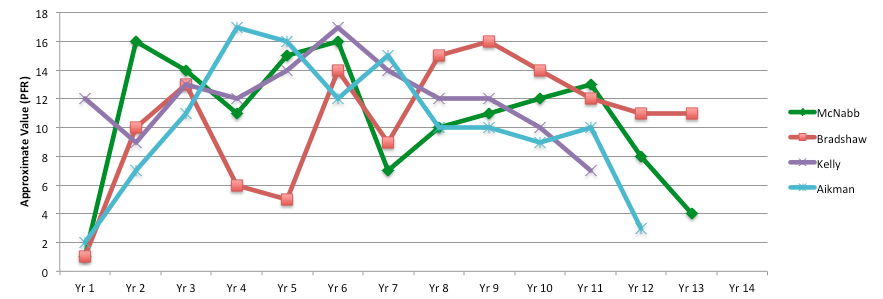
I realize that Bradshaw and Aikman both get bonus points for SB wins, but if that’s the point of differentiation, then Kelly is still unexplained and you’re saying McNabb was 4 points away from being a HOFer, a ridiculously fine line to draw. Overall, using Approximate Value, it’s clear that McNabb, once again, belongs among this group.
The “Worm-Burner” Weakness
The next aspect of the anti-McNabb case I want to address is the point people use to discredit the strongest part of McNabb’s resume. Donovan McNabb has one of the most impressive TD/INT ratios of all-time (2.0). He also has one of the lowest interception rates ever (2.2%, 4th overall behind Rodgers, Brady, and Neil O’Donnell).
The man did not throw interceptions. That’s a very good thing.
However, in response to this, people frequently mention that McNabb played too conservatively. Many times, he threw the ball into the ground, giving nobody a chance to catch it. The common refrain is that he didn’t “give his guys a chance”.
Is this a fair critique?
Well let me put this a different way.
Imagine you are McNabb. Your best receivers each year are: Chad Lewis, James Thrash, Todd Pinkston, Reggie Brown, Kevin Curtis. No joke, those were the Eagles leading recievers from 2000-2008, with TO excluded.
Now tell me, with those WRs, how comfortable would you be throwing 50/50 balls? Do you think it’s an admirable decision to let James Thrash fight it out with a DB for the pass? Reggie Brown?
Donovan McNabb had just one full season with an elite WR, 2004. That year, he completed 64% of his passes, threw for 31 TDs with just 8 interceptions. He also led his team to the Super Bowl, losing by 3 points to Tom Brady and the Patriots.
Given just one chance, McNabb took full advantage of having an elite WR, putting up historically great numbers and getting to the Super Bowl. Also note, he played with the same roster in the playoffs as in the regular season.
Compare that to Jim Kelly’s Buffalo Bills, with Thurman Thomas and Andre Reed. Or to Troy Aikman’s Cowboys, with Emmitt Smith and Michael Irvin (among others).
McNabb put up similar numbers (better if you include the running stats) with a FAR inferior cast around him. That has to count for something. His reticence to “force the throw” is completely understandable, and in fact was likely the optimal play the vast majority of the time. Not sure I can make it any clearer: based upon the standard set by the current HOF QBs, McNabb definitely belongs. At least the Eagles franchise has recognized that and will retire his number. Forget all the bullshit (you’d be bitter too) and focus on the numbers, it’s not nearly as “borderline” as people make it.
What else you got?









 Eagles Rewind