Optimizing for Chemistry

It’s no secret I was not exactly satisfied by this offseason.  It wasn’t terrible, but it wasn’t great either (I know it’s not over, but the roster-movement phase is largely done).  Between the draft, free agency, and the D-Jax cut, it’s been hard to find a logic thread connecting all of the moves.  For the most part, it looks like the Eagles realize they’re still in the “build” stage of team construction.  That explains the draft.  Smith, Matthews, and Huff are all fine prospects, but as I’ve covered before, they shouldn’t be expected to contribute a lot in year one (the team knows this, the fans haven’t realized it yet).

It also partially explains the Jackson move.  Howie/Chip don’t want to pay a WR that much, and Jackson’s cap hit was going to hurt at some point, especially when it came time to extend Foles, Cox, Kendricks, etc… Now that doesn’t explain the TIMING of it (why now and not next offseason), but it at least has some logic to it.

On the flip side, though, there’s the trade for Darren Sproles.  If you’re still in “build” mode, you probably aren’t looking to give up draft picks for a 30+ year old running back.  I still haven’t quite figured this one out.  Similar to the rookies, I don’t think the team plans on using Sproles as much as fans seem to think they will.  If that’s true, though, a 5th round pick is a lot to give up for a part-time, fill-in weapon like Sproles.  I think this is mainly insurance.  The Eagles know they are heavily dependent on McCoy, and despite what they say, they know there’s at least the risk that the offense without Jackson wouldn’t be as dynamic (that was phrased very carefully so as to avoid another blogwar).  Picking up Sproles gets some of that dynamism (word?) back, at least in theory.  Using Sproles as a band-aid until Ertz and Matthews are ready to step up might be the play here.  I don’t think it makes sense from a resource allocation standpoint, but I can understand not wanting the offense to slide too far.

So that’s the “build” theory of the offseason.  The Eagles overshot expectations last year, meaning fans are now expecting too much this season (recency bias).  The Eagles are not yet ready to contend, and management knows this.  They’d like to contend for the division this year (and with the competition it doesn’t seem that difficult), but they’re more focused on the year AFTER next season.  That’s when the “window” should really start opening if things go according to plan.

There is another story in here, though.  As the title indicates, it’s Chemistry.  Not only is Chip trying to remake the team on the field, he’s trying to instill a different attitude off of it as well.  I don’t think anyone would argue differently.  Whether you call it chemistry, attitude, locker-room presence, or whatever, it’s clear Chip’s trying to change it.  I’m not going to get into whether that’s good or bad.  The general attitude of the team is important.  I don’t typically address it because it’s intangible and unquantifiable.  There’s not data.  Without data, it’s impossible to form an objective opinion of any real value.

BUT….we can analyze it conceptually.  Let’s assume for a minute that Chemistry is both important AND can be quantified.  So for each player we can assign a Chemistry rating, Madden-style.  So along with things like Speed, Size, Catching ability, etc…, prospects and players are analyzed by Chemistry as well.

Now, what happens if you want to optimize for Chemistry?  In other words, in that situation, if you wanted to increase the overall Chemistry rating of your team, what are the other effects?

First, we need to ask a very important question.  Is Chemistry correlated to any other attribute?  So if we assigned a discrete rating for “Skill” as well, would that rating be tied in any way to the Chemistry rating?  Let me start by saying I don’t think they’re positively correlated.  The most “skilled” players do not seem to be more likely to be high “chemistry” guys.  In fact, anecdotally, it seems more likely that the two are negatively correlated.  For now, though, let’s just assume NO CORRELATION.

If there is no correlation, and you want to optimize for Chemistry, you’re going to face a trade-off in skill.  Note that optimizing for BOTH is the same thing, you’re just trying to minimize the negative trade-offs.   So let’s say you’re choosing between three players with the following ratings:

Player A:  Chemistry (90), Skill (70)

Player B:  Chemistry (80), Skill (80)

Player C:  Chemistry (70), Skill (90)

Which player do you choose?  If you’re overall goal is to improve the “Chemistry” on your team, you will take player A, despite that fact that he is less skilled than the other two.  Or, you might compromise and take Player B.  What you WON’T do is take player C.  So one war or another, you’re NOT maximizing Skill.

If we apply this conception to the Eagles, we can see a few issues.  We believe Chip is actively trying to improve “Chemistry”.  As I’ve just explained, doing so will involve trade-offs with other attributes, most notably Skill.  Therefore, it is reasonable to assume that, in the “Chemistry” building process, there will be at least a near-term shortfall in skill.

Now think about DeSean Jackson.  Great player, but probably an asshole in the locker room and during practice.  Think of him as Player C above.  Cut him and the overall Chemistry of the team improves.  However, the overall Skill also decreases.

Over the long-term, a change in attitude is probably a very good thing.  BUT, assuming that the process of improving the team’s attitude does not involve trade-offs anywhere else is foolish.  NOTHING IS FREE (well except trading 6th round picks for multiple 7ths).

This also might explain the Matthews and Huff picks.  By all accounts, those two players rate very highly in our “Chemistry” attribute.  I can see why Chip liked them.  But if that played a role in their selection, it’s likely the team passed on more “skilled” players.  That’s not necessarily a bad thing and I’m not suggesting that it is.   Long-term, the hope is that this leads to a team that’s not only successful, but one you can be proud to root for.  But it takes time, and it requires tradeoffs.


Short term setbacks and My Response to Tommy Lawlor

In my last post, I mentioned that, from my point of view, there’s a relatively significant chance that the Eagles will take a “step backwards” next season.  Many people took exception to that, specifically Tommy Lawlor over at Igglesblitz.com.  Today I will respond, after I make a few important points.

First, I have not made any projection for this team yet.  It’s very possible that after examining each factor in more detail, I’ll come to a different conclusion. However, it’s foolish to do such an analysis now.  There are simply too many things that can happen between now and the start of the season.  Moreover, we’ll get more information about specific players as we move through the summer and training camp.  Once that’s all finished, I’ll have an “official” projection that probably looks a lot like what I did last season.

Second, I’m relying on a number of factors, not just the on-paper roster changes, when I suggest the potential for a step-back.  For example: Nick Foles’ regression, injury regression, aging, harder schedule, etc….  Each of those (and there are others) requires an in-depth analysis, and deserves a full post.  I won’t do much of that today, but rest assured we’ll take a closer look between now and the beginning of the season.

Third, I am not a pessimist or perma-bear.  In fact, prior to last year, I was one of the few Eagles writers/bloggers/analysts/whatever predicting such a good season.  I thought Nick Foles should start from the beginning.  I thought Chip Kelly was a great hire, provided Lurie was confident he really wanted to be in the NFL.  I projected the team to win between 9 and 10 games.  How did I do that?  An objective analysis of the team, including a deep look into what made the 4-12 team that bad (a lot of bad luck).  Here’s the important part though:  If you’re truly being objective, the numbers and factors say what they say, and you need to be willing to believe them whether that’s good or bad.   Ideally, the team does its own analysis before the season, identifies (objectively) the expected performance distribution for that season, then tries to make specific moves to improve it.   Here, we can only do the first part.

Lastly, the rest of this post is done in typical “takedown” form.  However, I want to stress that this is NOT a “takedown”.  As Tommy said, we’re all better off when smart people look at the same information and disagree, provided we’re each willing to change our stance in light of new evidence or arguments.  The biggest virtue of blogs, in my opinion, is that they allow this type of back-and-forth in a public forum.  These blogger-to-blogger conversations happen a lot in finance and economics (though they’re not always as civilized as they should be) but rarely in sports.  That should change.  Moreover, and perhaps most importantly, he’s actually provided a response to some of the things I will say below, and I encourage you to go read it at Igglesblitz.com afterwards.

In italics you’ll find Tommy’s words.  Mine are in regular type.

First, I don’t get why Jordan Matthews and Josh Huff can’t be expected to contribute. DeSean Jackson and Jeremy Maclin both contributed as rookies, and that was in a more complex passing offense.

The questions isn’t “can they contribute?”, it’s “how much can they reasonable be expected to contribute?”.  The track record of rookie WRs, unfortunately, is not good.  I will do a full post about this with a more in-depth look at the statistics, but for now just note that from 2000-2013, 49 WRs were selected in the 2nd round and played at least 10 games in their rookie years.  The average receiving yards of that group is 437.  Jordan Matthews was taken in the second round.  

That does NOT mean he won’t do better.  I’m very confident he will.  BUT, when you’re making a projection for him, you need to keep that context in mind.  If you say he will register around 800 yards, just know that would be nearly TWICE as good as the average 2nd round WR.  Again, I’ll have more detailed stats later, but the upshot is: be very careful in assuming any significant contributions from rookie WRs.  There are a number of reasons Matthews might be different, and they are important to note as well.  But if you’re analyzing those factors without reference to the context of average rookie performance, you’re not going to end up with very good projections.

Speaking of Maclin, why isn’t he mentioned at all? I know he’s coming off an ACL injury, but that happened last summer and these days players are coming back from standard ACL tears at a pretty high rate.

If the Eagles tried to replace Jackson with just a rookie or just Maclin, I could see some extreme skepticism. Instead, the Eagles brought back Maclin spent 2 early picks on WRs and added Sproles to help the passing game.

I should have mentioned Maclin, though Tommy hits on the primary reason for concern.  He’s coming back from a torn ACL injury.  I intend on doing a post-ACL injury study to see just what we can expect from Maclin, but for now I don’t have any numbers.  Yes, Maclin has come back from a torn ACL before.  But I’m not sure that’s a good thing.  The fact is, we don’t know one way or the other, at least until I do the analysis (provided there is good data on WR cal injuries).  However, even at 100%, he is a VERY different receiver from DeSean, and the offense will look much different with him as a #1 option.

I explained in two very detailed posts just why DeSean will be so hard to “replace”.  I won’t rehash that here, just see those posts.  We can argue about why DeSean had such a good year and whether it was him, Foles, or Kelly that deserves the credit; but that doesn’t actually matter!  The point is, whatever was going on, DeSean + Foles + Chip = one of the most ridiculous and unique seasons EVER put up by a WR.  Again, see the post.  If DeSean was still here, we’d have to look at whether that was largely luck or whether it could have persisted.  With him gone, though, we can say that it will not persist (it can’t).

While I like Maclin, I think it’s a near certainty that he isn’t putting up a 65% catch rate while going deep 40+% of the time.  He’s just not that type of player.  So the offense will undoubtedly look different, even with Maclin at full strength, whether it ends up better or worse is a tougher question to answer.

I’m less impressed by the addition of Sproles than many others seem to be.  He obviously represents some “addition”, but I think fans are getting carried away a bit.  He’ll be 31 at the start of next season and he’s just not the same player he was a few years ago.  Over the past three years, his receptions, yards, and TDs have declined.  So has his yards per rushing attempt.  We can examine the general performance/age correlation for RBs in more detail later, but I’ll tell you right now that it’s not good.  The upshot is that I don’t see any good reason to expect Sproles to exceed his production from last year (604 receiving yards) and he will likely do worse, considering his trend.  There’s a lot more to look at there, and I haven’t looked at his “advanced” stats like target rate and catch rate, but that’s my hypothesis for now.  It’s not as if Sproles is leaving some terrible offense either, he’s been catching passes from a HOFer for the past 3 years.

Combined, Maclin and Sproles and the Rookies certainly COULD fully compensate for losing Jackson.  I just don’t think it’s likely, or if it is, I don’t think it will be enough to compensate for risk factors elsewhere.  Moreover, while they might match his production on a pure yards/TDs basis, there are additional effects that are harder to account for.  For instance:  DeSean likely helped open things up for the rest of the offense more than a 100% Jeremy Maclin can.  Again, that needs analysis, but I think that hypo is more reasonable than the opposite (saying Maclin will have greater effects on the rest of the offense).

The defense added a veteran Safety in Malcolm Jenkins. That means that Nate Allen and Earl Wolff will battle for the other starting spot. Nolan Carroll and Jaylen Watkins add depth at CB. If you don’t think that is important, just go re-watch the loss to San Diego. Bradley Fletcher missed that game and Philip Rivers threw for 419 yards and looked like Peyton friggin’ Manning.

Of course depth is important, but from a pure points for/against standpoint, the 1s and 2s matter far more than the rest.  Malcolm Jenkins is a nice addition, but let’s be clear: he’s not a great player.  He’s an OK safety.  Last season he registered an Approximate Value of 6.  Nate Allen, by comparison, registered a 7.  Pro Football Focus says QB’s registered a Rating of 101.8 when targeting him last season.  He’s also never played in all 16 games.  So the value of Malcolm Jenkins is debatable.  I do believe the Safety corps will be better than last season, but I’m not seeing a great leap in performance.

I do like the Nolan Carroll addition.  No argument there, he definitely helps the CB depth chart.  Jaylen Watkins is a different story.  He’s a 4th round pick.  It’s possible he contributes on D this year, but I don’t think that’s likely, given the historical performance of later round DBs.  Note: I like the pick!  I just don’t think it will pay big dividends THIS year (which is pretty much the overall theme of this offseason).

Marcus Smith adds depth up front and gives the coaching staff an athletic option to mix into different packages if they want. He can play on the right or left side. The backup LOLB last year was Casey Matthews. That meant the coaches stuck with Connor Barwin as much as humanly possible.

Marcus Smith is a wildcard.  However, if the Eagles do take a step forward this year (record-wise), he really HAS to play a big role.  I don’t think the depth chart sets up that way.  Long-term, Smith might turn out to be a great pick.  However, we’re only concerned with this season.  I’m going to put him in the wait-and-see category for now, because we’ll learn a lot more about his potential usage during training camp and preseason.  It’s just very difficult to tell how much playing time he’ll get this year.  Without a lot of snaps, he obviously won’t be able to make a big impact.

The qualitative benefit of having better depth behind the 1s is real, but the magnitude is difficult to evaluate.  If having Smith allows the Coaches to make more optimal strategic decisions, then his impact could be big beyond the snaps he sees.  However, how much stock can you put in this?  Again, we’re not trying to predict what WILL happen!  We’re trying to get a sense of what is MOST LIKELY TO HAPPEN.  Just as we can think of hypos benefitting the team, we can also think of hypos working against them.  If you’re not looking at both sides of the coin, your analysis is incomplete.  For example, maybe Smith isn’t ready to be an impact player but the Coaches want to get him snaps to speed along his development.  Sounds reasonable, right?  Of course, that would (probably) leave the team with worse on-field performance in the near-term (this season).

Ideally Chip Kelly would rotate his players on defense to limit some of their wear and tear. The Eagles played more snaps on defense than any other team last year. They didn’t have the depth to rotate as much as they wanted. Players like Smith and Watkins and Taylor Hart and Beau Allen can help that situation. They don’t have to start or make lots of plays in order to help the defense.

Might be a valid point, and it’s one I’ll have to take a longer look at.  To the extent the additions to the defense allow the 1s to play fewer, higher impact snaps, there could be an increase in overall performance.  However, beyond Smith we’re talking about late-round draft picks.  Over the long-term, most of these guys (late rd rookies in general, not just these specific players) will NOT contribute anything significant to the team.  We know this. It’s possible the Eagles had a great draft and that each of these guys will see the field this season, but it’s NOT likely!  The objectively reasonable assumption is that guys drafted from the 4th round and beyond will contribute, if at all, on Special Teams.  I do think the Eagles STs will be much better this year than last.  BUT, STs just don’t have a very large impact on games.  They absolutely matter, but generally speaking, teams do not get a lot better just by improving on STs.

I get that the Eagles lost a star player in DeSean Jackson and didn’t replace him with an obvious star. That fact is going to skew the perception of some folks when it comes to the offseason discussion. I don’t know if Brent is in that camp and I don’t want to try and speak for him.

I’m not sure enough people appreciate the Foles angle in regard to DeSean Jackson. Foles doesn’t have a great arm and he’s not a consistently good vertical passer. Jackson had 3 catches that covered 50 or more yards from Foles. One was a short pass from Foles in the MIN game that Jackson turned into a big play with a long run after the catch. There was the 55-yard TD vs the Packers on a ball that was underthrown. Foles did make a pretty good throw for a 59-yard gain in the Oakland game.

Jackson is a dynamic deep receiver. Foles is not a dynamic deep passer. Jackson was still a good receiver for Foles and the Eagles last year, but his value becomes diminished because of the fit. You’re limiting what makes him special.

I don’t understand this line of argument.  Again, see my posts on DeSean’s performance last season.  He was spectacular last year.  One of the best WRs in the league.  That doesn’t mean getting rid of him was a bad idea, perhaps there’s a rational “scheme” or “chemistry” argument there.  But that’s LONG-term thinking, not short-term.  In the SHORT-term, i.e. next season, the Eagles offense has lost a dynamic weapon.  There’s just no way around it.  Repeating myself: This might be a long-term positive, but a short-term negative.

There is no denying that losing Jackson will affect the offense, but I think it won’t be nearly the same as if Vick or even McNabb was the QB. They were much better vertical passers. Foles excels on short and intermediate throws. This is where having a WR corps of Cooper, Maclin, Matthews and Huff should be fine. You lose some verticality, but gain some physicality.

As I said above, the offense will definitely be different.  The question is: is the “physicality” more than enough to make up for the loss of “verticality”.  Also, I don’t quite understand the QB argument.  Foles and Jackson did great things last year.  Yes, Foles is not the deep passer Vick is, but why does that matter?  Foles is still the QB, and he did great things with Jackson last season.  Maybe Tommy is saying the Eagles weren’t dependent on the deep game last year.  That’s probably true (I need to check), but it doesn’t mean that losing it won’t hurt a lot.  The WR corps certainly seems to “fit” Foles better, but just how many WRs/TEs can you really have running short routes?  Someone has to go deep, regardless of the QB’s strengths, and Jackson was really good at that.  Conversely, I don’t see the huge benefit of “physicality”, outside of perhaps the running game, which was already great.  

I think the offense will still be very good (assuming OL stays healthy, another potential issue given age), but last year the offense was great.  A small step backwards seems like a reasonable expectation.

It would have been great to see the Eagles land some major impact players this offseason, but the team didn’t miss out on anyone that I coveted. There was no Kearse or TO to go get. Brian Orakpo would have made the most sense, but he got tagged. I admit to being curious about DeMarcus Ware, but age and injuries have started to affect him. Darelle Revis would have been interesting, but I’m guessing Kelly didn’t want a “mercenary”. Revis wanted a 1-year deal so he could turn around and go for another mega-deal in 2015.

There were no slam dunk, can’t miss, gotta have him guys for the Eagles.

Agree completely.  But the above explanation is also completely irrelevant.  It perhaps explains why the Eagles didn’t make more significant additions.  But it doesn’t mitigate the fact that they didn’t.  Again, I don’t hate the offseason moves, I just don’t see them translating to big short-term benefits.

Another question some may have is at QB. If Foles gets hurt, can Mark Sanchez or Matt Barkley win games? That is a mystery. But it also would have been with Vick. He was an erratic player for the Eagles and lost his starting job last year. He didn’t want to return as a backup. I’m not worried about Sanchez or Barkley for a game or two. You can argue that having Vick would have helped if Foles went down long term, but then you have to acknowledge Vick’s biggest problem…getting hurt himself. He never stayed healthy for the Eagles and when he got dinged, his performance level dropped quite a bit.

I think Sanchez is a better acquisition than people realize. He failed in New York because the Jets saw him as a franchise QB, which I don’t, and because they failed to keep the right pieces around him. Sanchez has made some big plays in some big games. He’s just not a guy you build a team around. I think he can be a solid backup.

I like Sanchez less than Tommy does, but in the end it doesn’t matter.  We’re talking about next season, and Nick Foles was healthy (mostly) last season.  I don’t think anyone would argue that if Foles misses significant time this year, the team will take a step backwards in performance, regardless of which backup plays.  Health is always major risk factor, but I’ll have more on that later.  The fact that the Eagles got such good QB play last season means they’re more likely to receive worse play this season!  Foles’ expected regression is a HUGE issue that I’ll analyze later, but I’m very comfortable saying he will not duplicate his performance (he can play a lot worse and still be really good, though).

While the team may not have gotten the dramatic help many wanted, I do think it got better. I see the loss of Jackson and Jason Avant as a wash when you look at Maclin, Matthews, Huff and Sproles coming in. I realize I’m projecting with the rookies, but they have the size, skills and athleticism to help right away. They also have experience in a similar offense that makes the adjustment easier.

The defense didn’t lose any key players, but added a good FS, some CBs and an athletic OLB. How is that not an improvement?

Tommy’s is ignoring the fact that while some players will improve, others will get worse!  I addressed the rookie WRs projection above.  I agree that the defense got better, I just think it did so by a smaller amount than Tommy apparently believes.

Overall, what I’m seeing is: Moderate step back on offense, small step forward on defense, and an improvement (potentially large) on special teams.

If you’re stuck on Jackson, that’s fine. I disagree, but I get that.

Not “stuck” on Jackson, I’m done analyzing it as a strategic move.  But if you’re comparing last year’s team to this year’s team, it’s impossible not to address Jackson.  He’s the biggest piece either added or subtracted.  I know people are tired of hearing about him, but he simply MUST factor into any year-over-year comparison or analysis.

I just think the team brought in too many talented players to think that it took a step back. That isn’t to say the Eagles might not go 9-7 this year or something like that. There are no guarantees when it comes to results. We saw that when the 2011 offseason happened and the Eagles added all the big names, but the team got worse.

If you’re asking me whether I like the 2013 roster better than the 2014 roster, no way.  I’ll take the current group in a heartbeat. Kelly has brought in another set of players who fit his system and fit his football culture. They also happen to be pretty talented as well.

We’re much closer to agreement here than it might seem.  For the long-term, I like this year’s roster better.  For this season, though, I think there’s a significant chance of a step backwards, but that also relies on factors beyond the roster.

As I said above, most of these points need more unpacking and research, and I hope to do that over the next few weeks.  The possibility for a step backwards is there, though.  That doesn’t mean I hate Chip Kelly (I love Chip), or the direction of the team (I like it a lot). We’d be foolish, though, to drink so much Chip-flavored Kool Aid to believe he is infallible, or that EVERY one of his moves will work.  They won’t, at least not quickly, and this year that could be a problem.
Draft Talk

Now that everyone’s had a chance to recover from the draft, it’s time to start breaking it down in more detail.  I had a few notes earlier this week, but today I want to take things a bit further.  First, though (as usual), I have to clear a few things up regarding the TPR model:

– The TPR model is not predictive; it is not meant to be.  Moreover, I developed the TPR model as a conceptual demonstration of what I believe to be the correct method of drafting.  Namely, consensus forecasts are more valuable, over the long term, than those of individual scouts.  Additionally, any useful draft board has to account for the difference in positional impacts.  Unfortunately, I don’t have nearly enough data to work with, hence the TPR model is mainly useful conceptually, and not practically.  So, just because the TPR model lists a prospect as a “reach” or a “steal” does not necessarily mean it was a bad pick, we’re just nowhere near the confidence level required to make such classifications.

However, that doesn’t mean we should ignore it.  While the model can’t tell us anything definitively, it can certainly shed light on particular picks and prospects that warrant increased scrutiny (that’s the law classes bleeding into my vocabulary).  So, I don’t want to represent that the TPR model is definitive.  Also, my personal opinions diverge from the model’s results sometimes (significantly in certain cases).

Hopefully that clears things up a bit.

That brings us to the Eagles draft.

Overall, I thought the team did OK:

– The trades, in particular, were phenomenal.  Getting a 3rd round pick for moving down 4 spots in the 20s is an absolute heist.  Getting anything for Bryce Brown is as well.  I like Brown, but it was abundantly clear last season that he did not fit the new offense.  The trade up for Jordan Matthews wasn’t quite as good, from a probabilistic view.  But, I’m willing to cut the team more slack here because (a) it was in the 2nd round, and (b) I really like Matthews.  With Lee coming off the board at 39, Matthews appeared to be the top WR remaining for most people (not the TPR rankings though).  As a result, he probably wouldn’t have been there at 54 (Davonte Adams, another WR, was taken at 53).

Theoretically, it’s possible the Eagles could have traded up fewer spots and still grabbed Matthews, but we have to assume Howie chose the best option available.  Hence, the Matthews trade wasn’t a great one, from a strategic standpoint, but it also wasn’t bad.

– I mentioned the possibility of saturation drafting at the WR position.  Hopefully you listened, because that’s exactly what the team did.  Rather than taking on in the first round, the Eagles took two later on.  See this post for the full breakdown of why that was a good decision.  Note, though, that the idea behind saturation drafting is that it dramatically increases the odds of finding ONE good player.  Hence, the Eagles are likely to get a good WR out of this draft.  That does NOT mean that both Huff and Matthews are both likely to pan out.

– The Eagles also seemed to follow what I had outlined as my Plans A, B, and C.   Plan A was to draft a LB (Mosley or Barr), Plan B was to draft a S (Pryor or Dix), Plan C was to trade down or take the best CB available.  Those top 4 players were off the board at 22 (Dix went with the 21st pick), so trading down became the best option.  Post-draft buzz says the Eagles also would have taken Cooks or Beckham (WRs) if they had been available at 22.  Regardless, I was pretty happy with the 1st round strategy (though not necessarily the end result).

– The Eagles did, however, take a LB after trading down to 26, just not one of the players we were all expecting or hoping for.  This, of course, is the biggest question in the Eagles draft:  Was Marcus Smith a “reach”?

The short answer is yes.  Howie admitted as much.  He said that the team really wanted an OLB and that Smith was the last player at that position they’d be happy with.  So they traded down a few spots and grabbed him.  That’s a relatively defensible strategy, provided they REALLY like this kid and there really weren’t other opportunities to trade down farther (but not too far).  However, it does seem like a low-probability play.  See the disclaimer above, but Smith was ranked just 140th overall in the TPR model.  He was selected 26th…  The only comparable “reach” in the first two rounds was the selection of Justin Britt, chosen 64th overall by the Seahawks.  He was unranked (i.e. not in the top 150).

One the bright side, the model does not differentiate between 3-4 and 4-3 positions.  Generally, I don’t think this is a big deal.  BUT, if there is one position the model is probably undervaluing, it’s the rush LB in a 3-4 scheme.  That seems to be where Smith fits.

Moreover, it’s been reported that there were two other teams ready to move up for or ready to draft pick in the late first round.  I’ve explained previously why I’m somewhat skeptical of reports like that, but to the extent it IS true, it adds confidence to the pick.

The upshot is: there were almost definitely higher probability prospects available at 26.  So Smith was not the optimal choice.  That doesn’t mean he won’t work out.  Drafting for need CAN result in fantastic picks, because a “hit” occurs where it will have the biggest impact.  However, it’s a higher risk play, because drafting for need means you pass on prospects with better chances of panning out.

So…Higher risk, higher reward (though the tradeoff is not equal, hence sub-optimal).  I’m guessing some fans are fine with that strategy, especially because the Eagles were able to trade down first before doing it.

– You’ll hopefully remember that I don’t pay much attention to the late round picks.  They usually don’t matter.  It’s fun to get excited about these guys, but the cold hard fact is that nearly all of them will end up either not making the roster or as bottom-of-the-depth-chart players.  So Taylor Hart, Beau Allen, Ed Reynolds….hope for the best, but it’s not worth spending much time analyzing them now.

The Bad News

There are a couple of higher level issues I have with this year’s draft:

– The team did not draft an OL.  I’ve made it clear that I think the aging line is a big area of risk.  The team’s offense revolves around the running game, and Foles isn’t exactly going to run away from guys that get through.  I was hoping the team would at least add a late-round OT (those guys have much higher hit rates than any other late-round position).  Maybe they means they’re confident in the current depth OL.   At some point, though, the Eagles will need to start lining up replacements for Peters and Mathis.  Herremans I was kind of hoping would be replaced this offseason…

The danger is in having to replace them all at once.  That’s the situation the team should be trying to avoid, because finding one good starter is hard enough.  Finding 3 at the same time almost guarantees that you’re going to have a big hole for at least a season or two.

– The Eagles, on paper, appear to be a worse team than they were last season.  I know this is a long term build, but it still hurts to see the team take a step backwards.  On offense, the team lost D-Jax and added two rookie WRs (not likely to contribute) and Darren Sproles (old and getting older).  On defense, the team added Malcolm Jenkins and Smith, who seems unlikely to start.  I know people expect guys like Ertz, Kendricks, Logan, etc…to get better, and that will probably happen (for at least 1 or 2 of them).  Still, I just don’t see any reasonably objective way to say this teams roster is better now than it was last season.

Again, I’d rather look long-term than short, but just start preparing yourselves for a potential step-backwards season.


Post-Draft Notes

Not going to do an in depth draft breakdown until later this week, but I did want to throw a few notes/comments up before then:

– It’s possible that Chip Kelly has an informational advantage over the rest of the league, for now.  As a college coach, Chip recruited/scouted/coached a lot of these players before.  Of course, every team had ample time to scout before the draft, but actually game-planning for a player or getting to know him while he’s in high school might provide a better insight into that player’s pro potential.  I wasn’t thrilled with last year’s draft process; I though a trade down in the 1st round made a lot of sense and felt the team reached for Bennie Logan.  However, as it stands now that draft looks pretty good.  Therefore, I’m inclined to give Chip the benefit of the doubt for the time being.  That doesn’t mean I’ll hide  my skepticism, it just means the “process” might deserve more credit than we can give it from an outsiders perspective.  If this advantage does exist, though, it will only last another year or two, so the team needs to take advantage of it now.

– Notice I kept saying “Chip”, and not “Howie and Chip”.  If there was any doubt remaining about who is really making decisions, this past weekend should have cleared that up.  Two Oregon players?  A trade up for a WR?  Chip is the one making the call, for better or worse.

– On the whole, I liked the players selected but didn’t like where they were taken.  The draft is an exercise in probability and value-maximization. I think the Eagles fell short in this regard, Regardless of how these players pan out.  Smith was clearly a reach, Howie pretty much admitted it.  Reaching for need generally does not work out…. Also, please don’t put too much stock into the “someone else was ready to take him” stories.  EVERY time there is a “reach” pick, there’s inevitably some “source” that says Teams X, Y, and Z were ready to take the player if Team A passed.  That’s a bit convenient, isn’t it?  If there were other teams ready to take a guy like Smith in the first round, SOMEBODY would have mentioned it as a possibility.   Instead, Chip decided he NEEDED an OLB out of this draft.

That’s why free agency is so important.  If you go into the draft with NEEDS, it makes it very difficult to maximize value, because you’re always scared you’re going to be left with a big hole.

Note: This DOES NOT mean Smith isn’t going to pan out.  He seems like a great fit for the defense and his speed/cover experience should help a lot.  However, the Eagles likely missed out on some additional value by not trading back farther (Howie said he didn’t want to go as far as the options he had) or taking a different player at 22 and rolling the dice to see if Smith was there at 54 (or trading up from 54 to get him, as they did with Matthews).

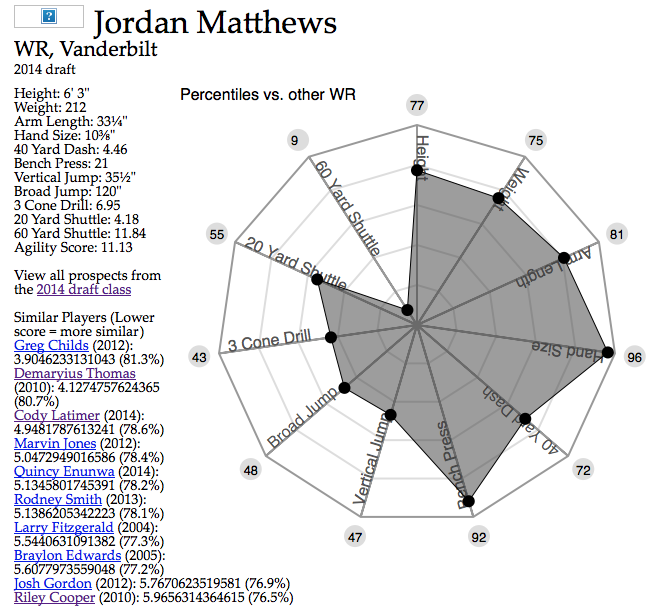
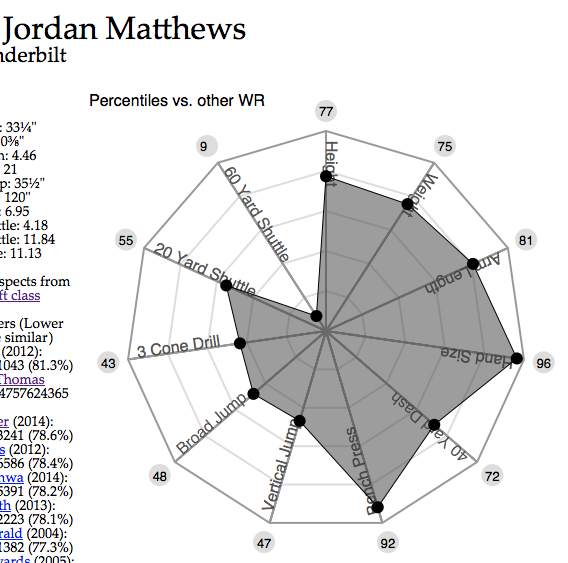
– I spent most of the pre-draft period talking about the WR position.  Needless to say, trading up for one wasn’t one of my preferred strategies.  I’m happy the Eagles ended up with Matthews (see his comparable players from mockdraftable.com below), but going up to get him like that is a low-probability move.

– Two Oregon Ducks.  Really?  Again, not saying they’re bad players, but what are the odds that the Eagles, going with a BPA strategy, just happened to select 2 of Chip’s former players?  This could go either way, of course, hopefully he knows these guys well.  But if could also mean he’s letting personal bias into the equation, in which case there’s a serious “process” problem.

As I said, I’ll have more later this week.  Until then, salivate over the following.  Demaryius Thomas, Larry Fitzgerald, Marvin Jones, Josh Gordon…pretty good company…

Screen Shot 2014-05-11 at 7.27.36 PM

The Rules for Drafting (Abbreviated)

Today’s the day.  Let’s go over the ground rules and lay out a few key things to watch for.

The Rules

1) Do not fall in love.  Trading up for a player or reaching for someone is a surefire way to blow things.  Regardless of how confident you are in a certain player, we know that there is a significant chance that you’re wrong.  Failing to understand the uncertainty in your own evaluations/models is a killer, no matter what industry you’re in.

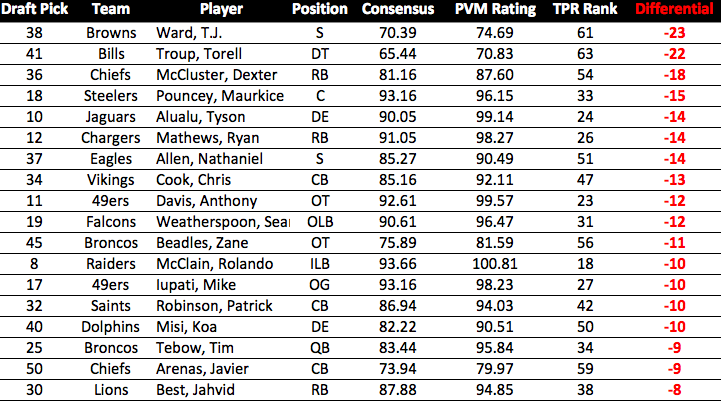
2) If a players “falls”, there’s usually a reason for it.  A “reach” pick, though, is usually just a bad pick.  This ties into the first point.   Below is a chart showing the biggest “reaches”, as I’ve defined them (difference from TPR), from 2010:

Screen Shot 2014-05-08 at 3.52.27 PM

Some of those guys are good players.  Most of them are not.  Not only did most of these players “bust”, but they probably cost the teams that chose them more than they should have.  If there’s a player you really like, trade down until he makes at least some sense at that draft spot.  Chances are you are not smarter than the rest of the league.

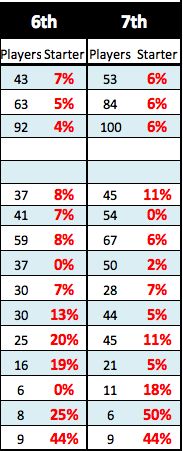
3) The 6th – 7th round arbitrage.  Always trade down in the 6th round.  Look at these success rates:

Screen Shot 2014-05-08 at 3.56.33 PMScreen Shot 2014-05-08 at 3.55.54 PM

Do you see the difference in success rates between the 6th and 7th round?  No?  That’s because there isn’t much difference.  Think about every draft pick as a lottery ticket.  The 1st round picks have the highest probability of “hitting” and those odds decline as you progress through the draft.  BUT, once you get to a certain point in the draft (somewhere around the 6th round), the odds flatten out.  At that point, everyone has roughly the same (low) odds of becoming a starter in the league.

I realize that every team gets to the 6th round and still has “fifth” round guys or better on their board.  That’s where self-awareness comes into play.  That late in the draft, NOBODY KNOWS ANYTHING.  If the player of interest was that good, he wouldn’t still be there.  As far as “free lunches” in the NFL Draft go, this is the most obvious.  Trading a 6th for two 7th round picks essentially doubles your odds of success.  It’s a no-brainer, and will be available for as long as there are over-confident GMs (so forever).

There’s obviously a lot more, but I’ve gone over most of it in the past and let’s face it, you won’t remember more than 2-3 of these anyway.

Things to Look For

– Teddy Bridgewater, Dee Ford, Ra’shede Hageman, Ryan Shazier, Eric Ebron Bradley Roby.  If you’re an Eagles fan, you should be hoping to hear these names called before #22.  As I see it,

Plan A for the Eagles is Mosley or Barr,

Plan B is Pryor or Clinton-Dix,

For one of those guy to all, we need some of the guys I listed to go earlier than expected.  Also watch the WRs and QBs.  A run on either of them is very good for the Eagles.

– Watch the QBs.  Last year, the top QB prospects, according to the “experts”, fell an astonishing distance in the draft.  This might be an anomaly.  Perhaps there’s information the teams had that the draftniks didn’t, in which case those guys didn’t really “fall”.  However, it’s also possible that GMs have adjusted to the increasingly passing-dependant league by holding QB prospects up to higher standards.  Maybe GMs, in general, are not as willing to overlook flaws at the QB position like they have in the past.  If so, that’s BAD for the Eagles, and we’ll see guys like Bortles, Bridgwater, etc.. fall.  Paradigm shifts are very rare, but that doesn’t mean we shouldn’t keep an eye out for them either.

– Trade down scenarios.  It’s really anticlimactic, especially when the Eagles have such a late pick, but a trade-down might be the best outcome for tonight.  Like I said, Plan A and B involve guys slipping a bit.  That’s unlikely.  Failing a shot at a top LB or S, moving back and grabbing another pick or two looks like a good plan.  As I showed earlier this week, the WR available at 54 will likely be nearly as good as one available at 22.  Additionally, while there are just 15 players rated 80-90 in my TPR rankings, there are 53 rated between 70 and 80.  Picking up another 2nd round pick would be well worth a trade-down if the defensive impact players are off the board.

– Trade up scenarios.  Lot of talk, and I hope that’s all it is.  If the Eagles do trade up, it means the probably made a strategic error (maybe a big one), but it DOESNT mean the draft’s a failure.  Trading up CAN be the right move, it just requires a degree of confidence that should be very rare.  But “very rare” does not mean “never”.  It’s possible, and if the Eagles trade up, I’ll obviously root for that to be the case.

– Lastly, Chip should have an advantage for this year and next.  Chip recruited and scouted a lot of these players.  This is the type of inside knowledge that couldlead to the type of confidence I talked about above.  If Chip can leverage his knowledge in the draft this year, it’ll go a long way towards building the foundation of a team that can contend for a long time.

That’s all.  It’s been a ridiculously long wait, but the draft is finally here.  Enjoy it.

Hacking the Draft

For those of you who don’t remember, last season I did a historical analysis of draft pick success according to position and round.  Below is one of the posts stemming from that project.  At the bottom are two charts showing round-by-round probabilities.   Note: counting someone as a “starter” is a bit subjective.  Inclusion in the below data means that a player started for at least 5 years in the league (according to Pro-Football-Reference), or if they joined the league less than 5 years ago, has started for more than half the time.  The sample is all players drafted between 1999 and 2011.

Hopefully everyone has enjoyed the round-by-round breakdown.  While there are obviously a number of variables that can’t be controlled for, the pure statistical look at each position group has already provided some interesting insight.

Before I get to the big chart, let me just clarify exactly what I think this type of analysis is good for, then dig into an Eagles example.  Feel free to skip to the chart and come back.

The purpose of this is NOT to arrive at a set of rules by which teams should draft players.  Instead, it is meant to provide a general guideline, or a “default draft position”.  For example, yesterday I said that selecting DEs in the 3rd round is a terrible value proposition according to the data I’ve collected.  That doesn’t mean drafting a DE in the 3rd round is ALWAYS a terrible decision, it just means that for a team to make that decision, it must see or know something about the subject player that makes him CLEARLY much better than any other prospect available at that position.

The biggest flaw in NFL draft strategy, as far as I can tell, is each team’s confidence in its own ability to evaluate talent.  Regardless of the general manager, every team has historically had a very large margin of error when it comes to talent evaluation.  For instance, in the 1st round less than 6 in 10 LBs selected from 1999-2011 had or are having significantly productive careers (according to our definition.)

So what does that mean?  It means teams, in general, should be mostly focused on value during the draft, as opposed to parsing prospects.  This is perhaps never more apparent than when a team decides to trade up to select someone.  Let’s use the Eagles as an example.  NOTE: This is a very rough example, with numbers pulled from my ass, and is only meant to illustrate a larger point.

When the team traded up for Brandon Graham, it swapped 1st round picks with Denver and gave up two 3rd rounders as well (moving up from 24 to 13).

At the 13th pick, no DEs had been taken.  Between picks 13 and 24, 3 were taken, including Graham.  So that means the Eagles, in their analysis, decided that they had to take a DE (will not argue that decision here, though I was mad they passed on Earl Thomas, and can produce witnesses that will verify I said that when it happened).

The only way the trade made sense was if the Eagles, in their DE analysis, decided that the odds of Graham becoming a stud DE were MUCH higher than the odds of JPP, Morgan, or Hughes becoming a stud DE.  Here is where the “margin of evaluation error” comes into play.

Using our historical draft data, we can calculate the odds of getting a starting DE with a 1st round pick and two 3rd round picks (I realize they were hoping more than an average starter, but stay with me).  Using the table below, we can calculate those odds to be 81.5%.  Using the Pro Bowl percentages from the earlier tables, we arrive at 37% for the odds of getting a Pro Bowl DE if you select DEs with a 1st round pick and 2 third round picks.  So here is the breakdown for “generic DEs”:

– 1st Round Pick – 24% chance of Pro Bowl, 67% chance of starting

– 1st Round Pick and 2 third round picks – 37% Pro Bowl, 81.5% starting.

Please note that this DOES NOT mean the Eagles made a bad decision.  Obviously the odds should be better for the 13th pick than for the 24th pick (we’ll get to that another time).  It DOES MEAN, however, that the Eagles, in their evaluation of Brandon Graham, should have been almost certain that he was more than 37% likely to be Pro-Bowl caliber, and more than 81.5% likely to start.

I have no doubt that they believed this, BUT, if they had applied a margin of error to their own analysis (as any good team should) prior to making the trade, they would have been unlikely to go through with it.  Let’s be extremely generous and assume the Eagles front office could peg these odds with a MOE of +/- 15% (WARNING: overly simplified statistics).   That means if they estimated Graham had a 90% chance of starting, his true odds of starting were almost definitely between 75-100%.

Immediately we can see an issue.  Even giving Graham incredibly high odds of starting (90%, which is more bullish than any team should be with any players outside the top few picks) and the Eagles a very generous MOE (+/-15%), the resulting range still does not exclude the 81.5% starting odds for the generic position of a first and two thirds (although it is near the bottom of that range).

That means the Eagles really should NOT have been (though I’m sure they were) confident that Graham would be better than just taking whichever DEs were available at #24 and in the third round, and hence, should not have made the trade.

I don’t mean to suggest that trading up is never a good idea, simply that the evaluative bar for whichever prospect is the target must be EXTREMELY high, and much higher than the standard currently being applied by most teams.

My final point:  Teams do not appear to take a probabilistic approach to drafting (which they almost certainly should), and I would guess that they do not actively overlay a margin of error onto their evaluations.  This is very much a “new-school vs. old-school” issue, similar to the statistical revolution in baseball, but IT IS NOT THE SAME.  It is largely a matter of GMs being willing to recognize and account for their own shortcomings and cognitive biases.  The franchises that can apply this will, in the long run, be more successful than those that don’t.  (Looking into which teams might be using this type of strategy will be another day’s post)

Ok, enough talk.  Here is the chart with every round included. I removed the All-Pro and Pro Bowl columns to make it easier to compare.  Dig into it and see what you think.  Later this week we’ll mine it for an “optimal default strategy”.

I updated the chart soon after the original post,  here is the updated version; so the numbers might not match the post exactly.  The original is reproduced below.

Screen Shot 2014-05-07 at 10.29.30 AM

Screen Shot 2013-01-29 at 10.54.06 AM

Examining the WR prospect tiers

There’s a lot of talk about the Eagles potentially trading up for a WR, or at least taking one with their 1st round pick.  Peter King has them giving up their 1st and 2nd round pick to get Odell Beckham Jr.  I’ve been very clear about why I think this is a poor strategy (trading UP for a WR is an unbelievably bad decision).  For more on those reasons, see my last post.  Today, though, I wanted to look at it from a different angle and discuss things in light of what the actual WR class looks like.  Previously, I left it at “it’s deep”, which doesn’t really provide the full context.

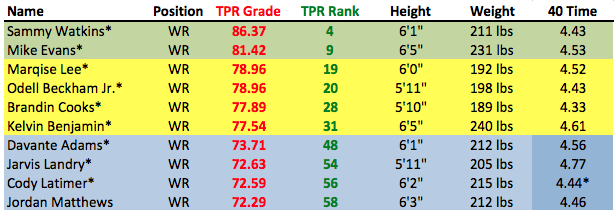
From my TPR rankings, here are the top 10 WRs in the draft.  Remember, since each of these guys play the same position and I took individual standard deviation out of the formula, these relative rankings are purely rankings are primarily the result of the NFL.com, ESPN, and NFP grades.  The multiplier stratifies the class a bit, but the effect is small.

Screen Shot 2014-05-06 at 10.04.32 AM

We can ignore Sammy Watkins and Mike Evans.  I’m sure Chip would love to grab Evans, but it’s extremely unlikely he falls out of the first 10 picks.

Instead, let’s focus on the second tier, the yellow shaded area.  Here we have four WRs that have all, at various points in time, been linked to the Eagles.  If the Eagles come out of the 1st round with a WR, it’s nearly a certainty that it’s one of these four guys.  But that’s not what we’re here for, is it?

Looks closely at each of those prospects and look at the grade assigned.  Now, how certain are you that you can identify which one will be the best NFL player?   “Not at all” is the correct answer.  I’m sure the Eagles have different grades and a different order of players, but the fundamentals are the same.  You need to ask yourself two questions:  How big is the difference between each prospect’s grade?  How big is the margin of error in our evaluations?

Within each tier, the MOE (if you’re being honest) is almost definitely larger than the difference in grades.  Therefore, practically speaking, they all have the same grade.  I other words, they all have the same expected value.

So why would you want to pay more for one of them than they other?

Now, let’s take aim at Peter King’s rumor, which is:

Eagles trade up for the 15th pick and select Beckham.

First, let’s see how necessary that trade is.  If they complete it, obviously they get Beckham.  If not, though, how likely is he to be available at the 22nd pick?

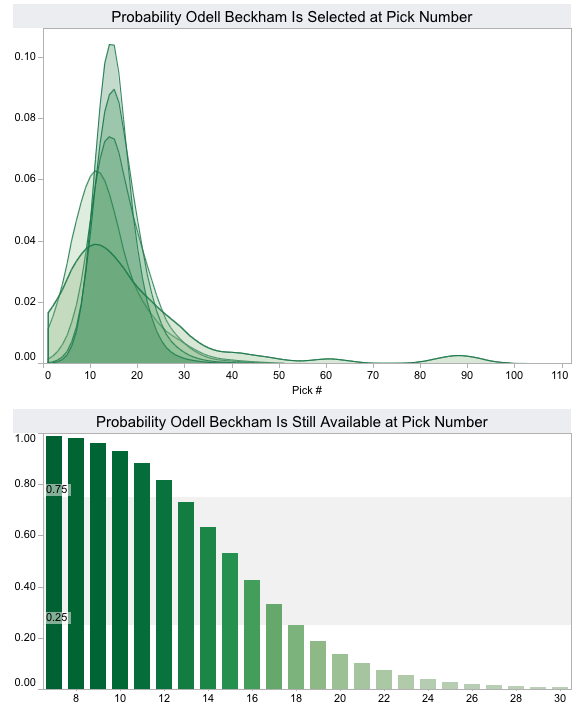
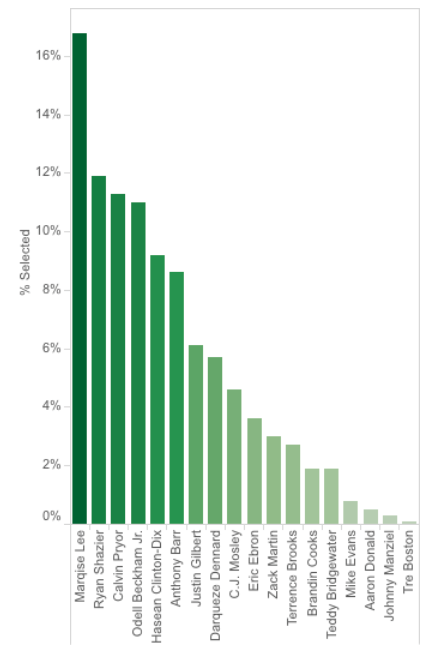
Well it just so happens that Brian Burke of advancedfootballanalytics.com (new name) has just released a Bayesian prediction model for the draft.  Obviously, we can’t put too much weight into this just yet, but it’s a very good representation of the type of thinking every team should be doing.  Here is Beckham’s output:

Screen Shot 2014-05-06 at 10.25.12 AM

According to this model, there is just a 7% chance that Beckham is available at the 22nd pick.  There is a 53% chance he is available at the 15th pick.  The Eagles would only make the trade if he was actually available at 15, so we don’t have to worry about that second probability.  Just note that it’s basically a flag that says: even if the Eagles and Steelers want to make that trade, there’s a 50/50 chance it won’t happen.

So, if the Eagles want Beckham, it looks like they really do need to move up.  How about the other guys in that tier?

There is a 51% chance that Marqise Lee will be available at 22.

There is a 21% chance that Brandon Cooks will be there at 22.

There is a 92% chance that Kelvin Benjamin is there at 22.

Now, these aren’t completely independent probabilities, so what I’m about to do isn’t 100% “correct”, but it’s not unreasonable either.  Combining those probabilities leaves us with a:

.49 * .79 * .08 = .03 or 3% chance that none are available.

So, the Eagles can give up their 2nd round pick for a 100% chance of Beckham, or they can keep their pick and have a 97% chance at one of the other three guys in that same tier.

Now can you see why trading up is such a terrible value?  We’ve already covered the margin of error issues.  Regardless of which players are in the same tier, conceptually they are all worth the same “value”.  So if the Eagles tiers looked like mine, they’d essentially be trading a 2nd round pick for a 3% increase in the odds of getting a WR from their desired tier.

That’s also known as a catastrophically bad use of resources.

Now let’s look at it a little differently.  Let’s say the Eagles do have Beckham rated significantly higher than the other three guys in that tier.  The operative question then becomes: how much higher?

This is important because we have to account for the opportunity cost of the 2nd round pick (which is large).  That brings me to the concept of saturation drafting.  In short, there’s no rule against using multiple picks in one draft on the same position.  For example, let’s say the Eagles have decided they NEED a star WR out of this draft.  They can:

A) Do Peter Kings trade, after which their odds of gaining a star WR will be whatever the odds of Beckham becoming one are.

OR

B) They can NOT trade their 2nd round pick, and use it on ANOTHER WR!

To examine this possibility we need to know who will be available in round 2.  Let’s move to the next tier on our list.  This one:

Screen Shot 2014-05-06 at 10.47.24 AM

What are the odds those players are available at the 54th pick?

Davonte Adams – 38%

Jarvis Landry – 62%

Cody Latimer – 8%

Jordan Matthews – 37%

Once again, they’re all in the same tier, and the individual margin of error means they each of roughly the same expected value.  Given the odds above, that means there is a:

.62 * .38 * .92 * .63 = .136  that none of those guys are available at 54.  Flipped around, that means there is a 86% chance one of those players will be available at 54.

Going back to our two options, that means the Eagles, spending the same amount of draft resources, can have:

100% chance of Beckham

OR

97% chance at a player like Marqise Lee AND an 86% chance at a player like Jordan Matthews.

Now, if you NEEDED a star WR, would you choose option A or B?  That ignores a lot of other options (for example, you could trade up in round 2 to give yourself a 100% chance of a 3rd tier WR), but it lays out the conceptual problems with trading up for a WR in round 1.

That’s a very long way of saying what I’ve said before:  If you are going to trade up for anyone, ESPECIALLY a WR, you need to be extremely confident he’s much better than the next guy.  Realistically, I just don’t see how the Eagles could possibly be that confident.

Therefore, trading up for a WR is a very poor strategic decision.  Remember, you’re not picking players, you’re picking lottery tickets.  Each one carries a different likelihood of “hitting”, but they all have risk of busting.  All you’re trying to do is maximize your odds.

The Eagles rankings undoubtedly look different from the tiers I’ve used above, but it really doesn’t matter what names you put in which tier.  Unless the Eagles think the gap between Beckham (or whomever) is EXTREMELY LARGE, trading up doesn’t make any sense.

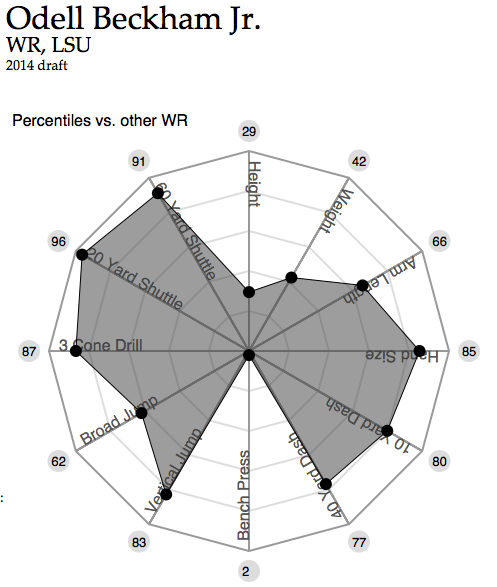
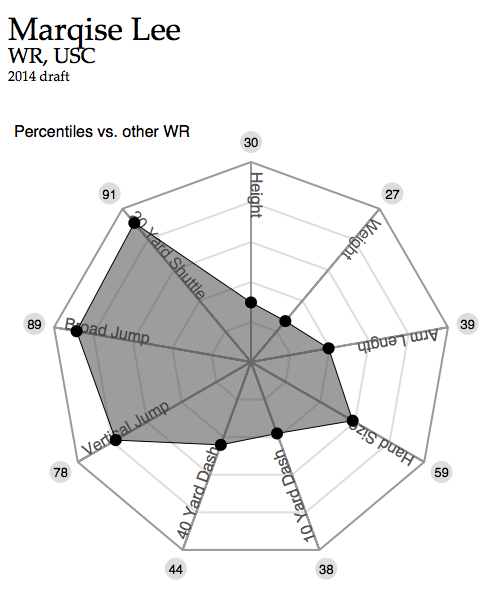
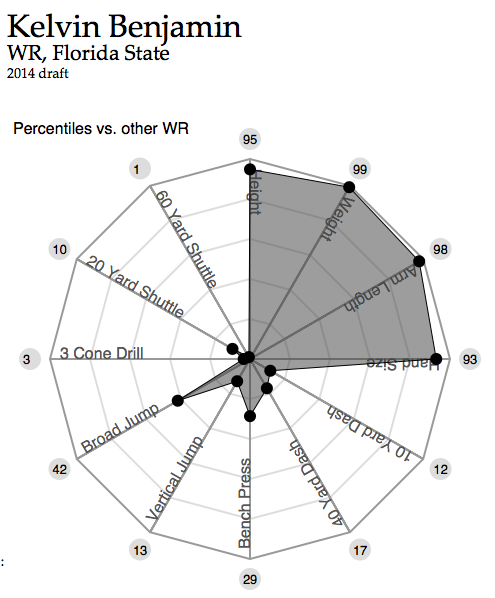
Lastly, I’ll leave you with some spider graphs (from mockdraftable.com):Screen Shot 2014-05-06 at 11.01.38 AMScreen Shot 2014-05-06 at 11.02.14 AM

Screen Shot 2014-05-06 at 11.03.16 AMScreen Shot 2014-05-06 at 11.03.55 AM

Screen Shot 2014-05-06 at 11.05.11 AM


Projecting the Eagles Pick

The draft starts this Thursday, which means we have about as much information as we are going to get regarding scouting reports, projections, team interests, etc…  Normally, I don’t do much projecting for the draft. I’ve been pretty clear in the past regarding optimal draft strategy (i’ll try to repost those this week), and the major takeaway is: Do Not Fall In Love With One Player.   That’s arguable the single most destructive thing a team can do.  Nobody’s projections are perfect.  In fact, they’re so far from perfect that the margin of evaluative error likely outweighs the difference between most (or all) prospects within a given tier.

However, I do want to point everyone to a post over at BGN.  James Keane took my TPR rankings and a set of team needs compiled by SBNation local sites and created this probability-driven simulation for the draft.  The results are pretty informative, but they’re not perfect.  I encourage you to read the post and play around with the simulation (it’s interactive), but I’ll cut to the headline.  Here are the “most likely” players to be drafted by the Eagles with their 1st round pick:

Screen Shot 2014-05-04 at 4.37.31 PM

Now about that “not perfect” part.  The biggest issue I see with the above list is Ryan Shazier.  I don’t think he’s a legitimate target for the Eagles.  Unfortunately, the system (my rankings and team needs) don’t allow for the resolution needed to differentiate between weak-side OLBs and strong-side OLBs.  Shazier looks to be a good fit at the WILL spot in a 3-4 defense.  Of course, the Eagles already have Mychal Kendricks there.  I haven’t done any scouting, so perhaps Shazier can be a pass-rushing 3-4 OLB (Trent Cole’s spot), but I doubt it.

Removing him from the list, we’re left with:  Marquise Lee (WR), Calvin Pryor (S), Odell Beckham (WR), Ha-ha Clinton-Dix (S), and Anthony Barr (LB) followed by two CBs.

As much as I disagree with the idea of selecting a WR in the first round, that seems like a pretty good projection given what we know about the Eagles and Chip Kelly.  So those are the guys to watch if you’re looking to do some pre-draft research.

Now, a note on WRs.  Here’s why I don’t like the idea of taking one in the first round:

– The Eagles just cut D-Jax.  Many are suggesting that the team now NEEDs a new WR weapon.  I think that’s backwards.  Ideally, the Eagles would have felt comfortable cutting Jackson precisely because they felt like they DIDNT need him.  If the Eagles end up using a 1st round pick on a WR, then the opportunity cost of the D-Jax move skyrockets.

– The WR position is widely considered the “deepest” in the draft.  If that’s the case, why take one early?  If a position is truly “deep”, then it means the best value MUST lie in selecting one relatively later in the draft.  “Deep” means there are a lot of high-quality players and that the difference between the best guy and the 7th best guy (just throwing numbers in there) is smaller than normal.  Hence, taking one of the first guys is a relatively poor value.

– Lastly, Wide Receivers have the highest miss rate of any position in the 1st round, according to the research I did for the Hack the Draft post.  In other words, WRs carry the highest inherent risk.  Confidence in an individual player can not mitigate the systematic risk inherent in that position.  When you combine that with the relatively small contributions rookie WRs make, it seems like a poor strategy for a team that still has holes throughout the roster.

Officially, I’m just rooting for a value-maximizing pick that adheres roughly to the TPR rankings I developed.  Personally, though, I’d love it if that pick happened to be a Safety (as I’m sure most of you would).

Or maybe they’ll just trade for Johnny Manziel…

2014 TPR Rankings

They’re here.  Below you’ll find the TPR rankings for the 2014 draft.  Scroll down if you don’t just want to see the numbers, but there are a few things we have to discuss before getting there.

As you know from my most recent posts, I’ve had to change the formula this year.  Part of that was by design; I always intended to tweak it over time in order to provide a better representation of what I think is, conceptually, the right way to think about the draft.  So what’s different this year?

I’ve dropped the individual standard deviation.  In theory, I still like this variable as a proxy for each prospect’s individual risk.  If scouts widely agree on a prospect’s ability (i.e. rating), that prospect should represent less risk than a prospect for whom there is wide disagreement.  Unfortunately, the change in grading scales has made using StDev much more complicated.  That, combined with the fact that I only have three different scouting ratings for each prospect, means StDev, as I can currently calculate it, is probably not a reliable proxy for idiosyncratic risk.  However, I still hope to use it in the positional ranking charts.

– Without StDev, we’re left with two factors: Systematic Risk and Positional Value.  This year, I’ve combined them into one factor, an overall Risk/Reward Multiplier.  Our stand-in for Systematic Risk is the Positional Hit rate I calculated for each position when I put together my “Hack the Draft” cheat sheet.  I’ve taken that measure, and multiplied it by the PVM values I posted yesterday.  Basically, we’ve now got an “Expected Positional Bonus” that combines positional impact with historical positional risk.  Make sense?

Just to recap, our formula now looks like this:

Consensus Rating * (1 + (Positional Hit Rate * PVM))

Also, I want to remind everyone what the goal is.  We are NOT trying to predict the draft.  Every team has it’s own scheme, for which different players fit and do not fit.  Additionally, while Relative Value (BPA+) is the best drafting strategy, you can’t be 100% blind to need.  For example, the Seahawks aren’t taking a QB in the first round.  The rankings below tell us, in a probabilistic sense, what the default ranking of prospects SHOULD be if we wiped everyone’s roster clean.

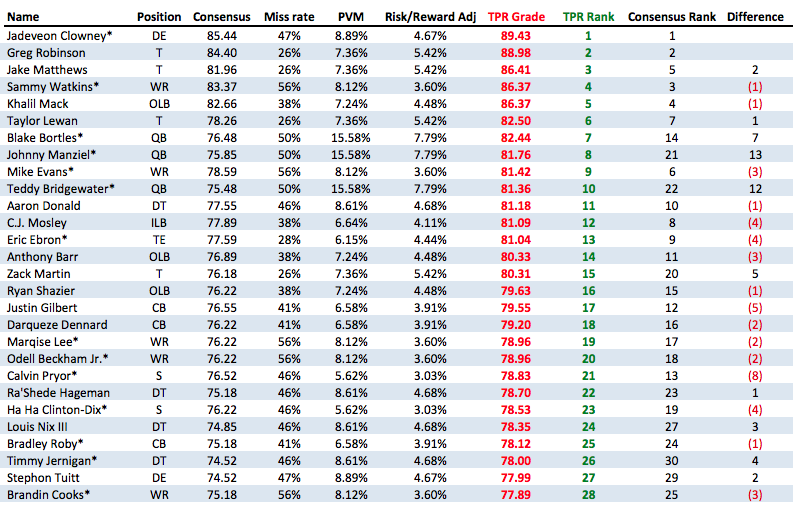
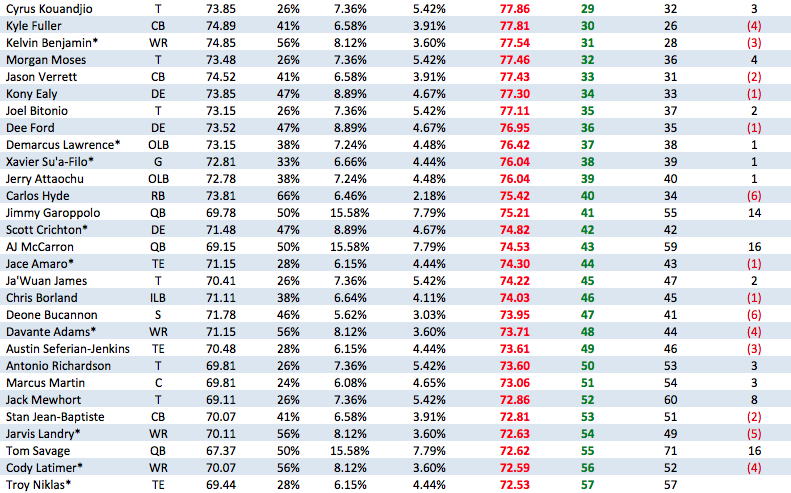
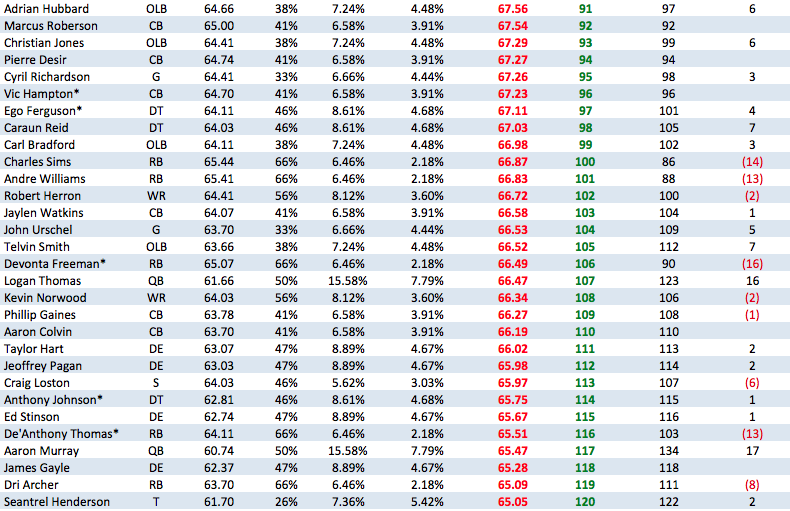
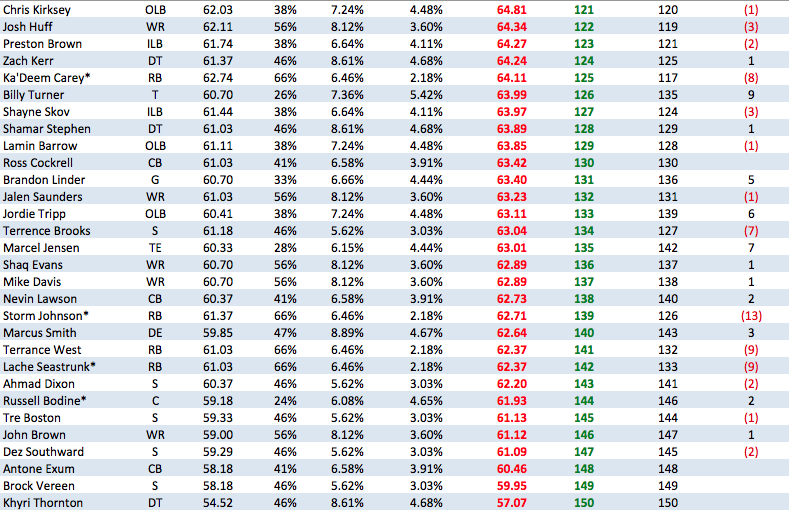
In other words, if the league was starting from scratch, this is how I would rank the players.  Note that I’ve shown each factor.  Miss rate does indeed show the miss rate by position.  I’ve adjusted that in the calc (to flip it to Hit Rate), so it’s not a mislabel or mistake.  Also, for the consensus ratings, if NFP did not rate a player, I plugged in a score of 5 for him (which is a very bad score).  NFP claims to not rank anyone they rate as 4.9 or below.  In the far right column, you can see the players for whom the Risk/Reward adjustment made the biggest difference; a positive number means they were helped by the adjustment.

Here’s the top 150, sorted by TPR Rank:

Screen Shot 2014-04-28 at 9.25.57 AMScreen Shot 2014-04-28 at 9.28.48 AMScreen Shot 2014-04-28 at 5.56.38 PMScreen Shot 2014-04-28 at 9.29.59 AMScreen Shot 2014-04-28 at 9.30.54 AMScreen Shot 2014-04-28 at 9.31.55 AM


2014 Positional Value Multipliers

As promised, I’ve calculated new positional multipliers for 2014.  Obviously, the main purpose of deriving these values is to apply them to our Consensus Ratings.  However, before I did that, I wanted to give the Multipliers their own post, because they show slight differences from last year.

As a refresher: The general idea of the multipliers is to properly account for the differing impacts of each position.  For example, a QB has a much bigger impact on the game than a Center does.  Therefore, all other things being equal, the QB prospect will be of more value than the C prospect.  The question is, how do we account for this?

Fortunately, the NFL has a salary cap, which means the league has done our work for us.  Since each team has finite resources, the way they distribute their cap space can, in theory, tell us how they value each position.  Looking at the league numbers in aggregate, we can get a sense of the default relative value the league places on each position.  However, it’s not as easy as just taking an average of every salary at each position.

We’re mostly concerned with the top of the draft (first 3 rounds), where teams are, hopefully, trying to identify and select future starters and stars.  Additionally, we have to account for positional scarcity.  There are a lot more CB snaps than QB snaps, by virtue of two CBs being on the field for every offensive play.  So, here’s what I did:

1) Used Pro Football Focus to determine how many players at each position played at least 50% of their team’s total snaps.

2) I then divided each of those measures by 4.  Basically, this tells me how many players are in the top 25% at each position.

3) Then I simply took the average of every cap hit that fell within that measure.

For example, 28 QBs played at least 50% of their team’s offensive snaps last year.  Divided by 4, that means 7 QBs comprise the top 25% of starting QBs (roughly speaking). The average of the top 7 QB cap hits this year is $18,407,457.

Pretty straightforward.  I did that for each position, then used their relative values to arrive at the PVM values listed below.  Next to them are last year’s values, along with the change year-over-year.

Screen Shot 2014-04-26 at 11.26.30 PM


The biggest gain in value was at the Center position.  The multiplier for Centers, while still relatively small, is 2.87% higher than it was last year.  Conversely, both CBs and RBs have seen their values decline somewhat substantially.

Perhaps most interesting is the placement of Safeties.  Despite the conventional wisdom being that Safeties are increasing in importance, the values above show they’re actually worth LESS than they were last season.

The top four spots remained the same (QB, DE, DT, WR), but after that, the order shuffled quite a bit.  However, note the spread of values between the 2nd highest and the lowest for both years.  As you can see, this year there’s a much narrower range.  With just two years of data, we can’t draw any substantial conclusions, but it’s certainly something to keep an eye on.

Next up, we’ll slap the Consensus Ratings and the PVM values together, along with our Risk factors (which I’m changing slightly), and arrive at our PVM Big Board…finally.  Sorry for getting this up so late in the game.  Turns out the NFL’s new draft schedule coincides precisely with law school finals.