Expect TEs and RBs to be a Focal Point of the Eagles offense

Patrick Causey, on Twitter @pcausey3

In case you haven’t noticed, the Eagles have several sizeable holes on the offensive side of the football. The only reliable receiver on the roster to date is Jordan Matthews, while the Eagles’ offensive line faces questions thanks to Jason Peters losing his battle with Father Time and Lane Johnson losing his battle with integrity. In a league predicated on protecting the quarterback and passing the football, that could spell trouble for the Eagles.

But the talent at tight end and running back could mitigate some of these concerns. Zach Ertz, Brent Celek and Trey Burton give the Eagles one of the deepest and most versatile tight end units in the league, and their presence should not only bolster the team’s receiving options but also help ameliorate the offensive line issues. And the oft-overlooked Darren Sproles could become a revelation in this offense, reassuming the Danny Woodhead-type role he practicaly invented in New Orleans.

These players could have helped the team last year, but Chip Kelly’s religious adherence to the 11 personnel — three wide receivers, one tight end, and one running back — meant more Miles Austin and Riley Cooper, and less Ertz, Celek, Burton, and Sproles. Of all the frustrating things about Kelly’s tenure (and there were many), his preference for allowing scheme to dictate playing time — instead of talent — was at the top of my list.

I would expect the opposite to occur under Doug Pederson, with tight end and running back being key cogs on this offense, especially in the passing game. Look no further than Pederson’s mentor, Andy Reid, to get an idea of how involved they could become. Dating back to 2000, Andy Reid coached teams have had a running back or tight end rank in the top two on the team in catches every single year (all numbers courtesy of Pro-Football-Reference.com):

That’s 15 years of heavily involving the running backs and tight ends in the passing game. That should be welcomed news for a team that — as Brent laid out earlier — have yet to see a good return on their investment in the wide receiver position.

More Tight Ends Please: 12 and 13 Personnel and the Y-Iso

Both Pederson and offensive coordinator Frank Reich recently praised the tight ends as a strength of the Eagles’ offense, hinting that they will have an expanded role this year. And if Pederson’s time at Kansas City is any indication — where they routinely relied on 12 (two tight end sets) and 13 (three tight ends) personnel groups — he will follow through on that promise.

We saw this on the first drive of the first preseason game, when the Eagles lined up three tight ends in a power run formation deep in the red zone. It was a jarring site to behold after watching three straight years of the Eagles foolishly running exclusively out of the shotgun:

The benefits of using multiple tight ends in the run game are obvious. Tight ends are typically larger, and better blockers than receivers, so it helps create better lanes for a running back to exploit. The extra reinforcements will be especially important during the first 10 weeks of the season when Lane Johnson is suspended.

The extra blockers should also help in the passing game. Last season, the Chiefs had issues all along their offensive line, but especially at the guard position. The Chiefs combated those concerns by keeping in extra blockers to buy Alex Smith more time to attack the defense down field.

Here, the Chiefs line up in 12 personnel, with Kelce and Demetrius Harris as the two tight ends. Kelce gets open and scores an easy 42-yard touchdown, but the play was made possible by Harris and center Mitch Morse double teaming J.J. Watt.

Given Celek’s strength as a blocker, I would expect to see him giving help to Allen Barbre often this season, easing the blow of losing Johnson to suspension. It’s a smart use of the players at your disposal, but was rarely something that Kelly did last season.

Extra tight ends has the secondary benefit of setting up the play-action pass, which is one of the few areas that Sam Bradford performed at an elite level last year. Indeed, if you continue to run the ball down a defense’s throat with the 12 or 13 personnel, they will counter by stacking 8 men in the box to stop the run. That creates easy pickings for the play action pass over the top, something the Chiefs used successfully last season with Travis Kelce:

The Chiefs routinely exploited the matchup problems Kelce’s size, speed and route running ability presented. He was too big for safeties, too fast for opposing linebackers, and that mismatch was especially problematic in the redzone. But it didn’t just occur by happenstance. Pederson/Reid purposefully designed plays to get Kelce in favorable matchups in the end zone.

Watch this play design. The Chiefs are using their 13 personnel, with three tight ends lined up at the top of the screen. Kelce is on the outside and is going to run a post pattern in the end zone. But watch as Harris and James O’Shaughnessy run staggered post and in routes at 5 and 10 yard intervals, respectively. They occupy the middle linebackers and safeties, freeing up Kelce for a one-on-one matchup on the outside.

Zach Ertz presents a similar matchup problem for opposing defenses, and flashed big time talent down the stretch last year catching 30 passes over the final three games of the season. But Kelly rarely designed plays for his best players, including Ertz. Kelly believed that he could scheme players open and expected his quarterback to find the open target, regardless of who it was. I don’t expect that to be a problem this year. Ertz should quickly become Sam Bradford’s favorite red zone target, with Pederson designing plays like the one above to get Ertz in favorable matchups.

Pederson will also look to generate favorable matchups by the location in which tight ends are placed on the field. The Chiefs routinely spread tight ends out wide against cornerbacks, which is like posting up a power forward on a shooting guard. It just isn’t a fair matchup for the defense.


The final, and perhaps most significant way we will see the tight ends get more involved is through the “Y-Iso” formation.  The formation consists of trip wide receivers on one side of the formation and a tight end lined up in the Y receiver spot on the other side. Bill Belichick reintroduced this to the league a few years back, unleashing Rob Gronkowski on unsuspecting defensive backs in a hilariously unfair mismatch.The Chiefs — and many other teams in the NFL — followed the Patriots lead and have used the Y-Iso formation to great success.

According to Pro Football Focus, the amount of snaps in the Y-Iso formation has more than doubled since 2011, rising from 1,569 to 3,503 in 2015. The Chiefs and San Diego — were Frank Reich was the offensive coordinator — ranked fourth and fifth in the league in Y-Iso snaps, respectively.

In week 16 last year against the Browns, the Chiefs lined up Kelce in the Y-Iso formation at the bottom of the screen, while three receivers were split out on the opposite side of the field. Kelce is matched up one-on-one with Pro Bowl cornerback Joe Haden, who has safety help over the top. That is, until Jeremy Maclin occupies the safety just long enough to free Kelce for the easy score.

If you watch Maclin closely on this play, I am not entirely sure he is even looking to catch the ball. It looks like he ran his route solely for the purpose of occupying the safety so that Kelce could get free. Regardless, that is just a great play design by the Chiefs, and another example of how Ertz, Celek and Burton could be used this season.


The Return of Darren Sproles

I’ve already laid out why I think Mathews could be an effective running back, but even at the tender age of 34, Sproles could finally become the dynamic threat in the passing game we all envisioned when he was acquired from the Saints. Sproles was Danny Woodhead before Danny Woodhead, and that fact was not lost on Frank Reich (who was Woodhead’s offensive coordinator last year in San Diego):

When Sproles was acquired by the Eagles in the 2014 offseason, he was coming off back to back seasons of being targeted over 100 times. During those two years, Sproles caught a combined 161 passes for 1,377 yards, and 14 touchdowns. He was a matchup nightmare and one of Drew Brees’ favorite targets.

But in Sproles’ three seasons with the Eagles, he has caught only 166 passes for 1,379 yards and 3 touchdowns. Kelly often praised Sproles dynamic ability, but failed to consistently use him.

If Frank Reich’s use of Danny Woodhead in San Diego is any indication, I wouldn’t expect that to continue. In 2013 and 2015 (Woodhead missed most of 2014 due to injury), Woodhead combined for 156 catches, 1,360 yards and 12 touchdowns in the air. Woodhead was Phillip River’s safety valve and one of his favorite red zone targets. And despite being viewed as only a third down back, Woodhead had 597 offensive snaps last season according to FootballOutsiders.com, which ranked 13th in the league among running backs and was 201 more snaps than Melvin Gordon, who was supposedly the starter.

Comparatively, Sproles had 393 offensive snaps last year under Chip Kelly, which ranked 35th in the league and placed him behind the likes of Theo Riddick and Isaiah Crowell. Even if Sproles isn’t used as often as Woodhead was last year — and indeed, I would be surprised if he was given his age — I expect to see smarter play designs aimed at getting the ball in Sproles hands.

Notice the play design here? It’s the Y-Iso formation we covered earlier. This play isn’t as important so much as what it does for setting up Woodhead to score on the next series, but play along for a minute. Ladarius Green is in the Y-Iso formation with Melvin Gordon lined up in the backfield on the same side of the field.  Green breaks free on a crossing pattern and scoots in for the easy score.

On the very next drive down in the red zone, the Charges call the same Y-Iso formation, this time with Green on the opposite side of the field and with Woodhead in the backfield instead of Gordon. Having just been burned by Green for a touchdown, the Raiders defense doubles Green, leaving Woodhead wide open for an easy score.

This is a great play call from Frank Reich and an example of how an offensive coordinator can set up certain play calls during the course of a game. Reich knew the defense would recognize the formation and stick Green, and used that aggressiveness against them. Sub in Ertz and Sproles for Green and Woodhead — different players, but likely the same results.

The Chargers didn’t just target Woodhead out of the backfield, either. They did a great job moving Woodhead all over the field, splitting him out wide and lining him up in the slot. Against the Dolphins (where Woodhead scored 4 total touchdowns), Woodhead was able to spring free with a nifty out and up route for a score.

Later in the game, the Chargers again dialed up a play designed to spring Woodhead for an easy score. Woodhead is lined up out wide on the lower side of the field, while the Dolphins are in man coverage with a single high safety.  The Chargers break Woodhead open by running a pick play on Woodhead’s man. That’s just easy money.


Over the last few years, I have been calling for the Eagles to use Sproles in a similar fashion. He is so difficult to cover in space given his precise route running and overall shiftiness. They rarely took advantage of that the last three seasons, but I expect to see Sproles (and perhaps Smallwood) get an opportunity to shine in the passing game this year.

I came into this season with serious reservations about the Eagles offense and their head coach, Doug Pederson. I still have those reservations, but digging into the film more gives me some hope that the offense will not be a total train wreck.

Both Pederson and Reich have a history of catering their scheme to their personnel, which is a nice contrast from the Chip Kelly experience. Given the Eagles holes at receiver and the potential issues along the offensive line, I expect to see the tight ends and Darren Sproles more heavily involved in the offense. It might not be the most prolific offense in the league, but it should be more effective and efficient than what we saw the last two years.
 

Don’t Forget About Ryan Mathews

Patrick Causey; Follow him on Twitter @pcausey3

There is a lot of angst surrounding the Philadelphia Eagles, most of which is justified. Sam Bradford is predictably mediocre. Lane Johnson is facing a 10 game suspension and the 34-year old Jason Peters will likely regress thanks to father time, so the offensive line figures to be a mess. And save for Jordan Matthews, the wide receivers look wholly unreliable.

But those legitimate concerns are starting to distort people’s views of some otherwise talented players on this football team. The perfect example is Ryan Mathews, who was one of the lone bright spots last season for the Eagles offense.

While concerns over Mathews’ injury history are fair, some have taken it a step further, suggesting that the Eagles backfield will be a train wreck and that Mathews should be outright released by the team. But a deeper look at Mathews’ productivity and film suggests that these types of reactions are completely unjustified.

The Numbers

Last year, Mathews totaled 106 carries for 539 yards with six rushing touchdowns, according to Pro-Football-Reference.com. While his total numbers were underwhelming, he was an highly effective runner in the limited opportunities that he received. Mathews 5.1 yards per carry ranked second in the NFL among qualifying running backs, according to ESPN.com, behind only Thomas Rawls of the Seattle Seahawks.

FootballOutsiders.com had Mathews rated as a top 10 running back in 2015 by both of its key metrics: DYAR and DVOA. As a refresher (or introduction), DYAR, or defensive adjusted yards above replacement, is a metric which FO defines as providing  “the value of the performance on plays where this RB carried/caught the ball compared to replacement level, adjusted for situation and opponent and then translated into yardage,” whereas DVOA, which stands for defensive adjusted value over average, is defined as the “value, per play, over an average running back in the same game situations. The more positive the DVOA rating, the better the player’s performance. Negative DVOA represents below-average offense.”

In other words, DVOA and DYAR attempt to place value on a running back’s play compared to how an average player at that position would perform, and adjusts for the situation and quality of opponent.

As you can see in the below charts, Mathews excelled in both metrics:

DYAR Rankings for 2015

Rank Player Team DYAR
1 Rawls Sea 216
2 Forte Chi 192
3 Williams Pit 184
4 Gurley Stl 170
5 Bell Pit 162
6 Peterson Min 143
7 McCoy Buf 139
8 Johnson Ari 133
9 Mathews Phi 133
10 Bernard Cin 131

DVOA Rankings for 2015

Rank Player Team DVOA
1 Bell Pit 28.1%
2 Rawls Sea 26.4%
3 Mathews Phi 20.4%
4 Johnson Ari 15.7%
5 Langford Chi 12.7%
6 Williams Pit 12.1%
7 Forte Pit 12.0%
8 Bernard Cin 11.8%
9 Gurley Stl 10.0%
10 Forsett Bal 9.1%

Mathews’ ranking on this list probably surprised some of you,  which is a testament to how narratives can distort our view of a player’s value. His DVOA ranking is particularly impressive, with Mathews besting the likes of Adrian Peterson, Todd Gurley, and Matt Forte, three of the best running backs in the league. While we cannot completely take these rankings at face value —  I don’t think anyone would argue that Mathews is a better running back than Gurley, Forte or Peterson   — these numbers underscore how much we might be overlooking Mathews as a viable option this season.

(Side note: for those wondering, DeMarco Murray ranked 39th out of 44 running backs in DYAR, and ranked 40th out of 44 in DVOA).

The Film

So what makes Mathews so effective? At 6’2, 220 lbs, Mathews is often described as a physically imposing, one cut, downhill runner. And indeed, Mathews doesn’t shy away from contact, as he flashes an aggressive disposition when running the football:

But it would be a mistake to pigeon hole Mathews into the downhill, thumper roll. Mathews also has good burst for a player his size, using his 4.45 40 time to beat defenders to the edge for big plays. Last season, Mathews had 5 runs for 20 yards or more, including a 63 yard touchdown against the NFL’s best defense, the Carolina Panthers.

And while Mathews will never be mistaken for LeSean McCoy, he also flashed the ability to make defenders miss, a skill set that was valuable last year given the offensive line’s incompetence (which might come in handy again this season):

In other words, Mathews possesses a rare combination of size, speed and agility, and has the Pro Bowl credentials to justify being a lead running back on a football team.

But there are two criticisms holding him back in the eyes of Eagles fans and the media: his ability to catch the ball and injury history.

Catching Ball

It’s a prerequisite for a running back to be able to catch the football in order to excel in Andy Reid’s (and by extension, Doug Pederson’s), West Coast offense. Jamaal Charles caught 75 passes combined over the 2010-2012 seasons, but in Reid’s first season in Kansas City in 2013, Charles caught 70 passes for 693 years and 7 touchdowns. From 2004-08, Brian Westbrook averaged 71 catches for 638.2 yards and 4.8 touchdowns per season.

Many have suggested that Mathews won’t fit this scheme given his struggles catching the football. Indeed, reading that last sentence likely conjured up memories for you of some horrific drops from Mathews last year:

But the concerns over Mathews ability to catch the football are being overstated. Per Prof-Football-Reference.com, Mathews has caught 166 of 212 passes during his career, which equates to a 78.3% catch rate. That actually bests Jamaal Charles career catch rate of  69.8%, (283/405) and — brace yourself — Brian Westbrook’s catch rate of 73.7% (442/599)

Admittedly, Mathews has been targeted much less frequently (212)  than Westbrook (599) and Charles (405). But 212 targets is a large enough sample size that his production should not be ignored. Mathews was reliable catching the ball out of the backfield last year, suggesting that he could be even more effective in an expanded roll this season.

Injuries

Without question, Mathews injury history is concerning. He has played in only 73 of 96 potential games during his career, and an argument can be made that it will only get worse as Mathews gets older. We already saw Mathews miss nine days of training camp because of an injury he suffered before he even started practicing. How can Mathews be counted upon if he cannot take the field?

Not to downplay those concerns, but there is a silver lining to his injury history. Mathews has only played in 19 of 32 games over the last two seasons, carrying the ball 180 times during that span. Most starting running backs eclipse 180 carries in a single season, so this actually can help Mathews’ longevity in the league since he has less wear and tear than your typical 28-year old running back.

And let’s put his injury history into context. Mathews has averaged 12.16 games per season during his career. Westbrook averaged 13.8 games per season when he was the Eagles primary running back (2004-08). And Charles has a career average of 10.6 games per season over his eight year career.

Again, Mathews’ injury history isn’t ideal. But Westbrook and Charles have proven that you can be an effective running back despite missing a few games per season (ditto Arian Foster during his prime).

I don’t expect Ryan Mathews to contend for a rushing title this year. I don’t expect Mathews to morph into Westbrook or Charles in their primes. But I do think it is reasonable to expect Mathews to have a productive season as the Eagles lead back, even if he misses a few games due to a nagging injury.


Evaluating Carson Wentz

Patrick Causey, on Twitter @pcausey3

There was a moment last night where I just stopped and shook my head. It had nothing to do with what was happening on the field, but was instead a reaction to the fact that I was studying film of Carson Wentz in a preseason game against third string competition. But given that this was likely one of the only extended looks we will see from Wentz in the next year (unless this season goes horribly wrong), here I am.

Overall, I thought Wentz’s play was in line with my scouting report that I did pre-draft: some positives, some negatives, and some hope for the future. Let’s break down the big take aways from his Eagles debut.

  1. Wentz looks like he belongs.

Yes, it was only a preseason game. Yes, Wentz was playing against second and third string competition. Yes, “insert any other caveat you want to apply.” But Wentz did not look overwhelmed by the moment or by the increase in speed from the FCS:

https://twitter.com/pcausey3/status/763908957018677248

There is a laundry list of quarterbacks that look less poised than Wentz but have significantly more experience: Geno Smith, Matt Leinart, Brady Quinn. While that is an admittedly low bar, it is nonetheless encouraging that Wentz looks like he belonged out there.

Two plays immediately come to mind. In the third quarter, the Bucs showed pressure off the edge with a corner blitz. Wentz quickly diagnosed where the pressure was coming from and hit the hot option in stride:

This looks simple, but many quarterbacks struggle with this, especially rookies, who can be overwhelmed by the moment, the added responsibilities, the more complex defenses, and the increased speed of the game. Wentz was not phased in the least.

The other play that exemplified Wentz’s poise came in the third quarter when Wentz was under enormous pressure almost immediately:

It looks like a botched snap count, as at least three lineman were slow to get off their blocks. Special shout-out to rookie offensive tackle Halapoulivaati Vaitai, who must have fallen asleep on this play:

Big V

But, back to Wentz. There are veteran quarterbacks in this league that wouldn’t have handled this immediate pressure as well as Wentz. He wasn’t phased, didn’t get the deer in the headlights look; he kept his cool, used his legs to break containment, kept his eyes down field and delivered a strike for a nice gain.

2. Wentz is incredibly athletic and is especially adept at throwing on the move

When Mike Mayock compared Wentz’s athleticism to Andrew Luck leading up to the draft,  people laughed. But Wentz is proving Mayock right.

Wentz is 6’5, 237 lbs, but moves like a gazelle. He routinely evaded pressure (as the clip above illustrates), minimizing the harm caused by a leaky offensive line.

That video cuts off right before Wentz slid to avoid the hit. According to Les Bowen, Wentz said after the game that was the first time he slid in his life, a welcomed development.

Later in the game, Wentz showed less restraint (while also flashing impressive mobility to beat the blitzer to the edge). The kid simply cannot afford to take these kind of hits on even a semi-regular basis:

Prior to the draft, I noted that Wentz excelled while throwing on the move. This is a unique trait for a young quarterback, as most quarterbacks’ mechanics fall to the wayside, impacting their accuracy. Wentz’s ability to throw on the move was on full display last night:

Wentz is especially impressive when he is stepping up into the pocket. I think part of this is that it forces better mechanics out of Wentz, preventing him from “arming” the ball, a problem I saw a lot in his college tape. Check out this play from his first series of the game, where he delivers an impressive strike to Ertz while stepping up into the pocket

3. Wentz needs to improve his accuracy

It wasn’t all pretty though. Wentz completed only 50% of his passes, thanks in large part to some ill-placed throws.

When Wentz misses,  he often misses high, sailing the ball beyond the reach of his receiver (and, at least to this point, the defenders as well). I counted at least three passes that were not catchable last night:

You can see another example here.

Wentz also needs to improve his precision, as his ball placement was inconsistent at times last night. Here’s one example:

Fourth year wide receiver (#16) T.J. Graham is running a seven-yard curl towards the inside of the field. He has a good 5 yard buffer on his defender, so it should be an easy pitch and catch. But Wentz puts the ball high and to the outside shoulder. Graham arguably could have caught this — and indeed, if it was a first string WR, perhaps it would have been caught (then again, it is the Eagles we are talking about). Wentz could have made Graham’s job considerably easier if he put the ball on his numbers, or at least threw it towards the direction in which Graham was heading– i.e., his inside shoulder.

Cleaning up his mechanics during this redshirt season should help with his repetitive accuracy. But it is something to keep an eye on as we progress through the preseason. You can see a couple more examples here and here.

4. Wentz made rookie mistakes, which are to be expected

Wentz put up underwhelming numbers last night: 12-24 passing for 89 yards, 0 touchdowns and 1 interception. This caused more handwringing than I expected, with some calling his performance “rocky” and others snidely saying he was in “preseason form.”

I try not to fixate on rookies making mistakes in their first year, especially at the quarterback position. The learning curve to the NFL is incredibly steep: systems are more complex, players are moving faster, and the magnifying glass you are placed under can be overwhelming at times.

That is especially true for a player like Wentz, who is making the jump from playing FCS football in North freaking Dakota to playing at the highest level of competition in one of the toughest markets in the world.

So when I saw this terrible decision last night — where Wentz forced a throw to a covered receiver deep in the red zone — I tried to keep things in perspective.

Look, I’m not excusing the throw — it was bad — but remember: Peyton Manning threw 28 interceptions to just 26 touchdowns his rookie year. Troy Aikman threw more interceptions than touchdowns in each of his first two seasons. They went on to win a combined five Superbowls during their Hall of Fame careers.

That’s not to suggest Wentz will be nearly as successful as those two (odds are he won’t), but it is to say that we shouldn’t freak out every time the kid throws a pick. If he is still making these mistakes consistently during his second season as a starter, then we should be concerned. Until then, give him time to grow.


Bottom line: I was impressed from the rookie quarterback. He made some good plays, flashed his athleticism, and didn’t look overwhelmed by the moment. Despite his mistakes, I think it was a strong debut. Hopefully we can see more of him in the remaining preseason games.

Jim Schwartz, A Profile in Aggression, Part II

Patrick Causey, on Twitter @pcausey3

Note: This article was broken down into two pieces because all of the gifs made the size too large. This is Part II. You can read Part I here.

The Downside

Of course, ask any Eagles fan over the age of 15 about the wide nine and they will look at you in horror. The 2011-12 defenses, where Jim Washburn forced the wide nine down Juan Castillo’s throat, was nothing short of an unmitigated disaster. Schwartz is a much better defensive coordinator than Castillo, but that doesn’t mean his scheme is perfect, either.

You might have noticed that I have primarily relied on three defenses in Schwartz’s time as a defensive coordinator: the 2007-08 Titans and the 2014 Bills. That was by design; the rest of his statistics are mediocre, at best.

I compiled data for key defensive statistical categories, courtesy of Pro-Football-Reference.comFootballOutsiders.com and NFL.com.  At his absolute best, Schwartz is a top flight defensive coordinator whose defense gets sacks and creates turnovers in hoards. But in the 14 years as a defensive coordinator or head coach, Schwartz’s defenses have ranked in the top 10 of FootballOutsiders’s DVOA ranking just four times, while they ranked in the bottom third of DVOA ratings six times. During his entire tenure, his defensive units ranked 17th, middle of the pack.

Year Team Def DVOA Rank Pts Rank TkA Rank Yds Rank Int Rank Sack Rank 3rd %
2001 TEN 25 25 25 25 25 Unavail. 9
2002 TEN 18 11 14 10 12 9 14
2003 TEN 11 13 8 12 8 9 1
2004 TEN 24 30 13 27 13 27 7
2005 TEN 30 29 27 19 30 9 8
2006 TEN 20 31 15 32 13 29 20
2007 TEN 1 8 6 5 2 7 24
2008 TEN 5 2 3 7 6 5 6
2009 DET 32 32 24 32 30 29 25
2010 DET 22 19 11 21 19 6 20
2011 DET 9 23 3 23 5 10 3
2012 DET 24 27 27 13 23 20 10
2013 DET 14 15 21 16 17 28 1
2014 BUF 2 4 3 4 6 1 1
Avg 16.9 19.21 14.2 17.57 14.9 14.53 10.64

A couple of caveats worth pointing out. Each of those bottom third defenses came on teams that were rebuilding (the Titans after the 1999 Super Bowl run, and Detroit after it’s 0-16 campaign in 2008). What’s more, Schwartz was not the defensive coordinator in Detroit, even if they did run his defense.

So it’s not entirely fair to blame Schwartz for how bad these units played. Coordinators, especially, are only as good as the talent at their disposal; and if a scheme could completely overcome talent shortfalls, everyone would use it. But we shouldn’t white wash his resume either. Those teams are evidence that we can’t just assume Schwartz will turn the Eagles into a top 10 defense this year. It could just as easily end up worse.

One area of concern that is not reflected in the above numbers, but showed up on the tape, is the run defense. The wide nine was created by Schwartz to help stop the Colts stretch run by forcing everything back to the middle of the defense.

But as  Chris Brown discussed back when the Eagles ran the wide nine, spreading the defensive line to its extremes creates secondary issues: “…this technique (it’s a technique if anything, there is no such thing as the “wide nine defense”), obviously opens up all kinds of issues in the run game: the defensive end aligns so wide the interior offensive linemen can quickly get up to the second level defenders like the linebackers, and the defensive ends are easy marks for traps, draws and counter plays as they sprint upfield.”

Just read this reaction from Mychal Kendricks after Jim Washburn was fired in 2012, ending the wide nine experiment, courtesy from Birds 24/7 :

Mychal Kendricks was asked how the change up front from Jim Washburn’s Wide-9 to Tommy Brasher’s more traditional scheme impacted what he was doing on Sunday.

The rookie linebacker paused a beat, gave a quick laugh, then turned to Jamar Chaney and said, “Should I answer that?”

He already had.”

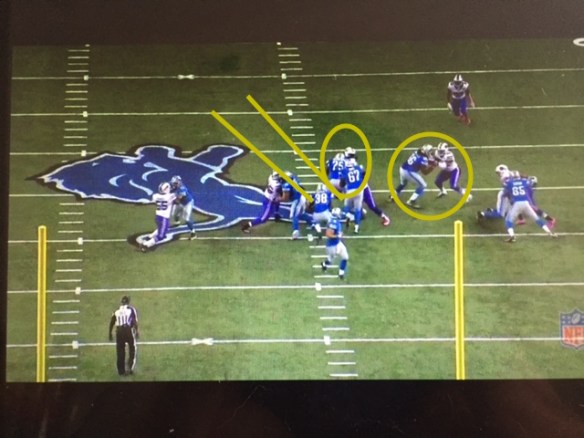
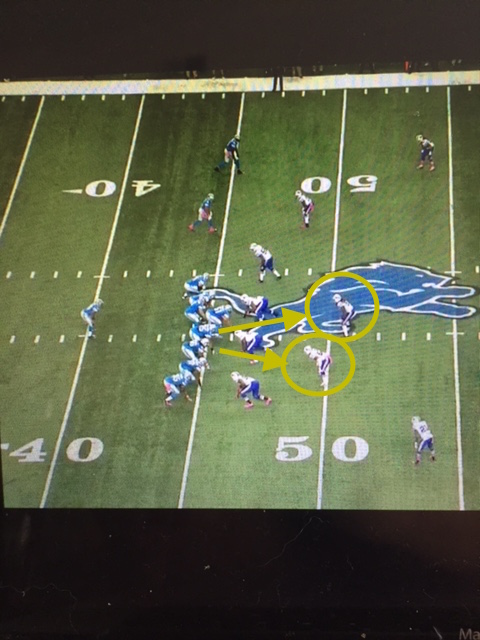
Here’s an example of what they are talking about. The Buffalo Bills have their defensive ends in the wide nine technique against the Detroit Lions. The Lions, however, come out showing a power run formation with seven players lined up in a blocking stance.

IMG_6007

Because the defensive line is spread out so far, the interior offensive linemen get a clean break to the second level, where they are able to  put a hat on the linebackers and spring running back George Winn for a huge gain.

IMG_6006-2

Here’s a vine of that play

In order for the Eagles run defense to be successful, two things must occur: Fletcher Cox and Bennie Logan will need to recognize run plays early so they don’t leave their linebackers in a bind on obvious run downs. Second, it is imperative that the Eagles linebackers are able to shed blocks to make a play in the run game. Kendricks has reportedly added 15 lbs of muscle this off-season for that very reason.

Can The Eagles Personnel Succeed?

We finally made it to the payoff. What type of players have made Schwartz’s defense succeed or fail in the past, and do the Eagles have players to make sure the former occurs? Assuming they can stay healthy at key positions, the answer looks promising.

The one constant connecting Schwartz’s best defenses is a dominant defensive line. Go back to that chart and compare Schwartz’s best defenses to his worst; the clearest indicator of success is their rank in sacks. If his team struggled to sack the quarterback, they likely struggled elsewhere. If sacks were up, everything else likely fell into place.

The 2007 and 2008 Titans teams were led by the Albert Haynesworth, Kyle Vanden Bosch and an aging, but still effective, Jevon Kearse. Haynesworth was arguably the best defensive player in the NFL in 2007 and 2008, making the 1st Team All Pro while spearheading the Titans dominant pass rush. Vanden Bosch got 12 sacks in 2007 and was rewarded with a Pro Bowl birth. The 2008 team lacked a single dominant pass rusher, but got 37 sacks from a combination of multiple players up front. 

The 2014 Buffalo Bills provided Schwartz with arguably the most talented defensive line he has had to date: with Marcell Dareus, Mario Williams, Kyle Williams and Jerry Hughes. Dareus and Williams were first team All-Pros, Williams was named to a Pro Bowl, and Hughes parlayed his 10 sack performance into a $45 million contract extension. 

It’s easy to see the similarities between those dominant units and the Eagles current personnel. Fletcher Cox is every bit as talented as Albert Haynesworth and Marcell Dareus. Haynesworth had 14.5 sacks from 07-08, while Dareus had 10 in Schwartz’s lone season in Buffalo.

Fletcher Cox got 9.5 sacks last year in a system that was designed to limit his opportunities to make plays. In the rare instances in which Cox was allowed to attack downhill last year, he was practically unguardable:


I think Bennie Logan, Vinny Curry and Brandon Graham should excel too. Logan will benefit from Cox getting routinely double teamed. That, plus the added space he will get from the ends split out wide, should give him ample opportunities to get after the quarterback. I expect a strong season out of Logan this year. This system seems to fit his strengths and will give him more opportunities to accumulate the stats needed to be recognized:


I, along with practically everyone else, expect Curry to shine as well. Curry played only 35% of the defensive snaps last year for the Eagles, another (of many) indictments on Billy Davis’ incompetence as a defensive coordinator. But in his limited opportunities, he was extremely productive. According to PFF.com, Curry finished second among 3-4 defensive ends in generating pressure on the quarterback in 2015, behind only JJ Watt. In 2014, Curry finished fifth, and finished second in 2013.

This scheme should accentuate his strengths as a pass rusher, limiting the amount of thinking he needs to do, and unleashing his freakish burst and athleticism on the quarterback.

And I haven’t even touched on Brandon Graham or Connor Barwin, who both figure to be productive in getting after the quarterback. Like the other units, the defensive line lacks depth. But if it’s top starters can produce as expected, this unit should carry the Eagles defense, and could rival the great defensive lines that Schwartz has had in the past.

The secondary also figures to be above average thanks to the presence of Malcolm Jenkins and Rodney McLeod. Both Jenkins and McLeod will be given free range to make plays and bat cleanup for any mistakes from our corners. Malcolm Jenkins and Rodney McLeod have the potential to match, if not exceed, that 2008 Titans safety tandem of Michael Griffin and Chris Hope.

And while I am not enamored with our cornerbacks, I think this scheme should help mitigate their lack of elite talent. Assuming the Eagles can get pressure on the quarterback, the corners will have more freedom to try to make plays.

If I had to identify the one achilles heel for the Eagles defense, it is the linebacking corp. I’d feel much more confident in the unit if Jordan Hicks was guaranteed to be healthy all year. But that seems like a tall order for a player that has missed significant time due to injury in three of his last four seasons. Outside of that, can Kendricks play effectively carrying 15 extra lbs of muscle? And what will Nigel Brandham provide, assuming he isn’t handed out a lengthy suspension by the league after his reported assault on a cabana boy?

In Schwartz’s defense,  the linebackers are the linchpin for the Eagles run defense. Look no further than that 2011 Eagles unit; their top three tacklers at the linebacking position were Jamar Chaney, Brian Rolle, and Akeem Jordan according to Pro-Football-Reference.com. Kendricks, Hicks and Bradham are certainly more talented than that awful trio, but what happens if Kendricks and Hicks get hurt?

If they can stay heathy and exceed expectations, I would not at all be surprised if this is a top 10 unit. But if Hicks goes down, or Kendricks fails to improve, or if their depth is tested? We could be in for a long season on the defensive side of the ball.


Jim Schwartz: A Profile in Aggression, Part I

http://www.gettyimages.com/detail/news-photo/former-detroit-lions-head-coach-and-current-buffalo-bills-news-photo/456702204


Patrick Causey, on Twitter @pcausey3 

When Jeffery Lurie fired Chip Kelly last December, he set about a reclamation project for his franchise. In his own words, he needed to “take his team back.” It turns out, “taking his team back” was an euphemism for trying to replicate the Andy Reid era, inarguably the most successful period in franchise history.

Instead of Reid, Lurie hired Reid’s hand-picked protégé, Doug Pederson, who was also a little known offensive coordinator schooled in the traditions of the Bill Walsh West Coast offense. And instead of the venerable Jim Johnson, Lurie hired Jim Schwartz, who also predicates his defense on pressuring the quarterback with an aggressive 4-3 defense. While Johnson relied on exotic blitz packages, Schwartz eschews the blitz in favor of lining his defensive ends in the wide-nine technique — just outside the tight end — where their speed and athleticism advantages over the offensive tackles can shine.

Reid and Johnson. Pederson and Schwartz. Add in a quarterback drafted #2 overall (McNabb/Wentz) and it’s hard not to get swept up in nostalgia.

And while the Pederson hiring was met with skepticism, the Eagles decision to hire Schwartz was met with near-universal praise. But is the unbridled respect justified?

It was a question I sought to answer after I was less impressed than I anticipated looking over Schwartz’s coaching statistics on Pro-Football-Reference.com. Coupled with the Eagles disastrous experiment with the wide nine under Jim Washburn (who practically coined the wide nine working alongside Schwartz in Tennessee), I had legitimate concerns over whether Schwartz could live up to the hype.

So I decided to profile  Jim Schwartz in this piece; studying his scheme and his results on the field. I also try to figure out why Schwartz has several sizable blemishes on his resume, including his early tenure in Tennessee and his stint as head coach of the Detroit Lions, and whether the Eagles have the right personnel to avoid adding another.

In Schwartz’s Words: “We want to attack”

The most common misconception about Schwartz’s scheme is that it is entirely predicated on the “wide nine.” As Mike Rodak of ESPN.com details, Schwartz takes issue with that characterization: 

“Mostly that’s thrown around by people that couldn’t line it up if they wanted to. That’s no disrespect to those people,” Schwartz said. “I’ll say this, there’s 32 teams in the NFL and all 32 line up in a wide nine. Not all of them are called wide nine teams, but that’s just the way it goes.”

Schwartz instead calls his defense an “attack scheme,” a fittingly simple description given his preference for streamlining information so that his defenders are attacking, not thinking or reacting: “It’s not a read-and-react system. It’s not a lateral, line of scrimmage; we want to attack, we want to knock back, we want to put pressure on the quarterback and we want to create negative plays.”

And that is a key distinction between Schwartz and his predecessor, Billy Davis. Davis ran a 3-4, two gap system that required his defensive lineman to read the play, occupy blockers and allow linebackers to wreak havoc in the backfield. But the defense never seemed to fit the Eagles’ personnel. Indeed, for a team whose biggest strength was the defensive line, it seemed illogical to run a scheme that limited their ability to make plays.

That will no longer be the case under Schwartz. Fletcher Cox and Company will be given less information, less responsibility, and more freedom to pin their ears back and get after the quarterback. “There’s going to be a lot of defensive lineman that will be real happy to play in a system like that.” Schwartz once said.

Attacking Through The Wide Nine, Stunts & Blitzes

While Schwartz is right that the wide nine isn’t a defensive scheme (it’s a technique), it would be a mistake to ignore how centrally important the wide nine is to Schwartz’s defense.

In order to understand the wide nine, it’s helpful to understand the basics of gap and technique assignments along the line. As you see below (image courtesy of BleacherReport.com), each offensive lineman is surrounded by gaps: the A gap is on either side of the center, B gap on the outside shoulders of the guards, and C gap on the outside shoulder of the tackles.

Defensive lineman have corresponding techniques, numbered 0 through 9, depending on their position along the offensive line. An even number technique (including zero), means the defensive player is lined up directly over the offensive lineman, an odd number means the defender is on the outside shoulder of the offensive lineman, and an even number with a small i (such as 4i), means the defender is on the inside shoulder of the lineman.

Gaps and Techs

Traditionally, a 4-3 defensive end lines up on the outside shoulder of the offensive tackle in the 6-tech, and is responsible for attacking the C gap. But in Schwartz’s scheme, the defensive ends line up on the outside shoulder of the tight end, in the wide nine, attacking the D gap.

Here is a still shot of the wide nine in action, from Schwartz’s time in Buffalo. Notice how defensive ends Jerry Hughes and Mario Williams are flanking the offensive tackles by a considerable margin:

IMG_5984

Lining defensive ends in the wide nine theoretically makes it easier to get to the quarterback; it gives them more space within which to operate, more time to build up speed, and forces the larger — and slower —  offensive lineman to cover more distance. This, in turn, reduces the need for Schwartz to dial up blitzes (which he rarely does), and gives his defense a decided numerical advantage when defending the pass– leaving 7 defenders against, at most, 5 pass catchers.

Here is the wide nine in action. Watch how much trouble Sebastian Vollmer (who is 6’8, 320 lbs and ran a 5.13 40) has keeping up with Mario Williams (who is one of the largest defensive ends in football, but is still smaller (6’6, 300 lbs) and faster (4.73 40) than Vollmer):

Getting Williams in space, and forcing Vollmer to move laterally, is an inherent mismatch that Williams capitalizes on with ease. This athletic mismatch is the key principle upon which the wide nine was built.

But the wide nine isn’t just about turning the corner on tackles. Beat a tackle consistently enough to the outside and they will start to overcompensate to regain outside leverage. That creates fertile ground for the end to attack inside, getting a cleaner, shorter path to the quarterback:

The wide nine also creates favorable matchups for defensive tackles. Albert Haynesworth (8.5)Marcell Dareus (10), Ndamukong Suh (10), and Kyle Williams (10.5) had career high sack totals in Schwartz’s defense thanks in large part to getting one-on-one matchups and more space within which to operate. (Hello, Fletcher Cox):


But, again, while the wide nine is a big part of Schwartz’s defense, it is not the only component. Another way that Schwartz tries to generate pressure without blitzing is through a stunt: a move which requires one defensive lineman to set a pick so that another defensive lineman has a free lane to the quarterback. It is simple, yet sometimes devastating, because offensive lineman fail to recognize the stunt in time to coordinate switching off the pick.

Here is a diagram of the stunt that the Bills ran against the Jets back in 2014. Kyle Williams attacks the outside, setting a pick for Jerry Hughes to cut behind and fill the open lane.

FullSizeRender-4

Here it is in live action:

The Jets blocked this play perfectly initially: Bilal Powell (#29) cuts across Michael Vick’s face to block Hughes, and gets help from the left guard, Oday Aboushi, who does a good job passing off Williams to left tackle, D’Brickashaw Ferguson. The only problem? Ferguson completely botches the handoff, giving Williams an easy sack.

Same play, different result. Marcel Dareus attacks the B gap, setting a pick for Hughes to come back around unblocked into the A gap and sack Alex Smith.

Expect to see stunts called at least 2-3 times a game. Schwartz will call variations of the stunts, either with two lineman setting the pick to spring one blitzer, or having the four defensive lineman running stunts on the same play.

While Schwartz would prefer not to blitz, he still does so, and is often very effective at it. In Buffalo, Schwartz sent an extra man on only 20.9 percent of downsaccording to Pro Football Focus, which was the 4th lowest rate in the league. But the Bills pressured the quarterback 36.6% of the time when a blitz was dialed up, which was the eight best mark in the NFL.

Bottom line: Schwartz’s scheme is centered on getting sacks without blitzing. In his 14 year career as a head coach or defensive coordinator, his defense has ranked in the top 10 in sacks eight times. Needless to say, I think his scheme is accomplishing that goal.

Turnovers and Third Down Percentage

But Schwartz’s scheme isn’t just about attacking the quarterback. As he told Dave Spadaro of PhiladelphiaEagles.comSchwartz is also concerned with creating turnovers and having good third down percentages: “We’re going to attack. We’re going to get after the quarterback. We’ve been good in getting sacks and creating turnovers, good on third downs. You know, I’m really not a stat guy, I don’t care how many yards we give up…”

When Schwartz is able to generate pressure on the quarterback without having to blitz, everything else falls into place. That is especially true for his secondary, which benefits from having extra defenders in space. Again, if four defenders are rushing, that leaves seven in pass coverage. Since an offense is already without six players (quarterback and five lineman), that means — in the best case scenario — the pass catchers are out numbered 7-5.

Because of this advantage, Schwartz primarily dials up press man coverage. His cornerbacks have more freedom to take risks and jump routes because they know they have safety help over the top. That combination of pressure on the quarterback and more defenders in pass coverage inevitably leads to more opportunities for turnovers.  Schwartz’s last three years as a defensive coordinator — 2007-08 in Tennessee, and 2014 in Buffalo — underscore this point. That 2007 Titans team ranked 7th in sacks, and 2nd in interceptions, thanks to seven players with at least two interceptions on the season, according to Pro-Football-Reference.com. The 2008 team ranked 5th in sacks, and had three Pro Bowlers in the secondary: safeties Michael Griffin (7 ints) and Chris Hope (4 ints), and cornerback Cortland Finnegan (5 ints). While the 2014 Bills had the most sacks in the league and sixth most interceptions thanks to nine different players with at least one interception

The 2008 Titans was the one year I could find where Schwartz’s secondary was loaded with playmakers. Despite lacking elite talent in other years, his teams ranked, on average, in the top 14 in the league in take-aways during his career. That is an encouraging sign for the Eagles given their lack of top quality corners at their disposal.

Schwartz’s scheme also creates good opportunities to get off the field after 3rd down. Simply stated, more sacks means longer distances to cover on third down, which means a lower probability of converting on third down.

Pat Kirwin of NFL.com recently conducted a study of the conversion percentage league wide for certain down and distances. Here is what he found:

Down/Distance Success Pct.
2nd and 1-5 yards 56%
2nd and 6-9 27%
2nd and 10+ 17%
3rd and 1 67%
3rd and 2 52%
3rd and 3 49%
3rd and 4 47%
3rd and 5 42%
3rd and 6 41%
3rd and 7 37%
3rd and 8 32%
3rd and 9 32%
3rd and 10+ 20%

It shouldn’t come as a surprise that the longer the distance, the lower the probability of getting a first down. So while you have a coin-flips chance (52%) of converting a 3rd and 2, your odds plummet to 20% for 3rd and 10+.

Intuitively, you would think that the high sack totals would lead to a better third down conversion rate. That’s exactly the case with Schwartz’s defense. In the 14 years as head coach or defensive coordinator, Schwartz’s units have averaged in the top 10 on third down percentages, according to Prof-Football-Reference.com. And according to FootballOutsiders.com, his 2014 Buffalo unit ranked 7th in the league on drives ending in 3-and-outs (24.4%), while his 2007 defense ranked 2nd in such category (27.5% of drives ending in a 3-and-out).

Sacks. Take-aways. Getting stops on third downs. Those are the three areas that Schwartz prioritizes on defense. Expect to those priorities translate on the field this fall.

You can continue reading Part II here.

Neglecting the QB Position Forced The Eagles into this Trade

http://www.gettyimages.com/detail/news-photo/quarterback-trent-edwards-quarterback-mike-kafka-and-news-photo/150082142


A combination of bad scouting and attempting to band-aid the QB position forced the Eagles to trade up to number two.

Patrick Causey, on Twitter @pcausey3

I was going to provide my thoughts on the Eagles trade, but was buried in work and couldn’t get to it in time while the topic was still relevant. There are some really good articles out there analyzing both sides of the debate, including Bill Barnwell’s skeptical view of the move, and James Keane of BGN.com explaining why the Eagles did not mortgage the future in this trade. (For the record, I am against the trade up for this QB prospect, which I explain more fully here).

Instead, I want to address the root cause for the Eagles having to make this trade. But first, analogy time.

Imagine for a moment that the Philadelphia Eagles are a house.

They invested big in a brand new roof back in 1999. It was top of the line and came with all the bells and whistles. And for about 10 years, that roof was incredible. It did almost everything the homeowners could ask for.

But then the roof started to show signs of wear and tear. Instead of fixing the problem, the homeowners just ignored it.

And ignored it.

And ignored it.

Years went by. They put a bandaid here and a did patch job there.

But they never invested the necessary money to fix the actual problem.

Then one day the homeowners came home after a big storm, and the roof had caved in. Now they not only needed a new roof, but they needed to buy new appliances and furniture. So they went all out again, spending huge money to fix the problem. The only problem is, they ended up spending twice as much as they would have needed to spend had they just fixed the problem when the signs first emerged.

As you’ve probably guessed by now, that bad analogy was my attempt at illustrating the Eagles approach to solving the most important position in football: the quarterback.

The Eagles invested a high first round pick in Donovan McNabb back in 1999. He lasted 10 years with the team, leading the Eagles to five NFC Championship games and a Super Bowl. It was the longest period of sustained success in franchise history, and McNabb will go down as the best quarterback in franchise history.

But since the Eagles traded McNabb to the Washington Redskins in the 2010 offseason, they’ve wholly neglected the quarterback position. Instead of investing a high draft pick when the opportunity presented itself (which history tells us is the smart thing to do), the Eagles opted to go with retread veterans and mid-round picks, and the results were predictably mediocre.

Here is a chart breaking down the number of draft picks the Eagles have had since 2010 and the amount of those picks they have used on quarterbacks:

Year # of Draft Picks QBs drafted
2010 13 Mike Kafka (4th)
2011 11 0
2012 9 Nick Foles (3rd)
2013 8 Matt Barkley (4th)
2014 7 0
2015 6 0

Two things stand out from this list. First, despite the commonly accepted view that more picks > less picks, the Eagles have steadily declined in the number of draft picks they’ve had over the last six years (they have only 7 this year). That’s not good.

But more pertinent to this article, they have taken only three quarterbacks in the last six drafts: Mike Kafka (2010), Nick Foles (2012), and Matt Barkley (2013). They’ve had 54 draft picks during that time. That’s 5% of their picks put towards solving the most important position in football.

And this was all while the Eagles projected starters were Kevin Kolb, Michael Vick, Nick Foles, and Sam Bradford. Not one quarterback on that list is considered an above replacement level quarterback in the NFL (and Kolb and Foles aren’t even close to being replacement level).

For comparisons sake, the New England Patriots also took three quarterbacks in the draft during the same time period (on 55 picks). The only difference, of course, is that they had Tom Brady as their quarterback.

But this is not even really about the quantity of picks they spent. My primary concern is about the lack of quality picks that the Eagles have invested in the position. The three quarterbacks they drafted since 2010 were in the third, fourth and fourth rounds respectively.

One way to better contextualize value is to use the draft value chart for the picks the Eagles used on quarterbacks since 2010:

Pick Value
122 (Kafka) 50
88 (Foles) 150
98 (Barkley) 108

Total

308

Assume for a moment that the Eagles have had 7 picks in each of the last six drafts, and they picked 15th each time. They would have 1,811.50 “points” each draft, or 10,869 total points worth of draft capital over the last six drafts. The 308 points the Eagles invested in the quarterback position is just 2% of their total draft stock during that time.

Now, this comparison isn’t perfect. The Eagles didn’t pick 15th every year and they didn’t have just seven picks (they usually picked in the 20s, but also frequently had more than 7 picks, so I think the value evens out). But it still provides a good illustration to the problem: they’ve invested so little in the quarterback position that we shouldn’t be surprised the position has been mired in mediocrity for the last six seasons.

Again, for comparisons sake, the Patriots used a second rounder on Jimmy Garoppolo after the Patriots went 12-4 the previous year. After they went 14-2 in 2010, they used a third rounder on Ryan Mallett. They also used a 7th round pick on Zac Robinson in 2010. Using that same math, the Patriots spent 506 points worth of draft capital compared to the Eagles 308.

AND THIS WAS WITH TOM BRADY ON THE ROSTER!

Good franchises plan ahead and invest in the position as their quarterback is starting to age. Drafting Garoppolo while Brady is setting the world on fire is a good example of this. Ditto the Pittsburgh Steelers drafting Big Ben 11th overall in 2004 while Tommy Maddox, who led the Steelers to the Super Bowl, was still on the roster. The Green Bay Packers were riding high with Brett Favre when they took Aaron Rodgers in the first round of the 2005 NFL Draft.

The Eagles were presented with, but failed to take advantage of, similar opportunities to draft a quarterback at a much more reasonable cost than the one paid to acquire Carson Wentz:

2011: The Eagles were coming off 10-6 season with Michael Vick as the starter. But Vick was never as good as people made him about to be: he had an inconsistent season that year, starting off very good but crashing down to earth once defenses started to bring pressure more consistently and take away his first read. In the first round, the Eagles took Danny Watkins (yikes). Andy Dalton and Colin Kaepernick were still on the board.

2012: The Eagles reportedly built his entire draft class around acquiring Russell Wilson. They had a first round grade on him and three picks in the first two rounds. Instead of grabbing Wilson with, say, the second 2nd round pick, the Eagles drafted Vinny Curry, hoping to grab Wilson in the third. We know the history: Seattle took Wilson one pick before the Eagles, who ended up trading back in the 3rd and drafting Nick Foles instead.

2014: Coming off Nick Foles’ 27/2 season, the Eagles were content to go with Foles and former starter Michael Vick as their quarterback. When they drafted first round bust Marcus Smith with the 26th overall pick, Teddy Bridgewater and Derek Carr were still on the board.

Some might claim this is hindsight 20/20 talking here. Perhaps to an extent. But I also think it underscores two issues that have plagued the Eagles during the last six seasons: they have neglected the quarterback position in the draft and have been poor at scouting quarterbacks when they tried to address the position. So this isn’t just to say that picking Foles was a bad move (in fairness, he likely has outperformed most third round quarterbacks). It also extends to their inability to recognize that Vick was not a viable solution in 2011, Foles in 2014, and so on and so forth.

So while we can — and should — debate the merits and demerits of the Eagles decision to trade up to two, we cannot dispute that the Eagles forced themselves into this position by neglecting the most important position in football for the last six years. And for that, they have only themselves to blame.

Carson Wentz Scouting Report

http://www.gettyimages.com/detail/news-photo/quarterback-carson-wentz-of-north-dakota-state-in-action-news-photo/513972756


Carson Wentz is a prototypical boom or bust quarterback prospect. He has the size, athleticism and arm strength you want, but needs significant work on his mechanics. I’d hesitate to take him in the top 5 of the draft.

Patrick Causey,on Twitter @pcausey3

When the last whistle blows and a new college football champion is crowned, NFL coaches, executives and scouts turn their attention to what is derisively known as the “beauty pageant” season.

Between that final game and the NFL draft, prospects are judged through a number of events that do not involve football players actually playing football: from the combine, to pro days, to individual workouts and team interviews. Prospects are measured, perform scripted plays in ideal conditions, and conduct job interviews under the same confines as speed dating.

NFL teams spend inordinate resources scouting players, investigating their background for red flags, and relying on advanced analytics to project their games to the pros. Yet, without fail, teams get seduced by prospects that excel during the beauty pageant phase of the draft process. Reports emerge about prospects rocketing up draft boards because of a great combine workout or because that “It” factor that shined during interviews, warts in their tape be damned

Two quick examples.

Leading up to the 2003 draft, Kyle Boller was an inaccurate quarterback with a fringe first round grade. During his pro day, Boller wowed scouts, coaches and executives with his athleticism (4.59 40 time) and by completing 96% of his passes, including a 75 yard bomb on the run.

But as Michael Wong of BleacherReport.com explained, the deal sealer came after the workout was over. “After his official workout had come to it’s conclusion, Kyle Boller proceeded to drop to his knees, exactly on the 50 yard line, and toss one of the most beautiful spirals I have ever seen cleanly through the field goal posts. Sixty yards away.

As Brian Billick acknowledged many years later, after seeing this workout and that throw, the Ravens brass convinced themselves that Boller’s inaccuracy was the result of his subpar teammates. So they traded up in the first round to draft him 19th overall, only to watch him fail to live up to the hype. Apparently throwing from your knees at midfield is not required to be a successful NFL quarterback.

In 2009, Mark Sanchez was leaving dinner with Rex Ryan and Jets general manager Mike Tannenbaum following his private workout with the team. They were walking towards their cars when Sanchez hopped on a nearby motorcycle, grabbed the helmet, and said to the stunned group “All right, I’ll see you guys later.” When Sanchez laughed and revealed the bike was not his, Ryan and Tannenbaum were convinced that his willingness to pull off that prank during the biggest job interview of his life revealed that Sanchez had the “It” factor needed to lead their team. The Jets traded up to the 5th overall pick to get Sanchez; even though his tape and numbers never justified such a lofty draft status.

Which brings me to Carson Wentz: I have never met him, but I watched all of his 2015 tape. I see a mid to late first round talent that needs considerable work on his mechanics and consistency. If it all pans out? He could be a stud. But that’s a big if; Wentz needs at least one year to fix his game, possibly more, and there is no guarantee that these issues can be ironed out.

So I was surprised to see the Wentz-hype following the combine. Reports emerged that he crushed the team interviews, flashing his moxxy and intelligence that allowed him to get a 40 on the Wonderlick test. Pretty soon, Wentz was drawing comparisons to once-in-a-generation prospect Andrew Luck:

When Wentz put on a clinic at his pro day, NFL analysts were tripping over themselves with the compliments:

I am not suggesting that I am right and these analysts are wrong; some of them have been around the NFL longer than I have been alive. But if Ozzie Newsome, one of the best general managers in NFL history, can be seduced by the allure of a kneeling 60-yard bomb during a pro day, these analysts are equally susceptible to the hype surrounding Wentz.

Before we break down why I think Wentz is not a top 5 pick, here is a quick table highlighting his strengths and weaknesses:

Strengths

Weaknesses

Above average athlete that will keep defenses honest Mechanics need considerable work; tendency to use only his arm to throw the ball, completely abandoning proper footwork, hip and shoulder rotations
Above average arm strength; with proper mechanics he can make all of the throws with ease. Struggles with the consistency of his accuracy on all throws given his mechanical issues
Not afraid to stand tall in the pocket and take the hit Deep ball is especially sporadic. Routinely overthrows receivers.
When his mechanics are on, he is very impressive: looks every bit the part of a franchise QB Below average pocket presence
High intelligence, scoring a 40 on the wonderlic exam Tendency to lock onto his primary target; did not see many instances of Wentz working through his progressions to the second and third receiver.
According to multiple reports, has the “it” factor

By the Numbers

Went’z stats were deflated because he suffered a broken bone in his throwing hand that limited Wentz to only 7 games on the season:

Year Cmp Att Cmp% Yds Y/A TD INT Rate
2015 130 208 62.5 1,651 7.9 17 4 152.3

Here’s Wentz’s accuracy chart, courtesy of Ian Wharton at BleacherReport.com:

IMG_2695

Wentz’s struggles on intermediate and deep throws are apparent: he completed only 53% of his passes while maintaining an impressive 8 touchdown to 1 interception ratio. While those aren’t horrible numbers by any stretch, they are not as impressive as Jared Goff’s numbers, especially on the deep ball. Whereas Goff completed 53, 75 and 48 percent of his passes on deep throws, Wentz completed only 25, 63 and 33 percent of such passes.

Here is Wentz’s spider chart, courtesy of MockDraftTable.com:

Wentz Spider Chart

Wentz checks all of the boxes from a size and athleticism standpoint, ranking in the top 20% of all quarterbacks in height, weight, broad jump, 3 cone drill, 20 yard shuttle, and arm length (for whatever that’s worth).

But the tape is where the red flags really start to emerge.

Breaking Down the Tape

Mechanical Issues

Wentz has significant issues with his passing mechanics. These issues did not hamper his production in college because he was just that much better than his competition. But in the NFL, proper mechanics are paramount. Passing windows and the margin for error shrink considerably from big time college football, let alone Division 1-AA. So while Wentz was able to skate by against the likes of Weber State and Northern Iowa, he will struggle significantly against the Seattle Seahawks or Pittsburgh Steelers trying to throw only with his arm.

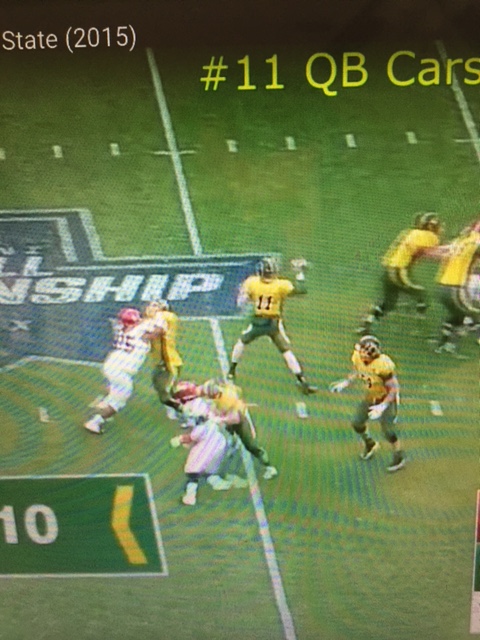
Here is a prime example of Wentz throwing with just his arm and neglecting any semblance of mechanical integrity with his feet, hips or legs.

Here is a close up of what I am talking about; Wentz’s entire lower body is statue-esque, with no rotation towards the receiver.

Here is another example; Wentz completed the pass, but it’s about the process, not the results:

There are other times that Wentz tried to have proper mechanics but stopped short halfway through the process. Let’s break this down by still shots.

Here is Wentz’s initial set-up. There is nothing wrong here. His head is facing his target, he has good bend in his knees, his shoulders are even, his legs are shoulder width apart and the ball looks to be held close to his body in ready position:

Initial Set up

After that, though, things start to go sideways:

Wide Base

Ideally, you want the legs to maintain integrity here and be shoulder-width apart. This might seem like nitpicking, but if you set up your legs too far apart, you lose accuracy and power — and at the NFL level, that makes all the difference.

While his stance was a relatively minor issue, this next frame — taken immediately after Wentz releases the football — raises a lot of flags:

Initial Release

Wentz should have rotated through his throw, ending up with his throwing shoulder facing the receiver and his back plant leg following through in like manner. Instead, Wentz stays open to the receiver, stopping his rotation after he initially releases the football. It should come as no surprise that Wentz missed his intended receiver on this throw.

These mechanical flaws should give pause for concern to any team looking to find a quarterback that can start from Day 1. They aren’t impossible to overcome, but it is going to take considerable work and time for Wentz to break free from his old habits and learn how to throw the football properly without having to think about it.

Accuracy Issues

Given the issues with his mechanics, it should come as no surprise that Wentz struggles with repetitive accuracy.

Those issues are most pronounced when Wentz tries to throw deep. More often than not, Wentz missed his receivers badly — often by 3-5 yards or more:

Wentz doesn’t even give the receiver a chance to make a play here. Without going overkill on this issue, here are three other examples of Wentz badly missing on the deep pass, click: here, here and here

But the accuracy issues aren’t limited to the long ball. Wentz is not a “precision” passer — at least at a consistent enough basis — that can put the ball where only his receiver can catch it.

This is an easy 10 yard out; the receiver has enough separation but Wentz throws the ball to the inside shoulder, forcing the receiver to turn back around and giving the defender an easy chance to make a play.

On this play, Wentz has a back breaking wide open out of the flat, but his bad ball placement forces the back to adjust and miss the opportunity for an easy score.

While that might seem like nitpicking, realize that it was third down and ND State had to settle for a field goal. Precision matters, especially in the NFL, and until Wentz fixes his mechanics he will continue to have these issues.

Examples of Good Mechanics Leading to Good Results

There is hope, however. There were times that Wentz was fundamentally sound and the results were very impressive. I suspect that when Wentz’s supporters project him to be a franchise quarterback, they are primarily relying on throws like this.

Wentz’s mechanics were on point here, from the footwork to the rotation in his hips and shoulders. Not surprisingly, the ball placement was perfect, only his receiver didn’t hold up his end of the bargain and dropped the pass.

Here is another good example; watch as Wentz climbs the pocket and delivers a strike to his receiver:

I think you get the point, but if you want to see more examples from the tape, check these throws out: herehereherehere and here.

Throwing on the Run

When Wentz is forced to throw on the run, it often isn’t a pretty result. He tends to try to only use his arm, which leads to… well, this:

Wentz does better when he is forced to step up in the pocket away from pressure.

That is a ridiculous pass. Compare the two prior passes: the thing that stands out the most is the direction in which Wentz is moving. On the first pass he pulls up and arms the throw; on the second throw he continues moving forward, which all but forces better mechanics: it prevents Wentz from standing still and not using his legs on the throw.

The other thing that is obvious — and not surprising — is that Wentz is far more comfortable running a bootleg to his right than the left side of the field. That is to be expected since Wentz is right handed:

Strong Athlete

Mike Mayock recently compared Wentz’s athleticism to Andrew Luck and Cam Newton. I agree. Wentz is very athletic for a player his size, and North Dakota State routinely took advantage of that athleticism with designed quarterback runs:

Here is another example of Wentz using his athleticism:

More examples are here and here. Given Wentz’s size — he’s 6’6, 235 lbs — there is less concern about injury. He should be able to withstand the beating that he will take from running, although he has also shown the ability to slide when necessary.

Standing Tall in the Pocket

One area that I have no concern with is Wentz’s ability to handle pressure. He routinely stood tall in the pocket and delivered an accurate pass despite knowing the hit was coming.

I legitimately have no idea how Wentz’s knee is still intact after this play

You can see another example here.

Tendency to Lock onto His Primary Receiver

If there were two areas where Goff has outperformed Wentz significantly, it’s with the deep ball pass and his ability to work through his progressions. Goff excels in both regards, Wentz is a work in progress.

I struggled to find examples of Wentz working through his progressions. The norm was Wentz locking on to his primary receiver and forcing the throw regardless of whether he was open. However, he has flashed the ability to do so:

Watch Wentz’s head. He starts looking to his primary option on the top part of the screen, then quickly moves to the center of the field where the slot receiver was running a post. Wentz steps up into the pocket and delivers a strike for a huge gain. Again, the hype around Wentz is somewhat defensible given his ability to flash plays like this.


A final example. The video stream broke down, but you should still be able to see how Wentz starts with his initial read, bounces outside to avoid pressure, and keeps his eyes down field so he can find the open receiver:

It bears repeating that this was the exception to the norm. Wentz routinely targeted his primary option, but he at least flashed some ability to move to his second and third options.

Conclusion

Carson Wentz is a boom or bust prospect. He has the size, athleticism, arm strength and apparent intangibles that you look for in a franchise quarterback. But he needs considerable work on his mechanics from top to bottom. These mechanical issues affect almost every part of his game, from the short to intermediate to deep throws, to throwing on the run. Until Wentz cleans these issues up, he will never reach his full potential. But if he gets drafted into a spot that allows him to sit for a year or two and clean up the finer points of his game, he could turn into a star.

Bottom line, I would be hesitant to use a top 5 pick on a player with this many holes in his game. I’d consider him at 8 for the Eagles, but even then I would be hesitant. I think he should go in picks 10-15, but will likely go much higher given the dearth of quality quarterbacks in this class.

Jared Goff Scouting Report

http://www.gettyimages.com/detail/news-photo/jared-goff-of-the-california-golden-bears-looks-for-an-open-news-photo/502826380


Jared Goff Is Not An Elite Signal Caller Worth Trading Up To The Top Of The Draft. But He Has The Potential To Be A Top 15 QB, So He’s A Quarterback that the Eagles Should Target.

Patrick Causey, on Twitter @pcausey3

Compile a greatest hits tape of Jared Goff’s 2015 season, and you’d see a blue chip prospect destined for greatness: his accuracy, deft touch on deep passes, functional mobility in the pocket and ability to manipulate defenders with his eyes are truly sights to behold. But if you dig a little deeper in the tape, the warts start to emerge: his inconsistent mechanics, head-scratching interceptions, and odd habit of miss-firing on open receivers should give any franchise pause for concern.

Bottom line: Goff has all of the tools you want in a quarterback: the accuracy, vision, work ethic, intelligence; and if he gets under the right coach in the right scheme, he could become an elite quarterback.

But odds are he won’t ever reach that ceiling. He is too inconsistent to be considered an elite prospect or project as an elite signal caller. The safer bet is that Goff turns into a top 15 quarterback in the league, which, as we have discussed before, is what you need to realistically compete for a Super Bowl.

So while I wouldn’t mortgage the future to trade up to the top of the draft to get Goff — cough, St. Louis, cough — I would strongly consider making a move if he slips out of the top four picks. Let’s break this down by the numbers and game tape.

By The Numbers

Raw Numbers and Accuracy Chart

Goff’s raw numbers are impressive, especially when considered in the context in which they were achieved: without a competent offensive line or legitimate skill players. Here are his raw 2015 stats, courtesy of Sports-Reference.com:

Year Cmp Att Pct Yds Y/A AY/A TD INT Rate
2015 341 529 64.5 4,714 8.9 9.4 43 13 161.2

But as you know, raw numbers in college can be misleading. That is especially true with completion percentage, where even middling prospects can put up gaudy numbers by completing a high percentage of passes within 10 yards of the line of scrimmage and feasting on the weaker opponents on their schedule.

A better way to judge how a quarterback’s accuracy translates to the NFL is to break his throws down by distance and location on the field. This shows whether a quarterback is able to complete “NFL type throws” — i.e., those beyond 10 yards and outside the numbers.

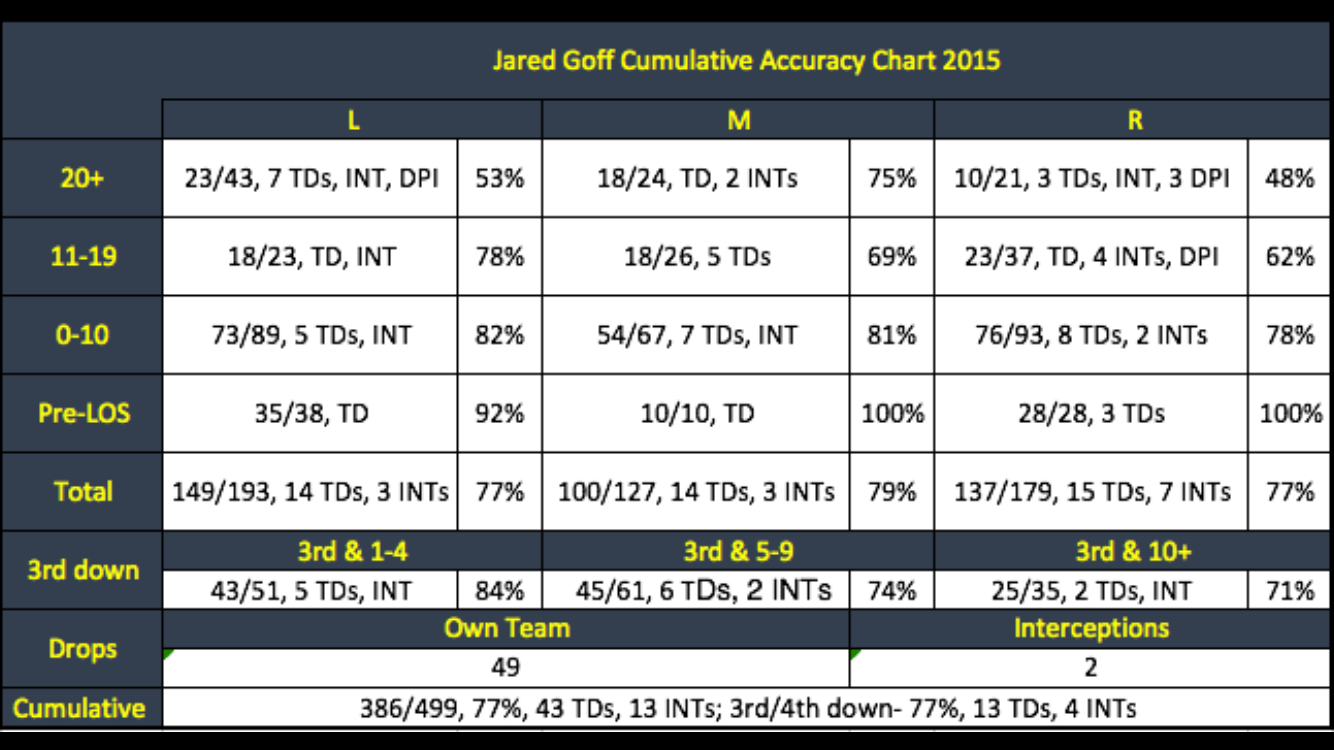
This chart courtesy of Ian Wharton at BleacherReport.com illustrates how proficient Goff is with NFL type throws:

IMG_2691

As you can see, Goff has strong numbers on deep and intermediate throws. On deep throws, Goff completes 53, 75 and 48 percent of his passes.  We also see that these high numbers aren’t the result of small sample sizes: Goff attempted 88 passes that traveled beyond 20 yards. That represents 17% of his passes on the year.

Goff also performed well in the mid-range throws, completing 78, 69 and 62 percent of his passes, respectively. When we combine Goff’s throws of 11+ yards, we see an impressive total: 110/174, 63%,18 touchdowns, 9 interceptions. These numbers suggest that Goff won’t struggle with the transition to the NFL.

College Comps:

Spend a few hours googling scouting reports on Goff and you will come away with a broad range of quarterback comps: from Aaron Rodgers to Matt Ryan to Brian Hoyer and Jake Locker. (Hint, the hyperlink takes you to each report).

So I thought it would be helpful to compare Goff’s 2015 season to some of his contemporaries. Static will always exist with these types of comparisons, since each quarterback played on teams with varying talent levels and against different quality of opponents. But the numbers still give us some baseline from which to draw accurate comparisons.

Here is how Goff’s last season in college compares to the same seasons for Andrew Luck, Marcus Mariota, Jameis Winston, Jake Locker, Blaine Gabbert, and Matt Ryan.

Goff

Year Cmp Att Pct Yds Y/A AY/A TD INT Rate
2015 341 529 64.5 4,714 8.9 9.4 43 13 161.2

Andrew Luck

Year Cmp Att Pct Yds Y/A AY/A TD INT Rate
2011 288 404 71.3 3,517 8.7 9.4 37 10 169.7

Marcus Mariota

Year Cmp Att Pct Yds Y/A AY/A TD INT Rate
2014 304 445 68.3 4454 10.0 11.5 42 4 181.7

Jameis Winston

Year Cmp Att Pct Yds Y/A AY/A TD INT Rate
2014 305 467 65.3 3907 8.4 7.7 25 18 145.5

Jake Locker

Year Cmp Att Pct Yds Y/A AY/A TD INT Rate
2010 184 332 55.4 2265 6.8 6.6 17 9 124.2

Blaine Gabbert

Year Cmp Att Pct Yds Y/A AY/A TD INT Rate
2010 301 475 63.4 3186 6.7 6.5 16 9 127.0

Matt Ryan

Year Cmp Att Pct Yds Y/A AY/A TD INT Rate
2007 388 654 59.3 4507 6.9 6.5 31 19 127.0

Goff’s TD/INT ratio is obviously impressive, but so to are his yards per attempt and adjusted yards per attempt. His numbers are behind only Marcus Mariota, but ahead of everyone else — including Andrew Luck. That’s important because it reaffirms that Goff wasn’t dinking and dunking his way to gaudy numbers like, perhaps, Blaine Gabbert or Jake Locker.

And from a big picture perspective, these numbers suggest that Goff is more Luck/Winston/Mariota than he is Gabbert/Locker.

But I’m hesitant to put him on the level of Luck, Winston and Mariota because of some of the  inconsistencies that I alluded to earlier.

Against Utah, Goff went 25/47 for 340 yards, 2 touchdowns and 5 interceptions. Against Oregon, Goff threw for 329 yards and 2 touchdowns, but he only completed 43.9% of his passes and threw an interception.

Luck’s season was more consistent in that regard — while he did not have any 5+ touchdown/0 int  performances like Goff had against Air Force and Arizona State — he didn’t have the ugly games like Utah on his schedule either. Indeed, Luck did not have any game in which he: (1) completed less than 60% of his passes or (2) threw more interceptions than touchdowns. Philadelphia’s favorite adopted son, Marcus Mariota, only had one.

Goff had three.

If we break the comparisons down into further detail, however, Goff still comes out favorably to most of his peers:

QB Sub-60% More INTs than TDs Even INTS/TDs 160+ Passer Rating 4+ TD Games 5+ TD Games
Goff 3 1 0 7 4 3
Luck 0 0 0 9 3 0
Winston 4 3 1 5 1 0
Ryan 6 2 3 1 2 1
Gabbert 4 3 2 0 0 0
Locker 6 3 2 2 2 1
Mariota 1 0 0 10 3 1

From a statistical standpoint, these numbers suggest that the Locker and Gabbert comps are off-base. Goff likely rests just below Luck, Mariota and Winston; a projection I am comfortable making because it is backed up by the film.

Breaking Down The Film

Goff’s game tape matches his numbers, filled with some “WOW” throws followed by some head scratchers. As a full disclosure, I watched the following game tape of Goff for this scouting report: ASU, Airforce, Utah, USC, Stanford, San Diego State and Texas.

Here is a quick chart breaking down his strengths and weaknesses, with analysis and game tape that follows.

Strengths

Weaknesses

Above average accuracy on short and intermediate routes Struggles at times with mechanics and consistency. Has a tendency to sail passes at inexplicable moments
Great accuracy on deep throws outside the numbers and up the seams Small hands (9 inches), which could be problematic in inclement weather
Excels at navigating the pocket and keeping his eyes down the field Sometimes misdiagnoses cover-2 zone, leading to interceptions
Good functional athleticism, enough to keep defenses honest and break off for a first down Did not play in an NFL offense or call his own plays
Ahead of his peers in the mental aspects of the game: able to manipulate defenses with his eyes and through pump fakes Slight frame
Can throw from multiple arm angles and in off-balance position
Adequate arm strength; he’s not Jay Cutler but he will have no problem making all of the throws
Flashes the ability to throw with anticipation – i.e., “throwing a receiver open”
Known as a film nerd and hard worker
Not afraid to stare down pressure and deliver a strike

Strengths

Mid-range Accuracy

Goff excels in the short to intermediate passing game, with precise ball placement on slants, hooks, and quick outs. The tape is filled with countless examples of Goff hitting receivers in stride, enabling them to gain yards after the catch.

One of the most impressive throws was this back shoulder throw against Air Force, which Goff completed despite having pressure bearing down:

Deep Ball Perfection

As we saw above, Goff excels with deep passing, especially on loft passes outside the numbers and up the seam.

But I’ll take the compliment a step further: Goff is the best deep ball thrower in this class, and one of the better deep ball throwers to come along in recent memory. It was almost impossible for me to narrow this list down — he seemed to complete at least 2-3 great deep balls per game.

Let’s start with this pass against Air Force:

For those of you counting at home, that’s a 60 yard pass hitting a receiver perfectly in stride. Goff released this ball right before he got hit — another thing in which he excels — and his receiver did not have to adjust his arms or slow down to make the catch.

This is one of my favorite throws from Goff, again against Air Force:

Goff is able to drop the ball on a dime between the safety and corner for the touchdown. Here is another angle:

One final throw, this time a 40 yard bomb for a touchdown against Utah:

As you can see, Goff’s accuracy and timing on deep throws is impressive. As we saw last year with Sam Bradford, when a quarterback refuses — or simply can’t — attack a defense deep it clogs up the offense. The defense jams wide receivers at the line without fear of the deep ball. NFL defenses will be hard pressed to do that against Goff; he consistently shows the ability to deliver the ball accurately and with good timing.

Pocket Mobility and Keeping his Eyes Down Field

One of the more underrated skills in a quarterback is the ability to navigate the pocket while keeping your eyes down the field. Too often we see quarterbacks who drop their heads when they sense pressure, or worse, take off before they let a play develop.

Goff does not have that issue, and next to his deep passing, this is probably the area in which Goff excels the most.

Against Utah, Goff was able to elude pressure with this spin move and complete a pass for the first down:

Watch as Goff scans to his right, senses the pressure coming, spins away and still has the wherewithal to get to his next read on the opposite side of the field.

I cannot show you the full context of this next play against Arizona State because the Vine cut short, but it is still worth showing:

For the curious minds, Goff ends up completing the pass for a first down. Watch his head closely; outside of when the defender almost tackles him to the ground, he never lowers his eyes to see the pressure. He consistently looks down field for the open receiver despite having defenders swarming all around him. That is some Aaron Rodgers/Big Ben/Tony Romo-esque maneuvers in the pocket.

Manipulating Defense With Eyes

Another area that Goff excels is his ability to manipulate defenders with his eyes and by using pump fakes. There are NFL quarterbacks who have not mastered this skill — cough, Geno Smith — cough, but Goff has shown no aversion to doing this at the collegiate level.

This angle doesn’t let you appreciate how Goff holds the safety on the opposite side of the field. But you will see that safety come crashing into the screen at the last minute, unable to stop the touchdown pass. That’s because of Goff looking to the left side of the field, which prevented the safety from providing help over the middle.

Grace Under Fire/Arm Strength/Throwing on the Move

To avoid going over board here, I am going to combine the last three categories into two throws. Goff consistently showed the ability to complete passes with pressure bearing down on him, as he did with this strike against San Diego State:

Goff quickly works through his progressions, senses the pressure and still has the ability to step into his throw and deliver a strike 25 yards down the field. While Goff’s arm strength will never be mistaken for Joe Flacco or Jay Cutler, we see here that he has plenty of strength to make all of the throws required in pro football.

Here is another good example of Goff’s arm strength, coupled with his ability to throw from awkward arm angles/while on the move:

Notice that Goff is moving to his left — which is never easy for a right handed quarterback to do — and still has enough zip to complete a pass 25 yards down field.

Here is a better view of the angle at which Goff delivers the football:

Plays often break down in the NFL, requiring a quarterback to improvise and deliver a ball from less than ideal positions. Goff flashes enough arm talent and strength to make those awkward throws.

Weaknesses

Despite all the talent in the world, Goff can be sporadic with his accuracy and short arm throws that lead to interceptions. I chalk this up to two issues. The first one I am reasonably confident in: Goff’s mechanics break down at times when facing pressure, leading to inaccurate throws or throws that lack power. The second one is more of a creeping suspicion, but it is the only explanation I can think of for when he miss-fires despite not being under pressure: Goff’s small hand sizes.

Faulty Mechanics

Like any quarterback, Goff’s mechanics can slip when he faces pressure, as it did here against Air Force:

Ideally, Golf would have his front shoulder facing his intended target and step through his throw towards his receiver. But if you look closely enough you can see that Golf’s body is parallel to the line of scrimmage when he releases the football. Inconsistent mechanics begets inconsistent results.

Hand Size

But there are other times where Goff simply misses on passes despite having a clean pocket and no obvious problem with his mechanics. My best guess — and this is just a guess — is that Goff’s hand size is causing him problems.

Goff’s hands measured at 9 inches at the NFL combine, causing a buzz on social media and among NFL teams. For those of you that think fixating on the difference between a 1/2 inch is silly, consider this: according to ESPN.com Insider, only 22 quarterbacks since 2008 — i.e., less than 10 percent of those at the combine  — had hands that measured 9 inches or less. The only quarterback to have success as a start is Ryan Tannehill. Outside of that, the quarterbacks haven’t done much in the league.

That might explain why we see Goff misfire on throws despite not being under pressure, like he did here against the Air Force:

It might also explain why his arm strength waivers on him from time to time, like we see on this flea-flicker attempt against USC:

That ball just dies on him after about 15 yards, forcing the receiver to drop to the ground to make the catch.

The larger the hand, the easier it is to grip the football, which in turn makes it easier to consistently deliver the ball with accuracy and power. I can’t say for sure that this is why Goff has a tendency to be off target or have passes die on him, but I think it is a reasonable conclusion based on the evidence before me.

Misdiagnosing Cover-2/Ball Placement Issues

Two final issues that popped up in the tape: misdiagnosing Cover-2 schemes and issues with ball placement.

While Goff has been praised as a cerebral player, I have seen several examples where Goff simply misdiagnoses a Cover-2 scheme, leading to interceptions:

I am not overly concerned about this — at least not yet — because it is likely something that can be ironed out over the course of his career. But it happened enough in his tape to warrant inclusion in the report.

The last couple gifs are more examples of Goff struggling — at times — with his ball placement.

Take this 10 yard slant that Goff completed against Utah:

This is an easy throw and catch, and one that Goff should be able to hit the receiver in stride with ease. But watch how the receiver has to lean back to catch the ball.

This may seem like nitpicking, but in the NFL, quarterbacks need to be precise with their ball placement. Being off several inches can mean the difference between a touchdown and interception.

Here is a more obvious example: if Goff delivers this ball in-bounds, it’s a touchdown. Instead, it’s two yards out of bounds, his receiver doesn’t even have a chance to make a play:

Conclusion

So where does this leave us? Goff has all the tools in the world that you want in a franchise quarterback: good size, accurate arm, cerebral player, with functional mobility to boot. But Goff is not as consistent as some of the other elite quarterback prospects that have come along. Which is why I project that —  if things pan out right — Goff will likely sit in the top 7-15 range of quarterbacks. Think Matt Ryan, Joe Flacco, and Eli Manning.

So I wouldn’t mortgage the future to go get him at the top of the draft, but I would definitely target him from pick 5-10.

Statistical Analysis of QBs by Round Drafted

http://www.gettyimages.com/detail/news-photo/russell-wilson-of-the-seattle-seahawks-congratulates-tom-news-photo/462644088


Why Pinning the Eagles hopes on Drafting a Mid-Round Quarterback to Develop  Into a Future Starter is Fools Gold. 

Patrick Causey, on Twitter @pcausey3

There is a trendy argument floating around on #EaglesTwitter that goes something like this: the Eagles don’t need to use a high draft choice on a quarterback because they can just target one in later rounds and develop him into a future starter.

It’s easy to understand the allure of this argument, like a mouth seduced by a flame, many are tricked into believing this approach is valid when when they see the likes of Tom Brady (6th round), Russell Wilson (3rd round), and Tony Romo (undrafted) performing at high levels.

But this argument is the functional equivalent of planning your retirement based on winning the lottery. Ok, perhaps the odds are not that far fetched, but you get the idea. Because for every Brady, Wilson or Romo, there are literally hundreds of mid-to-late round quarterbacks that don’t even play a single snap in the NFL.

In other words, planning to get your franchise quarterback after the first round is the rare exception to the rule: a generational lucky roll of the dice that cannot be relied upon with any degree of certainty.

To figure out just how improbable this is, I relied on three data sets: one that I compiled, one compiled by the venerable FootballOutsiders.com, and one from NumberFire.com, an analytically inclined website known more for its fantasy advice.

To pacify my ego, let’s start with the simple data sets that I compiled: Super Bowl appearances and best single seasons based on Pro-Football-Reference.com’s approximate value metric.

Super Bowl Appearances By Round

Using Super Bowl appearances, we can determine which round is most likely to produce Super Bowl quarterbacks. Obviously, this isn’t a perfect statistic: Super Bowl winning teams are more than a byproduct of quarterback play. But it is a telling stat nonetheless.

Starting in 1990, here are the quarterbacks that have played in the Super Bowl and the round in which each quarterback was drafted:

Year                     QB (Round)                                   QB (Round)
1990 J Hostletler (3) J Kelly (1)
1991 J Kelly (1) M Rypien (6)
1992 T Aikman (1) J Kelly (1)
1993 T Aikman (1) J Kelly (1)
1994 S Young (1)* S Humphries (6)
1995 T Aikman (1) N O’Donnell (3)
1996 B Favre (2) D Bledsoe (1)
1997 J Elway (1) B Favre (2)
1998 J Elway (1) C Chandler (3)
1999 K Warner (Undrafted) S McNair (1)
2000 T Dilfer (1) K Collins (1)
2001 T Brady (6) K Warner (Undrafted)
2002 Brad Johnson (9) Rich Gannon (4)
2003 T Brady (6) J Delhomme (Undrafted)
2004 T Brady (6) D McNabb (1)
2005 R Grossman (1) P Manning (1)
2006 B Roethlisberger (1) M Hasselbeck (6)
2007 E Manning (1) T Brady (6)
2008 B Roethlisberger (1) K Warner (Undrafted)
2009 D Brees (2) P Manning (1)
2010 A Rodgers (1) B Roethlisberger (1)
2011 E Manning (1) T Brady (6)
2012 C Kaepernick (2) J Flacco (1)
2013 R Wilson (3) P Manning (1)
2014 R Wilson (3) T Brady (6)
2015 C Newton (1) P Manning (1)
That’s 26 games and 52 quarterbacks. The breakdown of appearances by round is as follows:
  • 1st: 28 (54%) (!)
  • 2nd: 4 (7%)
  • 3rd: 4 (7%)
  • 4th: 1 (2%)
  • 5th: 0 (0%)
  • 6th: 9 (17%)
  • 7th: 0 (0%)
  • Undrafted: 4 (7%)
The 6th round aberration can be explained by two words: Tom Brady. Otherwise, there is a very clear separation between first round quarterbacks and everyone else.
Best Single Season Based on Approximate Value
Have a gripe with evaluating quarterback play based on team success? Fair enough. Even if we focus on the best single seasons that have occurred from 1990-2015, based on Pro-Football-Reference.com’s approximate value, we see the first round picks carrying the day yet again:

Name

Year

AV

Round

Tom Brady

2007

24

6

Aaron Rodgers

2011

23

1

Steve Young

1993

23

1

Steve Young

1994

23

1

Steve Young

1992

22

1

Tom Brady

2011

21

6

Daunte Culpepper

2000

21

1

Peyton Manning

2004

21

1

Aaron Rodgers

2014

21

1

Drew Brees

2011

20

2

Daunte Culpepper

2004

20

1

Rich Gannon

2000

20

4

Jeff Garcia

2000

20

Undrafted

Peyton Manning

2006

20

1

Cam Newton

2015

20

1

Kurt Warner

2001

20

Undrafted

Steve Beuerlein

1999

19

4

Randall Cunningham

1990

19

2

Randall Cunningham

1998

19

2

Peyton Manning

2013

19

1

Warren Moon

1990

19

Undrafted

Cam Newton

2011

19

1

Philip Rivers

2009

19

1

Aaron Rodgers

2009

19

1

Kurt Warner

1999

19

Undrafted

14 of the top 25 single seasons were produced by first round picks. Undrafted quarterbacks produced the next highest total (4), thanks in part to Kurt Warner. Unsurprisingly, the second round had the next highest total (3), followed by Tom Brady holding down the 6th round (2), which tied with the 4th round.
In other words, 56% of the best single seasons were produced by a first round pick, only 2% points off the percentage of first round quarterbacks that have played in the Super Bowl during that same time period.
Football Outsiders Study:
Football Outsiders tackled this very question back in 2013, measuring quarterback success for all quarterbacks from 1994-2013. While the data is three years old, we haven’t seen anything to suggest that the data is unreliable to date.
It’s an exhaustive study worth reading, but I wanted to focus in on three relevant findings: win/loss record, playoff success, and leaders in single season weighted passer DVOA.
Wins/Loss Records
Below is the win/loss record of quarterbacks by round drafted:
  • 1st round: 1724-1614-5 (.516)
  • 2nd round: 440-413 (.516)
  • 3rd round: 196-246-1 (.44)
  • 4th round: 157-224-1 (.412)
  • 5th round: 33-60 (.355)
  • 6th round: 317-266 (.544)
  • 7th round: 124-195-2 (.389)

Again, we see a sharp decline after the first two rounds, lending credence to the idea that drafting a quarterback is a certifiable crapshoot after the second round. Heck, it’s even a crapshoot drafting quarterbacks in the first two rounds, but I digress.

And we see a spike in the 6th round, which — yet again — we can easily explain with two words, (say it with me): Tom Brady.

And before we get too excited about finding the next Tom Brady, consider this: 86 quarterbacks were drafted in rounds six and seven. 43.0 percent (37) of the quarterbacks have played zero games. So for every one Tom Brady you find, 37 more don’t even play a single snap.

Playoff Success:

Different metric, largely the same result. Quarterbacks drafted in the first two rounds were much more likely to have success in the playoffs than their counterparts taken in rounds three through seven:

Rounds

1-2

3-7

Number

71

166

Playoff Games

Started

201

116

Playoff Wins

101

50

On Average Starts

2.83

.69

On Average Wins

1.38

.30

Without Tom Brady:

Average Starts

.54

Without Tom Brady:

Average Wins

.16

In other words, every quarterback drafted in the first two rounds produced, on averaged, 2.83 playoff starts, compared to .69 for quarterbacks drafted in rounds three through seven. The win totals were equally disparate, with the top rounds producing an average of 1.38 wins per quarterback drafted, compared to .30 for the later rounds.

And those latter statistics were inflated by the presence of — you guessed it — Tom Brady. If we removed him from the equation, the numbers are even less inspiring: .54 starts per quarterback and .16 wins per quarterback, respectively.

Weighted DVOA By Round:

FootballOutsiders.com also compiled a list of the top rated single seasons based on its advanced metric, DVOA. While there are slight differences with PFR’s approximate value ranking highlighted above, the end result is still the same: first round quarterbacks dominate:

Leaders in Weighted Passing DVOA (1994-2013)
Rk Quarterback Round Total DYAR PASS DVOA
1 Peyton Manning 1 25,299 32.5%
2 Tom Brady 6 17,498 26.9%
3 Aaron Rodgers 1 7,693 23.1%
4 Drew Brees 2 14,827 20.3%
5 Philip Rivers 1 8,772 20.0%
6 Tony Romo UFA 7,809 19.1%
7 Matt Ryan 1 6,381 17.1%
8 Ben Roethlisberger 1 8,065 14.9%
9 Chad Pennington 1 4,581 14.8%
10 Kurt Warner UFA 7,151 14.4%
11 Jeff Garcia UFA 6,404 11.8%
12 Matt Schaub 3 4,886 11.1%
13 Steve McNair 1 7,764 10.5%
14 Carson Palmer 1 6,779 9.9%
15 Daunte Culpepper 1 4,919 7.0%
16 David Garrard 4 2,859 4.0%
17 Byron Leftwich 1 1,608 3.4%
18 Matthew Stafford 1 2,478 3.3%
19 Donovan McNabb 1 6,229 3.1%
20 Eli Manning 1 4,698 2.5%
21 Marc Bulger 6 2,864 2.0%
22 Cam Newton 1 1,689 1.5%
23 Brian Griese 3 2,527 1.5%
24 Andy Dalton 2 1,410 0.6%
25 Jay Fiedler UFA 1,581 0.6%
Only includes QBs who debuted since 1994 (min. 1,000 passes)

As with PFR’s metric, 14 of the 25 top single seasons since 1994 came from first round picks. We are getting beyond the point where we can write this off as a statistical fluke, folks.

 NumberFire.com’s Study:
I am at the point at which the dead horse has been thoroughly beaten.
But for the sake of comprehensiveness, let’s top this off with another study done by NumberFire.com.
NumberFire uses an advanced metric called Net Expected Points, which essentially measures how much more value a player adds on a single play compared to what the historical average is for that very play. Taking it out of the abstract, here is a helpful example from NumberFire.com’s website:
The Chiefs may be facing the Pittsburgh Steelers, with a third-and-two on the 50-yard line. That’s a ton of variables, but luckily, numberFire has data from the past dozen years of every single play, so most situations have come up at least once. According to our data, an average team may be “expected” to score 1.23 (estimated number) points on that drive. However, Jamaal Charles reels off a 32-yard run to bring the Chiefs into the red zone, increasing the “expected” point value of the next play to 4.23 (still an estimated number) points. Jamaal Charles then gets credit for the difference, in this case 2.96 points, as his NEP total.
Get it? Got it? Good.
NumberFire compiled all of the quarterbacks drafted out of the first round since 2000 that have finished in the top 10 of Total NEP in at least two seasons. Here is the list:
Quarterback Year Drafted Round Drafted Years in Top 10
Tom Brady 2000 6 9
Marc Bulger 2000 6 3
Drew Brees 2001 2 11
Tony Romo 2003 UDFA 6
Matt Schaub 2004 3 3
Russell Wilson 2012 3 3

136 quarterbacks had been drafted in rounds two through seven since 2000. Only five, or 3.6%, had produced top 10 seasons more than once. Only one undrafted quarterback — Tony Romo — fits the bill.

Needless to say, those are staggering odds.

NumberFire also found that of all the quarterbacks drafted outside of the first round from 2005-2011, not one ranked in the top 10 in Total NEP more than once.

Conclusion

To be clear: this is not to say that a team should never draft a quarterback after the first round or two. That’s nonsensical. But this is to say that a team should not plan on finding its franchise quarterback in the middle or tail end of the draft.
Drafting a quarterback is a lot like buying a suit. Sure, you can get a quarterback at a discount in the 5th round, just like you can go to Joseph A Bank and get a buy one suit get 18 free deal. But odds are the quarterback sucks as much as those cheap ass suits.
So buy the good suit, and draft the good quarterback. Otherwise, you are wasting your time.

On Doug Pederson, The Front Office and The Quarterback, Part 3

http://www.gettyimages.com/detail/news-photo/sam-bradford-of-the-philadelphia-eagles-passes-the-ball-in-news-photo/503297988

Sam Bradford improved considerably down the stretch, but key statistics suggest he might not be the Eagles long-term solution.

Patrick Causey, on Twitter @pcausey3

A quick note before we start: We are at the end of a three part series analyzing the Eagles head coach (read here), front office (read here) and now, quarterback. A special thanks to David Menard, who helped me with the Chip Kelly statistical comparisons in this piece. Give him a follow on Twitter @heyyou_ca.

The Eagles are at a crossroads right now, starring square in the face of a franchise altering decision that could have far reaching implications for the next half decade. What should the Eagles do with soon-to-be free agent quarterback Sam Bradford?

Debating the Eagles quarterback position has become an offseason tradition of sorts since Donovan McNabb was traded. It provides the perfect opportunity to pass the time between the end of another disappointing season and the eternal optimism that comes with the summer, when we somehow talk ourselves — yet again — into believing that “this year will finally be our year.”

The options facing the Eagles are simple: they can sign Bradford to a long term deal, let Bradford walk and fill the quarterback void via the draft and/or free agency, or use the franchise tag to evaluate Bradford for another year or trade him to a quarterback needy team.

The one option that can easily be dismissed is releasing Bradford outright. The NFL is starving for quarterbacks and Bradford showed enough promise down the stretch that, at a minimum, the Eagles should be able to trade him for a valuable draft pick (how valuable remains to be seen).

But choosing between the remaining options — signing Bradford long term or franchising him — is anything but simple. So I broke this down by using an easy decision making matrix: look at the positives, look at the negatives, and then come to a solution (profound stuff, I know).

When viewed through this prism, a clearer picture starts to emerge. Bradford undoubtedly has positives working in his favor: he has all the tools of a franchise caliber quarterback, tools that have tantalized scouts, coaches and football executives since he burst onto the scene during his Heismann trophy campaign at Oklahoma. We saw glimpses of those tools, first during training camp and the preseason, and then at the tail end of the 2015 season when he finally started to look like the quarterback we had all hoped he would become.

But sandwiched in the middle of those strong performances was a reminder why Bradford was traded by the Rams in the first place: his sporadic accuracy, faulty mechanics, and refusal to attack defenses deep were significant impediments to the Eagles offense. And when we take a step back and analyze not just the 2015 season, but Bradford’s entire career, the scales start to tip decidedly in favor of franchising Bradford instead. Indeed, we would be foolish to ignore the risk of relying on such a small sample size of good games from Bradford when making our decision. We would be remiss to ignore the impact that playing in Chip Kelly’s quarterback friendly offense had on Bradford’s strong play. We would be wise to recognize the limitation that Bradford’s risk adverse approach to playing quarterback (i.e., refusing to attack defenses deep) has on the Eagles ability to score points. And we must remember that any long term deal risks coinciding with Bradford suffering another significant injury.

Let’s break this down further.

In Support of Bradford

Bradford’s Improvement Over The Course Of The 2015 Season

If we look at Bradford’s season as a whole, his mediocre numbers largely mirror his mediocre career, leading to the inevitable conclusion that Bradford is nothing more than a mediocre quarterback.

Year Rec Cmp% TD TD% INT INT% Y/A Y/G Rate QBR
St. Louis 18-30-1 58.6 59 3.4 38 2.2 6.3 225.8 79.3 N/A
2015 7-7 65.0 19 3.6 14 2.6 7.0 266.1 86.4 41.83

But, as is often the case, extenuating circumstances exist which require us to take Bradford’s 2015 numbers with a grain of salt. Bradford came off a two-year layoff thanks to consecutive ACL tears, missed significant time in training camp thanks to rehab, and had to learn a new offense and develop chemistry with new teammates. So as I said back in training camp, some growing pains were to be expected.

And as we saw, Bradford’s play improved as the season progressed, which suggests that he was indeed rusty. If we break Bradford’s season down into halves, that improvement becomes apparent (Bradford’s rank among qualifying quarterbacks are in parentheses):

Cmp% Acc% Yards Y/A TDs INTs Drops QBR PFF Rate
1st Half 62.0 (23rd) 9th 1,766 (17th) 6.4 (32nd) 9 (20th) 10 (4th) 25 (1st) 31st -0.4 (12th) 76.4 (32nd)
After Week 9 68.2 (3rd) 4th 1,959 (21st) 7.6 (11th) 10 (20th) 4 (19th) 17 (12th) 17th 11.5 (8th) 97.0 (10th)

The two areas where he either maintained or regressed in rankings — total yards and touchdowns — were likely the byproduct of Bradford missing 2 1/2 games more than an issue with his play.

Still, those numbers aren’t overwhelming. At best, these numbers show that Bradford went from one of the worst quarterbacks in the league to middle of the pack.

But what if we limit our focus to the last five weeks of the season, after Bradford came back from injury? That was, without question, Bradford’s best stretch of the season:

Cmp% Acc% Yards Y/A TDs INTs Drops QBR PFF Rate
67.0 (9th) 4th 1,428 (5th) 7.2 (17th) 8 (10th) 4

(9th)

15 (2nd) 20th 10.9 (7th) 93.2 (15th)

These numbers are something worth considering. As I’ve laid out before, history suggests that on average, you need at least a quarterback that ranks in the top 13 of DVOA and DYAR to realistically compete for a Super Bowl. If Bradford could replicate these numbers for the entire season, he would certainly be within striking range of that baseline production.

We can also see Bradford’s improvement over the course of the season by comparing each game he played to how the rest of the NFL has performed against that defense. On the left, you see the averages for each defense that Bradford faced on the year. On the right are Bradford’s stats for each particular game. The numbers highlighted in green are the areas in which Bradford outperformed the defense’s average, the numbers in red are where Bradford under-performed.

You will notice a lot of red in the early part of the year, but  see that the green starts to predominate as we get down the stretch.

Averages                                                                Bradford

Team  Cmp%  Yards TD INT Rate Cmp% Yards TD INT Rate
ATL 66.0 249.9 1.2 0.9 86.9 69.23 336 1 2 77.1
DAL 65.2 241.6 1.2 .5 94.2 62.16 224 1 2 65.6
NYJ 57.1 248.7 1.4 1.1 79.0 50.00 118 1 0 73.2
WAS 62.5 274.5 1.9 .7 96.1 53.57 270 3 0 122.6
NOR 68.4 297.2 2.8 .6 116.2 71.11 333 2 2 88.5
NYG 66.3 307.5 1.9 .9 95.9 63.16 280 1 3 61.3
CAR 60.0 253.4 1.3 1.5 73.5 56.52 205 0 1 58.7
DAL 65.2 241.6 1.2 .5 94.2 69.44 295 1 0 103.4
MIA 64.6 264.1 1.9 .8 97.4 76.00 236 1 0 118.1
NE 60.6 263.1 1.5 .8 87.0 58.33 120 2 0 99.3
BUF 57.6 255.5 1.9 1.1 83.3 60.53 247 1 1 77.4
ARI 59.9 247.3 1.5 1.2 80.9 68.29 361 2 2 91.6
WAS 62.5 274.5 1.9 .7 96.1 66.07 380 1 0 91.4
NYG 66.3 307.5 1.9 .9 95.9 78.95 320 2 1 108.3

These statistics lend credence to what many of his supporters have been saying: Bradford struggled early on because of his time off from the game and his adjustment to a new offense. But once he became comfortable, Bradford’s play started to improve.

And to an extent, that theory is backed up by the tape as well. I brokedown the tape on Bradford four times this year (which you can read herehere, here and here). I can’t rehash all of it, but I do want to briefly cover some of the areas where we saw Bradford’s play improve the most: accuracy, throwing under pressure, and manipulating the defense.

Accuracy

Per PFF.com, Bradford ranked 11th in completion percentage on the year, completing 65% of his passes. But if we account for drops — which were an issue all season long for the Eagles — Bradford was the fourth most accurate passer in the league, with a 78.1 accuracy percentage according to PFF.com.

But accuracy goes beyond just completion and accuracy percentages. Ball placement is critical in the NFL. It requires quarterbacks to fit a ball through impossibly tight windows with regularity. That repetitive accuracy is what separates the good quarterbacks from the great ones, the latter of whom are able to carve through a defense with surgeon like precision to move the ball down the field.

Bradford struggled mightily with his accuracy early in the year, something which I attributed mainly to his faulty mechanics. But as the season progressed, Bradford’s accuracy started to improve. Whether it was building more confidence in his knee or thinking less on the field (or both), we started to see the pinpoint accuracy that was so often discussed during training camp:

Throwing Under Pressure

When the Eagles acquired Bradford, I was concerned with his inability to perform well under pressure. As this chart shows, Bradford was one of the worst passers in football when facing pressure in St. Louis:

Year Cmp% TD INT
2010 41.1 (23/29)* 4 (T-18) 7 (T-5)
2011 38.4 (23/24) 6 (21) 2 (22)
2012 41.6 (20/27) 5 (11) 2 (T-23)
2013** 38.8 (26/29) 2 (T-12) 1 (T-21)

About halfway through the year, Bradford was still struggling, completing only 44.6% of his passes under pressure, which ranked 26 out of 31 qualifying quarterbacks. His 4 touchdowns and interceptions also ranked 2nd and 3rd worst in the league.

But Bradford improved considerably as the season progressed and ultimately finished the season as PFF.com’s top passer under pressure. While you can (and arguably should) quibble with PFF’s ranking system, his numbers were still impressive: he completed 56.6% of his passes (4th best), had a league high 74.6% accuracy percentage, and threw the 9th most touchdown passes in the league.

Go back and watch the Arizona Cardinals game; it was an absolute clinic on how to deliver passes under pressure:

Manipulating the Defense

There are certain things that separate the best quarterbacks in the league from the mediocre ones. Repetitive accuracy, smart decision making, and manipulating the defense are near the top of that list. While Kelly prevented Bradford from making adjustments at the line of scrimmage presnap, Bradford was still able to show off the cerebral part of his game on occasion.

I’ve covered this play before, but it is the quintessential example of how a quarterback can outsmart a defense:

The player whose ankles Bradford just broke with his eyes is Carolina’s All Pro linebacker Luke Kuechly. Bradford deftly manipulated Kuechly to open up the middle of the field for Jordan Matthews.

We didn’t see this from Bradford with any sense of regularity until the second half of the season. But it was an encouraging sign nonetheless, providing hope that Bradford could build off this next year.

All good things right? Let me channel my inner-Lee Corso for a moment: Not so fast my friends.

For starters, Bradford’s improvement occurred over a small sample size of five games. And as we have seen in the past, putting too much stock in good production over a short period of time is fraught with risk. (Remember Nick Foles?)

We would also need to consider two other factors that suggest Bradford is not the long-term solution: whether Chip Kelly’s offense has artificially inflated Bradford’s stats and how much value Bradford actually contributed to the Eagles.

(Note: this article was split up into separate pages due to its size. Please click on 2 to continue)