The MOST Underrated Teams and Potential Explanations

Yesterday I compared the FO win projections for every team against the O/U lines from online bookmaker Bovada.lv.  I was light on analysis, so today I’ll focus more deeply on a few teams that carry the largest deviations.  After writing the UNDER-rated section, it was apparent that this post needs two parts.  So the OVER-rated teams will have to wait until tomorrow.

Reminder – The Bovada line isn’t meant to be a prediction, but in theory, should function as a measure of what the general (betting) public thinks of each team.  So when the Bovada line is HIGHER than the FO projection, I’m calling that team OVERrated.

First, let’s look at the UNDER-rated teams.  Here they are:

Screen Shot 2013-08-07 at 11.00.36 AM

Above are all of the teams that have a higher FO projection than Bovada O/U.  I’m going to focus on the teams with the largest differential, for obvious reasons.

Carolina

A difference of 2.5 wins is HUGE.  If betting we legal (and if I had data on FO’s predictive accuracy), I’d be very tempted to take the over here, figuring that if the “true” value of the Panthers team is 2.5 wins above its O/U, then the team can suffer some bad luck and still hit the over.  Why the big difference?

The Panthers won 7 games last year, the same number as the current 2013 O/U.  That makes things fairly easy from a projection standpoint.  All we need to do is answer: Why will the team be better this year than last?

The main factor in the FO projections (i think, I don’t now the formula) is the team’s 0-7 record in close games.  Typically, that record in close games (<7 Points) is close to .500.  Just going 2-5 last year in such situations would have given the team 9 wins.  FO is careful to note that this may, however, be the result of terrible coaching (Ron Rivera).

Looking at the team’s statistical performance, the 2012 Panthers offense (Points Scored) was just 2% worse than average.  Meanwhile, the teams was exactly average on defense.  Put together, you’ve got the definition of an average team.

The biggest plus on offense is the assumed development of Cam Newton.  Newton is entering just his 3rd year in the league and has obvious “elite” talent.  While it’s reasonable to expect a player like this to improve, I do wonder how much “upside” is left.  Cam Newton had an 86.2 QB rating last season, already a very strong performance.  Additionally, compare the stat line from the last two years:

Screen Shot 2013-08-07 at 11.23.22 AM


Notice anything?

The lines are close to identical.  It’s possible that Cam Newton’s rookie year was actually a very good representation of his “true” ability.  The biggest difference above is the significant decline in Interception Rate, which is obviously a big step forward (if it’s not a one year anomaly).  However, the overall lack of improvement from year one to year two, combined with the fact that he’s ALREADY very good, tells me people might be overlooking the possibility that Cam is as good as he’s going to get (or at least close to it).  In short, there’s not much higher he can go (and I don’t think he’ll ever challenge for the Brady/Manning/Rodgers level).

Before you ask, his rushing stats also show the same consistency from year one to year two.

On defense, the team returns a very strong DL backed by Luke Kuechly, who had an incredibly strong rookie year.  The team, in the draft, added Star Lotulelei.  Readers who followed my draft projections will know that Star ranked, according to the TPR system, as one of the biggest “steals” in the first round.  If he is as good as those projections suggest, the Carolina defense will be strong (certainly stronger than last year).

The biggest issue is the Secondary, which was/is terrible.  However, since the team managed league-average status last year with a similar group, I don’t see that costing them  more this year.  If anything, the stout front 7 should allow the team to scheme around its issues (a bit).

There aren’t a statistics that immediately jump out to me as “mean-regressors”, so not much adjustment to do there.  The 2012 schedule strength wasn’t out of whack, so no potential there either.

Overall, I’m leaning more towards Bovada here than FO.  All things considered, I’d put the Panthers at 8 wins, which is still higher than the Bovada line.

Washington

The Redskins are the other team that qualifies as significantly underrated, according to our comparison.  FO projects the team to register 10.3 wins, which is 1.8 games higher than the Bovada O/U.  Putting that projection in context, 10.3 wins is the 3rd HIGHEST FO projection (behind New England and Green Bay), tied with Denver and Seattle.

Raise your hands if you had the Redskins as a member of the “SB favorites” group.

Essentially, the FO argument for the Redskins is: RG3 is awesome.  It’s a very valid point.  a healthy RG3 and an average defense may be good enough to get you to 10 wins (it’s easily good enough for playoff contention).  That’s the upside to having a Superstar QB.

Once again, I have to raise a few red flags regarding the FO projection.

– The 2012 Redskins had a TO differential of +17.  Needless to say, that’s unlikely to repeat.  In my database (last ten years) I can find just ONE team that registered a TO differential of +17 and managed to avoid a significant decline the next season, the 2011 Patriots (+17 followed by +25 last year).

– Despite having the league’s top rushing attack, the Redskins lost just 6 fumbles last year, with an overall recovery rate of 67%.  Again, neither measure is likely to be as beneficial this season.

On the plus side for the team (minus if you’re an Eagles fan) is the recovery of Brian Orakpo, who missed most of last season with a pectoral tear.  The defense was -7% last season in points scored, and adding Orakpo is a pretty big addition.  Assuming the Redskins finish 2013 around the 0% mark on defense, the team merely needs to duplicate last season’s offensive performance to finish in the +70 to +80 point differential range.

That puts the team at around the 10 win mark (Pythagorean using a 2.67 exponent).  However, given the TO stats I mentioned above, I think that’s the HIGH end of the potential range.

That’s slightly below the FO projection (10.3), meaning even if things go well luck-wise for the Redskins, I don’t expect the team to hit that mark (though 10 wins is essentially equal).

Regardless, Washington is likely to the best team in the NFC East, meaning Eagles fans need to pay attention.  However, I’d say 9 wins is much more likely.  Similar to the Carolina projections above, that leaves me in between the Bovada and FO lines.

Naturally, I just realized that we should take the average of the two measures to create a separate projection, so I’ll include that tomorrow, when we take a look at the most OVERRATED teams.


Overrated and Underrated Teams: Looking at expected Wins

We’re close enough to the season for win projections to have some validity.  For the most part, rosters are set (the important pieces anyway).  A big injury or two will obviously sway our expectations, but I thought it would be interesting to take a look at expected performance today so that we can gauge the relative importance of any injury from here on in.

I’m going to use two sources for expected wins: Bovada (a proxy for Vegas) and Football Outsiders.  The reason I’ve chosen these two is because their projections are readily available (free on Bovada.lv and included if you buy the FO Almanac), and, in my opinion, represent two different viewpoints.

Basically, Bovada is a proxy for “general sentiment” while FO is a proxy for “analytical projecton”.  The FO viewpoint is straightforward.  Regarding Bovada, remember that gambling lines are directed at the general public.  The idea, for the bookmakers, is to get as close to 50% of the bets to land on either side of the over/under line.  That’s why you see gambling lines move as people place their bets.

Therefore, gambling lines are essentially a reading of the “consensus” opinion of the general public (gambling public at least) for each team.

That’s how I’m getting to over or underrated.  Below are charts for each division in the NFL.  Listed are the teams, their Bovada over/unders, and their FO mean win projections.  Also included is a column showing the difference between the two expected values (FO – Bovada).  In the difference column, RED numbers are “overrated” teams and BLACK numbers are “underrated”.  The absolute value of each numbers tells you the magnitude of the difference.

Today I’m going to break it out by divisions, with minimal comments for each.  Tomorrow I’ll look at the most over and underrated teams and see what the difference is telling us.

Let’s start, naturally, with the Eagles.

Screen Shot 2013-08-06 at 11.05.33 AM

Within the NFC East, the Redskins stand as the most “underrated” team.  FO has them nearly 2 full wins higher than Bovada.  I’m not sure of the full explanation, but we can assume it has A LOT to do with RG3 and the difficult in projecting recovery from an ACL tear.  The Eagles, meanwhile, are technically “underrated”, though we have to acknowledge that Bovada only deals in .5 win increments, so 7.8 is nearly the same as 7.5.  I’ve said before that I currently have the Eagles at 8-9 wins, but I’ve also showed that the team has one of the highest ranges of potential performance for this season (i.e. riskiest).

The Cowboys, perhaps not surprisingly, are significantly overrated.  This may reflect the optimism and size of the Cowboys fan base. A lot of “homer” bets could push the gambling line up.  I don’t have data to confirm that, but my guess is the Cowboys O/U lines are frequently distorted due to that factor (as are a few other popular teams, perhaps even the Eagles).

Screen Shot 2013-08-06 at 11.17.35 AM

Apparently, the entire NFC North is overrated.  Minnesota shows the biggest discrepancy, 2 full wins.  Detroit is a “chic” pick for surprise team this year, but FO isn’t as confident as the public.

Screen Shot 2013-08-06 at 11.20.02 AM

This is perhaps the most interesting division, since FO and Bovada almost could not disagree more.  FO has Carolina as the best team in the division, while Bovada (the public) has them as the worst.  Conversely, the reverse is true with Atlanta.  Clearly, there are some severe distortions at work here.  I’ll get into it more tomorrow, but this is likely the result of the type of seasonal “luck” we’ve talked about in the past.  Atlanta won 13 games last year, and has kept the bulk of its roster intact.  However, the Falcons had one of the easiest schedules in 2012.  The team also fell on the “lucky” side of stats like fumble recovery rate (which is likely to regress).

Screen Shot 2013-08-06 at 11.25.32 AM

There are some big differences here as well, but the overall outlook for the division doesn’t change.  It’s a two-horse race between the 49ers and the Seahawks.  St. Louis, despite getting a lot of press as an “under-the-radar” team will probably struggle to reach mediocrity.

Screen Shot 2013-08-06 at 11.27.39 AM

No big surprises here, outside of the fact that Bovada has Miami at 8 wins.  That seems high to me, and FO agrees.  Buffalo and the Jets are interesting because they both have potential rookie starting QBs.  Typically that means a poor season, but given the terrible QB play each team has had recently, we might actually see a surprise here if either EJ Manuel or Geno Smith is legit.

Screen Shot 2013-08-06 at 11.29.54 AM

Projected by FO to be the tightest division, the AFC North shows no clear favorite.  Pittsburgh is a bit overrated, and might be subject to the same distortion as the Cowboys.  Baltimore, though, despite winning the Super Bowl, comes in as significantly UNDER-rated.

Screen Shot 2013-08-06 at 11.32.25 AM

The AFC South looks like a pretty weak division.  I like Andrew Luck, but the Colts are a prime contender for regression this year.  I think the FO projection for Jacksonville is high.  The rest looks reasonable.  Houston as a 10.5 win team seems aggressive.

Screen Shot 2013-08-06 at 11.39.20 AM

Denver, barring an injury to Manning, is going to be among the best teams in the league.  Still, that’s a tough over to hit (12 wins or better).  I’m more bullish on Kansas City than FO is, and lean towards Bovada here at 7-8 wins.  San Diego is the only team in the league for which the FO and Bovada projections agree completely.

As I said at the top, I’ll have some more detailed analysis tomorrow, I just didn’t want this post to end up at 2000+ words.  For now, this is a good cheat sheet for anyone trying to get their bearings on the upcoming season.

More McNabb (lets talk about Eras)

Didn’t really mean for this to become a multi-day subject (naive), but given what I’ve seen in the comments and on Twitter, it’s clear my job isn’t finished yet.  To refresh, I posted yesterday about McNabb’s career and why he deserves a lot more credit than he gets.  I made a few player comparisons with other great QBs to show McNabb is not out-of-place in that company.

In response to this, several people mentioned that the players I cited (Jim Kelly for example) played in a different era, and therefore it is not fair to compare things like QB Rating.  McNabb’s habit of throwing the ball into the ground was also mentioned.  I’ll address both of those “weaknesses” now.

QB Rating and other stats across Eras

Before I even try to account for this, let me say I remain unconvinced by this argument.  The formula for QB Rating has not changed.  It’s an apples-to-apples comparison.  This argument is most compelling when we talk about advanced statistics.  In baseball, for example, you could argue that previous eras should not be judged with stats like on-base percentage or WAR, because the players in those days did not know what those stats were.  If they did, it’s logical to believe they would have adjusted their individual games to improve.

However, this argument doesn’t hold for many NFL stats.  The importance of throwing many more TDs than INTs is not a new concept.  Similarly, I wasn’t there but I’m pretty sure everyone knew that completing a high percentage of your passes was a good thing.

Regardless, that’s the argument I’m facing (QB Rating inflation, offensive inflation, etc…), so let’s take a shot at it.

First, let’s adjust for league-average play.  I’m going to lean heavily on Pro-Football-Reference.com today.  If you don’t visit that site, you’re missing out.  In fact, if I had just one website to choose for NFL access, it’d be that one.  Anyway, among the valuable stats on there is Rate+.  Basically, this compares each QB’s rating each year to league average.  100 is average, with higher numbers equalling better performance.  So this accounts for changes in the league.  Here are the season breakdowns for 3 different players.  See if you can guess who they are.

Screen Shot 2013-07-30 at 8.26.07 AMScreen Shot 2013-07-30 at 8.22.48 AM Screen Shot 2013-07-30 at 8.25.18 AM

Any ideas?  Obviously one of them is McNabb, but which one?

The point isn’t that any one of these careers is better than the others; the point is that it’s very difficult to discern which is best.  What do you value?  Is it the # of above average seasons?  Is it the highest “peak”?

The three players, in order from left to right, are Jim Kelly, Donovan McNabb, and Troy Aikman.

Notes:

– Kelly had 10 seasons of 100 or better (average or better).  Aikman had 9.  McNabb had 9 (and a 99 and 98).  Keep in mind that the key here is longevity.  Obviously, HOF QBs need to be well above average.  However, being above average for a decade is very difficult to do.

– How about “good” seasons?  Let’s look at seasons in which each player recorded a Rate+ measure of 110 or greater.  Kelly has 5, McNabb has 5, Aikman has 5.

Again, the point is not that McNabb is BETTER than either of these players (though he was, definitely better than Aikman), it’s that they clearly belong in the same category.  The reason I typically don’t use Aikman for comparison is because his SB rings distort the argument (everyone values titles differently).

Also, remember that this is just PASSER RATING.  It does not take into account the 29 TDs that McNabb ran for (or the 3400+ yards).  That’s a huge part of McNabb’s resume that people are overlooking in the QB comparisons.

So that’s QB Rating, adjusted for league changes and different “eras”.  What else can we look at?

Remember Approximate Value?  That’s the PFR statistic that attempts to create an apples-to-apples comparison for every player, regardless of position.  I used it for the draft skill vs. luck series.  It’s far from perfect, but since we’re comparing players of the same position, I’m very comfortable using it.

So here’s our next mystery game.  Guess who?

Screen Shot 2013-07-30 at 8.37.14 AM  Screen Shot 2013-07-30 at 9.01.08 AM  Screen Shot 2013-07-30 at 9.03.38 AM  Screen Shot 2013-07-30 at 9.02.37 AM

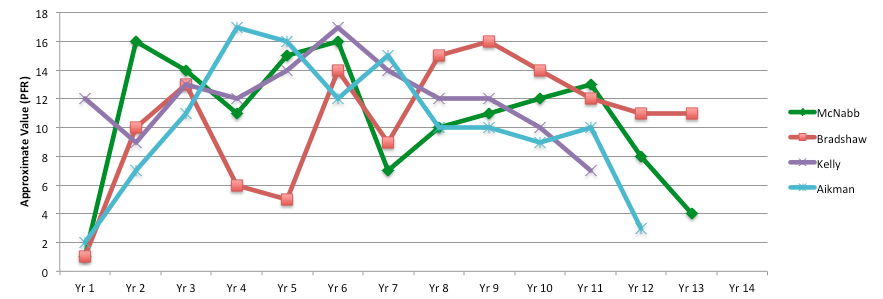
Rather than just reveal the names, I’ve put them in a chart (below) so you can see the career progression of each QB.

Screen Shot 2013-07-30 at 9.15.27 AM

I realize that Bradshaw and Aikman both get bonus points for SB wins, but if that’s the point of differentiation, then Kelly is still unexplained and you’re saying McNabb was 4 points away from being a HOFer, a ridiculously fine line to draw.  Overall, using Approximate Value, it’s clear that McNabb, once again, belongs among this group.

The “Worm-Burner” Weakness

The next aspect of the anti-McNabb case I want to address is the point people use to discredit the strongest part of McNabb’s resume.  Donovan McNabb has one of the most impressive TD/INT ratios of all-time (2.0).  He also has one of the lowest interception rates ever (2.2%, 4th overall behind Rodgers, Brady, and Neil O’Donnell).

The man did not throw interceptions.  That’s a very good thing.

However, in response to this, people frequently mention that McNabb played too conservatively.  Many times, he threw the ball into the ground, giving nobody a chance to catch it.  The common refrain is that he didn’t “give his guys a chance”.

Is this a fair critique?

Well let me put this a different way.

Imagine you are McNabb.  Your best receivers each year are: Chad Lewis, James Thrash, Todd Pinkston, Reggie Brown, Kevin Curtis.  No joke, those were the Eagles leading recievers from 2000-2008, with TO excluded.

Now tell me, with those WRs, how comfortable would you be throwing 50/50 balls?  Do you think it’s an admirable decision to let James Thrash fight it out with a DB for the pass? Reggie Brown?

Donovan McNabb had just one full season with an elite WR, 2004.  That year, he completed 64% of his passes, threw for 31 TDs with just 8 interceptions.  He also led his team to the Super Bowl, losing by 3 points to Tom Brady and the Patriots.

Given just one chance, McNabb took full advantage of having an elite WR, putting up historically great numbers and getting to the Super Bowl.  Also note, he played with the same roster in the playoffs as in the regular season.

Compare that to Jim Kelly’s Buffalo Bills, with Thurman Thomas and Andre Reed.  Or to Troy Aikman’s Cowboys, with Emmitt Smith and Michael Irvin (among others).

McNabb put up similar numbers (better if you include the running stats) with a FAR inferior cast around him.  That has to count for something.  His reticence to “force the throw” is completely understandable, and in fact was likely the optimal play the vast majority of the time.  Not sure I can make it any clearer: based upon the standard set by the current HOF QBs, McNabb definitely belongs.  At least the Eagles franchise has recognized that and will retire his number.  Forget all the bullshit (you’d be bitter too) and focus on the numbers, it’s not nearly as “borderline” as people make it.

What else you got?

Donovan McNabb; a Defense of an Unappreciated HOFer and the Greatest Eagles QB Ever

Lot’s to talk about, but I’m going to limit today’s post to Donovan McNabb.  Given his “retirement” and the fact that others are running McNabb columns today, I figured the time was right to finally put my thoughts about McNabb into post form.  As I’ve alluded to before, I believe McNabb is the greatest Eagles QB ever AND a Hall of Fame caliber player. 

As usual, I will not be rehashing all the draft-day stuff or the TO event, you can go elsewhere for that.  Here, I’ll just give you what I believe is often missing from McNabb discussions: CONTEXT.  I have much more to say about all the external crap, but I’m already at 1500+ words, so that’ll have to wait.

The Stats

Given all the noise and drama surrounding McNabb’s career with the Eagles, it’s almost understandable that many commentators/fans don’t fully appreciate how good #5 was.  Here are some major statistics, followed by the comparable numbers for other QBs.  Again, just trying to provide objective context.

Career Record (regular season): 92-49-1, .647 win percentage

P. Manning with the Colts – .688 win percentage

B. Favre with the Packers – .632 win percentage

J. Elway with the Broncos – .641 win percentage

Passer Rating with the Eagles: 86.5

D. Marino – 86.4

B. Favre with GB – 85.8

J. Kelly – 84.4

T. Aikman – 81.6

– 9 Playoff Wins

P. Manning – 9

J. Kelly – 9

D. Marino – 8

– 2.16 TD/Int Ratio with the Eagles

P. Manning – 2.08

D. Brees – 1.96

J. Montana – 1.71

D. Marino – 1.66

Donovan McNabb’s career with the Eagles was among the best QB/Team runs of ALL-TIME.  Look at the names above and how McNabb with the Eagles compares.  My guess is that, if asked, most fans wouldn’t place #5’s run in this company.  However, it EASILY belongs, and in some cases exceeds the statistical greatness of some legendary players.

So what’s the problem?

I’m guessing most people don’t consider McNabb a HOFer because of the ridiculous concept of his “big-game” performance.  McNabb did not win a Super Bowl.  NFL writers typically cling to this criteria when measuring greatness, despite its obvious outrageousness.  First off, this is not basketball, one man can not win a ring single-handedly.  This should be obvious, but the importance of winning titles is so ingrained in hack-writing that it’s frequently glossed over.

Ascribing such importance to titles is how you get fans seriously arguing that Terry Bradshaw and Troy Aikman are among the best QBs ever.  It’s a complete joke, yet it will probably lead to a HOF that includes Eli Manning while excluding McNabb (also a complete joke).

However, regardless of how stupid I think it is, playoff performance is an important criteria for evaluating a QBs career.  Let’s look at McNabb’s.

“Big-Game” performance

As I showed above, McNabb has more playoff wins than Dan Marino and just as many as Peyton Manning and Jim Kelly.  Despite that, people cite McNabb’s “clutch” performance as among his biggest weaknesses, pointing to him throwing up in the Super Bowl and his empty ring finger as evidence of his shortcomings.  Once again, though, we need to put his performance in the correct context.

Donovan McNabb lost 7 postseason games.  Lets look at a few of them:

2001 – Eagles (11-5) lose to the Giants (12-4) by a score of 20-10.

This was McNabb’s first playoff lost, in his second playoff game.  The Eagles had defeated  the Bucs the week before.  In this game, McNabb passed for just 181 yards, with 1 touchdown and 1 interception.  Not very good numbers (though not terrible either).  How about that context?

– The Eagles rushed just 14 times for just 46 yards.  BTW, McNabb had 17 of those rushing yards.

– The Eagles offensive leaders (other than McNabb) were Charles Johnson, Brian Mitchell, and Torrance Small.

– The Giants went to the Super Bowl that year, losing to the Baltimore Ravens (the historically great defense).

2002 – Eagles (11-5) lost to the Rams (14-2) by a score of 29-24

Donovan McNabb passed for 171 yards, with 1 TD and 1 Int.  He also ran for 26 yards and a TD.  Not great numbers, but again, we need context:

– The Eagles had a lead at halftime.

– Kurt Warner passed for just 212 yards and 1 TD that day, meaning McNabb and Warner had extremely similar statistical games (McNabb had 1 more TD and 1 more Int).

– St. Louis fumbled the ball twice, but recovered both of them.  The Eagles fumbled once, but lost it. (LUCK!!!)

– Putting up 24 points in a playoff game is a pretty good performance.

– The Rams were historically good on offense that year, scoring more than 500 points.  Warner, Faulk, Bruce, Holt, Hakim, etc…(as compared to McNabb, Staley, Buckhalter, Lewis,…)

– The Rams had the best point differential in the league that year and went to the Super Bowl, losing by 3 points to the Patriots, in what would mark Tom Brady’s arrival.

2003 – The Eagles (12-4) lose to the Bucs (12-4) by a score of 27-10

This is a VERY important game in the McNabb/Eagles canon.  The team, playing at home,  only put up 10 points.  Clearly a very disappointing game, and the finger was pointed directly at the offense, and obviously, at McNabb.  However, this game, more so than any other, is misunderstood.  McNabb went 26-49 for 243 yards, no TDs, and 1 interception.  He also fumbled twice.  A bad game, no way around it.  HOWEVER, the context:

– The 2002 Tampa Bay Bucs allowed just 196 points and are among the greatest defenses in recent NFL history.  The Bucs were 44% better than league average on defense that year, second only to the previously mentioned Ravens defense for the BEST in the last 12 years (likely longer than that as well).

– The Bucs defense had 5 Pro Bowlers that year and 3 1st-team All-Pros.  The roster included Derrick Brooks, Warren Sapp, Simeon Rice, John Lynch, as well as Ronde Barber and Brian Kelly (who had 8 INTs and 21 passes defensed that year).

– Against this defense, McNabb’s “weapons” consisted of Duce Staley, Todd Pinkston, James Thrash, and Antonio Freeman.  For the 2002 season, those were the Eagles leading offensive players.  Brian Westbrook was on the team, but did not yet feature in the offense.

Suddenly McNabb’s 243 yards and no TDs doesn’t look so bad.  The Eagles only chance in this game was for the DEFENSE (+31% that year) to shut down the Bucs offense as completely as the Bucs did to the Eagles.

This did not happen.

The Bucs did score on the 92 yard Int return by Ronde Barber, but neither of McNabb’s fumbles turned into Tampa Bay points.

Blaming McNabb for this loss is ridiculous.

2004 – The Eagles (12-4) lose to the Panthers (11-5) by a score of 14-3. 

This is the bad one.  This loss is the ONLY time during the “Peak” that the Eagles lost to a clearly inferior team.  McNabb passed for just 100 yards and had 3 interceptions and no TDs (obviously).

No real contextual mitigation here.  McNabb played terribly.  His supporting cast sucked (as usual), but that excuse doesn’t go anywhere near as far as would be needed to absolve #5 of his performance. UPDATE: I forgot that McNabb was injured during the 2nd quarter of this game and missed a play.  He remained in the game until midway through the 4th quarter.  Note that all 3 of his interceptions occurred after the injury.  

If you want to denigrate McNabb’s career, this is THE game to point to.  As I’ve shown above, the other losses aren’t nearly as bad as people remember them being.  This one, depending on how much leeway he gets for being injured, may be worse.

2005 – The Super Bowl.  The Eagles (13-3) lose to the Patriots (14-2) by a score of 24-21.

This, along with the previous 2 losses above, form the bulk of the anti-McNabb “evidence”.  McNabb threw up at the end of the game, and didn’t more the offense as quickly as the situation demanded.  That’s true.  However,

– McNabb threw for 357 yards.  He had 3 interceptions, but he also threw for 3 TDs.

– The Eagles rushed for just 45 yards, meaning McNabb was the entire offense.

– The Patriots had a point differential that year of +177, the 11th best measure over the past 10 seasons (out of 320 teams).

– The Patriots allowed just 16.2 points per game that season, the Eagles scored 21 against them.

– In the playoffs that year, Peyton Manning and the Colts put up just 3 points against the Patriots.

– The Patriots may have cheated (Spygate!!!).

Conclusion

After looking at McNabb’s statistics, with the context I provided, it should be clear to any objective observer that #5’s career was remarkable and deserves to be celebrated to a much greater extent that it is.  The “big-game” performances that McNabb takes hits for were not as clear-cut as they seem.  As far as I can tell, there is just one game where McNabb clearly performed far below expectations (Carolina).  Just as evaluating an entire career based on Super Bowl wins is ridiculous, so is ascribing any more meaning to one playoff game versus all the rest.  Remember, I only covered the losses (most of them).  The only ones I excluded were the loss to the Cardinals (the Eagles scored 25 points and lost, again, to the NFC Super Bowl rep) and the 2010 loss to the Cowboys (which was an awful defensive performance and included some Mike Vick).

The man had a Hall Of Fame career, regardless of whether the hack-writers recognize it.   If you had the type of career #5 had and received the same amount of shit for it, you’d be bitter too.  I wish McNabb’s personality was more affable, but everything he’s upset about is 100% justifiable.  He doesn’t get the credit he deserves; not everyone (very few in fact) can be magnanimous enough to ignore that.

Look at the stats, watch the highlights; you’ll see an All-Time Great.  It’s time for everyone to agree on that.

Lastly:

 I’ve used this before, but here is Hall of Famer Jim Kelly compared to Donovan McNabb:

Screen Shot 2013-06-24 at 1.14.05 PM

Tell me how Kelly is a HOFer and McNabb isn’t?

Eagles Projected Team Performance and the Most Unpredictable Teams

Taking a break from vacation for this post, so I’ll be MIA again until at least Monday.

I previously mentioned that I believed the 2013 Eagles have perhaps the widest potential performance distribution in the entire NFL.  Between the roster turnover, the new coaching regime/scheme, and last year’s injuries and craziness, there are A LOT of uncertainties surrounding this team.  Today, let’s compare my prediction with that of the guys at Football Outsiders.  For those of you who don’t know, the 2013 Football Outsiders Almanac has been released, and is well worth the $12.50 price (you can buy it at that link).

In other Almanac news, the 2013 Eagles Almanac has been distributed to all Kickstarter backers and will be available for everyone else within the next day or two.  I haven’t gotten through the whole thing yet (91 pages), but it’s fantastic and is a must-read for any real Eagles fan.  Follow @EaglesAlmanac for more information. You can get the PDF now for $10 at EaglesAlmanac.com.

Within the Football Outsiders Almanac, there are projected performance odds for every team in the league.  The group assigns odds of achieving a number of wins within 4 categories; 0-4, 5-7, 8-10, 11+.  So how do the Eagles look?

Screen Shot 2013-07-24 at 10.20.18 AM

It certainly looks like the Football Outsiders team/formula (I don’t know the methodology they use to determine those odds) agrees with the very wide expectation distribution.  According to FO, the Eagles have a 13% chance of winning 11 or more games, a very significant chance given the 4-win performance last season.

However, the team also has a 10% chance of winning 4 or fewer games.

Overall, the FO projection for the Eagles has a mean of 7.8 wins.  You’ll recall that my current projection is 8-9 wins (more likely 8 than 9, so lets call it 8.3); again, I’m more bullish on this team than most.

I think the odds above are underselling the actual potential for this team to have a “true” value of both 10-11 wins and 4-5 wins.  Remember that luck plays a very significant role in NFL teams’ final records.  So a “true 5-win” team will have a significant chance for finishing with 0-4 wins on account of the potential for bad luck.  Similarly, a true 10 win team will have strong odds for winning 11+ games by virtue of good luck.

I have no idea what the Eagles “true” value is right now, my guess is 8-9 wins.  However, it seems eminently possible for the true value to be both very high (if Chip’s system works as well) and very low (if the defense sucks again, Foles/Vick doesn’t work out, or Chip’s system fails).  If FO agreed with that, then I’d expect to see higher odds for both 0-4 wins and 11+ wins.

How do the Eagles compare?

In a vacuum, those odds don’t mean much.  We need to compare the Eagles with other teams to get a true sense of what FO expects.  Here is a chart showing the projections for the NFC East.

Screen Shot 2013-07-24 at 10.26.11 AM

Overall, the Redskins are the heavy favorites.  The Giants and Eagles have remarkably similar projections, while the Cowboys lag.  There’s not a lot to disagree with here, but I do not have as high an opinion of the Giants as FO does.  That looks like a 6-7 win team to me, but FO probably knows exponentially more about the Giants than I do, so there’s that.

The Redskins definitely stand as the biggest threat in the division, but I’m skeptical RG3 can repeat his (outrageous) performance from last season.  Still, even if he takes a step back, he’s likely to be among the top QBs in the league, if healthy.  So there’s the target for the Eagles, making Game 1 about as important as any season opener can be.

What about the rest of the league?

In other words, do the Eagles actually have the widest distribution?

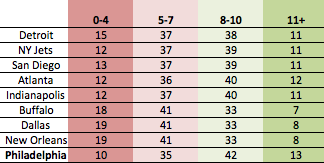
One way of looking at it (I’m going to avoid higher level statistical measures here) is to find the teams with the lowest “peak”.  For example, the Eagles “peak” is 42 (% chance for 8-10 wins).  Since all categories must add to 100%, a lower peak means a more even (probably wider) distribution.  Here are the teams with the lowest peak:

Screen Shot 2013-07-24 at 10.48.07 AM

The difference between Detroit and Philadelphia (by this measure) is relatively small, just 4% difference in “peak” projection.

Another way to do this is to look for teams with the greatest odds of finishing in EITHER extreme (0-4 wins or 11+ wins).  These are the true “boom-or-bust” teams.  Here are the teams that, according to FO, have a 10%+ chance of finishing with both 0-4 wins and 11+ wins:

Screen Shot 2013-07-24 at 10.56.19 AM

So there they are.  As should be expected, each of these teams is included in the previous table above.  Basically, these are the teams for which FO is MOST uncertain.  The Eagles are here, but do not feature as the MOST uncertain.  However, I do have to disagree with a few of the projections above:

– The Colts were very “lucky” last year, so it’s possible the team regresses greatly.  However, Andrew Luck is very good, and I believe he’ll be much better this year than he was last year.  Overall, I think the odds of the Colts finishing with 4 or fewer wins are basically the same as the odds of Andrew Luck getting injured and playing less than half the season.  I do not think the odds of an injury like that are anywhere near 12%.

– The NY Jets winning 11+ games seems laughable to me.  I know the team won 11 games as recently as 2010, but 11% odds seem very high to me.  That % is likely due to the potential for “good luck” to push the team several wins beyond its true ability, but that would require the Jets “true” win potential to be in the 8-9 range, which also seems at least a full win high to me.

– Atlanta receiving a 12% chance of 0-4 wins also seems strange.  This is almost the mirror image of the Jets above.  The Falcons have won 13, 10, 13, 9, and 11 wins over the past 5 seasons.  The team still has Matt Ryan and Mike Smith.  Barring a big injury to Matt Ryan (very unlikely), how does this team win fewer than 6 games?  Just like with the Jets, we have to account for the potential for luck (bad luck this time).  However, even very bad luck will only account for a few wins, meaning the Falcons would have to be a “true” 7 win team for very bad luck to push them into the 0-4 win category.  FO has them at 7.6 wins, so that’s not far off, but I’d have them in the 8-9 win range.

That leaves the Eagles, San Diego, and Detroit as my “Most Uncertain” teams.  Detroit is a crazy team to follow statistically, and nothing that team does will surprise me (outside of a 16-0 season).  San Diego also seems permanently schizophrenic, so a wide distribution can be expected.

I think one of those teams will finish the season with a very good record (11+ wins)…

Not All Yards Are Created Equal

So yesterday (and the day before) I discussed game theory as it relates to 3rd down strategy, hilighting that it appears as though NFL teams should be running much more often on 3rd and 1 (and 3rd and 2 to a lesser extent).  I also believe teams are incentivized to run more often on 3rd and 3-5, but I’ll have to come back to that later.

Today we need to start looking at one of the potential reasons for the discrepancy we saw in the Call/Success rates for Run and Pass plays.  The overall “game” that we created assumes the goal is to get a 1st down.  On 3rd and 1, that’s obviously a very important goal, but it’s not the ONLY goal, complicating our game.

In the comments, I mentioned that a potential reason for the lack of efficiency is the fact that teams may not be valuing 1st downs as highly as I expect them to.  That raises an obvious question:

How valuable are 1st downs?

To get an idea, we are going to go back to the concept of “expected points”.  Some of you will remember that our 4th Down Strategy series (and the chart accessible off the main menu above) are built from this concept and largely derived from the work of Brian Burke at AdvancedNFLStats.com.  I’m not going to go through the explanation of expected points again, since most of you are already familiar with it.  If you aren’t, see this post, which is the initial post of the 4th Down Strategy Series.

Today we are looking at just one scenario: 3rd Down and 1 yard to Go.

Obviously, in this case, the FIRST yard is the most important one.  Put differently, we should expect the bulk of the value in any 3rd down and 1 yard play to result from gaining the initial yard.  Each gained yard after that also has value, but since you only need 1 yard for a first down, we should see diminished returns after getting the conversion.

That’s pretty logical, but now I want to quantify it.  To do that, I used the data from Advanced NFL Stats, found here.  At this site, you can actually download the Expected Points spreadsheet if you’re interested in exploring it yourself.

Methodology

From this spreadsheet, I put together a fairly simple analysis.  Remember this is only for 3rd and 1.

With every 3rd and 1 play, there are two major outcomes, a first down or a fourth down.  To gain the first down, you only need 1 yard.  So I compared the expected points value of a 1st down at each yard line with the expected value of a 4th down at each yard line.

I then offset them, to account for the gained yard and looked at the difference in expected points.  Here’s an example:

3rd and 1 at the 10 yard line:  A 1st down at the 9 yard line (so gaining 1 yard) is worth 4.83 expected points.  Conversely, failing to convert, resulting in a 4th down from the 10 yard line (original spot) is worth just 2.15 points.  Therefore, in that situation, the 1 yard gain is worth 2.68 points.

Simple enough?

From there, I looked at the marginal increase in value for each additional yard.  So gaining 1 yard in the above scenario gives us a 1st and goal at the 9 yard line, worth 4.83 expected points.  Gaining 2 yards gives us a 1st and goal at the 8 yard line, which is worth 4.94 points.  Consequently, the second yard gained in that scenario is worth 0.11 expected points.

I did the same thing for the third and fourth yard gained, then put them all in an area chart seen here:

Screen Shot 2013-07-19 at 12.54.47 PM


As you can see, in a 3rd and 1, the first yard gained is worth A LOT more than each yard gained after it.  If we extrapolated further, it’d become clear that in any given 3rd and 1 scenario, there are TWO particular yards that are far more important than the others: the yard that get you the first down, and the yard that gets you the TD.  In fact, the yard that gets you the TD isn’t worth as much as you think, since being stopped just short would give you a 1st and goal at the 1 (itself worth nearly 6 points).

Pulling it Together

That’s a long way of saying that teams, in 3rd and 1 situations, should be valuing that one yard above all else.  I’ll do a more detailed analysis of this later, but choosing a less optimal play (lower odds of getting the first yard) in hopes of hitting a “big play” isn’t worth it, as least not in the offensive half of the field.

Not all yards are created equal.  Any yardage that gets you a First Down should be the absolute priority on 3rd down.  This will require another post, but I’ll leave you with another example.

Given 3rd and 1 and the 20 yard line, a 1 yard run is worth 2.39 expected points.  A 5 yard gain (presumably from a pass) is worth 2.65 expected points.

Let’s just assume for a second the odds of success for each are equal to the Run/Pass odds we saw yesterday (I know that isn’t right, but its instructive). That means the expected payout for each is:

Run: 2.39 expected points * 70.7% success = 1.69 Expected Points

Pass: 2.65 expected points * 54.6% success = 1.45 Expected Points

For that to be correct, that expected yardage for a run on 3rd and 1 would have to be 1 yard and the expected yardage for a pass would have to be 5 yards, neither of which is likely the case.  However, as you can see, the difference in expected yardage gained would have to be very big to account for the difference in success rates.

Administrative Note: I may or may not be going on vacation next week.  I have no idea if I will be able to post or not, so apologies in advance if I don’t get much up.

Nash Equilibrium and 3rd Down Strategy

Today I’m following up on yesterday’s post.  I encourage anyone who hasn’t done so to read that before moving to this post.

Now, onto the important stuff.

I discussed how we can apply Game Theory to NFL 3rd Down Strategy, highlighting what appeared to be a large inefficiency in 3rd down play-calling.  Basically, we should expect the Run/Pass play call breakdown to reach a point at which both options are equally likely to succeed.

This is the point of equilibrium.

I did some more digging into the numbers, the result of which is better resolution and more actionable intelligence.  Yesterday we looked at all plays run on 3rd down with between 1 and 5 yards to go.

Given what we know about the NFL, this is a very wide range for yardage; teams should run more often on 3rd and 1 than on 3rd and 5.  Below, I’ve broken the data down into smaller parts.  The results are encouraging.  Here is the complete table.  Note that I’ve put this together under the assumption that the original ranges are inclusive of each smaller range (3rd and 1-5 INCLUDES the 3rd and 1 stats), if that’s not the case, then this data is useless.

Screen Shot 2013-07-18 at 10.14.35 AM

See why I find it encouraging?

Starting with the bottom row (3-5 yards), we see that the NFL has, in fact, reached the expected equilibrium (close enough).  In a 3rd down situation with between 3 and 5 yards to gain, run and pass plays are both equally likely to succeed.

Remember the Tecmo Bowl Model, though.  As we can see, the equilibrium point occurs at a Run/Pass split that his HEAVILY tilted towards the Pass (18%/82%).  This is expected.  The important part is that play-callers appear to be operating efficiently, that is, calling runs and passes with the theoretically correct frequency.

This could be a coincidence, but given that we made the prediction beforehand and its the logical extension of yesterday’s theory, that seems unlikely.

Now the important part:

Screen Shot 2013-07-18 at 10.21.30 AM

While the league looks to have hit its Nash Equilibrium in 3rd and 3-5 yard situations, it DOES NOT look to be operating efficiently in 3rd and 1 and 3rd and 2 situations.

Again, our theory is that at the league level (a very important point), the call rate on 3rd downs should naturally evolve to a point at which the average success of both run and pass are close to equal.

Given the information above, teams should be running a lot more often on 3rd and 1.  Even though they are already calling a run roughly 75% of the time, the success rate of such plays is still significantly higher than for pass plays.

So….teams should run more, which will cause defenses to adjust by “expecting” the run more (Tecmo Bowl), which will presumably lead to Pass plays being “less expected” and therefore succeeding a higher percentage of the time.  Over time, the success rates for both run and pass should converge until they reach equilibrium.

Looking at the 3rd and 2 situations, we can still see some inefficiency, though it’s not as severe as in the 3rd and 1 situations.  Again, the process should be the same.  Offenses should run more, defenses should then commit to the run more often, and pass success rates should increase (while rush success decreases) until both Run and Pass have an equal chance of success.

It’s very important to note that this is League-level data.  Therefore, applying it to any individual team is tricky.  We can NOT say, for example, that the Eagles should definitely run more than 75% of the time in 3rd and 1 situations.  All we can say is that the LEAGUE should run more than 75% of the time in these situations.  It’s certainly a logical step to then take it to the team level; but know that it becomes more difficult at that point, since you have to weigh individual strengths and weaknesses as well as the relative strength of the opponent.

Conclusion:

– NFL offenses are not running enough in 3rd and 1 and 3rd and 2 situations.

– This is a short-term opportunity to exploit an inefficiency in the game.  Once offenses adjust, defenses will too, with the end result of equal success rates and no advantage.

– While I didn’t discuss it here, teams should likely ALSO be running more often in 3rd and 3-5 yards situations, though for a different reason.  I haven’t run the numbers yet, but my guess is that once we incorporate 4th down opportunities into the equation (especially 4th and 1), running will still carry the higher overall success rate (and therefore need to be used more until the defense adjusts).

– This, along with 4th down strategy that we previously discussed (see tab on menu bar), is an area ripe for a “forward-thinking” coach to take advantage of.

The Tecmo Bowl Model; Inefficiency in 3rd down play selection

Unfortunately, I haven’t yet found the necessary data to complete the type of 3rd down examination I’m aiming for.  Yesterday, I mentioned that many commentators are overlooking the fact that you have to be a very good offense in order to run a lot of plays (you need to gain a lot of first downs).  That might sound obvious, but it’s important to consider when thinking about Chip Kelly’s stated preference for “pace”.  Just wanting to push the pace won’t mean much if the team can’t gain first downs.

Obviously, that train of thought needs more research.  For today, though, I figured I’d highlight something I stumbled across while searching for data.  See this site:

http://football.10flow.com

I have no idea where it came from, but I’ve downloaded the data its supposedly based on and it seems legit.  It’s useful for illustrating an area of the game that I believe is potentially the largest untapped resource of analytical advantage: Run/Pass play selection.

At a very basic level, we can look at play selection through what I will call the Tecmo Bowl Model (or Tecmo Super Bowl if you prefer the upgrade).

What’s the Tecmo Bowl Model?

I’m making this up as I type, but in my head, it’s an incredibly simple construct for visualizing the importance of Game Theory in play selection.  For those who don’t know the game (I’d be very surprised if any readers don’t, but just in case), Tecmo Bowl was a groundbreaking football game for the original Nintendo system.  I won’t go into any more detail than they that, but if you haven’t played it, you should go find an emulator and change that.  The important part is the play selection screen, shown here:

Screen Shot 2013-07-17 at 12.55.57 PM

Basically, for both offense and defense, a selection of 4 plays are shown.  The player picks one of these plays by pressing the corresponding button combination (shown below each play).  Here is the key part:

If the Defensive player picks the same play as the Offensive player, then as soon as the ball is hiked, pretty much every offensive lineman is pancaked, resulting in a likely sack or a throw from the QB that’s no more than a jump-ball.

Without getting into any higher-order strategy, the defense has a 25% chance of “picking” the offenses play.

Despite its relative simplicity, I believe this game has a LOT to tell us about modern (and real) football.  In essence, the defense is continuously trying to “pick” the offense’s play.  The results aren’t as dramatic as in the game above, but the fundamentals are the same.

Is the offense going to run or pass? Short or deep? Maybe play-action?

These are all questions defensive play-callers have to ask themselves.  Each subsequent decision is largely determined by both the defense’s overall strategy/strengths AND the subject down/distance/score/time scenario.  

Just as in the video game, if the defense successfully “picks” the offense’s play, the result SHOULD be a “win” for the defense.

So what?

This has obvious reprecussions for offensive strategy.  It is not enough to just pick a good play; you also need to account for what the defense will be expecting.  Correlating to the statement above: if the offense picks a play that the defense is NOT expecting, it has a distinct advantage and will be more likely to “win” that down.

Let’s take a look at an example.  From the site I referenced at the top:

The Scenario:  3rd Down, 1-5 yards to go, All Scores, Any Time.

The Results:

Screen Shot 2013-07-17 at 1.09.06 PM

For this scenario, “success” is defined as a 1st down or a touchdown.  What can we infer from the data above?

The output makes it very easy to see the relevant discrepancies.  In this situation, Run plays were 14% MORE successful than Pass plays.

Despite this, Pass plays were called nearly TWICE as often.

There are two leading explanations for this difference:

– It’s a true inefficiency.

– It’s simply the result of the type of Game Theory I described in the Tecmo Bowl example above.  Basically, Run plays are more successful BECAUSE they are called less often.  Pass plays are called 67% of the time, meaning the defense is most likely EXPECTING PASS, leaving them more susceptible to a RUN.

The big question is, has this game (long-term play selection) reach its Nash Equilibrium?

The Nash Equilibrium (very basic explanation) is the point at which both sides know the other’s strategy, but neither side is incentivized to change its own in response to that knowledge.

This situation is slightly different, since we’re talking about individual occurences within a long term game, but I believe the overall point holds.  More importantly, I do NOT think the NFL has reached the point of equilibrium (within this particular scenario at least).

Here’s where I need some help.  It seems to me that the point of equilibrium would naturally occur around the Run/Pass split that equates to a roughly equal chance of success for each.  Note that because of the Tecmo Bowl Model explanation above, this does NOT necessarily equal a 50/50 split in play calling.  Regardless, I might be mistaken in my reasoning here.  If you have any other predictions/analysis, please let me know.

Also, lest we fall victim to a small sample, here is the output when we include every season from 2002-2012:

Screen Shot 2013-07-17 at 1.28.41 PM

The numbers are almost identical, which means I’m either missing something in my prediction/analysis (very possible), or NFL play-callers are operating at a very inefficient clip.

Obviously, if it’s the latter, it has HUGE implications for in-game strategy.

Plays Per Game – Chip Kelly’s Offense and NFL Trends

Yesterday I looked at defensive plays per game, trying to get a sense of whether teams created more fumbles purely because they had more opportunities to do so.  They do not, but that’s because the difference in # of plays defensed is so small, on average.

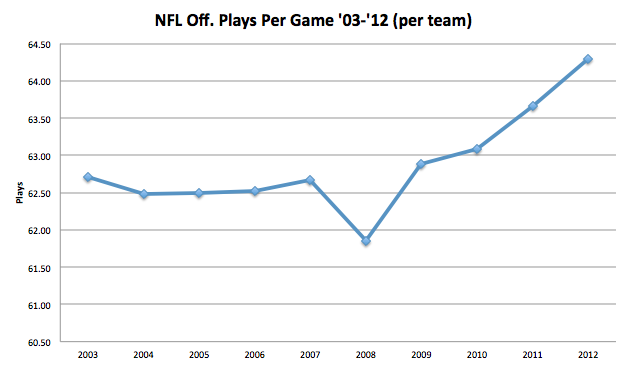
More interesting, though, is this chart.  You’ll recognize it from yesterday, though I’ve re-labeled it “Offensive”.

Screen Shot 2013-07-16 at 11.04.52 AM


As mentioned, this clearly illustrates an uptrend in the # of plays run per game by NFL offenses over the past 10 seasons.  The overall magnitude is small (see the Y-Axis labels), but the direction is unmistakable.  Last season, teams ran about 1.5 more plays per game than they did in 2003.

The difference is small enough that it could easily be the result of chance.   However, if is was purely a result of natural variability, we’d be very unlikely to see such a smooth trend in the chart above.  Aside from 2008, a distinct outlier, the annual increase in plays run per game has been both smooth and accelerating.

What’s going on?

Let’s take a look at the data in more detail, drilling down to the team level.  As usual, I’ll start with the Eagles.  Here is the same chart, with the Eagles annual plays per game illustrated.

Screen Shot 2013-07-16 at 11.18.19 AM


The Eagles annual variability is expected, since the league average will always be more smooth than the individual team measures.  However, notice that the Eagles individual trend is also unmistakable.  Here is the raw data for the team:

Screen Shot 2013-07-16 at 11.24.48 AM


Last season, the Eagles ran more than 7 more offensive plays per game than they did during the 2003 season.  Again, the increase hasn’t been smooth (the team ran just 60.6 plays per game in 2009), but it’s real.

Looking at the Eagles line in the chart above versus the League line also tells us that the team has a disproportionate influence on the league-wide uptrend.  The Eagles began the subject time-period well below the league average and finished well above it.

There are a number of potential explanations for this, but before we get to that, let’s look put the Eagles into context.  Here is a table showing the average plays per game run by each team from 2003-2012.

Screen Shot 2013-07-16 at 11.39.37 AM

There are a few obvious results (Patriots and Saints at the top, Buffalo and Cleveland at the bottom), but some surprises as well.  St. Louis ranks 7th, for instance, which I certainly would not have guessed.  However, the 10-year average isn’t really what we’re interested in, is it?

We want to look at the relative increase.  Here is another table, this one showing each team’s average over two time periods, ’03-’05 and ’10-’12.  In other words, the first and last 3 seasons of the 10 year period.  Also, I’ve included the change for each team (+/-) and ordered by that measure, so teams that saw the biggest increase in average plays run are at the top.

Screen Shot 2013-07-16 at 11.47.00 AM

This confirms what I asserted earlier, that the Eagles have had a disproportionate effect on the overall league trend. Just 5 teams have seen larger increases between the two time periods.

So what?

I probably shouldn’t have taken this long to get to Chip Kelly, but better late than never.  As we can see, the Eagles have already been towards the front of the league in terms of running higher numbers of plays.  Whether this was an emphasis or not, it means that Chip Kelly’s overall effect on the # of plays run may be more muted than is expected.

Given the finite amount of time in each game, the minimum required time for each play to be called and set up, and the fact that the other team get’s a roughly equal number of possessions, there is only so much that Chip can do to ensure the Eagles run more plays.

Notice that New England, a team that clearly emphasizes speed of play, averaged just 2.43 more plays per game than the Eagles did over the past 3 seasons.  Last season, the Patriots ran 74.3 plays per game, which I believe is the all-time record.  Still, that was just 7 more per game than the Eagles.

Overall, a difference of 7 plays per game is HUGE.  However, from a practical standpoint and from a fan’s viewpoint, it’s not going to LOOK much different.  When one considers that the Eagles are very unlikely to be able to run as many plays as the Patriots did last year, that means the team will likely be running no more than 4-5 more plays per game than it did last year (and that’s if things go according to plan.)

Why should we care about # of plays run?

As explained in this article over at Philly Inferno, positive play differential is correlated with winning.  Looking purely at offensive plays run per game, I get a correlation value of .30 (off. plays run – Wins).

SImply put, more plays —-> more yards —-> more points.

However, I want to emphasize something that isn’t getting a lot of attention.  Emphasizing offensive pace is not enough to ensure you will run more plays.

In order to run more plays, you need to keep the ball.  In order to keep the ball, you need to convert on 3rd down.

If the Eagles can’t convert 3rd down’s at a high rate, it doesn’t matter how fast Chip wants to play.  Want to see the data?  I thought so.  Here is a chart of offensive plays per game against 3rd down conversion %.

Screen Shot 2013-07-16 at 12.11.42 PM


Given that I’ve probably lost a lot of readers by now, I’m going to come back to this point in another post.  For now, though, let’s leave it at this:

Last season, the Eagles converted 37.4% of 3rd downs.  If the team can’t improve on that measure (significantly), it won’t matter how badly Chip wants to run more plays.  

Defensive Plays Against

After last week’s fumble posts, I realized that no team-level analysis would be complete without equalizing for number of plays.  We saw that the distribution in forced fumbles (team totals) over the past ten years does not appear to be random and is certainly not normally distributed.

However, it’s possible that the teams forcing the most fumbles (Chicago) simply had more opportunities.  Basically, is there a “natural” fumble rate?  If so, then the difference in forced fumbles could be largely dependent on the number of defensive plays run.

In compiling the data for this problem, I noticed something interesting, which I’ve touched on previously (very lightly).  Specifically:

There is a surprising lack of variability in # of plays run from team to team.

In my post about potential injuries and Chip Kelly’s offense, the main takeaway was that even the “fastest-pace” offenses do not, on average, run a lot more plays than “slow-paced” offenses.  Today we are looking at # of defensive plays, but since every defensive play is also an offensive play (for the other team), the higher level distribution should be the similar.

Here are the average defensive plays run per game over the past 10 years (for each team, ordered highest to lowest):

Screen Shot 2013-07-15 at 10.53.08 AM

The Eagles rank 10th, with an average of 63.51 defensive plays per game.  However, the key is to look at the Max and Min of the table above.  Cleveland has faced the most plays, just under 65 per game.  Pittsburgh has faced the least, just under 60 per game.

So the long-term difference comes out to an average of just 5 plays per game.

Put differently, over the past 10 years, the defense that ran the MOST plays faced just 50 more plays than the defense that faced the fewest.  Note that this is an approximation since there are presumably rounding differences due to the use of averages rather than # of plays (only data available).

Going back to last week, it means that the variability in the number of forced fumbles for each team is likely NOT a function of # of plays (I say likely because the # of plays data does not include Special Teams, which could potentially skew the numbers, though I think that’s extremely unlikely.)  The correlation between average plays against and forced fumbles is -.03; so no connection.

While that’s not a huge surprise, the overall lack of variability in the # of plays data is.  Given how many different factors there are in every football game that affect the number of plays run, I expected to see a somewhat random but certainly WIDER distribution.

Perhaps it’s simply a result of the sample used (a big one, 10 years).  Over that length of time, teams are likely to cycle between “good” and “bad”, which may help the overall numbers even out.

Also, defenses have much less control over the number of plays they face than offenses have over the number of plays they run.  We can assume that “good” defenses will tend to face fewer plays than “bad” defenses, but that’s about as far as we can go.

Let’s look at individual season numbers.

Perhaps most importantly, the entire NFL is trending upward in terms of number of plays per game.  Here is a chart showing defensive plays per game over the past 10 years.  Remember that this is equivalent to offensive plays per game.

Screen Shot 2013-07-15 at 11.32.08 AM

If you look at the Y-Axis, you can see that the overall difference isn’t huge (the increase from 2003 to 2012 is just 1.57 plays per game.) However, the trend is unmistakable, with the past 4 seasons showing the most severe increases.

To this end, Chip Kelly’s offense (presumed to emphasize # of plays) is not revolutionary; it’s EVOLUTIONARY.  Tomorrow, I’ll take a detailed look at offensive plays run (same overall data, but different team data and we can draw more from it due to the “control” of the offense).  The key point here, though, is that Chip Kelly’s offense appears to be a natural extension of what we are already seeing in the league.  We have not, of course, actually seen what Kelly’s offense will look like; but it’s safe to say his “plan” fits firmly within the long-term NFL offensive progression.

Let’s take a quick look at some individual defensive play stats.

Over the past ten years:

– The 2010 Titans faced the most offensive plays, with an average of 71.2 per game.

– The 2004 Pittsburgh Steelers faced the fewest plays per game, with 55.6.

– The long-term, league-wide average is 62.9 defensive plays per game.

– The 2006 Eagles faced 65.8 plays per game, the most for the team over the past ten years.  The 2007 Eagles faced the fewest; 61.2.

– There is, not surprisingly, a positive correlation between defensive plays per game and points against, with a value of .28.

As I said above, tomorrow I’ll do a deep dive into OFFENSIVE plays per game, which should give us some idea of what we can expect from Chip Kelly.   I looked at defensive plays today since I had to address the # of Plays effect on forced fumbles (no effect).