Total Prospect Rankings (PVM Version 2.0), Balancing Risk and Reward in the NFL Draft

As promised, I have completed a relatively dramatic overhaul of the PVM system.  Just as I did in the original post, I’ll explain the methodology and theory first (and changes) and then list the updated rankings.  Feel free to skip to the bottom if you don’t care how the system works.

Please note that this is still far from a finished product.  There are a number of issues (mostly calibration) that I will only be able to address after collecting several years of data.  Additionally, I’m posting it now so that I can incorporate and comments/criticism prior to the draft.

The Theory

The original PVM system was meant to function as a better determination of BPA (Best Player Available) rankings.  In essence, a player’s scouting grade is not enough.  A complete system will account for positional value and positional risk IN ADDITION to the scouting grade.

Basically, this system is an attempt to provide a “Default BPA Ranking”, against which all team drafts can be compared/graded.  The original system included two components, scouting grades and a positional value multiplier (hence the PVM name).  Today, we’ll add a measure of risk to the formula.

Methodology 

As mentioned above, the system is composed of three components:

Consensus Scouting Grade – Player/Positional Risk Adjustment + Positional Impact Bonus

Consensus Scouting Grade

This is the easiest part.  I compiled prospect ratings from 3 4 reputable sources: Scouts Inc. (ESPN), NFL.com, the National Football Post, and Draft Ace.  The NFP’s scale is different, so those number were adjusted for an apples-to-apples comparison.  Additionally, NFP includes letter grades/modifiers that were not incorporated here.  Each source is weighted equally, with the average score taken as the “Consensus Rating”.

Player/Positional Risk Adjustment

This is the new addition to the system.  Obviously, some players/positions carry more risk than others.  I’ve attempted to quantify that using two measures: standard deviation of the scouting ratings and historical positional miss rates.

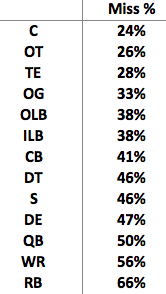
Positional Miss Rates:  To quantify the positional risk, I looked at every player drafted in the 1st or 2nd Round between 1999 and 2011.  Basically, players selected in the 1st and 2nd round are expected to be starters, regardless of position.  The miss rate is an attempt to see which positions have larger margins of evaluative error.  Here are the rates I arrived at:
Screen Shot 2013-04-09 at 5.51.49 PM

A player counts as a “miss” if they did not start for at least 5 seasons (according to Pro-Football-Reference.com) or, if they have not been in the league that long, have not started at least half the time. Note that my historical data does not break out LBs by outside/inside, hence the same miss rate.

As you can see, there is a very wide disparity in success rates.  As expected, offensive linemen are “safer” picks, while offensive skill positions are the riskiest.

Here’s where calibration comes into play.  The scouting grades are out of 100 points.  To arrive at a positional risk measure, I multiplied the historic miss rates by 100, then took the square root of that.  For example, the risk adjustment for the TE position would be 100 * .28 = 28.  SQRT(28) = 5.27.

That’s the first half of the risk measure.

I then took each player’s rating standard deviation and multiplied it by .5.  Basically, the idea here is that wide agreement among scouts should equate to more certainty and vise-versa.  Therefore,  a high standard deviation means we are less certain about the consensus rating.  A low standard deviation means we are more certain.  I took half of the SD measure to avoid overly penalizing players with high consensus grades but high standard deviations.  On the pure SD measure, players with lower grades across the board can jump players with higher grades across the board, by shear virtue of small deviation.

I then added this to the positional measure explained above to arrive at the Risk Adjustment.  The Risk Adjustment is subtracted from the consensus prospect rating.

For Example: Sharrif Floyd’s consensus rating is 92.98.  His standard deviation multiplied by .5 = 1.66.  His positional risk measure (DT) equals 6.76.

6.76 + 1.66 = 8.42

So Floyd’s Risk Adjustment is 8.42, his score after accounting for risk is 84.56.

Now we need to add our last component, positional value.

Positional Value Multiplier

The overall idea here remains the same as the original system.  However, I’ve changed both the sources of data and the subset included.

Previously, we used the average cap hit for each position across the entire league.  Since the NFL has a salary cap, the relative allocations should tell us how teams, in general, value different positions.

However, those measures included rookie contracts and contracts for players not expected to contribute at their position (like a special teams ace).

So here’s what I did instead:

First I went to Pro Football Focus and counted how many players played more than 50% of their team’s snaps at each position.  I did this to account for positional scarcity (e.g. there are a lot more WRs than Cs).  I then took 25% of those measures so that we will only be looking at players considered well above average at their position (at least by pay).

Then I looked up the top _ contracts at each position and found the average value at each position.

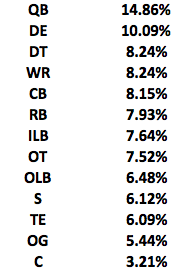
I used those averages to create new positional multiplier values.  Here are the new measures:
Screen Shot 2013-04-09 at 6.17.29 PM

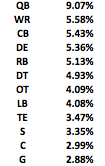
Compared to the original measures, there is a wider disparity.  For instance, the QB measure was previously 9.07%, significantly less than the new measure.

Just as we did before, I used these measures to inflate the Risk Adjusted Prospect score for each player.

To recap: We start with the Consensus Ratings, Subtract a Risk Measure to account for player rating uncertainty and positional scouting error, then inflate according to the PVM numbers to account for positional impact.

Overall, the biggest flaw right now is the calibration of the Risk Measure and PVMs, their subjective.  However, I attempted to balance the relative magnitude of both of them.  Additionally, if we step back and look at the overall measure, we see that relative importance is as follows:

– Consensus ratings (by far the most important)

– Positional Value and Risk

– Individual player rating uncertainty

That looks right to me, as far as what I’m going for.  As I mentioned above, the only way to arrive at a “correct” calibration is to use the system for several years, then analyze the rankings to see which parts of the formula are over-weighted and which are under-weighted.

By all means, if you have thoughts as to how to improve the system, let me know.  We still have a couple of weeks to make revisions/improvements.

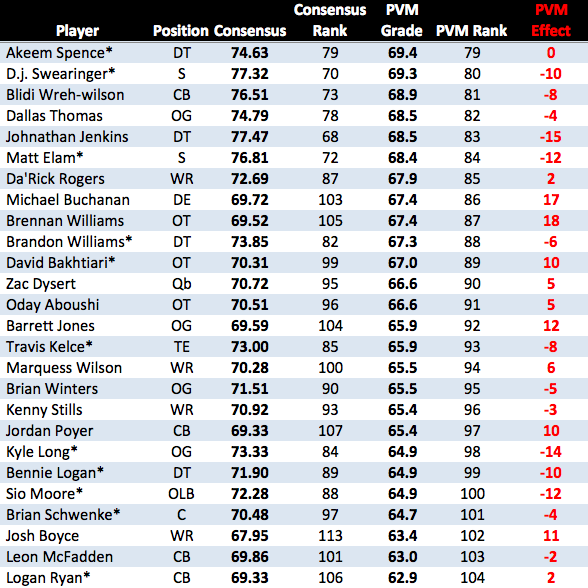
Total Prospect Rankings

Here they are, we’ll talk about them in more detail starting tomorrow.Screen Shot 2013-04-09 at 6.35.52 PM

Screen Shot 2013-04-09 at 6.36.45 PM

Screen Shot 2013-04-09 at 6.38.14 PM

Screen Shot 2013-04-09 at 6.39.39 PM

Screen Shot 2013-04-09 at 6.40.18 PM

Random Thoughts

Since it’s Friday, I’ll use today’s post as a kind of clearinghouse for thoughts on several areas.  FYI, I probably won’t have time to post on Monday, so I apologize in advance for not providing the requisite time-kill.

Free Agent Tackles

– I would be very surprised if the Eagles aren’t interested in both Winston and Clabo.  I don’t think the team is completely enamored by either, but given the current OL, it’d be foolish not to consider bringing either of those guys in at the right price.  I think Winston is holding out for a deal the Eagles are unlikely to provide.  Clabo is more interesting.  Given his age, I doubt he’ll find any long-term offers.  At a reasonable price for 1-2 years, he’d address a need for the Eagles.

Again though, if the Eagles are sold on Fisher in the draft, there’s no way they sign a starting RT.

Draft

Everyone is trying to game out what Chip Kelly is thinking.  I think everyone is forgetting about Howie a bit too easily.

We already know Howie has the final say on draft matters.  Obviously Kelly has a huge amount of input, but Howie very recently experienced what happens when a GM bows too easily to a coach’s wishes (Jarrett definitely, maybe Watkins as well).  I doubt he’ll let that happen again so soon, especially with a coach who’s never done this before.

Therefore, “what is Howie thinking?” should be a question more people are asking.

If I had to guess, may answer would be “please god let me trade down”.  I know that it’s popular to say how little interest there is in trading up in this draft, but I find that to be a bit overblown.  There are a number of prospects that I can easily see individual teams falling in love with (Eric Fisher, Sharrif Floyd, Dion Jordan, Ziggy Ansah, Star Lotulelei, Geno Smith).  Additionally, there is such uncertainty that no team has a good handle on when any of those guys will be available.

In that scenario, all it takes is one team with an itchy trigger finger.  It’s very conceivable that the Eagles could choose any of the prospects I mentioned above.  That should be enough to scare a team into action if they really like one of those guys.

That may just be wishful thinking, but I think it’s a scenario that is being dismissed too hastily.

Individual Prospects

I’m starting to get a feeling that perhaps we’re all overlooking the obvious.

– Our defense needs a lot of improvement (far more than the offense).

– The DL has a particularly glaring hole in it.

– Chip has repeatedly professed a love for big, freakishly athletic players.

and yet…I have yet to see Ziggy Ansah mocked to the Eagles.

Ansah is 6’5″, 270 lbs with long arms and big hands.  Explosive athleticism and great quickness.  He’s “old” at 24 yrs, and first played football in 2010 if I’m reading correctly.  So here we have a top DL prospect with freakish athleticism who sounds like he could step into the 5-tech spot, a position of great need for the Eagles.

I don’t think it’s likely, but it makes too much sense to me to not consider it a real possibilty.

Sharrif Floyd –

This is almost the opposite of Ansah.  I’m seeing Floyd mocked to the Eagles and I still don’t understand it.  He looks to be a 3-tech guy; we already have Cox, end of story.  He might be able to play 5-tech, but certainly doesn’t look to be a NT, severely limiting his value for the Eagles.

Star Lotulelei –

I’m just going to keep on repeating this (I’ve been saying it for a LONG time), Lotulelei is an EXCELLENT fit for the Eagles.  Now that his heart issue is resolved, there are no more red flags.  He can play 5-tech, he can play NT.  His first-step quickness makes him a nightmare for centers when he’s lined up at 0.  Yes, please.

Eric Fisher –

Fisher, obviously, is a likely possibility for the Eagles.  Top OT (after Joeckel) and the Eagles need one.  However, keep in mind that OTs are also among the easiest to find later in the draft.  Especially if Kelly is OK with Herremans at OT this year, waiting until the 2nd or 3rd round to take one makes a lot of sense.

Dion Jordan –

Popular pick due to his size/athleticism and the Oregon ties.  This may be a tricky one for the Eagles though.  Kelly might know him TOO well.  I imagine a coach like Kelly will inevitably think VERY highly of players who played a large role in his earlier success.

However, Kelly is a very smart guy, so hopefully he knows that his opinion is inherently biased, potentially to a large degree.  This is where Howie really needs to step up.  If he doesn’t think Jordan is the best guy on the board, the Eagles can’t take him, regardless of what Chip thinks.  This goes back to the point I made above:  This is Howie’s draft, not Chip’s.

That’s all for today.  Enjoy your weekend.  I’m making some heavy revisions/updates to the PVM system and hope to have it available some time next week (that way we have time to pull it apart for a little while before the draft).

1st Round Breakdown

A couple of people asked for a more detailed breakdown of the 1st round, so we’ll do that today.  First, however, I need to apologize for a fairly large mistake.  As I was putting together today’s data, I noticed a mistake in the Strategy Chart I posted yesterday (and have posted before).  The upshot?

– 1st round LBs are much more successful than I had listed them.

Obviously this affects the Dion Jordan comments yesterday and will affect my draft analysis going forwards.  Sorry for the misinformation, just a typo in excel that I missed.  Thankfully I caught it before we start incorporating the data into the PVM rankings.

Now back to the subject:

If you haven’t seen the post showing the top 15 breakdown, please read that here:

Top 15 Breakdown

That post illustrates pretty clearly that there isn’t nearly as big a difference between, say the #5 pick and the #12 pick, as some people believe.  However, there is a big drop-off after #15.  In general, the real “first round” is picks 1-15.  Hence my point about the advantages of trading down from #4 but remaining in the top 15.  There is some positional loss from trading down (no QBs in general), but overall it appears to be a good strategy.

For those wondering, I also did a positional breakdown post for the Top 15 picks here.  That’s also a must-read for anyone interested in the draft, as it gets to the “prospect tiers” aspect of strategy.  Please note that both of those use a slightly different time-frame than we will use today.

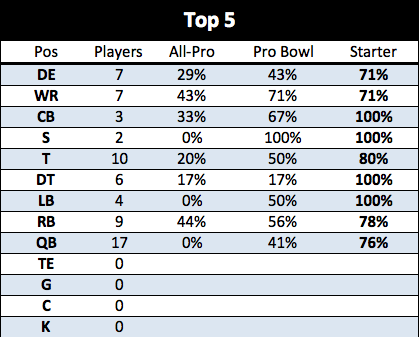
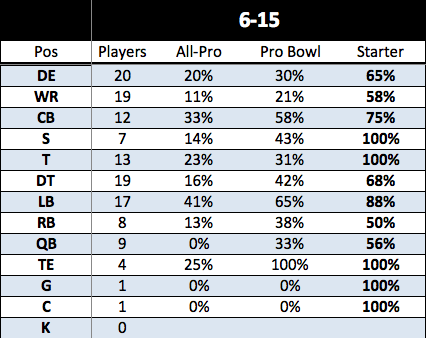
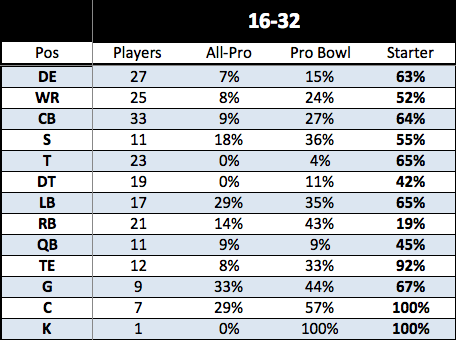
Now let’s look at success rates for the first round.  Here is the complete chart, with the first round broken into three segments.  Following is each segment by itself to make it easier to read.  The data does not include this past season, so pro bowlers/all-pros from this past year are not included.

Screen Shot 2013-03-20 at 11.54.05 AM

Screen Shot 2013-03-20 at 11.55.33 AM

Screen Shot 2013-03-20 at 11.56.58 AM

Screen Shot 2013-03-20 at 11.57.25 AM

Before we start analyzing, I want to warn everyone about the danger of small sample sizes.  The reason I haven’t typically broken the draft into such small sections (1-5) is that when you do that and combine it with a positional breakdown, the samples get way too small to draw any conclusions from.  For example, there have been just 2 safeties drafted in the top 5, Sean Taylor and Eric Berry.  Both were/are very good players and each made the Pro Bowl.  However, it’d be wrong to suggest that the odds of a top 5 safety making the pro bowl are 100%.  In light of that, try view this data in a proper context.

Now the takeaways-

– Notice that the odds of getting an All-Pro caliber player fall significantly after the top 15.

– QBs, as we’ve discussed, are very risky throughout the first round, but especially so in the second half of it.  Just 45% of QBs drafted between 16-32 became “starters”.   Just one of the 11 became a Pro Bowler (Aaron Rodgers).

– The charts certainly support the point I made earlier: The “first round” of the draft should really be viewed as just the top 15 picks.  Odds of success fall dramatically after that, so it’s unreasonable to hold all 1st round selections to the same standard.

– Obviously positional distribution is a major factor here.  Since the best QBs are typically taken high in the first round, we can assume that those selected towards the end of the round are lesser prospects.  Compare that to positions like G or TE, which are not typically taken high.  As a result, it makes sense that those positions would carry greater odds of success towards the end of the first round.

– In all, this highlights the importance of BPA discipline.  Just because you need a QB doesn’t mean you should take the best one available.  As we can see above, taking the best prospect, regardless of position, is a much better strategy.  Note I still believe in adjusting for positional value, but BPA with that adjustment remains, by far, the best draft strategy.

– RBs are really terrible value picks and should be taken in the 1st round much less often.

– Regarding the Eagles, the data shows that, regardless of which position the team selects, it has good odds of getting an elite player.  With several “needs”, the Eagles main focus should be on minimizing risk.  Blowing the #4 pick because you picked “potential” over “performance” or were focused on one position would be a HUGE missed opportunity.  I’m not directing that comment at any prospect in particular, just trying to emphasize how important it is for the Eagles to maintain BPA discipline.

Sorry again for the bad LB data. I’ll be updating the full chart and reposting next week.

I’m on the road the rest of this week, so NO POSTS TILL MONDAY.  I may be able to respond to comments, but full posts will not be possible.

Thanks for reading.  I appreciate all the feedback and hope you continue to find this blog interesting.


Draft Strategy Chart

Today let’s take another look at our draft strategy chart, this time using it to talk about a few prospects.  Some of you have seen this, newer readers have not.  I apologize if its tough to see without zooming in, but I like to get a comprehensive look with this chart.  Note that the 6th and 7th round columns were included in yesterday’s post.  The sample is all players drafted from 1999-2011.Screen Shot 2013-03-19 at 3.12.35 PM

The different color backgrounds reflect my quick attempts to eliminate sub-optimal round/position choices (in black).

Between now and the draft, I am hoping to mine this in a little more detail and ultimately combine it with the PVM system.  However, for today, let’s talk about specific players.

First, a note on value.  Obviously applying this chart to individual players is a misuse of the data.  There is no guarantee that the sample is representative, and there are potentially a lot of other factors at work.  In general, I believe the value of this type of data is to give us a sense of which positions are easier/harder to evaluate.  For example, LBs seem to have a much larger margin of evaluative error than OTs.  Therefore, a LB with similar ratings to an OT will carry more inherent risk by virtue of the fact that, historically, LB projections are less accurate.

Hopefully that made sense.  We’ll be revisiting this a lot in the next few weeks.  Now let’s get to the players.

Dion Jordan – He immediately pops out because A) he’s been frequently “mocked” to the Eagles, and B) plays a position that carries the worst 1st round hit rate.  This doesn’t mean Jordan won’t be a good player, only that LBs are very hard to project coming out of college.  This is a major reason why I do not like him for the #4 pick.  Added risk, no additional reward.  With a lot of similarly rated prospects, no reason to take on any additional risk.  Also, notice that the odds of finding a starting LB in the second round are almost as good as in the first round.

Star Lotulelei – I’ve been a big proponent of Star for as long as this blog has been up (I may have actually been the first one to peg him to the Eagles).  I still believe he is among the best potential picks for the Eagles.  He’s a run stopper and a natural pivot on the d-line, able to hold his ground against a double-team, allowing the LBs  to fly to the ball.  Heart condition notwithstanding, Star would immediately become the Eagles 5-tech and could play NT as well if Spooky doesn’t perform.  However, the chart above is a bit of a red flag.  DTs carry some of the lowest “elite player” odds (all-pro, pro bowl) as well as relatively low starter odds.  Additionally, the odds of finding a starting DT in the second round are good.

Once I figure out how to factor this in to the PVM model, I expect to see Star move down the board a couple of spots.  For now though, he remains a personal favorite.  In a perfect world, the Eagles would trade down to #7 or #8 and pick him up there.

Joeckel/Fisher – The Eric Fisher train has picked up a bit of speed recently, especially with the Eagles sitting out the OT FA market (for the moment).  I’m not a huge Fisher fan, but the odds clearly submit him as a “low-risk” pick.  It is common knowledge at this point that OTs are safer picks in the 1st round than any other position, and the data definitely bears this out (im not counting Cs due to sample size).  HOWEVER, that is an overly simplistic way of looking at it.  You also have to account for the fact that OT is one of the EASIEST positions in which to find contributors later in the draft.  You won’t get an elite OT after the first round, but notice you still have 25% chance to get one as late as the 4th round (and 13% in the 7th).

Let’s play a quick probability game.  Assume that this data was perfectly representative of the upcoming draft.  The Eagles have four 7th round picks.  If the team were to use all 4 of them on OTs, what would the odds of finding a starter be?

Well the chances of missing, according to our table, are 87%.  The chances of missing with all 4 picks are .87^4, or 57%.  Therefore, the odds of NOT MISSING all of them would be 43%.

A 43% chance isn’t great, but it’s pretty significant, and remember this is in the 7th round.

In the second round, 70% of OTs in our sample ended up as “starters”.

This is a long way of saying that the Eagles resources, according to the current prospect rankings and team needs, are probably better spent elsewhere than on an OT in the 1st round.

Dee Milliner – Another guy who has picked up steam (the 40 time helped a lot).  He could go as high as #1, though I think that’s unlikely.  I like him because he is ranked #1 by PVM, though we’ll have to wait and see if he holds onto that position as ratings are updated.  The major pushback on him is that he doesn’t rate as a “shutdown” corner.  Obviously, if you are using the #4 pick on a CB, you want him to be an “island” sort of player.  However, this is a pretty ridiculous read of the situation.  Essentially, draftniks are comparing Milliner to CBs in OTHER drafts.  Obviously there have been better CB prospects.  The fact remains, though, that in THIS draft, Milliner is by far the best CB prospect, and is also one of the best prospects PERIOD.

You can chalk this up to bad timing for the Eagles, in that they got a high pick in a relatively weak draft (projected), but at the end of the day you have to play the cards you’re dealt.  The table above says DBs are pretty safe in the first round.  For those asking, CBs and Ss are not separated because the often switch positions coming out of college or in their first few years (or last).  I’m doing some work to fix this, but keep in mind that this is also a potential advantage.  If a CB fails in the NFL, he may be able to switch to Safety and become a productive player.  If a WR or QB fails (or most other positions), there is no outlet  to salvage that prospect.  Consequently, DBs are lower risk.

In case you didn’t realize it, this is a big thumbs UP for Milliner.

Geno Smith – This chart definitely throws the brakes on the Geno hype.  QBs have a very low success rate, even in the first round (relatively).  That would make me wary of drafting a QB with more than a couple small flaws in his game.  I still think Geno goes high (top 5), but I wouldn’t want to be the team that takes him.

The chart illustrates just how hard it is to draft quarterbacks.  Remember that it isn’t a “reach” just because a QB went higher than his rating suggests.  Hitting on a QB offers a MUCH greater reward than hitting on any other position (hence the PVM adjustment).  HOWEVER, with that reward obviously comes greater risk.  For a team like the Eagles, which has a bunch of holes and some existing talent at QB, a high-risk/high-reward play like Geno Smith doesn’t make much sense.


Time to step back and reflect

After a couple busy days in free agency, it’s time to step back and take stock of where the team is and where it might be going.

First, regardless of where you believe the team’s weaknesses are, the Eagles deserve a very high grade for what they’ve done so far.  As I showed after day one, they’ve hit on most of my “wish list” and there are still plenty of players out there and no reason the team will not sign anyone else.  I do have a few concerns, but I’ll get to those later.

The surface $ numbers surprised me on a couple of the deals (Barwin and Williams), but the reported guaranteed numbers make a lot more sense.  The Eagles haven’t hamstrung themselves with any outrageous deals, which is (or should be) rule #1 for FA.

Now for specifics:

Chip Kelly doesn’t give a fuck about Graham, Cole, Curry, or anyone else on the roster.

After the Barwin signing, a lot of people are worried about how Kelly will fit the DEs into the scheme, which is flawed thinking.  Kelly has no ties to these players.  Right now he is signing any player he believes will be a good fit for his system, as long as they take reasonable contracts.

If at the end of the day that means Cole and Graham are relegated to the bench, so be it. Kelly’s not going to lose sleep over that.

Overall, I think he’ll enter camp with an open competition for just about every position, and go from there.  That was his MO at Oregon, and I see no reason why he’d change his philosophy here.  I’m as excited as anyone about how Graham played last year, but Kelly is not going to alter his plan just to keep a guy like that on the field.

I believe you can summarize the Eagles FA philosophy like this:  Add depth/talent, breed competition, don’t kill your cap, and let the depth chart shake itself out in camp.

Still need another DT: 

The team still needs to add a DT. RJF seemed to be the perfect guy, but the money didn’t make sense.  They could (and likely will) add someone in the draft.  If it were me, even with a rookie addition, I’d want another low-budget veteran that has some experience in a 3-4.

Don’t get too excited about the safeties: 

Patrick Chung and Kenny Phillips, when healthy, would be BIG upgrades over what the Eagles had last year.  Not sure if I have made this point before, but the Eagles Safeties last year were SO bad, that merely getting league average play from them this year would be a huge improvement.

In light of that, the Eagles really didn’t need to do much to start fixing that area of the team. My problem with Chung and Phillips is that they took on risk when they didn’t need to.  I really like the upside of both players, but both are SIGNIFICANT injury risks.  That means there’s a distinct possibility that, at some point in the season, the Eagles will be left with the same starting safeties as last year.

Again, I like both signings; they’re the definition of low-risk/medium-reward as far as the numbers go.  However, I’d have felt better if they had added an average level veteran that they KNEW was going to be available every game, even if he provided just mediocre play.

I’d be shocked if Eagles don’t add a S in the draft (they may do so as high as the 2nd round), so perhaps that’s where the additional player comes in.

In any case, don’t get too excited about the secondary being “fixed”.  Odds are one of the guys they signed (if not more) is going to either get injured or not pan out.  That’s why you have to throw a lot of shit at the wall; not everything’s gonna stick.

For the record, Connor Barwin did have a down year last season.  However, he is just 26 years old, and even off his peak from two years ago is far better than most of the LBs we have.  He also has a LOT of 3-4 experience.  This was a great signing, even if he doesn’t get close to double-digit sacks.

The starting CBs?

This is a similar story.  I like each player the Eagles signed individually, but it’d be silly to pretend there isn’t a lot of risk here.

Cary Williams appears to be the clear leader for #1 CB….I’m not sure he’s that good.  He certainly has the talent, but to date has been inconsistent.  The good news is he plays with a lot of “attitude”, which I sincerely believe was a big factor in the signing.  Kelly/Roseman must have watched tape last year and seen the team roll over.  Williams is not wired that way, he’ll fight (sometimes literally) regardless of the time/score/record.   He’s also very physical and not afraid to tackle, which will be a nice change of pace from what Eagles fans have seen the last few years.

Bradley Fletcher, as I’ve already explained, is a great risk/reward signing.  He’ll compete for the second starting CB job.  If he’s healthy he gets it.

The big thing to remember here is the ceiling we are looking at.  Previously, the Eagles somewhat consistently had, on paper, the best CB pairing in the league (or one of them).  Going back to Vincent/Taylor through Brown/Sheppard (for a time) to Asante/Nnamdi/DRC (remember I said “on paper”).  We are no longer looking for that, so adjust your expectations accordingly.

Even at full health, a Williams/Fletcher combo is not going to be among the best CB tandems in the league (it’s possible but very unlikely).  The Eagles are now looking for reliability, not excellence.  After last year, though, average will look like excellent.

The OL: 

This is the elephant in the Eagles FA room.  Everyone expected the team to address this group, either by adding a starting OT or, at the very least, adding a young player to provide depth.  So far we’ve got….crickets… I’ve got a couple of theories on this.

A) The Eagles have tracked the medical progress of their starters and are convinced all of them will be ready for day 1 of the season.  As a result, no need to pay big money for a starter.  Maybe add a low-priced depth guy after the rest of FA shakes out or draft a couple of players late to compete for back-up spots.

B) The Eagles new regime has watched tape of Danny Watkins and truly believes he can be a viable starter.  This is like adding another starter, so no need to find a big name OT in FA.  Herremans remains on the right side.  Youth and depth will be added in the middle of the draft.

C) The Eagles have already decided that they love Joeckel/Fisher and are set to take him with #4 overall.  Obviously, if they plan on selecting a starting OT in the draft (with the #4 pick), there’s no reason to sign a FA to fill that role.

No idea which theory is accurate (there are certainly others to consider as well).  I hope it’s not C though, and I don’t believe it is.  Which leads me to…

The Draft: 

A lot of people have mentioned that the Eagles moves have “freed” the team to do whatever they want in the draft.  This is a mistake.  The Eagles were free to do what they wanted regardless of who they signed.  Roseman has made it VERY clear that his picks will not be dictated by positional need.  My reading of the situation is that Reid forced the Watkins pick on Howie, and that backfired spectacularly.  Hence, Howie will not choose for need in the first couple rounds.

That is obviously good news for Eagles fans.  Other good news for Eagles fans is the increasing hype for Geno Smith.

Remember folks, I made this point a long time ago.  Smith is very athletic, had a great college career, and completed 70% of his passes last year.  This guy has 1st round written all over him.  Also, PVM has him ranked as the #8 OVERALL prospect.

A while ago I mentioned that the Eagles may be holding the best pick for any team that wants to trade up.  Kansas City isn’t trading its pick.  Oakland and Jax could conceivably each select Geno Smith, but I think the odds of that are low.  Seems too rational for Oakland, and Jacksonville has so many holes that I’m not sure they can afford to give up on Gabbert just yet.  After that, a team like the Cardinals is a prime suspect to get scared and make the jump.

For the record, I do believe there is some legitimate interest in Geno on the Eagles part.  However, I don’t think there’s any way they take him at #4.

I think the most likely scenario is that they make every effort possible to trade down within the top ten, select the BPA (probably an OT or DT) and pick up an extra 2nd round pick.  Then they can use one of those 2nd rounders on defense and the other on whichever QB prospect they secretly like (EJ Manuel?  Nassib if he’s there?).

Regardless, the fact that Geno is now getting serious love increases the value of the Eagles pick.

That’s all for now, I’m at over 1500 words and half the audience (if not more) has probably already left…

Hopefully we’ll have another signing or two to talk about soon.


2013 NFL Draft Prospect Tiers

I’ve talked a lot about the importance of prospect tiers when it comes to the NFL Draft.  However, to my knowledge I have not yet provided any for this year, so I’ll do that today.

The value of this approach is obvious to me and I’ve explained it in detail before.  Quickly: Teams have to recognize that there is a significant margin of error in any individual player evaluation.  Therefore, saying Player A is a 99 and Player B is a 98, so I should take Player A is complete foolishness.  Nobody’s evaluations are accurate enough to allow for that much precision.  Again, refer back to your fantasy draft strategies. I’m confident most of you use some form of a tiered approach.  Each team can (and should) have their own tiers according to their evaluations and positional values, but the overall concept remains.

Now let’s look at the players.

First, glad to see Todd McShay has bought in.  Here are his top tiers, which can be found at ESPN (you might need Insider to see the whole article).  Overall, his take is that if you remove Andrew Luck and RG3, this year’s talent level is no worse than last year, despite what most are saying.

Screen Shot 2013-03-14 at 11.59.41 AM

Screen Shot 2013-03-14 at 11.59.50 AM

Screen Shot 2013-03-14 at 12.00.01 PM

Screen Shot 2013-03-14 at 12.00.11 PM

A big note: McShay’s ratings here do not match up entirely with the Scouts Inc. ratings on ESPN’s main page.  My guess is that the ratings here are updated, but I have no way of knowing that.  As a result, the PVM ranks and the tiers below have not been updated with these numbers.  Once I know which ratings are the right Scouts Inc. numbers, I will update the PVM consensus ratings and repost.  I will update for changes in the other sources as well so that on draft day we will have an accurate measure for consensus ratings.

The good news?  Mcshay’s top tier is 4 players deep, all of whom play a position at which the Eagles need help.  This means the Eagles can stop thinking and just take whatever player is on the board, ensuring themselves of getting one of the draft’s few elite prospects.

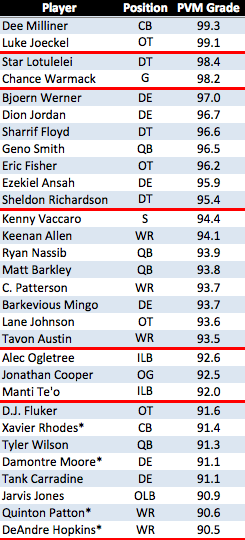
The bad news (well maybe bad news)?  My tiers are a bit different.  Building from the PVM rankings:

Screen Shot 2013-03-14 at 12.36.23 PM

Drawing the lines is admittedly a bit subjective; I’ve included the ratings so you can draw your own if you’d like.  Obviously this set of tiers is slightly worse for the Eagles, since it shows just 2 prospects in the top tier.  Additionally, the 4th ranked player is Chance Warmack, who some of us would be less than thrilled with getting.

However, I’m getting a bit too deep in the weeds there.   The key to this breakdown is the wider view.  The idea is that NOBODY has any real idea of who be be the better player out of, for example, WRs Patterson or Allen.   The best you can do is make sure you get one of those guys (if you need a WR) while spending as little draft resources as possible.

I realize that players at the same position may project differently and therefore be better or worse fits for certain teams.  Teams will incorporate “fit” into their individual draft tiers, so the idea still holds.

It’s all about recognizing and accepting uncertainty.  For example, if there are 3 DEs rated similarly and you can either trade up to #13 to grab the “best” one or stay at #24 and take whoever is left, it’s probably best to sit tight (or to trade up just a couple of draft spots to ensure you get whoever is left).

FA thoughts and the 2010 2nd Round

Was asked to post the 2010 2nd round table, so here it is.  Still waiting for FA news.  I think it’s best to ignore the “rumors”, hence no speculation here.  In general though, my FA plan would be:

– Add depth (everywhere) with low-priced veterans on 1-2 year deals.

– Add a NT. Doesn’t have to be a great one (not many of those in the NFL), but a huge need if the team is moving to a 3-4.  This wouldn’t preclude taking one in the draft, but even then you need a back-up and it would be nice to not be overly reliant on Dixon.

– MAYBE add one marquee guy, as long as he is relatively young (<26-27).  Plenty of cap space, so if the team loves a guy like Smith or Long then take a shot.  Key is to pick the one they really like and let the others go.

– Don’t tie up cap space beyond this year.  This is a massive transition for the Eagles, and the fact is that Howie/Chip themselves don’t know how it’s going to shake out.  They key is to bolster the roster while maintaining cap flexibility for the next couple years.  With so many moving parts, it’s impossible to say who fits and who doesn’t, so throwing big money around is very risky.

Conversely, if you preserve space until the rest of the foundation is together, you have a much clearer picture of where your needs are and which impact FAs fit the team best.

Patience is the key, though it remains to be seen if the Eagles new front office has any.

Oh, and I wouldn’t consider, even for a moment, giving up the #4 pick for Revis.

Now the 2010 draft table:Screen Shot 2013-03-12 at 1.17.08 PM

As noted by a commenter yesterday, TJ Ward has had a pretty good start to his career and was drafted 1 spot after Nate Allen.  This system has Ward as one of the biggest reaches; he had one of the lowest included prospect ratings.

– Taylor Mays presents an interesting case.  His aggregate scouting rating was pretty good, hence the high rating here.  However, I remember a LOT of commentators downgrading him.  He may be a good case of why the system needs more sets of ratings.  My guess is there were a lot or scouts who did not score him as highly as ESPN or NFL.com.

– Torell Troup looks like a big mistake by the Bills, though injuries have wrecked his career, so its hard to judge him.  It’s worth noting that Terrance Cody and Linval Joseph were both ranked significantly higher and available at the Bills pick.

– Regarding Cody (since he came up yesterday as well), he’s been pretty inconsistent, and was supplanted by Kemoeatu in the starting line-up, but PFF actually graded him better last year than Kemoeatu.

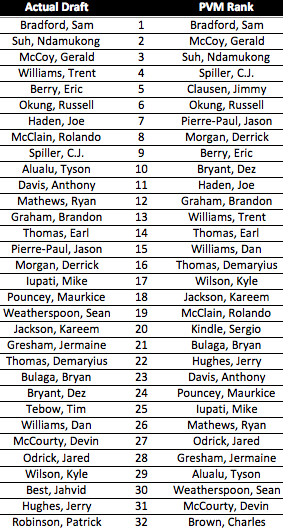
Also, I realized I didn’t do a good job of showing the big picture.  No individual player’s ranking will be perfect in any system.  The goal is to create a system that, overall, does a better job of valuing players.  Here is a table showing the actual first round of 2010 with the PVM top 32.  We’ll delve deeper into this type of comparison some other time, for now you can analyze/compare them and make up your own mind.

Screen Shot 2013-03-12 at 1.48.50 PM

One last note:  This system is by no means a finished product.  To that end, if you have an idea for improving it, please let me know.  No pride of ownership here, I just want to create the best system possible.

Revisiting the 2010 NFL Draft with PVM Multiplier

As of this writing, the Eagles haven’t made any FA news, so I’ll continue with our draft talk. Today we will look at the 2010 NFL Draft (B-Graham year).  For those of you who noticed, I’ve skipped 2011 for two reasons:  2010 is more interesting, and I can only find 1 set of prospect ratings for 2011.

I haven’t really emphasized this yet, but a MAJOR part of the PVM ranking system is the consensus prospect ratings.  The average rating is far more important than the PVM adjustment.  As a result, if I have only one set of ratings the rankings will not be nearly as valuable.  To that end, if any of you know where I can find 2011 prospect grades/ratings (numerical), please either email me, tweet me, or respond via comments.  I still hope to find another set to work with (right now I only have ESPN’s).

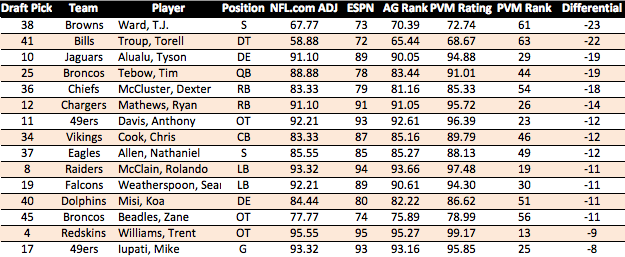
In the meantime, here are the top 32 prospects for 2010 via the PVM system.  For these, I used ESPN and NFL.com ratings, though the NFL.com ratings had to be adjusted to a 100 points scale.  Remember, the right-most column is the player’s actual draft pick minus his PVM Rank.  So players with a negative number were drafted HIGHER than their PVM Ranking.  Only players chosen in the top 2 rounds are included in the analysis.Screen Shot 2013-03-11 at 2.51.20 PM

I’ll break this down so it’s easier to see in a second, but a couple of big notes first:

– Jimmy Clausen shoots WAY up the board.  While the PVM adjustment helped, this is mainly due to the fact that his average rating was 92.27.

– CJ Spiller jumps into the top 5.

– Brandon Graham, regardless of the trade involved, appears to have been taken right where he should have.  However, both JPP and Derrick Morgan rank higher and were on the board when the Eagles picked.

To be fair, all three players were taken by the 16th pick (Eagles originally has the 24th), so had the team not traded up there was a strong chance they would not have been able to choose any of them.

– The biggest “overdraft” in the top ten belongs to Rolando McClain, narrowly beating Trent Williams.  Needless to say I feel pretty good about the PVM system here…

Now let’s take a narrower look.  Here are the most OVERDRAFTED:Screen Shot 2013-03-11 at 3.01.15 PM

Really like this one for obvious reasons.

– Tyson Alualu and Tim Tebow stand out as the worst “value” picks in the first round.  Tebow, even with the positional impact bump, rated as the 44th prospect (he was taken 25th).  The Jaguars, picking Aluala, were derided (correctly) at the time.  If I remember correctly, the Jags justified it by saying he was the best guy on their board.  However, it was pretty clear at the time that they could have traded down and still got him.

It’s a valuable reminder that there is a lot more to “winning the draft” than just setting your board more accurately than other teams (better scouting).  As I’ve explained, the “skill” portion of the draft involves moving around so you get the guys you like at draft spots where they offer maximum value.

– Nate Allen’s here as well, drafted 12 spots ahead of where the PVM ranking has him.  This was a 100% “need pick” and clearly hasn’t worked out the way the Eagles hoped.

– Conversely, Anthony Davis has worked out for the 49ers, despite being taken 12 spots ahead of where he was ranked.

One big note here that, although obvious, I feel compelled to explain:  Every team will have their own individual position values, which means each team’s PVM Board (if they made one) will look different from the one above.  For that reason, it’s tough to grade teams on individual picks because we don’t know what their internal positional ratings are.  It’s possible that the 49ers place a higher premium on OT than the rest of the league (likely in fact).  In that scenario, their PVM board (with no regard for scouting), may have had Anthony Davis (and Iupati) ranked higher, which might justify taking both OL well ahead of their rankings above.

Prior to this year’s draft, I hope to compile individual PVM ratings for each team.  It will probably be very “noisy” due to various contract issues, but it also might help us infer what teams might do.  Perhaps I’ll even put an “ideal” mock draft up, showing what each team should do with their picks under this system.

Now back to 2010.  Here are the most UNDERDRAFTED players:Screen Shot 2013-03-11 at 3.30.30 PM

Some BIG hits here as well as some BIG misses.

– Clausen I mentioned above.  Though he appears to be a miss, the idea here is that at the time of the draft, his potential upside warranted a much higher draft choice than 48 overall.  That said, it’s conceivable that he has just been lost behind Cam Newton and can still be a productive player on the right team (though I’m not holding my breath).

– Sean Lee and Dez Bryant both fly up the board here.  Bryant ranked #10 overall by PVM.

– At the bottom of that chart we can see JPP and Derrick Morgan, who both ranked as top 10 prospects by PVM.

– Charles Brown jumps a full round by PVM, though it’s still unclear how his career will pan out (injured his knee this year).

– Terrence Cody and Sergio Kindle both rank high, and coincidentally or not, were both selected by the Ravens.  Though neither player has played up to their projections, it’s interesting to note the Ravens’ multiple selections. I’ll be keeping my eye on which teams show up more/less on the over/under-draft lists.  In theory, teams that are applying a system of this type should find their way onto the under list with some frequency.

That’s all for today.  Hopefully we’ll have some Eagles FA news to discuss soon.  Again, if anyone knows anywhere to get past prospect rankings, please let me know.


Applying PVM to 2012 Draft

Yesterday I unveiled the Positional Draft Multiplier (“PVM”), an attempt to adjust prospect rankings by relative positional importance.  If you haven’t yet read that post, I encourage you to do that before continuing here.

While I won’t re-explain the entire process here, I will say that, in essence, the PVM uses the consensus prospect rankings and adds an “impact bonus”, the size of which varies by position.  For example, QBs have a much bigger impact on games than Centers do, so the bonus for QBs is bigger.

Today, I’ll apply the system to last year’s draft.  Please note that this will not be a direct comparison to this year’s rankings, due to the fact that I can’t find NFP’s ratings for last year.  For today’s post, I’ve only used ESPN and NFL.com’s ratings to arrive at the “consensus rating”.  Also, it’s obviously too early to judge any of these players, so while I think the below tables will be interesting, their full value won’t be apparent until at least next year.  I hope to go back a few more years with the same analysis next week.

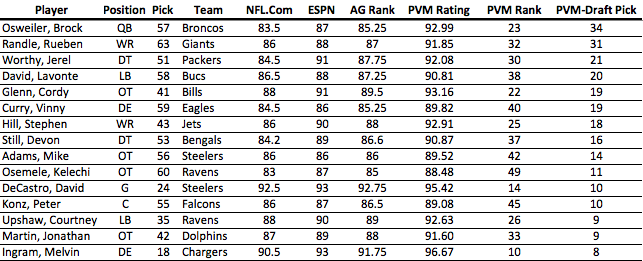
First, here are last year’s prospect rankings re-ordered according to PVM Rating (only players drafted in the top 2 rounds were included).  The right-most column is the difference between the player’s PVM ranking and actual draft spot.  I’ve calculated it so that a positive number means the player was UNDERDRAFTED according to the system (so positive means a “steal”).  A negative number means the player was a reach.

To reiterate, this isn’t meant to be a ranking according to which players are best or most likely to pan out, just a better measure of potential Risk vs. Reward.

Screen Shot 2013-03-08 at 10.53.25 AMScreen Shot 2013-03-08 at 11.05.19 AM

Take some time to look through those tables, there’s plenty of info there.  Actually very little change in the top ten, with the only big shifts resulting from Mark Barron and Stephen Gilmore falling.  Fletcher Cox appears to have been a good value pick by the Eagles, taken 3 spots later than his PVM Rank suggested.

To make things a bit clearer, below are two tables illustrating which players were most under/over drafted.

Let’s start with the good:Screen Shot 2013-03-08 at 11.09.03 AM

No surprise to see a QB at the top of the list.  Due to the structure of the system, QBs receive, by far, the most benefit.  However, note that on an absolute basis, the scout’s ratings still count for much more.

Notables-

– Lavonte David jumps out immediately.  According to PVM, he should have been the 38th overall prospect, but fell to the 58th pick and ended up having a superb rookie year.

– Vinny Curry makes an appearance high on the list, falling 19 spots from his PVM Ranking.  Let’s hope Chip Kelly finds a way to realize the potential most scouts think he has.

– Cordy Glenn, though not widely known, had a good rookie year as well, ranking as the #31 overall OT for 2012 by Pro Football Focus.  #31 might not sound great, but remember there are 64 starting OTs in the league.  To be better than half of them in your first year is a good sign.

– Kelechi Osemele was ranked #36 overall by PFF, ahead of more famous players like Jake Long, Michael Oher, and Jermon Bushrod.

Now for the bad:

Screen Shot 2013-03-08 at 11.25.58 AM

Bruce Irvin leads the pack by a longshot, drafted 39 spots ahead of his PVM Ranking.  While he did record 8 sacks (ESPN), impressive for a rookie, he was weak against the run and received a negative grade overall by PFF.

– Derek Wolfe had a similar rookie year, though he was strong against the run and weak against the pass (according to PFF).  Overall, PFF has him as the 54th overall 4-3 DE.

– A.J. Jenkins might be the most anonymous first rounder in last year’s class.  Be honest, did you know anything about him prior to seeing him in the table?  Yes, he played for a great team, but he couldn’t even get on the field and registered ZERO catches.  Obviously, he’s got plenty of time to turn his career around, but it’s safe to say if the 49ers had a do-over, they wouldn’t repeat that pick.

– Mychal Kendricks shows up here, though a 10 pick difference that late in the draft isn’t that surprising.  However, if you look closely you’ll see Dont’a Hightower, while also over drafted, was ranked significantly higher than Kendricks by PVM.  For what it’s worth, PFF had Hightower as the 8th overall 4-3 OLB….Kendricks ranked 42nd.  (Lavonte David was #5)

As I said in the beginning, it’s way to early to judge last year’s draft class.  I hope to do this same post with several other draft classes (provided I can find pre-draft ratings to use).  While the PVM Ranking is interesting, and I believe is has a lot of value, the overarching theory I want to advance is:

When teams go against the prevailing wisdom in the draft (consensus ratings), they are wrong much more often than they are right.

So the big question is, can we, without any particular scouting insight, use only consensus ratings and logical adjustments (like positional value) to come up with a rankings system that is as good or better than average team’s proprietary board?  I think we can (though it obviously won’t be easy).

Prospect Rankings via Positional Value Multiplier

Today, with the help of a collaborator, I’ll give you prospect rankings for the NFL Draft that you won’t find anywhere else.  As I’ve explained before, I am not a scout and have not watched film on every top prospect in this year’s draft. However, I believe what I’ll show you today is more useful than any individual scout’s ranking.

First things first, big thanks to George Laevsky (JD from Georgetown) for the help.  He came up with the idea and name for the Positional Value Multiplier and worked with me on compiling/computing the necessary data.

To keep this clean, I’ll explain it in 3 sections.  First I’ll tell you what we did, then I’ll tell you how we did it, then I’ll show you the results.  That way, if you want to skip the middle section you can.

What We Did:

The overall aim of this project was to apply a positional value modifier to the consensus prospect rankings, with the hopes of generating a more accurate system of ranking value.  We compiled a composite prospect rating for each player (through the first couple rounds) and then adjusted for positional importance according to last seasons’ league-wide positional salary distribution.

Before we go into the How details, here is the consensus prospect ranking using ratings from Scouts Inc (ESPN), the National Football Post, and NFL.com.  Note: NFP uses a different grading scale, so those scores were adjusted to give us an apples-to-apples rating.

Screen Shot 2013-03-07 at 11.19.43 AMThat graphic alone is pretty interesting, particularly when the ratings diverge (see Ryan Nassib at the bottom), but we’ll look at that some other time.

For today’s post, we have to adjust.

How We Did It:

I mentioned last week that no BPA ranking is complete without an adjustment for relative positional value.  For example (an extreme one), if a QB and K both carry a 95 rating, you’d obviously choose the QB first.  The question is, how do we measure relative importance by position?

While there is no bullet-proof method of doing so, the salary distribution in the NFL is as good a place as any to divine information from.  In theory, since the NFL has a salary cap, the distribution of limited funds between positions will give us an idea of how the league, on average, values different positions in relation to each other.

We pulled salary cap information from this awesome graphic featured in the Guardian at the end of January.  It’s not perfect (reflects cap hits from last season and misses some IR guys), but in general I believe it’s as good a breakdown as any for our purposes today.  After adjusting for the number of players by position, we calculated a Positional Value Multiplier (“PVM”) for each major position (FB, K, P not included).  We then applied that multiplier to the above consensus rankings.

Here are the multiplier values we arrived at, in order from largest to smallest:

Screen Shot 2013-03-07 at 11.26.43 AM

For the most part these make a lot of sense, based on what’s “common knowledge”.  QBs are, by far, the most important position.  However, the relative rankings of WRs and RBs certainly surprised me, though due to the noise in the data, it’s best not to get hung up on the minute differences in values above.  Instead, we can see there are some clear “tiers” (I feel like I am using that term a lot).

Tier 1 – QBs

Tier 2 – WR, CB, DE, RB, DT

Tier 3 – OT, LB, TE, S

Tier 4 – C, G

The only thing in those rankings that immediately draws my attention is the OT position in the 3rd tier.  But that data is what it is, we can debate the reasons later.

Now that we have the PVM values, we can apply it to the prospect rankings.

The Results:

Screen Shot 2013-03-07 at 11.42.44 AM

Some very interesting movement.  The right-most column shows the effects of the positional modifier.  The AG Rank column is the pre-adjustment consensus ranking.

Notes:

– Dee Milliner jumps two places to become the top overall prospect.

– Chance Warmack, though he drops 3 spots, remains a top 5 prospect, damaging my belief that a G in the top 15 picks is a very poor decision.

– QBs, as expected, benefit the most.  Geno Smith jumps 11 spots to become a top ten prospect, while Nassib and Barkley move into the middle of the first round.

– The biggest jump overall comes from Tyler Wilson (20 spots), who moves from the middle of the second round to the end of the first.

– Zach Ertz (TE) and Jonathan Cyprien (S) are hurt the most, falling out of the first round, and therefore off the chart above.

One last thing: I want to be perfectly clear about the value of this analysis.  The idea here is that BPA is an overly simplistic and flawed method of drafting by its current definition.  For example, while Geno Smith (19th consensus) may be a worse prospect than Kenny Vaccaro (9th consensus), with lower odds of success, the potential payoff is so much greater for Smith that he becomes a better choice (at least as shown here).  Hitting on a QB offers a MUCH greater reward than hitting on a S (or really any other position), so it makes complete sense that QBs are perennially “over-drafted”.

In essence, what we are showing here is that they are not, in fact, “over-drafted”.  Yes, they might have greater odds of failure, but that does not make them bad picks.  Remember, you have to look at both Risk AND Reward, balancing the two.  The above rankings is an effort to do that in a method as simple and transparent as possible.

Over the past few months, I’ve tried to advance the idea that the “consensus” forecast should carry a large degree of inertia within NFL front offices.  Imagine the above rankings as equivalent to a total market stock index.  For anyone going against the total market index, they must believe VERY STRONGLY that they have better information or better analysis than the rest of the market.  It should function in much the same way in the NFL (and all professional sports leagues).  The idea is NOT that teams should blindly follow the “market”, just that they should hold their own evaluations up to very high scrutiny before acting on them, especially when they largely conflict with available data.

I’ll be examining this in a lot more detail, which may or may not lead to more posts on the subject.  In any case, this should give everyone something to think about come draft day.

For what it’s worth, my subjective pick for the Eagles would still be Lotulelei/Joeckel.  However, unless I adjust the PVM formula (or if the consensus ratings change), it looks like Dee Millner is now, objectively, in the lead.

UPDATED: Also, below is the same analysis for the rest of the players we looked at:

Screen Shot 2013-03-07 at 3.06.03 PM

Screen Shot 2013-03-07 at 3.08.36 PM