Chip Kelly and Two Point Conversions (hypothesis formulation)

UPDATE: The following is a case for occasionally attempting 2 pt conversions earlier in the game (when current coaches don’t typically try them), NOT going for two every time.  Should have made that clearer.

There’s an article up on Bleacher Report that talks about the possibility of Chip Kelly attempting 2-point conversions more often:

http://bleacherreport.com/articles/1489471-philadelphia-eagles-on-chip-kelly-and-two-point-conversions.

It’s interesting because it indirectly highlights how one of the biggest weaknesses (assumed) to Chip Kelly’s candidacy might also be one of the biggest strengths.  Kelly’s lack of NFL experience is presumed to increase the risk that he won’t be successful as a coach, however, all Eagles fans should hope that this also has the side effect of freeing Kelly from some prevailing NFL wisdom.  Specifically, I’m hoping Kelly takes a much more aggressive approach to both 2-point conversions.

As most fans know, the 2-point conversion gives the offense the ball at the 2-yard line, with one play to get in the end zone.  Much has been written about the optimal strategy regarding 2-point tries, with mixed opinions.

However, among NFL coaches, there seems to be a general consensus that you should NOT go for two unless it is absolutely necessary.  Assuming NFL coaches have actually looked at the statistics, we are led to believe that they are deferring to the historical success rate, which is in the 47%-48% range depending on which plays the data compilers include (botched kicks for instance).  A 48% success rate means the expected value of an extra point is higher, and therefore the correct play.

So why do I want Kelly to go for it more often?  I believe that the following three aspects, when aggregated, will lead to a higher than 50% success rate, meaning the expected value for the 2-point conversion will be higher than an extra point.

– If we assume that the league-wide success rate is 47-48%, then obviously some teams have better conversion rates.  I have not pulled the statistics (unfortunately they are not as readily available as most other measures), but I think it’s reasonable to suggest that a team with an above-average offense can expect to have an above-average conversion rate as well.  (If Chip Kelly does not put together a better-than-average offense, he will be a huge disappointment.)

– I’m also hypothesizing that the element of surprise via the no-huddle offense will itself add to the conversion success rate.  NFL defenses have been conditioned to leave the field after allowing a TD.  It’s a fairly small jump to assume that an NFL team using a hurry-up offense to attempt 2-point conversion, especially in the first half, will catch the defense off-guard.  The associated confusion/lack of defensive focus will presumably add to the likelihood of offensive success.  (Yes, if the Eagles always went for two, they would lose this element of the strategy.  That’s why its best implemented only occasionally.)

– Lastly, currently teams do not devote a significant amount of practice time towards the 2-point conversion.  Obviously, considering the rarity with which most teams attempt the play, devoting practice time to it likely isn’t worth the time spent.  However, if a team decided to implement the 2-point play more often, then it would therefore make sense to practice the 2-pt playbook more often.  Does anyone disagree that practicing the plays more often would make them more effective?

So…

I apologize for the lack of data here, but we’re dealing largely with a theory that hasn’t been tested in the NFL.  While the above analysis may seem a bit disjointed, the overall question is as follows:

Would the 3 factors mentioned above (strong offense, surprised defense, more practice) add more than 2%-3% to the overall 2 pt. conversion success rate?

If you believe the answer is yes, then hope that Chip Kelly’s ego is (as I suspect) big enough to give him the confidence to move strongly against prevailing NFL wisdom.

P.S. Unfortunately, the most easily predicted aspect of this plan is commentator reaction.  Even if it is statistically the right play, you can bet every announcer will talk about how “bold” and “risky” the decision is, as well as how stupid it is every time it doesn’t work.
Chip Kelly effects…

To date, I’ve avoided most coaching discussion, especially when it comes to comparing candidates.  The fact is, the only people who can begin to have an educated opinion on that subject are those who personally know each candidate.

Needless to say, I don’t have that knowledge, and neither to almost all of the sports writers who have been profiling the coaches.  Ignore everything you hear about who made the best hire…nobody in the press has any real knowledge of how each new coach will do.

However, now that a new coach has been found, we can talk a little about what it means for the team.

Immediately after Chip Kelly was hired, the discussion turned towards the QB situation.  For some reason (likely the need for a column topic), many commentators seem to believe that this somehow complicates the Eagles QB options.  It doesn’t.

– Michael Vick will NOT be the Eagles QB next year.  Much is being made of Kelly’s desire for mobile QBs, particularly those that can run an option-based scheme.  Those making this argument then jump to “Vick is a good runner so maybe Kelly will want him”.  This jump ignores a few aspects that each preclude Vick from being a “Chip Kelly” QB:

Vick takes a lot of sacks and has very poor pocket awareness.

Vick is one of the least accurate QBs in the league.

Vick turns the ball over a relatively high rate.

Ignoring Vick’s contract situation and age, I am confident that Kelly will review game tape of Vick and decide that he isn’t the guy to go with.  Anyone suggesting otherwise is, in my opinion, struggling to come up with things to talk about.

– This is NOT the end of Nick Foles.  While I don’t know how Kelly will adapt his offensive system in the NFL, my guess is that it will be a balanced (run-pass) but very fast paced scheme, much like the NE Patriots run.

People think of New England as a Pass-Heavy offense; this year they ranked 4th in the league in passing yards.  However, the Patriots also ranked 7th in the league in rushing yards.  

Also note that Tom Brady is one of the slowest QBs in the league and does not contribute anything significant to that rushing rank.  Yet, Brady is a perfect QB for that system because he:

– is very accurate with the ball and almost never throws an interception.  His 2.1% interception rate is the second lowest EVER. (Aaron Rodgers is 1st with a ridiculous 1.7% rate.)

– makes good decisions quickly, rarely forcing anything and consistently making the optimal read.

– has limited mobility but excellent pocket awareness, with a sack rate of just 4.84% (20th all-time).

While Nick Foles is obviously not as good as Tom Brady, he has a similar skill set.  As such, there is no reason to believe he can’t run a fast-paced, balanced offensive system (which I believe Kelly will attempt).  Also, with the RB talent that the Eagles have, I’m hopeful that Kelly will be able to construct a playbook that takes a lot of the pressure away from Foles.  I think there is a strong chance that Kelly reviews Foles’ performance this year and decides to make a go of it with him.

– Root for Geno Smith…but not for that reason.  Geno Smith has also begun to gain some traction with Eagles’ writers. Fortunately, by now most have dispelled the notion that Smith is a “running” QB.  He isn’t, although his race appears to be obscuring that fact for some.  However, he is very accurate, and has the size/athleticism/reputation that NFL teams love.  Therefore, with strong pre-draft workouts or a good combine performance, he has the potential to move up draft boards.  If he gets taken in the top 3, that means the Eagles have an excellent chance to get one of the two best fits for the team (Joeckel and Lotulelei, IMO).  Without a QB moving into the top 3, it gets a bit dicey and, as currently projected, there’s probably even odds that both Joeckel and Lotulelei are gone by #4.

If the current rumors regarding a move to a 3-4 defense are true, then missing out on both Lotulelei (the NT we’d need to run that scheme) and Joeckel would be a terrible outcome (fit wise).  Hopefully whoever the Eagles draft will be an impact player, but getting an impact player at a true position of need obviously will lead to a much quicker turnaround for the team.

So every Eagles fan should hope to see very positive Geno Smith stories between now and the draft.  As it happens, Smith’s skill-set would appear to be a great match for Andy Reid’s system, and we all know that Reid started his last job by drafting a QB with a top 5 pick.

P.S. now that I’ve offered completely subjective opinions/predictions, I’m sure Kelly will trade Foles, sign Vick to a long-term deal, and draft Smith to be a wildcat specialist…

Draft History Breakdown – 1st Round

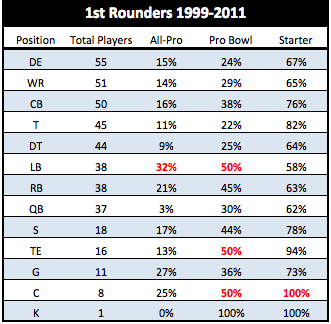
Which positions are most likely to fail/succeed when taken in the first round?

I pulled the data and put together the chart shown below.  Note that counting someone as a “starter” is a bit subjective.  Inclusion in the below data means that a player started for at least 5 years in the league, or if they joined the league less than 5 years ago, has started for more than half the time.  However, just because they have started doesn’t mean they have been good.  Unfortunately, an analysis that deep will have to wait.  For now:

Screen Shot 2013-01-16 at 2.32.56 PM

Takeaways:

– It does appear as though the conventional wisdom regarding O-Linemen is correct.  They are typically safer picks, as evidenced by the high starter % for G/C/T.

– Choosing a QB is, statistically, a very bad decision.   Just 62% of the 37 QBs drafted in the first round ended up “starting” for a reasonable amount of time.  However, that number is definitely inflated, as the sunk cost aspect of choosing a QB with a high pick (at least until the most recent CBA) led teams to continue starting players who didn’t deserve to.

Unless you’ve got a top pick and there is a truly incredible prospect, you SHOULD NOT DRAFT A QB.  Hopefully Chip Kelly reads this before jumping on Geno Smith at #4.  That’s not to say he should draft him, only that he has to be blown away by Smith to make it a reasonable decision.

– LBs have proven to be the most difficult to peg.  The position has the lowest rate for starters out of the first round (58%), but the highest rates for All-Pros and Pro Bowls.  That tells me LBs are perhaps the hardest players to evaluate coming into the league.

We’ll take a look at the other rounds soon, and eventually put it all together for a complete draft guide, but for now it appears as though there is clear split regarding the odds of success for draft picks (in the first round):

– O-Line, TE, DBs (Safer)

– DEs, DTs, LBs, QBs, RBs (Riskier)


More on Foles

After putting yesterday’s post together and getting a helpful twitter suggestion, I decided to take a look at how Foles stacked up against a larger sample of rookie quarterbacks.

I pulled together the rookie stats for every quarterback drafted in the first round since 1999.  Including Nick Foles (I realize he wasn’t a first round pick), that gave me 38 QBs.  I then eliminated 7 QBs that played in fewer than 5 games in their rookie seasons (Losman, Russell, Grossman, Rodgers, Pennington, Rivers, Quinn.)  I did not include this year’s other rookies, as we don’t know yet how their career’s will progress, though it certainly looks like each will be successful.

That leaves us with 31 QB’s.  Here is the sample charted by rookie Passer Rating, with Nick Foles in red:

Screen Shot 2013-01-15 at 12.46.42 PM

The interesting takeaway is that there are very few “false positives”.  Of the 8 QBs with higher rookie ratings than Foles, the closest there is to a “bust” is Tim Tebow, who is still relatively young and has a chance (however slight) to turn his career around.  Jake Locker doesn’t really impress me, but he did make progress this year and it’s fair to say the jury is still out on him (also note that he played in just 5 games his rookie year, the minimum for the sample.)

Other notes from that chart:

-Eli Manning’s rookie rating, with 9 games played, was just 55.4.

-Donovan McNabb’s was just 60.1.

Now let’s look at completion percentage:

Screen Shot 2013-01-15 at 1.04.22 PM

We see a similar story as with the Rating graph.  Only Big Ben, Culpepper, Matt Ryan, and Carson Palmer completed a higher percentage of throws in their rookie seasons.

If Foles had been taken in the first round, there wouldn’t be any talk of even looking at other potential quarterbacks heading into next year.  Additionally, he would have played a much larger role in the head coaching search, and we’d be hearing stories of how “Coach X is really excited to work with Foles”.

The fact is, statistically, Foles had a VERY strong rookie season, especially when one considers the patchwork O-Line he was playing behind.

Now I’ll get back to the draft…


Guess who…

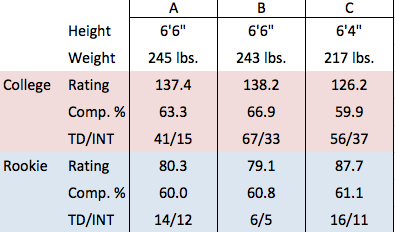
Let’s take a break from the draft research and play a quick game.  See if you can identify the following three quarterbacks.

Screen Shot 2013-01-14 at 1.38.18 PM

Better yet, with no additional information, which one would you choose?

Any answer is right, because there is almost nothing there to differentiate the three players.   So who are they?

Most serious Eagles fans will know that Player B is Nick Foles.  His 6/5 td-int ratio is a giveaway.

The other two players will both be leading their teams this weekend in the NFC/AFC title games.  Player A is Joe Flacco, player C is Matt Ryan.

Anyone out there who doesn’t want Nick Foles to start next year?  Otherwise, feel free to join me on the bandwagon.  Still plenty of room.

Best drafting teams from 1999-2011…

Continuing our draft research, I attempted to create a method for determining which teams were the best and worst at drafting over Andy Reid’s tenure, with 2012 excluded since it’s too early to judge most of this year’s rookies.

Before the results, I have to explain how I got there (feel free to skip if you don’t care about the methodology):

First, in order to evaluate players, I used the Career Approximate Value statistic from Pro-Football-Reference.com.  This is FAR from a perfect measure, but I don’t know of any better way to compare player production for different positions.

Second, Career AV is a cumulative measure.  So players with longer careers will tend to have higher Career AVs.  To compensate for this, I divided each players CAV by the number of seasons they were in the NFL.  It’s important to note that this skews the data in favor of players who were productive over long periods of time versus those (i.e. Shawn Andrews) who were spectacular for a short time and non-existent the rest.

I then totaled those measures for each team, giving us a rough idea of the amount of production derived from each team’s drafts.

However, we aren’t done yet.  In order to adjust for the differing value of each draft pick, I calculated the average point value of each round (according to basic NFL draft chart), then used those measures to calculate the total “Draft Points” used by each team.  That way, teams that use a lot of 1st round picks to find production will not be equal to teams that found the same production with lesser picks.

Finally, I divided the Total Adjusted CAV for each team by the total Draft Points used to obtain that production.

The results?  Some expected, some shocking.  Here are the ten teams (in order) that ranked best from 1999-2011 in identifying and selecting productive players in the draft:

Tennessee, Chicago, Indy, Dallas, Green Bay, Atlanta, Carolina, San Diego, Philadelphia (9th), Houston.

Here are the ten worst (ordered worst to best):

Detroit, St. Louis, Oakland, San Fran, Washington, Minnesota, Kansas City, Cincinnati, Buffalo, Tampa Bay.

Note: This is an attempt to rank teams based on the efficiency with which each used their draft picks.

For the skeptics: A first glance at the best and worst drafting teams would lead one to believe there is a flaw in the methodology.  The Titans?  Really?  On a hunch, I graphed each team’s Adjusted AV/Draft Point (the measure I walked through above) against each team’s wins over the subject time period (Texans not included since they were not in the league for the whole time period).  Here is the chart:

Screen Shot 2013-01-11 at 4.06.26 PM

Interesting, right?  We see a clear positive correlation between the drafting measure we calculated and team performance (wins).  Not only that, but it’s a pretty strong relationship (coefficient of .55).

This doesn’t prove the effectiveness of my methodology, but it is certainly what we would expect to see given an accurate measure of drafting skill.  Teams that draft better should, on average, perform better on the field.

Here is a graphic showing each team’s Adjusted AV per Draft Point, with the Eagles highlighted in red.

Screen Shot 2013-01-11 at 4.15.42 PM

So what did we learn?  The Eagles actually have been pretty good at using draft picks since 1999 (and Detroit has been absolutely terrible).  Keep in mind that this just measures a team’s ability to find productive players with each pick. It doesn’t account for whether picks achieved success while with the team that drafted them.  For instance, the Eagles get credit for Derrick Burgess, even though most of his success came with another team.

Also remember that this is per pick, not total production (i.e. New England had the 4th highest total Adjusted AV, but also used the second most picks to get there).

I’ll be digging further into the data to see what else we can get out of it, but I believe we can drop the whole “Andy Reid sucked at drafting” meme.  It’s also a good reminder that as much as some fans hated Reid, over his tenure here, most other franchises were much worse.


Importance of First Round (Chart as promised)

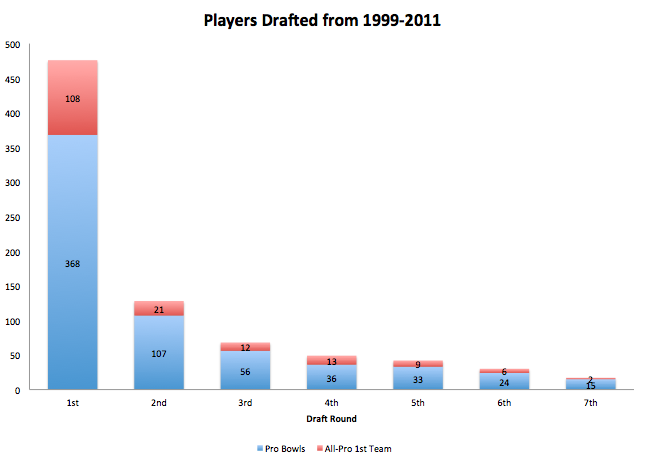
Below is the chart I promised yesterday.  The data is from Pro-football-reference.com and it does not include the supplemental draft.  The data is total occurrences, not individual players.  So 108 All-Pro mentions includes multiples from players who made it more than once; it does NOT mean 108 different players made the All-Pro 1st team.

Screen Shot 2013-01-10 at 2.25.04 PM

I doubt anyone is overly surprised, but it certainly illustrates the importance of 1st round picks.  Also keep in mind that there were less 1st round picks made overall than any other round other than the 2nd.  So on a percentage basis, the data would be even more skewed towards the first round.

Obviously there is some skew to consider, since a players get longer/more opportunities if they are drafted early.  However, given how many variables go into talent evaluation and performance projection, it’s pretty clear to see that NFL scouts do a very good job of identifying the most talented players.

It is extremely rare for an elite player to drop beyond the second round.  We do not yet know if there is persistent “market-beating” talent among GMs or whether an “index-tracking” approach would be better off.

I use those terms because I believe the stock market provides a good model of how to view drafting in professional sports.  Just as it’s extremely difficult to consistently beat the market trading individual stocks, I expect it is also very difficult to draft consistently better than the “consensus” best available.  Unfortunately, without seeing every team’s draft board, we don’t know the true “consensus” rankings.  Therefore, we’ll try a few different ways of measuring draft skill, starting tomorrow.

Food for thought:

Over the subject time period, here are the five teams with the most and least draft picks (Houston not included):

Most-

Tennessee (122), Green Bay (119), New England (118), Philadelphia (116), San Fran (114).

Least-

New Orleans (83), NY Jets (84), Washington (87), Miami (96), Detroit (96)


New Orleans (


Quick draft history note

Going through draft data since 1999 (Reid’s first draft), figured I’d throw out a quick note:

– From 1999-2011, the average number of draft picks per team was just over 104.   (Note: the Texans were not included in that count since they haven’t existed that long.)

– The Eagles made 116 selections over that timeframe.  The Patriots, famous for accumulating picks, made just two more than the Eagles with 118.

– The Titans made 122 picks, leading the league.

– The Saints and Jets made the fewest picks, with 83 and 84.

In total, the players drafted from 1999-2011 were named to the All-Pro first team 171 times. 108 of those were by players drafted in the first round, or an astounding 63%.   I’ll do a graph on this soon, but needless to say, if you want an elite player, you can’t afford to miss with 1st round picks.

For instance, just 21 All-Pro first team mentions came from the second round, or just over 12%.

Note: All data came from pro-football-reference.com.

More reasons for hope…examining turnover luck and field position.

I’ve been digging through a lot of data while putting together a database that we can examine for interesting information.  In the process, I’ve come across some encouraging news for the Eagles heading into next year.

First, a few stats from this year:

– According to Football Outsiders, the Eagles ranked 14th in yards per offensive drive (35.51 ypd).

– The team also ranked 14th in defensive yards per drive (30.50 ypd), or yards allowed per drive.

Neither of those is great, but if you looked at nothing besides those measures, you’d be very surprised that the team finished 28th in the league.  Now let’s look at two related stats (also from Football Outsiders):

– The Eagles ranked 24th in offensive points per drive (1.54).

– The team ranked 28th in points allowed per drive (2.21).

Those numbers make it a bit easier to see why the team’s record was so bad.  But why the discrepancy?  Why were the Eagles so much worse than almost every other team at converting yards to points?

It will be news to almost nobody that the answer lies mainly in two stats, turnovers and field position.  However, most people don’t fully appreciate just how bad the team’s performance was in those areas this year.  Here are a few more stats from this year before we get to the hopeful part (I promise there is one).  Over the past ten years:

– Many people know the Eagles had the worst TO differential of any team (-24, tied with this year’s Chiefs and the ’04 Rams).

– However, a big reason for this was that the team lost 22 fumbles this year.  Over that time frame, only the ’07 Ravens were worse.  Conversely, the Eagles threw 15 interceptions this year, which is nothing to get too upset over.

–  The team only had 13 takeaways, behind only the ’06 Redskins for least since 2003.

–  The Eagles average starting field position (25.19 yard line) ranked 27th in the league this year.

– Eagles opponent’s started with better field position (31.86 yard line) than anyone else in the league.

– Combined, the net result of  -6.67 yards was by far the worst difference in the league (St. Louis was next with -5.87.)  In clearer terms, the Eagles had to go nearly 7 more yards each drive than their opponents in order to find the end zone or field goal range.

So we have a team that lost more fumbles and created fewer turnovers than almost any other team in recent history.  That, along with poor special teams play, led to the worst field position differential in the league by far, which goes a long way towards explaining why the offense and defense could finish in the middle of the pack for yards per drive without scoring/preventing points.

It also explains how Nick Foles could look good (i.e. move the offense) without better results.  He almost literally could not have received less help from the rest of the team by way of field position or extra possessions.

So where’s the hope I promised?  For that we have to re-engage our old friend, the correlation analysis.  Here’s what it tells us:

– Earlier this year, we looked at individual player fumbling rates and found that most of it is the result of luck.  In other words, be very skeptical whenever you hear that a player has a “fumbling problem”.  Therefore, it should come as no surprise that the same holds true for teams.

Using every team’s performance from the last ten years and measuring lost fumbles from one year to the next, I derived a correlation coefficient of .0837 (very weak).  This means that although the Eagles had a historically bad year (losing 22 fumbles), there is no reason to expect next year will be anywhere near as bad.

A little mean reversion will go a long way towards improving the TO differential. (Also, see the fumbling recovery rate post from earlier this year.)

– Similarly, I ran the same analysis on takeaways, and found a similarly weak correlation coefficient of .0838.  Turns out, there is very little persistence in takeaways as well.  Therefore, we have no reason to expect the Eagles to be as impotent next year when it comes to creating turnovers as they were this year.

For those of you that are skeptical, here is the data chart.  Takeaways are on the Y axis, with takeaways the following season on the X.

Screen Shot 2013-01-08 at 1.00.02 PM

Note:  I am not suggesting that both takeaways and fumbles are COMPLETELY luck.  At the margins, there are players who are clearly good at not fumbling and similarly I expect that there are a few teams/players that are persistently good at forcing turnovers.  However, overall, those teams/players are exceptions.

Wrapping up, by examining data from the last 10 years, we can see some evidence that suggests that this year, the Eagles were both a bad team AND a very unlucky one.  While there’s no guarantee they become a good team next year, I feel comfortable saying it is likely they won’t be as unlucky.

Illustrating the Roster

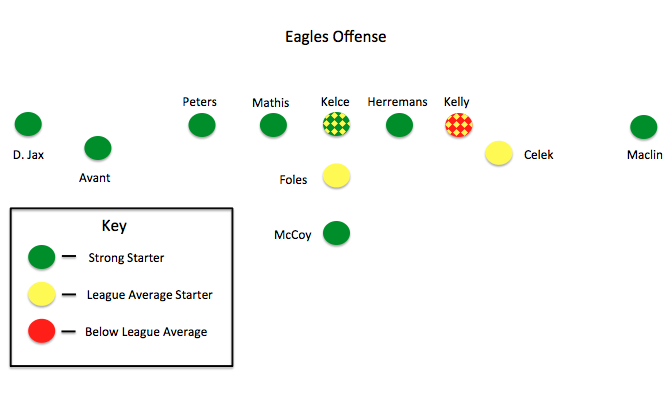
Everyone likes graphics, so I put one together showing the holes in the current Eagles roster (only starters.)  I realize not every player will return, but as of this moment, this is what it looks like. First, the offense:

Screen Shot 2013-01-06 at 6.09.55 PM

There’s going to be some disagreement, but on the whole most of the Eagles are easy to pin.

– Kelce is a question-mark because of his injury, but he certainly has the potential to be an above-average center.

– Celek is a bit of a fan favorite, but the fact is there is a clear upper-echelon among league TEs and he isn’t among them.

– Foles is an unknown, but I see no reason why he can’t be at least a league-average QB.  Obviously it’s hard to win if that spot isn’t green, but that’s a separate issue.

– Kelly made some progress, but I don’t see his ceiling as anything higher than league average and think it’s more likely he ends up as a career depth player.

Overall, a pretty good lineup, and the biggest reason why the Eagles have a chance to rebound quickly from this year.

Unfortunately, we do have to look at the defense:

Screen Shot 2013-01-06 at 6.18.30 PM

Much more to debate here, but at the very least, there is far too much red in this picture.

– Kendricks gets a rainbow because he’s shown signs of being everything from a scrub to a pro bowler.  I think it’s likely he ends up as a slightly above-average LB, maybe more, but he has some big weaknesses that could hold him back.

– Can’t believe Nnamdi gets the yellow/red, but there’s really no way around it after the season he had.  Maybe he bounces back, but it won’t be for the Eagles.

– This is the first time since 2006 that Cole doesn’t grade as well above-average, but he had a very quiet year.  Showed very little ability to beat his man one-on-one (which he used to be great at.)  Let’s hope it was a fluke, but at age 30 (31 next year) that may be wishful thinking.

Now look at both pictures and it should be pretty easy to see why I’d like the Eagles to use the #4 pick on the best defensive player available (hopefully the DT.)  As nice as a stud OT would be, the talent level on defense is far too low.  Unfortunately, there’s no top safety or corner this year, so we could be looking at a trade down situation.

New coach might like to make a splash with such a high draft pick, but the best way to build the team could very well be moving down, picking up extra picks, then drafting a safety/lb/corner where it makes sense.  It’d be a very unsatisfying use of the #4 overall pick, but then again, watching a similarly bad defense next year would be far worse than unsatisfying.