Momentum: Yes it’s real…but that’s no excuse

Before I get to today’s topic, Momentum, I wanted to note that yesterday’s post, The Hot Seat Index, has now been updated.  There was a flaw in the win change column of the table that was helpfully pointed out by a commenter.  It’s now fixed.  The results aren’t dramatically different, but scroll down to see the update if you want.

Now…

Everybody who watches the NFL (or any sport for that matter) is familiar with the term “momentum”.  It’s used very often by commentators and announcers to describe the ebb and flow of the game.  More importantly, it’s dismissed and derided by the “analytic” community.  On the surface, it’s a clear front in the battle between “old school” and “new school” fans/analysts/etc…  Now I want to weigh in.

As you may have predicted, at a high level, I agree with the “new school”.  However, I think a lot of the members of the side of the discussion, whether through inattention or ignorance, aren’t characterizing Momentum correctly.

Momentum absolutely exists.

I have no doubts about that.  So why do I still agree with the analytic community over momentum’s relative worthlessness?

Well first, let me define momentum exactly as I see it.  When we discuss Momentum, we’re essentially saying that the events of the game have unfolded such that a player’s expected performance distribution fundamentally changes.  Some combination of pressure, confidence, attitude, etc…, supposedly diminishes the expected performance of the players.

I’m willing to admit that it’s possible for a player to underperform his true ability based on one or more of these factors.  However, why is the converse not possible?  Given a host of different stimuli, we can find people who react to said stimuli in contrary ways.  Just as not “having the momentum” can diminish performance in some players, it seems logical that it can also INCREASE performance among other players.  For example, can you think of any athletes that seem to play BETTER when they are losing by a lot or when the other team seems to “have” the momentum?  If so, we have a problem.  In order to assert Momentum, you’d have to accurately balance the players who play worse against those who play better.

More importantly, in football, there are a LOT of players on the field at once.  Even if we knew how one player would react, it wouldn’t tell us much about the game unless we knew how the OTHER 21 players on the field reacted.

That’s a long way of saying that, even if Momentum is real, it is NOT knowable.  We can’t even agree on what factors play a role, let alone measure them.  If a factor is not measurable, or even theoretically knowable, is it of any actual value?

Let’s equate it to Luck.  Clearly, luck is real and plays a very real role in the outcome of NFL games.  However, luck, as I’m thinking of it, is also UNKNOWABLE.  We don’t know how the ball will bounce once it’s fumbled.  We don’t know if a sudden wind gust will blow a field goal off course.  So we have a similar knowledge of luck and momentum.

However, commentators appear to think we KNOW things about momentum that we can’t possible know.  Let’s play a game.  I’m going to list a common phrase, then we’ll do a little variable replacement.

– “Team A really needs to score to shift the momentum”

Hear it all the time.  As we’ve just discussed, we have just as much knowledge about momentum as we do about luck, so what happens when we use that equivalence to rewrite the sentence above?

– “Team A really needs to score to shift the luck”

Sounds ridiculous, right?  Like, completely outrageous and anyone who said it on the air would be ridiculed mercilessly.

So why are we so tolerant when commentators use “momentum”?  As I tried to explain, we don’t really know anymore about the effects, conditional requirements, or significance of momentum, so isn’t it ridiculous to assert it as a goal?

Or how about:

– “Team B really has the momentum on their side now!”

We have no idea what that means!  We CAN’T know what that means, because momentum is made up of an extremely large number of unquantifiable variables, the effects of which are unclear even if we DID know how to measure them.  It’s as ridiculous as saying:

– “Team B really has the luck on their side now!”

It doesn’t make any sense, and it’s worthless as an explanatory phrase.

Now, this doesn’t mean that “momentum” should be stricken from the vocabulary of every announcer.  Just as there are very appropriate uses of “luck” while describing the game, there are potentially valid uses of “momentum”.

The problem occurs when announcers and fans start using MOMENTUM as a justification for play-calling or as a goal itself.  For example, going for it on fourth down because you “had” the momentum.  It’s likely that going for it was the right move (see previous posts), but that justification is ridiculous.   There’s just absolutely no way of knowing if the particular circumstances at any point in time qualify as “Momentum” or if that actually means that your players are more likely to perform or the other team is any less likely to perform.

I don’t think most announcers think about these things when they use the phrase.  It’s, unfortunately, a descriptive crutch.  It’s just another way of saying “Team A has made a lot of good plays in close succession”.   That in itself isn’t a huge offense, but it’s frequently used to justify some assertion that Team A is then MORE LIKELY to be successful on plays until the momentum changes again.

That of course is ridiculous, and why most “analytic” minded fans and commentators are so dismissive of the concept in general.  If it ended at a description of what HAS happened rather than support for what WILL happen, it would’t be nearly as annoying.

So…the final point:

Momentum is very real.  However, it’s not quantifiable or knowable, and therefore is completely useless to us in terms of advancing our understanding of the NFL or sports in general.

Now…about “clutch”…
The Hot Seat Index: Predicting NFL Coaching Terminations

Time for another guest post from Jared.  You may remember him from:

One of the Coolest NFL Charts Ever

– The Fourth Down Decision Series and Cheat Sheet (Part 1 of 4)

– When does it make sense to return a kick?

Well today, he’s ready to unveil at least the first iteration of his Hot Seat Index, and attempt to predict which coaches will be fired at or by the end of the season.  You can follow him @jaredscohen and at kebertxela.blogspot.com.  Without further ado:

————

So the Eagles had another especially depressing loss to the Giants this week. And with such a depressing loss, it got me thinking of another depressing outcome, watching your team stink to the point where they fire their coach.

So, this was something I wanted to wait on until much later in the season, but with Greg Schiano working as hard as he can to get fired as soon as possible, I needed to put it out a bit early.

One of the things I hate hearing about as the NFL season progresses is all the discussion around the coaching ‘hot seat’. It’s not that I mind the speculation, but all of the discussion centers on conjecture and the occasional ‘anonymous source’ (the exception being Schiano where the sources have noticeably opted to forgo anonymity!)

As I was thinking about it, I really wanted to see if we could make this a bit more objective and data driven. So with that as the goal, I gathered some data, did some analysis, and am now ready to introduce the NFL Coaching Hot Seat Index!

The Coaching Hot Seat Index is a model that, at any point in the season, will give you the approximate odds of an NFL coach getting fired after the season!

It’s based on a collection of data on all NFL coaching seasons since 1980. I broke the data down and for each coaching season, identified whether a coach was fired or kept their job (with some adjustments for retirements etc.)

With over 900 observations (and ~200 firings!), I started looking for factors which were significant in predicting whether coaches got fired or not. I tried lots of things, number of wins, playoff appearances, having the last name ‘Kotite”, all to see what was really significant in predicting when a coach will get fired.

I ended up with two primary factors, which were by far the most significant in predicting a coach getting kicked to the curb.

– Total point differential (points scored-points given up)
– Change in team wins from prior season (current year wins-prior year wins)

Those shouldn’t come as a huge surprise. (Note: I’m disappointed because I couldn’t examine another factor I wanted to see, the difference between Expected Wins at the Season Start and Actual Wins at season’s end…I wanted to use gambling lines to get at it but didn’t have nearly enough data to look at it. I still think it would be a more compelling variable)

But anyway, with those two factors, and using (or, abusing) a technique called logistic regression, I arrived at an equation to give us the odds a coach will get fired. Logistic regression is basically something you can use to help predict the likelihood of a binary outcome (a coach either gets fired, or he doesn’t) based on some variables (in this case, his team’s point differential and win change from prior season).

In the end, the result is the percentage chance (out of 100%) a coach will be fired after the season. The higher the odds, the more likely the coach is going to be filing some unemployment papers right around the Pro Bowl.

But I couldn’t just create a model and throw it out there without testing it a little. So I created a first draft of it, using only data from 1980-2011, and used that model to ‘predict’ the 2012 season based on its point differential and change in team wins (which, obviously, I already knew). When that passed the sanity check, I updated the model for 2012 and used it on teams from this year.

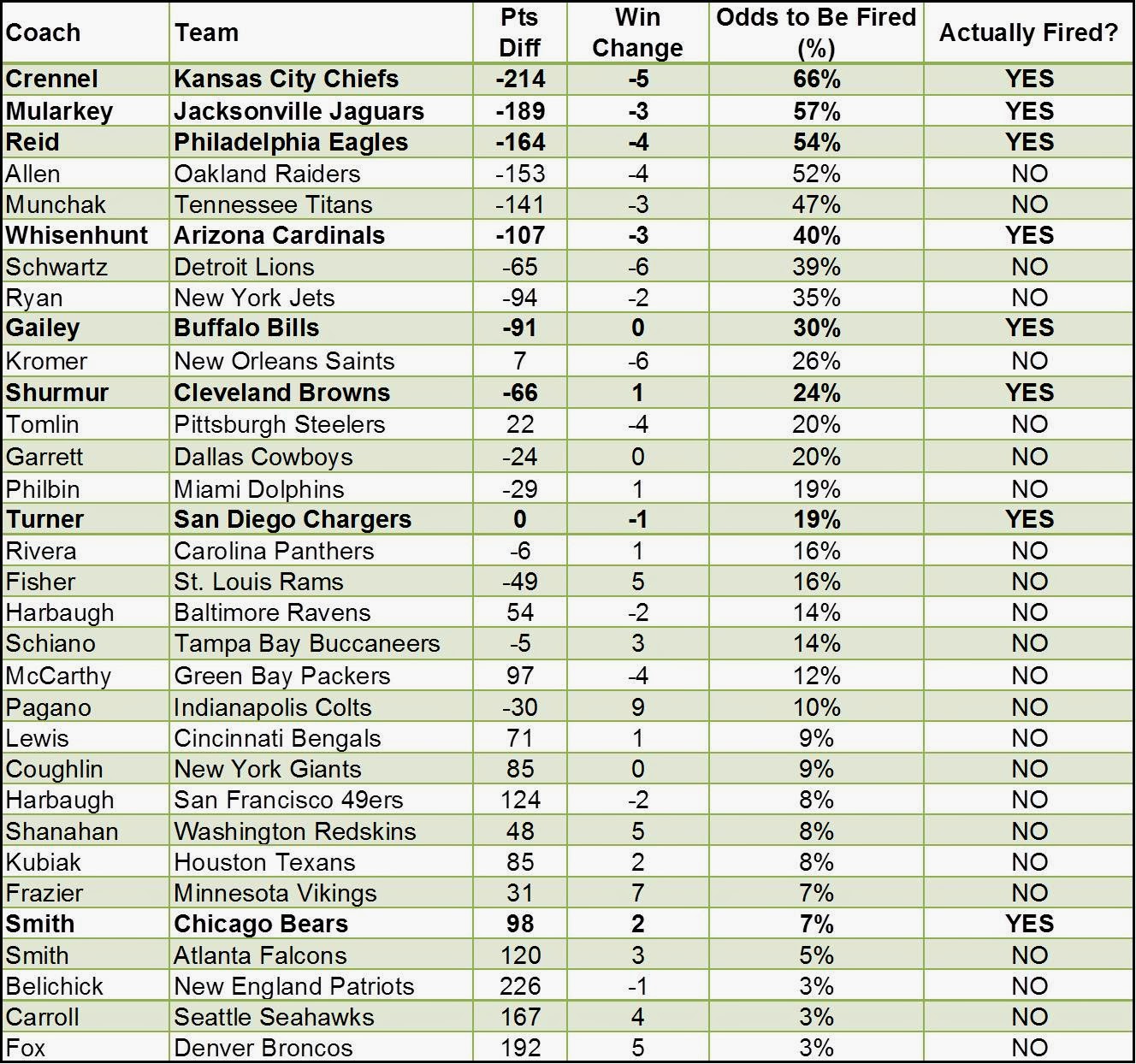
Those results are included below, with coaches sorted by their ‘odds to be fired’

Not a bad first result. Romeo Crennel, Mike Mularkey, Andy Reid all got canned, and those were the coaches with the highest likelihood. The model obviously isn’t perfect, as the plenty of coaches can still get fired, but at least there’s a structure and some logic here (we can also rank the coaches from safest to least safe!!!)

So this is interesting, and now we can apply it to the current season, and see what 2013 coaches are most likely to be fired!!!

Now, I had to make a couple of assumptions, because this model is based on a full season of performance, which of course we won’t have. But we do have a good sample and some reasonable projections of performance we can use as proxies.

For point differential, we can use a teams’ current point differential and pro rate it out for 16 games. This doesn’t account for changes in either a team’s performance or strength of schedule, but it’s not unreasonable.

For win difference from last year, we can take an estimate of the team’s full season (which I’ve borrowed from Football Outsiders Playoff Odds report, which runs simulations to calculate average team wins) and then just check the difference from 2012 wins.

So, at this point in the season (Week 7, because Week 8 is going on as I write this), which coaches have the highest odds of getting fired?

Well – it’s no surprise to see the Jaguars on the list, but we may have to make an exception for first year coaches as they typically get more than one season to right the ship. We’ll give Gus Bradley a pass (although no one can argue their performance is historically bad…it’s no wonder the odds are higher than anything seen in 2012)
Tom Coughlin checks in at number 2, although we’ll unfortunately need to update that after the Eagles managed to lose to them this week. Their performance has been really bad as well, and any coach without Super Bowl rings would likely be on their way out. But Coughlin may overcome the odds with all the goodwill he’s built over the years (or maybe he changes his mind and “retires”)

Next comes Schiano, where I think we can all agree the odds calculation actually UNDERRATES his odds of being let go. This guy might want to think about booking some tee times in late November if he continues at his current pace.

But the next coaches on the hot seat, Gary Kubiak, Leslie Frazier, and Mike Shanahan, should also probably get their acts together if they want to stay employed.

From an Eagles perspective, Chip Kelly doesn’t seem to be in too much danger (although as I said, we probably should eliminate all first year coaches as a general rule). Of course, this assumes Kelly behaves competently, unlike the absolute sh*t show we just saw against the Giants (which my brother is probably already dissecting)

Of course, from a FORMER Eagles perspective, it looks like Andy Reid has done quite alright for himself in the move to Kansas City.

I’m just saying.

Eagles vs. Giants: Week 8 Post-Game Thoughts

Backlog of posts for this week, including another guest post from Jared, who did the 4th down decision series, a note about “momentum”, and more on expected points and underdog strategy.  First, though, I have to say a few things about yesterday’s game.

– If you’re forced into playing a 4th round rookie at QB, all bets are off.  To that end, don’t read too much into the performance.  The defense was OK (not as good as some have claimed, but not a disaster) and there were plenty of opportunities for the offense to move, Barkley just couldn’t get it done.  That marks the second week in a row that the Eagles lost a game that they would have likely won with just average QB play.  If they get that, we’re looking at 5-3, 1st place in the division, and a whole different storyline.

– Keep the defensive performance in context.  The defense looked competent, and many are running with the “they’ve turned a corner” storyline, but I think it’s too early for that.  Consider:  The Giants are a TERRIBLE offense.  Additionally, while the Eagles kept the Giants out of the end one, they also allowed the Giants to score points on 5 of the first 6 drives, and forced just one three-and-out in the first half (the 1st possession).  The also sacked Eli Manning just once (he had been sacked 18 times in the first 7 games of the season, or roughly 2.5 per game).  So yes, the point total against was a good result (15), but in context, it was just an OK performance.

– Vinny Curry was back on the bench.  This is just one of Kelly’s (and Davis’) many perplexing decisions during the game.  As I said pre-game, this was a great opportunity to play Curry without worrying about his problems against the run.  Instead, he got just 12 snaps (and the Eagles struggled to get a pass rush).  I have no particular insight here, other than saying that logic is clearly not the determining factor in the playing time decisions.

– Matt Barkley isn’t the guy.  I’m usually the first person to urge caution and restraint when making snap judgments based on small sample sizes.  However, there were two plays Barkley “made” that I found extremely troubling. I’m sure everyone knows which ones I’m talking about (the fumble and the 4th and 20 check down).  Normally, we could pass these things off as “rookie mistakes”.  Unfortunately, it seems like Matt Barkley’s biggest strength should be “Football IQ”.  He’s been starting for big-time programs forever.  Nothing about either of these situations is materially different in the pros.  Maybe I’m being to harsh on him (as I said, most rookies would deserve a pass), but he’s a unique player by virtue of his experience.

– Are the Eagles stuck in no man’s land?  I probably should have listed this first, because it’s arguably the most important point, but I’ll leave it here as a reward for reading this far.  Here’s the dilemma:

1) The Eagles clearly do not have the talent to seriously contend for a Super Bowl.

2) The Eagles are currently just one game out of first place (behind a very suspect team).

Given the potential 2014 QB draft class, the long-term best interests of the team are probably served by losing, improving the draft slot, and using the draft to build the foundation of “Chip’s” team.

Unfortunately, given the profit-incentive and the general short-term incentives of NFL coaches, it’s too much to ask for the Eagles to NOT do everything they can to make the playoffs.  That means when Vick is healthy, he plays, unless Foles comes back before then and remembers how to throw the ball.

There’s probably not a worse outcome for the Eagles this season than a 7-9 finish and missing the playoffs by a game.  Sadly, that appears to be the most likely result at this point in the season.  Note, if both Foles and Vick are out for a while, then this doesn’t hold (they won’t win many more games in that case).

– Kendricks had a very good game.  Cox played well also.  Have to end on a good note, so here it is.  Pending review, of course, the 2 Eagles players that have the biggest potential for “foundation” status on defense (Boykin may work his way into this category soon) had good games.  Let’s not get too excited, for reasons I mentioned above (bad offense), but it’s a good sign nonetheless.

P.S. I’m not ignoring the decision-making from Chip, I just realized that it probably needs its own post.

Eagles v. Giants: Week 8 Pre-Game Notes

A win today and the Eagles are back at .500, and more importantly, might be back in a share of 1st place (the Cowboys play the Lions).  I’m a little surprised at most of the analyst take’s on the game.  For some reason, nobody seems willing to admit the fact that all available evidence suggests the Giants are a terrible football team.  What evidence is that? Glad you asked.

– As I explained in the handicapping post, Football Outsiders takes a very dim view of the Giants.  New York ranks 31st in total DVOA (-34.9%).  For reference, the Eagles rank 20th, at -4.6%.  So far this season, the Eagles have been the much better team.

– The Giants have just 6 sacks this season.  This should be a huge red flag for anyone picking the Giants to win, because it mitigates the one factor that could make this game a toss-up…Vick’s health.  Normally, if Vick can’t run, he’s lost most of his potency.  However, if there’s no pass rush, it won’t matter.  If the Eagles O-Line can do its job, the Giants will be forced to blitz, which SHOULD leave a lot of openings for the passing game.

– The Eagles defense can win this game by itself.  I have no concerns remaining from last week’s terrible offensive performance.  There were opportunities there, and Foles just missed them.  That’s an indirect way of saying that the Eagles will score often today.  Conversely, the Giants are on of the worst offenses in the league. The Eagles defense has struggled this season, but seems to be less of a disaster than it was early on.  It’s still bad, but it can’t ask for a much easier matchup than this.  The Giants are averaging just 67 rushing yards per game.  Given their record, perhaps we should expect the Giants to have been forced to give up on the run fairly often.  However, in that case we should see inflated pass stats.  Instead, the team is averaging 260 passing yards per game, which ties them with the Eagles (they’re slightly ahead if we go to decimals).  By itself, 260 passing yards per game isn’t bad (ranks 10th overall).  But for the reason I mentioned above (losing a lot), it’s misleading and bad.

– Blanket Victor Cruz.  The fast receivers should scare the Eagles much more than the big receivers.  Specifically, Nate Allen trying to run with Cruz is a nightmare.  Double-cover him every play.  Normally, you’d be scared that Hakeem Nicks would then run wild, but have you seen him play recently?  He’s either mailing it in or actually forgot how to catch a football.  Either way, I’d make him prove it before shading any real attention his way.  Rueben Randle is the actually bigger Non-Cruz concern here.  He has 9 catches this season of 20+ yards, and is quietly developing into an actual threat.  Look for him to be the “guy casual fans don’t know who blows up against the Eagles”.

– Vinny Curry time… Curry’s playing time takes a hit because he’s a liability against the run.  Improving or not, he’s not the guy you want out there against a good rushing attack. As I said earlier, though, the Giants do not present that situation.  Instead, they seem to be a perfect team against which to fully unleash Curry.  Manning is a statue, and he’s makes foolish throws if you pressure him.  Peyton Hillis will be the primary back, so let’s not get too worried about letting the Giants take advantage of Curry’s aggressiveness.  I’ll gladly trade a couple of 8-10 yard runs allowed in exchange for having Manning’s pocket collapse every time he drops to pass.  The key is that Hillis isn’t going to rip an 80 yard TD run, so the risk of playing Curry is less than normal.

That’s all.  Eagles, if they don’t do something stupid like take a bunch of penalties or fumble the kickoffs, should win this game, and frankly, it shouldn’t be that close.  If Vick isn’t 100%, than we might be in for a tight one, but unless he’s significantly hobbled, the only ones that can beat the Eagles today are themselves.

Expected Points: Providing Context

This is perhaps only indirectly related to the strategic post I’ve been looking to expand upon, but it’s important nonetheless, and, in my mind, more immediately relevant.  The topic, as the title suggest, is Expected Points, the concept developed by Brian Burke at AdvancedNFLStats.com.

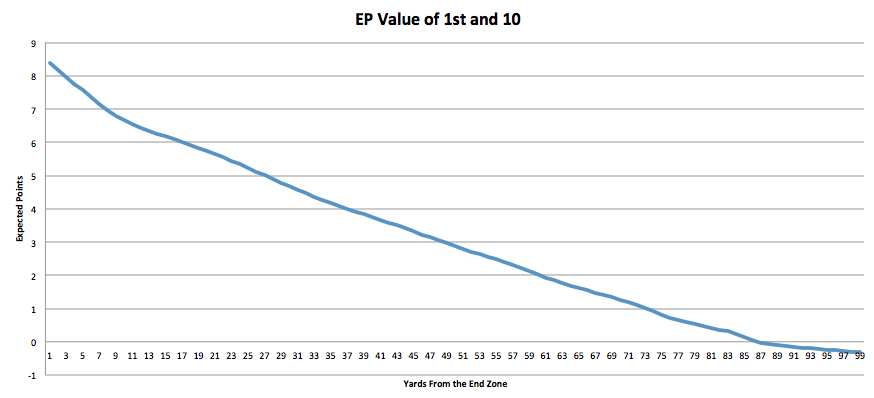
I’ll spare you the full explanation because I think most readers here are aware of it, but basically it assigns a point value to each down/distance combination to provide a measure of how valuable each situation is.  For example, 1st and 10 at the 50 yard line is worth MORE than 1st and 10 at a team’s own 20 yard line.  Simple enough.  However, many people (myself included) have been a bit to cavalier in using the Expected Points concept to evaluate in-game strategy.

Today, I want to clear that up.  There is a major limitation to the Expected Points concept; that is, it’s an AVERAGE, and it doesn’t account for the relative strengths and weaknesses of each team.  Logically, a certain field position is worth more to the Broncos than it is to the Buccaneers, right?  Similarly, a particular field position is worth LESS against the Chiefs defense than it is against the Eagles.  Unfortunately, that’s not accounted for, limiting the usefulness of the Expected Points analysis.

I’m not saying it’s worthless, far from it in fact; I’m just saying that we need to remember that the EP analysis for a given situation reflects average teams, and therefore must be adjusted when applying it to real-world situations.

Allow me to demonstrate (as you knew I would).

Here is the chart of EP value for 1st downs.

Screen Shot 2013-10-25 at 4.45.35 PM


The problem, as I mentioned above, is adjusting for relative strength.  To explain, we need to pick 2 teams.  For the sake of clarity, and consistency, we’ll use Denver and Jacksonville (FO’s best and worst teams by DVOA).

Let’s just look at Denver’s offense.  To adjust, we need to know how the Broncos offense compares to average.  Luckily enough, Football Outsiders provides us with a measure of just that.  Note that, for now, I’m knowingly glossing over the fact that FO’s DVOA might not be the best measure here.

Anyway, Denver, according to FO, ranks 40.9% better than league average.  Well that makes things easy, right?  All we have to do is increase the average EP value of each yard line and re-graph.  Well here’s that graph:

Screen Shot 2013-10-25 at 4.52.08 PM

I’m guessing you all see the problem, but if not, hang in there, I’ll get to that in a second.  We ALSO have to account for Jacksonville’s relative strength/weakness on defense.   Just as I did above, I can just use FO’s rating (17.9%) to adjust again, right?

Well here it is:

Screen Shot 2013-10-25 at 4.55.06 PM


Perfect….now we have the adjusted EP value for the Broncos versus the Jaguars.  We can do the same calculations as before, using these values, to determine the “optimal” play-call (where optimal means maximizing expected points).

Only…there’s still that problem I mentioned above, which by now EVERYONE has noticed.  Looking at the graph above, it’s pretty clear that we’ve made a mistake in our analysis.  Touchdowns are only worth 6 points, which means no field position can be worth more than that (violated above).  Moreover, since, regardless of relative strength, scoring a TD can never be 100% assured, we shouldn’t even see a value of 6 anywhere on the chart.

Basically, as the mismatch becomes more and more favorable to the offense, the line should approach a limit of 6, but never reach it.  Unfortunately for us, that complicates our plans.  How do we account for this?

I’m not sure, but I do have one potential out.  

We can ignore everything I did above (ugh) and go back to using the average values for EP.  Rather than accounting for the relative strength here, we can instead adjust the expected success rates to account for relative strength.  That raises it’s own issues, but it seems to be more intuitive.

HOWEVER, that only addresses the problem when we’re using a combination of EP and Success Rates to game out the Optimal Value of a certain situation.  It does not address the issue when we are only using EP (which is how many analysts are using it.)

That brings me back to the main point: be careful when using Expected Points to justify in-game strategic decisions.  It can be done (and EP remains the best model for quantifying such situations), but you have to remember that the actual results will be distorted by the relative strength of the teams.

If that reminds you of this E = R ((60 – T) / 60) + C then I’ve done my job.  I apologize for the slap-dash way I’m addressing the overall concept, but it is what it is…I don’t have the luxury of taking the time to plan these things in advance.

I’ll try to return to this soon, hopefully using a real situation from Sunday to game out the options using our adjusted success rates.

Next up, though, we need to talk about Bayes and reconciling New Information (what happens during the game) with what we already “knew” (R before the game starts).

Eventually, I do believe it will be possible to create an algorithm that essentially tells you what the “optimal” decision is in every Go/Kick/Punt situation.  We’re kind of there already, on an average basis.  The key, of course, is to adjust for the teams involved in order to allow actually reliance and use (not that NFL coaches would ever admit that a computer can make better decisions than they can).  At the very least, it’ll provide a valuable guide with which to grade coaches.

This should probably be a permanent end note, but all comments are encouraged.  As I said, I’m trying to develop a useful model here, so suggestions are always welcome.

Week 8 Odds

I promise i’ll get back to the “Not All Points Are Created Equal” post soon, hopefully tomorrow, and incorporate some of the very good comments/feedback I’ve received (both here and at BGN).  For now though, here’s a breakdown of this week’s betting lines for the Eagles/Giants.  I’m doing a weekly breakdown for BGN, so obviously I’ll share it here as well (though I think I forgot to post it here last week).  I’ve had a pretty good season thus far, hopefully that continues (straight up, I’m challenging Jaworski for the top spot in the Sports Media Monitor’s rankings, seen here.)

—————

After a few very successful weeks, I got tripped up by last week’s Eagles/Cowboys game.  I did say that I’d take the Cowboys, so I was on point there, but I was also confident in the Over, especially if it was teased down by 6 points.  Obviously, the teams came nowhere near hitting the over.

I’m not going to rehash why the over didn’t it, because I think it’s instructive without explanation.  Basically, games don’t have to proceed as all reason and logic suggest they should.  I doubt anybody doesn’t already know that, but it helps to be reminded from time to time.

With that, let’s try to do a bit better this time.  The Eagles visit the Giants on Sunday, and as I’m writing this, the lines are as follows:

Spread – There is some disagreement among the online bookmakers, though all of them have the Eagles as favorites.   The lines range from -4.5 (BetOnline) to -6 (Bovada).  As I’ve previously explained, I’m going to use Bovada as the default, so for today’s breakdown, we’ll be assuming Eagles -6.

Over/Under – A little more agreement here.  It’s set at 51 or 52, depending on the source.  We’ll go with 52.

Here are the major stats:

– The Eagles have a point differential of -27.  The Giants have a differential of -90, which is worse than every other team in the league outside of Jacksonville.

– The Eagles have scored 169 points, and rank 8th overall in Offensive DVOA (14.2%, Football Outsiders).  The Giants have allowed 216 points, and have the 23rd ranked defense by DVOA (5.2%).

– The Eagles have allowed 196 points, and rank 29th overall in Defensive DVOA (12.1%).  The Giants have scored just 126 points, and rank 29th overall by Offensive DVOA (-18.2%).

– The Eagles Special Teams rank 28th by DVOA.  Fortunately, the Giants are worse (31st).

– Overall, the Eagles Team DVOA is -4.6%, good (bad?) for 20th overall.  The Giants rank 31st in the league, at -34.9%.

The Spread

As I just showed, there’s no question that the Eagles are the better team.  In both traditional measures and “advanced” ones like DVOA, the Eagles maintain a significant advantage over the Giants.  The question, of course, is how much better?

Normally, I’d be happy with the -6 line, on the Eagles side.  After all, the teams played each other just 3 weeks ago, at which time the Eagles won by 15 points.  However, there’s the extremely significant issue of Michael Vick’s health to account for.  Put simply, we have no idea how healthy Vick is or if he’ll be at all inhibited on Sunday.  He is going to play, but if he’s a shell of his normal self, it obviously affects the outcome of the game somewhat dramatically.

With Nick Foles likely out of commission, if Vick re-aggravates his injury (or suffers a new one), the Eagles will be relying on Matt Barkley, in which case I’d be avoiding the Eagles -6 line like the plague.

In a sense, this is a pretty simple analysis, and the outcome just depends on your personal view of Vick’s health.  If Vick plays and is anywhere close to 100%, then take the Eagles with confidence.  If you think Vick is more injured than the team is letting on, then stay away from the game.

Me?  I’m inclined to go for it.  As I said, the team’s just played each other 3 weeks ago and the Eagles won by 15 points. Even if Vick is not quite 100%, the team shouldn’t have trouble winning by a touchdown.  The only player on the Giants that worries me is Victor Cruz, and he has registered more than 5 catches just twice this season, with the last time coming back in week 4 against the Chiefs.

6 points is a fairly large line, especially considering the Eagles schizophrenic performance this year (and the terrible defense), but, as anybody who watched the Giants-Vikings knows, the Giants are REALLY bad.  Barring a complete “shit the bed” performance from the Eagles or a serious injury to Vick, I say the Eagles cover fairly easily.

The Pick:  Eagles -6

The Over/Under

The Over/Under is a bit trickier, largely as a result of the Eagles inexplicably bad performance on Sunday (well Nick Foles’ inexplicably bad performance).  With the line at 52 points, these teams need to score fairly often to hit the over. That’s a little under 7.5 touchdowns.  Can these teams do it?

Eagles games, thus far, have averaged 52.14 points, just above this game’s line.

Giants games have averaged 48.86 points.

So that doesn’t help much.  Against the Over/Under, the teams are a combined 9-5, meaning the “market” has generally underestimated the amount of points these two teams will score/allow.  Point for the over.

In the team’s last meeting, the final score was 36-21, or a combined 57 points.  So another point for the over.

We also have last week’s results to account for.  Here, I’m talking about the Recency Effect, or people’s general habit of overweighting the most recent information.  Against the Cowboys, the Eagles offense looked terrible.  The team scored just 3 points.  So a 51 point line is crazy, right?

That’s what I’m hoping “the public” thinks, because I’m taking the over.  As some of the All-22 breakdowns have noted, the Eagles poor offensive performance was largely the result of a very bad game from Nick Foles.  As you may have noticed, Nick Foles is not the Eagles QB this week.  In other words, last week was likely an anomaly, and we should expect the team’s offensive output to come much closer to the 30 point level it’s hit 4 times this year.

Last game, the Eagles scored 36.  If the team repeats that performance, the Giants need to score just 16 points to push the O/U line.  The Eagles defense has been playing a bit better recently, but let’s not lose sight of the big picture, it’s still quite bad.  Conveniently enough, the team has yet to hold a team below 17 points.

All together, I’m taking the Over, though I’m less confident on this side of the game than I am on the Spread.  Note that this too is predicated on Vick playing, and not missing a significant part of the game with injury.  That’s your risk here, adjust your personal thoughts accordingly.

Summary

I feel best about the Spread, taking the Eagles at -6 (though obviously go get the -4.5 or -5 if you’re not agnostic regarding the bookmaker).

If I take the Over/Under, I’m going Over the posted 52 points.  This one’s a bigger risk, but I think it’s a better bet than the Under, though not by a large margin.

I’m staying away from a teaser option this week, though if I was doing it I’d push the game to a Pick’em and take the Eagles while moving the O/U down to 46 and take the over.  The reason I’m not going for this option is because you’re not getting enough risk reduction in the lines to account for the payout difference (slightly worse with the teaser).  If the Eagles win, it’s very likely to be by at least 6 points.  If they lose, it probably involves a Vick injury, in which case the Eagles wins of 1-5 points become much more unlikely.

Eagles vs. Cowboys: Week 7 Post-Game Notes

Eww…(can I stop there?)

Let’s put aside everything else from today’s game for a moment and focus on the biggest issue:  the complete, shocking, inexplicable, incompetence of Nick Foles today.  The WRs deserve some blame for dropping catchable balls, the O-Line deserves some blame for not protecting better, and Chip Kelly deserves a lot of blame for not calling the game like he should (Play-Action dammit!).  However, Foles was awful, and will rightfully shoulder most of the blame for today.

As a supporter of Foles, where does that leave me?  Disappointed, obviously, but not as despondent as some may have expected.  Let’s do this in bullet form.

– People who are writing off Foles after today are clearly falling victim to confirmation bias.  They’re convinced he can’t play, and today was an overwhelming affirmation of that sentiment.  HOWEVER, just as 1 great game (last week), didn’t warrant proclaiming Foles “the future”, one terrible game doesn’t warrant throwing him away.  Simply put, 1 game can NEVER be held to mean that much.  Like everything else, we need to assimilate it into what we already know about Foles, then adjust our expectations accordingly.  So it definitely hurts, but let’s not go crazy here.

– I feel compelled to remind everyone that the case for starting Foles was not entirely (perhaps not even largely) built upon Foles’ being good.  The case for Foles was that A) he’s an unknown, and we have to know, so play him, B) Mike Vick is not a long-term answer, so starting him for a non-contending team is useless, and C) if Foles is good, you have an asset, if he sucks, you have a good draft pick.

Given the divisional competition, you could maybe convince me that the “contending” bit is debatable, but the fact remains, playing Foles still seems to make the most sense.

– Today’s performance was very….confusing.  Foles has weaknesses, no doubt.  The problem is that today, his issues came almost entirely from what we though were his strengths.  He was woefully inaccurate. He lacked the poise we’ve come to expect.  He didn’t move as well in the pocket as we’ve seen before.  He didn’t take advantage of open underneath receivers or “what the defense gave him” in common NFL analyst parlance.

I have no particular insight as to what happened, which is why it confuses me.  If he was victimized on poorly thrown deep-balls, I’d get it.  If he was sacked a bunch of times because he’s slow, I’d get it.   This though?  WTF…Maybe he was actually injured (skeptical), maybe he just had a terrible day (possible), maybe the “pressure” of starting in a big, meaningful game got to him, maybe he left his contact lenses at home and couldn’t see (does he where glasses?)  Regardless, it was either a fluke, or he can’t play in this league.

– Temporary end to the “QB Competition”.   Despite what I think is best for the long-term future of this team, it’s clear what Chip Kelly thinks.  Michael Vick is the starting QB.  I should note, though, that even if Foles played well, I think we’d see Vick back in there when healthy.  The reason I said “temporary” above is because we kind of have to assume that Vick will be injured again before the end of the season.  We haven’t seen the last of Foles.

– Foles didn’t turn the ball over.  Doesn’t mean much, given that he didn’t complete passes to his own team either, but it’s pretty remarkable that, given how awful the game was, he didn’t actually throw a pick or fumble the ball.  Matt Barkley provided a good illustration of what really bad QB play will do to you….keep that in mind when judging Foles.

That’s all I’ve got on Foles.  Maybe the All-22 will shed some light on the subject.  In the meantime, remember:

– Dallas looked pretty bad as well, so the division race is still wide open.

– The Eagles play the Giants and Raiders the next two weeks….they could be back in first place sooner than you think.

Eagles vs. Cowboys: Week 7 Pre-Game Notes

Big game today for reasons so obvious I won’t list them.  The Eagles are favored, though I disagree with that.  To date, the Cowboys have a better resume, though the gap isn’t huge.      Both teams have, in my mind, proven their mediocrity.  Trying to parse mediocre teams is an exercise in futility, so I think the best way to frame the game is as a true toss-up.  There are, however, a few areas I’m particularly interested/concerned in/about.

– Fletcher Cox.  Great game last week.  Was it a fluke? Was he just taking advantage of a poor interior O-Line and a rookie QB?  Is he finally adjusting to his new role?  We don’t know, but today will shed some more light on the subject.  I said preseason, and I maintain today, that Cox is currently the most important “piece” on the team.  The Eagles need him to be a difference-maker, otherwise this defense is going to take a long time to come around.  Keep an eye on him.

– Nick Foles.  Stating the obvious here, but it needs to be said.  The Foles detractors have just one objective card to play, small sample size.  With every game, that becomes less relevant.  Now one more game isn’t going to change too much, but with every good performance, the chances of Foles being as good as his numbers increases.  He had some good “luck” last week, so dial back the expectations a little bit.  But, he’s got plenty of room to “come down” and still have a good game.  In particular, watch the deep throws, which have been his biggest weakness thus far.   Hit hit a couple last week, but one was under-thrown (Cooper).

– Special Teams.  The Eagles’ special teams have not been good (-7.9% DVOA, 29th overall).  The Cowboys’ have been very good (6.5% DVOA, 4th overall).  In what looks to be a close match, that’s a red flag for anyone rooting for the Eagles.  Hopefully Alex Henery is on his game, touchback-wise, but if not, hold your breadth, cause this could get ugly.

– Onside Kick.  Related to the last point, this is a good opportunity to go for a “surprise” onside kick.  Check with Henery pre-game, but if he can’t kick every kickoff out of the end-zone, the risk-reward tradeoff for an onside kick looks pretty attractive.  Given the STs disparity, you have to assume that every Cowboys return has a significant chance  to result in a big play.  Assume that these kicks will give the Cowboys field position at the 35 yard line (that might be conservative…).  Well a failed on-side kick will likely give the Cowboys the ball somewhere between the Eagles 45 and the 50 yard line.

There’s some dispute as to what the success rate of surprise onside kicks is, but AdvancedNFLStats.com says that when the WP of the kicking team is between .4 and .5 (when its early or the game is still close), the rate is close to 60%.

Would you give up 20 yards of field position (remembering how bad the Eagles defense is) in exchange for a 60% chance of regaining possession?  DEFINITELY.

– That covers the areas of focus.  Obviously the DBs will be important, but not much left to say about them.  If the Eagles can hold the Cowboys to less than 30 points, they’ll be in good shape.

Not All Points Are Created Equal: Part 2

Let’s return to last week’s post, found here.

I want to start looking at this in smaller chunks, which will hopefully be a little clearer.  First, some overall major takeaways:

– E = R ((60 – T) / 60) + C, the formula, for reference.

– Large underdogs should be extremely aggressive early in games, when R (relative strength) is at its largest.

Underdogs should attempt to use as much of the clock as possible.  This is more “conventional” and something I didn’t talk about last week, but it’s a logical extension of what I was talking about.  If you have two very mismatched teams, and make them play 100 games, it’s almost certain that the “better” team will win more than it will lose.  The larger the sample, the more likely it is to reflect that actual “relative strength”.  By using up a clock, the underdog is limiting the sample size “# of plays” from which the relative strength advantage can play out.  Using our formula, by bleeding the clock, underdogs are attacking the R value indirectly, using T, instead of going at R itself (scoring points).

– During the game, strategic decisions should incorporate an objective view of how the rest of the game is likely to play out.  For large underdogs, this means they should expect to be outscored, and therefore need to be aggressive in scoring points.

Favorites Strategy

I didn’t discuss how this effects the strategy of the Favorite.  In the most simple reading, it can be assumed that the Favorite should be more “conservative”.  Going back to our Broncos vs. Jaguars example, 3 points is a lot more valuable to Denver than it is to Jacksonville (hence “not all points are equal”).  Therefore, given the same FG opportunity as the one we gave Jacksonville (expected points for FG and going for it are equal, purely a risk/reward play), it should elect the LOW risk option (the FG).

That’s because, as I explained above, at any time T, the favorite can expect to outplay the underdog over the rest of the game, i.e. the R value is advantagous.  As time goes on, this becomes less of a factor (T declining ultimately takes the R half of the equation to 0).

In general, I agree with this.  Large favorites should be content to take whatever points they can get, early in the game.

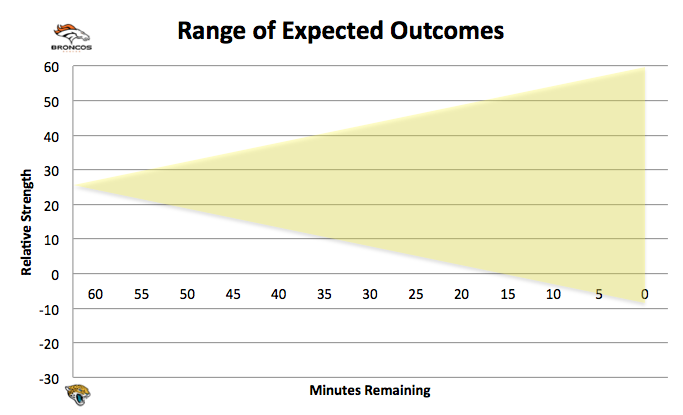
However, there is a slight wrinkle, one that will appeal to the more aggressive fans.  Let’s go back to our graphic for a moment.  Here is the range of outcomes at the start of the game:Screen Shot 2013-10-10 at 10.28.23 AM

As you can see/remember, if we assume a “random walk” from there, Denver should expect to win a very large percentage of the time.  There is a case to be made for being aggressive, though, and hopefully you can see it.

It goes back to when I explained that you can actually “win” the game before the game is over.  Assume the same EP-Neutral opportunity above, but this time imagine that gaining 7 points is enough to shift the range of outcomes (yellow shade) entirely above the X-Axis.  Would you go for it or kick?  Probably go for it, right?  After all, if you have a chance to “win the game”, with relatively low risk (still have a heavy advantage if you don’t convert), you should do it.

Obviously, I have to note that this is a purely theoretical situation.  During the game, it’s not possible to know EXACTLY where the range of expected outcomes lies.  Therefore, we can’t be sure of where the line between 100% win and 99% win is, even if some of us see that final 1% as extremely valuable.

Still, it implies that there are some situations, even if they are hard to identify, where the Favorite should also be aggressive. In general, though, it should take the lower risk strategic options, because it does NOT want to significantly shift R (outside of the specific scenario I just outlined).

Random Walk

I don’t think I made a big enough point of this model in the post last week.  There are two ways to view the game, ex-ante, and I think one of them is much better than the other.

1) This is the normal model.  Teams start on even ground (Score tied 0 – 0) and we “expect” the course of play to naturally favor one team (the favorite) over the other (the underdog).  During actual play, we project that the difference in skill will gradually manifest itself in the score, and ultimately mean victory for the Favorite.  That’s the usual way of thinking about it.

What I’ve done is to flip that around a bit.

2) Teams start on UNEVEN ground (R value), and from there we expect a random series of events to occur, though they will be within a range of possible outcomes.  This certainly isn’t the “natural” way of thinking about things, but it appeals to me for one very big reason.  Can you guess what that is?

I like it because it forces us to accept and recognize the large role of luck and chance in the outcome of the game.  Future human events are inherently unpredictable, right?  So how do we reconcile that with the first option I outlined above (the normal model)?  Isn’t it explicitly forcing us to predict that which is, by its very nature, unpredictable?

The result of this is that we get ridiculous explanations for unexpected outcomes of games.  For example, take the Giants-Patriots SB (Helmet Catch).  The Patriots were heavy favorites, and yet lost a close game.  Why?

– Is it because Eli Manning is just REALLY clutch?

– Is it because the Patriots “choked”?

– Is it because the Giants have more “heart”?  or “wanted it more”?

Of course not, those are all ridiculous explanations, and yet they’re a natural outgrowth of the way we normally think of games (option 1).

Now let’s look at the “Random Walk / Ex-Ante Relative Strength” model (the name needs work).  Here’s the picture again, just imagine a Patriots logo instead of the Broncos and a Giants logo instead of the Jaguars.

Screen Shot 2013-10-10 at 10.28.23 AM


Suddenly there’s no explanation needed for the outcome of the game.  Just look at the picture; you can see there’s a section of the yellow shaded area below the X-Axis.  If we assume that at time T=60, all future game events will take a random path through the yellow area, then it’s obvious that SOME of those infinite paths will end up in the area below the X-Axis.  It just so happens that THIS PARTICULAR run was among those.

Now there’s also obviously some unpredictability in deriving a value for R.  It’s very difficult to know just how good each team is and how they match up against each other.  However, I’d argue that all of the necessary information for getting an accurate R value is theoretically knowable.  Compare that the Normal Model.  It requires us to predict future events, which is NOT POSSIBLE, even in theory.

The upshot of the “Random Walk” is that it forces people to confront a lack of “control”.  It basically boils the game down to a lottery.  That sucks some of the fun out of it, but that doesn’t mean its a less accurate model of analysis.

Similar to last time, I’m going to cut this off prematurely for the sake of time and clarity.  Hopefully you’re still with me.

Eagles v. Bucs: Post-Game Thoughts

I was tied up most of the weekend for wedding festivities (not mine), so I didn’t have a chance to post anything about the Bucs, other than my odds column for BGN (which, BTW, I nailed…again).  I’ve got a few things from the Bucs game, but I really want to get back to the strategic discussion I started at the end of last week, so I’ll keep this relatively short.

– Nick Foles…still looks good.  I’ve long been a Foles supporter, though that was more for the rational aspect of the argument than it was a strong case for Foles being a good player.  However, it looks as if the Foles discussion is now about his ability.  Basically:

Foles supporters point to his numbers, which are VERY good, and wonder what all the haters are looking at.

Foles detractors are watching him play, and claiming he fails the “eye test”.  Similarly, they’re wondering what the hell the Foles supporters are watching.

I do understand the detractors.  His arm strength isn’t great, and occasionally his passes get wobbly (especially to the sidelines).  However, the ball seems to get where it needs to go.  That was a very good defense he just tore apart, and I’m not sure what more you could ask for.  He’s got weaknesses, but so does nearly every QB, and I’ll take a “weak” arm over stupidity and inaccuracy every time (in no way does that refer to Vick).

– The Offense had just 1 three-and-out.  That’s a pretty clear illustration of the point I made preseason about a Foles-led offense.  There won’t be as many big plays (though he did hit a couple deep throws this time), but there also won’t be many go-nowhere drives.  Yesterday, the Eagles only went three-and-out once (though the LeSean fumble killed another drive).

– Riley Cooper finally made a “Riley Cooper” play and it was glorious.  The deep TD to Cooper was underthrown.  In these situations, it’s far too common for the WR to run to the spot where the ball is thrown and then wait for it to get there, which turns the pass into a 50/50 jump ball.  Cooper, though, adjusted his speed so that he would arrive at the point of the throw in stride.  As a result, the CB also had to adjust his speed; if he hadn’t he would have run into Cooper and been called for PI.  In essence, Cooper used his size and positioning to box out the CB as they ran.  Given his attributes, we should see this more often from him.

– Zach Ertz was targeted 5 6 times and played 42 offensive snaps.  He only caught 2 of those 5 3 of the 6 targeted balls, but it’s nice to see him finally playing a significant role.  He was a very high draft pick and, given the lack of WR depth, he should be making an impact.  Keep an eye on him as the season progresses to see just how much Chip likes/trusts him.

– Damaris Johnson is allowed to play offense.  It was just 8 snaps, but I’m encouraged nonetheless.  I think he can be a valuable WR out of the slot, and have been surprised by the lack of playing time he’s received over the first stretch of the season.  Similar to Ertz, it looks like Chip might be slowly working up to what we thought his player-usage would be during the pre-season.  Maybe it just took time for these guys to learn the play-book to Chip’s satisfaction.

– The defense still sucks.  They were hurt by poor field position on a few drives, but the defense had issues against what had been one of the worst offenses in the league.  Individual weaknesses aside, Billy Davis is still blitzing way too ineffectively.  I understand that the front 4 has failed to generate pressure, but there’s got to be more reason used when scheming these blitzes.  Rushers are still coming from too far away and or not rushing soon enough.  It’s an attempt to “disguise”, which I castigated Davis for not doing early in the year, but it’s a poor attempt.  He doesn’t have much to work with (talent-wise), but he’s also not doing much with the little he has.

Fortunately the offense is good enough to bail him out of a few games.

That’s all for now, I told you it’d be short.   Tomorrow or Wednesday we’ll start breaking down the last strategy post into pieces and hopefully build on it.