Random Stuff

Not much football to talk about today, but a great sports weekend nonetheless.

—–

First, the Eagles.  With a new coaching staff and scheme, we have to expect several players to be unsuccessful in transitioning.  Most of the suspects have been on defense (Cole, Graham), but we need to recognize that some offensive players may not make it either.  Unfortunately, until training camp begins, we won’t really know who the prime suspects are.  Allow me to name my surprise pick…

DeSean Jackson.

I’ve long been a big Jackson fan. I think he’s underrated as an all-around receiver and wasn’t used well by the previous scheme.  His straight-line speed is among the best in the league, and used properly, he should open the entire field up by forcing safety coverage deep.  However, it wouldn’t surprise me if he makes a less successful transition than I hope and others expect.  Let’s talk about what the new offense might look like:

– Most expect it to be run-heavy and potentially option-based.

– Requires WRs who can block…

– Emphasizes short passes and YAC. (It’s very tough to run no huddle if you use a lot of deep routes)

None of those aspects play to DeSean’s strength, though he can absolutely be a YAC threat in the slot (he’s much stronger in the middle of the field than people realize, owing mainly to his contract-related issues).

Also, if the Quarterback battle plays out the way I think it will (i.e. Nick Foles wins), we could be looking at a QB who’s biggest weakness is deep-ball accuracy (if he hasn’t improved this offseason).

So now we’ve got an offense that needs WRs who can block, doesn’t emphasize the deep ball, and doesn’t have a QB that can get it deep with any consistent accuracy.  That sounds like it could spell trouble for D-Jax.

If I had to place a bet today on D-Jax’s future, I’d still wager that Kelly uses him the right way and helps return Jackson to the upper echelon of NFL deep threats.  However, I think  we’re all overlooking the transition risk for Jackson.

——

To the NBA for a minute:

Check out Danny Green’s shot chart for the NBA finals.


For those of you watching, you’re seeing an absolutely unprecedented performance.  Green’s turning in the greatest shooting performance in the history of the finals (perhaps any series depending on how the next game or two goes) and making a case for NBA finals MVP.  More surprising is the fact that, coming into the series, NOBODY would have ranked Green any higher than 5th in terms of the Spurs best players (Parker, Duncan, Ginobli, Leonard).

Lost in the Green/Parker hype (and Ginobli’s breakout last night) has been remarkable play by Kawhi Leonard.  People have been talking about the Spurs “window” closing for years now, but it looks to me like the team might have a much more successful post-Duncan/Ginobli transition than anyone expected.

—–

I’m not going to talk about the NHL much.  The Finals have been great, but it seems to me that if you’re a hockey fan you already know that, and if you’re not, there’s probably not much I can say at this point to convince you to watch.

It also doesn’t help that there isn’t a natural side for Flyers fans to take.  I’m going Blackhawks, mainly because they’re not Boston and have the best jerseys in professional sports (the Red ones obviously).

Selected Team Performance Progressions

Today, let’s look at some other teams’ performances from the last decade.

First up, the Patriots.  Remember the yellow highlights are SB winners, the red highlights are SB losers:

Screen Shot 2013-06-14 at 10.52.29 AM

An extremely impressive decade all around (obviously).  The defensive performance is perhaps a small surprise, since the offense gets so much attention.  One of the most puzzling aspects of the Brady-Belichick run has been the lack of press attention on the defense.  Notice the Patriot defenses of the last three years don’t come close to approaching the defensive performances of the Super Bowl winning teams from 2003 and 2004.

Also, notice the Patriots 2003 title came with a team that was just 5% better than average on offense.

The Saints (otherwise known as the Drew Brees effect):

Screen Shot 2013-06-14 at 10.59.35 AM

I like the Saints’ table because it clearly illustrates just how quickly teams can change their fortunes with a new coach/QB combo.  Look at the offensive side of the table above; can you see when Payton/Brees joined the team?  I thought so.

It’s also interesting to see how badly the defense has trailed the offense.  If the Saints’ defense was just consistently average, the team might have played in another SB or two.

The Giants (sorry):

Screen Shot 2013-06-14 at 11.05.11 AM

The Giants’ performance further highlights the relative randomness of the two Super Bowl titles.  In the past ten years, the Giants have had two REALLY good teams, 2005 and 2008.  Naturally, neither of those teams went to the Super Bowl.

The 2007 title team remains perhaps the most puzzling SB Winning team in more than 30 years (maybe ever, but I prefer to stay within my lifetime).  Not only was the 2007 team remarkably average, but they defeated the greatest team in modern NFL history.

If you want a great example of the “any given Sunday” saying, compare the performance ratings of the 2007 Giants with those of the 2007 Patriots (in the table above).

Want to feel better?  Take a look at the Raiders:

Screen Shot 2013-06-14 at 11.09.57 AM

No comment needed other than to say the past decade in Oakland has been one of ASTONISHING futility.

Lastly, any time you’re disappointed or frustrated by the Eagles, take a deep breath and say “thank god I’m not a Browns fan”.  Check out the offense:

Screen Shot 2013-06-14 at 11.13.23 AM

Charting Team Performance

Went to the U.S. Open practice round yesterday, hence no post.  Biggest takeaway?  Players are going to score, but only those that avoid the rough at all costs.  My wrists hurt just watching players try to get out.

Today’s chart stems from a commenter’s suggestion.  I’ve graphed the offensive and defensive performance (league-average adjusted) for all NFL teams from the last ten years and highlighted the Super Bowl teams in Yellow.  It’s a little tough to read, so to be clear:

The X-Axis (left-right) is OFFENSIVE performance.  So the farther RIGHT a dot is, the better the OFFENSE.

The Y-Axis (up-down) is DEFENSIVE performance.  The HIGHER the dot is, the better the DEFENSE is.

So the best teams are in the upper-right quadrant (the 1st if my high-school geometry memory is correct).  The worst teams are in the lower-left quadrant (the third).Screen Shot 2013-06-13 at 11.05.58 AM

I did not label the Eagles teams, since doing so crowds the graph too much.  However, below is a table showing the Eagles’ performance going back to 2000 (note the graph only goes back to 2003).  The 2004 team is highlighted red because they lost in the Super Bowl.

Looking at the chart above, we can clearly see the teams that won with great offenses (Saints) and those that won with great defenses (Steelers ’08).  We can also see that the 2004 Patriots were the most balanced Champion (best?) by a fairly wide margin.  Also, the 2007 Patriots are the blue dot by itself on the right.  In terms of regular season performance, that was easily one of the greatest professional teams ever, regardless of sport.

While comparing the Super Bowl winners above is interesting (clearly illustrates the relative strength of each team), I’d also like you to take a look at the axis scales.  Notice the offensive axis (left-right) has a much higher maximum than the defensive axis.

No team in the last ten years has finished with a defense more than 40% better than league average (Points Against).  Conversely, over that same time period, 11 teams have finished with an offense at least 40% better than league average (Points For).  Clearly, though, a great offense does not lead to a Super Bowl win with any certainty.

If we go back to the post earlier this week.  We can see the visual illustration of the necessary-condition strategy.  Basically, to win a Super Bowl, you MUST be on the right side of the Y-Axis (average offense or better).  The same rule does not hold for defensive performance.  However, it also appears as though, for Offense, the point of diminishing returns is reached rather quickly (i.e. going from -5% to 5% has a much greater effect on winning than going from 40% to 50%.)

Lastly, here are the Eagles.  I’ve listed them in (X,Y) order so you can easily place them in the graph above.  Remember, Off (X) is right-left, Def (Y) is up-down.

Screen Shot 2013-06-13 at 11.20.54 AM

Revisiting Necessary Conditions – Defense

Today we look at the defense.  Here are the best defenses since the 2000 season, adjusted for league average scoring.  Yellow teams are Super Bowl Winners, Red are Losers, and I’ve highlighted the Eagles in Green.

Screen Shot 2013-06-11 at 10.54.55 AM

Whoa…a lot more yellow than the offensive table.  Also, we can clearly see the Andy Reid Peak here.  While McNabb was the face of the franchise, the defense is what really carried the best Reid teams.

Again, this isn’t much different from our pervious look (which didn’t adjust for points inflation).  However, it seems pretty clear from that table that a GREAT defense can go a very long way towards winning a Super Bowl.

Notice also that the 2002 Bucs are at the very top of the list.  I’ve said before that the 2002 Eagles were the best of all the Andy Reid teams.  Unfortunately, it ran into a historically great defense that year.  Is it possible that single game led to a Reid overreaction and strategic shift away from the defensive focus that led to so much success?   Yes, yes it is.

After that game, everyone talked about how inept the Eagles offense was.  Meanwhile, it’s quite possible (likely?) that the Bucs that year would have shut down ANY offense.  They were that good.  However, I’ve talked about that before.  Back to today’s topic…

Similar to yesterday’s table, here are the past ten Super Bowl winners and their defensive performances:

Screen Shot 2013-06-11 at 11.07.59 AM

For reference, here is the offensive chart for Super Bowl winners:

Screen Shot 2013-06-10 at 11.03.20 AM

The performance of teams in both areas is strong (as it should be), but it’s clear the bar for defensive performance is significantly lower.  Not only do we have 3 teams that Won a title with a below-average defense, we have 2 teams that won with a significantly below average defense.

Also interesting to note is the fact that the only Super Bowl winner with a negative offensive performance (the 2008 Steelers) had a historically great defense (37% better than league average).

What about the Super Bowl losers?

Screen Shot 2013-06-21 at 2.25.23 PM

Strong performances again. In fact, the average performance of the losing teams is better than the average for the winning teams.  However, we also see that, while defense is clearly important, it is not necessarily mandatory.  The Arizona Cardinals of 2008 were 21% below league average on defense and still managed to come within a Santonio Holmes tip-toe of winning the Super Bowl.

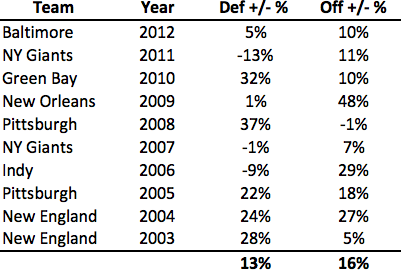
Lastly, here is a chart of the past 10 Super Bowl Winners showing their defensive and offensive performance.

Screen Shot 2013-06-11 at 11.24.22 AM

At first glance, it doesn’t look like a huge difference, though average offensive performance is better by 3%.  However, if we look at the minimums on both sides, we get a clearer picture.

After all that, our original thesis stands:

– An average offense (or something extremely close to it) is required to win the Super Bowl.

– An average Defense, while certainly helpful, is NOT required.

THEREFORE

Teams should focus on the offensive side of the ball until they’ve met the average threshold, and then turn towards maximizing defensive performance.

P.S. The table above also makes it extremely clear that the Giants teams that won in 2007 and 2011 are, BY FAR, the weakest winning teams of the last decade.  I’m not sure if that makes me feel better or worse, but it supports my assertion that those teams were largely lucky, and not good (not that it matters).

Revisiting Necessary Conditions – Offense

If you remember back a couple of months, I did a couple posts that went into necessary vs sufficient conditions regarding the construction of a Super Bowl team.  At the time, I looked at every team from the last 10 years and used their PPG and PPA to gauge their relative percentile ranking.  However, since then I’ve gone back and adjusted each team’s performance to account for the league average PPG that season.  This adjustment will help account for the general offensive inflation the league has seen over the past decade.

Today, we’re looking at the offensive side of the ball.

The question is, how good are Super Bowl winning teams on offense?  The idea here is to get an idea of what a truly optimal team construction strategy would look like.  There is a salary cap, and the number of roster spots means every team must sacrifice somewhere in order to improve a different area.  What is the best mix of offense and defense?

My last look came to this general conclusion (ignoring Special Teams for now): Teams should focus on building an above-average offense.  Once that’s assured, the team should focus 100% on developing the best defense possible.

After adjusting each team’s performance, does that still hold?  And if so, what does it mean for the Eagles?

First, let’s revisit the best offenses.  My main data set only goes back to 2003, but for this, I went back to 2000 to make sure I was including some all-time greats (to give us a sense of just how great they were).  You’ve seen this before, but here are the best offenses in recent history:Screen Shot 2013-06-10 at 10.48.06 AM


The teams highlighted Red LOST in the Super Bowl.  Teams in yellow WON the Super Bowl.  We can see the overwhelming dominance of the Patriots, as well as some less-heralded performances, like the 2011 Packers.

However, we also see a lot of red.  Just as in our original look, it seems that a great offense can go a very long way towards winning a Super Bowl, but can’t guarantee a win.

We do have to be careful with the sample size here.  5 of the top 16 offenses since 2000 went to the Super Bowl.  The 1-4 record of those teams in the final game may just be bad luck.

How about all the Super Bowl winners?

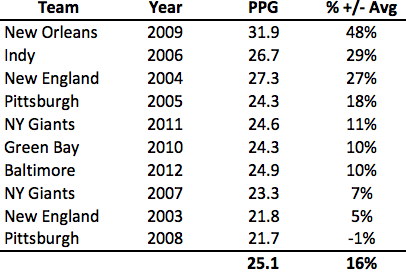
Here are the winning teams from the last 10 years:

Screen Shot 2013-06-10 at 11.03.20 AM

As you can see, the only team to win a Super Bowl in the last ten years with a below-average offense was the 2008 Steelers, and that team was just 1% off the mark.

Additionally, the average offensive performance of Super Bowl winners is +16%.

It appears as though our previous conclusion, at least on the offensive side of the ball, stands.  An above-average offense is close to a necessary condition for winning the Super Bowl.

That should be good news for Eagles fans, since it explains why the focus of this offseason has really been on Offense, despite the terrible defensive performance of last year.  Given Chip Kelly’s background and skill-set, meeting the league-average offensive threshold SHOULD be close to guaranteed for the Eagles, if not this year, then soon (likely depending on the QB situation).

But wait! What about the Losers?

If there have been Super Bowl LOSING teams that did not have a strong offense, then we may just be over-extrapolating based on a what is likely the result of chance.

Here are the LOSERS from the past 10 years:

Screen Shot 2013-06-10 at 11.21.12 AM


Combining this chart with the Winners chart shows us that just 3 teams have even made it to the Super Bowl with below average offense in the past 10 years, and the worst among them was San Francisco this year.  The 49ers were just 4% off the league-average mark.

Tomorrow we’ll look at the defense, but it appears as though our original conclusion not only stands, but looks stronger.  You cannot win the Super Bowl with a bad offense.  Not only that, but you can’t even MAKE IT without a league-average offense.

Vick Notes and the NBA Finals

I think we all expected the QB battle to be a major point of focus for the Eagles this offseason, and it is indeed playing out that way.  The national media hasn’t really jumped in yet, though they will.  The local beat writers have written a lot on it though, with Vick’s apparent displeasure with the competition the current story.  Tommy at IgglesBiltz had some thoughts yesterday that I agree with and are worth checking out.

I’m firmly on record as saying that Nick Foles is the better choice.  Not only that, IT”S NOT CLOSE.  That obviously reflects my personal philosophy and is not a prediction of how Chip Kelly will decide, but I did find a recent Vick quote that was encouraging (for me):

“When you have a strong arm, you can attack all areas of the field, but we’ve got multiple quarterbacks with strong arms; I think that’s not the determining factor,” Vick said. “I think you’ve just got to be able to make good decisions with the football, that’s what’s most important.

Beyond the obvious importance of QB decision-making, we have been led to believe that Chip Kelly is especially critical of this area of the game.  If that’s true, and Vick seems to think it is, there should be very little chance of Vick winning the job.  HOWEVER, I wanted to highlight something that does bode well for Vick.

Vick has a career Passer Rating of just 80.6 and a completion percentage of 56.3%.  Neither is reflective of a good starting QB.

BUT

Many people overlook the fact that Vick has improved significantly since joining the Eagles.  Perhaps it was Andy Reid’s magic or maybe Vick just figured some things out.  Regardless, look at his splits:

ATL:  74 Games Played, 53.8% completion, 75.7 Rating, 1.36 TD/INT Ratio

PHI:  47 Games Played, 60.1% completion, 87.8 Rating, 1.73 TD/INT Ratio

Also, his YPA increased from 6.7 to 7.6, meaning the higher completion percentage is not a result of just throwing easier (shorter) passes.

Now a big part of that improvement was his stellar 2010 campaign, which no right-minded person should expect him to duplicate.  Note, though, that his rating of 78.1 last year (his worst as an Eagle) was better than all but ONE season with the Falcons.  In fact, his best year with the Falcons was in 2002 when he recorded a rating of 81.6.

To be clearer, his worst year so far with the Eagles was nearly as good as his BEST year with the Falcons.  That’s not to say he’s now good enough (I still like Foles better), but to ignore his improvement over the past few years is unfair.

The Eagles version of Michael Vick has been a much better “decision-maker” than the Falcons version ever was.  Time will tell if that’s good enough for Chip Kelly.

————–

Allow me to delve into the NBA for a moment.  If you hate basketball, you can leave now.  If, however, you are like most non-NBA fans and just aren’t that enamored with the game, I encourage you to watch this year’s Finals (Game 1 was last night).  I won’t go into detail, but believe me when I say that watching these games MAY TURN YOU INTO A TRUE FAN.

If you follow the league casually and occasionally tune in to whatever game is on TV, you probably have not seen anything close to what basketball can be when played at the highest level.  The biggest knock on the NBA is that there are only a handful of teams worth watching, and some of those aren’t even worth it until the playoffs.  I completely agree with that.  However, in the Spurs and the Heat, we’ve now got two of the best teams in recent history going at it in the Finals.  You should be watching.

Last night was one of the best-played games of basketball I’ve ever seen and a great example of what the NBA SHOULD be on a more consistent basis.  That obviously isn’t happening anytime soon, so you’ve got to appreciate the opportunities when they present themselves.

Also, Grantland has its problems, but it’s a FANTASTIC site for basketball.  Zach Lowe does a particularly good job in explaining the strategy behind the game (at the very least, check out the first link below).  Here are some excellent articles to get you up to speed:

The Finals Preview

Last Minute Notes

How Each Team Scores

The Spurs Offense

Notes for the Summer and a few stats

Now that summer is here, I’ve decided to scale back the posts a bit.  Ideally, this will mean continued daily posts, though of a shorter variety.  There’s less relevant information to discuss, and I’d rather not just ramble every day (I try to make every post interesting/thought-provoking/or in some other way valuable).  However, that may mean an occasional day without a post; I know you’re all heartbroken.  I’ve assembled a lot of data and want to do some higher level things that require more than a few hours work.  On days without posts, you can rest assured that I’m spending some time on these larger projects.

We’ll obviously ramp back up as the season approaches.

————————-

In the meantime, I’m working on my articles for the Almanac.  Here are a few notes to come out of that:

– Eli Manning has a career Passer Rating of just 82.7 and a TD/INT ratio of 1.47.

– Jason Campbell’s career Passer Rating is 82.5 and his TD/INT ratio is 1.46.

– Donovan McNabb’ career Rating is 85.6 and his TD/INT ratio is 2.0.

Eli Manning is likely headed to the Hall of Fame.  You may commence vomiting now…

——–

There is no statistic more important for evaluating college QBs than completion percentage.  I’m straying dangerously close to my Almanac stuff now, but obviously that will be more detailed.  For now, I’ll just give you a chart, with Pro Passer Rating on the Y-axis and College completion % on the X-axis:

Screen Shot 2013-06-05 at 11.32.09 AM


The correlation value is a moderate .324.  Given the difficulty of projecting human performance in addition to all the other variables involved, that’s actually an extremely strong indicator.

Kyle Boller had a college completion percentage of just 47.8%.

He was selected #19 overall in the 2003 NFL draft.

27 Pro Bowlers were selected after him (7 more went undrafted, including Tony Romo).


TPR Update

I’ve added prospect ratings from Draft Ace to the TPR system. Again, the idea is to get as many reasonable ratings as possible and derive a “consensus” rating for each prospect.  That measure then gets adjusted for positional risk and impact to give us a final prospect ranking.  I’m not too familiar with Draft Ace, but they’ve performed well over the past 5 years (according to the Huddle Report), so in they go.

I’m not going to go through the entire list again (I’ll update the TPR Tab above though), but here are the major takeaways:

– Lane Johnson improved 1 spot, moving from #9 overall to #8.  Not a meaningful change, but still.

– Matt Barkley falls from the #15 overall prospect to #34, a very big drop considering it’s due to the addition of just one ranking.  However, given where the Eagles drafted him (#98), he still qualifies as a great value pick.

– Zach Ertz falls, but just 3 spots, from #50 to #53.  This is a pick to keep a close eye one.  Seems like a bit of a reach (not a huge one), but also fits the Eagles very well (for what we think they want to do).  It’s safe to assume he was ranked much higher than #53 on the team’s board; let’s hope that ranking was accurate.

– Bennie Logan, unfortunately, does not benefit greatly from the update.  He does improve by 4 spots, but remains a definite “reach”, taken almost a full round early (29 spots).  I’m most disappointed by this pick, and nothing I’ve heard or seen since draft day has changed that.  If the team really liked him, then fine, but it’s very likely they could have slid down to draft him more in line with his value.

I understand that there might have been another team interested in him, but Logan doesn’t appear to be the type of player for whom the risk of losing outweighs the benefit of trading down and trying to take him lower.

– Jordan Poyer, picked #218 in the draft, rates as the #75 prospect overall on the TPR board.  He hasn’t practiced yet (graduations rules), but he’s the guy to watch from the late rounders.

– Ryan Nassib jumps 8 spots and becomes the top QB and the #13 overall prospect.

– Geno Smith falls 8 spots to become the #19 overall prospect.  I (along with the rest of the universe), am bearish on Geno Smith, not least because he landed in a terrible spot.  The Jets have a miserable recent history with Quarterbacks.  If Smith does fail, we won’t know if he was just overrated to begin with or if he wasn’t developed correctly.  unfortunately for him, the chances of the second possibility are relatively high.

– John Cyprien and Kenny Vaccaro both fall, to become the #32 and #33 prospects.  While Vaccaro was taken earlier, it means even if Cyprien had been available for the Eagles at #35, he would not have been as big a “value” pick as initially indicated.  That makes me feel a bit better, given that I really wanted him going into round two.

– The biggest “reaches” of the first round haven’t changed much, and our current bust watch-list is as follows:

Kyle Long, EJ Manuel, DJ Hayden, Justin Pugh, Matt Elam, Travis Frederick, Eric Reid

That’s all for now.  Check the TPR Tab for the updated list if you’re interested (I’ll update it within 10 minutes of this post).

Back from Vacation; Odds and Ends

Just back from vacation, trying to catch up (I had close to zero internet access).  Doesn’t look like I missed much, as the “off-season” has finally arrived.  OTAs are happening, but I tend to believe the lead to far more overreaction and hype than genuine intelligence.

Don’t read into the day-to-day depth chart (who’s running with the 1s and so on) too much.  Kelly is just getting a feel for every player and will likely use this as an opportunity to test some potential offensive ideas out and see how various personnel groups handle it.

I do, however, think the high-tempo offenses are a very good thing.  The risk is that they aren’t coordinated correctly and end up too frantic and scattered.  However, if done correctly they:

1) give more reps to everyone, which should help ease the offensive learning curve.  It also gives the coaching staff more tape on everyone, meaning players that are lower on the depth chart should have a better chance of getting serious consideration.

2) maximize the inherent advantage of the offense.  As everyone knows, prior to the snap, the offense knows the play and the defense does not.  Standing at the line for a while or taking a long time in the huddle mitigates this advantage, as it allows the defense to swap personnel and gives them time to read the offensive alignment.

The no-huddle minimizes this time, and therefore takes full advantage of the natural information asymmetry at the snap.  It’s not easy (or it’d be more common), but running sprint-paced practices is obviously a key step towards being successful.

3) While it’s tough to tell without watching practice, you’d think lots of reps would also help the overall fitness level of the team.  I’ll be keeping an eye on this during the season, particularly as it relates to the O-line play late in the game.

If the O-line is in better physical shape and the opposing D-line can’t rotate (no time with the no huddle), that should translate into a late-game advantage for the Eagles.

——-

I missed this. It’s another great example of why I love having Jerry Jones in our division.  As Tommy said, the Cowboys had Sharrif Floyd ranked #5 overall and he was available at their #18 pick.  For most people, that’d be a no-brainer pick, immediately followed by a draft room celebration.  There are only a handful of elite players in each draft, and getting them is usually very expensive if you don’t have a high pick to begin with.  If the Cowboys believed Floyd was one of them (as their draft board suggests), then the decision to trade down is absolutely outrageous.

As readers here know, the key to the draft is two-fold: Find elite players (who are usually selected in the top 15), and maximize value (sticking to “tiers” and getting those players with the lowest possible pick).

The Cowboys obviously do not believe in this strategy, which goes a long way to explaining   why they’ve won just 2 playoff games since their 1995 Super Bowl win.

—–

Though most people have probably moved on, I’ve found additional ratings for my TPR draft rankings.  Haven’t yet incorporated them, but I will soon.  As I’ve explained, consensus rankings should be more accurate than any individual ranking (over the long-term), and each additional set of realistic ratings should improve the overall set.

—–

Thanks to everyone who pre-ordered their 2013 Almanac.  We’re doing our best to make sure it’s worth much more than you paid for it.

One of the Coolest NFL stats charts ever…

Bonus post before I go on vacation, and this one is awesome.

Remember that area chart I showed you that illustrated how the Eagles playmakers changed over time?  Well I gave Jared (who did the 4th down series) my complete data and he put this together.  Enjoy.  (Sorry you have to click to open it, WordPress apparently doesn’t support Java, so I can’t embed it).

BTW: It’s interactive, play with it…

Screen Shot 2013-05-23 at 4.58.09 PM