Eagles vs. Jags Review

Following Saturday night’s game, there were two major issues I wanted to address.  One is Vick’s performance, the other is the overall defensive performance.  Vick first:

Vick

If anything, Saturday’s game was a good illustration of what we should expect from the team this year.  The previous two games, the offense had looked very good.  There were a few miscues but, overall, the unit moved quickly and consistently.  That, of course, was not the case on Saturday.

I’m not that concerned, but that’s because my expectations were already different from many commentators/analysts.  I’ve said it several times, in several different places, but:

56.3%

80.6

1.5

What are those?  Michael Vick’s career completion percentage, QB Rating, and TD/INT ratio.  To be clear, I think the offense will be very good this year with Vick at QB.  However, the guys has played 10 seasons in the NFL; our expectations for his performance this year should be made in reference to that sample.

The upshot?  The offense is going to be good, but inconsistent, if Vick is the QB.  Derek Sarley, formerly of IgglesBlog, has a great breakdown here. (Promo code Q42B).  The reason I like his analysis so much is that it perfectly highlights two of the biggest issues I have with Vick (both of which I’ve mentioned before):

– He doesn’t anticipate routes, he waits for receivers to be open.

– He often turns down the open short throw (and primary option) in hopes of getting something downfield.

That second point, in particular, is a major reason why I was hoping for Foles to be named the starter.  All of Chip’s schemes and the entire idea behind the “simple math” option design, by definition, requires the QB to consistently take whatever the defense gives him. That’s definitely an attribute of the offense, not a drawback, but it means Vick needs to be willing, for example, to throw a quick screen rather than wait for a downfield throw.

Part of this might be confidence.  Vick’s strength is overwhelmingly in his deep throw accuracy and power.  Therefore, it makes sense that those would be the throws he looks for most often.  However, that mindset is going to result in some missed opportunities (like the missed screen in the link above).

With Vick as QB, there are going to be a lot of stalled drives.  The flip-side is that there will also be a number of deep-strikes.  The hope, obviously, is that the “explosiveness” more than compensates for the weaknesses.  Time will tell, but I’m hopeful.

Remember when I said that Vick as the starter is BAD for the O-Line?  I don’t have the All-22, but I suspect that played a role in the unit’s relatively poor performance on Saturday.  He holds the ball for a long time (partly because he doesn’t take the open short routes consistently), and he’s prone to rolling out of the pocket rather than stepping up in it.  Again, that’s NOT GOING TO CHANGE.

So far, this probably sounds like an “I told you so” post and a likely overreaction to one preseason game; that’s not my intention.  So let me repeat:

I expect the offense, under Vick, to be very good this year.

My overall point here is that, over the past two weeks, I’ve tried to remind everyone that Vick’s game has several large, and well-known weaknesses.  Over the first two preseason games, those weaknesses were largely hidden, which led some to suggest they were no longer there.  Saturday’s performance should have dispelled that notion.

The Defense

I’m guessing a lot of fans were disappointed with the defense, particularly on the long TD run.  Again, this goes back to expectations.  Odds are, the Eagles’ defense will not be “good” this year.  We’re going to see some ugly play, there’s simply no way around it.  The overall talent level on defense is low.  As a result, I’m not going to get upset over the occasional 60 yard run.  It’s terrible defense, and the team won’t win a SB until its fixed, but expecting better, at this point, is just foolish.  It’s going to take at LEAST another offseason to address the defense.  Until then, we all have to hope that the huge breakdowns can be minimized.  Whereas last year, the team was destroyed by long passes, I expect this year’s team to be attacked on the ground.  That should be a net positive, but it’s going to be frustrating anyway.

The Roster

Look for the Eagles to add a CB and/or S after league-wide cuts are made.  The DB depth is, by far, the biggest current roster construction issue.  Right now, the team is one or two injuries away from being in serious trouble on the back end.  As I said last week, if anything is going to blow this season up, it’s an injury or injuries to guys like Fletcher/Williams or Chung.  The Eagles desperately need some insurance there.  As cuts get made, that’s the only position group I’m really looking at around the league.

Preseason Game #3: What you should REALLY be watching for…

The third preseason game is tomorrow night.  It’s standard at this point for Eagles commentators/beat writers/bloggers to put up a “what I’m watching” post, and I’m no different.  I will say, however, that I tend to look at things a bit differently.  For example, at Birds 24/7, Tim McManus is watching:

– Kenny Phillips

– Cole/Graham

– Watkins

– Herremans

– Russell Shepard

Click the link to see his rationale, but none of those strike me as particularly meaningful, though they’re all of some interest.

Defensive Line, especially Logan/Curry

So far, the defensive line is FAR ahead of where I (and most others) expected them to be.  Preseason performance obviously has to be discounted, but there’s no doubt the group looks stronger than I thought they’d be.  Of note here are Bennie Logan and Vinny Curry.  Both players have shown signs of being very good players in this defense.  However, both have also been predominantly matched up against backups.  I want to see what they do when playing against #1s.

Logan, in particular, is an important piece, by virtue of Sopoaga playing in front of him.  Sopoaga isn’t exactly a world-beater at NT, and isn’t likely to produce anything beyond mediocre play.  Every team needs some draft luck in order to contend, and hitting on a 3rd round NT would certainly qualify.  If Logan can contribute, it eliminates a big hole in the defensive roster.

Rumor has it both Logan and Curry will rotate in early tomorrow night.  If we’re talking long-term (and we should be), that’s the biggest thing to watch.  Can either player be a significant contributor?

Nate Allen

It’s looking more likely that Nate Allen will be starting for the Eagles this year, at least in Game 1.  The question here is, can he be average?  With what is expected to be a very good offense, the Eagles don’t need a GREAT defense, just a passable one.  Last year, the team’s Safety play was horrendous.  Missed tackles and bad angles against the run and broken coverage in the pass game.  I’m confident that Patrick Chung (while he’s healthy) will provide solid, if unspectacular, play.  If Nate Allen can do the same, the Eagles will have filled the biggest hole on the team.

Michael Vick

Now that he’s the unquestioned starter, I hope to see a better representation of Chip’s playbook.  We won’t get it all (he’ll save a lot for the regular season), but we should get a much better feel for how the offense will function.  Beyond that, I’m looking for one thing from Vick:  Can he hit throw the bubble screen accurately?  So far, it looks like the WR screen will be a foundation of the offense.  However, it’s not as easy a throw to make as it looks.  To be successful, the ball has to be delivered quickly and with precise accuracy.  If the throw ends up on the WR’s back shoulder, it essentially ruins the play.  With DeSean especially, it can mean the difference between a huge gain and a negative play.

TEs in the Slot

There might not be an area of this offense I’m more excited about.  With the TEs the Eagles have, specifically Clay Harbor and Zach Ertz, this should be a consistent source of positive match-ups.  I want to see a lot of it.  At the highest level, it forces the defense to change its personnel.  Normally, the defense would be in a Nickel alignment, with 3 CBs to cover the offense’s 3 WRs.  However, a CB won’t be able to consistently cover Harbor/Ertz.

There are a few options for the defense, but none of them are that attractive.  It also plays to both Harbor and Ertz’s strengths, namely the Size/Athleticism combination.

Health Insurance

I’m not overly concerned with the bottom of the roster.  It’s obviously important for the players, but for the team’s overall performance, the last few spots on the roster aren’t going to matter much.  However, I want to remind everyone that a few of the Eagles’ offseason additions and presumed starters must still be considered injury risks.  Specifically:

– Patrick Chung.  He’s missed 14 games over the past 3 seasons.  In all likelihood, he won’t play 16 games this year.  Someone has to be able to step in and provide adequate play.  I’m not sure that person is on the roster.

– Bradley Fletcher. He played all 16 games last year and in 2010, so I’m more confident in him than I am in Chung.  Let’s not forget that he’s torn the ACL in his right knee TWICE (as well as the MCL once).  The Eagles aren’t exactly deep at CB.

Therefore, if you want to watch what’s really important during the second half of the game, keep your eyes on the DBs.  It was the team’s biggest weakness last year, and while it should improve based on the current starters, there’s very little depth.  If the wheels are going to come off this year, it’ll likely have something to do with this position group.

Whether its Wolff, Coleman, Phillips (not likely), Whitley, Lindley, etc… doesn’t really matter.  The Eagles just need SOMEBODY that can step in and deliver non-catastrophic play.


Run/Pass Game Theory; Optimal 3rd and 1 play selection

Today we’re going to revisit the Run/Pass play selection series I began a few weeks ago.  For those of you have didn’t see it, here are the primary articles:

Marginal Value of 1 yard on 3rd and 1

Nash Equilibrium and 3rd Down Strategy

The overall theme of the articles was that NFL play-callers are not running as often on 3rd and 1 as they should.  I supported this argument with a fair amount of evidence, using expected points and run/pass success probabilities.  However, there were a couple of holes in there.  Today I want to close one of those, refining the analysis and consequently lending it more confidence.

First, from the first link above, this is what I’m talking about:

Let’s just assume for a second the odds of success for each are equal to the Run/Pass odds we saw yesterday (I know that isn’t right, but its instructive). That means the expected payout for each is:

Run: 2.39 expected points * 70.7% success = 1.69 Expected Points

Pass: 2.65 expected points * 54.6% success = 1.45 Expected Points

For that to be correct, that expected yardage for a run on 3rd and 1 would have to be 1 yard and the expected yardage for a pass would have to be 5 yards, neither of which is likely the case.  However, as you can see, the difference in expected yardage gained would have to be very big to account for the difference in success rates.

The section in bold highlights a particularly large potential weakness, which I’ve now fixed. Using the Pro-Football-Reference play finder, I was able to provide a higher level of resolution.  For my data set, I used all 3rd and 1 plays run over the past 5 seasons.  From this, we need the following pieces of information:

– The average gain of a successful run on 3rd and 1.

– The average gain of a successful pass on 3rd and 1.

– The odds of success for a run.

– The odds of success for a pass.

Using the play-finder, we can see that the average successful run gained 4.43 yards.  The average successful pass gained 11.26 yards.

While I previously used this site for out success rates, we can now find them ourselves using Pro-Football-Reference.  Since our data set is now just 5 years, we need to update our rates.  Over that time frame, on 3rd and 1, run plays succeeded 69.3% of the time.  Pass plays were successful 57.7% of the time.

Now we have our building blocks.  Just as we did before, we can use them in combination with Expected Points (AdvancedNFLstats.com) to calculate the expected value of each (run/pass), which will tell us which is the better choice (on average for the league).

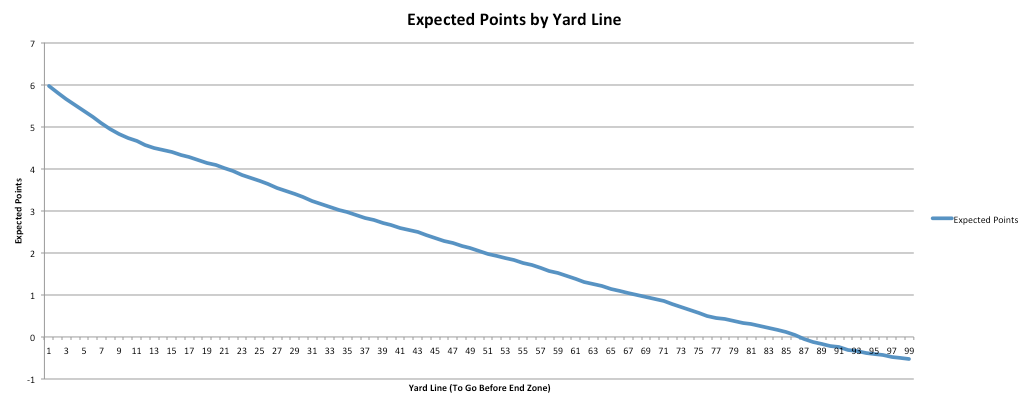
To refresh, here is the expected value of each yard line:

Screen Shot 2013-08-22 at 12.31.10 PM

Using this concept, we can calculate the value of the average gain on 3rd and 1 for both run plays and pass plays.  For example, given 3rd and 1 at the 20 yard line (opposing), a successful run can be expected to gain 4.43 yards, leaving the offense with a 1st down between the 16 and 17 yard line, which is worth 4.35 expected points.  Similarly, a successful pass will gain, on average, 11.26 yards, giving the offense a first down between the 8 and 9 yard line.  That position is worth 4.86 expected points.

However, we’re not done yet.  We need to factor in the different success rates.  Here is a table, summarizing the previous paragraph and adding the expected success rates:

Screen Shot 2013-08-22 at 12.37.29 PM

As you can see, once we factor in the expected success rates, the Run option stands out as the optimal choice.  It’s expected value is 3.01 versus an expected value of just 2.81 for the pass option.

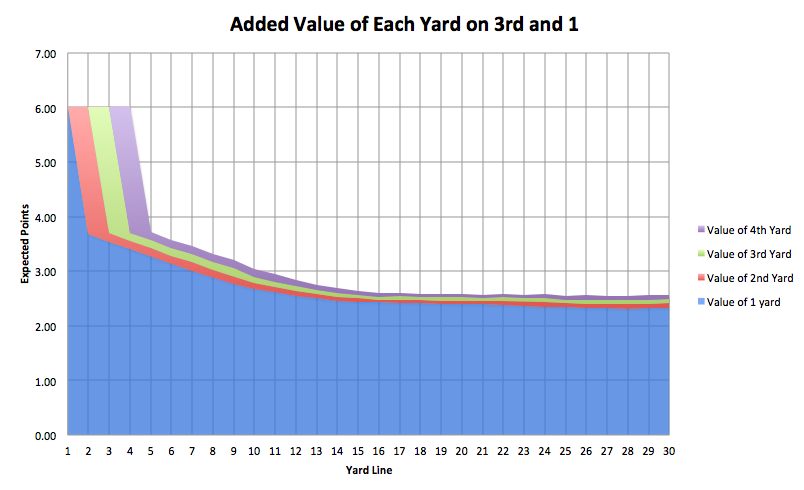
If this sounds counterintuitive, remember the chart I gave you in the “Marginal Value” post, seen below:Screen Shot 2013-08-22 at 12.40.30 PM

The bulk of the value in any successful 3rd and 1 play lies in the first yard gained.  To that end, sacrificing additional yards in exchange for a higher success rate is typically a good trade-off.

Finally, I ran the numbers at each yard line, giving me this chart, which shows the expected value of a run and a pass at each yard line, in a 3rd and 1 situation:

Screen Shot 2013-08-22 at 12.46.22 PM

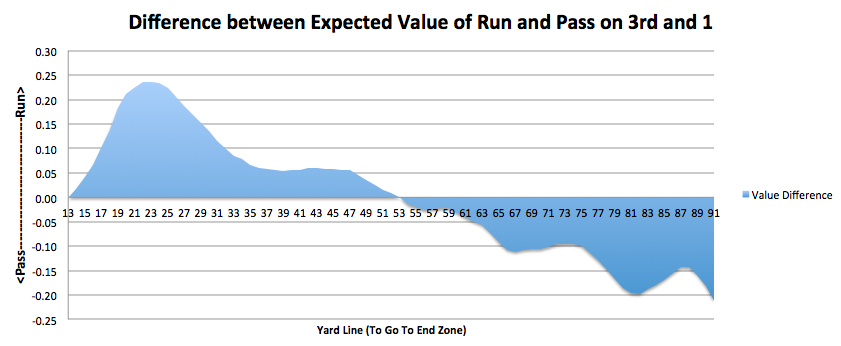
Now that’s interesting.  It’s hard to see, but the optimal play call switches from run to pass at the 53 yard line (so own 47 yard line) as you move farther away from the end zone.  Here is chart that illustrates the difference more clearly.

Values above zero mean the Run is the better option, values below the axis mean Pass:Screen Shot 2013-08-22 at 1.18.04 PM

So it looks like our overall thesis needs some updating.  Note that the lumps in the data (particularly on the right side of the chart) probably reflect statistical anomalies in the Expected Points data.  Theoretically, that should be a smooth line.  However, the magnitude of the difference isn’t that important, so it doesn’t effect the overall point.

Given recent NFL success rates on 3rd down and the expected value of a first down at each yard line, NFL teams should RUN when they are beyond their own 47 yard line, and PASS if they aren’t.  Note that the values once again converge with 13 yards to go until the end zone.  Obviously, beyond that the 11.26 average pass gain gives you a TD, which skews the results and likely isn’t representative of what happens in real life (presumably the average gain for a pass declines when you’re that close to the end zone, it kind of has to).

We can also assume that if NFL play-callers followed this analysis, the success rates would change, leading to the overall equalization in expected value of a Run versus a Pass, eliminating the inefficiency.  That point would represent the Nash Equilibrium.  However, until that happens, smart NFL teams can exploit this for an advantage.

Quick Thoughts on Vick

Much of what needs to be said about Vick as the starting QB has been.  I just wanted to add a few things to the discussion:

– I thought Foles was the better choice, but that’s because I’m more concerned with the long-term than near-term.   No doubt Vick earned the spot, and I think he’ll perform well.

– However, keep Vick’s skill/ability in perspective.  If he plays like he has over the majority of his career, this could be a shorter stint than many realize.  Kelly won’t put up with poor decisions and inaccuracy when he has a backup QB he has confidence in.

– In that vein, the obvious question is: How long is Vick’s leash?  Kelly said Vick doesn’t need to “look over his shoulder”, but frankly, I don’t see how that’s possible.  The world now knows that Foles has some ability and can play in this offense.  If the Eagles drop 3-4 games in a row (maybe that Denver, NYG, Tampa away game stretch?), will Kelly still be as confident?

Almost by definition, selecting Vick is a choice of “Win Now” over “Develop for the future”. Therefore, if the team is around .500 and Vick falters a bit, how do you not pull him for Foles?  You’ve already stated you’re trying to win this year.

Basically, the pressure is on Vick to play very well.  However, if he plays to his long-term averages, I think we’ll see Foles get a shot.

– The key to Vick playing very well?  For me, it comes down to two things, which I’ll be watching closely for every game.  (Health is a given, but it’s not something Vick really controls)

1) Patience.  Does Vick have the discipline to consistently take 5-6 yard gains?  Put another way, can Vick consistently lead TD drives that don’t involve 20+ yard passes?  I hope so, but I’m skeptical.  His entire career has suggested he looks for the big play first, the smart play second.

2) Short throw accuracy.  Can Vick consistently put the ball exactly where it needs to be, hitting receivers in stride?  Yards after catch figures to be vital in this offense.  “Catchable” is not good enough.  I anticipate seeing a lot of WR screens and slants.  Those will fail if not delivered perfectly.

What about the rest of the offense?

This is good for DeSean and Shady.  Vick’s deep throw ability is his clearest advantage over Foles.  As a result, DeSean will likely be much better off with Vick at QB.  Any time the defense wants to stack the box (for instance with a multi-TE set), DeSean will have an opportunity for a home-run, which Vick will undoubtedly be happy to throw.

Conversely, the presence of the deep threat (Vick-DeSean combo) will stop defenses from consistently bring safeties down to the LOS.  That should give Shady the space he needs to get past the first level, at which point he’s more dangerous than any back in the league. The one area this might hurt Shady is in the passing game.  I think Foles would be better at throwing to Shady out of the backfield.  Naturally, that’s a secondary option, so the tradeoff is still overwhelmingly positive for Shady.

This is bad for the O-Line, the TEs, and Damaris (if he gets playing time).  Perhaps Vick’s worst attribute is his inability to intelligently navigate the pocket.  He’s too quick to roll out, which is extremely harmful to the OLs ability to block.  The short drops should help, but that assumes Vick will actually deliver the ball on-time.  His history suggests he’ll be prone to holding the ball after the 3-step drop, looking for a downfield option.  Vick creates a lot of sacks, and is unquestionably harder to pass-protect than Foles.

The TEs and Damaris figure to be hurt as well.  This goes back to the “ball-in-stride” point. I have no idea how much playing time Damaris will get, but I hope it’s a lot.  His game, though, requires pinpoint accuracy from the QB.  If he has to hesitate or break momentum to catch the pass, it negates his best attribute (his quickness).   It’s a similar story for the TEs, though probably not as big of a difference from Vick to Foles.

One could argue that Vick’s deep throw ability and his ability to draw a defensive spy will give the TEs more space to work with than they’d have with Foles.  That’s positive.  On the other hand, the TEs are worse than WRs at both catching the ball and adjusting their speed/routes.  Vick’s combination of inaccuracy and power (he throws the ball very fast) will likely lead to more difficult catches for the TEs than they’d have with Foles at QB.

– Lastly, if you were a backup QB and could hand-pick any NFL starter to sit behind, Vick would be high on the list.  “Staying healthy” for Vick means playing 14-15 games.  In all likelihood, Foles will get a chance to start a game or two this season, at which point we’ll really be able to tell how different the offense is with each QB (we haven’t seen anything close to the whole playbook yet).


Charting the course to 9 wins; Laying out the Schedule

Yesterday, I explained why I believe the Eagles are a “true” 9 win team.  In fact, prior to yesterday’s post, I had them at 8-8, so I actually became more bullish.  Today, I want to take a more conventional look at the season, using the schedule.  First, though, a note about yesterday’s post. (If you have no issues with yesterday’s analysis, skip to the next section).

A lot of people seem uncomfortable with that type of analysis.  The problem, I think, is that assigning such “values” lends an appearance of false precision and undue confidence.  To say you expect the Eagles to produce points at a rate 15% better than league average sounds very precise (and wrongfully so).  However, I don’t believe we’re actually falling victim to that issue here.  Allow me to give you the base-case projection from the beginning, showing, more clearly, how I got to the assumption values.

I expect the Eagles offense to produce points at a slightly higher rate than the 2011 team.  Similarly, I do NOT expect the team to produce points at a rate as high as the 2009 and 2010 teams.  I won’t go into the details, but comparing the rosters, luck statistics, and looking at the talent on team right now, I think that’s a reasonable assumption.

Therefore, using this rationale, I expect the team’s points production to fall between 2010 (+25%) and 2011 (+12%).  That’s our range.  I chose +15% because it’s closer to the 2011 team, which I thought was the more reasonable expectation, and because it’s a round number, making it easy to use/explain.

For the defense, I expect this year’s team to allow points at a rate similar to the 2010 team. For this assumption, I started with last year’s defense (-22%).  We essentially KNOW that the Eagles will not turn the ball over at anywhere close to the rate they did last year.  I’ve covered this before, but if you disagree, take a look at the older posts on EaglesRewind.com for proof.  Additionally, the Eagles DB corps figures to be improved as well, simply because last year was so terrible (being just bad will be an improvement).  Overall, terrible play + terrible luck left us with a -22% value last year.  Realistically, that sets one boundary of our range.  In fact, the turnover luck was so historically bad (mostly in fumbles lost and fumble recovery rate) that our boundary is likely much higher than that (-15% perhaps?).  Couple that with a look at the new personnel and the easier schedule, and I’m left with a team that should ALLOW points at a similar rate to the 2010 team.

That’s all.  Basically, I’m using what we know about previous Eagles teams to provide context for this year.  The “values” actually reveal themselves.  From there, it’s just a matter of using those values to compute projected Points For and Points Against, and putting those points into the Pythagorean Win formula (which is close to unassailable as far as accuracy goes).  You can ignore the numbers.  Just know that my base-case expectation is for the team to produce points at a rate slightly better than in 2011 and allow points at a rate similar to 2010.  In all likelihood, that gets you to 9 wins.

I hope that cleared a few things up, as far as how that analysis was put together.  I left out most of the actual details regarding comparing rosters/stats, but that’s the general framework.

The Schedule

Now to the point.  Just because the Eagles should win 9 games doesn’t mean they will.  The schedule plays a big role in team performance.  Here, of course, is good news.  The Eagles, by virtue of finishing last in the division last year, get relatively easier schedule this year.  I do this a bit differently from others.  They idea here is NOT to pick every individual game.  Teams lose games they should win (and win games they shouldn’t) all the time.  Instead, I break the schedule into sections and try to find out what the Eagles would NEED to do to realistically reach 9 wins.

So this isn’t what the Eagles WILL do, it’s what the Eagles HAVE to do, if they are to perform as well as I project.  During the season, we can check back in with these benchmarks to see how on/off track the team is.

Here is the schedule:

Screen Shot 2013-08-20 at 9.35.36 AM

Section 1 – The Sprint Start

3 games, 11 days.  The Eagles first stretch, in my view, comprises these 3 games (Redskins, Chargers, Chiefs).  The Chargers and Chiefs are both home games.  The Eagles, realistically, NEED to win 2 of these 3 games.  Again, it doesn’t really matter which two teams they beat (beating the Redskins would obviously help within the division).   However, the San Diego and KC games count as part of the “easy” side to the schedule.  San Diego is a mess and they’re coming across the country for an away game.  Kansas City is much improved (I think they’ll challenge for the playoffs, maybe get to 9 wins as well), and given the Andy Reid return and the McNabb ceremony, it’ll be a crazy game.

Benchmark: 2 Wins

Section 2: The Darkness

Three straight away games.  Denver, NY Giants, Tampa Bay.

This is the part of the season after which I expect a fair amount of hand-wringing.  If/when that happens, remember what we’ve said here.  The Eagles will probably lose 2 of these games, maybe even 3.  Denver is a beast; Peyton Manning against this defense is a very bad matchup.  I don’t think the Giants will be as good as most expect, but it’s still a road divisional game.  Tampa Bay is a bit of a wild card.

The key here is getting 1 win.  Again, it’s most helpful if it comes against the Giants (division) or Bucs (conference), but that’s a secondary concern.

Benchmark: 1 Win

Section 3: The Meat

At this point, the benchmark for the team is 3 Wins (so a 3-3 record).  Now comes a 5 games stretch before the week 12 bye.

Cowboys, Giants, @Oakland, @Green Bay, Redskins

Three home divisional games.  An away game against the Packers.  That’s a tough slate.  Oakland is still Oakland.  The entire NFC East figures to be tightly bunched this year, in terms of team ability (though I’m skeptical of the Cowboys).  As a result, I don’t see any NFC East team sweeping the others.  The Eagles need to win 1 of these three divisional home games, as well as 1 more win from the remaining 4 games.

Benchmark: 2 Wins.

Section 4: Dessert

This is the important part.  According to my “plan”, the Eagles need to be 5 – 6 at the bye week.  Not a great record, but it’s good enough, because the final stretch of games sets up very well for the team.

Home games against the Cardinals and Lions.  Either of these teams could “surprise” the league (the Lions are a popular pick), but at the same time, they don’t seem unwinnable either.  If the Eagles are as good as projected, a home game against the Cardinals shouldn’t be a major hurdle.

@ Vikings.  Christian Ponder and a team that’s likely to regress (very lucky last year and probably won’t have an all-time great season from AP).

Home game against the Bears, who are the same as they always are (great defense, erratic offense).  Shapes up as a fairly good matchup for the Eagles, provided they can score some points.

@ Cowboys.  Road divisional game to close the season, but it’s against what I project to be the weakest divisional team.  If the Eagles are to get to 9 wins and a playoff spot, the finale is likely to be a key game.

Cardinals, Lions, @Vikings, Bears, @Cowboys

The question here is: Can the Eagles win 4 out of 5?  It’s not a hard stretch, with 3 home games and an away game against the Vikings.  Remember that to start this final push, the team will be coming off a Bye week, which should help (as well as increase the chances of a win versus the Cardinals).

Benchmark: 4 Wins

Putting it Together

Adding up the benchmarks gets you to 9 wins.  To repeat, this isn’t what I think the Eagles WILL do, it’s what I think the Eagles HAVE to do in order to fulfill my projection of 9 wins.  Overall, I think it’s fairly conservative over the first 3 sections, then perhaps aggressive over the final stretch.

The biggest thing to note here is the timing of the schedule’s “difficulty”.  It comes early, meaning the team could absolutely lose 3 consecutive games and still be in decent shape. It’s probably a bit more risky with a first-year coach, since presumably losing 3 straight games will invite a lot of pressure/skepticism (maybe a QB change?).  However, don’t forget that the last 5 games are very favorable.

Finally, we can summarize the “W/L goals” as follows:

– Start strong.  Win 2 of the first 3 games.

– Tread water. Win 2 of the next 5 games.

– Take care of divisional business. Win 3 of 6 games, including at least 1 divisional game.

– Capitalize on the schedule after the bye.  Win 4 of the final 5 games, across an easy (relatively speaking) slate of opponents.  For bonus points and a potential divisional crown, stick it to the Cowboys in the finale.

That’s my course.  9 wins seems achievable.  Obviously, a lot can go wrong.  We’ll check back in during the season to see if the team is hitting these benchmarks.


Projecting the Eagles 2013 Record

We’ve still got 2 more preseason games and a couple of weeks before the official start of the season, but I think it’s time to actually game out what this season might look like.  I’ve said several times that I think this is a “natural” 8-9 win team (closer to 8).  However, that prediction was essentially made in a vacuum.  Now it’s time to put some real evidence behind it.  To do this, I’m going to use Pythagorean win probability, using base-case/upside/downside assumptions for both the offense and defense.


Tomorrow, I’ll take a look at the actual schedule and try to discern where, exactly, the Eagles wins SHOULD come from, setting benchmarks along the way so we can check in during the season and see how the team is doing (rather than overreact to short 2-3 game stretches).

For this analysis, we need to project how good both the Eagles offense and defense will be.  I’m going to discuss this in terms of percentage +/- league average (same look we’ve talked about before).  In both cases, we’re looking at Points (points for and against).

First, the offense.  How good can the Eagles be?

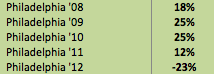
Let’s start by looking at the team’s recent performance.  Here is a table showing the previous 5 seasons:

Screen Shot 2013-08-19 at 9.46.51 AM

As you can see, the Eagles offensive production was very good over that time period.  Last season was very bad, but it stands out as an anomaly.  The offensive line was destroyed by injuries, and the Eagles best offensive player (Jason Peters, maybe 2nd best) was hurt before the season even started.  This year, the O-Line looks to be healthy (crossing fingers), plus the team has added Lane Johnson, the 4th overall pick in the draft.  Couple that with Chip Kelly’s expertise and the performances we’ve seen in the preseason thus far, and I think it’s fair to say we expect the offense to be closer to the ’09 and ’10 teams than last year’s.

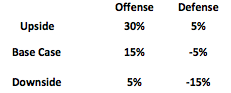
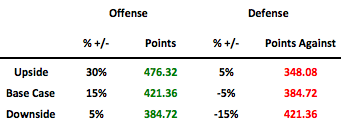
Remember, we’re using 3 different cases here to get a range of expected win values.  For the offense, I’m going to set them as follows:

Upside – +30%.  Not expected, but that’s why it’s the UPSIDE case.  The 2010 Eagles were +20%, and with Chip Kelly at the helm and many of the same skill players, it’s not ridiculous to think the team could be slightly better.

Base Case – +15%.  This might be too aggressive, but I think it’s fair as a base-case expectation.  The offense is clearly the strength of this team.  Chip Kelly + Shady + DeSean + the O-Line SHOULD mean a very good offense.  I think, regardless of the Vick/Foles debate, that this team will be very good on offense.  Given that the team was +12% in 2011 and +25% in both 2009 and 2010, I think +15% is a reasonable expectation.

Downside – +5%.  Note that we are looking at the “Downside”, not the “disaster” case.  Simply put, unless the team suffers injuries to multiple offensive stars, I don’t see any way it finished below league average in points scored.  The team finished below average (<0%) just 3 times during Andy Reid’s tenure, and I expect that type of consistent offensive output to continue with Kelly.

Now the Defense.

As every fan knows, this is the side of the ball that will likely determine whether the Eagles are a playoff contender or not.  As I showed on offense, here is the defensive performance, relative to league average, over the last 5 years:

Screen Shot 2013-08-19 at 9.57.21 AM

Obviously, the defense is much harder to project.  Last year was terrible, but remember that was also greatly effected by the historically bad turnover results as well as awful special teams.  Special teams looks to be improved, and, statistically speaking, it’s close  to impossible for the team not to rebound significantly in turnover margin.  That’s a long way of saying that we should expect improvement from last year, though how much improvement is a big question.  As it is, my assumptions are:

Upside – +5%.  Not likely, but it’s within the realm of possibility that the Eagles will be slightly above average on Defense this year.  While preseason isn’t always a great indicator, it looks like the D-Line will be a bit better than I expected it to be.  The LBs are a question, but Mychal Kendricks could certainly take a big step forward this year.  Also, it looks like Patrick Chung has plugged one of the gaping holes at Safety (for at least part of the season while he’s healthy).  Bradley Fletcher looks good at CB, as does Brandon Boykin, who’s positioning himself as a contender for the biggest surprise on the team.  If what we’ve seen so far continues, then average-slightly above average is a reasonable upside case.

Base Case – -5%.  Slightly below average.  Say the words while picturing this year’s defense and I think you’ll agree it sounds about right.  If we start from last season’s performance (-22%) and factor in improved field position and turnovers, then add a less than catastrophic defensive backfield, and it’s reasonable to expect the team to move from very bad on defense to purely mediocre (on the negative side).

Downside – -15%.  This one’s easy.  Last year the Eagles were -22%.  Just about everything that could go wrong, did.  I just don’t see any reasonable scenario that results in the team being as bad or worse than it was last season.  In fact, taking the exact same quality of performance and adjusting for better turnover luck would itself lead to relatively large improvement, hence the downside case of -15%.

So where does that leave us?  Here’s the summary matrix:

Screen Shot 2013-08-19 at 10.42.20 AM

Now we need to translate that into points, then we’ll use the Pythagorean Win Probabilities to calculate or expected win range.  What should we expect the league average to be?

Here is a chart showing scoring per team, per game from 2003-2012:Screen Shot 2013-08-19 at 10.16.04 AM

Last year the average was 22.7, but as the chart shows, we should expect an increase this season.  The average annual increase over that time period is approximately .2 points per game.  Therefore, we’ll use 22.9 as our expected average for this season.

So, using the values in our matrix, we get the following:

Screen Shot 2013-08-19 at 3.33.40 PM

This chart gives us 9 potential values given our assumptions for this season.  Here they are, with expected wins included.

Screen Shot 2013-08-19 at 10.47.30 AM

The average win expectation is 9.1.  I guess I need to shift my expectations upwards.  Tomorrow, I’ll use the actual schedule to see whether the Eagles will win as many games as this analysis suggests.  However, the overall message is this: the proper expectation for Eagles fans is a team that contends for the division and at least wins a Wild Card spot.

Preseason Game 2: Eagles vs. Panthers

Reminder that we are without All-22 film until the season starts, so the diagrams won’t reappear until then.  However, last night the Eagles played a very good game, and I wanted to give you some takeaways:

– Both QBs look really good.  It looks like everyone is jumping on the Vick train, but I’m sticking with Foles.  Given the performance of both QBs, this is turning into a fairly simple decision.  If you want the highest upside for this season, Vick’s your guy (though he likely doesn’t offer as big an advantage as most seem to believe.

On the other hand, I don’t understand how anyone can watch Nick Foles and not get at least a little excited about his potential in the NFL.  Last night, Foles finally put a stake in the heart of the “too slow, not mobile” argument.  I’m not even talking about the TD run.  Watch him move in the pocket and avoid the rush.  He consistently helps his O-Line by sliding away from pressure while keeping his eyes downfield.  Most importantly, each of his throws was about as accurate as they could possibly be.

Finally, I don’t mean to bring everyone down, but just remember that Michael Vick has been in the NFL for a very long time.  He’s played 10 seasons and has thrown nearly 3000 passes.  That sample is likely a MUCH BETTER indication of what we should expect than these past two preseason games.  Maybe Chip Kelly “unlocked” Vick.  It’s possible, just know that its unlikely.

– Shady shouldn’t touch the field again until the regular season.  I said at the end of last season that the Eagles’ rebuilding plan was relatively simple:  Rely on McCoy and a healthy O-Line to carry the offense while you focus on fixing the defense.  Regardless of who the QB is, its clear who will be the driver of the offense.  Shady looks fantastic, lets not get him hurt.

– I’ve mentioned it a few times (including yesterday), but last season the Eagles offense started their drives, on average, nearly 7 yards behind where the opposing team did.  It doesn’t sound like much, but its a huge disadvantage.  A big reason for that was terrible Special Teams.

Perhaps the biggest preseason development is how improved the STs look.  I’ve talked about how improvement was assured (by virtue of how bad the team was), but we might have to actually raise those expectations.  Punt return/coverage, the biggest weakness from last year, looks really good.  That should lead to a lot more points scored, regardless of whether the offense itself improves.

– Some bright spots on the defense as well, though I’m grading them on a curve.  Patrick Chung, if he can stay healthy, looks like he’ll be a big upgrade at Safety.  The fact that he can consistently step up and make tackles is big, even if he isn’t great in coverage (haven’t seen much of this without the All-22, so I can’t grade that part of his game).

– Bennie Logan and Vinny Curry are both flashing big potential.  A word of caution though, they haven’t been playing against #1’s.  My biggest hope for the next game is that we see a D-Line combo of Cox-Logan-Curry.  Given how well Logan/Curry has played so far, Kelly owes it to them to see if they can hold up against better competition.

If both players can turn into at least solid starters, the team’s defensive rebuild accelerates by at least a full season.

Might be time to forget about Trent Cole and Brandon Graham.  We knew it was going to be a tall order to fit them into a 3-4/4-3 Under defense, and it looks like it’s not going to happen.  At this rate, I expect to see Graham quietly traded later in the season for a middle-round draft pick.  Maybe it’s too early to judge, but I’m firmly pessimistic that either one of these players can play a significant role in the new defense.  At best, they’re placeholders on the depth chart until the team can draft/sign players who fit the scheme better.

Get ready to hate Cary Williams.  Last night was a great example of what he “brings” to the table.  He’ll be a big improvement over last year, but expect to see a high number of passes completed to his man.  The book on him is he gives WRs a lot of space to make the catch underneath, but tackles them after the catch to limit gains.  For this year, that’s fine, it’s a big step up from getting beat deep every other play.  However, I have a feeling Eagles fans will get tired of that style fairly quickly.

– I’m a little worried about Zach Ertz.  In my ratings system, I had this pick as a reach.  So far, he looks like a good receiver (which we expected).  However, the fact that he, a high second round pick, isn’t getting more playing time tells you he must be doing something wrong in practice. Update: After finding the snap counts, it seems Ertz played more than I thought (20 snaps).  I’d still like to see more of him in-line before the season starts. The easiest guess is his blocking, which was a known weakness.  Still, it’s not as if the Eagles TE corps comprises a bunch of pro-bowlers.  I like Celek a lot, but I’d expect the #35 overall pick to at least give him a battle for the #1 spot.  Definitely not a big deal yet, but it’s something to keep an eye on.

– Matt Barkley is quietly having a pretty good stretch.  Granted he’s not playing against starters, but considering he was a 4th round pick, he’s acquitting himself very well.

Lastly, some of you may have noticed that yesterday’s chart was also posted over at BleedingGreenNation.com.  I’ve joined that site as a contributor, but this site will remain the main focus.  In fact, for the time being, my BGN posts will consist entirely of what I feel are the most interesting/important EaglesRewind posts.

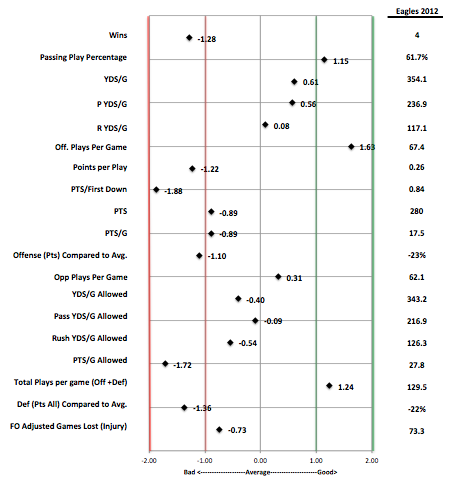
Eagles 2012 Performance Dashboard

This is something I’ve wanted to put together for a while, and I finally got around to it.  Below is an illustration showing the Eagles’ 2012 performance, relative to long-term league averages, in a variety of statistics.  The format is far from perfect.  Ideally, I’d put this into a Tableau pop-out.   Unfortunately, that software is not available for Mac.  If someone has it and is interested in putting that together, please email me and I’ll give you the necessary data.

For today, though, we’ve got two charts.  I apologize for the small size, you might want to zoom.  Just getting it in this format took about 5 times as long as actually putting the data together.

I’ve standardized all the data using standard deviations and ordered it so that the left side is bad and the right side is good.  Please note that not all of these statistics are necessarily normally distributed.  However, this is the easiest way to get everything on one chart, which allows us to quickly identify where the team’s weaknesses and strengths were last season.  Additionally, we can quickly identify the areas for which we can expect significant improvement purely as a result of mean reversion.

In particular, you should focus on the stats for which the Eagles were more than two standard deviations WORSE than long-term league average.  All averages and standard deviations were computed using 10 years of NFL data (except for Net Field Position and FO Adjusted Games Lost, which uses 5 years of data).  The right side of the chart shows you the actual statistical measure for the 2012 Eagles for each stat (i.e. Average Net Field Position was -6.67 yards).

Screen Shot 2013-08-15 at 11.35.24 AM

Above, we can see a number of areas where the Eagles were more than 2 standard deviations worse than the long-term average.  More importantly, those areas are either predominantly luck-based, or show no year-to-year persistence.  Specifically:

– Fumble Recovery Rate

– Fumbles Lost

– Net Field Position

– T/O Differential

Eagles fans can expect significant improvement in each of these areas (obviously they’re all interrelated to a degree).

This next chart isn’t as severe, but gives a good view of just how good/bad the Eagles’ performance was last season.

Screen Shot 2013-08-15 at 11.47.13 AM

Of particular note is the last one (bottom of the chart).  That’s Football Outsiders’ measure of injury loss per team.  It’s a weighted statistic that attempts to account for the relative importance of the players lost to injury as well as the overall number of games lost.  The 2012 Eagles, while hit hard by injuries, are not outside the expected range.  The concentration of injuries along the O-Line may mean that statistic underrates the degree to which injuries hurt the team, but the point remains, health is likely not an area in which to expect dramatic improvement (already losing Maclin already stopped much of that conversation anyway).

New Predictive Formula for College QBs

If you haven’t read yesterday’s post about 4th and 1 strategy, please do.  It’s important and uses concepts that I’ll be revisiting very soon (looking at other scenarios).

For today, I’m going to give you a taste of what’s featured in the Eagles Almanac.  If you haven’t done-so already, I strongly encourage you to purchase the PDF version (only $10). The paperback is also available now.  Both can be found here.

I made two contributions, one of which is a brief synopsis of the case in favor of starting Nick Foles this year.  My other article covers in-depth what I will discuss briefly today.  Basically, I’ve created a new formula for evaluating the professional potential of college quarterbacks.

You’ll have to read the Almanac for the complete breakdown, but here are the basics.  First, a couple of key charts:

For all QBs who were drafted between 1999 and 2012 and have at least 200 NFL pass attempts:

Screen Shot 2013-08-14 at 10.29.06 AM

The correlation value is -0.289.  While many “analysts” have expounded on the importance of college completion percentage (we’ll look at that next), Wonderlic scores, or games started, very few (if any) have highlighted College Interception Rate as a statistic to use as an indicator of professional success.  I looked at a lot of statistics for this article, and found very few that had the predictive value of Interception Rate.

Now, with the same sample, college completion percentage to NFL Rating:Screen Shot 2013-08-14 at 10.36.35 AM

The correlation value here is 0.35.

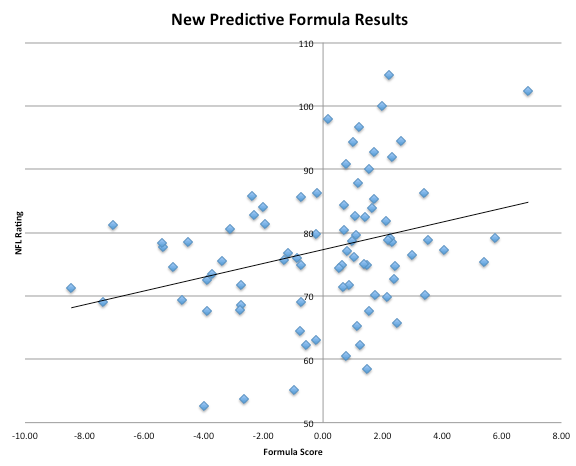
As you can imagine, we can use both of those stats (with apparently predictive value) to create a new formula for predicting QB success.  You can see the complete formula in the Almanac, but here are some of the results.  As far as scale goes, all you need to know is that receiving a negative score is bad.  How bad?

Here are the QBs who received a negative score:

Screen Shot 2013-08-14 at 10.55.49 AM

Depending on your definition of a good QB, there are potentially a few “false negatives” (most notably Donovan McNabb).  However, regardless of your definition, there aren’t many.  Conversely, I think it’s safe to say that, if they could do it over again, teams would not use 1st round picks on Kyle Boller, Joey Harrington, Cade McNown, J.P. Losman, Akili Smith, and Brady Quinn.

Similarly, though they’ve had good careers, have Michael Vick and Carson Palmer lived up to #1 pick status?  Maybe, again depending on your personal opinion, but the point is it’s very debatable.

Here is the complete correlation chart for “Formula Score” and NFL Rating:Screen Shot 2013-08-14 at 10.59.39 AM

The correlation value is .363.  That doesn’t sound like much, but given what we’re tackling here (predicting human development), it’s very good.  Additionally, in the Almanac I test this formula against the popular “26-27-60” rule, with encouraging results.

Lastly, I’ll leave you with a few specific points:

– Both Nick Foles and Matt Barkley registered positive scores.

– Robert Griffin the Third had, by far, the highest score in the sample (you can see him in the far top right of the chart above).

– Geno Smith registered the highest score overall (he wasn’t in the sample).

For more detail and specific scores, get the Almanac!  If you do, you’ll also get (among other things):

– An insider’s look at Chip Kelly’s time at Oregon (perhaps the best contribution in the entire Almanac)

– Diagrammed breakdowns of a few key “Oregon Offense” plays.

– A great reflection on the Andy Reid era.

In other words, everything you need to be ready for the start of the Chip Kelly era.

NFL Teams should (almost) always “go for it” on 4th and 1

Anyone who has looked at the 4th down strategy chart above knows that going for it on 4th and 1 (trying to convert) is ALMOST ALWAYS the optimal play.  While the multi-part series of posts (Part 1 can be found here) that culminated in that chart explained the thinking behind it, it occurred to me that we didn’t actually lay out the numbers.

So here is the theory, using the concept of expected points, of why it’s usually best to go for it on 4th and 1, from nearly ANY spot on the field.  Remember that when I use expected points, I’m piggybacking off the work done by Brian Burke at AdvancedNFLStats.com  (expected points).

The overall thesis is: Possession in an NFL game is EXTREMELY valuable, and NFL coaches voluntarily surrender it far too often.  With just 1 yard to gain, the odds are heavily in the offense’s favor of gaining a first down and keeping the ball.  Despite this, “common” strategy calls for giving the ball away in these cases.  This is wrong.

Basically, we are combining what we know about the probabilities of converting 4th and 1 with the expected point values of each yard line.  By doing so, we can come up with the actual expected point trade-off for each punt/go-for-it decision.  Put more simply, just how valuable is “field position” gained by punting on 4th and 1?

Before I get to the good stuff, I want to make one caveat very clear.  I’m using NFL averages to compute the following values.  Obviously, most teams deviate from the league average to some degree.  However, if I can show that all NFL teams, in aggregate, should be more “aggressive” on 4th and 1, then it’s a fairly small step to then apply it to the Eagles specifically.  I just have to acknowledge that there is, in fact, another step there.

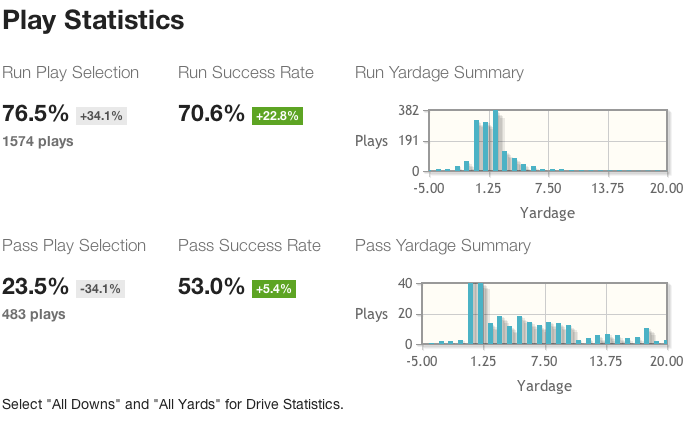
First, we need an expected success rate.  Using this site, which I cited for our 3rd down play-selection/game-theory discussion, we can see that over the past 10 years, all 4th and 1 plays have been successful 66.5% of the time.  Below is the output.  The 66.5% is simply the weighted average success rate.

Screen Shot 2013-08-13 at 11.30.16 AM

Second, we need to know just how much field position can be expected to be gained by a punt.  Using ESPN’s stats, we can see that last year, the median NET punting average was approximately 41 yards (between 41 and 42).

So we have our building blocks:

– Teams are successful at converting 4th and 1 yard 66.5% of the time.

– By choosing to punt, teams can be “expected” to gain approximately 41 yards of field position.

Now let’s look at expected points and put those two things in context.  Here is a graph showing the expected value of a first down at each yard line.

Screen Shot 2013-08-13 at 11.33.37 AM

Unsurprisingly, the expected value of a first down increases towards 6 points as you get closer to the goal line.  By itself, though, this chart isn’t overly helpful.  However, we can use this chart to gauge the value of an average punt in each spot.

Let’s look at the scenario of a 4th and 1 at the offense’s own 9 yard line (the worst possible field position at which this can occur).  Simplifying things, there are 3 potential outcomes.

– Punting, which we will assume results in the opposing team taking possession at the 50 yard line (41 yard kick).

– Going for it and converting.  Here, to keep things easy, we’ll assume the offense gains just 1 yard, the minimum needed to gain a 1st down.

– Going for it and failing, the result of which gives the opposing team the ball at the 9 yard line.

Applying the success rate and expected points we saw above, we come to the following values for each scenario:

Punting is worth -2.04 points, which is the expected value of a 1st down at the 50 yard line (for the other team, hence the negative).

Going for it and gaining 1 yard is worth -0.21 points, which is the value of a 1st down at the 10 yard line.  However, this only has a 66.5% chance of happening, which we’ll adjust for in a moment.

Going for it and failing is worth -4.83 points, which is the value of a 1st down for the OTHER team at the 9 yard line.

Using the 66.5%/33.5% success odds, we can calculate the expected value of going for it, that is the expected value WITHOUT KNOWING if you will succeed or fail.

Converting: -0.21 * .665 = -0.14

Failing: -4.83 * .335 = -1.62

Combined: -1.62 + -0.14 = -1.76

See why that’s a big deal?

Given a 4th and 1 at your own 9 yard line, an average punt is “worth” -2.04 points, while going for it (with average success) is “worth” -1.76.

Going for it is worth 0.28 points MORE than punting.

Hopefully one example was enough, so rather than continue, I’m just going to give you a chart.  Here is the expected value of both punting and going for it at each yard line (between the 9 and 50), assuming a 41 yard punt, a 1 yard gain if converting, and league average success rate when going for it.

Screen Shot 2013-08-13 at 12.03.20 PM

So there you have it.  As you can see, going for it is more valuable than punting regardless of field position.  As I said at the top, with just 1 yard to gain, the odds heavily favor the offense, yet they don’t seem interested in taking advantage of it.

Giving up possession of the football, regardless of whether it’s the result of a TO or punt, is bad.  It looks like teams are underrating the degree to which punting the football is a negative play.  They also seem to be under-appreciating the odds of converting in 4th and 1 situations.  As a result, “common” NFL strategy is far from optimal, leaving an opportunity for a forward thinking team to gain a significant advantage over the rest of the league.

Obviously each of these assumptions needs to be tweaked for individual teams.  However, if the league, overall, should be going for it a lot more often in 4th and 1, then by definition, many teams should going for it more often.  Here are some quick adjustments that result in “going for it” more often, with the reciprocals being adjustments that should result in punting more often:

Bad Punter – Go for it more often (lower net punting average)

Good Offense – Go for it more often (higher expected value of a first down)

Bad Defense – Go for it more often (value of OPPOSING team’s possession after a kick is higher)

Someday, we’ll see a team take advantage.  I think Chip Kelly will be more aggressive than average (closer to optimal), but far from as  “aggressive” as he should be.  Hopefully, after developing a successful track record and some credibility, he’ll have the stones to implement strategy like this more fully.