Week 17: Eagles vs. Giants Rewind

Two notes before we get to it:

1) There was almost nothing positive to take from that game.  On review, it was as bad as it seemed live (maybe even worse since the lack of effort was abundantly clear when each player was viewed individually.)

2) There weren’t many players of interest for the team’s future due to injuries.

In light of that, here are the Rewind thoughts, followed by some pictures:

– Anyone who watched Vick on Sunday should have a newfound appreciation for Nick Foles.  There are few things as annoying for a football fan than to watch the QB repeatedly miss open receivers.  The super-athletic “mobile” QB’s can have their speed, I’ll take accuracy over running any day.

LeSean McCoy is crazy good.  The lone bright spot this week, McCoy might have single-handedly made the Eagles head coaching job the most attractive available.  I have mixed feelings on Chip Kelly, but there’s no doubt that he must be salivating at the prospect of having McCoy/Brown as his backfield.

As far as turnaround plans go, the Eagles is fairly simple:  Let McCoy carry the offense behind a healthy line while you fix the defense and get a longer look at Foles.

– I mentioned that Graham would be a focus while reviewing the tape, so…he played an OK game.  Wasn’t nearly as disruptive as he has been over the past few weeks, but the Giants are among the toughest match-ups in the league for pass rushers.  Graham made a few nice plays and repeatedly drove his blocker backwards, but couldn’t get off the block to finish the job.  However, given the fact that everyone else on the defense either mailed it in or didn’t have the talent to be on the field in the first place, it’s probably not a game to draw anything significant from.

– The LBs for the Eagles had an absolutely embarrassing performance.  I’d prefer not to mention their names in the hope that they will just disappear from both the roster and my memory.  Demeco and Mychael can come back, everyone else needs to go.   Complete lack of ability.

Now the illustrations:

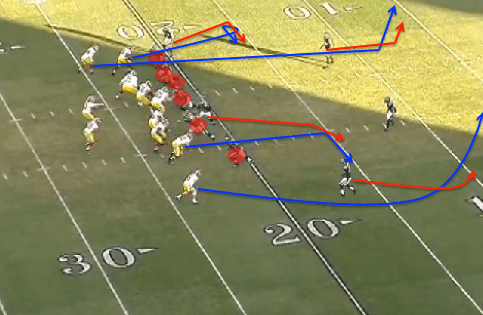
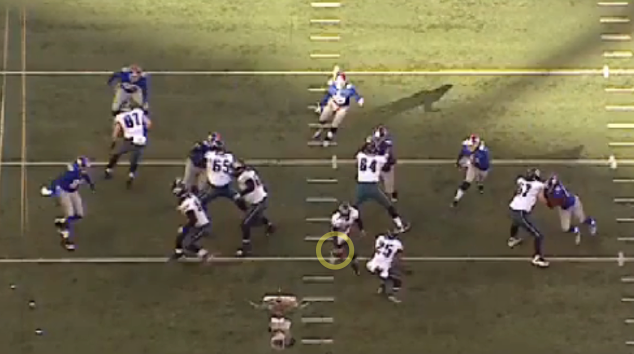
Hand-off to nobody – One of the most frustrating aspects of the Vick era can be seen below.  Most readers here will recognize it, since we’ve seen it much more often than anyone should.  Vick either fakes the hand-off with nobody in the backfield, or does it to the side opposite the runner.
Screen Shot 2013-01-04 at 2.04.08 PM

Running PA when you’re not a running team is problematic enough, but doing it without even having a RB to fake-accept the hand-off is downright obnoxious.  Normally I’d chalk this up to a miscommunication, but it’s happened often enough that simple miscommunication seems unlikely.  Additionally, though I haven’t gone back and checked, I don’t recall seeing this from Foles, which indicates it’s not by design.  Needless to say, I’m stumped.  Regardless, with Vick gone, let’s hope we never see it again.

Dear Colt, thanks for playing, better luck next career.

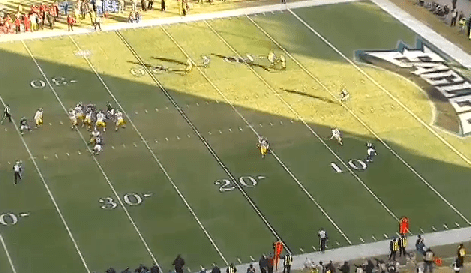
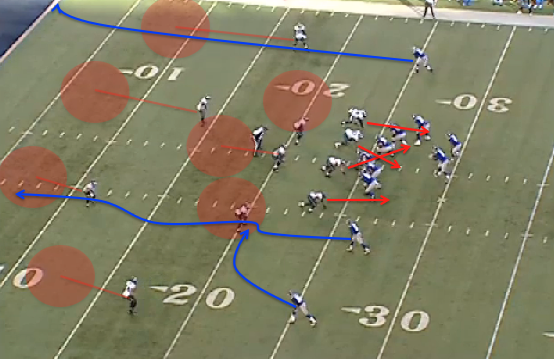
Though there were lots of plays that highlighted the myriad defensive holes of the Eagles, this one is particularly galling because of the situation.  The team is already losing 28-7.  There are just 10 seconds left in the half and the Giants are already in field goal range.  That means this is a pretty straightforward play for the defense:  KEEP THEM OUT OF THE END ZONE.  The Giants have 3 TOs, but with only 10 seconds remaining, they likely only have two plays left, this one and a field goal attempt.

The Eagles recognize the situation and line up accordingly in a quarters-zone prevent defense.  That means the two safeties and outside corners essentially split the field into four slices, with each of them responsible for one.   Meanwhile, the two LBs and Boykin (slot corner) each have an underneath zone.  The goal of the play is not necessarily to prevent a completion, it’s simply to force the Giants to complete a ball in bounds and tackle them in play, eliminating a TD as a possibility and forcing a field goal.  The DTs run a twist, but it doesn’t produce much pressure.
Screen Shot 2013-01-04 at 2.52.57 PM

With the above picture and situation in mind, lets jump to later in the play:
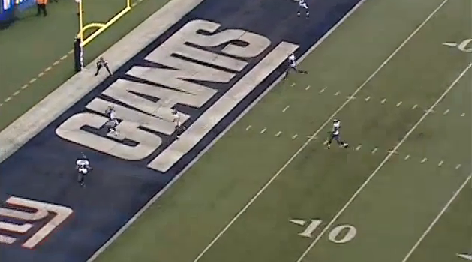
Screen Shot 2013-01-04 at 2.39.12 PM

This is the moment of the catch and the only correct response is either What?!? or various profanities strung together.  To recap, the Eagles’ only goal on this play was to prevent a receiver from getting behind them for a TD.  Not only does that happen, but Colt Anderson manages to wind up nearly 5 yards under his man at the catch!

So how did it happen?  Colt Anderson had a brain-cramp.

If you look back at the initial diagram, Cruz runs a seem, but stutter-steps twice.  His second stutter-step occurs just in front of Colt and causes Anderson to freeze.  The only thing Anderson CAN NOT do in this situation is stop moving and let Cruz behind him, so of course that’s exactly what he does.  Here is Colt’s freeze:
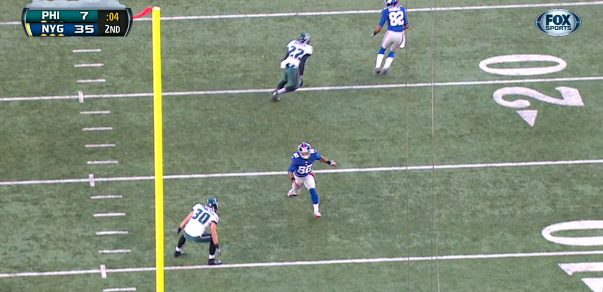
Screen Shot 2013-01-04 at 3.11.36 PM

An absolute disaster of a play for Colt and the Eagles, though it obviously wouldn’t have changed the outcome.  Even if Anderson gets thrown by the stutter-step, he absolutely MUST maintain his momentum moving backwards.  That way, even if he guesses wrong on which direction Cruz is going, he has a chance to recover.  Instead, he stands still, while Cruz is still near full-speed.  The chances of Colt catching Cruz after giving him a head start?  Absolutely none.  We knew Anderson didn’t have the speed to run with fast receivers, but we’ve also learned that he doesn’t know how to compensate for it.

The Wheel Route strikes again.

This play is from earlier in the game, when the outcome was still technically in doubt.  The Giants are up 14-0 with 3:26 left to go in the 1st quarter.  3rd down with 4 yards to go.   The result of the play is a 41 yard completion to Bradshaw out of the backfield.  Here is the pre-snap setup:

Screen Shot 2013-01-04 at 3.36.52 PM

Nothing too crazy going on, though there is one big note to make.  See Colt Anderson’s assignment (safety to the bottom of the screen)?  Immediately after the snap, Colt moves to double-team the slot receiver.  Not sure exactly what Todd Bowles saw to make him call this up, but regardless, it results in a huge hole that the Giants end up exploiting.  UPDATE: To clarify: this looks a bit like robber coverage with Colt playing an underneath zone.  However, at the snap Anderson moves full speed at the slot WR with no regard to his route.  Therefore, it seems more like a double-team than a zone read that Anderson saw and reacted to.

Below is the key moment of the play.  Say what you want about Eli Manning, but the guy is very good at manipulating defenses, especially with the pump-fake.  Here, he uses it perfectly to shift Demeco Ryan’s coverage angle, resulting in the separation he needs to get the ball over top to Bradshaw.  I’ve highlighted Demeco’s angle as he falls for the pump-fake and attacks where he thinks the ball is going.  Also highlighted is Colt Anderson and the space he vacated, resulting in a huge window for Manning to deliver the ball.
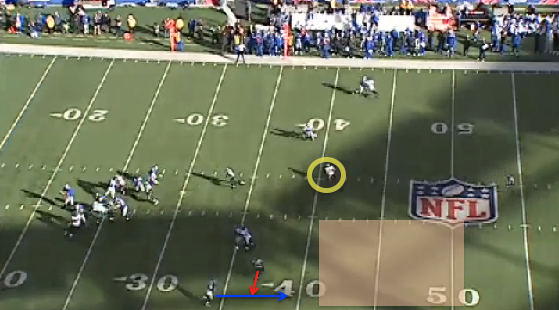
Screen Shot 2013-01-04 at 3.47.06 PM

And finally, below, we see Bradshaw as he gets behind Ryans.

Screen Shot 2013-01-04 at 3.23.58 PM

The Wheel Route is one the Giants have used with great effect against the Eagles over the past few years.  The key is that it forces a LB into coverage, where they are typically uncomfortable, and then increases the pressure on said LB through the pump-fake.  The fakes are hard enough for CBs to resist, but even more difficult for LBs purely because they aren’t in coverage as often.  Normally, the safety would provide deep help and ideally break up the play, but Colt left for the double-team, resulting in a very tough matchup for Demeco and 41 yards for the Giants. This particular play is not an indictment of Colt.  It appeared as though the double-team was 100% by design.

Also of note: Kurt Coleman (the deep safety) misses a tackle on Bradshaw after the reception and DRC makes the tackle after chasing the play from more than 15 yards back.

End of the Rewinds

That’s the end of the Eagles Game Rewinds for this year.  However, I’ll probably diagram a few big plays from the playoff games.

Meanwhile, we’ll shift to a roster evaluation and see what the weaknesses are heading into the offseason before an in-depth dive into draft history to see how much is luck vs. skill.

More on Post-4 Win Success

Regarding yesterday’s post, two of the 10+ win teams following a 4 win season were under new coaches:

NY Jets ’06 – Eric Mangini was hired and led the team to 10 wins.  However, his tenure thereafter was mixed and I don’t think any Eagles fan wants a similar experience.

Atlanta ’08 – The team won 11 games in Mike Smith’s first year.  Also Matt Ryan’s rookie year.  This is really the gold standard for 4 win turnarounds.

Other notable new-coach turnarounds:

Miami ’08 – Biggest turnaround in NFL history, improved from 1-15 to 11-5.  Tony Sparano’s first year, as well as Bill Parcells’ first year leading the front office.

Saints ’06 – Team hired Sean Payton and Drew Brees, improving to 10 wins from just 3 the previous season.

Colts ’12 – Obviously Andrew Luck’s rookie year, team improved from 2 wins to 11.  Also Chuck Pagano’s first season as coach, though that was complicated by his cancer treatments.


Hope for next year?

The Eagles finished the year with 4 wins.  Everyone’s heard plenty of talk over the last few seasons of parity in the NFL, but what kind of season could the Eagles put together following such a bad year?

Over the past 10 seasons, 27 teams have finished the year with 4 wins (not including this year.)

The good news?

Ten of them (more than 1/3) have followed a 4 win season with 9+ wins, with six teams registering 10 wins or better.

Here is the frequency chart:

Screen Shot 2013-01-03 at 3.16.17 PM

Quick rebounds not only happen, they do so relatively often.  The coaching decision is obviously huge, but regardless, given the injuries this team sustained and the past performance of 4 win teams, seen in the chart above, it’s not unreasonable to expect the Eagles to contend for a playoff position as soon as next year.

“Pass to score TDs, run to kick field goals”…or not

With the current emphasis on the passing game in the NFL, the adage “throw to score TDs, run to kick field goals” has become popular with commentators.

Is it true?

To get an idea, I looked at the passing play percentage and points scored for every team in the league going back to 2003, giving me 320 data points.  Here is the chart, with passing play percentage on the X and points scored on the Y:

Screen Shot 2013-01-02 at 4.01.26 PM

See a relationship?

If you said no, you’d be correct.  The correlation value for the above data series is -.083, which means there is really no relationship.  Passing the ball more often does not appear to lead to more points scored.

Some of you (if not everyone) are probably thinking:  “Wait, teams change their play-calling when the are winning/losing, skewing the run/pass ratio.”  My answer: Of course they do, but that itself should not skew the above data to such a degree that there is NO relationship between passing percentage and points scored (if passing really did lead to more points scored.)  Teams that noticeably change their strategy can only do-so late in the game, limiting the number of plays they can run that will skew their overall averages.  Additionally, teams that are running the ball to kill the clock take as much time as possible, running as few plays as possible, again limiting the skew.  Overall, of all the plays run in the NFL every year, relatively few of them are run by teams focused on anything except scoring points.

Feel free to disagree, but if passing the ball more really did lead to more points scored (i.e. TDs instead of field goals), I’d expect to see at least a weak-moderate positive relationship despite any skew effects of teams killing the clock.

Conversely, we can also ask: “Do teams pass more when they are losing?” While the data can’t tell us definitively which is cause and which is effect (do losing teams throw more or does throwing lead to more points against?), it can show us if there is a relationship between the two. Here is the chart, this time with Points Allowed on the Y axis:

Screen Shot 2013-01-02 at 4.37.13 PM

A fairly clear positive relationship exists.  In fact, the correlation value of .46 confirms there is a moderate positive relationship between Passing Play Percentage and Points Allowed.

Let me note again that the data doesn’t prove “Losing teams throw more often”, but it does lend pretty strong support to that hypothesis.  However, given the data above, perhaps losing teams should consider running the ball more, since passing it doesn’t appear to give them a greater chance of catching up (scoring points.)

Obviously this doesn’t hold for end of game scenarios where the clock becomes a big factor (passing takes less time then running.)  However, it does suggest that teams that fall behind early shouldn’t alter their game plan until it is absolutely necessary (very late in the game), something Andy Reid repeatedly did over his career with the Eagles.

Andy Reid Playcalling

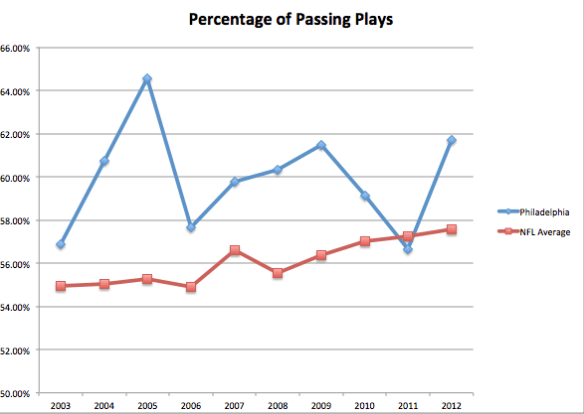
Andy Reid’s play-calling has been a favorite topic of discussion for fans since he was hired.  Now that he’s gone, let’s take a look back at he run/pass ratio.  I’m compiling a lot of data for a more in-depth look (and one we’ll be able to draw statistically significant conclusions from), but for now, here is a basic view of the percentage of passing plays called by the Eagles:

Screen Shot 2013-01-02 at 1.59.22 PM


Notes: The data is from teamrankings.com and only goes back to 2003.  The averages are not weighted by number of plays, in hopes of giving a better view of differences in general offensive philosophy.

Over that time period (2003-2012):

– The Eagles average annual passing rate was 59.90%, behind only 4 other teams (Arizona, Detroit, New Orleans, St. Louis).

– Detroit passed the most, by far, with an average rate of 62.84%.

– The Steelers had the lowest average rate, passing 52.47% of the time.

– The highest single year rate was registered by Detroit in 2006, when the Lions passed on 68.43% of plays.  They went 3-13 that year.

– The lowest single year rate came from the Steelers in 2004, when the team passed on just 39.20% of plays.  That year the team went 15-1 (Big Ben’s rookie year).

Next up, we’ll tackle the obvious question:  Does passing more equal winning more? More points scored?  Putting the data together now.  I hope to have an answer in the next day or so.

Andy Reid Era Stats: Part 2

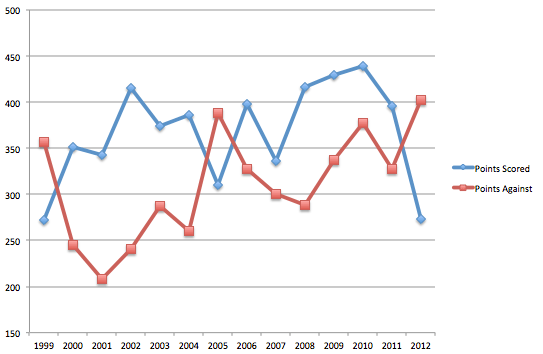
I highlighted turnover differential earlier but figured it would be interesting to look at how the offense and defense progressed over the Andy Reid era.  Below is a chart showing Points Scored and Points Against (total, not league rank).  Here are some interesting notes:

– Over his first seven seasons, Andy Reid’s team had an average league rank of 12.4 for Points Scored.  Over his last seven: 10.3.  Pretty consistent.

– Points Against average rank over the same time periods?  First seven seasons: 9.4    Last seven: 14.9    The defensive performance declined substantially over time.

– From 2000-2004 (Andy Reid’s peak), the Eagles average Points Against rank was 3.4.  Safe to say the Eagles success was built on defense.  (Points For average rank over the same period was 8.8)

– Over the past 4 seasons, the Eagles average Points Against rank is 19.

– For those of you thinking of Jim Johnson (hard not to when confronted with these numbers):  Average points against with JJ: 290.  Without JJ: 346.6.

Screen Shot 2012-12-31 at 10.22.03 AM


This ties in rather well with the message gleaned from the draft history post.  Reid’s inability to find quality defenders in the draft was perhaps his biggest persistent weakness (I know it wasn’t only Reid in the draft room, but you’re kidding yourself if you think he didn’t have the final say.)

T/O Margin and Wins (Strong Correlation Alert)

Rather than posting one huge Andy Reid retrospective, I’ll be doing it in pieces while attempting to highlight things that most writers are not paying attention to.

First up: Turnover Margin

As we’ve seen very clearly this year, turnovers are bad (shocking, I know.)  However, I was surprised to see just how strong of a correlation there appeared to be between wins and turnover differential.  Here is the chart for Andy Reid’s tenure (wins are the x-axis, T/O margin is the y-axis):

Screen Shot 2012-12-31 at 9.55.45 AM


This is too small of a sample to make any conclusions about the NFL in general, but over the next few days I’ll compile a lot more data and see what it looks like.  Regardless, it’s pretty clear that for Andy Reid, turnovers were highly correlated to success (for what it’s worth, the correlation coefficient for the above data is .69, really strong.)  This also further supports the notion that Reid’s downfall was tied closely to his decision to go with Vick as QB.  McNabb had his faults, but he was among the all-time best when it came to taking care of the football.  Vick, sadly, was not as careful, and that may have cost Andy Reid his job (along with the ridiculously bad fumble recovery luck this year.)

I think we can all agree that last year was the tipping point for Andy Reid.  He finished 8-8 and everyone’s expectations were higher, putting pressure on him for this year.  Although the 8-8 record isn’t great, the Eagles ranked in the top ten in both Points Scored (8th) and Points Against (10).  As you probably guessed, that performance was undone by the team’s turnover differential, which ranked 30th in the league.

I’ll be comparing correlations between wins a various statistics over the next couple weeks, but I’d be surprised to find one more determinate than turnover differential (other than point differential, for obvious reasons.)

Post-game notes: Eagles vs. Giants.

First things first:  Thank you to the Eagles for not winning, thereby securing the #4 pick (chance at #3 as of this post.)

Now to the game:

Wow…truly epic destruction.  Perhaps the defense figured that since none of them made the Pro Bowl, they could replicate the experience by playing this game as though it was in Hawaii.  There are really few words that could adequately describe the performance of this team today, but I will highlight one:  SAD.

As in, it’s really SAD that Andy Reid’s final game as head coach of the Eagles will go down as one of his team’s worst games ever.  Prior to the game, I was very concerned that the team would put it together to honor their coach, with Vick playing well in hopes of continuing his career and the Eagles pulling out a victory over the tailspinning Giants and ruining their draft spot.

Needless to say, that concern was sorely misplaced.

Here are my immediate notes:

– Is Michael Vick’s career over?  My gut says no, but I find it very hard to believe that there is an NFL coach/owner that believes he can be a difference maker for a contender.  Additionally, he’s about the last “veteran” you’d want to come in as a backup and help tutor a younger QB.  Perhaps Rex Ryan will make a play with him, but I don’t see a real role for Vick next year.  If he does get the job somewhere, expect that team to regret that decision.

– Do we still have LBs?  The Eagles entire LB corps registered 1 tackle in the first half.  Let that sink in for a moment.  In what was a terrible year for Eagles LB play, today was probably the worst individual game.

– B-Graham was silent.  Hard game to judge Graham on, but he was fairly quiet nonetheless.  I’ll be watching him closely on the film, but it looked like he did not have the same energy today as he has had most of the season.

– Has Nnamdi been Space-Jammed?  There may be no bigger example of unmet expectations than Nnamdi Asomugha.  Either he has had a precipitous decline in skill (likely combined with being overrated in the first place) or his skills have been stolen from him by pint-sized aliens hell-bent on world domination.  Either way, he’s not coming back.

– Is Trent Cole victim #2?  Though he’s done-so more quietly than Nnamdi, Trent Cole has also seen a huge decline in performance this year.  He recorded at least 8 sacks in every year after is first (when he had 5) and had 11 sacks last year.  This season?  Just 3.  With a new regime coming in, Cole might be one of the roster surprises next year, either because he’s no longer on the team, or because he moves to the bench.

Though I don’t expect to see anything useful/interesting, I will be completing a full Rewind of this game by the end of this week.

We’ll also take a data-driven look at Andy Reid’s tenure and start looking at possible replacements.

Pre-game Notes: Eagles vs. Giants

With today’s game, the Eagles season from hell finally ends.  Injuries have robbed us of the most interesting players to watch (Foles/Cox/Kendricks) but there are still a few reasons to remain engaged (other than doing it just because you are a real fan and love football.)

– A loss guarantees the Eagles pick no worse than 4th in the draft (a loss with a Raiders win over the Chargers gives the Eagles #3.)  A win, however, could drop the Eagles as low as 7th (according to BleedingGreenNation) if the Lions, Bills, and Browns all lose (very possible.)

– The Giants have lost 5 of their last 7 games, though maintain a slight chance to make the playoffs.  They need a win today and losses by Chicago, Minnesota, and Dallas.  It should also be noted that despite their streak of poor play, they’ve been good in their own stadium and bring a 5-2 home record into the game.

– Bryce Brown.  The Giants are allowing 130.4 yards rushing per game, so if Brown gets an honest chance, we could see some fireworks.  If McCoy dominates the carries, we’ll still get the fireworks, but they won’t be as meaningful (we know McCoy is awesome.)  If I was Jeffrey Lurie, I would have made it abundantly clear that I expected to see Brown get at least 10-15 carries…

– Brandon Graham.  Graham has had a good season, let’s see how he finishes it out.  He hasn’t erased the bust label yet, but he has shown enough potential that fans should be legitimately excited to see what he can do next year.  The Giants are a good test, giving up the least sacks per game at 1.3.  If Graham can be disruptive today, it’s a very good sign for next season.

– Michael Vick.  Vick’s play today really doesn’t matter to Eagles fans since he will almost certainly not be on the team next year, but it felt wrong not to include him.

– Jeremy Maclin.  Maclin has 293 yards receiving in his last three games.   Though the change to Vick will mean a different type of offense, hopefully Maclin can continue his strong play.   The Giant’s are ranked 28th in the league in passing yards allowed per game (257.4), so there should be some room for Maclin to work.

– Want to play the worst drinking game ever?  Drink every time you hear Jamar Chaney’s name mentioned…

Eagles vs. Redskins Rewind

This week:   All-22 thoughts and 2 plays diagrammed.  Unlike previous weeks, there were not many positives to take out of this game.  Starting to see clear evidence of the lack of talent at several positions for the Eagles.  I talked about some of this in the post-game, so I’ll try not to repeat myself.

All-22 thoughts:

– RG3 was clearly not 100%….That should scare you.  I’m really not excited that this guy is in our division.  He appears to have just about every tool you can imagine for a quarterback.  Eagles fans should hope the Redskins continue to neglect the defensive side of the ball, because that offense is going to be tough to stop for a long time if RG3 stays healthy.

– A mixed day for Nick Foles.  3 bad moments surrounded by a lot of positives, which is becoming a theme.  The fumble was a huge mistake, likely costing the Eagles 3 points on what should have been a throw-away.  The missed throw to Maclin was Foles’ worst attempt of the day.  It’s impossible to know whether his hand fracture is to blame, but in any case that is a pass he has to make.  The final play of the game was painful to watch.  It doesn’t look like there’s much more he could have done, but he has to know that his two choices are throw it out the back of the end zone or put up a 50/50 ball, can’t take a sack there (essentially what he did by grounding it.)

However, the rest of the day was strong, and he again showed that he has the ability to move the offense down the field consistently.  There were a few plays where he was hesitant to pull the trigger, even though he appeared to have a receiver to throw to.  Probably him being risk-averse, but he’ll need to become more confident in his reads.

– Tough day for the defense against the run.  Allowed 4.6 ypc and 128 total rushing yards.  Alfred Morris is a tough match-up for anyone, but the Eagles really need to do a better job of stopping the runner at first contact.  You can’t expect to win every one-on-one battle, but there were several plays where Morris dragged multiple Eagles defenders for additional yards.  When you’ve got 2+ defenders in contact with a runner, he should not gain any additional yards.  The LBs were a bit exposed, though they didn’t get much help from the safeties….

-Speaking of safeties, Colt Anderson had a bad game.  I know he’s become a fan favorite, mostly due to his clear effort and big-play ability on special teams, but the guy really shouldn’t be anywhere near the starting safety position.  He missed several tackles and was beat in coverage for a TD by Santana Moss.  Great effort on every play, but clearly doesn’t have the athleticism to do that job full-time.

– OL had another poor game.  Not something to really focus on, as it’s about what you’d expect from a bunch of depth players, but it’s worth noting that Foles was pressured often.

– Bryce Brown?  Absolutely unacceptable to ignore Bryce Brown, regardless of his “fumbling problem”.  The sole purpose of this team for the last few weeks of the season should be getting young players game experience and trying to evaluate the talent they have.  4 carries isn’t getting it done.  The only reason for it is Andy Reid putting his own performance above the long-term best interests of the team (can’t blame him but it still sucks.)

I liked the idea of him at KR, but he was far too hesitant on Sunday.  The returner needs to pick a seam and attack it.  Hopefully he’ll step his game up against the Giants, but it’s a tough mindset to get into if it’s not natural.

– Questionable play-calling from Marty.  The Eagles continue to use a lot of draws, the reason for which is beyond my comprehension.  The general idea of the draw is twofold: it shows pass, which holds the LBs, and it also gives the DEs time to rush themselves out of position, hopefully opening up running lanes for the back.  However, it also gives the DL extra time to attack the backfield.  Considering the poor quality of the OL for the Eagles, is making them protect longer really the best strategy?  I’ve seen far too many of these plays get blown up in the backfield, yet the Eagles continue calling them.  They’ve had some success running PA while faking the draw, but those gains have been nowhere near great enough to offset the negative plays.

Play 1:  Foles to Maclin

1st and 10 at the Redskins 27.  10:24 remaining in the First quarter.

This was a very nice play all-around for the Eagles, as all 5 linemen handled their assignments, picking up an extra rusher, while Foles delivered a perfect ball to Maclin, who was running a corner route.  Below, we can see every player’s assignment.  The defenders noted with red circles all rush the QB at the snap.

The key to the play is the Redskins alignment.  They’ve chosen to blitz (sending 5 rushers, all on the LOS at the snap.)  In order to gain that extra rusher while still marking all Eagles receivers, they’ve left themselves with just a single deep safety, positioned in the middle of the field.

Screen Shot 2012-12-28 at 8.46.58 AM

Riley Cooper’s route gives Maclin the space he needs to complete the TD.  Cooper runs a seam or a dig (he cuts it off inside after the play develops, can’t tell if it was part of the design), which holds the safety in the middle of the field.  Unable to commit until the ball is thrown, the safety isn’t quick enough to get to the sideline and break up the play.

Screen Shot 2012-12-28 at 8.34.26 AM

Above, there are three things to note as the play is in progress:  the OL has given Foles plenty of space/time, the safety’s only movement has been two steps backwards, and Maclin’s CB has failed to recover after trying to jam the WR at the line.  The CBs play has allowed Maclin to get behind him, which gives Foles the window he needs to make the throw.

Below we see the final shot of the play, just after Foles releases the football.  Notice that the safety has just reacted and is just a step from his starting position.  Riley Cooper is about to break inside, but his job is done, as he forced the safety to honor his route and kept him from getting to Maclin.  Maclin has just made his cut and now has separation from the defender.  Foles is able to step into the throw, which he delivers perfectly, allowing for an easy TD catch.

Screen Shot 2012-12-28 at 8.34.37 AM

The takeaway from this play should be familiar: when the OL diffuses the blitz, the odds shift dramatically in the offenses favor.  That, combined with a smart route combination (Riley seam + Maclin corner) led to a relatively easy TD throw/catch for the Eagles and a quick start to the game.

Play 2: Blitz Backfire

3rd and 10, 1:37 to go in the 3rd Quarter.  Ball on the Eagles’ 22 yard line.

This is the Santana Moss TD.  Similar to the play above, the key is that the Eagles rush 6 at the QB and don’t get home, leaving Colt Anderson in single coverage against Santana Moss…a poor matchup for the Eagles to say the least.

Here is the alignment at the moment of the snap.  The Eagles are in the nickel, with 3 CBs, 2 LBs, and 2 Ss.  The DL is in the Wide-9, and the LBs (Ryans and Kendricks) are on the LOS in the A gaps (to the left and right of the Center.)  Kendricks backs out at the snap, but the Eagles bring the slot corner blitz (leaving Colt to cover Moss), for a total of 6 rushers, highlighted by the red circles below.

Screen Shot 2012-12-28 at 9.26.14 AM

There’s nothing fancy to the Redskin’s play design.  The key is that the RB stays in to block, leaving 6 blockers (5 OL + 1 RB) for 6 rushers, and everyone hits their assignment.  Meanwhile, Santana Moss runs a route similar to Maclin’s TD, just on the opposite side of the field.  Anderson underestimates Moss’ speed and his ability to maintain it through his break, allowing the WR to run past him and gain separation shockingly fast.

Below, we can see the play in action.  Notice RG3’s pocket, he’s got plenty of time to let Moss get downfield despite the blitz.  Anderson is still flat-footed, with 6-7 yards of space between him and Moss.

Screen Shot 2012-12-28 at 9.14.11 AM

Finally, we see Moss just after his break and Griffin’s throw.  At this point, Anderson is in good position, however, now it’s just a footrace, which obviously Anderson loses badly (Moss is one of the faster players in the league, Colt is….not.)

Screen Shot 2012-12-28 at 9.14.25 AM

Two final things to note on this play:  First, RG3’s throw was phenomenal (roughly 45 yards through the air with pinpoint accuracy.)  Exhibit A of why this guy scares me as a an Eagles fan (Exhibit B would be his running, but he decided to leave that at home on Sunday.)

Second, very questionable defensive play-calling here by Bowles.  It’s 3rd and 10, meaning if you play a standard defense you should have a very good chance of holding them to a field goal attempt.  Additionally, the ball is on the 22, so a sack doesn’t take the Redskins out of field goal range.  Therefore, rushing 6 men at the QB is really a High-Risk/Low-Reward decision.  This is something coaches do fairly often, and I find it infuriating, as it’s clearly not an optimal decision.  Some may argue that Bowles was trying to keep Griffin from having the time to complete a long pass, but the fact is that a 10 yard route does not take very long to develop and rushing TWO extra men leaves a lot of holes in the secondary, which NFL QBs typically do not need a long time to find.  The blitz needs to be used intelligently and sparingly…3rd and 10 in the red zone (practically) is not the time.